
The search for a new television is a high-stakes decision that directly impacts every movie night, gaming session, and sports viewing for the next half-decade or more. With display technologies like Mini-LED and QD-OLED now accessible across a wider price spectrum than ever, the line between a good picture and a truly great one has never been finer—or more confusing. Choosing blindly on brand alone risks leaving you with crushed blacks, washed-out HDR highlights, or a smart interface that slows to a crawl the moment you load a modern app.
I’m Min — the co-founder and writer behind Gadgets Feed. My approach to this guide involved analyzing hundreds of hours of user reviews, cross-referencing technical datasheets for contrast ratios, local dimming zone counts, HDMI 2.1 bandwidth capabilities, and native refresh rates to identify which 4K Smart TVs actually deliver on their spec sheet promises in real-world living rooms.
Whether you are upgrading from a decade-old 1080p panel or outfitting a dedicated home theater, this guide cuts through the marketing noise to present the best 4k smart tv options that earn their place through measurable performance and genuine user satisfaction.
How To Choose The Best 4K Smart TV
Selecting the right television today requires understanding three core pillars: the display technology that governs picture quality, the refresh rate that dictates motion clarity, and the smart platform that delivers your content. Ignoring any one of these can lead to buyer’s remorse that lasts the life of the TV.
Display Technology: Mini-LED, QLED, and OLED
The backlight architecture defines what your eyes actually see. Mini-LED televisions use thousands of tiny LEDs to create precise dimming zones that can turn black while adjacent areas remain bright, offering high contrast without the burn-in risk of OLED. QLED is a Quantum Dot layer that enhances color volume and brightness, and is often paired with Mini-LED backlighting. Standard LED backlights with edge or basic direct lighting produce weaker blacks and visible haloing around bright objects. For a dark room, Mini-LED with high zone counts brings the most cinematic experience; for a bright living room, QLED with high nits of peak brightness cuts through glare.
Native Refresh Rate and HDMI 2.1 for Gaming
The native refresh rate—60Hz, 120Hz, or 144Hz—determines how smoothly motion is rendered. A native 120Hz panel is the baseline for fluid sports and console gaming, supporting 4K at 120Hz over HDMI 2.1. The newer 144Hz panels offer an extra edge for PC gamers with capable hardware. True HDMI 2.1 ports with full 48Gbps bandwidth enable Variable Refresh Rate (VRR) and Auto Low Latency Mode (ALLM). Some budget models advertise a high refresh rate using internal interpolation that adds input lag, so always verify the native specification rather than a marketing term like “Motion Rate.”
Smart Platform: Operating System Longevity
The software that powers your TV determines whether it remains fast and receives app updates for years. Roku TV is the simplest and most consistent, but its app selection is solid without being as deep as Google TV. Fire TV (Amazon) offers excellent Alexa integration and broad app support, but budget-tier Fire TV hardware can become sluggish. Google TV is the most flexible with the widest app library, though some implementations include bloatware. Samsung’s Tizen is polished and fast on premium models but has a smaller niche app catalog. Choose a platform that aligns with your ecosystem—if you use Siri and AirPlay, Sony’s Google TV is the strongest; if you live in Alexa’s world, Fire TV is native.
Quick Comparison
On smaller screens, swipe sideways to see the full table.
| Model | Category | Best For | Key Spec | Amazon |
|---|---|---|---|---|
| Hisense 65″ U7 Mini-LED | Mini-LED | Premium Gaming | Native 165Hz, 3000 Zones | Amazon |
| Samsung 55″ S90F | QD-OLED | Reference Picture | NQ4 Gen3, 144Hz | Amazon |
| Sony BRAVIA 7 85″ | Mini-LED | Sony Processing | XR Processor, PS5 Sync | Amazon |
| TCL 85″ QM7K | Mini-LED | Large Value | LD2500 Zones, 144Hz | Amazon |
| Toshiba 65″ Z670R | Mini-LED | Feature Depth | Native 144Hz, Fire TV | Amazon |
| Samsung 85″ Q8F | QLED | Bright Room QLED | Quantum Dot, 144Hz | Amazon |
| Sony BRAVIA 2 55″ | LED | PlayStation 5 | 4K X1, Google TV | Amazon |
| Amazon Ember 55″ | Mini-LED | Amazon Ecosystem | QLED, 144Hz, 512 Zones | Amazon |
| Panasonic 65″ W70 | LED | Budget Fire TV | HDR10+, MEMC | Amazon |
| Roku 55″ Plus Series | Mini-LED | Simple Roku OS | QLED, Dolby Vision | Amazon |
| Roku 65″ Select Series | QLED | Entry Value | 4K QLED, HDR10 | Amazon |
In‑Depth Reviews
1. Hisense 65″ U7 Mini-LED ULED 4K UHD Smart Google TV (65U7SG)
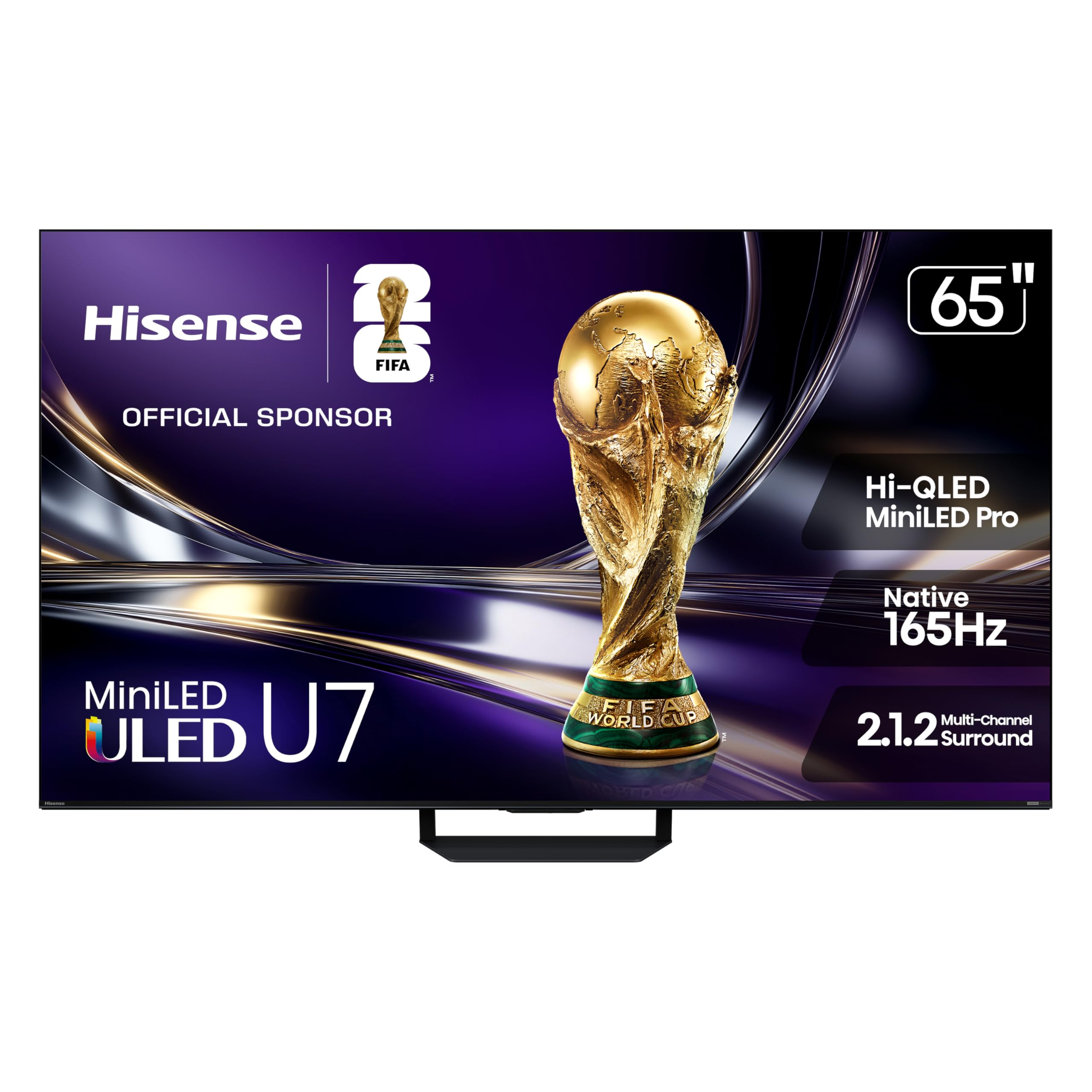
The Hisense U7 series sets a new benchmark for what mid-range pricing can achieve in the Mini-LED category. With thousands of local dimming zones delivering up to 3000 nits of peak brightness, it produces HDR highlights that genuinely compete with televisions costing twice as much. Deep blacks in a dark room are remarkably uniform, and the anti-reflection layer keeps the image clean even with direct overhead lighting or windows in view.
The native 165Hz refresh rate pushes past the 144Hz crowd, making it an exceptional partner for high-frame-rate PC gaming. The Hi-View AI Engine Pro intelligently adjusts color, contrast, and detail scene-by-scene without introducing noticeable processing artifacts. Google TV runs smoothly on this hardware, with fast app launches and consistent performance across streaming services.
Built-in 2.1.2 channel audio with Dolby Atmos provides respectable bass and clarity that delays the need for a soundbar, though purists will still want external speakers for the full cinematic effect. Filmmaker Mode is accurate out of the box, delivering a calibrated look for movies without manual adjustment. For a premium-oriented buyer who also wants robust gaming features, this is the most complete package in the list.
Why it’s great
- Exceptionally high zone count for deep black levels and bright highlights
- Native 165Hz delivers class-leading motion clarity for competitive gaming
- Anti-glare screen works well in bright rooms without washing out colors
Good to know
- Soundbar recommended for full Dolby Atmos immersion
- Google TV includes pre-loaded apps that need manual removal
2. Samsung 55-Inch Class S90F Smart TV (55S90F)

The Samsung S90F employs QD-OLED panel technology, merging Quantum Dot color volume with per-pixel self-emissive blacks for a picture that is essentially unmatched at this price tier. The NQ4 AI Gen3 processor uses 128 neural networks to upscale lower-resolution content to near-4K precision, producing sharp, clean images from standard cable and streaming sources. The infinite contrast ratio means letterbox bars are truly black, and HDR specular highlights pop with stunning intensity.
Motion Xcelerator supports 4K at 144Hz over HDMI 2.1, making this one of the most capable gaming displays available. Input lag is minimal, and the Game Bar provides quick access to VRR and response time settings. The Tizen operating system is fast and clean on this model, with Samsung Gaming Hub consolidating cloud gaming services in one place.
The main caveat is brightness ceiling: while impressive for OLED, it does not match the raw luminance of a high-end Mini-LED in a sun-drenched room. The screen is also fragile, so careful handling during installation is essential. For a dedicated home theater or nighttime viewing room where absolute black levels matter, the S90F delivers a reference-grade experience.
Why it’s great
- QD-OLED provides per-pixel perfect blacks and vibrant Quantum Dot color
- AI upscaling through 128 neural networks cleans up low-res content remarkably
- 4K 144Hz support with low input lag is elite for console and PC gaming
Good to know
- Reflective screen can struggle in very bright rooms with direct light
- Panel is physically delicate; handle with extreme care during setup
3. Sony 85 Inch Mini LED QLED 4K Ultra HD TV BRAVIA 7 (K-85XR70)

Sony’s BRAVIA 7 leverages thousands of Mini-LEDs driven by the XR Backlight Master Drive to produce some of the most natural highlight rendering in the industry. The XR Processor analyzes content in real-time, boosting color, contrast, and clarity without creating an artificial or oversharpened look. This is the television that excels at upscaling lower-bitrate streaming and broadcast content, making old cable channels and YouTube streams look far cleaner than they have any right to.
Exclusive PlayStation 5 integration including Auto HDR Tone Mapping and Auto Genre Picture Mode means the TV automatically switches to the optimal picture preset when a PS5 is detected. The XR Clear Image upscaling is noticeably superior to generic scaling algorithms. Google TV provides a comprehensive app library, and the Acoustic Multi-Audio system gives sound a directional quality that matches on-screen action surprisingly well for built-in speakers.
The viewing angle is narrower than OLED, so off-axis seating loses some contrast and color saturation. The screen also has noticeable light bloom in very challenging high-contrast scenes, though it is much better controlled than standard LED implementations. For a buyer who prioritizes processing quality and Sony’s color science above raw zone counts, the BRAVIA 7 is a compelling choice.
Why it’s great
- Sony XR Processor delivers best-in-class upscaling and motion handling
- Seamless PS5 integration with automatic HDR and picture mode optimization
- Acoustic Multi-Audio creates surprisingly wide and directional sound
Good to know
- Can exhibit blooming in extreme high-contrast scenes
- Narrow off-axis viewing angle compared to OLED panels
4. TCL 85 Inch Class QM7K Mini LED QLED 4K HDR (85QM7K)
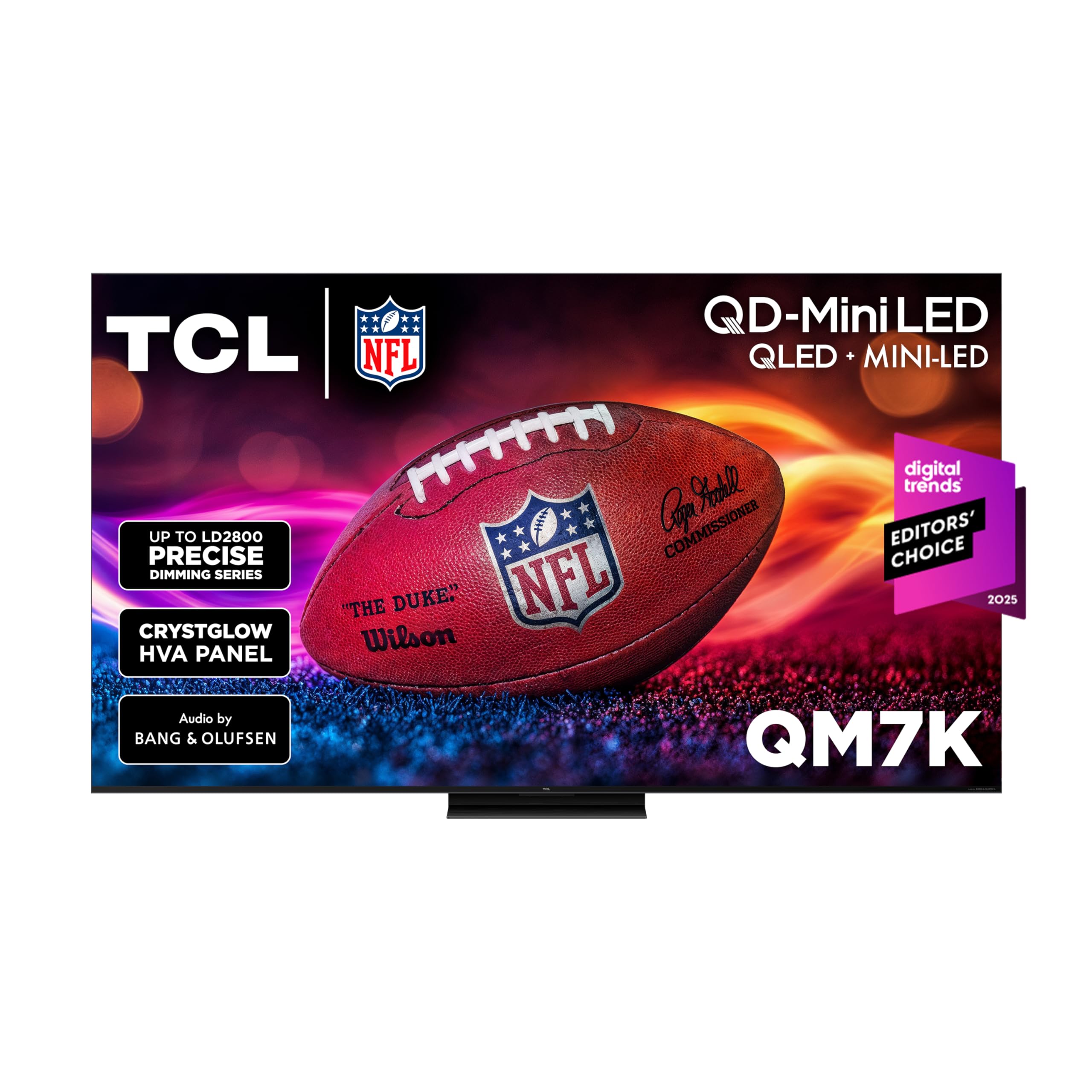
TCL’s QM7K brings the 85-inch screen size into the Mini-LED value conversation with up to 2500 precise local dimming zones. The CrystGlow HVA panel and anti-reflective coating keep the image crisp and visible even in rooms with significant ambient light. The QD-Mini LED backlight produces bright, punchy HDR that rivals televisions at a higher price point, with deep blacks that hold up well in darker environments.
Native 144Hz refresh rate with VRR support up to 288Hz makes this one of the smoothest large-screen options for gaming. The TCL Halo Control System manages the thousands of Mini-LEDs with zero-delay transient response, reducing haloing around bright objects. The partnership with Bang & Olufsen for audio tuning provides built-in sound that is richer than typical TV speakers, with noticeable bass and clear dialogue.
Google TV is responsive on this hardware, though the included remote feels basic relative to the premium screen beneath it. The lack of a 3.5mm audio jack means external audio routing requires an HDMI connection or optical cable. For anyone prioritizing maximum screen real estate without sacrificing modern Mini-LED performance, the QM7K is a standout.
Why it’s great
- 2500 local dimming zones provide excellent contrast on an 85-inch canvas
- Anti-reflective CrystGlow HVA panel handles bright rooms effectively
- Bang & Olufsen audio tuning delivers above-average built-in sound
Good to know
- No 3.5mm audio output; HDMI or optical needed for external speakers
- Remote control feels cheap compared to the television’s premium build
5. Toshiba 65″ Class Z670R Series Mini-LED 4K UHD Smart Fire TV (65Z670R)

The Toshiba Z670R brings Japanese-engineered REGZA Engine ZRi Gen3 processing to the Mini-LED space, delivering natural color and controlled backlight performance. The Full Array Local Dimming system with Mini-LED precision produces deep blacks that hold up impressively against much more expensive competitors. Dolby Vision IQ adapts the HDR tone mapping to ambient room lighting, preserving highlight detail whether you are watching in a bright afternoon or a dark evening.
Native 144Hz refresh rate paired with AMD FreeSync Premium and VRR support creates a tear-free gaming experience. Game Mode Pro minimizes input lag for competitive play. The built-in REGZA Power Audio Pro with a dedicated bass woofer produces floor-shaking low end that genuinely reduces the need for a separate subwoofer in smaller rooms.
The Fire TV interface is fast on this hardware, though the operating system carries Amazon’s promotional content on the home screen. Setup is quick with the Alexa voice remote, and the AI Light Sensor Pro adjusts brightness and color temperature automatically to reduce eye strain. For a mid-range price that undercuts premium brands while delivering a dense feature set, the Z670R punches well above its weight.
Why it’s great
- REGZA Engine ZRi provides excellent color accuracy and backlight control
- Built-in bass woofer delivers surprisingly deep and immersive audio
- Native 144Hz with FreeSync Premium supports high-refresh gaming
Good to know
- Fire TV home screen includes promoted content and ads
- AI Light Sensor can be overly aggressive in dim environments
6. Samsung 85-Inch Class QLED Q8F 4K UHD Smart TV (2025 Model)

Samsung’s Q8F focuses on high brightness and quantum dot color volume, making it an ideal choice for bright living rooms where glare would wash out a standard LCD. The Q4 AI Processor analyzes content type and optimizes color and audio accordingly. 100% Color Volume with Quantum Dots ensures that shades remain accurate and vibrant even at peak brightness levels, which is a clear advantage over standard LED panels that desaturate under bright light.
The AirSlim design keeps the profile remarkably thin for an 85-inch television, allowing it to sit nearly flush against a wall. Motion Xcelerator supports 4K at 144Hz for gaming with VRR, and the Tizen interface is responsive. Samsung TV Plus provides over 2700 free channels without any subscription requirement, adding immediate content value out of the box.
Black levels are not as deep as Mini-LED implementations, as the Q8F uses a traditional QLED backlight without dense local dimming. Light bloom around subtitles in a dark room is more noticeable here than on zone-based competitors. For a primary television in a sunlit space where brightness and color saturation are the top priorities, the Q8F is an excellent fit.
Why it’s great
- Quantum Dot color volume stays accurate even in very bright rooms
- Ultra-slim AirSlim design for clean wall-mount aesthetics
- Samsung TV Plus provides thousands of free channels immediately
Good to know
- Black levels are not as deep as Mini-LED or OLED competitors
- Light bloom around subtitles in a completely dark room
7. Sony BRAVIA 2 II 55 Inch 4K Ultra HD LED Smart TV (K-55S20M2)

The Sony BRAVIA 2 II is engineered as a direct companion for the PlayStation 5, offering exclusive features like Auto HDR Tone Mapping and Auto Genre Picture Mode that automatically configure the TV’s picture settings when a game or streaming app launches on the console. The 4K Processor X1 delivers natural color reproduction and sharp detail that makes everyday streaming and cable content look clean. 4K XR-Reality PRO upscales HD content to near-4K resolution effectively, reducing visible artifacts.
Google TV provides access to the full ecosystem of streaming apps, and the inclusion of Sony Pictures CORE gives buyers free access to a rotating library of high-bitrate movies. Motionflow XR ensures that fast-moving sports and action sequences remain clear without introducing soap-opera effect artifacts. Eco Dashboard centralizes power-saving adjustments in one easy menu.
The standard LED backlight does not achieve the deep blacks of Mini-LED or OLED, and the viewing angle is narrower. The thin remote, while sleek, can be easy to lose in couch cushions. For a PlayStation user who values Sony’s image processing and seamless console integration above absolute black levels, this is a smartly targeted mid-range option.
Why it’s great
- Exclusive PS5 Auto HDR and Genre Picture Mode for seamless gaming
- 4K XR-Reality PRO upscales lower-resolution content effectively
- Sony Pictures CORE includes credits for high-bitrate movie streaming
Good to know
- Standard LED backlight lacks deep black performance
- Narrow off-axis viewing angle, typical of VA-type panels
8. Amazon Ember 55″ Mini-LED Series with Fire TV (Newest Model)
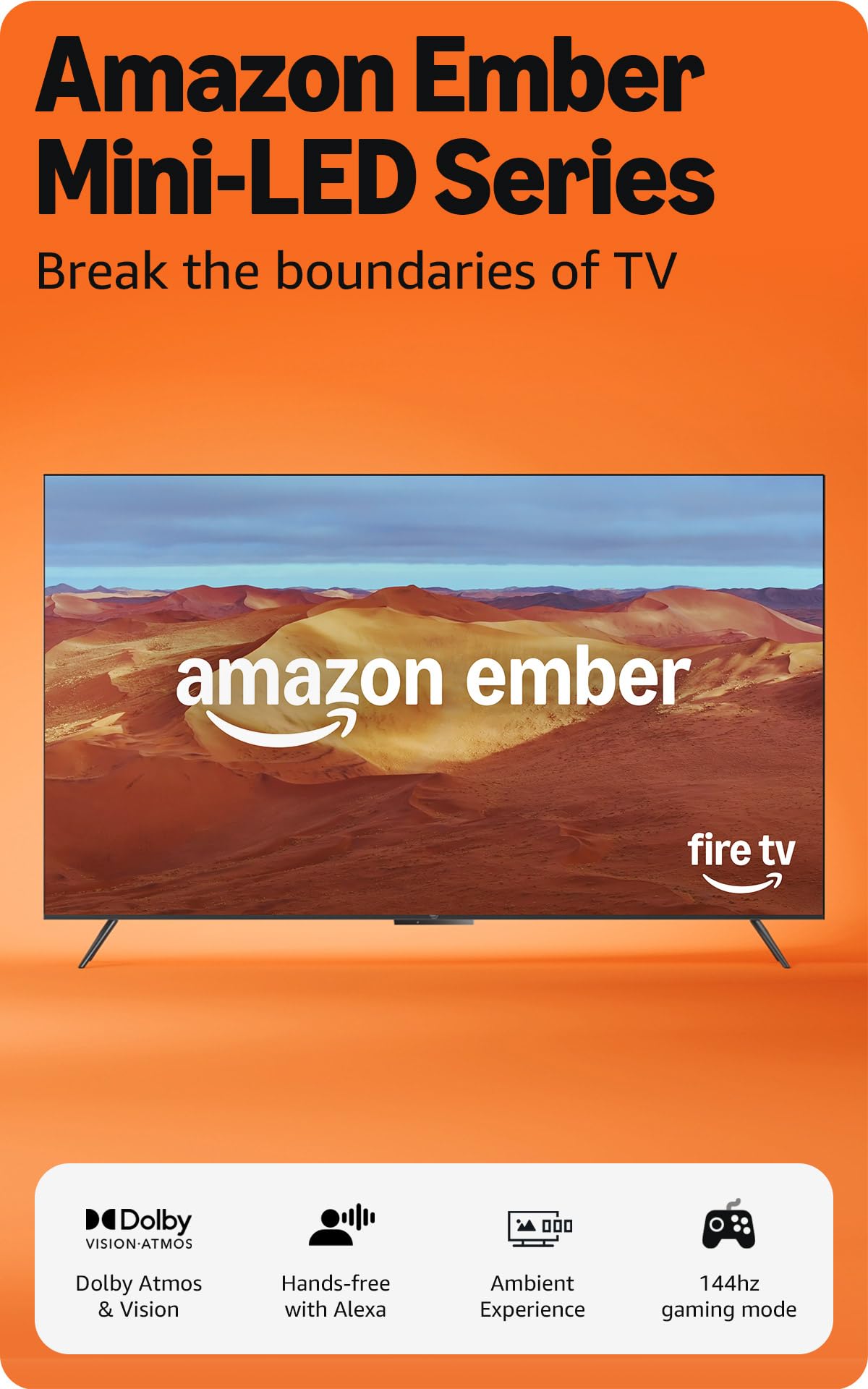
The Amazon Ember Mini-LED Series brings a 4K QLED panel with 512 local dimming zones and peak brightness up to 1400 nits, producing vibrant colors and strong contrast. Dolby Vision IQ and HDR10+ Adaptive dynamically adjust the picture based on ambient room light, ensuring consistent HDR performance whether the curtains are open or closed. The custom Omnisense technology wakes the display when you enter the room and shows artwork or the home screen instantly.
The new Fire TV interface (2026 release) is a significant redesign that prioritizes content discovery and reduces scrolling. Alexa+ with natural language processing makes searching for shows and controlling smart home devices faster. The 144Hz refresh rate with AMD FreeSync Premium Pro certification delivers tear-free, fluid gaming that matches the best in this class.
The physical privacy switch that disconnects the microphones is a thoughtful addition for privacy-conscious users. Some users report occasional interface lag after extended use, and the Amazon-centric home screen may feel restrictive if you prefer a more neutral smart platform. For households already invested in Alexa and Amazon services, the Ember integrates deeper than any other TV.
Why it’s great
- 512 Mini-LED dimming zones with 1400 nits peak brightness for strong HDR
- Omnisense technology with hands-free Alexa wake and ambient art mode
- FreeSync Premium Pro certified for tear-free high-refresh gaming
Good to know
- Fire TV interface includes ads and can lag after extended use
- Amazon ecosystem focus may not suit users of competing smart assistants
9. Panasonic W70 Series 65″ LED 4K Ultra HD Smart Fire TV (65W70BP)

Panasonic’s W70 series leverages a 4K Studio Color Engine and HDR Bright Panel to produce a solid picture for its price tier, supporting HDR10+, HDR10, and HLG. MEMC (Motion Estimation, Motion Compensation) technology smooths motion in fast-moving content, a feature rarely found at this level. The inclusion of an HDMI 2.1 port is a welcome addition for gamers who want access to higher bandwidth features without stepping up to a more expensive model.
Fire TV with Alexa built-in provides a familiar interface with access to the full Amazon app ecosystem. Setup is fast, especially for existing Fire TV users who can sync their profile via QR code. The metal chassis feels more substantial than the plastic build of many entry-level competitors, giving a premium physical presence in the room.
The processor driving the Fire TV interface can feel sluggish when switching between apps, and the design is utilitarian rather than elegant. Some reviewer reports mention software stability issues after the return window. For buyers on a strict budget who still want a 65-inch screen with Fire TV integration and a trusted brand name, this is a functional entry point.
Why it’s great
- MEMC technology reduces motion blur in sports and action content
- HDMI 2.1 port provides access to higher bandwidth gaming features
- Metal chassis offers a more premium physical build than plastic competitors
Good to know
- Fire TV interface can feel slow during app switching and navigation
- Some reported software stability issues after the initial return period
10. Roku Smart TV – 55-Inch Plus Series, Mini-LED TV
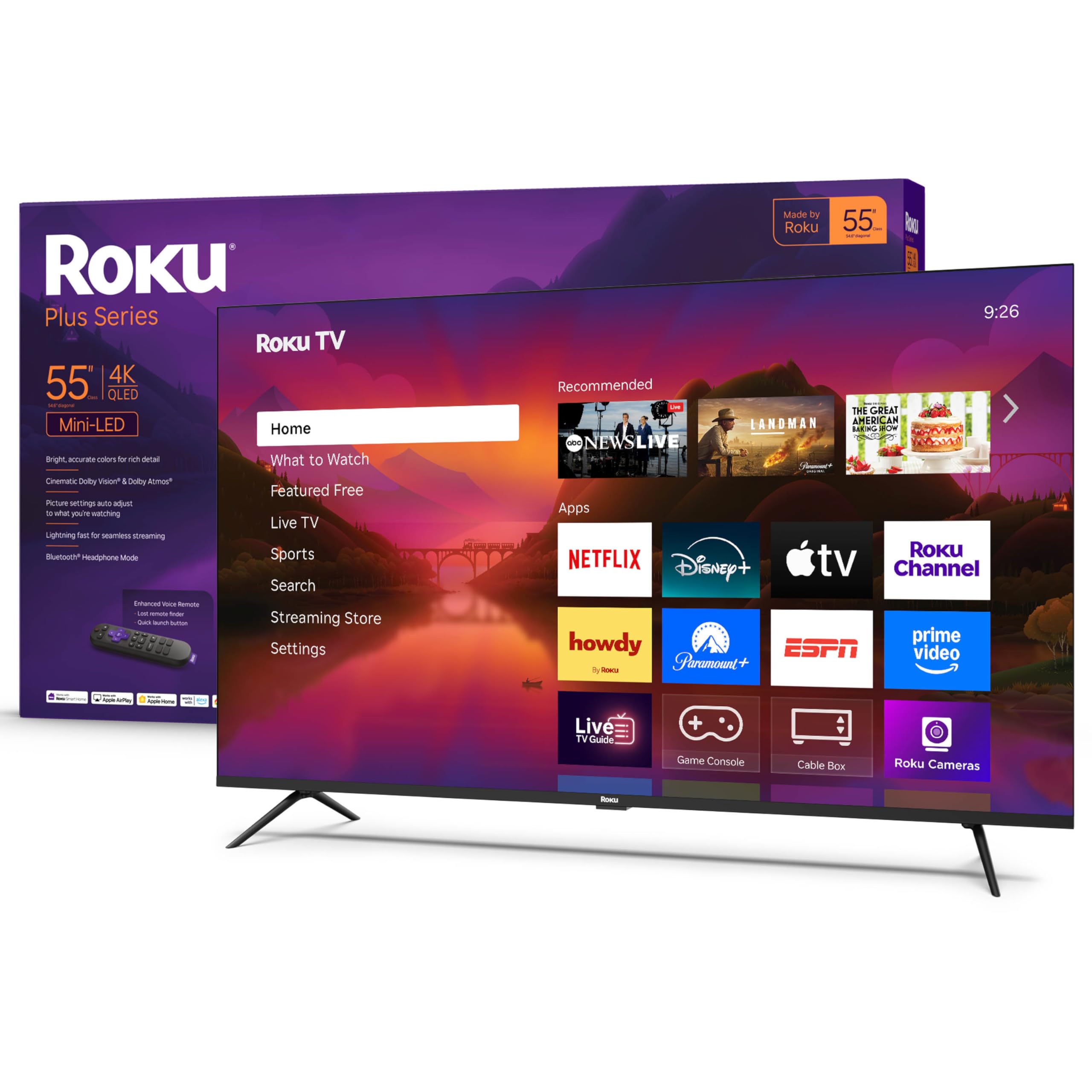
The Roku Plus Series 55-inch brings Mini-LED backlighting and QLED color to the Roku platform, combining excellent picture quality with the most intuitive smart TV interface on the market. Dolby Vision and Dolby Atmos support ensure compatibility with the highest quality streaming content. The AI-powered Roku Smart Picture Max automatically cleans up incoming signals and optimizes sharpness and color scene-by-scene, reducing the need for manual calibration.
The enhanced voice remote includes a lost remote finder and programmable shortcut keys for favorite apps. Bluetooth Headphone Mode allows private listening through any Bluetooth headphones without waking others in the room. The metallic stand feet add a premium touch that is rare at this price point.
The Roku OS is deliberately simple and lacks the deep customization of Google TV or the smart home integration of Fire TV. It does not include USB port support, which limits media playback from external drives. For a buyer who values a frustration-free interface, great picture quality, and minimal learning curve, the Plus Series is one of the most satisfying televisions to live with day-to-day.
Why it’s great
- Roku OS is the cleanest, fastest, and most intuitive smart platform available
- Mini-LED backlight with QLED and Dolby Vision delivers excellent HDR
- Bluetooth Headphone Mode allows private listening without a wired connection
Good to know
- No USB port limits playback from external drives
- Roku ecosystem has fewer niche apps than Google TV or Fire TV
11. Roku Smart TV 2026 – 65-Inch Select Series, 4K QLED TV
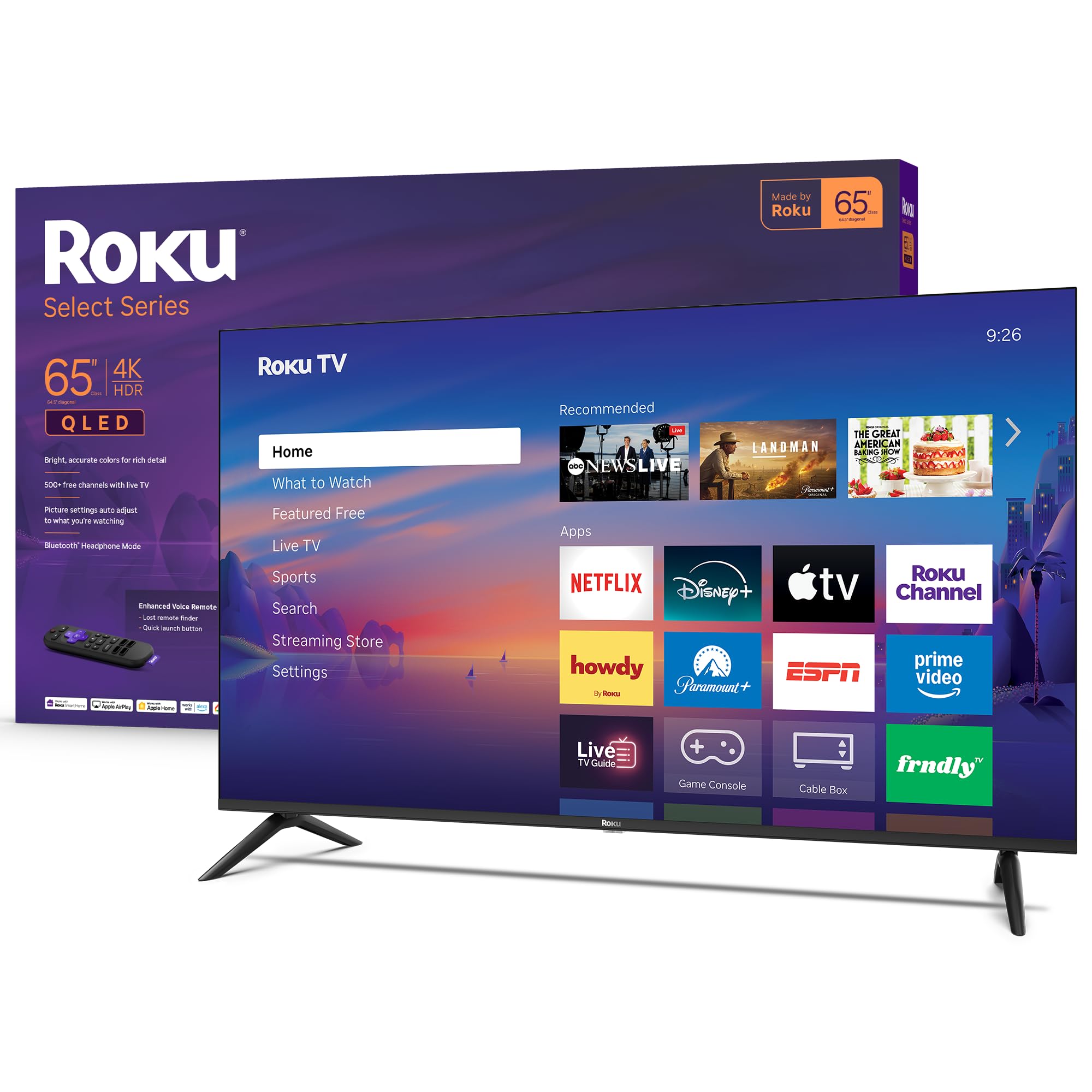
The Roku Select Series 65-inch provides a QLED screen with HDR10 support and a Direct LED backlight at an entry-level price that makes 65-inch 4K accessible without sacrificing the excellent Roku software experience. The frameless design gives it a modern look that blends into any room. Roku Smart Picture automatically selects the appropriate picture mode for the content being watched, simplifying the experience for non-technical users.
The enhanced voice remote with lost remote finder and shortcut keys is included. Fast Wi-Fi ensures smooth streaming without buffering, and the automatic software updates keep the app library current. Setup takes under ten minutes, and the home screen is clean and responsive out of the box.
The Direct LED backlight does not support local dimming, so black levels are standard for the category rather than Mini-LED class. The sound is clear and louder than many budget TVs, but lacks the bass extension of models with dedicated woofers. For a family room or secondary space where ease of use, large screen size, and budget discipline are the primary drivers, the Select Series delivers consistent satisfaction.
Why it’s great
- Roku OS remains the gold standard for simple, fast, and ad-light navigation
- QLED screen provides better color than standard LED at an entry price
- Frameless design offers a clean, modern aesthetic for a budget model
Good to know
- Direct LED backlight lacks local dimming for deep black levels
- Built-in speakers lack bass extension; a soundbar improves audio significantly
FAQ
Is it worth paying more for Mini-LED over standard LED backlighting?
Do I need a soundbar for a Mini-LED or QD-OLED television?
What are the signs of a defective panel to look for during the return window?
Final Thoughts: The Verdict
For most users, the best 4k smart tv winner is the Hisense 65″ U7 Mini-LED because it combines an extremely high local dimming zone count, a native 165Hz refresh rate, and excellent anti-glare performance at a price that undercuts its premium rivals. If you want the deepest possible black levels with infinite contrast for a dark home theater, grab the Samsung 55″ S90F QD-OLED. And for a massive 85-inch screen that retains strong Mini-LED performance, nothing beats the TCL 85″ QM7K.