
That dead zone in the back bedroom, the buffering every time you walk into the kitchen, the video call that drops when you move to the home office — these are the symptoms of a single router trying its best and failing. A mesh WiFi system replaces that single point of failure with multiple nodes working together, and the gap between budget and premium performance has never been narrower.
I’m Min — the co-founder and writer behind Gadgets Feed. I spend hours analyzing network topology, real-world throughput benchmarks, and user feedback across dozens of mesh systems to surface the ones that actually deliver consistent coverage without emptying your wallet.
A well-chosen two- or three-pack can finally kill every dead spot in your home. That is exactly what this guide to the best budget mesh wifi systems is about: finding the efficient, reliable performers that solve real coverage problems for under two hundred dollars.
How To Choose The Best Budget Mesh WiFi
Picking a budget mesh system isn’t about finding the cheapest box. It’s about matching the right node count, wireless standard, and port configuration to your home’s layout and internet plan. Here are the three factors that matter most.
Node Count vs. Square Footage
A two-pack with a claimed 3,000-square-foot range is unlikely to cover a 2,500-square-foot two-story home with a finished basement. Walls, floors, and interference from appliances cut real-world coverage by 30 to 50 percent. Over-provision by one node: a three-pack provides the safety margin needed for consistent performance in tricky layouts, and most budget systems scale easily if you need to add more later.
Wi-Fi Generation and Speed Rating
Wi-Fi 6 (802.11ax) is the standard to aim for. Even budget-tier AX1500 and AX3000 systems handle OFDMA and MU-MIMO, which improve multi-device efficiency dramatically compared to older Wi-Fi 5 (AC) gear. Don’t chase the highest number on the box — a well-placed AX1500 two-pack will outperform a poorly placed AX5400 single router every time. The mesh architecture matters more than the theoretical speed cap.
Backhaul Options
Ethernet backhaul is a game-changer for budget mesh. If your home has Coax or Ethernet wiring, running a cable from one node to another frees the wireless bands for client traffic, eliminating the speed penalty that wireless backhaul imposes. Some systems also support dedicated wireless backhaul on a separate band, but wired backhaul remains the gold standard for consistent throughput in affordable setups.
Quick Comparison
On smaller screens, swipe sideways to see the full table.
| Model | Category | Best For | Key Spec | Amazon |
|---|---|---|---|---|
| TP-Link Deco X55 Pro | 3-Pack Mesh | Multi-gig internet plans | 2 x 2.5G ports per node | Amazon |
| Tenda BE5100 ME6 Pro | Wi-Fi 7 3-Pack | Future‑proofing on a budget | 1 x 2.5G + 2 x 1G ports | Amazon |
| Google Nest WiFi Pro | Wi-Fi 6E 3-Pack | Simple app-first setup | Tri-band Wi-Fi 6E | Amazon |
| Amazon eero 7 | Wi-Fi 7 3-Pack | TrueMesh reliability | 2.5 GbE auto‑sensing ports | Amazon |
| Tenda MX12 | AX3000 3-Pack | Large homes under | 7,000 sq. ft. coverage | Amazon |
| Linksys Atlas MX2000 | AX3000 2-Pack | Qualcomm chipset stability | 160 MHz channel support | Amazon |
| NETGEAR Nighthawk MK72 | AX3000 2-Pack | NETGEAR Armor security | 2 x 1G Ethernet LAN ports | Amazon |
| TP-Link Deco X15 | AX1500 2-Pack | Smallest budgets, small homes | 2 Gigabit ports per node | Amazon |
| NETGEAR Orbi 770 | Wi-Fi 7 3-Pack | Ultra-premium coverage | Up to 11 Gbps, tri-band | Amazon |
In‑Depth Reviews
1. TP-Link Deco X55 Pro

The Deco X55 Pro is the rare mesh system that doesn’t force you to choose between modern features and a friendly price. Each of the three nodes packs two 2.5 Gigabit Ethernet ports, making it ready for internet plans above 1 Gbps and ideal for wired backhaul setups. The AX3000 spec covers 2×2 streams on both bands, and TP-Link’s AI-driven mesh learns the network environment to optimize roaming patterns over time.
Coverage is rated at 6,500 square feet for the three-pack, and real-world feedback from users with 4,000-square-foot homes confirms seamless handoff between nodes when wired backhaul is engaged. The Deco app remains one of the most polished in the category, handling setup, parental controls, and HomeShield security features without requiring a subscription for the basics. A 20-year IT professional reported that after switching the units to Access Point mode, the system solved handoff issues that had plagued a previous non-mesh setup.
If your internet plan already exceeds 1 Gbps or you plan to wire the nodes together with CAT6 cable, the X55 Pro delivers performance that punches well above its price tier. The only real compromise is the lack of a dedicated wireless backhaul band, but the 2.5G wired ports more than compensate.
Why it’s great
- Two 2.5G ports per node handle multi-gig internet and wired backhaul
- AI-driven mesh optimizes roaming and channel selection automatically
- Three-pack covers up to 6,500 sq. ft. with excellent signal penetration
Good to know
- No dedicated 5 GHz backhaul radio — wired backhaul is strongly recommended for peak performance
- Some ISP modem/router combos require switching to Access Point mode for stable operation
2. Tenda BE5100 ME6 Pro
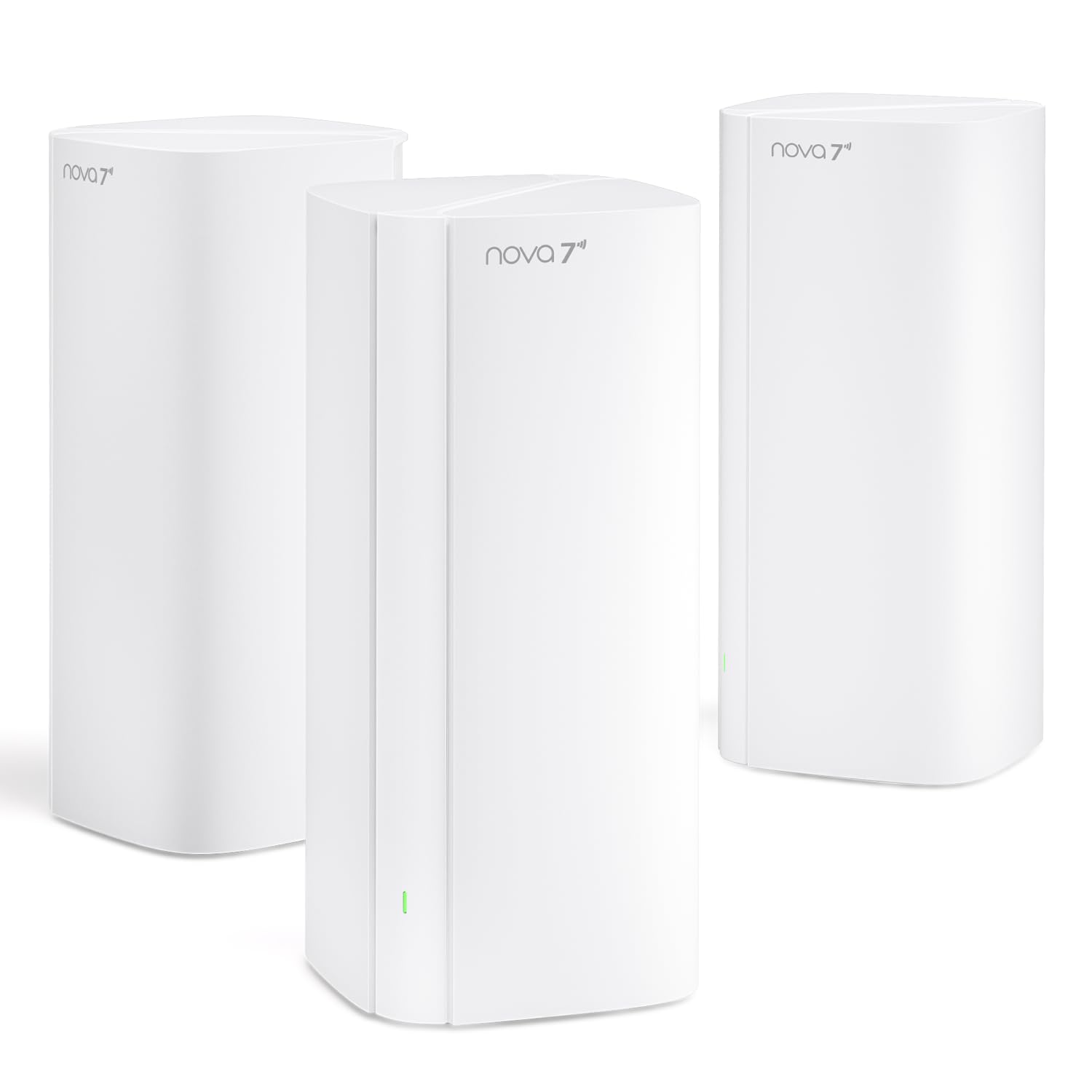
Wi-Fi 7 at a budget price sounds like a contradiction, but the Tenda BE5100 ME6 Pro makes it real. This three-pack uses dual-band Wi-Fi 7 with speeds up to 5,100 Mbps, and it brings Multi-Link Operation (MLO) to combine the 2.4 GHz and 5 GHz bands for lower latency and higher throughput. The 2.5G WAN/LAN auto-sensing port is a smart inclusion for anyone with gigabit-plus broadband or a local NAS.
Coverage is rated at 6,600 square feet, and five internal antennas per node with high-power FEMs push signal through walls and floors effectively. Users upgrading from older Tenda Nova MW6 systems reported a significant jump in consistency, with wireless throughput hitting 600–800 Mbps on a 900 Mbps plan. The Tenda WiFi App handles setup in minutes, and the system supports wired Ethernet backhaul for those who want rock-solid node-to-node links.
The BE5100 lacks a tri-band configuration and a 6 GHz radio, which keeps the cost down but means you won’t get the full Wi-Fi 7 multi-gig experience. For the price, however, this system future-proofs your network against the next generation of devices without requiring a premium investment today.
Why it’s great
- Wi-Fi 7 MLO reduces latency and improves throughput on compatible devices
- Auto-sensing 2.5G port handles WAN or LAN use flexibly
- Strong 6,600 sq. ft. coverage with high-power FEM amplifiers
Good to know
- Dual-band only — no dedicated 6 GHz radio for third-band backhaul
- Customer support responsiveness has been inconsistent in some user reports
3. Google Nest WiFi Pro

Google’s Nest WiFi Pro delivers the smoothest setup experience of any mesh system on this list. The Google Home app walks you through the entire process in under ten minutes, and the tri-band Wi-Fi 6E architecture includes the 6 GHz band for a clean, interference-free channel that newer devices can use. Each node covers about 2,200 square feet, and the three-pack provides up to 6,600 square feet of reliable coverage.
Automatic network optimization is a key strength here: the system prioritizes video calls and streaming while self-monitoring for issues and fixing common problems without manual intervention. Users consistently praise the “set it and forget it” reliability, with several reporting that it solved persistent dead zones in two-story homes. The lack of a dedicated router port and the single 1 Gbps Ethernet port per node are the main hardware limitations — this system is designed for households with internet plans at or below 1 Gbps.
If you value a friction-free experience and have a household full of Pixel phones or Chromecast devices, the Nest WiFi Pro integrates seamlessly. The 6 GHz band provides genuine performance uplift for compatible clients, though you’ll want wired backhaul if your home layout pushes nodes far apart.
Why it’s great
- Tri-band Wi-Fi 6E opens the 6 GHz band for interference-free connections
- Setup is genuinely fast and intuitive through the Google Home app
- Self-healing network automatically diagnoses and resolves many issues
Good to know
- Ethernet ports are limited to 1 Gbps — no multi-gig option for faster plans
- Not backward compatible with older Google WiFi or Nest WiFi hardware
4. Amazon eero 7

Amazon’s eero 7 brings Wi-Fi 7 to a more accessible price point while keeping the company’s patented TrueMesh software at the core. TrueMesh, TrueRoam, and TrueChannel work together to proactively route traffic across the strongest connection path, and the system handles internet plans up to 2.5 Gbps thanks to two auto-sensing 2.5 GbE ports on the main node. The three-pack covers 6,000 square feet and supports over 120 devices simultaneously.
Users consistently highlight the simplicity of the eero app and the compact, unobtrusive design of the nodes. One reviewer replaced a five-satellite Netgear Orbi system with four eero 7 units and reported that wireless security cameras performed better with the eero network. The three-year warranty is industry-leading and adds confidence for long-term investment. Some users noted that the units can run warm under heavy load, and the optional eero Plus subscription (/month) is required for advanced security features like ad blocking and parental controls.
For households already embedded in the Amazon ecosystem — Echo devices, Fire TV, Ring cameras — the eero 7 integrates at a deeper level than any competitor. The combination of Wi-Fi 7 readiness, multi-gig port support, and TrueMesh reliability makes this a strong premium choice that won’t break the bank.
Why it’s great
- TrueMesh software optimizes routing for consistent whole-home performance
- Auto-sensing 2.5 GbE ports support internet plans up to 2.5 Gbps
- Three-year warranty and responsive customer support
Good to know
- Advanced security and parental controls require the optional eero Plus subscription
- Units may need additional clearance for ventilation to prevent overheating
5. Tenda AX3000 WiFi 6 Mesh System Nova MX12
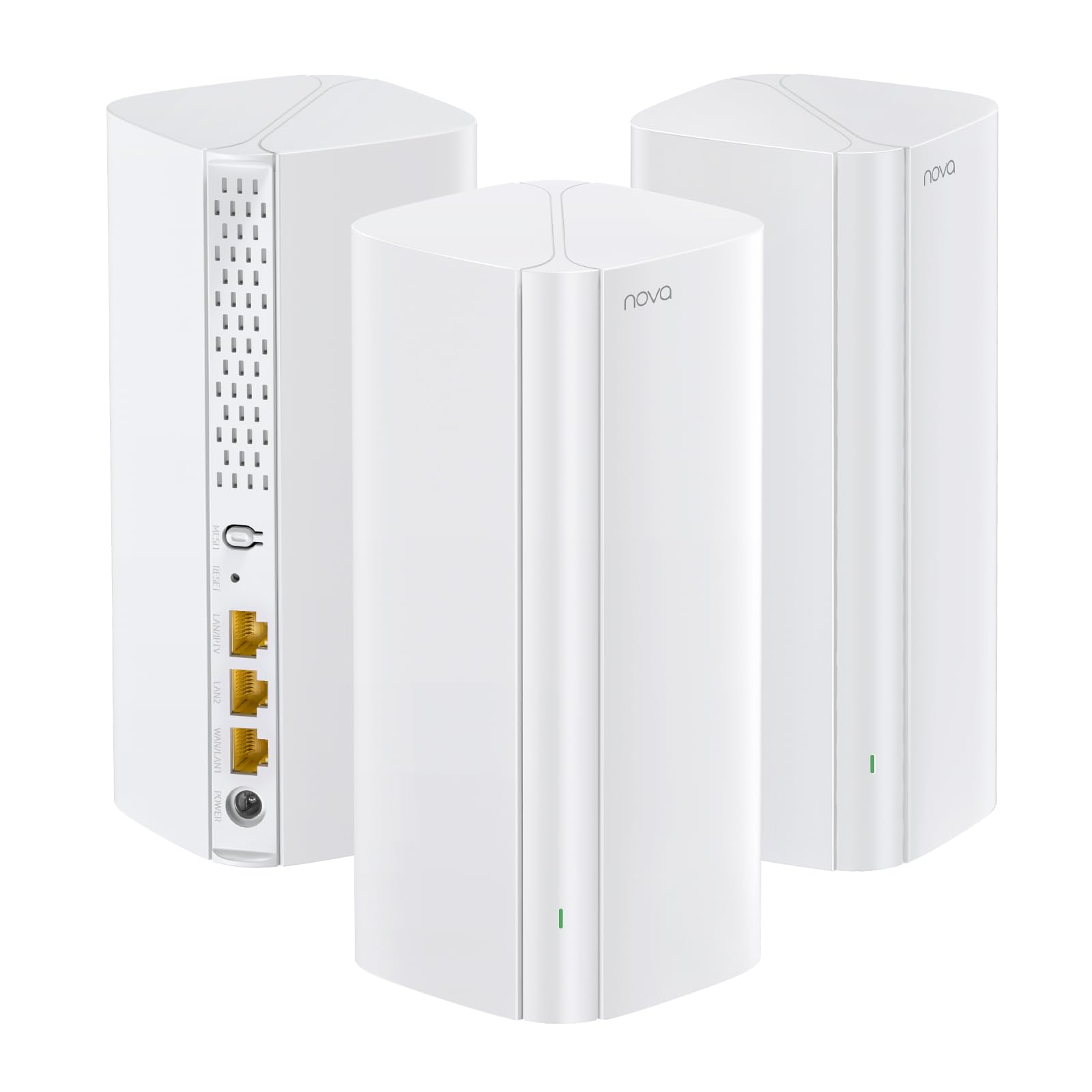
The Tenda Nova MX12 three-pack is the coverage king of the budget category. Rated for up to 7,000 square feet, it uses AX3000 dual-band Wi-Fi 6 with OFDMA and MU-MIMO to handle 160+ devices without breaking a sweat. Setup does not require an app — you can configure it via the web GUI or use the Tenda WiFi App, and adding new nodes is as simple as pressing the Mesh button.
Users praise the plug-and-play nature of the system, with several reporting strong 5 GHz signal penetration through multiple floors in three-level homes. The intuitive web interface allows band separation (different SSIDs for 2.4 GHz and 5 GHz), which is a useful feature for older smart home devices that struggle with band steering. A few users reported that Ethernet backhaul did not work reliably in some configurations, so wireless backhaul may be the safer default for this system.
At this price point, the MX12 offers the highest coverage-per-dollar ratio on the market. If you have a large, open-concept space or a multi-level home where three nodes can be spread widely, this system fills the area with strong, consistent signal better than most two-pack competitors.
Why it’s great
- 7,000 sq. ft. coverage from a three-pack at an exceptional price
- Simple setup with web GUI or app — no mandatory account creation
- Band separation option for better compatibility with older IoT devices
Good to know
- Ethernet backhaul has been reported as unreliable in some configurations
- Customer support responsiveness has been mixed in user feedback
6. Linksys Atlas WiFi 6 Mesh System MX2000

The Linksys Atlas MX2000 two-pack is built around an advanced Qualcomm chipset that delivers stable AX3000 performance across a 4,000-square-foot coverage area. The 160 MHz channel support on the 5 GHz band is a significant advantage — it doubles the channel width compared to standard 80 MHz implementations, boosting throughput for compatible clients. The system supports 50+ devices with automatic firmware updates and a separate guest network.
Setup through the Linksys App is straightforward, though a known bug can cause the initial configuration to fail. The fix — pressing the reset button five times — is simple enough, but it is worth noting for first-time users. Once running, the system provides solid range both indoors and outdoors, with users reporting strong signal on lawns and patios. The Qualcomm chipset keeps latency low, making this a capable option for casual gaming and 4K streaming.
For anyone who values chipset quality and long-term stability over raw coverage numbers, the Linksys Atlas MX2000 is a safe bet. The 160 MHz support is a genuine differentiator in this price range, and the brand’s reputation for reliability adds peace of mind.
Why it’s great
- Qualcomm chipset delivers low latency and stable AX3000 performance
- 160 MHz channel width boosts 5 GHz throughput for compatible devices
- Reliable coverage stretches to outdoor areas like patios and lawns
Good to know
- Initial app setup may require a five-press reset to bypass a known bug
- Three-pack configuration is not available — max coverage is with two nodes
7. NETGEAR Nighthawk MK72

The NETGEAR Nighthawk MK72 is a two-piece AX3000 system designed for homes up to 3,000 square feet. It includes a router and one satellite, with each unit offering two 1G Ethernet LAN ports. The system supports 35+ devices and includes a 30-day trial of NETGEAR Armor, which provides automatic security scanning and VPN protection for all connected devices.
Setup via the Nighthawk app takes about 20 minutes, and users report strong, consistent coverage for 4K streaming, video calls, and gaming after initial configuration. A key consideration: WPA3 security is enabled by default, which can cause connection issues with older Wi-Fi clients — users with legacy devices may need to disable WPA3 or replace those devices. Some units require a firmware update out of the box, which means contacting your ISP to enable bridge mode on the existing modem/router combo.
For households with 1 Gbps or slower internet that need coverage across a medium-sized home, the MK72 delivers reliable dual-band performance with the added security of NETGEAR Armor. The system is expandable with additional MS70 satellites, though it is not compatible with other Nighthawk or Orbi mesh lines.
Why it’s great
- NETGEAR Armor provides integrated security scanning and VPN protection
- Setup is manageable in under 20 minutes through the Nighthawk app
- Expandable with additional MS70 satellites for larger homes
Good to know
- WPA3 default can block older Wi-Fi clients from connecting
- Some users report random disconnects after the first few months of use
8. TP-Link Deco X15

The TP-Link Deco X15 is the most affordable entry point into the Wi-Fi 6 mesh ecosystem. This two-pack delivers AX1500 dual-band performance with 2 Gigabit Ethernet ports per node and support for wired backhaul. Coverage is rated at 3,900 square feet, and the system can handle up to 120 devices — impressive numbers for a system at this level. AI-powered roaming technology learns your movement patterns and optimizes the handoff between nodes.
Users consistently praise the Deco app for its clean interface and quick setup. Homeowners with 1,100-square-foot houses reported that a single unit eliminated dead zones caused by firewall blockages, while others used both nodes to cover a two-story home with no signal drops. A notable concern: TP-Link announced that firmware updates for the X15 have been discontinued, which means no future security patches or feature improvements.
For very small homes, apartments, or as a temporary solution while saving for a more advanced system, the Deco X15 works well right now. The lack of ongoing firmware support makes it a short-term play rather than a long-term investment.
Why it’s great
- Lowest price for a Wi-Fi 6 mesh system with wired backhaul support
- Deco app provides polished setup and management experience
- Two Gigabit ports per node offer flexibility for wired connections
Good to know
- Firmware updates have been discontinued — no future security patches
- AX1500 speed is the slowest Wi-Fi 6 tier; not ideal for gigabit+ plans
9. NETGEAR Orbi 770 Series

The NETGEAR Orbi 770 Series represents the peak of what a consumer mesh system can deliver. This tri-band Wi-Fi 7 system includes a router and two satellites, covering up to 8,000 square feet with theoretical speeds up to 11 Gbps. The dedicated backhaul radio on the third band ensures that satellite connections don’t steal bandwidth from your devices, and the 2.5 Gigabit WAN port supports multi-gig internet subscriptions. The system handles up to 100 devices without breaking a sweat.
Users with over 100 connected devices — including computers, smart TVs, IoT gadgets, and outdoor cameras — report flawless performance after setup. The Orbi app provides clear visibility into satellite connectivity and signal strength, and the system’s 360-degree antenna design delivers consistent coverage across complex home layouts. A few users noted that wired backhaul can be finicky with older CAT5e cable, recommending CAT6 for stable operation. The system lacks a physical power switch and only offers two rear Ethernet ports per node, which may require a separate switch for wired devices.
For households with multi-gig internet, a high density of connected devices, or a larger home with challenging construction materials, the Orbi 770 is the ultimate solution. It is the clear choice when budget constraints are secondary to maximum performance and coverage.
Why it’s great
- Tri-band Wi-Fi 7 with dedicated backhaul maintains peak speeds across all nodes
- Up to 8,000 sq. ft. coverage handles the largest homes and outdoor areas
- 2.5G WAN port and multi-gig support future-proofs for faster internet plans
Good to know
- Wired backhaul may require CAT6 cable for stable operation
- Only two Ethernet ports per node; a switch may be needed for wired devices
FAQ
Can I mix different brands of mesh nodes in one network?
Will a budget mesh system work with my gigabit internet plan?
How many mesh nodes do I really need for a 2,500-square-foot home?
Final Thoughts: The Verdict
For most users, the best budget mesh wifi winner is the TP-Link Deco X55 Pro three-pack because it combines future-proof 2.5G ports, AI-driven mesh optimization, and Wi-Fi 6 reliability at a price that undercuts the competition. If you want Wi-Fi 7 without breaking the bank, grab the Tenda BE5100 ME6 Pro. And for the simplest, most foolproof whole-home coverage, nothing beats the Google Nest WiFi Pro.