
An action video camera lives or dies by its stabilization. Without it, even a casual mountain bike run turns into a queasy, unwatchable blur. The real challenge isn’t finding a camera that records 4K—nearly all of them do now. It’s finding one that keeps that footage smooth when you’re bouncing down a trail or carving a wave.
I’m Min — the co-founder and writer behind Gadgets Feed. I’ve logged countless hours dissecting stabilization algorithms, comparing sensor sizes, and stress-testing battery claims to separate the gear that actually delivers from the marketing fluff.
The right best action video camera matches your specific activity to a stabilization system that can actually keep up, a battery that won’t die mid-run, and a waterproof rating that matches your depth needs.
How To Choose The Best Action Video Camera
Picking an action camera means matching specs to your world. A vlogger needs a front-facing screen and good internal audio. A diver needs deep waterproofing without a housing. A mountain biker needs stabilization that handles high-frequency vibration. Here’s what to check first.
Stabilization: Electronic vs. Mechanical
Electronic image stabilization (EIS) uses gyroscope data to crop and shift the frame. Modern EIS like GoPro’s HyperSmooth or DJI’s RockSteady is incredibly effective for most sports. A 3-axis mechanical gimbal, like on the Xtra Muse, physically counters motion and never crops the sensor, but adds bulk and fragility. For high-impact sports, prioritize the best EIS. For walking vlogs, a gimbal is worth the trade-off.
Sensor Size and Resolution
A larger sensor captures more light, producing cleaner footage in dusk or indoor settings. A 1/1.3-inch sensor is the current sweet spot for action cameras, while the DJI Action 6’s 1/1.1-inch sensor and variable aperture push into low-light territory. Resolution matters for cropping and reframing—8K gives you room to punch in without losing crisp detail. For most users, 4K at 60fps is the practical baseline for smooth slow-motion.
Waterproofing and Durability
Check whether the camera is waterproof out of the box or requires a dive housing. Out-of-the-box ratings save setup time for snorkeling or rain. Housing-dependent cameras offer deeper depth ratings but add one more thing to carry. Also look for cold-resistant batteries if you shoot in winter—standard lithium cells lose capacity fast below freezing.
Quick Comparison
On smaller screens, swipe sideways to see the full table.
| Model | Category | Best For | Key Spec | Amazon |
|---|---|---|---|---|
| GoPro HERO13 Black | Premium | Best-in-class 5.3K with modular lenses | 5.3K60 video, 27MP photos | Amazon |
| DJI Osmo Action 6 Essential Combo | Premium | Variable aperture for low-light mastery | 8K video, f/2.0–f/4.0 aperture | Amazon |
| GoPro MAX2 | Premium | True 8K 360 capture with reframing | 8K spherical video, 29MP photos | Amazon |
| DJI Osmo Action 6 Enhanced Combo | Premium | Extended shooting with dual batteries | 8K video, 2 batteries, 1.5m rod | Amazon |
| Xtra Muse | Mid-Range | Pocket gimbal for cinematic vlogs | 1-inch CMOS, 4K/120fps, 3-axis gimbal | Amazon |
| Insta360 X4 | Premium | 8K 360 with invisible selfie stick | 8K 360 video, 135 min battery | Amazon |
| Xtra Edge Pro | Mid-Range | Large 1/1.3″ sensor for budget | 4K/60fps, 65ft waterproof | Amazon |
| AKASO Brave 7 LE | Value | Dual-screen vlogging on a budget | 4K/30fps, dual color screens | Amazon |
| SJCAM C300 | Budget | Long battery life for casual users | 4K/20MP, 7-hour battery | Amazon |
In‑Depth Reviews
1. GoPro HERO13 Black

The HERO13 Black is the benchmark for a reason. Its 5.3K resolution at 60fps delivers noticeably more detail than standard 4K, giving you room to crop or stabilize in post without losing sharpness. HyperSmooth stabilization remains class-leading—it virtually erases bumps from mountain biking and motocross footage without introducing the jello effect that plagued older EIS systems.
The HB-Series lens system is the standout feature here. Swap on the Ultra Wide Lens Mod for immersive POV shots or the Macro Lens Mod for extreme close-ups. The camera auto-detects which lens is attached and adjusts its settings, removing the usual fumbling with menus mid-shoot. The Enduro battery extends cold-weather performance, though at 79 minutes of 5.3K recording you’ll want spares for a full day out.
Waterproof to 33 feet without a housing, the HERO13 handles everything from snorkeling to rain-soaked trail runs. The water-repelling lens cover also reduces flare. It’s the most well-rounded package for anyone who wants a mix of high-resolution capture, interchangeable optics, and proven durability.
Why it’s great
- Best-in-class 5.3K60 video with 91% more resolution than 4K
- HB-Series lens system with auto-detection for flexible shooting
- HyperSmooth stabilization that rivals a mechanical gimbal
Good to know
- Battery life is short at max resolution—carry spares
- Lens mods are sold separately and add to the total cost
2. DJI Osmo Action 6 Essential Combo
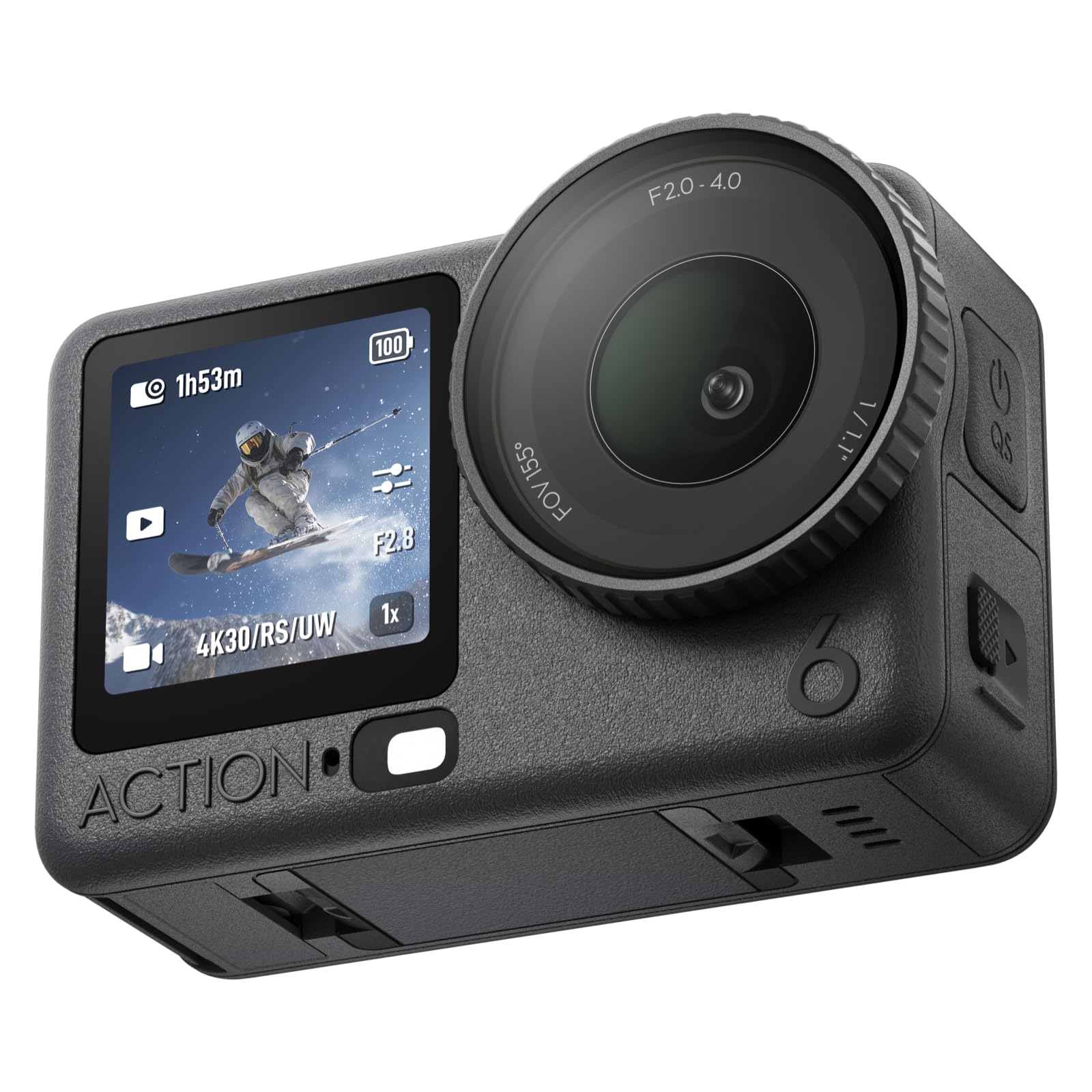
DJI’s Action 6 flips the script on action camera design with a variable aperture—f/2.0 to f/4.0—that lets you control depth of field and light intake directly. This is a massive advantage for dusk or indoor shooting, where fixed-aperture cameras produce muddy, noisy footage. The 1/1.1-inch square sensor is the largest in any mainstream action camera, pulling in detail that smaller sensors miss.
RockSteady 3.0 and HorizonSteady deliver ultra-smooth footage, with the latter keeping the horizon locked even if you rotate the camera 360 degrees. This makes it perfect for POV clips where you want that drone-like level horizon. The 50GB of built-in storage is a lifesaver for days you forget your microSD card, and the cold-resistant battery holds up in sub-zero conditions.
Gesture and voice controls let you start recording hands-free—useful when you’re gloved up for a ski run. Connect two DJI microphones directly for clear interview audio without an external receiver. The Essential Combo includes one battery; heavy shooters should consider the Enhanced Combo for dual batteries and the extension rod.
Why it’s great
- Variable aperture adapts to changing light for cleaner low-light footage
- 50GB built-in storage provides a reliable backup
- HorizonSteady locks the horizon regardless of camera rotation
Good to know
- Essential Combo only includes one battery
- No GPS or accelerometer for telemetry data overlays
3. GoPro MAX2
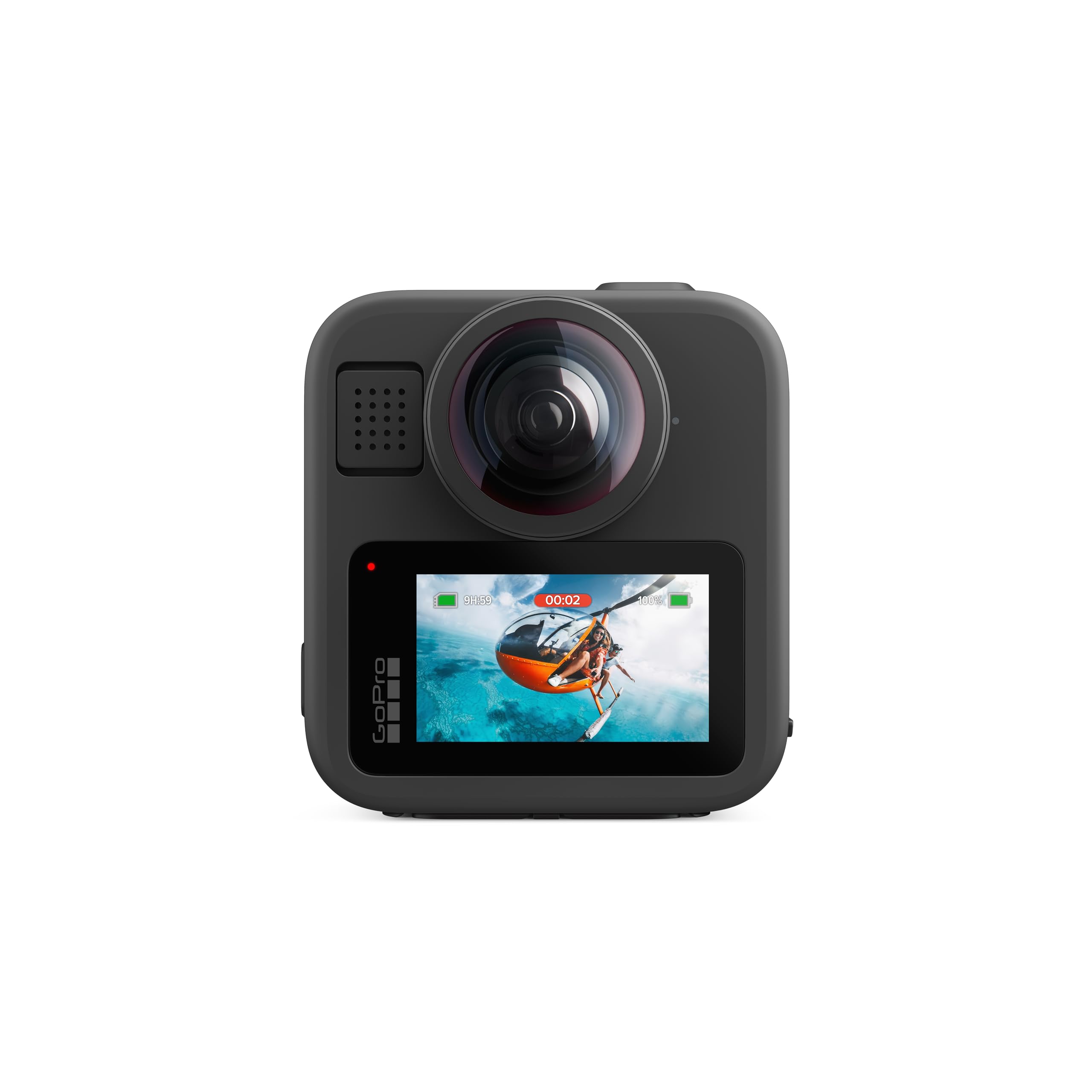
The MAX2 is GoPro’s 360-degree answer to the Insta360 line, and it delivers true 8K spherical video that retains crisp detail even after you reframe to a standard 16:9 clip. The stitching is seamless—there’s no visible line or color mismatch where the two lenses meet, which was a common failure point in earlier dual-lens cameras. You capture everything around you, then choose your angle later in the Quik app.
The invisible selfie stick effect is the killer app here. Attach the MAX2 to an extension pole via the 1/4-20 thread, and the pole vanishes from the footage. The result looks like a drone shot or a dedicated cameraperson following you. The 6-microphone array captures spatial audio that shifts perspective as you reframe, adding another layer of immersion.
Replaceable glass lenses are a huge durability upgrade. If you scratch a lens on a rock or pavement, you swap it instead of the whole camera. Waterproof to 33 feet without a housing. Some users report heat buildup during extended 8K recording, but for short takes and reframing, the creative flexibility is unmatched.
Why it’s great
- True 8K 360 spherical video with seamless stitching
- Invisible selfie stick effect for drone-like third-person shots
- Replaceable glass lenses protect your investment
Good to know
- Can heat up during extended 8K recording
- Large video files require substantial storage management
4. DJI Osmo Action 6 Enhanced Combo
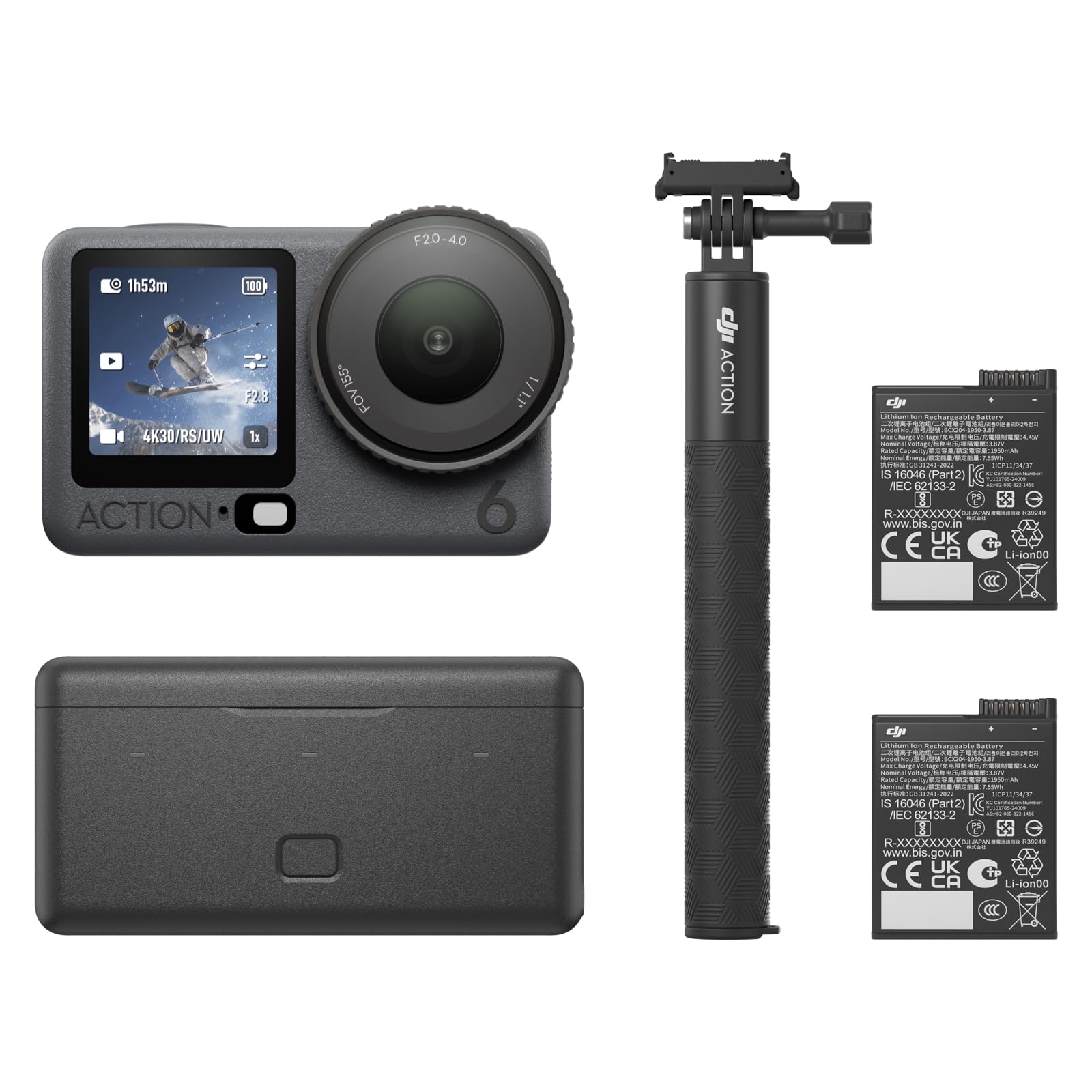
This is the same core Action 6 camera as the Essential Combo, but the Enhanced Combo adds a second Extreme Battery Plus, a multifunctional battery case, and a 1.5-meter extension rod. For anyone filming multi-hour sessions—a full day of skiing, a long hike, or an event—this is the practical choice. Two batteries give you roughly 8 hours of mixed-resolution recording, and the case charges them on the go.
The extension rod transforms your selfie game. It collapses small enough to stash in a pack but extends to 1.5 meters for wide-angle follow-cam shots. The magnetic quick-release mount system makes it fast to detach the camera for a handheld clip. The same variable aperture, 8K resolution, and RockSteady 3.0 stabilization apply, ensuring the video quality matches the premium single-battery version.
Underwater, this camera shines. The 1/1.1-inch sensor captures true-to-life colors at depth without color grading. Built-in 50GB storage is the same, and the cold-resistant battery is excellent for winter use. The only trade-off is the microphone—fine for ambient audio, but serious vloggers will want an external mic.
Why it’s great
- Two batteries and a charging case for all-day shooting
- 1.5m extension rod for dynamic follow-cam and selfie shots
- Same variable aperture and sensor as the standard model
Good to know
- Internal microphone quality is average
- Bluetooth connection can be finicky in crowded areas
5. Xtra Muse

The Xtra Muse is not an action camera in the traditional clip-to-your-helmet sense—it’s a pocket gimbal camera that excels at smooth walking vlogs and cinematic b-roll. The 1-inch CMOS sensor captures 4K at up to 120fps, giving you ultra-slow-motion that retains detail. The built-in 3-axis gimbal physically counters every step and turn, producing footage that looks like it was shot on a much larger rig.
Face and object tracking is surprisingly reliable. Mount the Muse on a tripod, walk into the frame, and it follows you without drifting. The 2-inch touchscreen flips between horizontal and vertical orientations, making it dead simple to shoot for TikTok or YouTube without cropping in post. X-Log color mode captures a flat profile with 10-bit color for serious grading in DaVinci Resolve or Premiere.
Battery life is rated at 161 minutes—impressive for a gimbal camera. It’s small enough to slide into a jacket pocket, making it ideal for travel vloggers who want gimbal-smooth footage without carrying a separate stabilizer. The trade-off is durability: it’s not waterproof and lacks the rugged build of a GoPro or DJI Action. Keep it dry.
Why it’s great
- 1-inch sensor and 3-axis gimbal for cinematic smooth footage
- Face/object tracking keeps you centered in the frame
- X-Log 10-bit color for professional-grade post-production
Good to know
- Not waterproof—avoid rain and splashes
- Accessories like DJI Pocket 3 mounts may not fit perfectly
6. Insta360 X4

Insta360 continues to push the 360 envelope with the X4, and 8K resolution makes reframing feel almost lossless. When you pull a standard 16:9 shot from an 8K sphere, the crop maintains a level of detail that 5.7K couldn’t match. The FlowState stabilization and 360-degree Horizon Lock keep the footage level regardless of camera orientation—great for skiing, skating, or any activity where the camera spins or flips.
The invisible selfie stick is the signature move. Attach the X4 to a pole, start recording, and the software erases the pole from the final clip. The result looks like a camera following you from a few meters away. The AI-powered app makes reframing intuitive, even for beginners. The 2.5-inch Gorilla Glass touchscreen is bright enough to see in direct sunlight, and the 2290mAh battery delivers a solid 135 minutes of run time.
Waterproof to 33 feet without a case, or 164 feet with the optional Invisible Dive Case. The removable lens guards are a welcome addition—they’re easier to swap than the X3’s versions. Downsides include the learning curve for the reframing software and the need for a microSD card large enough to handle 8K 360 files. But for creative shots that no single-lens camera can replicate, the X4 is unmatched.
Why it’s great
- 8K 360 capture with near-lossless reframing
- Invisible selfie stick creates third-person perspectives
- 135-minute battery life with fast charging
Good to know
- Editing 360 footage requires learning the app or desktop software
- File sizes are large—invest in a fast 256GB+ microSD card
7. Xtra Edge Pro
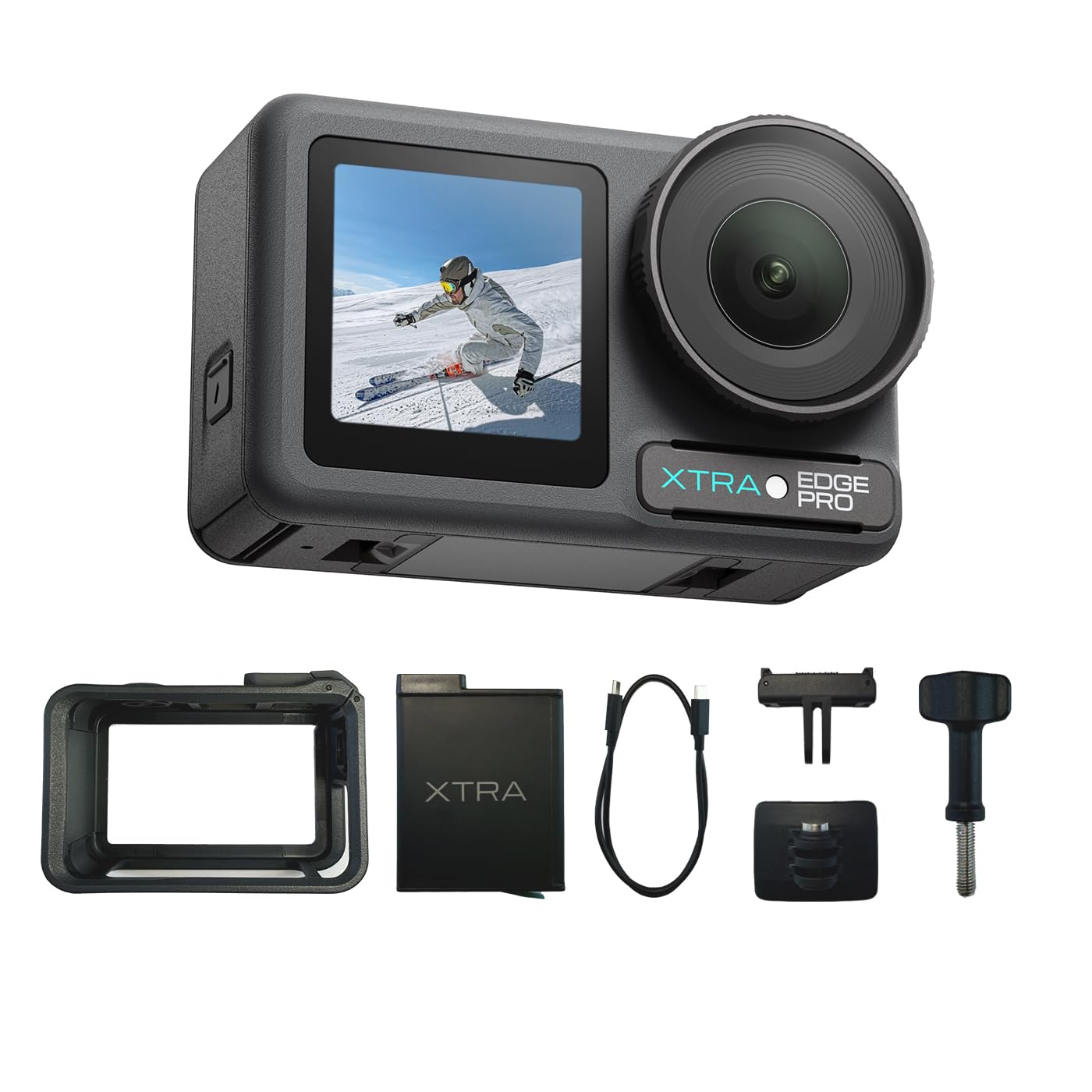
The Xtra Edge Pro punches above its price point with a 1/1.3-inch sensor that competes with cameras costing twice as much. That larger sensor translates to noticeably cleaner footage in twilight or shaded forests. Night View Mode intelligently boosts exposure without blowing out highlights, making it functional for campfire scenes or evening runs. 4K at 60fps is smooth, and the stabilization system—dubbed 360 Lock and TiltGuard—handles moderate bumps well.
Waterproof to 65 feet without a housing is a standout spec at this level. That’s deep enough for recreational scuba diving and serious snorkeling, while most budget cameras max out at 30 feet. The cold-resistant battery keeps recording when temps drop, and the bundle includes a dual-facing mount adapter for creative angles. Build quality feels solid, though the touchscreen response lags slightly behind the premium-tier models.
Users report compatibility with DJI accessories, which expands your mounting options without buying proprietary gear. The 240-minute battery rating is generous, though real-world 4K recording is closer to 90 minutes per charge. If you need a rugged, deep-water camera without spending premium money, this is the strongest contender in the mid-range.
Why it’s great
- Large 1/1.3-inch sensor for superior low-light performance
- 65ft waterproof depth without a case—great for diving
- Works with common DJI accessories for expanded mounting
Good to know
- Touchscreen response is not as snappy as premium models
- Battery life at 4K is shorter than the advertised max rating
8. AKASO Brave 7 LE
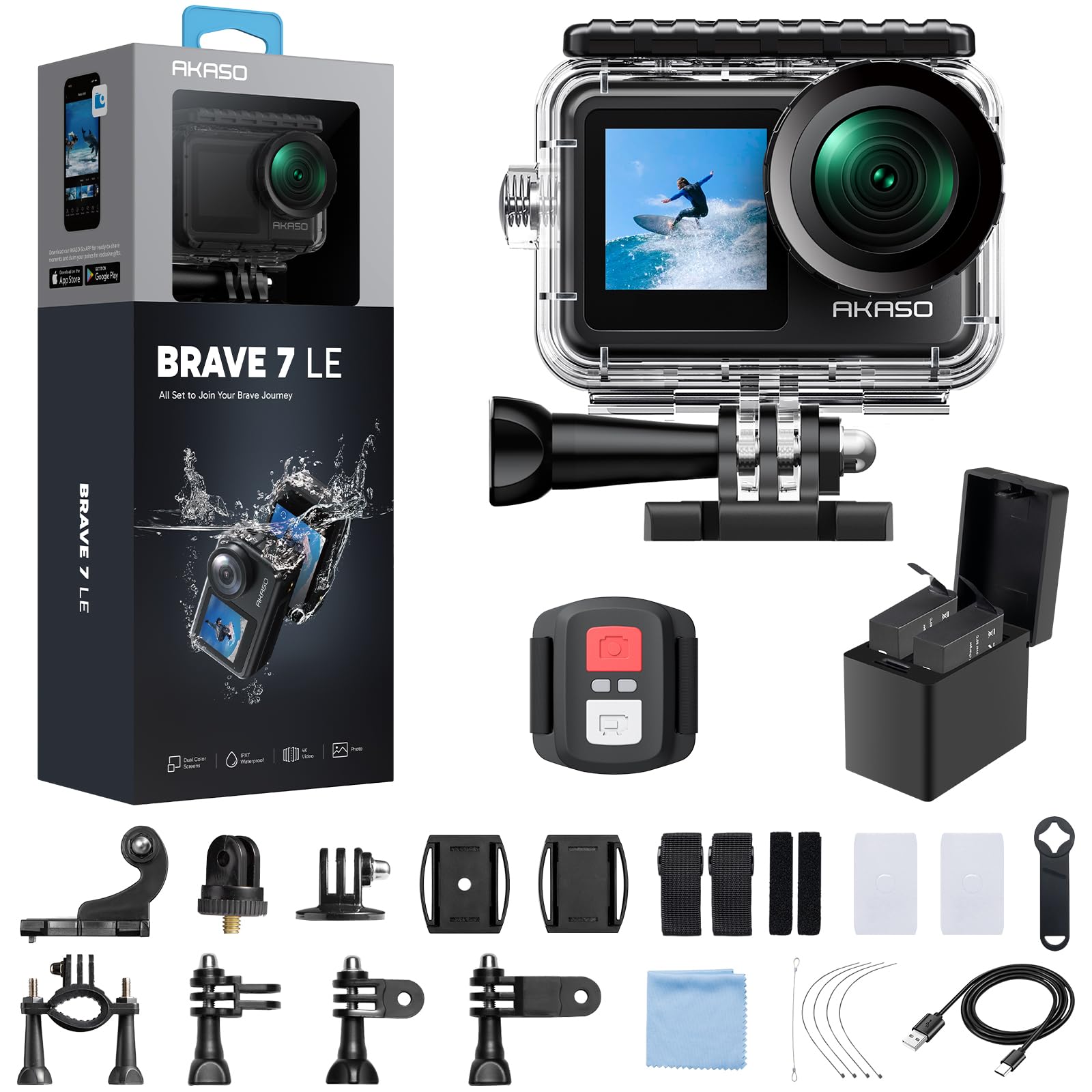
AKASO’s Brave 7 LE brings dual-color screens to the value tier, making it an easy recommendation for beginner vloggers and parents. The front screen lets you frame your selfie shot perfectly—no more guessing whether you’re in the frame. The back 2-inch touchscreen is responsive for the price, though menu navigation can feel a touch sluggish compared to premium cameras. 4K at 30fps is standard for this class, and the Electronic Image Stabilization 2.0 uses 6-axis correction to smooth out walking shots.
Included accessories are generous: two rechargeable batteries, a remote control, a waterproof housing rated to 131 feet, and a full mounting kit. The remote control is particularly useful for attaching the camera to a helmet or bike and starting/stopping recording without reaching up. IPX7 water resistance means it survives rain and splashes even without the housing.
Video quality is good in bright light but struggles in low-light conditions—noise creeps in quickly. The 20MP photos are acceptable for social media but not for large prints. Battery life runs about 2 hours per charge, and the two-battery setup helps extend a day of shooting. For the price, it’s the best way to get a dual-screen vlogging experience without stepping up to a premium model.
Why it’s great
- Dual color screens make selfie framing easy
- Includes remote control and two batteries
- IPX7 water-resistant body with 131ft dive housing
Good to know
- Low-light performance is weak—keep it in sunshine
- Touchscreen can lag during menu changes
9. SJCAM C300
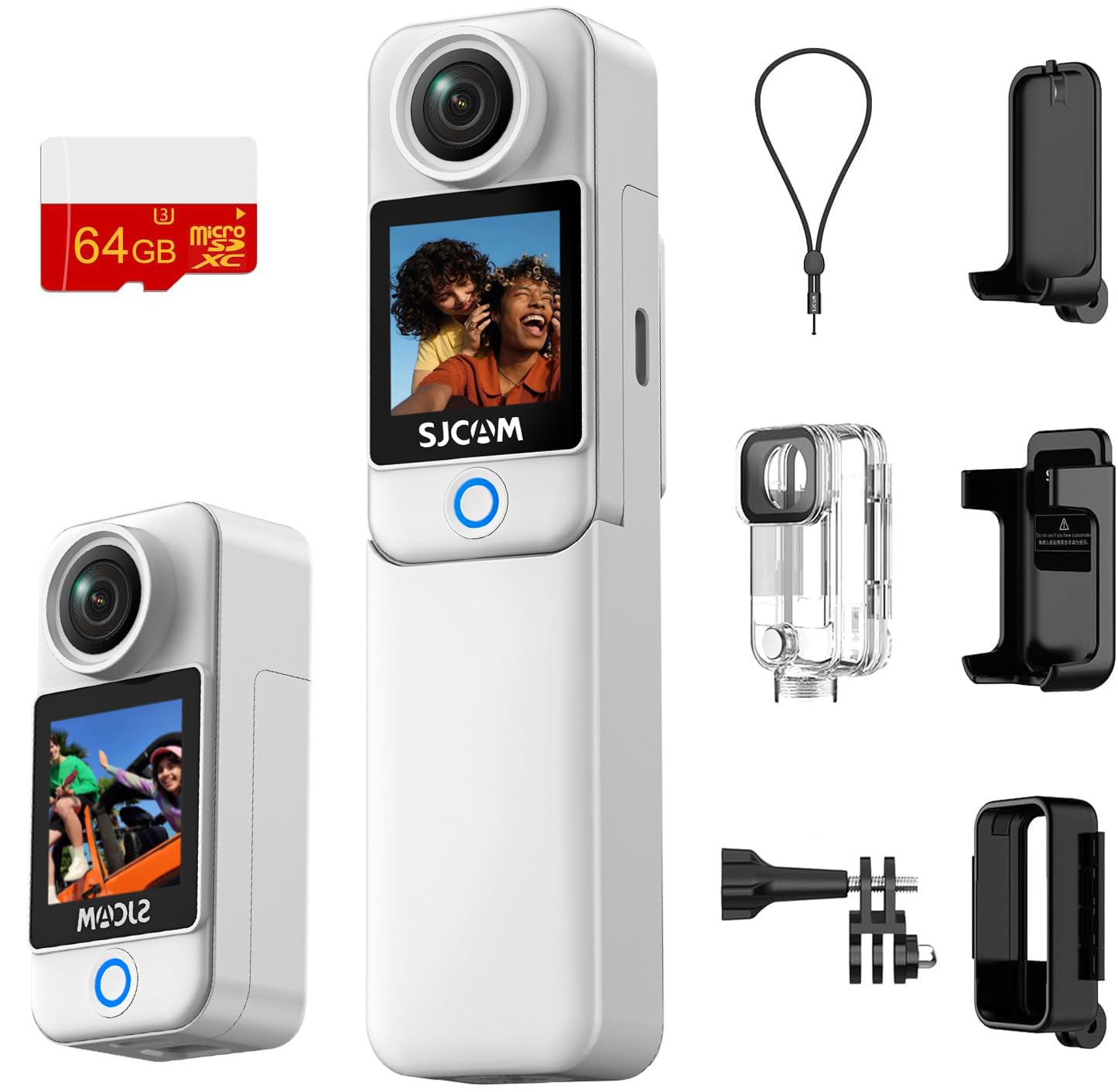
The SJCAM C300’s headline feature is a dual-battery system that delivers up to 7 hours of continuous recording. That’s enough to film an entire day trip without swapping once. For parents capturing a long day at the beach or a casual hiker who doesn’t want to micromanage power, this is a compelling angle. The 4K resolution at 20MP hits the basics, though the image quality is noticeably softer than mid-range competitors—fine for social media sharing.
Stabilization is listed as 2.0 with noise reduction, but in practice it handles gentle walking better than high-impact sports. The IP68 waterproof housing takes the camera down to 30 meters, making it suitable for snorkeling and shallow dives. The included accessory bundle covers bike mounts, helmet bases, and a waterproof case, so you rarely need to buy extras.
5G WiFi transfer allows quick file dumping to your phone, though connection stability is hit-or-miss based on user reports. The 8X digital zoom is digital—use it sparingly as it crops into the sensor and degrades quality. This camera is best understood as an entry-level option for casual users who prioritize battery endurance above all else.
Why it’s great
- 7-hour battery life is class-leading for all-day recording
- IP68 waterproof housing to 30m for diving and snorkeling
- Comprehensive accessory bundle included
Good to know
- Video quality is softer than GoPro and DJI alternatives
- WiFi connection can be unreliable during transfers
FAQ
What stabilization level do I need for mountain biking?
How deep can I take an action camera without a housing?
Is 8K video actually useful or just marketing?
Final Thoughts: The Verdict
For most users, the best action video camera winner is the GoPro HERO13 Black because it offers the best balance of resolution, stabilization, and lens versatility across a wide range of activities. If you want a variable aperture for superior low-light capture, grab the DJI Osmo Action 6 Essential Combo. And for creative 360 shots that no standard camera can replicate, nothing beats the Insta360 X4.