
A car that pulls to one side or chews through tires in a few thousand miles isn’t broken — it’s just out of alignment. What you need is a way to measure and correct the suspension geometry yourself, without paying a shop a hundred dollars every time you hit a pothole. An alignment kit for cars turns a guessing game into a precision task, letting you set toe, camber, and caster at home.
I’m Min — the co-founder and writer behind Gadgets Feed. I’ve spent hundreds of hours analyzing alignment tool specifications, reading through shop manuals and owner reviews to separate the tools that deliver repeatable results from those that introduce more error than they fix.
Whether you’re correcting camber on a lifted truck or setting toe on a weekend track car, choosing the right best alignment kit for cars means understanding which components — cam bolts, toe plates, gauge clamps — actually matter for your specific suspension type.
How To Choose The Best Alignment Kit For Cars
An alignment kit is not a single product — it’s a category that spans replacement hardware for damaged suspension parts, measurement tools for DIY alignment, and heavy-duty service sets for front-end repairs. The right choice depends entirely on what your car needs: correction of an existing angle, measurement of the current angles, or replacement of worn components to make alignment possible again.
Bolt-On Correction Kits vs. Measurement Tools
If your vehicle lacks factory adjustment points, a bolt-on kit like the MOOG K100025 adds eccentric cam bolts that let you shift camber and caster back into spec. These kits are vehicle-specific and solve one problem: non-adjustable suspension that can’t be aligned. Measurement tools, on the other hand — toe plates, camber gauges, wheel clamps — tell you where your alignment currently sits so you can make informed adjustments. Many shops use both: hardware to enable adjustment, gauges to verify the results.
Know Your Suspension Type and Rim Size
MacPherson strut suspensions adjust camber at the top mount or through eccentric bolts at the lower knuckle. Double-wishbone setups often use shims or eccentric bushings. Before you buy any alignment component, check your vehicle’s service manual to see whether the adjustment points exist or need to be added. For wheel clamps and toe plates, measure your rim diameter: the AutoSolo and RULLINE clamps work for 11 to 25-inch rims, but budget plates may not fit low-profile tires or large off-road wheels properly.
Accuracy Tolerance and Build Quality
A gauge that reads within 1/4 degree is adequate for street driving, but track use demands tighter tolerances. The Longacre caster/camber gauge uses CNC-machined surfaces and individually checked vials, while the RULLINE kit’s magnetic gauge claims 1/2-degree increments. Bubble levels drift over time and with temperature changes; better kits include digital level adapters or machined reference surfaces that minimize parallax error. Stainless steel toe plates resist bending — cheap plates that flex under tape tension produce false readings that compound into uneven tire wear.
Quick Comparison
On smaller screens, swipe sideways to see the full table.
| Model | Category | Best For | Key Spec | Amazon |
|---|---|---|---|---|
| MOOG K100025 | Camber Kit | F-150 & Expedition alignment correction | Adjustable ball joints + cam bolts | Amazon |
| OEMTOOLS 24233 | Stud Guide Set | Wheel installation on studless hubs | 8-piece, 12mm & 14mm threads | Amazon |
| Powerbuilt 648626 | Service Set | Removing ball joints & tie rods | Pitman arm puller & ball joint separator | Amazon |
| Zackman 3-in-1 Plates | Toe Plates | DIY toe & thrust angle measurement | Stainless steel, 5 lbs total | Amazon |
| AutoSolo ZAWG001 | Wheel Clamp | Mounting camber/caster gauges | Fits 11-25 inch rims, stainless steel | Amazon |
| Longacre 52-78260 | Camber/Caster Gauge | Precision chassis setup | +6° to -6° camber, 1/4° accuracy | Amazon |
| RULLINE 2-Set | Full Alignment System | Complete home alignment setup | 2 wheel clamps, 2 gauges, 21 lbs | Amazon |
In‑Depth Reviews
1. MOOG K100025 Alignment Caster / Camber Kit

This MOOG kit solves a fundamental problem on 2004-2023 F-150s and Expeditions: the factory suspension lacks sufficient camber and caster adjustment after a leveling lift or over time. The included adjustable ball joints and eccentric cam bolts introduce the range of motion needed to bring the front end back within factory specification. At 11.4 ounces, the hardware is compact but built to handle chassis loads — the eccentric bolts are hardened steel and the ball joints feature MOOG’s proprietary powdered-metal gusher bearing for long service life.
Installing both sides takes about 30 minutes on a lifted truck with basic hand tools. The bolts replace the factory lower control arm bolts, and the integral camber plate allows gross adjustment without prying or shimming. One reviewer fixed a 2024 F-150 Platinum after a 2.5-inch leveling kit; another reported saving over in shop labor by doing the correction at home. The kit only addresses the front suspension on 4×2 and 4×4 configurations with coil-over or torsion bar setups — it does not fit rear solid axles.
MOOG does not manufacture this kit under its own roof; it is a rebadged SPC Performance kit, which means the actual engineering comes from a respected alignment specialist. That explains the higher build precision relative to generic eBay cam bolts. The trade-off is vehicle specificity — this kit fits nothing outside the Ford/Lincoln platform it was designed for. For anyone driving a truck or SUV from that family, however, it is the single most effective way to regain full alignment adjustability after lifting or after suspension wear.
Why it’s great
- Adds camber adjustment where factory hardware offers none
- SPC manufacturing means true precision alignment engineering
- 30-minute install with no drilling or welding required
Good to know
- Fits only specific Ford/Lincoln models — verify compatibility
- Requires torquing bolts to factory spec for accurate readings
- Two kits needed to cover both sides of the vehicle
2. Longacre 52-78260 Caster/Camber Gauge

The Longacre gauge is the reference standard for non-digital camber and caster measurement. It reads camber from 6 degrees negative to 6 degrees positive with a stated accuracy of 1/4 degree, and caster from 12 degrees positive to 4 degrees negative in 1/2-degree increments. Every bubble vial is individually checked for calibration and assembled on a CNC-machined fixture, which eliminates the parallax drift that plagues off-the-shelf hardware-store levels used for alignment. The magnetic adapter sticks firmly to flat steel hub faces or wheel clamps.
Owners consistently report repeatability across multiple measurements — set the gauge, turn the wheel 20 degrees, read caster, turn the opposite direction, confirm the number. One reviewer fixed a truck over 1 degree out of camber spec after a single session; another ditched a cheap digital gauge after inconsistent readings and found the Longacre vials far more trustworthy. The aluminum housing keeps weight at 3.66 pounds, and the included case protects the vials from shop dust and accidental drops. The gauge does not measure toe — you still need toe plates or a tape method for that axis.
The tapered end of the gauge housing helps seat it against the wheel rim or clamp adapter for repeatable placement. For track use, the CNC-machined surfaces allow the gauge to sit flush against a hub-mounting plate without wobble. The bubble levels are spirit-filled, so extreme cold can slow response time, but for typical garage temperatures between 40°F and 90°F the readings settle within two seconds. This is a single-purpose instrument that does one thing exceptionally well — the only reason not to buy it is if you prefer a digital inclinometer with datalogging.
Why it’s great
- Proven accuracy with individually calibrated bubble vials
- Strong magnetic adapter holds securely during adjustments
- CNC-machined surfaces ensure repeatable placement
Good to know
- Does not measure toe angle — sold separately
- Spirit levels react slower in cold garage conditions
- Price point is higher than basic digital alternatives
3. RULLINE Wheel Alignment Tool 2-Set

This RULLINE kit provides two complete wheel clamps, two magnetic camber gauges, and two adapter plates — enough hardware to measure all four corners in a single session without moving equipment around. The clamps fit 11 to 25-inch rim diameters using adjustable pins that grip either the inner or outer lip, and the stainless steel frame resists the flex that causes false readings on cheaper brackets. The magnetic gauges read camber from -6° to +6° in half-degree increments, which is adequate for street alignment but not as tight as the Longacre’s quarter-degree resolution.
One reviewer mounted the clamps on a 1965 Chevy with RideTech aftermarket suspension and achieved a straight alignment on the first attempt. Another noted that the included bubble level is basic — several owners recommend pairing the clamps with a digital camber gauge rather than relying on the supplied spirit levels for race-level precision. The weight of the complete set is substantial at 21 pounds, reflecting the steel construction. Both clamps include two styles of rim seat posts, so you can choose concentric or offset mounting relative to the wheel hub.
The versatility of having two matching clamps is the primary advantage here. If you plan to do camber and caster measurement plus toe plate mounting, this system gives you enough reference planes to run strings or lasers for a full four-wheel alignment. The included instructions are minimal — you will need some mechanical intuition or a YouTube reference to set up the mounting geometry correctly. For the DIYer who wants one kit that covers measurement and gauge attachment for multiple vehicles, this is the most complete hardware package at its tier.
Why it’s great
- Two complete sets allow simultaneous front and rear measurement
- Heavy-duty stainless steel clamps resist flex under load
- Dual post styles fit inside or outside rim lips
Good to know
- Included bubble levels are less accurate than aftermarket gauges
- No printed instruction manual included
- 21-pound weight is heavy for mobile tool bags
4. Powerbuilt Front End Service Kit 648626
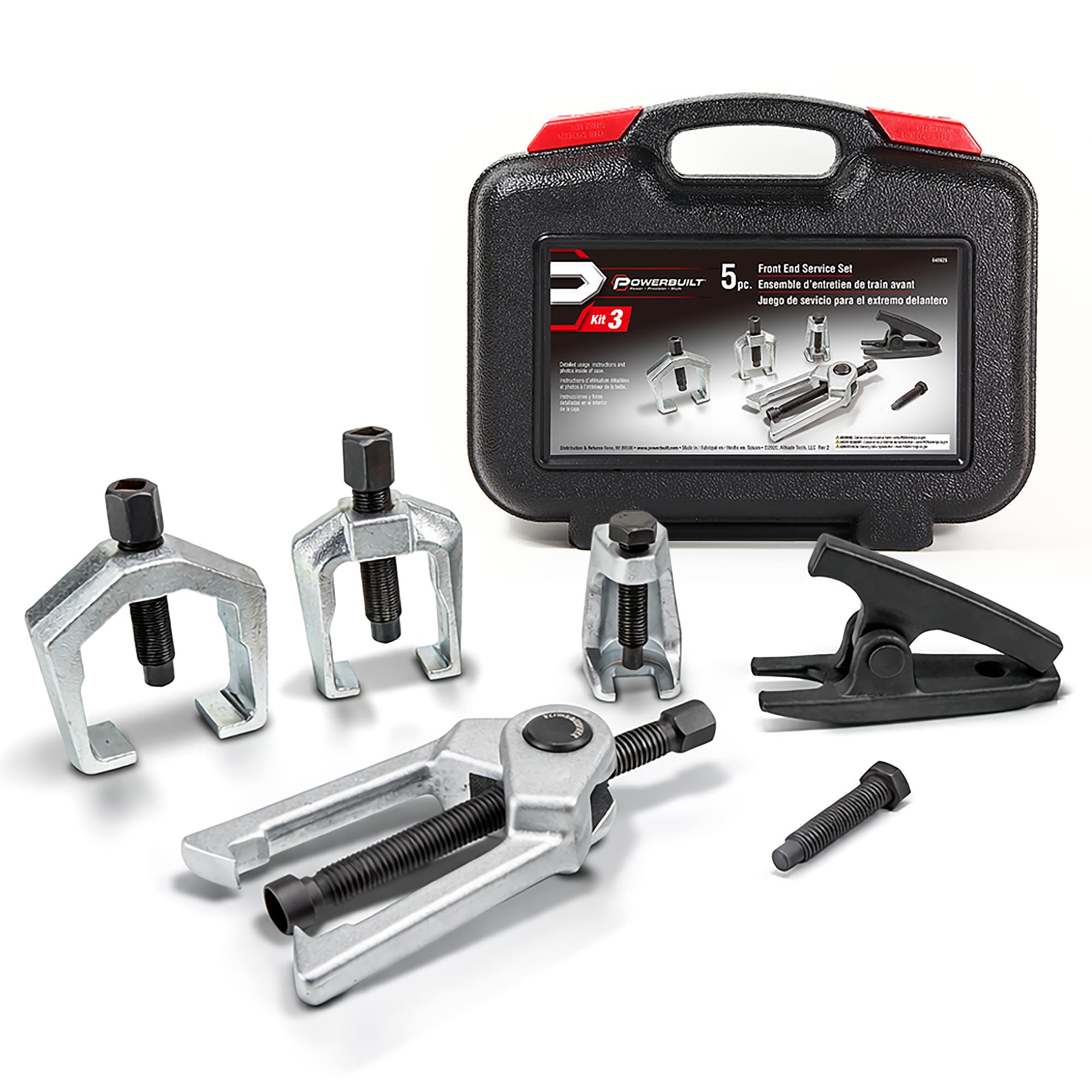
Alignment measurement is useless if the suspension components are seized, bent, or worn. This Powerbuilt kit addresses the prerequisite to alignment: removing and replacing the parts that hold alignment settings. It includes a pitman arm puller, a ball joint separator, and tie rod removal tools — three critical functions for front-end service on trucks and passenger cars. The forged steel construction handled a stubborn outer tie rod on a Toyota Sequoia without bending, and the ball joint separator works via a large forcing screw that can break loose rusted joints quietly if penetration oil is used first.
The kit does not include any measurement tools — no toe plates, no camber gauge, no wheel clamp. Its job is limited to disconnecting suspension links so you can replace worn bushings or install adjustable alignment hardware. The included carrying case organizes the six pieces and includes a laminated instruction sheet with photos for each operation. Reviewers consistently note that the kit costs a fraction of equivalent Snap-on or Matco sets while delivering the same functional result on home jobs and side-work repairs.
The pitman arm puller uses a two-jaw design with a hardened forcing screw rated for high torque applications. The ball joint separator has a tapered split end that wedges between the knuckle and the joint body. These tools see significant stress during use — the key limitation is that the forcing screw threading can gall if over-torqued without lubrication. For anyone doing suspension work before an alignment, this set fills the gap between measurement and correction.
Why it’s great
- Forged steel handles high-stress removal tasks
- Includes three different removal functions in one case
- Fraction of the cost of professional truck-brand sets
Good to know
- No measurement or alignment gauge included
- Forcing screw threads need lubrication to prevent galling
- May not fit oversized or heavy-duty pickups with large ball joints
5. AutoSolo 3D DSP Wheel Alignment Clamp
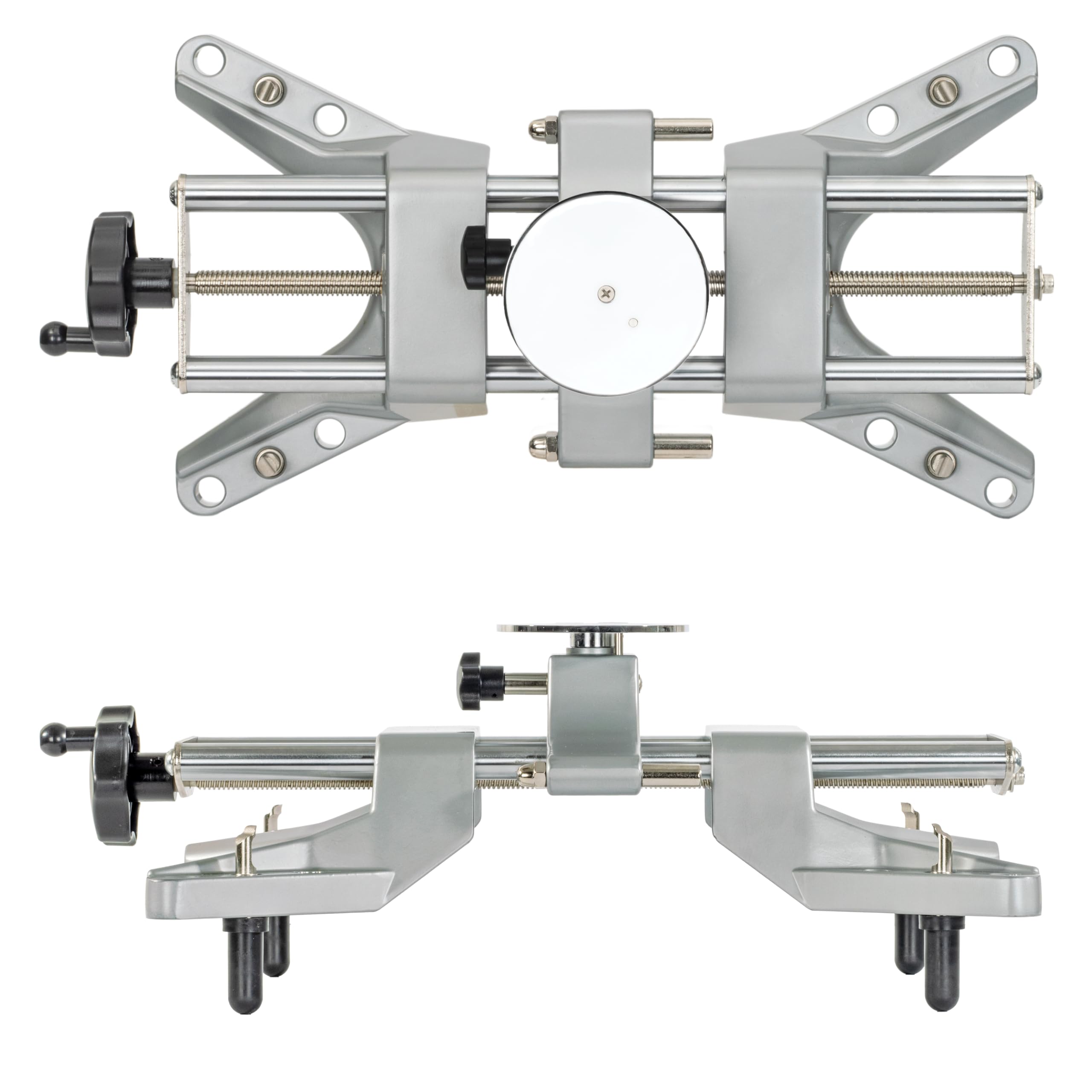
This AutoSolo clamp is a dedicated mount for attaching camber and caster gauges to the wheel rim. It uses a rotating knob to tighten adjustable pins against the lip of rims from 11 to 25 inches, and the stainless steel frame keeps the clamping force stable at the point of contact. The integrated magnetic adapter plate accepts any gauge with a magnetic base — Longacre, RULLINE, or digital inclinometers — making it a universal intermediary between your tool and the wheel.
At 8 pounds, the clamp is heavy enough to stay rigid during measurement but light enough to move between corners. Owners report that the clamping pins grip securely without marring wheel lips, though one reviewer found casting flash burrs on the locator pin tips that needed light sanding to avoid scratches. The chrome-plated adapter rotates freely on the clamp body, allowing the gauge to be zeroed at any angle relative to the wheel. The kit ships with plastic caps on the locator pins and a short bungee cord for securing the gauge — documentation is sparse, so some trial fitting is expected.
This clamp is essential for anyone who already owns a magnetic camber gauge or plans to buy one separately. It does not measure anything on its own — it only provides a stable, repeatable mounting surface that eliminates the error of holding a gauge against a dirty or curved hub. The zeroing technique described in the manual asks you to compare the clamp plate angle against a digital level on the rim face. For about the cost of a single shop visit, this clamp allows unlimited alignment checks on multiple vehicles as long as the gauge is accurate.
Why it’s great
- Universal magnetic adapter works with any magnetic gauge
- Stainless steel frame resists flex during measurement
- Fits a wide range of rim sizes from 11 to 25 inches
Good to know
- Locator pins may have burrs that require sanding
- No measuring capability without a separate gauge
- Instruction manual is limited to a short insert card
6. OEMTOOLS 24233 Wheel Stud Alignment Kit

This kit solves a different problem than the others in this list: it helps you mount wheels onto studless hubs on cars like BMW, Audi, VW, and Mercedes. The eight alignment pins — in 12mm and 14mm thread sizes with various pitches — thread into the hub to act as temporary guide studs. The wheel slides onto these guides, then you replace them with the actual lug bolts one at a time. This prevents the wheel from falling off the hub during installation and avoids cross-threading the lug bolts.
Each pin is color-coded and marked with its thread size, so identification is immediate even in a crowded toolbox. The kit comes in a plastic storage case with individual cutouts for each pin. Reviewers who work in shops confirm that these make wheel installation on studless European cars faster and safer — no more balancing a heavy wheel with one hand while trying to start a bolt with the other. The pins are machined from steel with a black oxide finish that resists surface rust from road salt and moisture.
This kit does not measure camber, caster, or toe — it is purely an installation aid. It belongs in an alignment conversation because aligning a car requires removing and reinstalling wheels multiple times to adjust suspension components. If you fight with hanging wheels on studless hubs during each adjustment check, you will rush the procedure and introduce errors. For owners of German or Italian cars with bolt-in wheels, this set saves enough frustration to pay for itself in the first alignment session.
Why it’s great
- Prevents wheel drops and cross-threaded bolts during alignment work
- Color-coded pins eliminate guesswork across thread sizes
- Works on Mercedes, BMW, Audi, VW, and more
Good to know
- Limited to hub-centric wheels with bolt patterns
- Does not measure or adjust any alignment angle
- Specific to vehicles without wheel studs
7. Zackman 3-in-1 Toe Alignment Plates
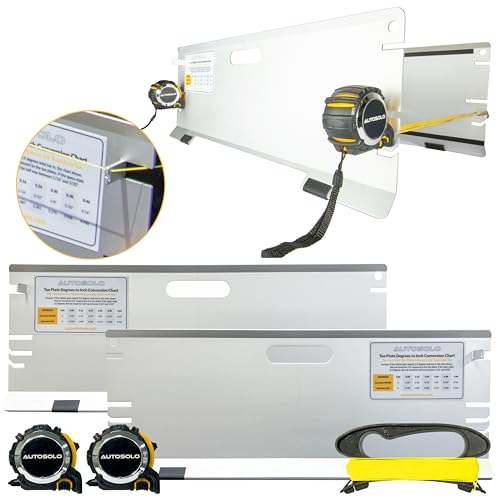
These stainless steel toe plates from Zackman Scientific provide a stable surface against the tire tread for measuring toe angle, steer ahead, and thrust angle. The set includes two plates, two measuring tapes, and a string kit — everything needed to perform a basic home alignment without any powered electronics. The plates weigh 5 pounds total and are solid enough to stay in place against the tire sidewall without bending, a common failure in budget toe plates made from thin aluminum.
To use the plates, you place them flat against the front of each front tire, stretch the measuring tape across the grooves in the plates, and read the difference between the front and rear edges of the plates. A difference in measurement indicates toe-in or toe-out. The included string kit allows you to establish a reference line parallel to the vehicle centerline for thrust angle checks. One reviewer described driving a car that pulled severely before the adjustment and tracked perfectly straight after setting the toe to zero using these plates.
The main limitation is the plate length — at roughly 12 inches, they provide adequate resolution for street toe settings but less precision than longer professional plates. On vehicles with thick sidewall tires or large off-road tread, the plates may not sit perfectly flat against the rubber, introducing measurement error. The storage bag is the weakest part of the package; multiple owners reported the velcro detached within a few uses. The plates and tapes themselves, however, are accurate enough to get any modern car driving straight and even tire wear back under control.
Why it’s great
- Solid stainless steel plates resist bending for accurate readings
- Complete toe measurement kit including string line and tapes
- Works on most modern passenger cars and trucks
Good to know
- Plate length limits resolution for race-level precision
- Storage bag velcro fails after minimal use
- Not ideal for thick off-road tire sidewalls
FAQ
Can I align my car at home with only toe plates and no camber gauge?
Do I need a wheel clamp to use a magnetic camber gauge?
Will a bolt-on camber kit fix a car that already has worn suspension parts?
Final Thoughts: The Verdict
For most users, the best alignment kit for cars winner is the MOOG K100025 because it directly solves the most common alignment headache — non-adjustable suspension that cannot be brought back to spec after lifting or wear. If you want precision measurement of camber and caster, grab the Longacre 52-78260. And for a complete home alignment setup including wheel clamps and gauges, nothing beats the RULLINE 2-Set system.