
Working the “Top Band” — 1.8 MHz — is the ultimate challenge for any HF operator. The massive wavelength (roughly 260 feet per half-wave) makes antenna design a brutal compromise between efficiency, physical space, and noise floor. A poorly designed 160 meter antenna will leave you deaf to the weak DX signals that make this band legendary, while a properly matched vertical or end-fed system can deliver surprising reach even with limited real estate.
I’m Min — the co-founder and writer behind Gadgets Feed. I have spent countless hours dissecting the technical specifications, construction materials, and real-world user reports for dozens of 160-meter antenna systems, from compact verticals to massive dipoles, to identify the models that actually deliver low SWR and solid gain on this demanding band.
This guide cuts through the marketing hype to find the best 160 meter band antenna for your specific installation constraints, whether you need a stealthy end-fed for a small lot or a resonant vertical for full-power DXing.
How To Choose The Best 160 Meter Band Antenna
Selecting a 160 meter antenna is an exercise in physics and compromise. The band’s low frequency means even a quarter-wave vertical needs a towering 130-foot element, pushing most operators toward loaded verticals, end-fed wires, or inverted-L designs. Your decision hinges on available space, noise tolerance, and whether you prioritize DX (low-angle radiation) or NVIS (high-angle regional coverage).
Resonant vs. Wideband vs. Tuner-Necessary Designs
Resonant antennas offer the best efficiency and lowest SWR on their native band but are physically massive for 160 meters. Wideband verticals like the Comet CHA-250HD use a transformer matching network to cover 80–10 meters without a tuner, but their efficiency on 160 meters is a fraction of a resonant design. End-fed antennas (EFHW or 9:1 ununs) require a tuner on 160 meters but pack into a compact, stealthy wire that can be deployed in trees. If you plan to operate primarily on 160 meters, prioritize a resonant vertical with a robust radial field. For multi-band flexibility, a tuner-driven end-fed is the practical choice.
Ground System and Radial Field Requirements
On 160 meters, the ground system is half the antenna. A quarter-wave vertical without an adequate radial field will suffer massive ground losses, turning it into an expensive dummy load. The rule of thumb is 16 to 32 radials, each a quarter-wave long on 160 meters (roughly 130 feet). If you lack space for a full radial field, an elevated vertical with tuned counterpoises or a dipole (which requires no ground system) becomes the better option. Radials are non-negotiable for any ground-mounted vertical on this band.
Noise Floor and Receive Antenna Considerations
The 160 meter band is notorious for high atmospheric noise, especially in suburban environments. A vertical antenna picks up more man-made noise than a horizontal dipole. If your location has high QRN (power line noise, switching supplies), a low-noise receiving antenna like a small transmitting loop or a well-isolated Beverage-on-ground can make the difference between hearing weak DX and hearing only noise. Some operators deploy a separate receive-only antenna for 160 meters. For transmit, the vertical’s lower radiation angle wins over noise performance for most DX hunters.
Quick Comparison
On smaller screens, swipe sideways to see the full table.
| Model | Category | Best For | Key Spec | Amazon |
|---|---|---|---|---|
| CHA EMCOMM II | End-Fed (EFHW) | Portable & Field Ops | 160m-6m via 9:1 Unun | Amazon |
| Comet CHA-250HD | Base Vertical | No-Tuner Home Station | 23ft, 3.5-57 MHz, 250W PEP | Amazon |
| Hustler 5BTV | Base Vertical | Resonant Multi-Band DX | 80/75-10m, 5 Bands | Amazon |
| Alpha Delta DX-CC | Parallel Dipole | Resonant Wire Dipole | 80-10m, 82ft, 1kW | Amazon |
| Radioddity HF-010 | Portable Vertical | POTA & Field Day | 80m-6m, 150W PEP | Amazon |
| Radioddity HF-009 | Portable Vertical | Quick-Deploy Portable | 60m-6m, 1kg, Coil-Tuned | Amazon |
| Sigma EUROCOM SE-HF-X80 | Vertical Radial | Small Space/Condo | 80-6m, Compromise Design | Amazon |
| Comet CAA-500 Mark II | Antenna Analyzer | Tuning & SWR Analysis | 1.8-500 MHz, SWR/Impedance | Amazon |
| Xiegu G90 | HF Transceiver | Compact Station | 20W, Built-in Tuner | Amazon |
In‑Depth Reviews
1. CHA EMCOMM II
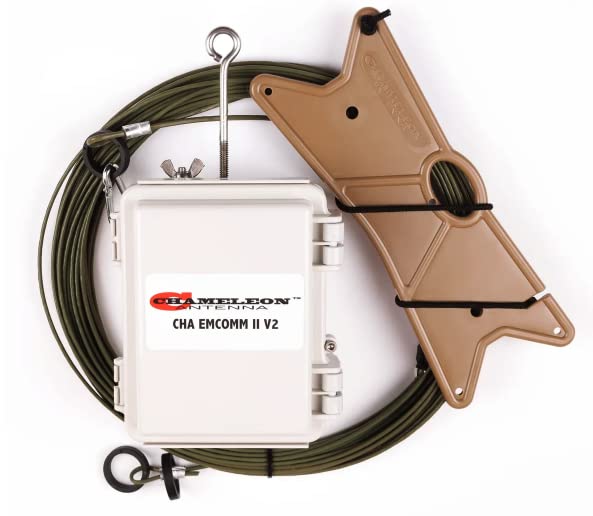
The CHA EMCOMM II is the top choice for a portable 160 meter antenna because it uses a 9:1 unun to transition a random-length wire into a remarkably efficient end-fed system. Its 60-foot Kevlar-reinforced copper wire delivers coverage from 160m through 6m, making it one of the few antennas that can hit 1.8 MHz without a dedicated matching network. Users consistently report exceptionally low noise floors — a critical advantage on the noisy Top Band — and strong signal-to-noise ratios that outperform many loop and vertical designs.
The transformer is built around a high-permeability ferrite core that Chameleon has tuned for broad SWR bandwidth across the HF spectrum. While the enclosure is compact, a few users noted the ferrite core can dislodge from its adhesive during transport; a quick dab of epoxy resolves this. The antenna ships without printed instructions (the manual is available as a PDF download), but the setup is straightforward: deploy the wire as high as possible in an inverted-L or sloper configuration and let the unun handle the impedance transformation.
For the 160 meter operator who also wants to work 80, 40, and 20 meters from a single wire, the EMCOMM II delivers the best balance of portability, multi-band coverage, and low-noise receive performance. It pairs superbly with a compact tuner like the one in the Xiegu G90. The 2-pound weight and Kevlar jacket make it ideal for POTA and SOTA activations where carrying a half-wave vertical is impractical.
Why it’s great
- Exceptional low-noise performance on 160m
- Covers 160m–6m with a single 60-foot element
- Lightweight and packable at just 2 pounds
Good to know
- Ferrite core may need re-gluing for rough transport
- No printed manual included; PDF download required
- Requires an external tuner for 160m operation
2. Comet CHA-250HD
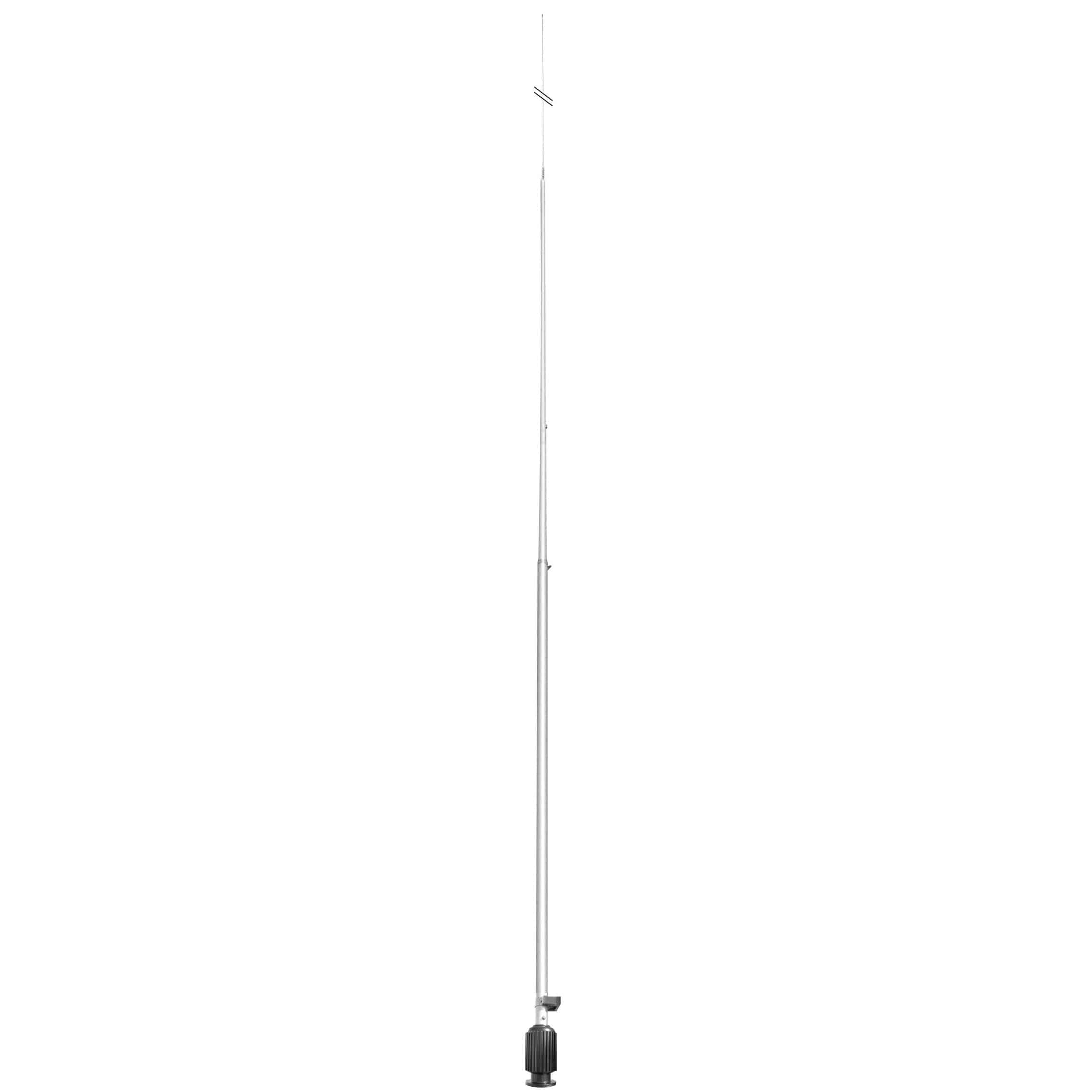
The Comet CHA-250HD is a 23-foot fiberglass vertical that achieves continuous 3.5–57 MHz coverage without a tuner, using a built-in transformer matching network to maintain 50-ohm impedance across the entire HF spectrum plus 6 meters. For the 160 meter operator, this means seamless band switching without stopping to swap coils or adjust a tuner — just key up on any band from 80 through 10 meters. Users report SWR readings of 1.0 to 1.3 on 40 and 20 meters right out of the box, with solid performance on 80 meters as well.
The HD suffix in the model name denotes the heavy-duty version with reinforced fiberglass, UV-resistant coating, and stainless steel hardware rated for 250 watts PEP. Assembly takes around 10 minutes, and the antenna can be mounted on a standard mast or tripod. A key advantage for suburban installations is that the CHA-250HD requires no ground radials — the transformer matching network eliminates the need for a radial field, making it a viable option for renters or lots where digging in 16 quarter-wave radials for 160 meters is impossible.
The trade-off is efficiency on 160 meters versus a resonant vertical. The CHA-250HD is a compromise antenna; its wideband design means it cannot match the radiation resistance of a full-sized quarter-wave vertical with radials. Users report making solid DX contacts from the US to Europe, South America, and the Pacific on 80–20 meters, but the 160 meter performance is limited by the antenna’s electrical height and the absence of a ground system. It works best as a general-coverage base antenna where 160 meters is a secondary interest.
Why it’s great
- No tuner or radials required for 80–10m operation
- 10-minute assembly, mounts on any standard mast
- Built with heavy-duty, weather-resistant fiberglass
Good to know
- 160m performance is compromised compared to resonant verticals
- Rated at 250W PEP, limiting high-power contest operations
- Requires precise tube alignment during assembly for correct tuning
3. Hustler 5BTV

The Hustler 5BTV is a classic 5-band resonant vertical that delivers efficient, trap-free operation on 10, 15, 20, 40, and 80/75 meters. Its design uses a parallel resonant circuit for each band rather than lossy traps, which means better bandwidth and lower losses on each band. The antenna is built around a heavy-duty aluminum radiator with stainless steel hardware, rated for a full 1 kW. On 80 meters, the 5BTV’s performance benefits from its resonant design — users report strong signal reports from 3,000 miles away when operating with as few as 7 elevated radials.
For 160 meters, the story is different: the 5BTV does not include a native 160 meter coil or element. However, many operators add an aftermarket 160 meter resonator (like the Hustler RM-160S) to the top of the antenna, turning it into a 6-band vertical. The tuning process is straightforward: install the resonator, adjust its tip rod length, and the antenna loads up on 1.8 MHz. Without the 160 meter resonator, the antenna’s 40-foot height is too short to provide meaningful performance on Top Band.
The 5BTV requires a radial system to achieve its rated performance. Hustler recommends a minimum of 16 radials, each at least a quarter-wave on the lowest band used. Users who skip the radial field report disappointing results, particularly on 40 and 80 meters. The antenna’s instructions are clear enough for a beginner with basic mechanical skills, but the best results come from taking the time to lay out a proper ground system. For the operator willing to invest in radials and a 160 meter resonator, the 5BTV is a premium, upgradeable foundation.
Why it’s great
- Resonant, trap-free design for high efficiency on 5 bands
- Can be upgraded to 160m with an aftermarket resonator
- Rated for 1 kW PEP with stainless steel hardware
Good to know
- Requires 16+ radials for rated performance on 80m
- 160m operation requires a separate resonator (not included)
- Instructions assume reasonable mechanical assembly skills
4. Alpha Delta DX-CC

The Alpha Delta DX-CC is a parallel-wire dipole covering 80, 40, 20, 15, and 10 meters with a single coax feed and no traps. The 82-foot antenna uses 12-gauge solid copper wire and stainless steel hardware throughout, with a heavy-duty center insulator that isolates each band’s element. Unlike trap dipoles that use capacitors prone to failure under high RF voltages, the DX-CC’s parallel design separates the elements by band, so each conductor is at its resonant length without any lossy components — a significant advantage for high-power contesting.
When deployed as an inverted-V with the apex at 40 to 60 feet, the DX-CC provides excellent low-angle radiation for DX on 20 through 10 meters. On 80 meters, it acts as a shortened dipole with reasonable efficiency, and many users find the SWR is acceptable across the lower portion of the band without a tuner. For 160 meters, the DX-CC’s 82-foot total length is roughly a half-wave on 80 meters but only a quarter-wave on 160 — meaning it will load up on 1.8 MHz with a tuner, but with significantly reduced efficiency compared to a full 260-foot dipole.
Installation requires threading the 20 and 10 meter wires through the parallel element spacers during assembly, a simple but necessary step. The antenna ships fully assembled except for this task. Once in the air, the DX-CC is passive — no moving parts, no traps, no adjustments. Users report it surviving storms for 15+ years with no degradation. For the operator who wants a no-fuss, high-power-rated dipole with 160 meter capability via a tuner, the DX-CC is a rock-solid choice that outlasts its competition.
Why it’s great
- No traps or capacitors to fail under high power
- Built with 12-gauge solid copper and stainless steel hardware
- Proven longevity — many users report 15+ years outdoors
Good to know
- 160m operation requires a tuner; efficiency is reduced
- Needs 40–60 feet apex height for best performance
- Minor assembly required to thread parallel elements
5. Radioddity HF-010
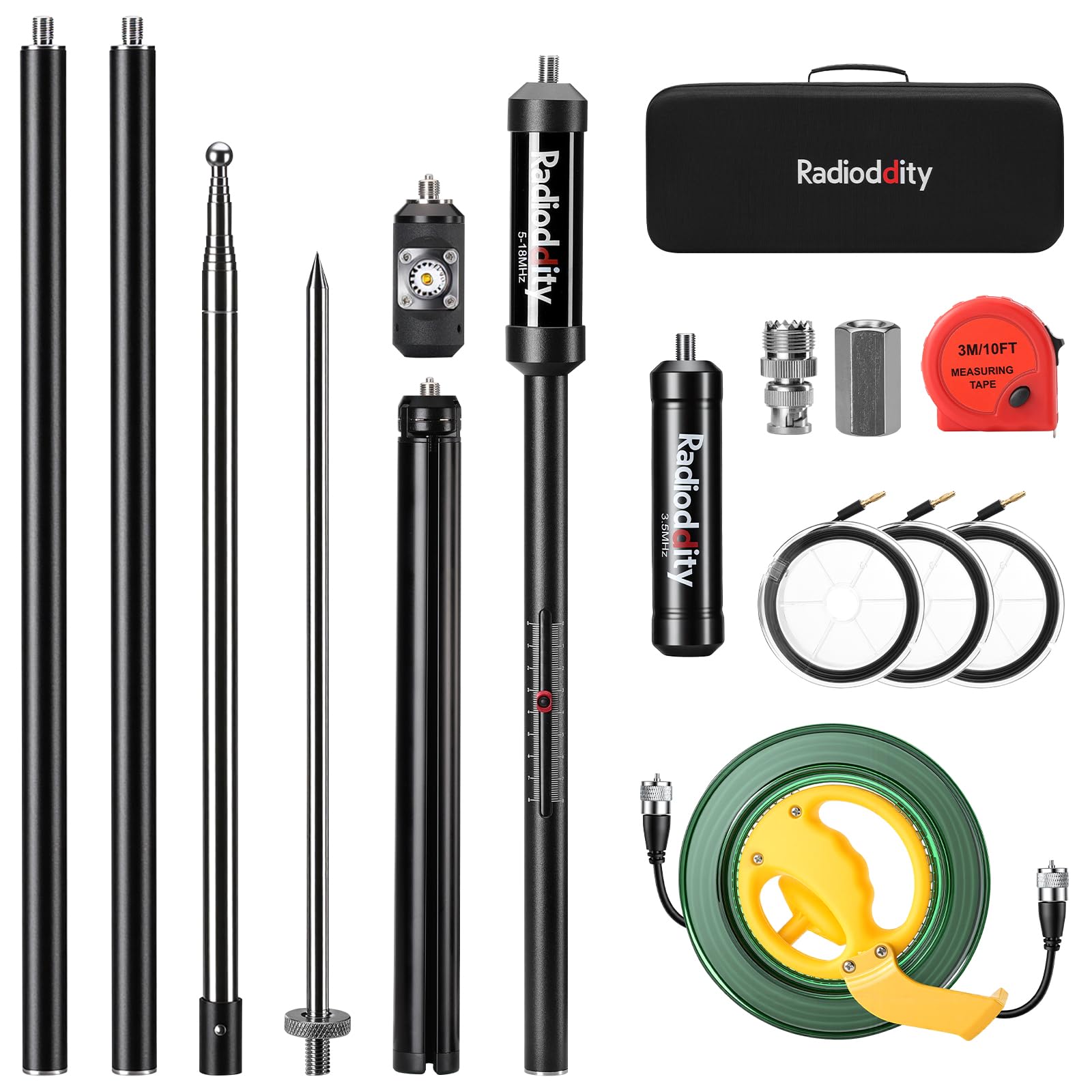
The Radioddity HF-010 is a 10-band portable vertical that covers 80 meters through 6 meters (3.5–50 MHz) using a combination of dedicated fixed coils for 80 meters and a smooth sliding tuning coil for 60–17 meters. The antenna is built around an upgraded 304 stainless steel connector system that resists corrosion far better than standard plated steel, making it a durable choice for salt-air POTA activations. The kit includes a 10-meter RG58 coax, a BNC-to-SO239 adapter, three radial wires with cable management spools, a ground spike, and a tripod with a weighted water bag for concrete deployment.
On 80 meters, users report the HF-010 tunes easily with an antenna analyzer and achieves SWR well below 1.5:1 with all three counterpoise wires deployed. For 160 meters, the antenna does not include a dedicated coil, but advanced users have successfully loaded it on 1.8 MHz by using the sliding coil at its longest setting and adding additional counterpoise wires cut to a quarter-wave on 160 meters (roughly 130 feet each). The 150-watt PEP power rating is adequate for most portable operations, though high-power contesting on 160 meters is not recommended.
The kit’s construction quality is a mixed bag. The segmented aluminum radiator and stainless steel connectors are well-made, but some users report the plastic cable reel and counterpoise wire plugs are fragile. The tuning markers are sliding heat-shrink tubing, which can shift during deployment — a tape measure is a better reference. Despite these minor quality-control issues, the HF-010’s performance for the price is impressive: users have worked over 1,000 miles from POTA parks on 80 meters with just 100 watts. It is a competitive option for the portable operator who wants 80 meter capability in a backpack-ready package.
Why it’s great
- 304 stainless steel connectors for corrosion resistance
- Includes both ground spike and tripod with water bag
- Easily tunes on 80m with three counterpoise wires
Good to know
- Plastic cable reel and wire plugs are prone to breakage
- No dedicated 160m coil; operation requires user modification
- Tuning markers (heat-shrink) can shift during transport
6. Radioddity HF-009
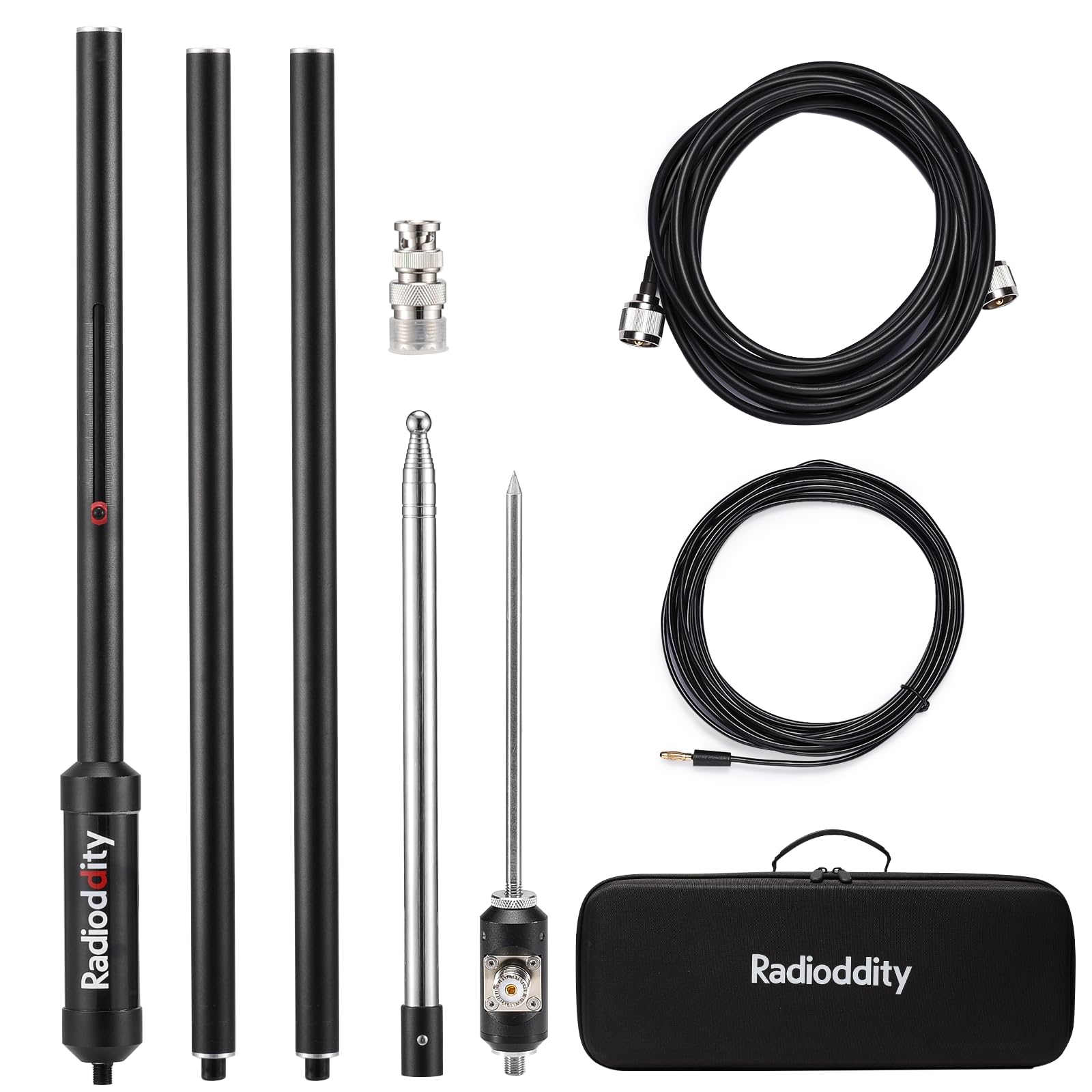
The Radioddity HF-009 is a 5–50 MHz portable vertical that covers the 60m through 6m bands with a slide-and-lock manual tuning system that eliminates the need for tools. The antenna weighs just 1 kg and collapses into a padded carry bag with reinforced Velcro straps, making it one of the most packable HF antennas on the market. Its high-grade aluminum alloy and stainless steel construction includes an anti-corrosion coating rated for rain and dust, while the internally housed tuning coil protects the adjustment mechanism from the elements.
For 160 meter operation, the HF-009’s 5 MHz minimum frequency means it cannot natively cover 1.8 MHz. However, the antenna’s ground spike system — which includes an integrated stainless steel spike that anchors directly into soil — can be paired with a 9:1 unun and a random wire to create a crude 160 meter end-fed. This is not a supported configuration, but resourceful field operators have made contacts on Top Band using the HF-009’s spike as a ground connection point for a separate wire antenna. The antenna’s native performance on 60–6 meters is excellent, with users reporting DX contacts at just 5 watts.
The HF-009’s main limitation is its connector system. The antenna uses a metric M8x1.25 threaded spike, while most US-market antenna mounts use 3/8-24 thread. No adapter is included in the kit, so you will need to source one separately to mount the antenna on a tripod or vehicle mount. The radio side uses a BNC connector with an included SO239 adapter, which works fine with most modern HF radios. For the portable operator who wants a lightweight, fast-deploying antenna for 60–6 meters with the ability to jury-rig 160 meter operation, the HF-009 is a capable companion.
Why it’s great
- 1 kg total weight — ideal for hiking and backpacking
- Tool-free slide-and-lock tuning for fast band changes
- Internal tuning coil protected from weather damage
Good to know
- Does not natively cover 160 meters
- Metric spike thread requires adapter for US mounts
- Requires an antenna analyzer for precise tuning
7. Sigma EUROCOM SE-HF-X80
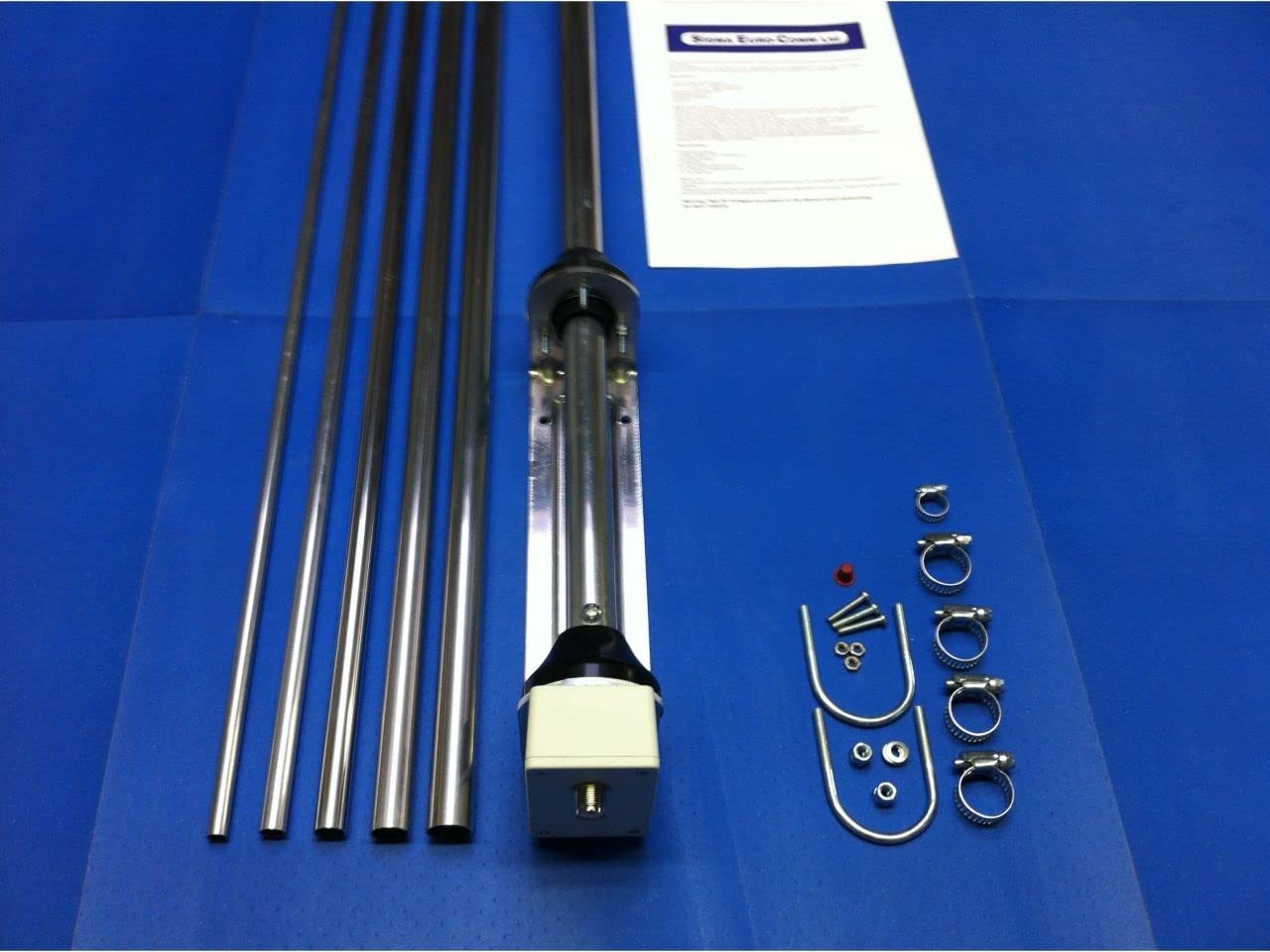
The Sigma EUROCOM SE-HF-X80 is a compact vertical antenna designed specifically for operators with severely limited space — balconies, patios, and small urban lots. It covers 80 through 6 meters using a tuned vertical element with the coax shield acting as the counterpoise, eliminating the need for an external ground system or radial field. The antenna extends to roughly 20 feet and can be assembled in under five minutes. Its 50-ohm impedance is designed for direct connection to most HF radios, though the manufacturer explicitly states a tuner is required for 80 and 40 meters.
On 160 meters, the X-80 is a deep compromise. The antenna’s native SWR bandwidth covers 6–20 meters well, with some users reporting acceptable SWR on 40 meters with an internal tuner. For Top Band, the X-80 requires both an external tuner and a significant ground improvement — adding a proper earth ground or a few elevated radials. Users who deployed the X-80 on 160 meters report mixed results: some made contacts into Venezuela and Brazil from Wisconsin, while others described the antenna as “deaf” on 160 compared to a quarter-wave vertical, with signal strength differences of 7 S-units.
The antenna’s construction is lightweight, using a silver-colored aluminum radiator with no damage-resistant coating. The lack of a native radial attachment point is a design oversight — users who want to add radials for 160 meters must get creative with ring terminals and hose clamps. For the price, the X-80 delivers adequate performance on 80–6 meters for QRP and casual operation. It is a viable entry-level option for the apartment dweller who wants to explore HF, but dedicated 160 meter operators should look elsewhere for a primary antenna.
Why it’s great
- Small footprint — works on balconies and patios
- Assembly takes under 5 minutes, no tools required
- Coax shield counterpoise eliminates traditional radials
Good to know
- 160m performance is poor without extensive ground modifications
- No native radial attachment point for multi-band optimization
- Aluminum radiator lacks corrosion-resistant coating
8. Comet CAA-500 Mark II

The Comet CAA-500 Mark II is not an antenna, but the single most important accessory for any 160 meter operator who wants to actually hear DX. This SWR and impedance analyzer covers 1.8–500 MHz with both analog cross-needle meters and a digital LCD for graphing SWR sweeps. On 160 meters, where even a few kHz of detuning can cost you 3 dB of radiated power, the CAA-500’s band sweep function lets you visualize the entire 1.8–2.0 MHz segment in seconds, identifying the exact resonant peak of your antenna system.
The analyzer features an auto band sweep function that cycles through any amateur band at the press of a button, plotting SWR versus frequency on the color screen. Users can overlay up to five separate sweeps, allowing direct comparison of antenna tuning before and after adjusting a loading coil or radial length. The cross-needle display gives real-time impedance magnitude and phase angle simultaneously, which is invaluable for diagnosing whether a high SWR is due to a poor match or a ground loss problem.
Power comes from six AA batteries (alkaline or NiMH) with a built-in trickle charger for rechargeable cells, providing up to 10 hours of continuous field use. The unit weighs 2.2 pounds with batteries — substantial enough to feel solid but light enough for a field kit. The only notable omission is USB connectivity for downloading sweep data; you must manually record readings. For the 160 meter operator investing hundreds of dollars in an antenna system, the CAA-500 Mark II pays for itself by eliminating guesswork and ensuring your antenna is performing at its peak.
Why it’s great
- Covers 1.8–500 MHz for full HF through UHF analysis
- Auto band sweep graphs SWR across any amateur band
- Built-in NiMH charger for rechargeable battery use
Good to know
- No USB data export; manual recording required
- Heavier than expected with 6 AA batteries installed
- Does not compensate for coax loss; use a short cable
9. Xiegu G90

The Xiegu G90 is a 20-watt SDR-based HF transceiver that sports one of the most capable built-in antenna tuners in the QRP class. The tuner matches antennas with an SWR as high as 5:1, which means it can load up end-fed wires, random-length antennas, and even compromised 160 meter designs that would choke lesser tuners. For the 160 meter operator, this is transformative: a 130-foot random wire thrown into a tree becomes a usable Top Band antenna when paired with the G90’s tuner.
The radio’s 48 kHz color waterfall display gives you real-time spectral visibility across the 160 meter band, revealing weak DX signals buried in the noise. The detachable faceplate allows remote head mounting, which is useful for separating the display from the radio body in a field deploy. The G90 produces 20 watts PEP on SSB and 20 watts CW, which is enough to work 160 meter DX under good propagation conditions — users report making contacts into Europe, South America, and the Pacific with just 20 watts and an efficient antenna.
The trade-offs are the learning curve and the 20-watt power ceiling. The menu-driven interface requires memorizing multi-function button presses, and the 20-watt output means you will struggle in pileups on 160 meters against stations running 1 kW. The radio also includes a built-in antenna analyzer function, so you can measure SWR without a separate analyzer — a rare feature at this price point. For the portable or budget-conscious operator who wants a complete 160 meter station in a 3.5-pound package, the G90 combined with a wire antenna is a powerful combination.
Why it’s great
- Built-in tuner matches high-SWR antennas (up to 5:1)
- Built-in antenna analyzer for tuning without extra gear
- Detachable faceplate for remote head mounting
Good to know
- 20W output limits performance in 160m pileups
- Menu-driven interface has a steep learning curve
- Some units have manufacturing inconsistencies in the tuner
FAQ
Does a 160 meter antenna need a radial field?
Can I use a 40 meter dipole on 160 meters?
Final Thoughts: The Verdict
For most users, the best 160 meter band antenna winner is the CHA EMCOMM II because its 9:1 unun and 60-foot Kevlar wire deliver the best combination of portability, multi-band coverage, and low-noise performance on 160 meters. If you want a no-tuner base station for multiple bands, grab the Comet CHA-250HD. And for the portable operator who needs a complete station, nothing beats the Xiegu G90 matched with a wire antenna.