
Programming a 12‑zone sprinkler system used to mean standing in the garage, flipping dip‑switches, and hoping you didn’t soak the sidewalk twice. The new generation of smart controllers has turned that chore into an effortless, app‑driven process where weather data trims your schedule automatically, watering duration adapts per zone based on soil type and slope, and every valve can be run remotely without touching the panel.
I’m Min — the co-founder and writer behind Gadgets Feed. I spend hundreds of hours each year comparing irrigation controller specs, plumbing specifications, and real‑world app performance to distill which units actually survive a full season outdoors and which ones just look good on a shelf.
If you’re looking for precise multi‑zone control that responds to real‑time weather, the 12 station irrigation controller market now offers everything from simple twist‑dial timers to fully autonomous units with surge protection and flow monitoring.
How To Choose The Best 12 Station Irrigation Controller
Choosing a 12‑zone controller is less about the station count — they all manage 12 valves — and more about how each unit adapts watering to your specific yard, weather, and schedule. The wrong pick can leave you with a panel that runs in the rain or burns out a solenoid because it lacks cycle‑and‑soak logic.
Smart Scheduling vs Manual Timer
Basic mechanical timers like the Irritrol Rain Dial rely on three independent programs and a simple calendar wheel; they are bulletproof but never adjust for a surprise thunderstorm. Smart controllers (Rachio 3, ImoLaza Ultra, Hunter PRO‑HC) pull hyper‑local data — temperature, wind, rain probability — and automatically pause or shorten cycles. If you travel or have multiple micro‑climates in your yard, a smart model saves water and prevents runoff.
Weather Sensor Integration
A rain sensor input is standard on nearly every 12‑station controller, but the smart units go further: they subtract real‑time precipitation from the next watering run using evapotranspiration formulas. Some, like the ImoLaza Ultra, also offer freeze‑skip and wind‑skip without any physical sensor. If your region swings between dry spells and sudden downpours, look for a controller that processes local weather data, not just a rain bucket switch.
Installation Environment and Power Backup
Outdoor‑rated controllers with lockable cabinets (Orbit 57900, Hunter PRO‑HC) protect against direct sun and hose splashes. Indoor models like the Rain Bird ESP‑TM2 need a garage or shed mount. A CR2032 coin battery or internal real‑time clock (RTC) keeps time during outages — crucial for units hardwired without backup power. The PRO‑HC and ImoLaza Ultra include RTCs that hold the schedule for days without Wi‑Fi.
Quick Comparison
On smaller screens, swipe sideways to see the full table.
| Model | Category | Best For | Key Spec | Amazon |
|---|---|---|---|---|
| ImoLaza Ultra | Smart / Premium | Fine‑tuned zone scheduling | Smart fault detection + ET algorithm | Amazon |
| Rachio 3 Bundle | Smart / Premium | Hyper‑local weather intelligence | Rain/wind/freeze skip + HomeKit | Amazon |
| Hunter PRO‑HC PHC-1200 | Smart / Professional | Professional‑grade remote control | Hydrawise software + predictive watering | Amazon |
| Rain Bird ESP‑TM2 | Mid‑Range / Wi‑Fi Ready | Add‑on Wi‑Fi via separate module | LCD display + 3‑year warranty | Amazon |
| Orbit B‑hyve 57950 | Mid‑Range / Smart | Budget‑friendly smart irrigation | Weatherproof case + free app | Amazon |
| Orbit 57900 | Entry‑Level / Manual | Simple, no‑nonsense replacement | Swing panel + push‑wire terminals | Amazon |
| Irritrol RD1200‑EXT‑R | Professional / Manual | Long‑term reliability (30+ yr lifespan) | 3‑program + remote ready | Amazon |
In‑Depth Reviews
1. ImoLaza Outdoor Smart Sprinkler Controller, 12‑Zone
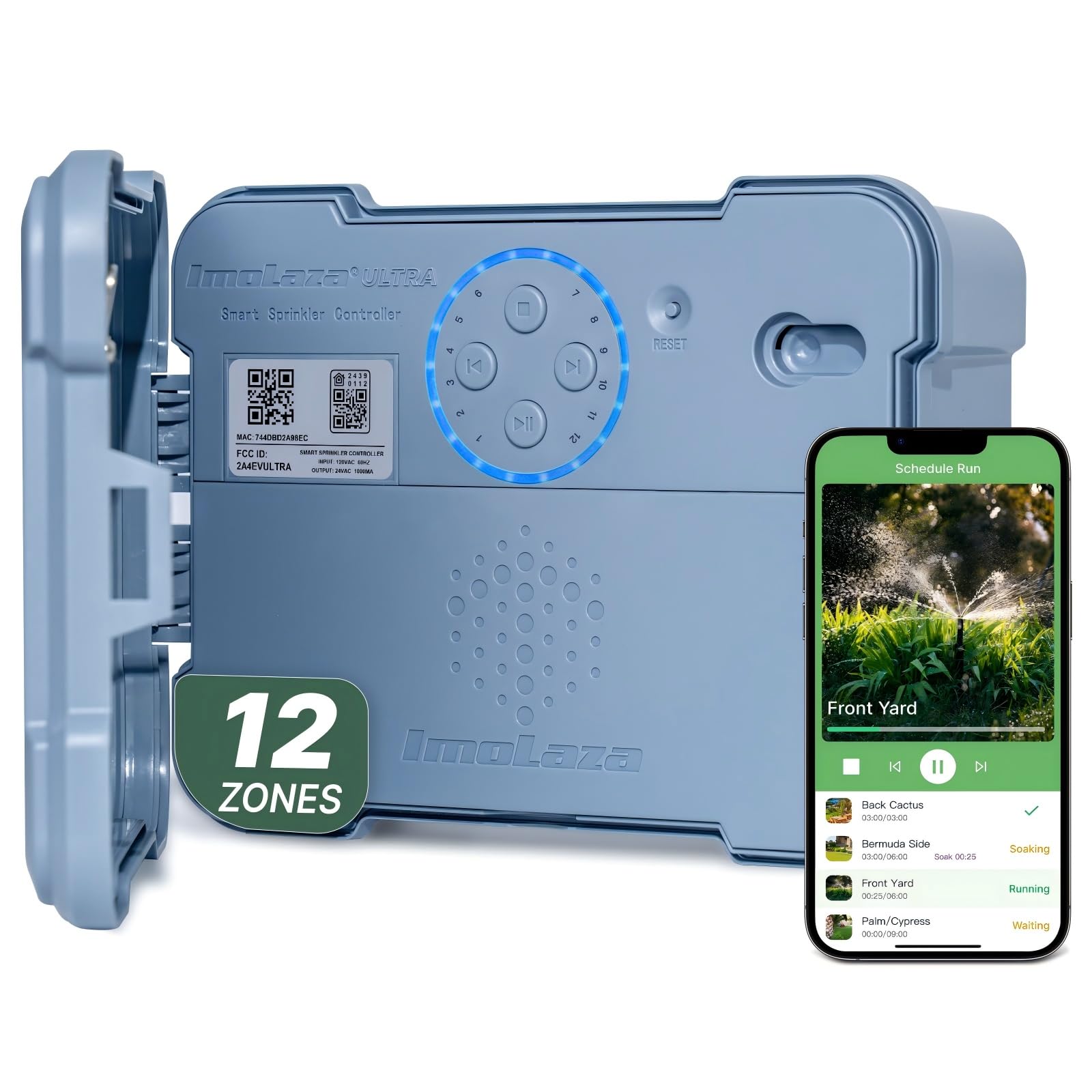
The ImoLaza Ultra pushes the smart‑controller standard further than most residential units by including evapotranspiration algorithms, zone‑specific plant‑type/soil/slope profiles, and a surge‑protected 120V converter that holds its schedule via a real‑time clock even when the power goes out. The app asks for details about each zone — grass type, root depth, sun exposure — then auto‑calculates the exact run time. Smart Fault Detection alerts you the instant a valve draws too much current or a wire shorts, which prevents a single bad solenoid from killing the whole cycle.
Weather monitoring is aggressive: rain, freeze, and wind skip all pull from hyper‑local data, so the controller won’t water during a 40‑mph gust or when a frost warning is active. The lockable ABS housing is weatherproof, and the internal RTC keeps accurate time for days without Wi‑Fi — a real advantage for outdoor mounts in garages or sheds where the signal can drop during storms.
Reviewers consistently report a 15‑ to 30‑minute install, with the detailed zone data entry taking another ten minutes. The app, including all premium features, is completely free with no subscription required. For anyone with a complex landscape or varied micro‑climates, the ImoLaza delivers the most precise per‑zone adjustment in this list.
Why it’s great
- Per‑zone soil, slope, and sun‑exposure settings produce incredibly precise watering
- Smart Fault Detection catches valve or wiring issues before they waste water
- No subscription fees for any app features
Good to know
- Requires 2.4 GHz Wi‑Fi; no 5 GHz support
- Housing is larger than some previous controllers — may need a new mounting footprint
2. Orbit B‑hyve Smart Indoor/Outdoor Sprinkler Controller – 12‑Zone (57950)
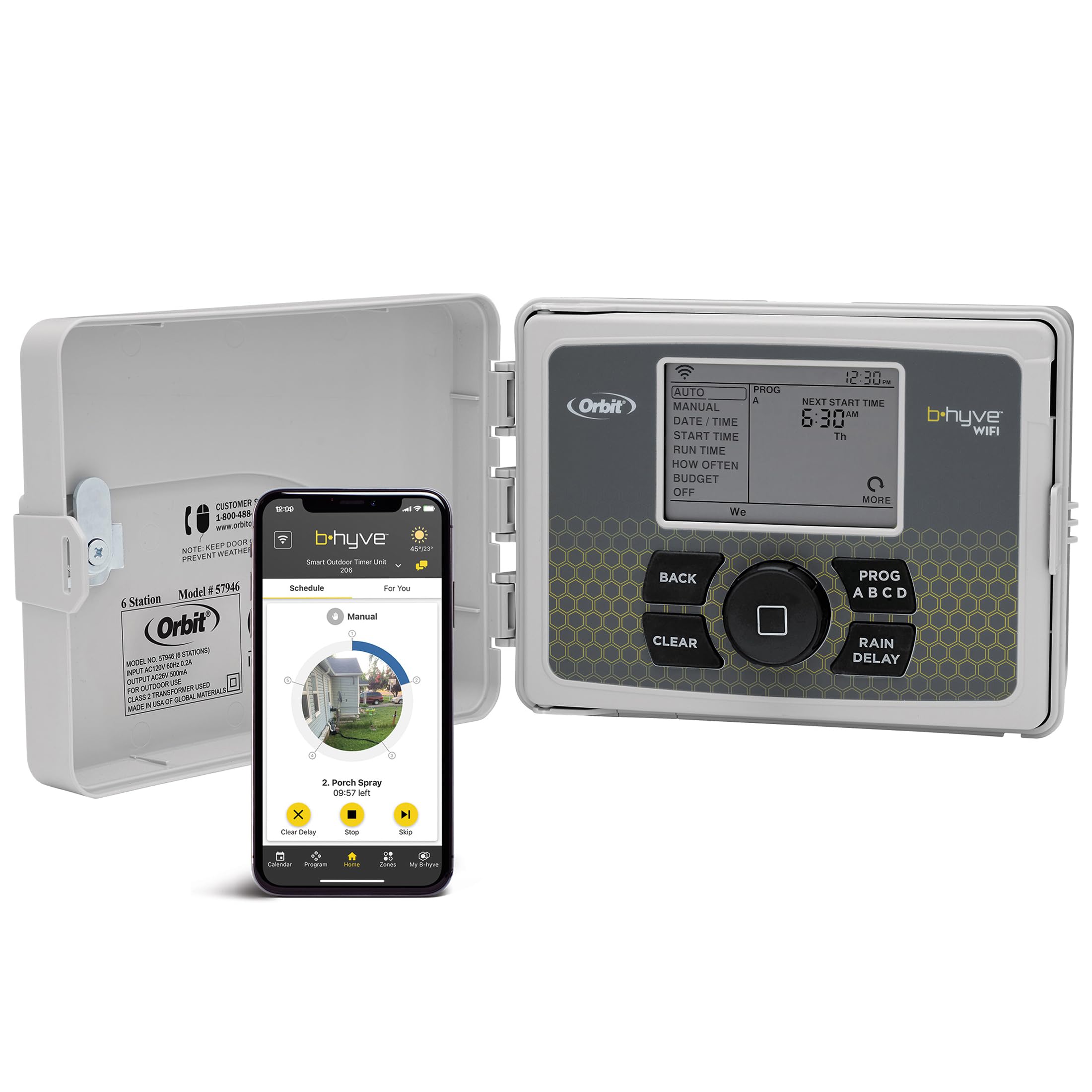
The Orbit B‑hyve 57950 brings smart watering to a price point that undercuts most competitors by ‑ while still delivering a weather‑resistant case, app‑based scheduling, and four independent programs. The gray plastic housing is rated for outdoor installation, and the backlit LCD allows manual program changes directly on the panel without pulling out your phone. Smart Watering uses local weather forecasts to automatically delay cycles when rain is predicted, and you can adjust the watering percentage globally in the app — useful during cool spring months when lawns need less water.
Setup is straightforward: take a photo of your old wiring, swap the faceplate, and the app discovers the controller over Wi‑Fi within a minute. Reviewers love the ability to run zones manually from anywhere, especially when traveling. Two minor caveats: the Android app has occasional bugs in the advanced smart‑watering screens, and the rain sensor input wiring isn’t labeled on the board (a quick online lookup solves it). For the price, the B‑hyve is the most affordable fully smart 12‑zone controller that still offers real weather skip.
Battery backup uses a CR2032 coin cell that holds the clock and schedules during power losses. The unit works with Alexa and Google Assistant, and the app interface allows zone‑by‑zone naming and photo association so you know you’re running zone 3 (the rose bed) instead of zone 4 (the lawn).
Why it’s great
- Excellent value for a fully smart, app‑enabled 12‑station controller
- Weather‑resistant enclosure allows outdoor wall mounting without a separate box
- Four independent programs offer flexibility for mixed landscapes
Good to know
- Rain sensor wiring terminal not clearly marked on the board
- Android app can crash in advanced smart‑watering settings
3. Rachio 3 Smart Bundle – 16‑Zone Controller + Weatherproof Enclosure

The Rachio 3 bundle pairs a 16‑zone smart controller with a custom weatherproof outdoor enclosure, solving the biggest complaint about earlier Rachio models — indoor‑only rating. The controller itself uses exclusive weather intelligence that factors in the exact forecast from your nearest weather station, not a regional average, to adjust watering. It supports rain skip, wind skip, freeze skip, and soak‑cycle logic that prevents runoff on sloped zones. The app interface is widely regarded as the most intuitive in the category, with a clear dashboard showing estimated water usage, upcoming schedules, and one‑tap manual zone runs.
Tailored Smart Schedules require you to input plant type, soil type, and sun exposure per zone — once set, the controller calculates the precise minutes needed and learns from seasonal changes. Installation is typical 30‑minute DIY with an in‑app tutorial that walks through wire labeling and zone naming. The bundle includes the outdoor enclosure, so you can mount it on an exterior wall without worrying about moisture.
Reviewers praise the convenience of checking and modifying schedules from anywhere, plus the estimated water savings of 30‑50% on monthly bills. Weakness: the unit relies heavily on a strong Wi‑Fi signal; if your router is far from the garage, a repeater may be necessary. The Rachio 3 is the best choice for Apple HomeKit users and anyone who values a polished, responsive mobile app.
Why it’s great
- Exclusive hyper‑local weather intelligence with rain, wind, and freeze skip
- Apple HomeKit, Alexa, and Google Assistant compatibility
- Weatherproof enclosure included — no separate outdoor box needed
Good to know
- Requires strong Wi‑Fi; distance from router may need a repeater
- Premium smart features locked into Rachio ecosystem; no third‑party sensor ports
4. Rain Bird ESP‑TM2 12‑Station WiFi Ready Controller (TM2‑12)

The Rain Bird ESP‑TM2 is built on a proven platform that landscape professionals have trusted for decades, but it separates smart functionality into an optional LNK2 Wi‑Fi module (sold separately). Without the module, it runs as a straightforward digital timer with LCD and three‑program flexibility. With the module, you gain remote scheduling, rain sensor integration, and seasonal adjustment from the Rain Bird app. This hybrid approach means you can start with a reliable manual timer and add smarts later without replacing the entire panel.
The hardware itself is compact — just 7.92 by 3.51 by 7.86 inches — making it one of the smallest 12‑station controllers on the market. Wire management is clean, with labeled terminals and a clear wiring diagram printed inside the door. The unit includes a built‑in rain sensor bypass switch and a coin‑cell backup that holds the schedule during short power outages. Reviewers who replaced older Rain Bird units report identical mounting hole patterns and a 15‑minute swap.
One trade‑off: the base controller lacks the advanced weather‑skip algorithms found in the ImoLaza or Rachio; the LNK2 module adds basic remote control and rain delay but doesn’t offer per‑zone evapotranspiration. For homeowners who want a rock‑solid controller first and smart features second, the ESP‑TM2 is a balanced choice with a strong warranty.
Why it’s great
- Compact footprint saves wall space in tight utility areas
- Optional Wi‑Fi module lets you upgrade only when needed
- Rain Bird brand reliability with 3‑year warranty
Good to know
- Smart features require a separate ‑ LNK2 module purchase
- No per‑zone weather‑based adjustments without module upgrade
5. Hunter PRO‑HC PHC‑1200 Residential Outdoor Wi‑Fi Controller – 12 Station

The Hunter PRO‑HC is the consumer‑facing version of Hunter’s commercial Hydrawise platform, bringing professional‑grade predictive watering to residential yards. The controller assigns the nearest local weather station to your property and uses historical evapotranspiration data along with real‑time temperature and rainfall to calculate daily run times. The result: watering that adjusts incrementally — not just binary rain skip — so your lawn gets exactly as much as it lost to evaporation the previous day.
The hardware is built for outdoor life: a rugged, white plastic cabinet with a locking latch and a bottom wiring channel that seals against insects and moisture. The LCD screen shows current program status, and the dial‑based interface lets you make quick changes without the app. The Hydrawise web portal and mobile app are identical in functionality — you can view schedules, manual zone runs, and water‑use reports from any browser. Users who upgraded from older Hunter Pro‑C timers report that the bottom mounting holes are 3/8 of an inch off center, so drilling new pilot holes is required.
Reviewers appreciate the controller’s ability to save water via predictive adjustments — one user reported a noticeable drop in their water bill within two months. The real‑time clock maintains the schedule during outages, and the controller supports up to six programs for extensive flexibility. For a homeowner who wants landscape‑pro technology without a recurring subscription, the PRO‑HC is the strongest contender.
Why it’s great
- Hydrawise predictive watering adjusts daily based on local weather and ET data
- Professional‑grade outdoor housing with locking latch
- Free web portal and mobile app with no subscription
Good to know
- Mounting holes are slightly offset from older Pro‑C models — new holes needed
- Initial app learning curve is steeper than Rachio or Orbit interfaces
6. Orbit 57900 12‑Station Outdoor Swing Panel Sprinkler Timer

The Orbit 57900 is the definition of no‑frills dependability: a 12‑station timer that relies on a rotary dial and large LCD screen for programming rather than a smartphone app. The swing panel flips open to reveal push‑wire terminals that accept 24 VAC valve wires without needing a screwdriver — a genuine convenience for anyone replacing an old corroded unit. The locking cabinet includes two keys, making it suitable for outdoor mounting on a fence or shed wall.
Programming covers three independent programs with up to four start times each, plus cycle‑and‑soak settings that prevent runoff on clay soil. A rain delay button on the front panel lets you postpone watering for 24 to 72 hours with one press. The built‑in transformer powers the valves directly, so no external transformer box is required. Reviewers report that taking a photo of the old wiring and using the quick‑install push terminals lets you swap controllers in under 30 minutes. The only catch: time setting is done via arrow buttons that feel slow when scrolling through all 24 hours.
The 57900 uses a CR2032 battery to retain the schedule during power outages — a step up from older 9V designs that corroded terminals. While it lacks Wi‑Fi or weather intelligence, the rain sensor input allows you to wire a physical sensor for basic rain skip. For users who want a reliable, easy‑to‑program controller without the complexity of an app, the Orbit 57900 offers the best value in the manual category.
Why it’s great
- Push‑wire terminals make valve wiring tool‑free and fast
- Locking cabinet with two keys for secure outdoor installation
- Cycle‑and‑soak feature prevents runoff on clay or sloped lawns
Good to know
- Time setting via arrow buttons is slow and tedious
- No Wi‑Fi or smart features; rain sensor must be wired physically
7. Irritrol Rain Dial RD1200‑EXT‑R 12‑Station Outdoor Controller
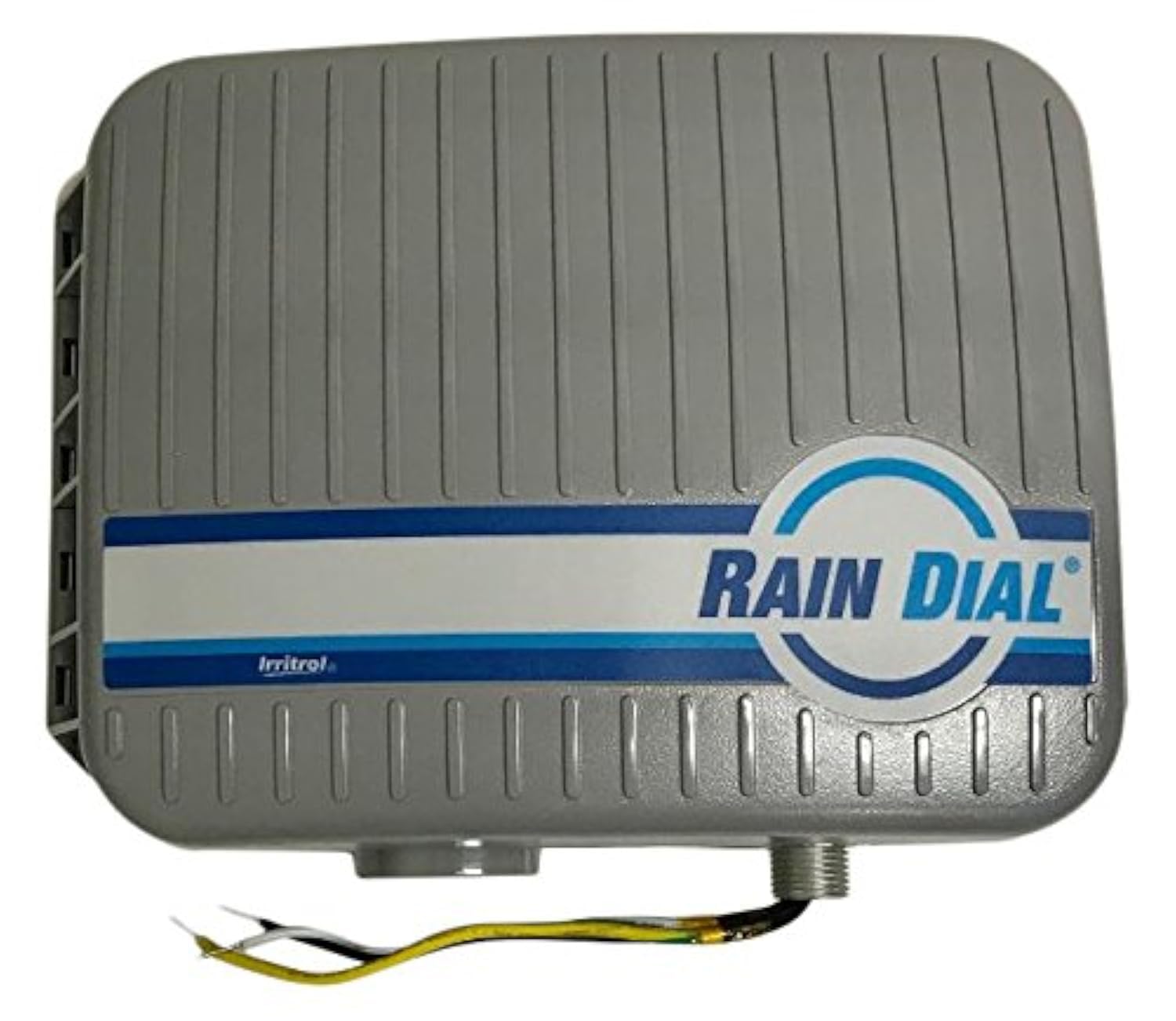
The Irritrol Rain Dial RD1200‑EXT‑R is the old‑school workhorse: a fully manual, dial‑based controller that offers three independent programs and a maximum per‑station output of 24 VAC at 0.5 amps. It is Climate Logic ready, meaning you can optionally install a Climate Logic module to adjust watering based on weather data, but out of the box it runs entirely on user‑defined start times and durations. The cabinet measures 7.75 by 4 by 10.75 inches and includes screw terminals for secure wiring — a preference for professionals who dislike push connectors.
One standout feature: the RD1200‑EXT‑R is compatible with the CRR (Contractor Residential Remote) series, allowing manual zone operation from a standalone remote without a smartphone. This is useful for large properties where you want to walk the yard and run zones without returning to the panel. The rain sensor bypass switch and terminal are integrated, and the water‑well recovery (delay between stations) option protects pump systems from running dry. Reviewers consistently note that these units routinely last 15 to 30 years — several users replaced identical Irritrol controllers that had been running since the 1990s.
The biggest drawback is the price and lack of modern connectivity: for roughly the same cost as a fully smart Rachio or Hunter PRO‑HC, you get no Wi‑Fi, no app, and no weather‑based auto‑adjustment without the extra Climate Logic module. If you value reliability above all else and plan to keep the controller for decades, the Irritrol is the most durable option. Note that some units ship without a power cord — the transformer requires a separate junction box for hardwire installation.
Why it’s great
- Exceptional longevity — documented 15‑ to 30‑year service life
- Screw terminals for wire connections pros trust
- CRR remote series compatibility for walk‑through zone testing
Good to know
- Highest upfront cost for a non‑smart controller
- No Wi‑Fi, no app, no weather skip without add‑on module
FAQ
Can I use a 12‑station controller with fewer than 12 zones?
Do I need a separate rain sensor with a smart Wi‑Fi controller?
What voltage do 12‑station irrigation controllers require?
Final Thoughts: The Verdict
For most users, the 12 station irrigation controller winner is the ImoLaza Ultra because its per‑zone soil, slope, and sun‑exposure profiles combined with smart fault detection deliver precision that saves water and prevents damage. If you want hyper‑local weather intelligence with an app that feels like first‑party software, grab the Rachio 3 Bundle. And for professional‑grade predictive watering without a subscription, nothing beats the Hunter PRO‑HC PHC‑1200.