
Stripping layers of paint from a metal surface requires an abrasive that cuts aggressively without warping the substrate. Walnut shells are gentle enough for soft metals yet coarse enough for thick coatings, while aluminum oxide chews through mill scale and epoxy like nothing else. Choosing the wrong grit or material type turns a weekend project into a frustrating mess of clogged nozzles and pitted surfaces.
I’m Min — the co-founder and writer behind Gadgets Feed. I’ve spent countless hours analyzing manufacturer spec sheets, cross-referencing Mohs hardness ratings, and studying real user reports on media consumption rates, dust generation, and reusability across dozens of blast media products.
The seven products reviewed below represent the smartest entry points for anyone searching for the best blasting media for removing paint from metal.
How To Choose The Best Blasting Media For Removing Paint From Metal
The wrong media either won’t cut through automotive enamel or will eat into thin sheet metal. You need to match abrasive hardness, grit size, and reusability to the specific metal thickness and paint thickness you are stripping. Soft organic media like walnut shells are ideal for non-ferrous metals and delicate surfaces, while hard mineral media like aluminum oxide and crushed glass deliver fast cuts on thick steel.
Match Abrasive Hardness to Metal Type
Aluminum oxide ranks 9 on the Mohs scale — just below diamond — and will strip powder coating and epoxy from steel quickly. Walnut shells sit around 3 to 5 on the Mohs scale, making them safe for aluminum, brass, and stainless steel without gouging or warping the substrate. Crushed glass falls in between, offering aggressive cutting on thick rust scale while being less expensive per pound than aluminum oxide.
Pick the Right Grit Size for the Job
Coarse grits (12/20 to 40) remove thick paint layers fast but leave a rough surface profile that may require additional finishing. Medium grits (50 to 80) balance stripping speed with a smooth enough anchor pattern for new paint adhesion. Fine grits (100 to 120) are best for light paint removal, surface etching before coating, or cleaning delicate components without dimensional change.
Consider Reusability and Dust Generation
Aluminum oxide lasts up to ten times longer than silica-based abrasives before breaking down, making it cost-effective for repeated use in a blast cabinet. Walnut shells degrade faster but produce minimal dust and are biodegradable. Crushed glass shatters on impact and generates the most dust, so it is best used in well-ventilated outdoor settings or with a proper dust collection system.
Quick Comparison
On smaller screens, swipe sideways to see the full table.
| Model | Category | Best For | Key Spec | Amazon |
|---|---|---|---|---|
| #80 Grit Aluminum Oxide (8 LBS) — TITGGI | Aluminum Oxide | General paint stripping on steel | Mohs hardness 9 | Amazon |
| Aluminum Oxide 14 LBS 100 GRIT — HDURCIR | Aluminum Oxide | Prep for cerakote / fine stripping | 100 grit fine profile | Amazon |
| #120 Aluminum Oxide (8 LBS) — INTERACTIVIA | Aluminum Oxide | Fine etching and paint removal | Mohs hardness 9, fine grit | Amazon |
| 30-60 Grit Crushed Glass (19 LBS) — INTERACTIVIA | Crushed Glass | Heavy rust and thick paint on steel | #50 mesh, ~559–254 microns | Amazon |
| 8 LBS Ground Walnut Shell 12-20 Grit — INTERACTIVIA | Walnut Shell | Stripping paint from soft metals | Mohs hardness 3 | Amazon |
| 18-40 Grit Walnut Shell (10 LBS) — GRITSMITH | Walnut Shell | Delicate metal / brass polishing | Mohs hardness 4.5–5 | Amazon |
| Premium Ground Walnut Shell 12/20 (5 LBS) — IMS | Walnut Shell | Low-pressure / sensitive surfaces | 12/20 medium grit | Amazon |
In‑Depth Reviews
1. #80 Grit Aluminum Oxide Blast Media (8 LBS) — TITGGI

Brown fused aluminum oxide with a Mohs hardness of 9 cuts through paint, rust, and mill scale on steel surfaces faster than glass or garnet. The #80 grit size strikes a well-defined middle ground — aggressive enough to strip automotive enamel in pass, yet fine enough to leave an anchor profile suitable for immediate repainting or powder coating.
Users report this media lasts through multiple cycles in a blast cabinet before breaking down, which translates to a lower effective cost per part compared to cheaper silica-based alternatives. The white plastic bucket packaging prevents moisture ingress and keeps the grit free-flowing even after storage in a humid garage.
The 8-pound quantity is adequate for small projects such as restoring steel rims or stripping a motorcycle gas tank. If you feed this through a handheld blaster, the angular grain shape cuts aggressively without clogging the nozzle — a common frustration with finer or softer media.
Why it’s great
- Mohs 9 hardness strips paint in fewer passes than glass or walnut
- Rated to last up to ten times longer than silica blast media
- Sealed bucket keeps grit dry and ready for immediate use
Good to know
- Not suitable for thin aluminum or soft substrates
- 8-pound quantity may be insufficient for large surface area projects
2. Aluminum Oxide 14 LBS 100 GRIT — HDURCIR
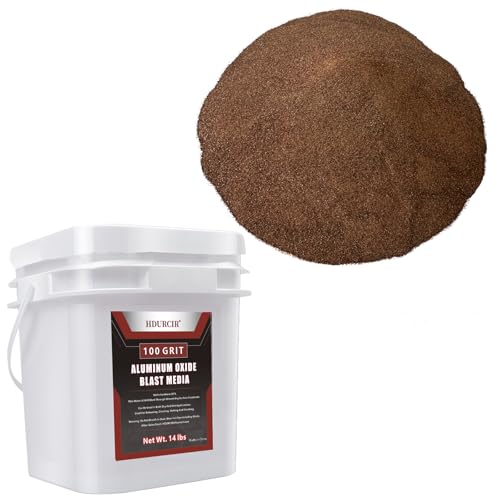
The 100-grit aluminum oxide from HDURCIR delivers a consistent fine finish that is ideal for prepping parts before cerakote or powder coating. At 14 pounds per bucket, it offers roughly 75 percent more media than standard 8-pound containers, making it a smart mid-range play for users who blast regularly.
The 100-grit particle size removes paint coatings effectively without digging deep grooves into stainless steel or aluminum surfaces. In customer reports, the media flows evenly through blast cabinet guns and breaks in slightly during the first hour of use, after which it stabilizes and continues cutting at a steady rate.
It ships in a sturdy plastic tub with an inner bag that prevents spillage during transit. Users working on mini bike rims or firearm components for cerakote application noted that the fine profile left by this grit eliminated the need for additional sanding steps before coating.
Why it’s great
- 14-pound bulk quantity provides better value per blast cycle
- 100-grit fine profile prepares metal for cerakote without extra sanding
- Reusable multiple times in a cabinet before needing replacement
Good to know
- Not aggressive enough for heavy mill scale or thick epoxy
- Inner bag inside the tub can shift during handling
3. #120 Aluminum Oxide (8 LBS) — INTERACTIVIA

At 120 grit, this aluminum oxide media sits squarely in the fine category, making it the right choice for users who need to etch glass, texture gun parts for cerakote, or remove thin paint layers from metal without altering part dimensions. The bulk density of 115-125 pounds per cubic foot ensures consistent feed in gravity-fed blasters.
It is manufactured in Canada with no detectable crystalline silica, which reduces respiratory hazards compared to traditional sand. Users running this through a Harbor Freight blaster cabinet reported that the fine grit produces a smooth, frosted finish on steel and aluminum that creates excellent mechanical adhesion for subsequent coatings.
The 8-pound container is sized appropriately for detail work rather than large panels. Because the media is finer and stays sharp longer than glass beads, it can be recycled through several cabinet loads before losing cutting efficiency.
Why it’s great
- Fine 120 grit leaves a smooth frosted anchor pattern for coatings
- No detectable crystalline silica — safer than traditional sand
- High bulk density feeds consistently in gravity blasters
Good to know
- Too slow for stripping heavy paint layers on large steel surfaces
- 8-pound quantity goes quick in continuous use
4. 30-60 Grit Crushed Glass Abrasive (19 LBS) — INTERACTIVIA

Crushed glass at #50 mesh (559 to 254 microns) offers a more aggressive cut than walnut shells at a fraction of the cost of aluminum oxide. This 19-pound box delivers enough volume to strip rust scale and thick paint from automotive subframes, trailer hitches, and steel beams without breaking the budget.
The angular glass shards fracture on impact and expose fresh sharp edges, which maintains cutting efficiency during the blast session. Users tackling heavily rusted car subframes reported that this media removed thick scale effectively when used with a 4-mil plastic tarp for catch and reuse.
The trade-off is dust generation — crushed glass powders quickly in a cabinet environment, clouding visibility faster than aluminum oxide. For outdoor blasting with a pressure pot, this media shines; for indoor cabinet work, a robust dust collector is non-negotiable.
Why it’s great
- Large 19-pound quantity at a cost-effective price point
- #50 mesh cuts heavy rust and thick paint efficiently
- Fresh sharp edges exposed on impact maintain cutting speed
Good to know
- High dust output requires good ventilation or dust collection
- Breaks down faster than aluminum oxide, reducing reusability
5. 8 LBS Ground Walnut Shell Media 12-20 Grit — INTERACTIVIA
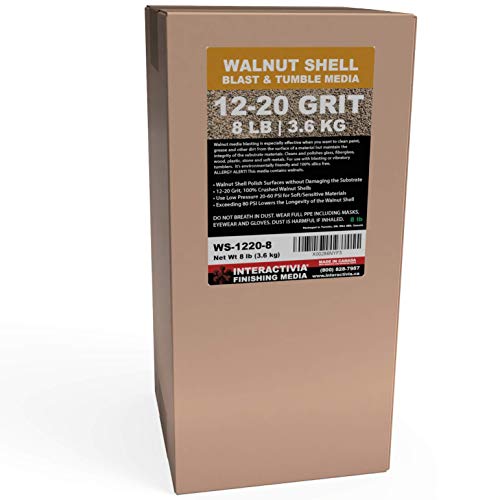
Ground walnut shells at 12-20 grit provide the most aggressive cut available from an organic media, making them capable of removing paint and carbon buildup from metal without damaging the base surface. With a Mohs hardness of only 3, these shells are safe on aluminum, brass, copper, and thin-gauge steel where aluminum oxide would cause warping or gouging.
The coarse 12-20 particle size accelerates stripping on stubborn coatings, and the loose bulk density of approximately 40-50 pounds per cubic foot means a cabinet hopper will feed this media steadily without bridging. Users cleaning heavily tarnished brass casings and vintage automotive parts reported that two to three hours of tumbling restored a bright finish without dimensional loss.
Because walnut shells are biodegradable and contain no silica dust, they are a practical choice for indoor use with minimal respiratory protection. The 8-pound package is suitable for hobbyists restoring single components rather than production-scale stripping.
Why it’s great
- Coarse 12-20 grit strips paint without damaging soft metals
- Biodegradable and silica-free — safer for indoor hobby use
- Does not alter dimensions of delicate brass or aluminum parts
Good to know
- Breaks down faster than mineral media in continuous use
- Not aggressive enough for epoxy or powder coating on steel
6. 18-40 Grit Ground Walnut Shell Media (10 LBS) — GRITSMITH
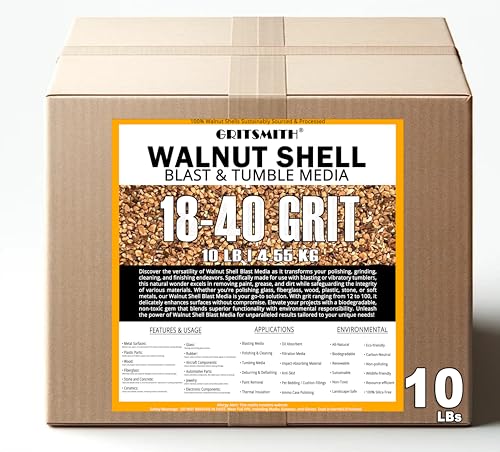
The GRITSMITH walnut shell media features a finer 18-40 grit range and a higher Mohs hardness of 4.5 to 5 compared to standard walnut shells, which gives it slightly more cutting power while still being safe for soft metals, wood, and plastics. The particle size falls between 0.42 mm and 1 mm, providing a balance between stripping speed and surface smoothness.
Users reloading brass casings in vibratory tumblers reported that this media cleaned primer pockets and surface oxidation more effectively than older walnut media they had been using for decades. The finer grit also reduces the tendency for particles to lodge in threaded holes or small crevices on metal parts.
The 10-pound quantity is packaged in a resealable bag inside the box, which helps maintain dryness between uses. It is compatible with both blasting guns and vibratory tumblers, making it a versatile option for shops that switch between stripping and polishing tasks.
Why it’s great
- Finer 18-40 grit reduces clogging in threads and small cavities
- Higher Mohs 4.5-5 hardness than typical walnut shells
- Works equally well in blasters and vibratory tumblers
Good to know
- Not coarse enough for heavy paint removal on steel
- 10-pound bag may require multiple refills for large cabinet jobs
7. Premium Ground Walnut Shell Media 12/20 (5 LBS) — IMS
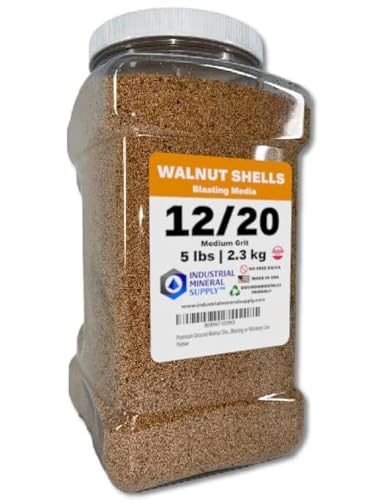
The Industrial Mineral Supply walnut shell media is a 12/20 grit product designed for low-pressure blasting between 20 and 60 PSI, making it a safe entry point for users who are new to blasting and working with sensitive substrates. It polishes surfaces without damaging the underlying material, and users have also repurposed it as filler for pin cushions due to its non-abrasive nature on needles.
The 5-pound quantity is the smallest package in this roundup, which makes it appropriate for testing media compatibility on a scrap piece before committing to a larger purchase. Several customers noted that the media is dusty on first use, but the dust settles quickly and does not impair performance significantly.
This media is best suited for removing thin paint layers or carbon deposits from aluminum, brass, and fiberglass rather than heavy-duty stripping. If your primary goal is removing thick epoxy or powder coating from carbon steel, skip this walnut shell option and reach for aluminum oxide instead.
Why it’s great
- Rated for low-pressure blasting — safe for soft metals and plastics
- Versatile enough for non-blasting uses like filler or media
- Small quantity ideal for testing before bulk purchase
Good to know
- Some dust present on first use
- Not effective for removing heavy paint from steel
FAQ
Can I use walnut shells in a pressure pot sandblaster?
What grit should I use to remove powder coating from steel?
Will aluminum oxide warp thin sheet metal during blasting?
Final Thoughts: The Verdict
For most users, the best blasting media for removing paint from metal winner is the #80 Grit Aluminum Oxide (8 LBS) by TITGGI because it combines a Mohs hardness of 9 with a medium #80 grit that strips paint efficiently without leaving an excessively rough surface profile. If you need a finer finish for cerakote prep, grab the Aluminum Oxide 14 LBS 100 GRIT by HDURCIR. And for restoring delicate aluminum or brass parts without surface damage, nothing beats the 8 LBS Ground Walnut Shell 12-20 Grit by INTERACTIVIA.