
That first blast of warm air from your vents on a scorching summer day is the unmistakable signal your car’s AC system has lost its charge. Before you grab any can off the shelf, understand that using the wrong refrigerant type or a stop-leak that doesn’t match your system’s material can turn a simple recharge into a costly compressor replacement. The difference between a fix and a shop bill often comes down to picking the right chemical formula and connector fitting.
I’m Min — the co-founder and writer behind Gadgets Feed. I’ve spent hundreds of hours analyzing the technical specifications, customer failure patterns, and chemical compatibility data for automotive AC refrigerants, stop-leak treatments, and charging hardware to build this guide on real-world performance metrics.
This guide breaks down the critical differences between R134a and R1234yf refrigerants, the chemical sealants that actually plug evaporator leaks, and the adapter kits that determine whether your DIY recharge succeeds or fails. This is your definitive resource for finding the best ac refrigerant for cars right now.
How To Choose The Best AC Refrigerant For Cars
Selecting the correct refrigerant starts with knowing which type your vehicle’s AC system was designed to use. Using the wrong chemical — such as pouring R134a into an R1234yf system — will not only fail to cool but can also damage the compressor seals and void your warranty. Always check the under-hood decal or your owner’s manual before buying anything.
Know Your Refrigerant Type: R134a vs. R1234yf
R134a was the standard for vehicles built roughly between 1995 and 2017, while R1234yf is the mandated replacement in nearly all 2018+ model years. R1234yf has a much lower global warming potential, but its can taps use a reverse left-hand thread specifically to prevent cross-contamination. If you own a 2018 or newer Honda, Toyota, Ford, or Chevy, you almost certainly need R1234yf.
Read the Can Weight, Not the Can Count
Refrigerant is sold by weight — 8 oz, 12 oz, or 3 oz cans — and your system holds a specific weight in pounds or grams. Most cars require between 16 and 32 oz of refrigerant total. The advertised “this kit covers two cars” claim on some products is meaningless unless the ounces add up to your system’s stated capacity. Buy enough individual cans to hit the exact charge weight, not an arbitrary can count.
Stop-Leak Treatments: Temporary Fix or Permanent Damage?
Chemical stop-leak products use polymer particles that circulate with the oil and bond to leak sites in evaporators, condensers, or hose fittings. These can buy you months or years of cooling — but the same particles can clog an expansion valve or orifice tube if your system has a heavy leak with high flow velocity. Use stop-leak only on slow leaks (e.g., losing charge over a full winter season), not on a system that empties in a week.
Quick Comparison
On smaller screens, swipe sideways to see the full table.
| Model | Category | Best For | Key Spec | Amazon |
|---|---|---|---|---|
| ZeroR R1234YF | Refrigerant | Direct R1234yf recharge | 8 oz weight-based fill | Amazon |
| A/C Pro Super Seal | Stop-Leak | Slow evaporator leaks | 3 oz polymer formula | Amazon |
| ZeroR Premium Kit | Repair + Recharge | Full system repair | 24” charging hose | Amazon |
| Orion Motor Tech Gauges | Gauge Set | Diagnostic & evacuation | 4-way, 800 psi hoses | Amazon |
| cmebiz R134a 3-Pack | Refrigerant | R134a recharge value | 3 cans x 6 oz | Amazon |
| Boltigen Adapter Kit | Adapters | R1234yf hose conversion | Brass with 5 lock balls | Amazon |
| Toyota AC Refresher | Cleaner | Musty odor removal | OEM Toyota formula | Amazon |
In‑Depth Reviews
1. ZeroR Genuine R1234YF Refrigerant Can
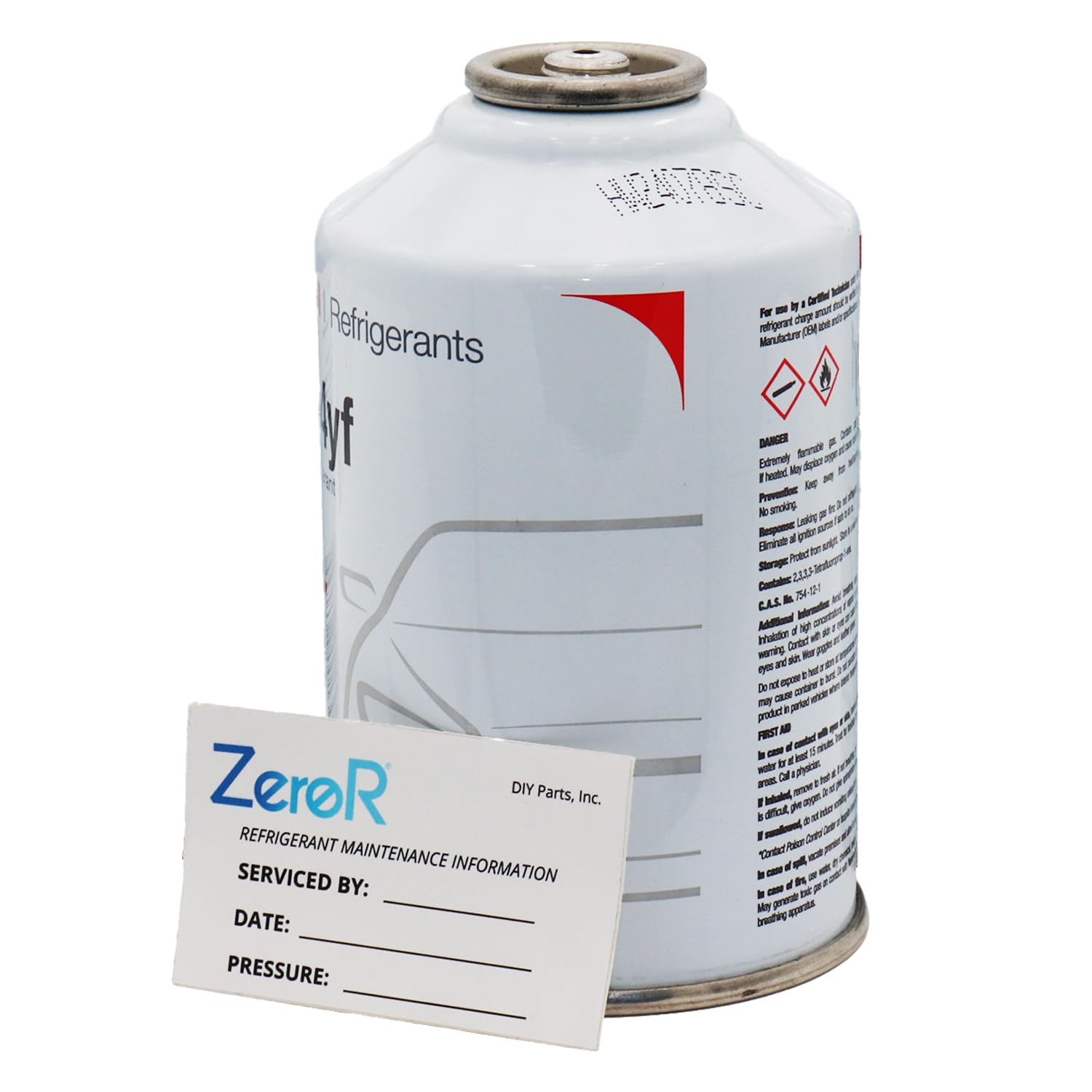
ZeroR’s R1234yf is the cleanest, most straightforward option for any 2018+ vehicle running the mandated refrigerant. Each 8-oz can is measured by weight rather than volume, so you know exactly how much charge you’re adding. The reverse-thread design is a critical safety feature — it physically prevents you from connecting an R134a hose and damaging the service port.
In real-world use, owners of 2018 Jeep Grand Cherokees and newer Toyota sedans reported restored vent temperatures around 45°F after adding just one to two cans. The included service sticker is a nice touch for tracking which refrigerant is in the system after the recharge, avoiding confusion for the next owner or mechanic.
Because R1234yf is expensive per ounce compared to R134a, buying multiple individual cans can add up. But using the correct refrigerant type from the start saves you from the far higher cost of compressor damage caused by chemical incompatibility.
Why it’s great
- Weight-based measurement ensures accurate charge
- Left-hand thread prevents cross-connection errors
- Service sticker included for system labeling
Good to know
- Most systems need 2–3 cans to reach full capacity
- Higher per-ounce cost than R134a
2. A/C Pro AC Super Seal R-134a Stop Leak Treatment
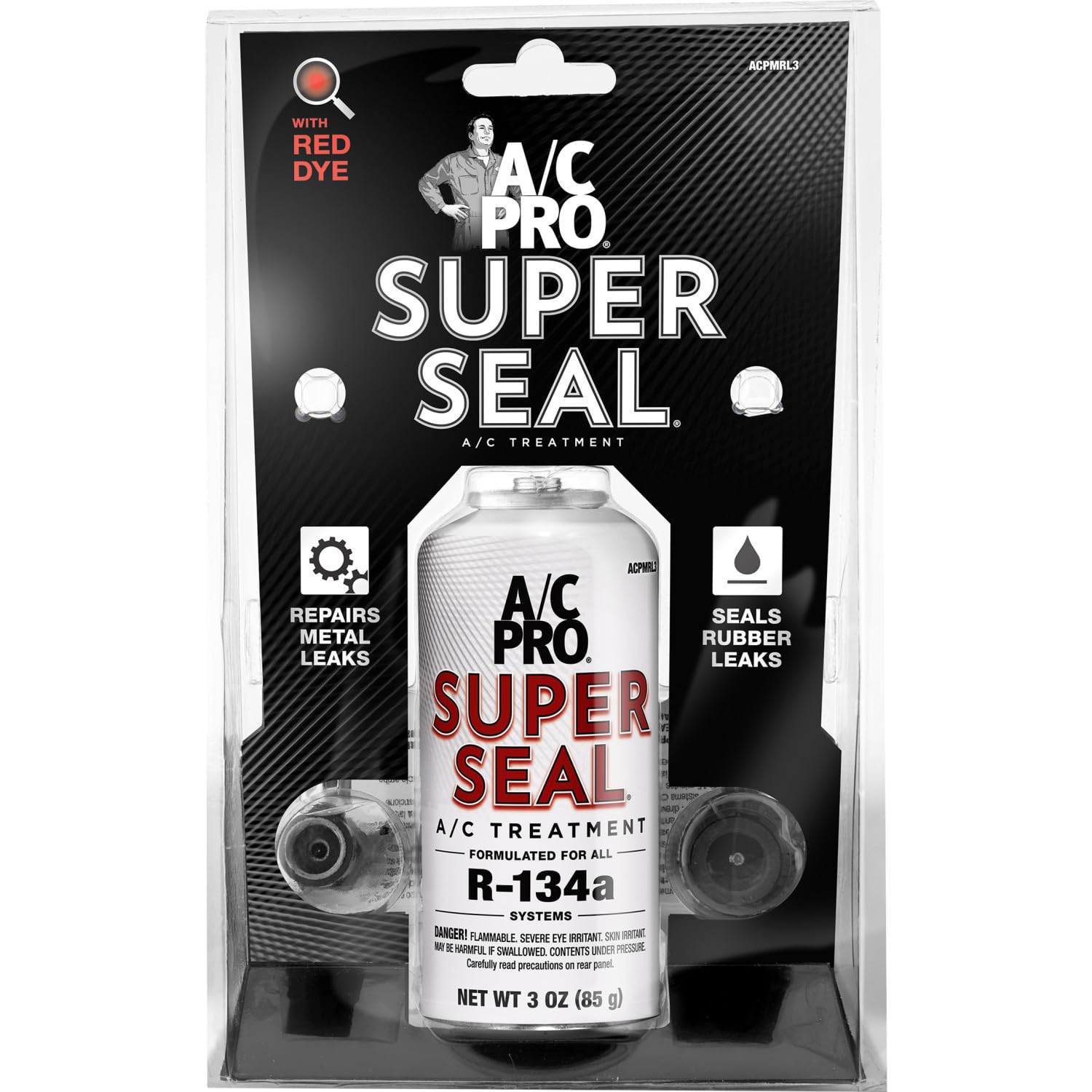
The A/C Pro Super Seal is arguably the most debated product in the automotive AC space — mechanics hate it, but a significant number of DIY users report it actually working. The polymer formula circulates through the system and bonds at leak sites, and several verified buyers confirmed it sealed a slow evaporator leak in a 2013 vehicle for an entire summer season.
One standout report detailed a 2012 BMW 135i whose evaporator leak held for 1.5 years in Florida heat after treatment. The trick appears to be applying it after vacuuming the system, then immediately following with fresh R134a to push the sealant through. The push-button dispenser makes application simple and requires no additional tools.
The risk is real: if your leak is large or your system has a clog-prone expansion valve, the particles can cause blockages. One buyer reported complete system failure 10 days after use, and their mechanic noted sludge formation. This is a calculated tool for slow leaks only.
Why it’s great
- Can seal evaporator and hose leaks for months
- Push-button dispenser, no extra tools needed
- Works with common R134a lubricants
Good to know
- Risk of clogging expansion valves on fast leaks
- Some users report sludge residue
3. ZeroR Premium Repair & Recharge Kit for R134a
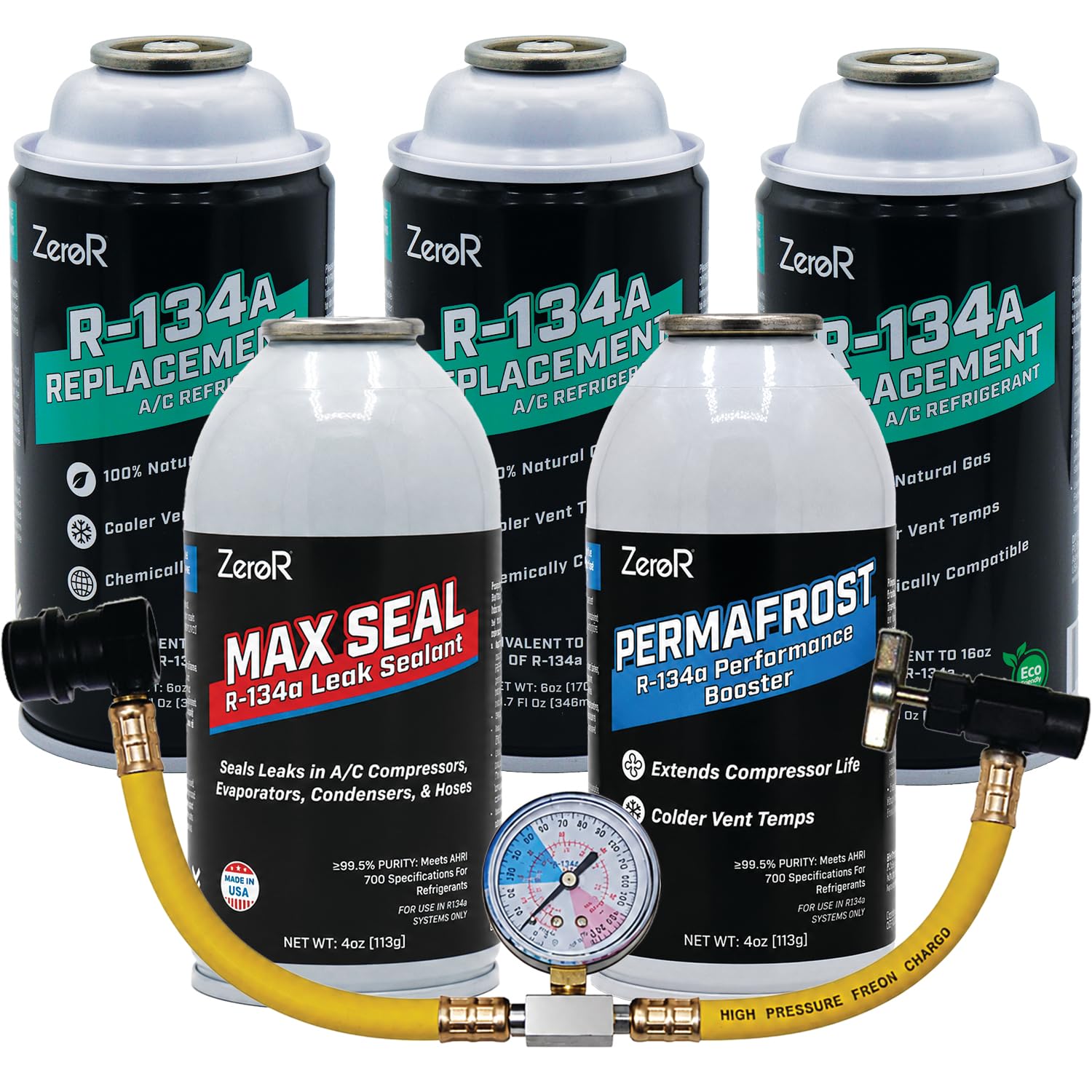
This ZeroR kit bundles a moisture-removing Permafrost additive, a Max Seal leak stop, and a 24-inch charging hose with an integrated can tap and gauge — all in one box. The extra-long hose is a genuine quality-of-life improvement for vehicles where the low-side port is tucked behind the firewall or under the alternator, a common complaint with standard 12-inch hoses.
The Permafrost component serves double duty: it draws dissolved moisture out of the system (moisture causes internal corrosion and ice formation at the expansion valve) and adds a lubricity additive to reduce compressor friction. Users reported restoring a completely non-operating AC system to ice-cold performance after following the two-can procedure.
Be aware that the included can tap uses a standard thread for R134a, and the connection hose may not fit every low-side port — one owner of a 2017 Silverado found it incompatible. Check your vehicle’s port type before purchasing, as the kit is non-returnable once opened.
Why it’s great
- 24-inch hose reaches hard-to-access ports
- Moisture removal + lubrication in one step
- Max Seal additive targets minor leaks
Good to know
- Hose may not fit some GM low-side ports
- Non-returnable once opened
4. Orion Motor Tech 4-Way Manifold Gauge Set
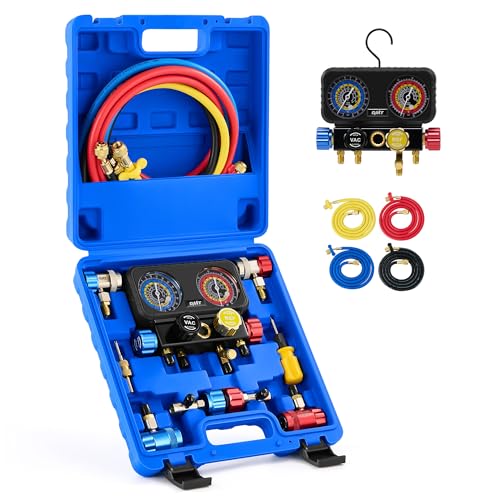
The color-coded hoses are rated to 800 psi with a 4000 psi burst pressure, which is critical when working with R1234yf systems that operate at higher pressures than R134a.
The kit comes with quick couplers for both R1234yf and R134a, plus self-sealing can taps for each refrigerant type. A 45-year mechanic noted the R1234yf can tap uses the correct left-hand thread, and the gauges feature calibration screws for accuracy within 1.6%. The site glass on the manifold lets you see refrigerant flow during charging.
Build quality is not on the level of Snap-On or Matco — some fittings on the R1234yf couplers were described as “poorly tooled” yet still functional. The plastic storage case is tight, and the R134a scale markings are small. But for the price, this is the most versatile way to service both refrigerant families.
Why it’s great
- 4-way manifold allows simultaneous vacuum and charge
- Includes couplers and taps for both R1234yf and R134a
- Oil-filled gauges resist vibration wear
Good to know
- Not pro-grade build quality on couplers
- R134a scale numbers are small
- Bulkier than single-hose recharge kits
5. cmebiz R134a Replacement 3-Pack (6 oz Cans)

The cmebiz 3-pack delivers 18 ounces of R134a total across three pre-filled cans, each equipped with a piercing valve for direct connection to a recharge hose. For older vehicles like a 1998 Jeep Cherokee or a 2007 FJ Cruiser, this is enough refrigerant to restore full cooling without buying multiple separate cans. Users reported vent temperatures dropping to freezing after a 15-minute process.
The cans use the standard 1/4-inch SAE thread, so they work with any basic R134a recharge hose or manifold set. Since the refrigerant is pre-weighed, you can track your total charge by counting cans — two cans (12 oz) covered the FJ Cruiser, while a third can is available if your system’s spec calls for a heavier fill.
Because this is straight R134a without any stop-leak additives or oil, you’ll need to verify your system already has proper oil levels. The 6 oz can size is slightly non-standard compared to the more common 12 oz cans, so check your system’s capacity in ounces before committing.
Why it’s great
- Three pre-filled cans with piercing valves included
- 18 oz total covers most R134a systems
- Simple operation for first-time DIY users
Good to know
- No oil or sealant included
- 6 oz can size may require 3 cans for larger systems
6. Boltigen R1234yf Adapter Kit
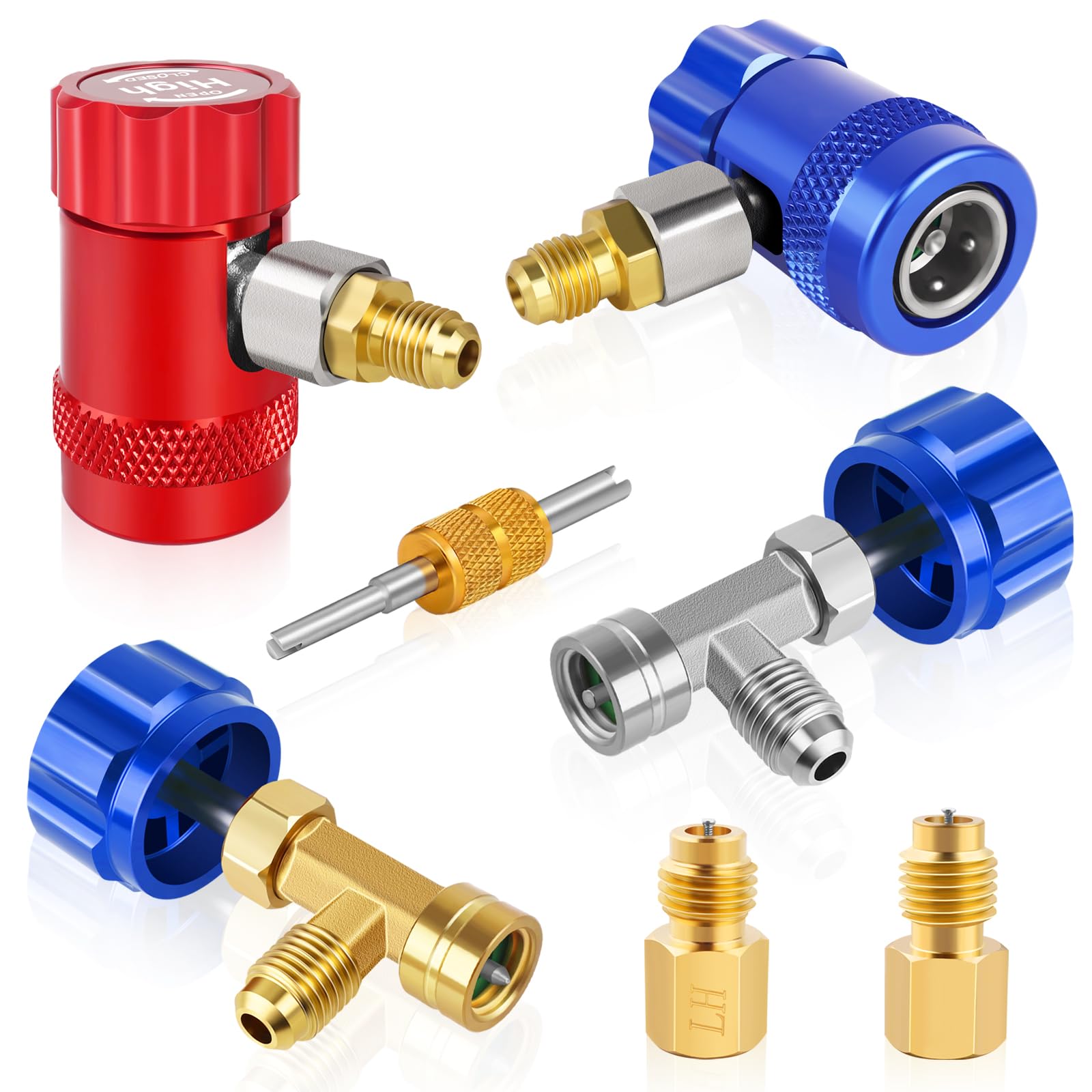
The Boltigen kit is a comprehensive adapter set for anyone working with R1234yf systems who needs to connect standard manifold gauges or recharge hoses. It includes both high-side (red) and low-side (blue) adjustable manual couplers, a self-sealing can tap, a piercing can tap, and a 1/4-inch female to 1/2-inch male tank adapter.
The couplers feature green O-rings and five lock balls for a hermetic seal, plus an adjustable top knob that controls the valve core opening. This is useful because some R1234yf service ports require partial valve depression to start refrigerant flow without losing seal integrity. One user fitted these to a late-model Honda with no issues after a failed attempt with a different brand.
A notable discrepancy appeared in one order where both tank adapters were left-hand thread instead of one left and one right. While the majority of units ship correctly, inspect your kit immediately upon arrival. The brass construction resists corrosion, and the 6-month warranty provides basic coverage.
Why it’s great
- Includes both self-sealing and piercing can taps
- Adjustable manual couplers for precise valve control
- Brass build with corrosion-resistant O-rings
Good to know
- Inconsistent thread orientation on tank adapters reported
- Not quick-release, requires manual valve operation
7. Toyota Genuine Parts AC Refresher Kit

The Toyota AC Refresher Kit is not a refrigerant or a stop-leak — it is a dedicated evaporator coil cleaning treatment that targets the musty, moldy sock smell that develops from moisture buildup on the AC evaporator. This is an OEM Toyota product, meaning it is chemically matched to the evaporator coatings used in Toyota and Lexus vehicles, reducing the risk of corrosion or coating damage.
Users with RAV4s and Lexus GX460s reported the smell was completely eliminated after a single treatment. The process involves spraying foam into the evaporator drain tube or cabin air intake, letting it dwell, and then flushing. One owner saved compared to a dealership service by doing it themselves after watching a YouTube walkthrough.
Not every user had success — one report claimed zero change after following the instructions precisely. This may indicate a more severe mold infestation or a blocked drain that prevents the treatment from reaching the evaporator surface. It works as a preventive measure and a first-line fix, but it is not a guarantee against deep biological growth.
Why it’s great
- OEM formula safe for Toyota/Lexus evaporators
- Eliminates musty odors quickly
- Massive savings vs. dealership service
Good to know
- Does not recharge refrigerant or stop leaks
- Ineffective on severe mold or blocked drains
- Results may vary with application technique
FAQ
Can I use R134a in a car that came with R1234yf from the factory?
How do I know if my car needs R134a or R1234yf?
Will stop-leak treatment ruin my AC compressor?
How many ounces of refrigerant does my car need?
Can I mix different brands of R134a in the same system?
Final Thoughts: The Verdict
For most users, the best ac refrigerant for cars winner is the ZeroR Genuine R1234YF Refrigerant because it offers the correct left-thread can, weight-accurate dosing, and a service sticker for system labeling. If you are dealing with a slow evaporator leak, grab the A/C Pro Super Seal. And for a full repair-and-recharge job on an R134a vehicle, nothing beats the ZeroR Premium Repair & Recharge Kit.