
Forget what you know about smartphone video. A dedicated cam recorder gives you an optical zoom lens that actually pulls in distant action without turning it into a pixelated mess, a built-in grip that stabilizes physical shake, and a full suite of audio ports so your subject’s voice isn’t swallowed by wind noise. Whether you’re documenting a family event, live-streaming a service, or crafting vlogs, the dedicated hardware exists for one reason: to capture a moment with a level of control and clarity that a phone simply isn’t built to deliver.
I’m Min — the co-founder and writer behind Gadgets Feed. I’ve spent hundreds of hours dissecting spec sheets, cross-referencing sensor sizes against real-world noise performance, and matching optical zoom ranges with practical shooting distances to separate genuine recording tools from marketing fluff.
After combing through dozens of models, I’ve narrowed the field to the options that genuinely deserve your attention. This guide represents the best cam recorder choices available right now across a wide range of budgets and use cases.
How To Choose The Best Cam Recorder
Selecting the right cam recorder depends on where you plan to shoot and what you plan to capture. A live-streaming presenter has a different priority list than a wedding videographer, and a travel vlogger needs portability above all else. By focusing on four core specs, you can confidently match a camera to your actual workflow.
Sensor Size and Low-Light Performance
The physical size of the image sensor—measured as 1/2.3-inch, 1-inch, or larger—dictates how much light the camera can gather. A larger 1-inch CMOS sensor will produce noticeably cleaner footage in dimly lit rooms or at dusk compared to a smaller 1/2.3-inch chip, which tends to introduce visible grain as the ISO climbs. If you plan to shoot indoors, at events, or during evening hours, prioritize a model with a 1-inch sensor or larger.
Optical Zoom vs. Digital Zoom
Optical zoom uses the lens glass to magnify the image without degrading quality, while digital zoom simply crops and enlarges the pixels, reducing sharpness. For a cam recorder, an optical zoom range—measured as a multiplier like 20x or 30x—is the single most important factor if you intend to film subjects that are not right in front of you, such as speakers on a stage or wildlife from a distance. A 20x optical zoom will deliver usable footage at a distance where any digital zoom will look soft.
Stabilization Technology
Shaky footage is the hallmark of an amateur recording. Three types of stabilization appear in cam recorders: optical (in-lens), mechanical (gimbal-based), and digital (software-cropped). Mechanical 3-axis gimbal stabilization provides the smoothest result because it physically counteracts hand movement, but it adds weight and cost. Optical SteadyShot systems are effective at reducing minor shake without cropping the frame. Digital stabilization, while cheaper, reduces the field of view and can introduce a jelly-like effect in fast motion.
Connectivity and Streaming Capabilities
Modern cam recorders must interface with computers, networks, and live-streaming platforms. A clear distinction exists between a simple camcorder and a production tool. Key connectivity options include HDMI out for external monitors, USB-C for UVC streaming (plug-and-play webcam functionality), and SDI for professional broadcast workflows. If you stream on platforms like YouTube or OBS, look for a model that supports direct live output without requiring a separate capture card.
Quick Comparison
On smaller screens, swipe sideways to see the full table.
| Model | Category | Best For | Key Spec | Amazon |
|---|---|---|---|---|
| DJI Osmo Pocket 3 | Gimbal Cam | Vlogging & Travel | 1-inch CMOS, 4K/120fps | Amazon |
| Canon VIXIA HF G70 | Traditional Camcorder | Event & Documentary | 20x Optical Zoom, UVC Streaming | Amazon |
| Sony FDR-AX43 | Traditional Camcorder | Family & General Use | Balanced OIS, 20x Optical Zoom | Amazon |
| Prisual TEM-30S PRO | PTZ Camera | Church & Live Streaming | 30x Optical Zoom, AI Tracking | Amazon |
| OBSBOT Tail Air | PTZ Camera | Content Creator Streaming | 4K PTZ, NDI, AI Tracking | Amazon |
| Xtra Muse | Gimbal Cam | Budget Vlogging | 1-inch CMOS, 3-Axis Gimbal | Amazon |
| Canon PowerShot V10 | Compact Vlog Cam | Ultra-Portable Vlogging | 1-inch CMOS, Built-in Stand | Amazon |
| ORDRO M5 | Gimbal Cam | On-the-Go Shooting | 3-Axis Gimbal, 5K Resolution | Amazon |
| OPRKQEE 6K Camcorder | Budget Camcorder | Entry-Level Vlogging | 6K Resolution, 18x Digital Zoom | Amazon |
In‑Depth Reviews
1. DJI Osmo Pocket 3 Creator Combo

The DJI Osmo Pocket 3 represents the current pinnacle of compact cam recorder engineering. Its 1-inch CMOS sensor captures 4K resolution at 120 frames per second, which translates to footage that remains sharp and free of artifacts even when you slow it down to 1/4 speed during editing. The Creator Combo includes the DJI Mic 2, a battery handle that extends runtime beyond the internal 166-minute rating, and a mini tripod for static shots.
The 3-axis mechanical gimbal is the defining feature of this unit. It physically counteracts hand shake, walking bounce, and even gentle running, producing footage that looks like it was shot on a slider or tracks. ActiveTrack 6.0 locks onto a human subject and keeps them centered in the frame as they move, which is invaluable for solo creators who mount the camera on a tripod and move around. The 2-inch rotatable touchscreen flips between horizontal and vertical orientation instantly.
On the audio side, the Osmo Pocket 3 connects wirelessly to two DJI Mic 2 transmitters simultaneously, so you can capture a presenter and an interviewee without a single cable. The D-Log M color profile with 10-bit depth allows for rich color grading in post-production, pulling detail out of highlights and shadows that standard 8-bit footage would clip into white or black noise. For a traveling content creator, this is the ultimate all-in-one tool.
Why it’s great
- True 4K/120fps from a 1-inch sensor produces smooth slow-motion.
- 3-axis gimbal stabilization eliminates the need for bulky external rigs.
- ActiveTrack 6.0 reliably keeps subjects centered during solo shoots.
Good to know
- The gimbal head is exposed and feels fragile if dropped; a protective case is essential.
- The Creator Combo price is a significant investment compared to entry-level cam recorders.
2. Canon VIXIA HF G70 Camcorder

Canon’s VIXIA HF G70 is a traditional camcorder designed for a specific purpose: long-form recording where optical zoom range and reliability matter more than pocketability. Its 20x optical zoom lens delivers genuine reach that brings a stage performer into tight frame from the back of a venue, and the 8-blade aperture creates natural, circular out-of-focus highlights that mirror the look of cinema lenses. The 1/2.3-inch 4K UHD CMOS sensor paired with the DIGIC DV 6 processor produces smooth 4K/30p footage with accurate color science.
One of the G70’s standout features is UVC livestreaming, which allows the camera to act as a high-quality webcam via a single USB connection to a PC or Mac without any additional capture card. This makes it a dual-purpose device for creators who want to shoot standalone footage during the day and stream commentary or interviews at night. The Hybrid AF system uses a dedicated phase-detection sensor to lock focus quickly, and face detection tracks moving subjects reliably.
The body houses dual SD card slots, which enable relay recording for uninterrupted long events, or simultaneous recording for an instant backup. The On-Screen Display Time Stamp recording embeds date and timecode directly into the video file, which is a lifesaver for security and evidence applications. Low-light performance is acceptable but not stellar; the camera introduces visible grain above ISO 1600, so supplemental lighting is recommended for indoor shoots.
Why it’s great
- 20x optical zoom provides genuine long-range reach without quality loss.
- UVC streaming turns it into a plug-and-play webcam for live broadcasts.
- Dual SD card slots and time stamp recording are practical for event work.
Good to know
- Low-light performance at high gain settings produces noticeable noise.
- HDMI output and UVC mode are limited to 1080p, not 4K passthrough.
3. Sony FDR-AX43 UHD 4K Handycam

The Sony FDR-AX43 sits in the sweet spot of the traditional camcorder market, offering proven Sony imaging technology in a familiar form factor. Its 1/2.5-inch Exmor R CMOS sensor uses back-illumination to improve light sensitivity, and the BIONZ X processor handles noise reduction and color rendering. The Balanced Optical SteadyShot image stabilizer operates by physically floating the lens unit, which compensates for shake without cropping the frame, preserving the full wide-angle field of view.
Optically, the AX43 uses a 20x optical zoom ZEISS Vario-Sonnar T lens with a 26.8mm wide-angle starting point. The Clear Image Zoom extends the reach to 30x in 4K and 40x in HD by combining the optical range with intelligent pixel interpolation, and the results are usable for casual shooting. The Fast Intelligent AF system predicts subject movement and adjusts focus continuously, making it easy to track a toddler running through a park or a pet moving across the room.
The camera includes both Wi-Fi and NFC connectivity for wireless file transfer and remote control via a smartphone app. The Highlight Movie Maker feature automatically edits short clips into a highlight reel, which is a nice touch for parents who want to share a quick recap without editing software. The main drawback is the external battery pack design, which protrudes from the back and can make the camera feel unbalanced when mounted on a tripod. It also lacks internal memory, so a fast UHS-I SD card is required out of the box.
Why it’s great
- Balanced Optical SteadyShot stabilizes video without cropping the frame.
- 20x optical ZEISS lens provides clear telephoto reach for distant subjects.
- Fast Intelligent AF delivers reliable continuous focus on moving subjects.
Good to know
- The protruding battery pack makes the camera less balanced for handheld use.
- No internal memory; requires a separately purchased SD card to operate.
4. Prisual PTZ Camera Gen 5
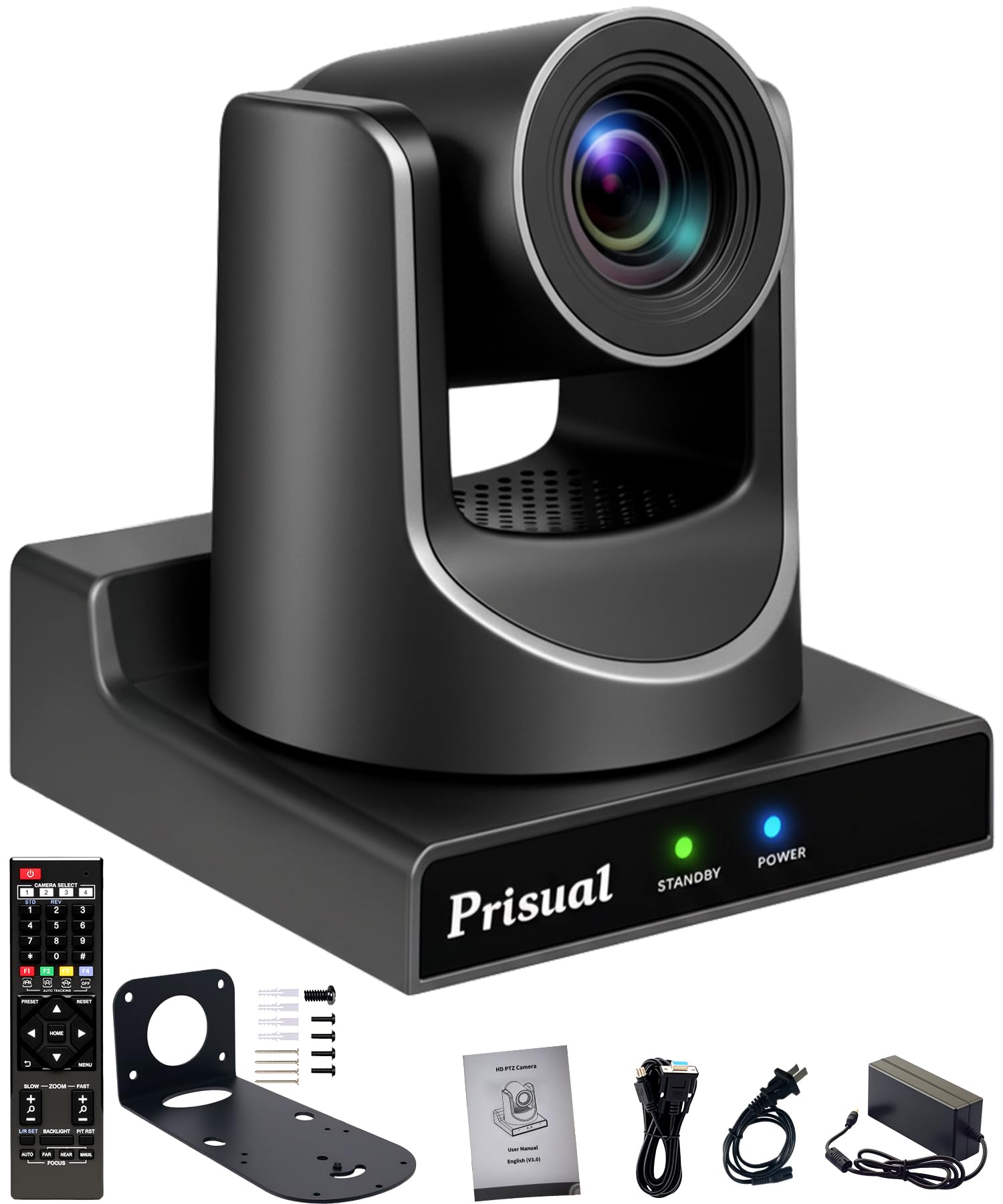
The Prisual PTZ Camera Gen 5 is a purpose-built studio tool designed for fixed installations like churches, conference rooms, and broadcast studios. Its 30x optical zoom lens is the standout specification here: with a 60.7° wide-angle field of view that can zoom into a tight head-and-shoulders shot from the back of a large room, all while maintaining crisp HD clarity. The camera supports simultaneous output over 3G-SDI, HDMI, and IP, allowing one unit to feed a local monitor, a streaming encoder, and a recording deck at the same time.
AI tracking in this generation has been refined to lock onto a speaker and follow them across the stage using four preset zones. The camera automatically adjusts framing between full-body and close-up based on movement, which means no operator is required for a single presenter format. Power over Ethernet (PoE) simplifies installation dramatically: a single Cat6 cable carries power, video, and control data to the camera, eliminating the need for a separate power run. The metal housing and synchronous belt drive system are rated for 10+ years of continuous use in a sanctuary environment.
Control options are extensive. The included IR remote allows instant access to 10 presets, and the full VISCA protocol support over RS232/RS485 enables integration with professional switchers like Blackmagic ATEM. The camera is NDI upgradable, though the license must be purchased separately. Image quality is excellent in bright conditions, and the low-light sensitivity down to 0.5 lux means it can handle dimly lit stages without significant noise. The menu system is deep and requires some initial configuration, but once set, the camera runs reliably.
Why it’s great
- 30x optical zoom delivers broadcast-quality close-ups from extreme distances.
- AI tracking automates camera operation for solo presenters or speakers.
- PoE simplifies installation to a single network cable for power, video, and control.
Good to know
- NDI functionality requires a separate purchased license key.
- The menu interface is complex and has a learning curve for first-time users.
5. OBSBOT Tail Air NDI Streaming Camera

The OBSBOT Tail Air is a tiny PTZ camera that packs professional streaming features into a body smaller than a soda can. It records 4K video at 30fps and supports a 320° horizontal and 180° vertical rotation range, which gives it an immense area of coverage suitable for a classroom, a stage, or a small studio. The 23mm f/1.8 fixed lens is wide enough for a single-person interview setup or a small group shot, and the sensor handles bright conditions well with accurate color reproduction.
This camera supports NDI, which allows it to stream high-quality video over a standard local network to multiple computers and switchers simultaneously—saving the cost and complexity of long HDMI runs. In addition to NDI, it provides Micro HDMI, USB-C, Ethernet, and Wi-Fi connectivity, making it compatible with virtually any setup. The AI tracking is a highlight: it can be configured to track humans, animals, or objects, and gesture control allows the user to trigger tracking modes hands-free by raising a hand.
The companion Obsbot Start app gives the user full manual control over ISO, shutter speed, white balance, and exposure, and it supports up to 10 preset positions for instant camera movement recall. The internal battery provides about 2.5 hours of runtime, which is useful for wireless roaming setups. A known concern reported by some users involves the non-removable battery degrading over extended use, effectively bricking the camera after 12-18 months, so this unit is best deployed in environments where it will remain connected to power continuously.
Why it’s great
- NDI capability streams to multiple devices on a local network without lengthy cables.
- Gesture control and AI tracking allow operator-free shoots for solo creators.
- Multiple connectivity options (HDMI, USB-C, Wi-Fi, Ethernet) ensure wide compatibility.
Good to know
- Non-removable battery may degrade and render the camera unusable if constantly unplugged.
- Some units have reported failure within the first year; support response time varies.
6. Xtra Muse Vlogging Camera

The Xtra Muse is a strong contender for creators who want gimbal-stabilized 4K footage without paying the premium for the DJI ecosystem. It features a 1-inch CMOS sensor that records 4K video at 120fps, enabling buttery-smooth slow-motion playback. The integrated 3-axis gimbal stabilization does an excellent job of cancelling out the shakes and jitters of handheld walking shots, producing running footage that looks like it was shot on a dedicated track.
The 2-inch touchscreen rotatable display supports both horizontal and vertical shooting orientations, which is essential for creators who publish across YouTube and TikTok simultaneously. The Master Follow mode relies on the built-in face and object tracking to keep the subject centered, and the autofocus system is snappy—locking onto a new subject almost instantaneously. The 10-bit X-Log color mode records up to one billion colors, giving editors significant latitude to adjust exposure and tonal values in post-production without banding artifacts.
Battery life is rated at 161 minutes, which is solid for a device this compact. The bundled accessories include a carrying bag, a wrist strap, and a handle with a 1/4-inch thread for tripod mounting. Build quality feels robust for its price class, and the gimbal motor is quiet enough for indoor event recording. It does lack some of the software polish of the DJI companion app, and the wireless audio integration is not as seamless, but for the money, it delivers 90% of the functionality at a lower cost.
Why it’s great
- 1-inch CMOS with 4K/120fps provides excellent image quality and slow-motion capabilities.
- 3-axis gimbal stabilization rivals much more expensive competitors.
- 10-bit X-Log color profile enables professional-grade color grading in post.
Good to know
- Wireless audio integration is not as seamless as the DJI ecosystem.
- Software companion app lacks some advanced control features found in premium models.
7. Canon PowerShot V10 Compact Vlogging Camera

The Canon PowerShot V10 breaks away from traditional camcorder design entirely. It is a vertical-oriented, lipstick-shaped camera that fits into a front pants pocket or a small fanny pack. The 15.2-megapixel 1-inch back-illuminated CMOS sensor captures 4K video at 30fps with impressive low-light performance, and the fixed 19mm wide-angle lens (35mm equivalent) provides a field of view that keeps the subject and background in context without making the room look tiny. The retractable front-facing screen is a clever solution: it pulls out of the body and tilts upward for self-view while keeping the overall footprint small.
The built-in foldable stand is a key design differentiator. It folds in both directions, allowing the camera to be placed on a tabletop in either vertical or horizontal orientation, completely hands-free. This makes it easy to set up for a timelapse or a sit-down vlog without needing a tripod. Audio capture is handled by a high-quality stereo microphone array that includes a third mic specifically tasked with cancelling background noise, and the audio quality is noticeably better than what smartphone mics capture in noisy environments.
Image stabilization improved significantly with firmware version 1.2.0, which added three modes: Off, On, and Enhanced. Enhanced mode is effective for walking shots but crops the already-wide 19mm lens further, narrowing the field of view. The lack of any optical zoom is the V10’s biggest limitation; you are stuck with a fixed wide-angle lens, which means close-ups of distant subjects require physically moving closer. Battery life is also modest, averaging around 45 minutes of active 4K recording, so carrying a USB-C power bank is advisable for longer shoots.
Why it’s great
- Ultra-compact size and built-in stand allow for spontaneous, tripod-free shooting.
- 1-inch back-illuminated sensor delivers excellent image quality for its size.
- Stereo mic with dedicated noise-canceling channel captures clear audio in noisy settings.
Good to know
- No optical zoom means you cannot get tighter shots of distant subjects.
- Battery life in 4K recording is limited; an external power bank is needed for extended sessions.
8. ORDRO M5 Handheld Camera
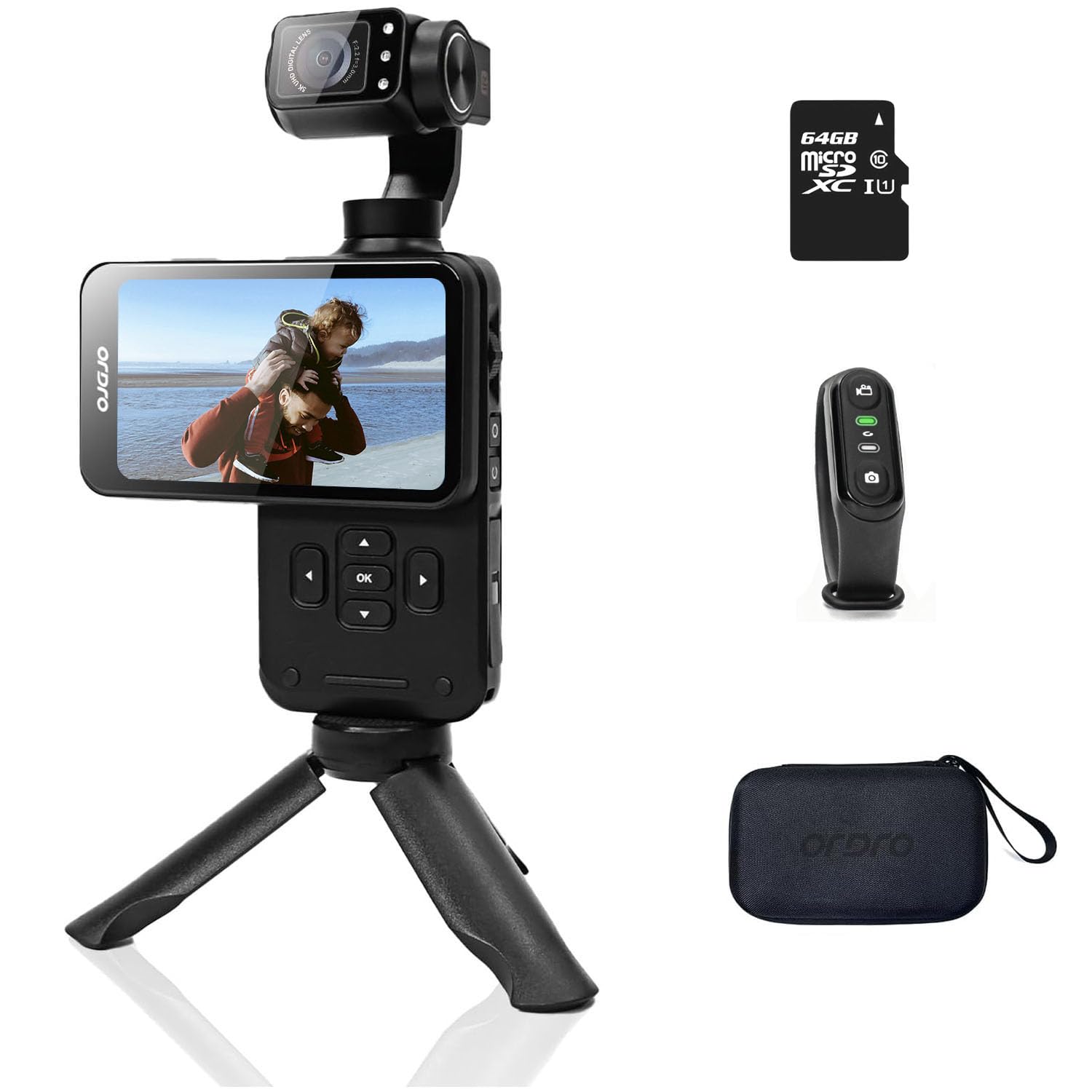
The ORDRO M5 is a pocket-sized cam recorder that prioritizes in-body stabilization and portability. At just 6.2 x 2.2 x 1.8 inches, it is designed for one-handed shooting while walking or traveling. The 1/2.5-inch CMOS sensor records at a 5K resolution at 30fps or 4K at 60fps, which provides a small resolution buffer for digital cropping in post without dropping to 1080p. The 48-megapixel still image capture is a bonus for quick photo documentation.
The M5’s primary selling point is its advanced 3-axis gimbal stabilization. It features a PTZ mode that allows the user to set the gimbal’s movement speed and behavior for different scenarios, such as a slow pan across a landscape or a fast follow on a moving pet. The 120° wide-angle lens is ideal for handheld selfies, ensuring the shooter’s face remains framed without the arm being fully extended. The 3.5-inch IPS HD touchscreen is larger than the screens on many gimbal cameras in this class, making touch-based menu navigation and focus selection more precise.
Connectivity covers Wi-Fi file transfer via the OD Cam app and USB-C for direct computer connection in PC Camera mode for streaming. The M5 comes with a 64GB microSD card and a mini tripod in the box, which removes the typical accessory-hunting headache. Infrared night vision captures black-and-white footage in complete darkness, which is useful for surveillance or after-dark recording. The stabilization is very good but not flawless—sharp lateral movements can cause a slight wobble as the gimbal motors recalibrate—and the audio quality from the built-in mic is mediocre, but an external mic port solves that.
Why it’s great
- Integrated 3-axis gimbal provides smooth, stabilized footage in a very small package.
- Large 3.5-inch touchscreen makes framing and menu control easy.
- Comes complete with a 64GB card, mini tripod, and remote control right out of the box.
Good to know
- Built-in microphone audio quality is poor; an external mic is recommended for serious recording.
- Gimbal can produce a slight wobble during rapid, sharp movements or directional changes.
9. OPRKQEE 6K Camcorder

The OPRKQEE 6K Camcorder is an entry-level unit that packs an impressive feature list for its price class. It advertises 6K (5760x3240p) video recording at 30fps and 4K at 60fps, paired with a 64-megapixel still image sensor. While the 6K resolution does provide more detail than standard 4K, the fixed-focus lens and small 1/3-inch sensor size mean the image quality is heavily dependent on good lighting; in dim conditions, the noise reduction software smears fine detail noticeably. The 4.0-inch touchscreen is the largest display in this lineup and simplifies menu navigation for beginners.
The included accessories are extensive: a 4500mAh battery rated for up to 4.5 hours of recording, a 64GB SD card, a handheld stabilizer, a wired external microphone, a 2.4G remote control, and a lens hood. The IR night vision mode uses built-in infrared LEDs to capture black-and-white footage in total darkness, which is a rare feature at this budget level. The Wi-Fi connectivity via the “Hello Cam” app allows for remote control and file transfer, though the app itself feels basic compared to more polished offerings.
Build quality is plastic-based but feels solid enough for casual use. The 18x digital zoom, however, is digital, so at full extension the image becomes soft and pixelated; it is essentially useless beyond 8-10x. The handheld stabilizer is a simple mechanical frame that connects to the camera’s base, not a gimbal, so it will reduce but not eliminate shake. For a first-time buyer who wants a complete kit to experiment with vlogging, event recording, or night surveillance without a significant financial commitment, this package provides a functional starting point with a very low barrier to entry.
Why it’s great
- Complete accessory bundle includes battery, SD card, remote, external mic, and stabilizer.
- Large 4.0-inch touchscreen and IR night vision are rare in budget cam recorders.
- 4500mAh battery provides over 4 hours of recording on a single charge.
Good to know
- The 18x digital zoom produces soft, pixelated images beyond moderate magnification.
- The sensor and fixed-focus lens struggle in low-light conditions, producing grainy footage.
FAQ
Can I use a cam recorder as a webcam for live streaming?
What is the difference between optical zoom and digital zoom?
How important is a large sensor for recording in low light?
Final Thoughts: The Verdict
For most users, the best cam recorder winner is the DJI Osmo Pocket 3 Creator Combo because it delivers professional-grade 4K/120fps imagery from a 1-inch sensor paired with a 3-axis gimbal in a truly pocket-sized body. If you need a powerful optical zoom range for events or stage recordings, grab the Prisual PTZ Camera Gen 5. And for a compact, ultra-portable vlogging tool that prioritizes simplicity and style, nothing beats the Canon PowerShot V10.