
Your cherished vinyl collection, your lossless digital library, your meticulously curated playlists — they all deserve a delivery system that preserves every nuance, every breath, every dynamic swing. An audio media streamer is the silent hero of a serious listening room, acting as the central nervous system that routes pristine digital signals from your network to your amplifier or active speakers without the compression and jitter that plague cheap Bluetooth receivers.
I’m Min — the co-founder and writer behind Gadgets Feed. I’ve spent many hours researching the DAC implementations, streaming protocol support, and analog output stages of the latest streamers to separate the true high-fidelity performers from the spec-sheet hype.
This guide cuts past the marketing noise to reveal the models that actually deliver transparent, engaging audio from your favorite streaming services. You’ll find the perfect best audio media streamer for your specific system, whether you need a pure digital transport or an all-in-one DAC/preamp solution.
How To Choose The Best Audio Media Streamer
Selecting an audio media streamer means balancing your existing system’s inputs, your preferred streaming services, and the sonic signature you’re chasing. A streamer that excels as a pure digital transport for an external DAC will have a different feature set than one built as a complete preamp with analog outputs, phono stage, and room correction.
DAC Implementation and Output Stage
The DAC chip (ESS Sabre, AKM, or Cirrus Logic) is important, but the analog output stage — the op-amps, capacitors, and power supply that turn the chip’s output into a signal your amplifier can use — determines the final sound quality. Premium streamers use balanced XLR outputs with differential amplification to reduce noise and crosstalk, while entry-level models rely on single-ended RCA. Look for THD+N figures below 0.001% and a signal-to-noise ratio above 118dB for reference-grade performance.
Streaming Protocol and App Ecosystem
Not all streamers support every service. Apple Music lossless requires AirPlay 2, while TIDAL Connect and Qobuz need native integration. Roon Ready certification is critical if you manage a large local library plus streaming subscriptions. The companion app’s stability and feature set — parametric EQ, room correction, playlist management — can make or break daily use. WiiM, Bluesound, and Eversolo have strong apps; some high-end brands outsource to generic UPnP controllers with mixed results.
Connectivity and System Integration
Count your inputs before you buy. Do you need HDMI eARC to pull audio from your TV? A phono stage for a turntable? USB input for a computer? A subwoofer output for a 2.1 system? The best streamer for a desktop headphone rig (like the FiiO R7) is overkill and inconvenient for a living room stereo setup. Balanced XLR outputs, 12V triggers, and multi-room grouping features like MusicCast or BluOS dictate how well the streamer integrates into a broader system.
Quick Comparison
On smaller screens, swipe sideways to see the full table.
| Model | Category | Best For | Key Spec | Amazon |
|---|---|---|---|---|
| WiiM Ultra | Mid-Range | Touchscreen all-in-one preamp | ESS ES9038 Q2M DAC, 121dB SNR | Amazon |
| Fosi Audio S3 | Mid-Range | Compact balanced streamer | AK4493SEQ DAC, XLR outs, Wi-Fi 6 | Amazon |
| Bluesound Node Nano | Mid-Range | Multi-room BluOS ecosystem | ESS ES9039Q2M DAC, 1.8GHz quad-core | Amazon |
| Cambridge Audio MXN 10 | Mid-Range | Roon Ready digital transport | ESS ES9033Q DAC, StreamMagic Gen 4 | Amazon |
| WiiM Amp Ultra | Mid-Range | All-in-one streaming amplifier | ESS ES9039Q2M DAC, 100W/ch, Roon Ready | Amazon |
| Yamaha R-N600A | Premium | Classic stereo receiver with streaming | ESS ES9010K2M DAC, 80W/ch, MusicCast | Amazon |
| FiiO R7 | Premium | Desktop streaming DAC/amp with Android | ES9068AS DAC, THX 788+, 3.6W output | Amazon |
| EVERSOLO DMP-A6 Gen 2 | Premium | High-end streamer with large touchscreen | Dual-mono ESS DAC, DSD512, 6″ LCD | Amazon |
| Yamaha R-N800A | Premium | High-power integrated amp with YPAO calibration | ESS ES9080Q DAC, 100W/ch, DSD 11.2MHz | Amazon |
In‑Depth Reviews
1. WiiM Ultra Music Streamer & Digital Preamp

The WiiM Ultra sets a new benchmark in the mid-range streamer category by combining a generous 3.5-inch touchscreen with an ESS ES9038 Q2M DAC that measures -116dB THD+N and 121dB SNR. This is not a stripped-down transport — it’s a full-featured digital preamp with HDMI ARC, a phono input for moving magnet turntables, and a dedicated headphone output. The aluminum chassis feels more substantial than the price suggests, and the included voice remote with Alexa and Google Assistant integration makes daily operation seamless.
Reviewers consistently report the Ultra delivers sound quality that rivals DACs costing several times more, with a slightly wider soundstage and more dynamic punch than the previous WiiM Pro Plus. The DSP suite includes parametric EQ and room correction, though some users wish the correction strength were adjustable. The WiiM Home app is among the most responsive and feature-complete in the category, offering input-specific EQ, volume limits, and multi-room grouping with other WiiM, Amazon Echo, and Google Home devices.
The only notable omission is AirPlay 2 support — WiiM explicitly states the Ultra cannot function as an AirPlay receiver, which is a significant limitation for Apple Music lossless users. For everyone else, the Ultra’s combination of connectivity, DAC performance, and app ecosystem makes it the clear all-around winner.
Why it’s great
- Excellent ESS Sabre DAC with -116dB THD+N outperforms many + units
- Comprehensive inputs including HDMI ARC, phono (MM), and USB
- Rich DSP with 10-band/parametric EQ and room correction
Good to know
- No AirPlay 2 support — incompatible with Apple Music lossless streaming
- Lacks balanced XLR outputs — RCA only
- Some users report occasional app-related reconnection delays
2. EVERSOLO DMP-A6 Gen 2 Hi-Fi Music Streamer
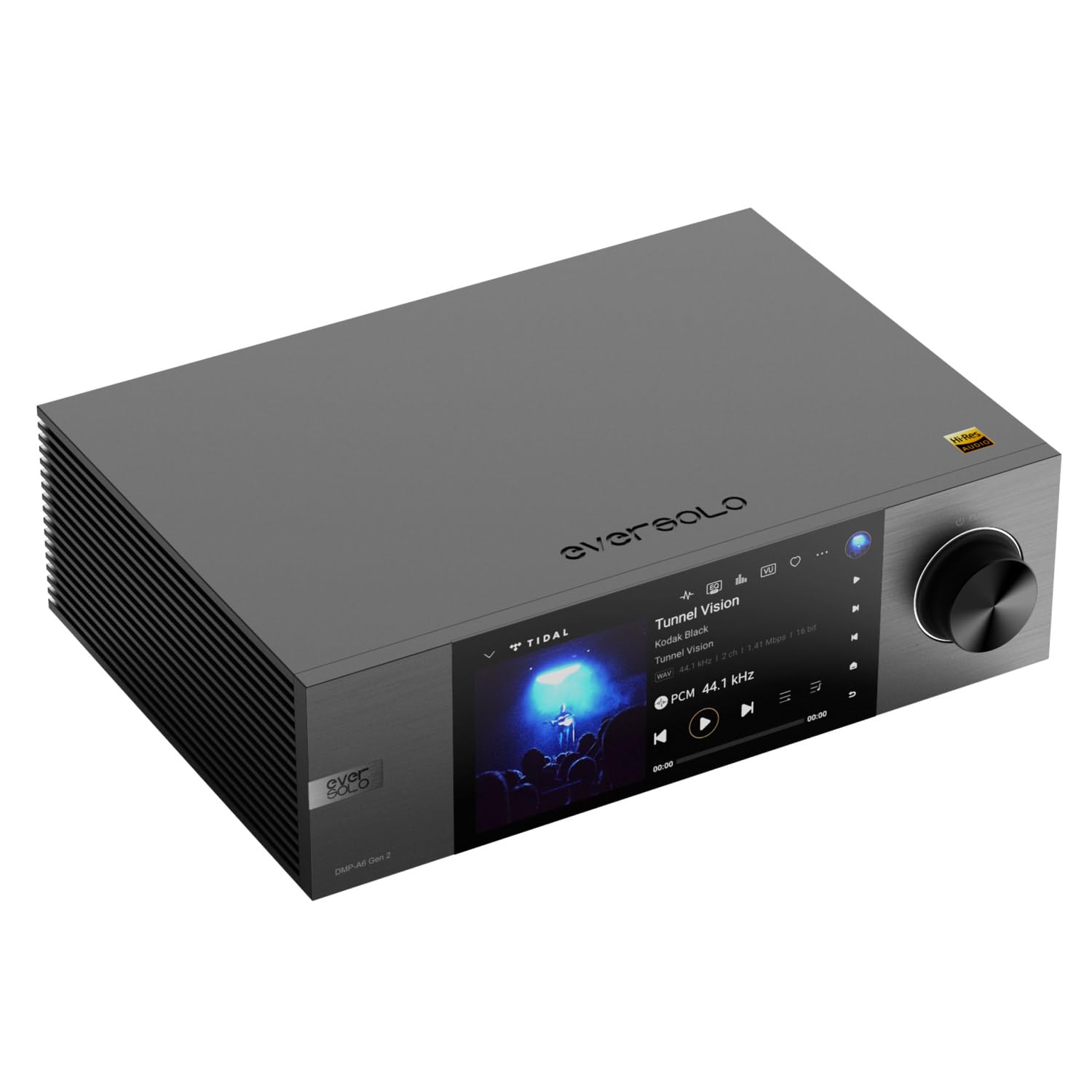
The EVERSOLO DMP-A6 Gen 2 is the streamer that finally convinced many users to upgrade from the WiiM Ultra. Its centerpiece is a gorgeous 6-inch LCD color touchscreen that displays album art, playback controls, and system settings with a responsiveness that rivals a high-end smartphone. Under the hood, the Gen 2 revision introduces a linear power supply with noise below 40uV, improving the already excellent dual-mono ESS DAC implementation that supports native DSD512 and PCM up to 32-bit/768kHz.
The Android 11-based operating system provides deep integration with TIDAL, Qobuz, Highresaudio, and Radio Paradise, plus the ability to install third-party streaming apps directly. The EOS audio engine ensures bit-perfect output regardless of the source app, a rare feature in Android-based streamers. The EVERSOLO Controller app mirrors the on-screen interface and allows full control from your phone. HDMI ARC and TRIGGER inputs allow seamless integration with home theater systems, though early adopters note the lack of automatic ARC switching and the absence of a subwoofer output.
Sonic reviews consistently describe a cleaner, wider soundstage than the WiiM Ultra, with more depth on complex orchestral passages. However, the user interface has some rough edges — the Qobuz integration exhibits dual-audio and queuing pausing issues, and the remote is barely functional beyond basic transport control. The power failure reports on early units are concerning, though EVERSOLO has been responsive with repairs.
Why it’s great
- Stunning 6-inch LCD touchscreen with lag-free album art display
- Upgraded linear PSU delivers ultra-low noise floor below 40uV
- Native DSD512 and 768kHz PCM playback with dual-mono DAC architecture
Good to know
- UI and Qobuz integration have polish issues — laggy screen casting in the app
- No room correction DSP compared to cheaper WiiM offerings
- Known power failure reports on early production units
3. WiiM Amp Ultra
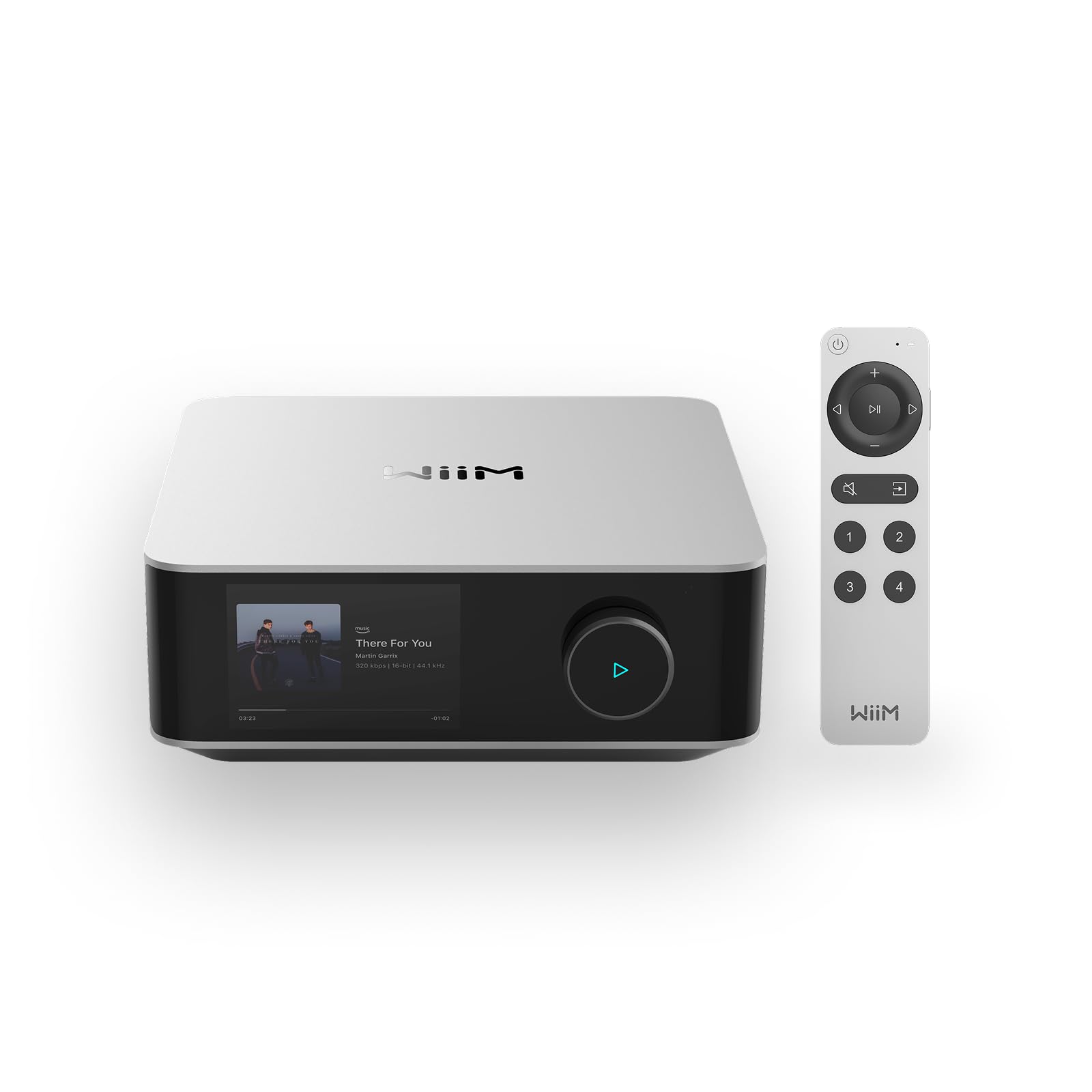
For those building a system from scratch, the WiiM Amp Ultra eliminates the need for a separate amplifier by integrating 100 watts per channel of Class-D power from dual TI TPA3255 chips alongside its ESS ES9039Q2M DAC. The amp employs PFFB (Post-Filter Feedback) technology to maintain performance independent of speaker impedance, measuring -106dB THD+N — exceptional for a product in this price bracket. The 3.5-inch glass-covered touchscreen mirrors the Ultra streamer’s interface for easy local control.
The RoomFit automatic room correction is a genuine audiophile feature at this price, calibrating the sound to your specific space and speakers via the microphone in your phone. The bass management system, including a dedicated subwoofer output with crossover settings, allows seamless integration into a 2.1 system. Reviewers upgrading from the previous WiiM Amp Pro report a noticeable increase in headroom, cleaner lows, and more extended highs when driving 3-way tower speakers.
Connectivity includes HDMI ARC for TV integration, optical and RCA inputs, and full Wi-Fi 6 with Bluetooth 5.3 LE Audio. The amp supports Roon Ready, Chromecast, and all major streaming services natively. The main limitation, like the WiiM Ultra, is the lack of AirPlay 2 support. Additionally, there is no coaxial digital input, which may complicate connection with certain CD transports.
Why it’s great
- 100W/ch with PFFB technology drives difficult speaker loads cleanly
- RoomFit room correction and parametric EQ provide precise tonal control
- All-in-one streaming amp eliminates extra boxes and cables
Good to know
- No AirPlay 2 — Apple Music users need an alternative
- Lacks coaxial digital input
- Bluetooth source input has noticeable delay; best used as a source-only device
4. Bluesound Node Nano

The Bluesound Node Nano is the entry point into the BluOS ecosystem, a platform shared with high-end NAD and PSB components. Despite the compact chassis — just 5.6 inches square and 1.4 inches tall — it packs a 1.8GHz quad-core ARM Cortex A53 processor and the ESS ES9039Q2M Sabre DAC, supporting up to 24-bit/192 kHz resolution. The Node Nano offers stereo RCA, optical, coaxial, and USB outputs, plus two-way aptX Adaptive Bluetooth that allows transmitting to wireless headphones as well as receiving from your phone.
Setup via the BluOS app is streamlined for the platform’s veterans, but first-time users may find the quick-start guide insufficient. The app supports TIDAL Connect, Qobuz, Spotify Connect, and AirPlay 2 — crucially including Apple Music lossless via AirPlay 2, an area where WiiM falls short. The unit also supports MQA rendering and Roon Ready, making it a versatile transport for an external DAC. Users report excellent results using the USB output with high-end DACs like the Denafrips Ares 2, achieving near-CD quality.
The streaming stability is generally excellent, with Ethernet providing the most reliable connection. Some users experienced occasional WiFi player list dropouts resolved by switching to wired Ethernet. The internal DAC is a competent bonus rather than the star — most audiophile users will connect an external DAC via coax or USB for the best performance. The compact size and wall-mounting system make it ideal for hidden installations.
Why it’s great
- Full AirPlay 2 support enables Apple Music lossless streaming
- BluOS ecosystem allows seamless multi-room grouping with NAD and PSB gear
- Two-way aptX Adaptive Bluetooth with USB output for external DAC connection
Good to know
- Must use included USB-C power adapter; lower-amp bricks cause restarts
- Internal DAC is competent but not class-leading
- Quick-start guide is sparse; online manual needed for LED status color meanings
5. Cambridge Audio MXN 10

Cambridge Audio’s MXN 10 is the digital transport specialist in this roundup, built around the company’s mature StreamMagic Gen 4 platform. The ESS Sabre ES9033Q DAC is the most modest chip in this lineup, but Cambridge’s implementation focuses on clean digital output via coaxial and optical for users who already own a high-quality external DAC. The Roon Ready certification and support for Spotify Connect, TIDAL, Qobuz, and UPnP/DLNA make it a versatile hub for computer-based audiophiles.
The StreamMagic app has earned consistent praise for its reliability and fluidity — a stark contrast to some competitors’ buggy applications. USB-A input allows direct playback of FLAC, ALAC, and DSD files from external drives, and the unit supports MPEG-DASH for high-quality internet radio. Reviewers pairing the MXN 10 with Schiit Modi Multibit 2 or Hugo2 DACs report exceptional soundstages with superior bass definition and realistic imaging that outperforms the built-in DAC of many competing streamers.
The MXN 10 lacks analog RCA inputs, S/PDIF inputs, and any form of HDMI connectivity, meaning it cannot serve as a preamp or TV audio solution. It is a pure source component — you feed it network audio and get digital or analog output. Occasional WiFi dropouts have been reported, mitigated by using the supplied Ethernet cable. For users with an existing high-end DAC who need a refined streaming front-end, the MXN 10 is a focused and capable choice.
Why it’s great
- Roon Ready with stable StreamMagic app — one of the best streaming UIs available
- Excellent digital output stage; superior to many streamers’ analog outputs when paired with external DAC
- USB-A input for direct playback of FLAC and DSD files from external storage
Good to know
- No analog RCA or HDMI inputs — cannot function as a preamp
- No AirPlay 2 — Apple Music users limited to AirPlay 1
- Occasional WiFi dropouts; Ethernet recommended for critical listening
6. FiiO R7 Desktop Streaming Player

The FiiO R7 is a desktop audio player first and a streamer second, optimized for headphone enthusiasts who also want to drive active speakers. Powered by a Snapdragon 660 octa-core processor with 4GB of RAM, it runs full Android 10, giving you access to every streaming app in the Play Store. The DAC is an ES9068AS Sabre chip, paired with dual THX AAA 788+ headphone amplifiers that deliver up to 3,600mW into 32 ohms — enough to drive even the most demanding planar magnetic headphones to concert levels.
The R7 functions as a complete desktop hub with five gain levels, balanced 4.4mm and 4-pin XLR headphone outputs, plus single-ended 6.35mm. Digital inputs include USB-C, USB-A, coaxial, and optical; outputs include XLR balanced line-out, dual RCA, coaxial, and optical. The ability to play music directly from a microSD card (up to 2TB) or USB drive bypasses network dependency entirely, a huge convenience for users with large local libraries. Bluetooth 5.0 supports LDAC transmission to wireless headphones, a rare feature among desktop streamers.
The major compromise is the lack of phone control — the R7 must be operated from its front-panel screen, which is fine for a desktop unit but frustrating for whole-home use. The hardware is also sizable at 6.3 inches tall in its angled base orientation. Reviewers note the R7 runs cool even under heavy load, and the sound signature is clean, detailed, and effortless at high volumes. The build quality is excellent, with a metal chassis and a satisfying volume knob that doubles as a navigation controller.
Why it’s great
- 3,600mW headphone output drives the most demanding headphones with ease
- Open Android 10 with access to all streaming apps and USB DAC functionality
- Five gain levels with balanced XLR, 4.4mm, and 6.35mm outputs for any headphone type
Good to know
- No phone control app — must be operated from the unit itself
- Large desktop footprint; not suitable for living room installations
- Remote control sold separately
7. Yamaha R-N600A Network Receiver

The Yamaha R-N600A is a full-featured stereo receiver that adds streaming capabilities to a traditional Hi-Fi component, appealing to buyers who want a single box for everything — radio, phono, streaming, and power amplification. The ESS Sabre ES9010K2M DAC handles high-resolution audio up to 24-bit/192kHz and native DSD 11.2MHz via its USB-B input. With 80 watts per channel into 8 ohms, the built-in amplifier is more than adequate for most bookshelf and floor-standing speakers in medium-sized rooms.
Yamaha’s MusicCast ecosystem is one of the most mature multi-room platforms, allowing grouping with dozens of other MusicCast-enabled speakers and components. The front-panel USB port supports playback of WAV, FLAC, and DSD files from flash drives, while the phono input (moving magnet only) lets you digitize and stream your vinyl collection across the house. The build quality is unmistakably Yamaha — a thick brushed aluminum front panel, sturdy knobs, and a substantial chassis weighing 12 pounds.
The main sonic critique is that the phono stage lacks gain and handles only moving magnet cartridges, so vinyl enthusiasts with moving coil cartridges will need an external preamp. The plastic remote control feels cheap compared to the receiver’s build. There is no HDMI input, limiting TV audio integration to optical or analog connections. The R-N600A is at its best when used as a simple, elegant all-in-one for a primarily analog listener who wants to add streaming without complexity.
Why it’s great
- Classic Hi-Fi receiver build with thick aluminum front panel and high-quality internal components
- MusicCast multi-room ecosystem with Spotify Connect, TIDAL, and internet radio
- Phono input and USB front-panel for vinyl and direct file playback
Good to know
- Phono stage lacks gain and only supports moving magnet cartridges
- No HDMI inputs; TV audio must use optical or analog connections
- Plastic remote feels out of place with the premium receiver build quality
8. Fosi Audio S3 HiFi Music Streamer DAC Preamp
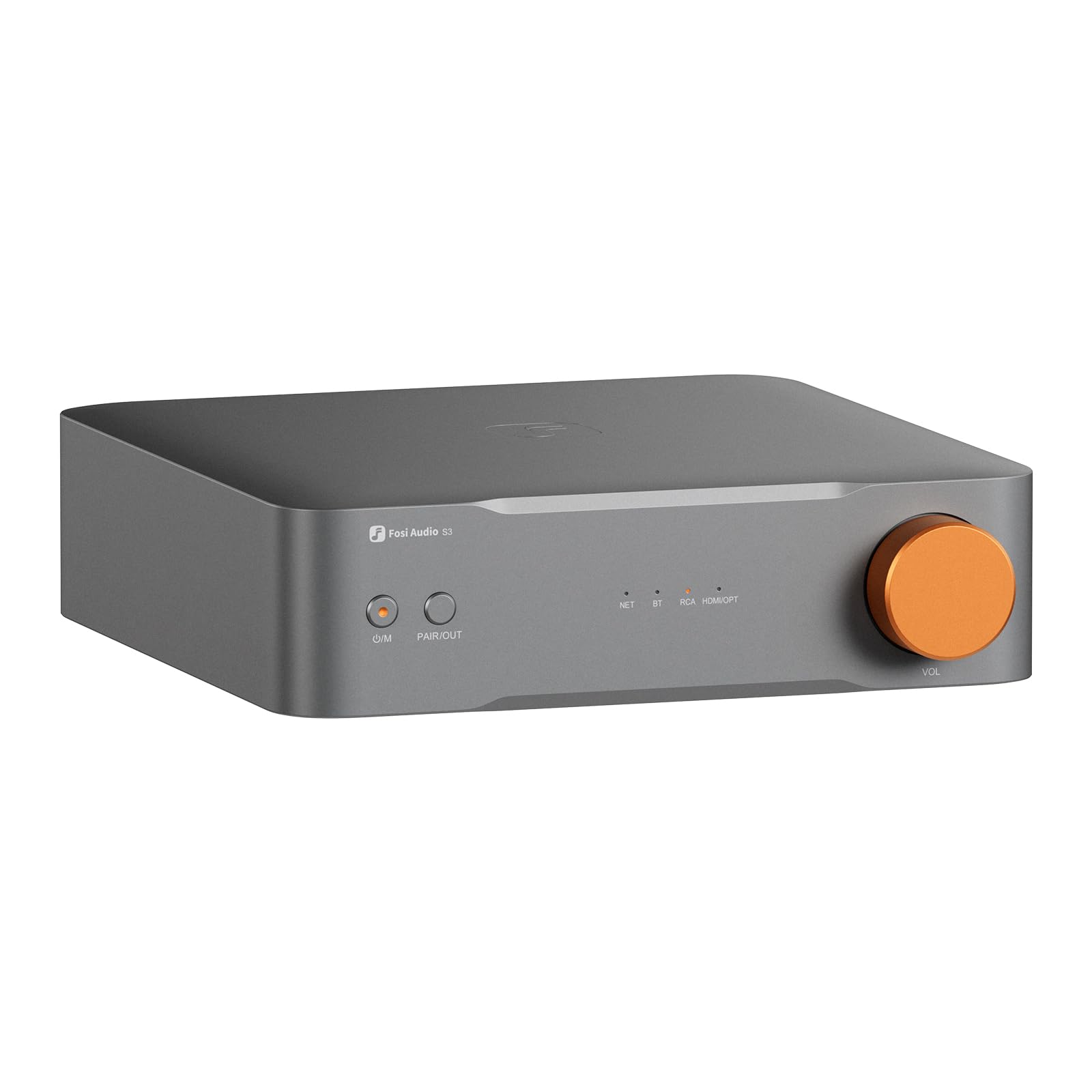
The Fosi Audio S3 delivers features typically found in streamers costing twice as much: a flagship AK4493SEQ DAC, true balanced XLR outputs, Wi-Fi 6, Bluetooth 5.3 with aptX Adaptive, HDMI eARC, and a dedicated subwoofer out. The DAC chip supports PCM up to 32-bit/384kHz with THD+N of just 0.00018% and a signal-to-noise ratio exceeding 120dB. These are genuine high-fidelity specs that rival many midrange dedicated DACs.
Connectivity is exceptionally versatile for the price tier: HDMI eARC pulls TV audio into your stereo system, optical and RCA inputs accept legacy sources, and the XLR balanced outputs connect directly to professional monitors or high-end amplifiers with superior noise rejection. The Fosi Audio App provides playback control and a 5-band EQ, though the app is notably basic compared to WiiM’s offering. The compact chassis (6.8 inches square) fits easily on any desk or shelf, and the 12V trigger allows automatic power-on with your amplifier.
User reports are generally positive for sound quality, with the S3 outperforming WiiM’s internal DAC for some listeners, but there are notable caveats. The optical output on at least one unit was defective, and customer support responsiveness is unverified at this scale. The app and software are clearly in early development stages, lacking Bluetooth TX mode (reception only) and having a slow source-switching reconnection time. This is a promising debut from Fosi in the streaming space, but the software maturity lags behind the excellent hardware.
Why it’s great
- AK4493SEQ DAC with XLR balanced outputs for professional-grade noise rejection
- Wi-Fi 6, Bluetooth 5.3, HDMI eARC, and subwoofer out in a compact chassis
- Reference-grade specs: 0.00018% THD+N and 120dB+ SNR
Good to know
- App and software are bare-bones; no Bluetooth TX mode
- Slow source switching and reconnection times reported by multiple users
- Quality control concerns — optical output defects reported on early units
9. Yamaha R-N800A Network Receiver

The Yamaha R-N800A is the step-up sibling of the R-N600A, adding a more powerful amplifier section (100 watts per channel), a higher-grade ESS Sabre ES9080Q Ultra DAC, and — crucially — YPAO-R.S.C. (Reflected Sound Control) automatic room correction. The YPAO system measures your room’s acoustics using the supplied microphone and applies precision EQ to compensate for standing waves, boundary reflections, and seating position irregularities, a feature usually reserved for multi-thousand-dollar AV receivers.
The R-N800A supports native DSD 11.2MHz and 384kHz PCM playback, and its USB-B input turns it into a high-performance DAC for connected computers. The MusicCast app is significantly more stable than competitors like HEOS, and the receiver can stream from Spotify, TIDAL, Qobuz, and internet radio without any additional hardware. Reviewers consistently note the organic, involving sound quality — less clinical than some Class-D competitors, with a weighty, natural presentation that makes vinyl, digital, and streaming sources all sound equally compelling.
The sheer weight of the R-N800A (25.2 pounds) hints at its oversized toroidal transformer and generous heat sinking, delivering genuine power into difficult speaker loads. The build quality is top-notch, with a thick metal front panel and robust binding posts. The main downsides are the thin sheet metal on the rear-panel RCA input section, which feels flimsy compared to the rest of the chassis, and a cheap-feeling remote. The YPAO calibration is effective but some users prefer the “off” setting for a fuller, less corrected sound.
Why it’s great
- YPAO-R.S.C. automatic room correction optimizes sound for your specific listening space
- ESS ES9080Q Ultra DAC with native DSD 11.2MHz and 384kHz PCM support
- Genuine 100W/ch with oversized toroidal transformer and high-current design
Good to know
- Rear-panel RCA inputs use thin sheet metal — feels fragile
- Plastic remote control doesn’t match the premium receiver quality
- Volume levels vary significantly between inputs; normalization is manual
FAQ
Do I need an audio media streamer if my amplifier already has Bluetooth?
What is the difference between Roon Ready and Chromecast built-in?
Can I use an audio media streamer with powered speakers?
Why would I choose a streamer with Android over a proprietary OS?
Final Thoughts: The Verdict
For most users, the best audio media streamer winner is the WiiM Ultra because it combines a class-leading DAC, flexible inputs including HDMI and phono, and the most responsive control app in the category — all at a price that undercuts rivals with similar feature sets. If you need true balanced XLR outputs and ultra-low noise for a professional monitoring setup, the EVERSOLO DMP-A6 Gen 2 delivers a gorgeous touchscreen experience and reference-grade streaming. For Apple Music users in the BluOS ecosystem, the Bluesound Node Nano offers seamless AirPlay 2 integration and the most reliable multi-room platform.