
Getting reliable over-the-air TV in a basement is one of the most challenging reception scenarios you can face. Concrete walls, below-grade positioning, and steel beams create a signal graveyard that standard indoor antennas simply cannot penetrate. You need a unit engineered to punch through these obstacles.
I’m Min — the co-founder and writer behind Gadgets Feed. I’ve spent hundreds of hours analyzing signal propagation, amplifier gain ratings, and customer reception reports specifically for below-grade installations to find the antennas that actually work down there.
After cross-referencing real-world basement performance data, I’ve identified the seven models that consistently deliver. This guide covers the best antenna for tv in basement based on concrete specs and verified user results.
How To Choose The Best Antenna For TV In Basement
Selecting an antenna for a basement is not like buying one for an attic or a living room window. The physics of signal penetration changes drastically below grade. You must prioritize raw gain, proper filtering, and the ability to aim accurately through obstructions.
Amplification and Preamp Gain
An unamplified antenna will almost certainly fail in a basement. The signal from broadcast towers loses significant strength passing through concrete and earth. Look for models with a built-in high-gain amplifier, ideally with independent gain control for UHF and VHF bands. The Televes DiNova Boss Mix, for example, uses intelligent gain control that automatically adjusts amplification per band to avoid overloading or underpowering the signal.
Directional vs. Omnidirectional Design
In a basement, you cannot rely on signal coming from multiple directions because most of it is blocked. A directional Yagi or multi-element loop antenna (like the Antennas Direct ClearStream 4V) focuses reception toward the nearest broadcast tower cluster, pulling in weaker signals that omni-directional designs would miss. If you have multiple tower clusters in different directions, a motorized rotator (found on the Five Star and PBD models) lets you aim remotely from downstairs.
Cable Quality and Splitter Loss
Long cable runs from a basement to an attic or roof mount are common. RG6 coax cable with proper shielding is non-negotiable. Every splitter you add cuts signal strength roughly in half. Models that include 40-foot RG6 cables and dedicated multi-TV ports (like the Five Star 150-mile model) help you minimize connector losses.
Quick Comparison
On smaller screens, swipe sideways to see the full table.
| Model | Category | Best For | Key Spec | Amazon |
|---|---|---|---|---|
| Televes DiNova Boss Mix 144286 | Premium Outdoor | Intelligent gain for weak signals | 29 dBi VHF / 34 dBi UHF | Amazon |
| Antennas Direct ClearStream 4V | High-Performance | Multi-directional 4-loop design | 70+ mile range | Amazon |
| Five Star Yagi 200 Mile | Long Range | Extended Yagi elements for reach | 200 mile max range | Amazon |
| PBD Amplified 360° Motorized | Motorized | Remote-controlled rotation | 150 mile max range | Amazon |
| Five Star 150 Mile 360° Rotation | Motorized / Multi-TV | Supports up to 5 TVs | 40 ft RG6 + 4-way splitter | Amazon |
| Mohu Leaf Amplified | Indoor Slim | Discreet indoor placement | 0.04 inch thin | Amazon |
| 1byone Omni-Directional | Omni-Directional | No aiming required | 100+ mile range | Amazon |
In‑Depth Reviews
1. Televes DiNova Boss Mix 144286

The Televes DiNova Boss Mix is engineered for difficult reception environments, making it the top pick for basement installations. Its TForce intelligent gain control adjusts amplification independently for UHF and VHF bands, preventing the signal overload or dropout that plagues fixed-gain amplifiers when conditions fluctuate. This is critical when your signal is already fighting through concrete and earth.
Built-in filtering for FM, LTE, 4G, and 5G interference is a major advantage in a basement where cell signals may be the strongest ambient radio source. The directional Yagi-style UHF array with 7 elements focuses reception precisely on broadcast towers, and the weather-resistant radome housing allows outdoor or attic mounting for maximum elevation. Users report pulling in stations from 90 miles away in challenging terrain.
The included 12V dual-output power inserter and J-mount bracket simplify installation, and the unit works in passive mode if power is lost. While it carries a premium price, the combination of adaptive gain, comprehensive filtering, and professional-grade build quality justifies the investment for a basement scenario where lesser antennas simply fail.
Why it’s great
- Intelligent band-specific gain control prevents signal issues
- Integrated 4G/5G and FM filtering reduces interference
- Weatherproof radome for outdoor or attic placement
Good to know
- Premium price point may exceed budget for some
- Mounting fasteners are not included
2. Antennas Direct ClearStream 4V
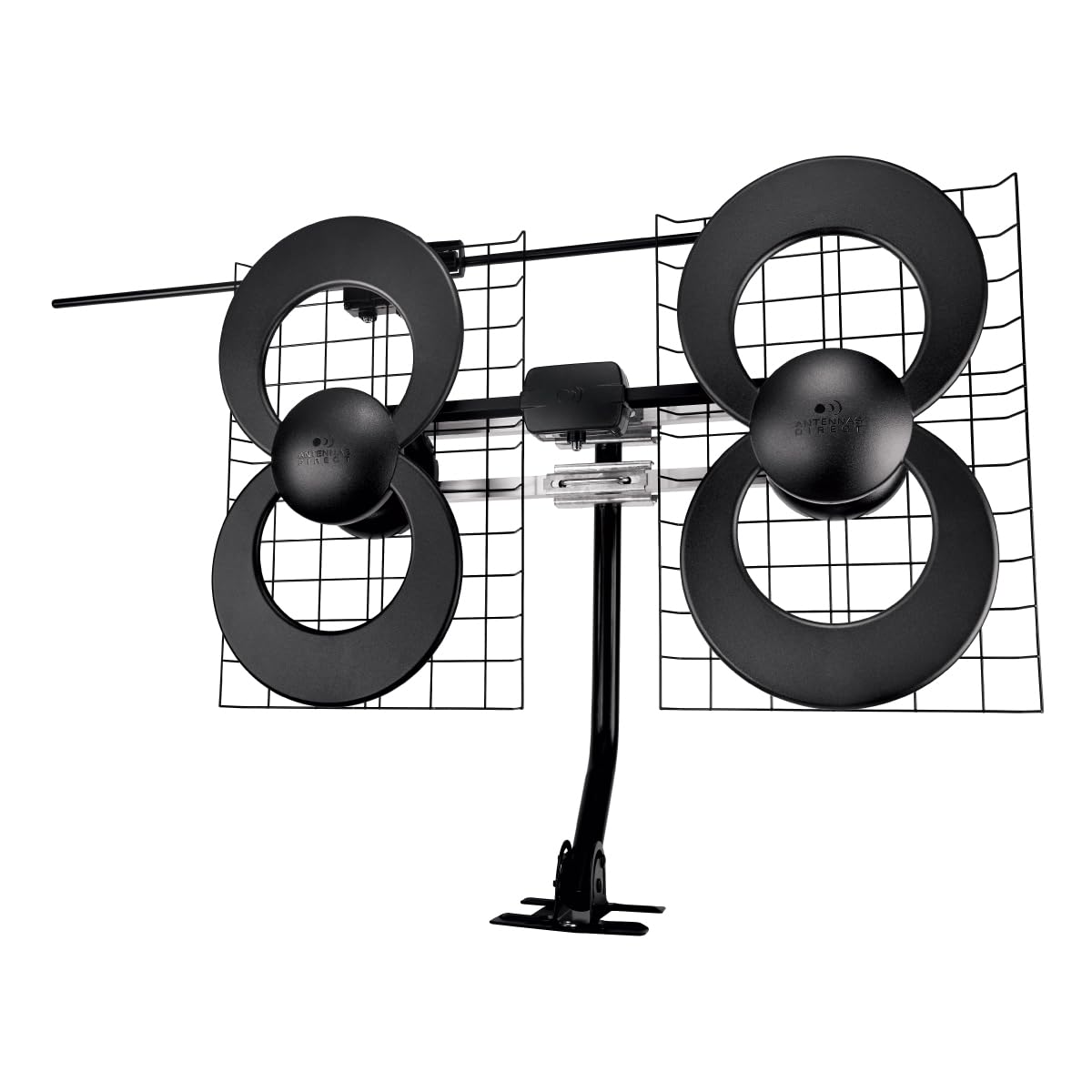
The ClearStream 4V uses four patented phase-loop elements to achieve multi-directional reception with serious forward gain. For basement use, this design is particularly effective because it can capture signals reflected off buildings or terrain that a strictly directional antenna might miss. The included 20-inch mast with a pivoting base allows flexible aiming even in tight attic spaces above the basement.
At 27.8 inches wide with reflectors, this antenna is larger than some competitors, but that surface area directly translates to better UHF signal capture. User reports consistently mention pulling in 60 to 70 channels from 35 miles away through heavy tree cover when mounted in an attic, which is comparable to the attenuation a basement wall produces. The VHF kit assembly requires attention, but the performance payoff is significant.
This model is NEXTGEN TV and 4K/8K UHD compatible, future-proofing your setup. The durable build and rigid combiners have earned praise from users who previously suffered pixelation with cheaper antennas. For a basement scenario where you can mount it in a crawl space or attic above, this is a reliable heavy hitter.
Why it’s great
- Multi-directional loops capture reflected signals
- Solid build quality with rigid metal components
- NEXTGEN TV and 4K/8K UHD ready
Good to know
- Large footprint requires adequate mounting space
- VHF kit assembly can be tricky
3. Five Star Yagi Satellite HD TV Antenna 200 Mile

Five Star’s Yagi design extends the receiving elements longer than typical outdoor antennas, which directly improves VHF and UHF capture in low-signal environments. The 200-mile claim is ambitious, but in practice, users in rural and hilly areas report pulling in 35 to 62 channels with clear HD quality when mounted just 10 feet off the ground. This suggests the gain structure is genuinely effective for below-grade signal hunting.
The package includes a 40-foot RG6 coaxial cable, a 4-way splitter, cable clips, and a 20-inch mounting pole — everything needed to run the signal from an outdoor or attic mount down to a basement TV. The antenna is pre-assembled in part, though full assembly is required. Some users noted the instructions are vague, but the hardware is straightforward for anyone comfortable with basic tools.
Weatherproof construction with lightning protection is included, though the plastic mount has drawn criticism for durability concerns in high winds. For basement use, mounting it on a side wall or eave rather than a tall mast reduces wind exposure while still getting the antenna above ground level. The smart chip technology reduces signal noise, which is crucial when the signal is already weakened by obstacles.
Why it’s great
- Extended Yagi elements boost weak signal capture
- Complete installation kit with 40 ft cable and splitter
- Lightning protected weatherproof construction
Good to know
- Plastic mount may need reinforcement for windy areas
- Assembly instructions are minimal
4. PBD Amplified Outdoor TV Antenna 360° Motorized

The PBD antenna solves the basement aiming problem with a 360-degree motorized rotation controlled by wireless remote. Since you cannot see the antenna from a basement window, the ability to sweep through directions while watching the signal meter on your TV is a massive practical advantage. The motor is built into the control box, and the antenna connects via a single coaxial cable.
With a built-in high-gain amplifier and 75-ohm impedance, this unit is rated for up to 150 miles. Real-world user reports show it replacing older Mohu Sky 60 antennas with better channel counts and reduced pixelization, even in ground-floor and obstructed apartment locations. The dual TV output means you can feed a basement TV and an upstairs TV simultaneously without an external splitter.
The package includes 40 feet of RG6 cable and mounting hardware. The lifetime warranty and 24/7 customer support provide peace of mind. Some users noted the remote requires AAA batteries (not included) and that the motorized rotation can feel imprecise when fine-tuning, but overall it delivers consistent results for multi-directional basement installations.
Why it’s great
- Remote-controlled 360° rotation for easy basement aiming
- Dual TV outputs without external splitter
- Lifetime warranty with responsive customer support
Good to know
- Remote needs AAA batteries not included
- Fine-tuning rotation can feel imprecise
5. Five Star HDTV Antenna Amplified Digital Outdoor 150 Mile

This Five Star model combines a 360-degree motorized rotator with a 4-way splitter included in the box, making it the most practical choice for feeding a basement TV plus multiple other sets in the house. The amplifier and smart chip provide automatic gain control to reduce noise, and the 150-mile range rating gives you headroom for challenging below-grade installations.
The antenna uses five reflector elements that extend and attach to the main unit with reflection panels. Assembly is straightforward, and the 40-foot RG6 coaxial cable allows flexible placement. The rotator is controlled via a remote (AAA batteries required), and the control box includes a manual button on the unit itself. A key installation note: the splitter must be connected to the RF IN/TV2 port — not the main antenna input — for the rotation to function properly.
User feedback highlights strong performance in valley locations where previous antennas failed entirely, pulling in 61 clear HD channels. However, some units experienced plastic mount failure after six months, and the remote lacks a directional compass display, making it harder to know which direction the antenna is pointing without visual confirmation. For basement use where you can mount it in an attic or on an eave, the multi-TV capability is unmatched at this price tier.
Why it’s great
- Includes 4-way splitter for multi-room distribution
- 360-degree motorized rotation for signal hunting
- 40 ft RG6 cable included for flexible placement
Good to know
- Plastic mount durability concerns reported
- Remote lacks direction indicator for precise aiming
6. Mohu Leaf Amplified Indoor TV Antenna

The Mohu Leaf Amplified is a slim, paper-thin indoor antenna designed for discretion, but its real value in a basement comes from the Jolt Switch in-line amplifier. This USB-powered amplifier lets you toggle the boost on or off in real time, which helps when a signal is borderline — turning the amp on can push it over the threshold for a stable picture, while turning it off can reduce overload if you’re close to a tower despite being below grade.
The multi-directional UHF and Hi-VHF elements receive signals from front and back, which is helpful when you cannot point the antenna toward a window. The 60-mile range is modest compared to outdoor units, but in suburban areas where towers are within 30 miles, users in brick homes have reported finding 47 crystal-clear channels versus 21 with budget antennas. The 12-foot coaxial cable is relatively short, so placement near a basement window is recommended.
At 7 ounces and 9.25 inches tall, this antenna is the easiest to mount of any in this list — hook-and-loop tabs and push pins are included. It is not a powerhouse, but for a finished basement with a window facing toward broadcast towers, it provides a clean, zero-tools solution. The one-year warranty and Mohu’s reputation for USA-engineered designs add confidence.
Why it’s great
- Ultra-thin design with discrete wall mounting
- Jolt Switch amp allows real-time gain toggling
- Multi-directional reception from front and back
Good to know
- 12 ft cable may be too short for distant windows
- 60-mile range is lower than outdoor models
7. 1byone Outdoor TV Antenna 360° Omni-Directional

The 1byone antenna uses a 360-degree omni-directional design that eliminates the need for aiming. For basement use, this is a double-edged sword: you do not need to know where towers are, but you also sacrifice the focused gain that a directional antenna provides. The smart pass amplifier technology boosts signals at the antenna itself, reducing losses from long cable runs — a key advantage when running coax from an attic or outdoor mount down to a basement.
With a built-in 4G LTE filter, this antenna removes interference from cell towers, which can be a significant issue in basements where mobile signals penetrate better than TV broadcasts. The unit is moisture-proof and flame-retardant, suitable for attic or outdoor placement. A 32-foot RG6U coaxial cable is included, giving enough reach for most basement drops. The compact 11.8-inch diameter makes it easy to fit in tight attic spaces.
User experiences vary widely by location. In Manhattan, a user got 60 channels with local networks coming in sharp, while another near Los Angeles initially got 124-149 channels but later saw the count drop. The key limitation for basement use is that omni-directional antennas trade peak gain for convenience, so if you are far from towers or have dense concrete above you, this model may underperform compared to a directional Yagi. It is best suited for basement windows facing open terrain or for attics with relatively clear sightlines.
Why it’s great
- No aiming required — receives from all directions
- Built-in 4G LTE filter reduces cell interference
- Compact, weatherproof design for attic placement
Good to know
- Less peak gain than directional Yagi designs
- Performance varies significantly by location
FAQ
Will a standard indoor antenna work in a basement?
Should I mount the antenna in the attic or outdoors for basement TV?
How do I aim a basement antenna if I cannot see the tower?
Does the 4G/5G filter matter for basement reception?
Final Thoughts: The Verdict
For most users, the best antenna for tv in basement winner is the Televes DiNova Boss Mix 144286 because its intelligent gain control and comprehensive filtering handle the unique signal challenges of below-grade placement better than any other model. If you want remote-controlled aiming without climbing up to adjust, grab the PBD Amplified Motorized Antenna. And for multi-room distribution with a motorized rotator at a reasonable price, nothing beats the Five Star 150 Mile 360° Rotation model.