
The moment the ball leaves the kicker’s foot or the runner explodes out of the blocks, your camera needs to lock focus and fire frames faster than your thumb can move. For a beginner stepping onto the sidelines, the challenge is balancing a capable burst rate and reliable autofocus with a budget that doesn’t require a second mortgage. The right body and lens pairing is the difference between a blurry mess and a sharp sequence of game-winning action.
I’m Min — the co-founder and writer behind Gadgets Feed. My market research has involved analyzing hundreds of spec sheets across mirrorless and DSLR platforms, comparing continuous shooting speeds, buffer depths, and AF point coverage to find the cameras that give new sports shooters the best chance at a clean shot.
This guide breaks down the top options in mirrorless and DSLR formats to help you find the perfect beginner camera for sports photography that matches your skill level and budget.
How To Choose The Best Beginner Camera For Sports Photography
Sports photography is a discipline where the gear’s handling speed matters more than absolute pixel count. A beginner needs a body that can keep up with the action without breaking the bank or overwhelming them with complex menus. Here are the key areas to focus on.
Burst Rate and Buffer Depth
This is your number one spec. Burst rate, measured in frames per second (fps), tells you how many continuous shots the camera can capture while you hold down the shutter. For most field and court sports, 5 fps is the bare minimum, 8 fps is comfortable, and 11 fps or higher gives you a real advantage. Just as critical is the buffer depth — how many frames the camera can fire before it slows down. A deep buffer lets you capture a full play sequence without waiting for the camera to write to the memory card.
Autofocus System and Tracking Capability
Phase-detection autofocus points that cover a wide area of the sensor are essential. Look for models with subject tracking that can lock onto a player or ball and follow it across the frame. The more autofocus points, and the closer they cover the frame edge, the easier it is to keep a fast-moving runner or ball in sharp focus. AI-based systems that recognize specific subjects (people, animals, vehicles) are a genuine step-change in this category.
Lens Compatibility and Reach
The body is only half the equation. A crop-sensor (APS-C) body gives you a 1.5x or 1.6x magnification factor, turning a 55-200mm kit zoom into an effective 82.5-300mm lens — pure gold for sideline shooting. Mirrorless systems offer adapters for DSLR glass, which can save a beginner significant money. Prioritize a system with a strong lens ecosystem where you can eventually add a fast telephoto prime or a 70-200mm f/2.8.
Quick Comparison
On smaller screens, swipe sideways to see the full table.
| Model | Category | Best For | Key Spec | Amazon |
|---|---|---|---|---|
| Sony a7 III | Full-Frame Mirrorless | Low-light sports & pro-level hybrid use | 10 fps / 693 phase-detect AF points | Amazon |
| Sony Alpha a6400 | APS-C Mirrorless | Fast AF & compact action kit | 11 fps / 0.02 sec AF / 425 phase-detect points | Amazon |
| Canon EOS R8 | Full-Frame Mirrorless | 40 fps electronic shutter for peak action | 40 fps (e-shutter) / uncropped 4K60 | Amazon |
| Sony Alpha 7 IV | Full-Frame Mirrorless | High-res stills + reliable tracking | 33MP / 693 phase-detect AF / 10 fps | Amazon |
| Sony Alpha 6700 | APS-C Mirrorless | AI-powered subject tracking | 26MP / AI processor / 4K120p | Amazon |
| Panasonic LUMIX G85 | Mirrorless MFT | Stabilized 4K video and hybrid shooting | 5-axis IBIS / 4K Photo at 30 fps | Amazon |
| Nikon D3300 | DSLR | Two-lens budget kit for field sports reach | 5 fps / 24.2MP / 11 AF points w/ 3D tracking | Amazon |
| Canon EOS RP | Full-Frame Mirrorless | Entry-level full-frame for daytime sports | 24.2MP / 5 fps / Dual Pixel AF | Amazon |
| Nikon Z50 II | APS-C Mirrorless | Compact travel kit with two zoom lenses | 20.9MP / 4K60 / subject detection (9 types) | Amazon |
| OM SYSTEM Olympus E-M10 IV | Mirrorless MFT | Lightweight everyday carry for action | 20MP / 5-axis IBIS / 121 contrast-detect points | Amazon |
| Canon EOS Rebel T7 Bundle | DSLR | All-in-one kit with telephoto add-on | 3 fps / 24.1MP / 9-point AF / 500mm lens incl. | Amazon |
In‑Depth Reviews
1. Sony a7 III Full-Frame Mirrorless with 28-70mm Lens

The Sony a7 III sits at a sweet spot for a beginner who wants full-frame performance without jumping straight into a professional-level price bracket. Its 24.2MP back-illuminated sensor delivers excellent noise control at high ISOs, which is crucial when you’re shooting under stadium lights at dusk. The 693 phase-detection points cover 93% of the frame, and the 10 fps burst with AE/AF tracking ensures you can follow a receiver down the sideline without losing focus.
The in-body image stabilization is a strong safety net for handheld pans, and the 15-stop dynamic range gives you room to recover shadow detail in a player’s dark jersey. Battery life is stellar at around 710 shots per charge — a practical advantage when you’re shooting a full day of tournaments. The included 28-70mm f/3.5-5.6 kit lens is decent for basic coverage, though you will want a longer telephoto zoom for tighter cropped action on the field.
Where the a7 III really shines for a beginner is its forgiving nature: the menu system is deep, but the core autofocus and burst controls are accessible. It is a body that can grow with you as your skills improve, handling everything from weekend soccer matches to indoor basketball.
Why it’s great
- Exceptional high ISO performance for low-light sports
- 693 phase-detection AF points with reliable tracking
- Long battery life for all-day tournament shooting
Good to know
- Requires a fast telephoto lens for field sports
- Menu system can be overwhelming at first
- Kit lens is a basic starter; expect to upgrade soon
2. Sony Alpha a6400 Mirrorless Camera Body

The Sony a6400 is arguably the most autofocus-capable camera in this roundup when measured against its price. Its 0.02-second acquisition speed and 425 phase-detection points spread across 84% of the sensor make tracking a sprinting athlete almost effortless. The 11 fps continuous shooting with real-time tracking is fast enough to capture the peak moment of a jump shot or a goal celebration without dropping frames.
It records 4K video with full pixel readout and no pixel binning, which is a strong addition for a beginner who wants to shoot highlight reels or training drills. The flip-up 180-degree touchscreen is good for low-angle shots on the track or court, and the compact body means you can pack it in a smaller bag alongside a telephoto lens. Battery life is decent but not class-leading, so you will want a spare for a long day of shooting.
The sensor is APS-C, which gives you a 1.5x focal length multiplier — meaning a 50mm lens behaves like a 75mm, and a 70-200mm lens gives you an effective 105-300mm reach. That crop factor is a real advantage for a beginner on a budget, because a shorter, cheaper lens delivers more apparent reach on the field.
Why it’s great
- Incredibly fast and accurate autofocus for the price
- APS-C crop factor boosts telephoto lens reach
- 4K video with full pixel readout
Good to know
- Menu system is complex and requires time to learn
- No in-body image stabilization
- Rolling shutter noticeable in 4K with fast panning
3. Canon EOS R8 Mirrorless Camera Body

The Canon EOS R8 is a full-frame body that borrows the core autofocus and processing engine from the much pricier R6 Mark II, making it a standout choice for a beginner who wants professional-level speed. The 40 fps electronic shutter with full autofocus tracking is a class above the competition at this price level — it practically guarantees you will freeze the action at the exact peak. Dual Pixel CMOS AF II covers 100% of the frame with 1,053 zones and uses deep learning to detect people, animals, and even aircraft and trains.
The 24.2MP sensor delivers uncropped 4K60 video oversampled from 6K, plus Full HD 180 fps slow motion for dramatic replay clips. It is Canon’s lightest full-frame RF-mount body, which matters when you are holding it with a telephoto lens for hours on the sidelines. The vari-angle touchscreen gives you flexibility for low perspective shots on the baseline.
The main trade-offs are the lack of in-body stabilization (you rely on lens-based IS), a smaller LP-E17 battery that may need swapping during a long game, and the 6 fps mechanical shutter limit. But for a beginner focused on capturing fast action, the R8’s burst speed and autofocus accuracy are hard to beat.
Why it’s great
- 40 fps electronic shutter with full AF tracking
- Shared autofocus system with the R6 Mark II
- Uncropped 4K60 from oversampled 6K
Good to know
- No in-body image stabilization
- Small battery, expect to carry a spare
- Overheating possible after ~30 min 4K60 recording
4. Sony Alpha 7 IV Full-frame Mirrorless

The Sony Alpha 7 IV is a 33MP full-frame powerhouse that offers a step up in resolution while maintaining strong speed with 10 fps continuous shooting and reliable real-time Eye AF for both people and animals. The 693 phase-detection points and BIONZ XR processor provide fast and accurate subject acquisition, which is essential when a player is sprinting directly toward you. The 7K oversampling for 4K30p video delivers crisp slow-motion replays.
Build quality is excellent with a weather-sealed magnesium alloy body, dual card slots (SD and CFexpress Type A), and an articulating touchscreen that is ideal for getting creative low angles on the field. Battery life is impressive at over 2,000 shots per charge, which means you can shoot a full day of games without needing a battery swap. The S-Cinetone color profile is a nice bonus if you plan to shoot interviews or post-game features alongside the action.
For a beginner, the Alpha 7 IV is a body that will not hold you back as your sports photography skills develop. The higher resolution gives you cropping flexibility in post-production, and the autofocus system is reliable enough to trust on a fast break or a sideline sprint.
Why it’s great
- High 33MP resolution for cropping tight on action
- Excellent battery life for marathon shooting sessions
- Dual card slots for backup security
Good to know
- Higher price point for a beginner budget
- Menu system is complex for absolute newcomers
- No built-in flash
5. Sony Alpha 6700 APS-C Mirrorless

The Sony Alpha 6700 is a significant generational leap in the APS-C lineup thanks to its dedicated AI processing unit. This chip drives subject recognition that can identify and track specific body parts, making it remarkably effective at keeping a running player’s face or eye in sharp focus even during sudden direction changes. The 26MP Exmor R sensor and BIONZ XR engine deliver 4K120p high-frame-rate video, which is a serious asset for capturing slow-motion replays of a touchdown or a pitch.
The 759 phase-detection points provide dense coverage across the frame, and the AI processor handles complex scenes with multiple moving subjects well. The electronic viewfinder is clear and responsive, and the flip-out rear screen works for vlogging or low-angle shooting on the sideline. Build quality is solid with a magnesium alloy frame, and the smaller E-mount body keeps weight down when you add a telephoto lens.
One limitation is the lack of a built-in flash, so you are dependent on the available light or an external unit. The menu system is deep and feature-rich, which may take a few sessions to navigate comfortably. But for a beginner who values cutting-edge autofocus technology, the Alpha 6700 is an incredibly capable tool for capturing action.
Why it’s great
- Dedicated AI processor for superior subject tracking
- 4K120p high-frame-rate video for slow-motion
- Compact APS-C body with 1.5x telephoto boost
Good to know
- No built-in flash
- Menu system is complex for beginners
- In-body stabilization is decent but not gimbal-level
6. Panasonic LUMIX G85 with 12-60mm Lens

The Panasonic LUMIX G85 stands out for its class-leading 5-axis in-body dual image stabilization, which works in tandem with the lens OIS to produce remarkably steady handheld shots and video. For a beginner shooting sports, this stabilization is a practical advantage when you are panning with a runner or shooting handheld with a longer lens. The 16-megapixel Micro Four Thirds sensor (with the low-pass filter removed) delivers about 10% more fine detail resolving power than earlier 16MP MFT sensors, and the 4K Photo mode lets you pull 8-megapixel stills at 30 fps from video.
The splash-proof magnesium alloy body has a deep ergonomic grip that fits well for extended use. The tilt-and-touch 3-inch LCD is useful for getting low shots on the court, and the eye-level OLED viewfinder is crisp. Autofocus is generally reliable in good light but can struggle with tracking in lower-light conditions — something to consider for evening games.
Battery life is a known weak area, so packing a spare is advisable. The 12-60mm kit lens is versatile with a useful range, but you will want a longer telephoto for true sideline action. The G85 is a great value introduction to the Micro Four Thirds ecosystem, which offers a huge range of affordable lenses.
Why it’s great
- Excellent 5-axis in-body stabilization
- 4K Photo mode pulls high-res stills at 30 fps
- Weather-sealed magnesium alloy body
Good to know
- Battery life is below average
- Autofocus can struggle in low light
- No headphone jack for video monitoring
7. Nikon D3300 with 18-55mm & 55-200mm Lenses

The Nikon D3300 is a classic beginner’s DSLR that earns its place with a very strong two-lens kit. The 18-55mm VR II and 55-200mm VR II lenses cover a wide range, with the 200mm end reaching an effective 300mm on the APS-C sensor — enough to fill the frame with a player on a soccer field. The 24.2MP CMOS sensor delivers excellent image quality with great dynamic range, and the 5 fps burst rate with 3D tracking is effective for slower to moderate action.
The optical viewfinder is bright and shows real-time feedback with minimal lag, which is preferable to some entry-level EVFs for tracking moving subjects. The Guide Mode built into the camera is genuinely helpful for a beginner who is still learning the relationship between shutter speed, aperture, and ISO. The compact and lightweight body makes it easy to carry alongside a second lens in the included case.
With only 11 AF points, the D3300’s autofocus coverage is limited compared to modern mirrorless systems, and 5 fps is at the low end of acceptable for fast-paced sports. The lack of built-in Wi-Fi (you need an optional adapter) is a minor inconvenience. But for the price, this kit gives you a capable stills camera and two lenses that can get you started shooting sports without a huge financial commitment.
Why it’s great
- Two-lens kit provides real field reach (55-200mm)
- Excellent image quality and dynamic range
- Helpful Guide Mode for absolute beginners
Good to know
- Only 5 fps burst and 11 AF points
- No built-in Wi-Fi
- Optical viewfinder means no exposure preview
8. Canon EOS RP with RF24-105mm Lens

The Canon EOS RP offers one of the most affordable entry points into the full-frame mirrorless world. The 24.2MP CMOS sensor and DIGIC 8 engine provide strong image quality with good high-ISO performance — a genuine advantage for shooting sports under less than perfect lighting. The RF 24-105mm f/4-7.1 IS STM kit lens gives you a wide-to-medium telephoto range that is useful for group shots and closer action, and the 5-stop optical image stabilization helps keep panning shots smooth.
The Dual Pixel CMOS AF is responsive and phase-detection fast, with good face tracking that works well for portrait and documentary-style shooting. The vari-angle LCD is great for getting creative angles, and the camera body is light and compact enough to handhold for extended periods. The menu system is Canon’s typically well-organized interface, which beginners will find easier to learn than some competitors.
The burst rate is capped at 5 fps with continuous AF, which is the main limitation for serious sports use — you will miss the peak of fast action. The kit lens is also slow at the telephoto end (f/7.1 at 105mm), making it less ideal for low-light field sports. Consider the EOS RP if you value full-frame image quality and intend to pair it with a fast prime or a longer telephoto zoom.
Why it’s great
- Affordable full-frame mirrorless entry
- Good high-ISO performance for low light
- Canon’s user-friendly menu and touchscreen
Good to know
- Only 5 fps burst with continuous AF
- Kit lens is slow at longer focal lengths
- Not ideal for fast-paced field sports
9. Nikon Z50 II with Two Lenses

The Nikon Z50 II is a refreshed APS-C mirrorless camera that comes with two compact Z-mount lenses: the 16-50mm f/3.5-6.3 VR and the 50-250mm f/4.5-6.3 VR. The two-lens kit gives you wide-angle for sidelines and a 250mm telephoto (effective 375mm on the crop sensor) for pulling in distant action. The 20.9MP DX sensor is paired with an autofocus system that can detect and track nine distinct subjects including people, dogs, cats, birds, and vehicles — a practical tool for youth sports where animals occasionally get onto the field too.
The electronic viewfinder is clear and responsive, and the built-in flash helps for fill-in light on overcast days. The Picture Control button on the front gives you quick access to 31 color presets, which can be a fun and fast way to get shareable JPEGs straight out of camera. The 4K60p video with 120p slow-motion capability in Full HD is solid for capturing replay clips.
The Z50 II is a lightweight, portable system that is easy to bring to a game. The main caveat for serious sports use is the f/6.3 maximum aperture at the long end of the telephoto, which limits low-light performance. For well-lit daytime games, however, this is a very capable and compact solution.
Why it’s great
- Two-lens kit provides wide to 250mm reach
- 9-subject detection autofocus system
- Compact and lightweight for easy sideline carry
Good to know
- Kit telephoto is slow at f/6.3 for low light
- Built-in flash is weak for distance
- Nikon lens ecosystem for Z DX is still growing
10. OM SYSTEM Olympus E-M10 Mark IV with 14-42mm Lens

The OM SYSTEM Olympus E-M10 Mark IV is a compact and beautifully built Micro Four Thirds camera that emphasizes portability without sacrificing core capabilities. The 20MP Live MOS sensor combined with 5-axis in-body image stabilization (rated at 4.5 stops of compensation) is a powerful tool for keeping shots steady when using longer lenses in low light. The 121 contrast-detect autofocus points are fast and accurate for single-shot focus, though continuous tracking of fast-moving subjects is not its strongest suit.
The flip-down touchscreen makes the E-M10 IV one of the easier cameras for getting a selfie or a low-to-ground shot. The 16 art filters, including a new Instant Film mode, add a creative layer for post-game event photography. The body is small enough to fit into a jacket pocket with the 14-42mm pancake lens attached, so you can bring it to a game without it being a burden.
Burst speed is adequate for slower action but not ideal for fast-paced sports, as the camera can slow down significantly when the buffer fills. The kit lens is a standard zoom with a moderate range, so you will need a dedicated telephoto lens for field sports. It is best suited for a beginner who wants a general-purpose camera that can also handle occasional sports shooting.
Why it’s great
- Very compact and portable with 5-axis IBIS
- Creative art filters for in-camera effects
- Excellent build quality and retro design
Good to know
- Burst speed and buffer limited for fast action
- Kit lens is basic; telephoto lens needed
- App connectivity can be slow
11. Canon EOS Rebel T7 Bundle with 500mm Telephoto
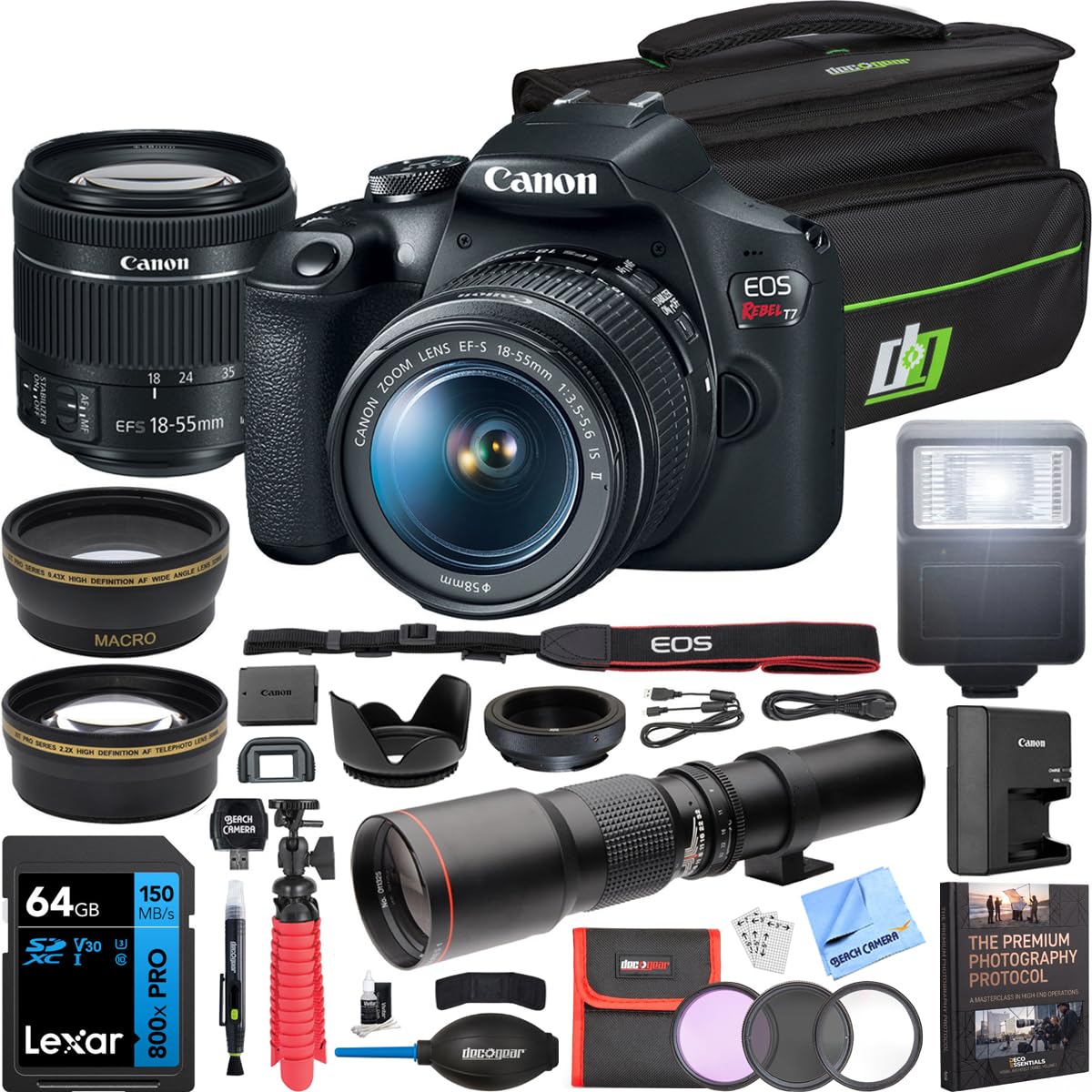
The Canon EOS Rebel T7 bundle is the most budget-oriented option in this guide, and it is frankly the easiest recommendation for a complete beginner who wants everything in one box. The core camera is a 24.1MP APS-C DSLR with a 9-point AF system and 3 fps continuous shooting — specs that are very basic by modern standards, but functional for static or slow-moving subjects. The true value of this bundle is the included 500mm preset f/8 telephoto lens, which gives you enormous reach on the crop sensor (effective 800mm).
The bundle includes a wide-angle converter, 2.2x telephoto converter, flash, filters, a 64GB memory card, a bag, and a tripod. Having all these accessories in one purchase eliminates a lot of the initial guesswork and additional spending that a new sports shooter would face. The 500mm lens, despite being a preset manual focus affair, allows a beginner to get tight headshots of a quarterback from across a large football field.
The limitation is the camera’s 3 fps burst: you will not capture a sequence of a player crossing the goal line. The AF system is slow and the preset telephoto lens requires you to manually focus (which takes practice). But for someone learning the fundamentals of composition, exposure, and getting close to the action, this kit offers the longest reach for the smallest investment.
Why it’s great
- Incredible value with 13-piece bundle
- 500mm preset telephoto gives massive reach
- Ideal for absolute beginners learning the basics
Good to know
- Only 3 fps burst, very slow for sports
- 500mm lens is manual focus only
- Battery life reported as poor by some users
FAQ
How many frames per second do I need for sports photography as a beginner?
Is a full-frame camera necessary for beginner sports photography?
Can I use an entry-level DSLR like the Canon T7 for youth sports?
What is the difference between mechanical shutter and electronic shutter for sports?
Final Thoughts: The Verdict
For most users, the beginner camera for sports photography winner is the Sony a7 III because it delivers full-frame image quality, 10 fps burst speed, and a massive autofocus system at a price that is within reach of a serious enthusiast. If you want the absolute fastest burst speed and the most advanced autofocus tracking in a lighter package, grab the Canon EOS R8. And for the best budget-friendly starter kit with real telephoto reach, nothing beats the Canon EOS Rebel T7 bundle.