
Deep cycle batteries power the off-grid life—solar banks, trolling motors, RVs, and marine electrical systems. Use a standard automotive charger on a deep cycle battery and you risk chronic undercharging, sulfation, and a dramatically shortened lifespan. The right charger matches the battery chemistry, applies a multi-stage absorption profile, and often includes a desulfation mode to recover lost capacity.
I’m Min — the co-founder and writer behind Gadgets Feed. My research process for this guide involved comparing charging profiles across multiple chemistries (LiFePO4, AGM, flooded lead-acid), analyzing UL and CE certifications, and cross-referencing real user reports on 0V activation success rates and thermal management under sustained 20A loads to identify which units truly protect deep cycle investments.
Whether you maintain a marine trolling motor bank, a solar-powered cabin, or a golf cart fleet, choosing the right battery charger for deep cycle battery means understanding amperage, chemistry compatibility, and multi-stage charging logic.
How To Choose The Best Battery Charger For Deep Cycle Battery
Charging a deep cycle battery isn’t the same as topping off a starting battery. Deep cycle units require a charger that can deliver a sustained, controlled current over many hours, followed by an absorption phase that reaches the correct voltage without overheating the cells. Ignore these requirements, and you’ll watch your expensive battery bank lose capacity within seasons.
Amperage vs. Capacity (The C-Rate Rule)
The safest charge rate for a deep cycle battery is roughly 10% to 25% of its amp-hour (Ah) rating. A 100Ah battery should see 10A to 25A from the charger. A 20A unit hits the sweet spot for most 100Ah to 200Ah banks—fast enough to recharge overnight, slow enough to avoid excessive heat buildup. Moving to a 5A charger on a large bank means waiting multiple days for a full charge, which encourages sulfation if the battery sits partially charged.
Chemistry-Specific Charging Profiles
Flooded lead-acid, AGM, Gel, and LiFePO4 each require unique voltage thresholds and absorption times. A smart deep cycle charger automatically detects the battery type or lets you select it. Using a lead-acid profile on a LiFePO4 battery will overcharge it; using a lithium profile on a flooded battery will undercharge it. Look for explicit LiFePO4 support with a 14.4V to 14.6V absorption voltage, plus a 0V activation mode that can wake a BMS-protected battery that has dropped below 2V.
Onboard vs. Portable vs. Multi-Bank
If your deep cycle battery lives inside a boat or RV and stays there, an IP68 waterproof onboard charger that bolts into a compartment simplifies wiring and keeps things tidy. For a battery that moves between a golf cart, a solar shed, and a hay truck, a portable desktop unit with clear LED indicators and heavy-duty clamps is more practical. Multi-bank chargers (2-bank or 3-bank) let each battery bank charge independently, which is critical when you run a house bank and a starter bank with different chemistries or states of charge.
Quick Comparison
On smaller screens, swipe sideways to see the full table.
| Model | Category | Best For | Key Spec | Amazon |
|---|---|---|---|---|
| YHCHKJ 35A Smart Charger | Portable Smart | Fast charging large banks | 35A max, 12V/24V | Amazon |
| LiTime 20A LiFePO4 Charger | LiFePO4 Specialist | Lithium solar & RV banks | 20A, 14.6V, Anderson connector | Amazon |
| FirstPower Pro 2-Bank 5A | Onboard Marine | Small boat dual-battery systems | IP68 waterproof, 5A/bank | Amazon |
| FirstPower Pro 3-Bank 10A | Onboard Marine | Large multi-battery house banks | IP68 waterproof, 10A/bank | Amazon |
| NOCO GENIUS5 | Compact Maintainer | Small battery maintenance | 5A, 6V/12V, Force Mode | Amazon |
| VEVOR 20A Smart Charger | Versatile Value | Multi-chemistry garages | 20A, desulfation mode, LCD | Amazon |
| E-FAST 20A LiFePO4 Charger | LiFePO4 Fast Charger | Golf cart & trolling motor | 20A, 14.6V, aluminum housing | Amazon |
In‑Depth Reviews
1. YHCHKJ 35A Smart Battery Charger
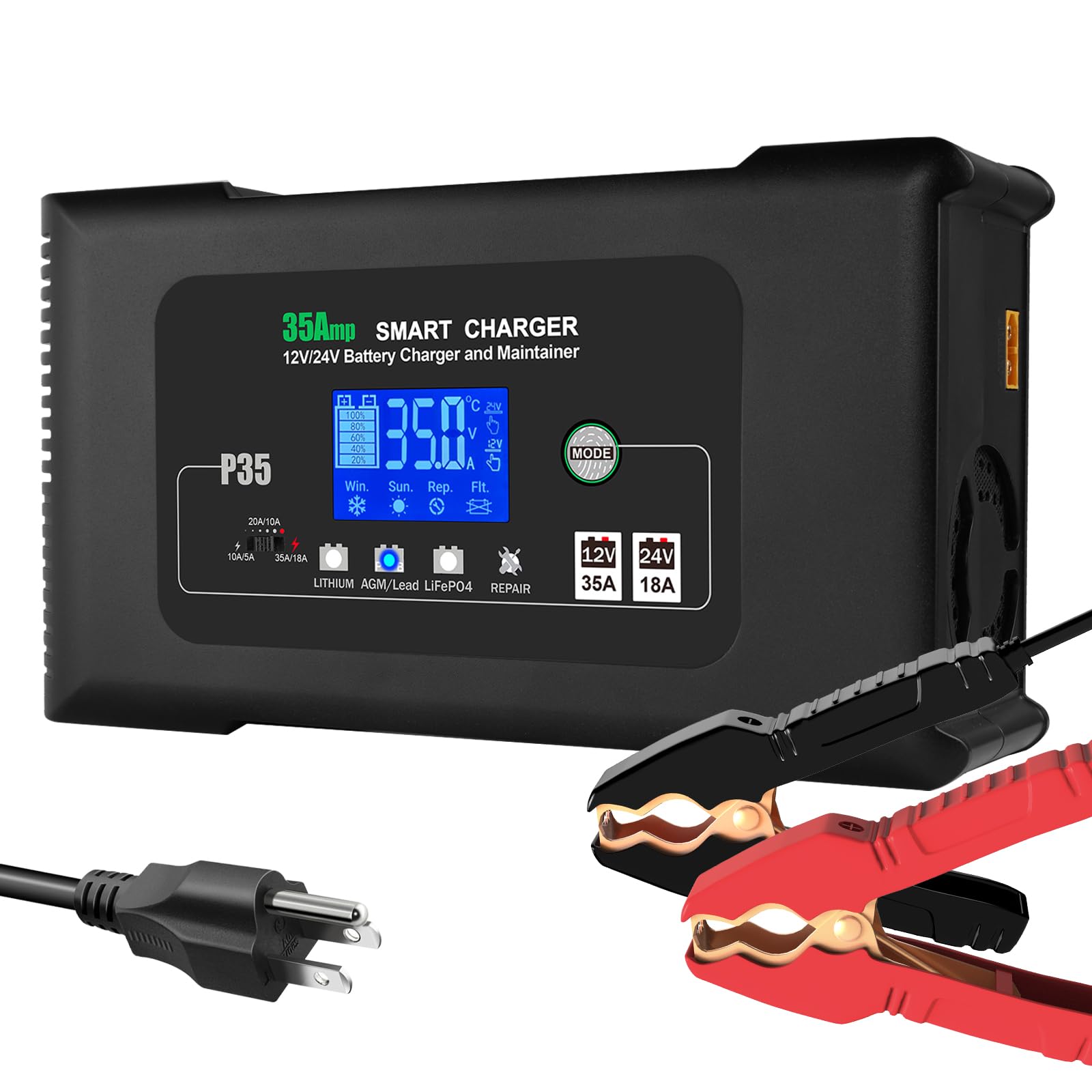
The YHCHKJ 35A charger tackles the widest range of deep cycle needs thanks to its variable current output—you can scale from 10A up to 35A on a 12V bank, or switch to a 24V profile for larger solar arrays. The 35A ceiling means a 200Ah flooded lead-acid bank can recover from a 50% discharge in roughly three hours, which is among the fastest times in this price tier. The unit also includes 9-stage charging logic that transitions from bulk through absorption to a true float stage, plus a pulse repair mode that has successfully restored sulfated AGM batteries according to multiple verified reviews.
Chemistry support covers Lithium, LiFePO4, AGM, Gel, SLA, and standard flooded lead-acid. The one-button start simplifies the selection process, though the real value lies in the summer/winter temperature compensation that adjusts the charge voltage automatically when ambient conditions shift. The LCD display shows internal temperature, charge percentage, and real-time current, which is helpful when monitoring a remote battery bank in an RV or boat.
Build quality feels robust for the price point, and the 5-year warranty provides peace of mind. The unit is compact enough to store in a toolbox between uses. Note that the minimum starting voltage is 2V, so completely dead batteries below that threshold may require an external boost or a manual-force charger to wake them up.
Why it’s great
- Adjustable 10A/20A/35A output fits small to large banks
- Summer/winter thermal compensation protects batteries in extreme temps
- Pulse repair mode successfully revives sulfated lead-acid batteries
Good to know
- Won’t charge batteries below 2V without manual intervention
- Lacks an engine start/mount mode for jump-starting applications
2. LiTime 12V 20A LiFePO4 Battery Charger

LiTime’s 20A charger is purpose-built for 12V LiFePO4 deep cycle batteries, and it nails that single job better than most multi-chemistry units. The absorption voltage is locked at 14.6V—exactly the sweet spot for lithium iron phosphate cells—and the three-stage algorithm (pre-charge, constant current 20A, constant voltage 14.6V, then float/cut-off) ensures a full charge every cycle without overstressing the BMS. Verified users report a 100Ah LiFePO4 battery going from 15% to 100% in roughly five hours, which aligns with the theoretical C-rate calculation.
The aluminum alloy housing and dual cooling fan keep internal temperatures well-managed even during sustained 20A operation. Several long-term reviews note the unit barely gets warm after a full charging cycle, a testament to the thermal engineering. The 50A Anderson connector plus M8 ring terminals make permanent wiring simple for RV or off-grid solar setups where the charger stays installed. 0V activation wakes BMS-protected batteries that have dipped below 1V, a critical feature for lithium batteries that sit unused over winter.
This charger does not support lead-acid or AGM profiles—it is strictly LiFePO4. Build quality is outstanding, with a 2-year warranty and responsive phone support. If your battery bank is exclusively lithium, this unit delivers the most precise charging curve available at this price.
Why it’s great
- Precision 14.6V absorption profile for LiFePO4 cells
- Aluminum housing + fan stays cool under continuous 20A load
- 0V activation revives deeply discharged BMS batteries
Good to know
- No lead-acid or AGM profiles—lithium only
- Cables and Anderson connector are permanently attached
3. FirstPower Pro 2 Bank Marine Battery Charger 5X2

For boaters who need a permanent onboard solution, the FirstPower Pro 2-bank charger delivers IP68 waterproof protection—meaning it can survive spray, bilge moisture, and even brief submersion without failing. Each of the two banks delivers 5A independently, with individual SLA/AGM, Lithium, or Calcium mode selection via a dedicated button. This allows you to charge a deep cycle house bank on lithium profile while the starter battery sits on AGM, all from one unit.
The Force Mode is a standout for marine environments: if a battery has dropped below 1V (common after winter storage), holding the MODE button for five seconds initiates a manual charging cycle that can wake even stone-cold batteries. The auto repair mode automatically desulfates lead-acid batteries without any user input, and the advanced diagnostics (over voltage, bad battery, over temperature, reverse connection) help troubleshoot problems before they sink your weekend trip.
At 4.5 pounds, the unit is heavier than expected, but that weight comes from the fully sealed epoxy encapsulation that makes the IP68 rating genuine. The included spare fuses and mounting hardware make installation straightforward. For twin-engine boats or small RVs with two battery banks, this is the most reliable onboard option at this price.
Why it’s great
- Genuine IP68 waterproof rating for bilge and deck mounting
- Independent chemistry selection per bank
- Force Mode revives batteries below 1V
Good to know
- At 5A per bank, large 200Ah+ banks charge slowly
- Heavier than portable units at 4.5 pounds
4. FirstPower Pro Upgraded 3 Bank Marine Battery Charger 10X3

When a vessel or off-grid cabin runs three separate deep cycle banks—house, thruster, and starter—the FirstPower Pro 3-bank charger becomes the only practical single-box solution. Each bank gets its own dedicated 10A channel, meaning a 100Ah lithium house bank can charge from empty in about 10 hours while the other two banks operate independently. The 30A total output is substantial, and the IP68 fully-sealed housing ensures this unit can live permanently in an engine bay or battery compartment without corrosion worries.
Channel independence extends to chemistry selection: you can set bank 1 to LiFePO4, bank 2 to AGM, and bank 3 to Calcium if needed. Each bank remembers its last setting, so you don’t have to re-configure after every power cycle. The auto repair mode operates per channel, detecting and desulfating lead-acid batteries automatically. Thermal compensation adjusts the voltage based on ambient temperature, which is critical in unheated boat compartments that range from freezing to 100°F.
At over 10 pounds, this is a heavy unit built for permanent installation rather than portability. The included spare fuses, three sets of battery clips, and mounting hardware cover most installations. For large marine, RV, or solar systems with three or more battery banks, this charger eliminates the need for multiple separate chargers and simplifies wiring.
Why it’s great
- Three independent 10A channels for multi-bank systems
- IP68 waterproof for permanent engine-bay mounting
- Remembered per-bank chemistry settings
Good to know
- Heavy (10.4 lbs) and large—carefully measure your compartment
- 10A per channel is moderate for very large 300Ah+ banks
5. NOCO GENIUS5 5A Smart Battery Charger

NOCO’s GENIUS5 is the gold standard for maintaining deep cycle batteries during storage rather than fast-charging them. The 5A output is ideal for topping off a 50Ah to 100Ah battery overnight, but the charger’s real talent lies in its thermal compensation and desulfation pulse. An integrated thermal sensor dynamically adjusts charge voltage based on ambient temperature—raising the voltage in cold weather to prevent undercharging, and lowering it in hot weather to avoid overcharging. This is particularly important for deep cycle batteries stored in uninsulated garages or sheds.
Force Mode is a genuine differentiator: it allows the GENIUS5 to initiate charging on a completely dead battery down to zero volts, bypassing the safety lockout that stops most chargers. This has saved many deeply discharged deep cycle batteries from being written off prematurely. The desulfation algorithm uses precision pulses to break down lead sulfate crystals that form on the plates of undercharged batteries, recovering internal capacity that standard chargers leave behind.
The compact size (about the footprint of a large smartphone) and included mounting bracket make it easy to install permanently under a hood or on a garage wall. The 72-inch AC cable and 80-inch DC cable with both clamps and eyelet terminals give flexibility. At only 5A, it’s not suitable for rapidly recharging depleted large banks—pair it with a higher-amp charger for bulk charging and use the GENIUS5 for the final float stage or long-term storage maintenance.
Why it’s great
- Thermal compensation prevents over/under charging in extreme temps
- Force Mode wakes completely dead batteries from 0V
- Desulfation pulse extends lifespan of lead-acid deep cycle batteries
Good to know
- 5A output is slow for recharging large 200Ah+ banks
- Plastic housing feels less rugged than metal-cased chargers
6. VEVOR Smart Battery Charger 20-Amp

The VEVOR 20A charger punches well above its price class by offering four distinct operating modes—charging, maintain, desulfation, and supply mode—plus support for 6V, 12V, and 24V systems. The desulfation mode has been consistently praised in verified reviews for reviving batteries that other chargers had given up on, using pulse repair to break down hardened sulfate crystals on the plates. The supply mode can charge batteries with voltages as low as 1V, which is rare at this price point.
The 3.6-inch LCD screen is the largest in this group, displaying working mode, charging voltage, current, and power percentage simultaneously. The independent button interface makes mode selection intuitive even for users who aren’t battery experts. Seven-level intelligent charging automatically transitions from bulk to absorption to float, and the trickle charge maintainer can be left connected indefinitely for winter storage. The output voltage of 14.4V DC is appropriate for most lead-acid and AGM deep cycle profiles.
Build quality is solid for the price—the unit weighs 1.8 pounds and feels well-constructed. The included copper wire terminals, 9.8-foot power cord with figure-eight tail plug, and battery clamps cover most connection scenarios. Some users note that the fan can be audible during sustained 20A charging, though this is normal for active cooling. For a garage that services mixed 6V, 12V, and 24V equipment (tractors, boats, cars, solar arrays), this charger offers the best compatibility-to-dollar ratio.
Why it’s great
- Wide voltage support: 6V, 12V, and 24V in one unit
- Large 3.6-inch LCD shows real-time charge data
- Desulfation mode revives deeply sulfated batteries
Good to know
- Fan noise is noticeable during 20A charging cycles
- Lacks LiFePO4-specific charging profile
7. E-FAST 12V 20A Lithium Battery Charger
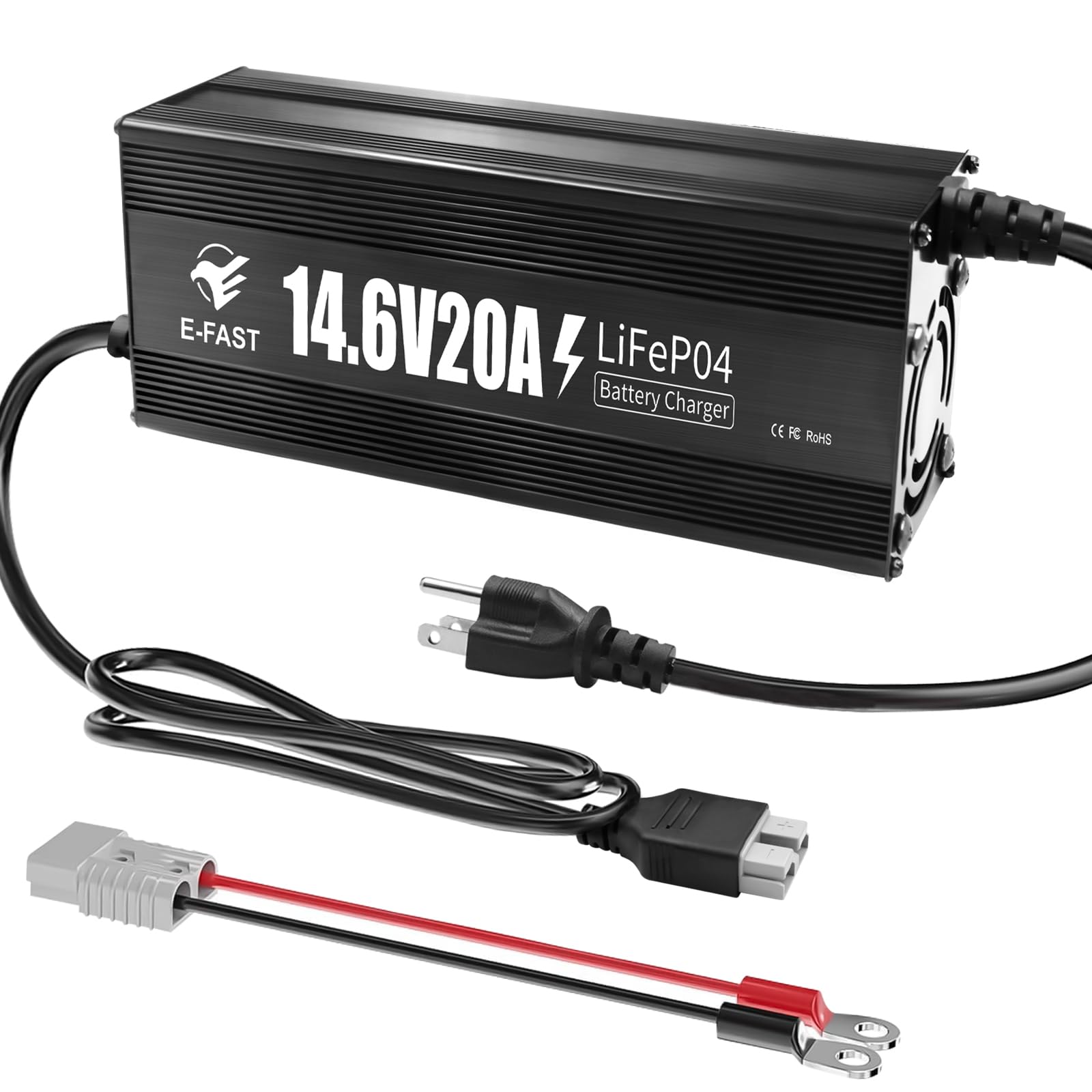
The E-FAST 20A LiFePO4 charger delivers a dedicated 14.6V charging profile for 12V lithium deep cycle batteries at a price that undercuts most competitors. The aluminum housing with built-in cooling fan dissipates heat effectively—users report the unit runs cool even after hours at maximum output. The CC/CV/Float-cut off transition logic ensures the battery reaches full charge without overstressing the cells, and the 0V activation feature can wake a BMS that has shut down due to deep discharge.
Dual heavy-duty connections (M8 ring terminals and a 50A Anderson connector) give flexibility for permanent installation or portable use. The red/green LED indicator provides instant visual confirmation of charging status. The 100–240V universal input means this charger works globally with just a plug adapter. Verified users regularly report successful charging of 100Ah LiFePO4 batteries from empty to full in about five hours, matching the theoretical rate.
This charger is strictly for 12V lithium (LiFePO4) batteries—it does not support lead-acid, AGM, or Gel. The fan noise is present but not intrusive, and the unit is UL certified for safety. For owners of golf carts, trolling motors, or off-grid solar systems running exclusively on LiFePO4 chemistry, this charger offers the most aggressive price-to-performance ratio available.
Why it’s great
- Dedicated 14.6V LiFePO4 profile at a budget-friendly price
- Premium aluminum housing with efficient cooling fan
- Anderson connector and M8 terminals for flexible wiring
Good to know
- Lithium-only—no support for lead-acid or AGM chemistries
- Fan noise is audible during operation
FAQ
Can I use a standard car battery charger on a deep cycle battery?
What does 0V activation do for a LiFePO4 battery charger?
How many amps do I need for a 200Ah deep cycle battery bank?
Is it safe to leave a smart charger connected to a deep cycle battery indefinitely?
Final Thoughts: The Verdict
For most users, the battery charger for deep cycle battery winner is the YHCHKJ 35A Smart Charger because it handles the widest range of chemistries and amperage requirements in one compact, portable unit. If you run exclusively LiFePO4 batteries and want absolute precision, grab the LiTime 20A Charger. And for permanent onboard installation in a boat or marine environment, nothing beats the FirstPower Pro 3-Bank 10A Charger.