
Our readers keep the lights on and my morning glass full of iced black tea. As an Amazon Associate, I earn from qualifying purchases.
The biggest mistake cyclists make when shopping for an indoor trainer is assuming a low sticker price means a wobbly, noisy, disposable stand that will collect dust after two rides. The reality is that the entry-level and mid-range segment now packs magnetic resistance, fluid damping, and even smart connectivity into builds that stay stable through sprints and fit under a bed when not in use. The challenge is separating the genuinely capable units from the ones that rattle your floorboards and frustrate your neighbors.
I’m Min — the co-founder and writer behind Gadgets Feed. I’ve spent dozens of hours cross-referencing resistance mechanisms, noise decibel reports, wheel-size compatibility charts, and load capacities so you don’t have to re-research what someone else already figured out.
After thorough analysis of seven different models, I’ve built a definitive guide that isolates the quietest builds, the most realistic road feel, and the sturdiest frames so you can confidently choose the best bike trainer on a budget without wasting time on overpriced features you will never use.
How To Choose The Best Bike Trainer On A Budget
Budget trainers live in a Goldilocks zone where you get a stable enough frame and usable resistance without paying for direct-drive internals you don’t need. The key is knowing which corners you can safely cut and which ones will destroy your riding experience. Here are the three specs that matter most.
Resistance mechanism: Fluid vs. Magnetic
Fluid trainers use a sealed chamber of silicone oil to create progressive resistance — pedal harder, feel more drag. This delivers the most road-realistic curve under . Magnetic trainers generate resistance via magnets pulling against a spinning flywheel, which gives you adjustable levels but rarely matches the smooth, linear ramp of fluid. For a budget setup, fluid wins on feel while magnetic wins on price and portability.
Noise floor: Your real-world constraint
The loudest component on any wheel-on trainer is the tire, not the resistance unit. Knobby mountain bike tires can exceed 85 dB — loud enough to bother neighbors two floors away. Switching to a slick trainer tire drops noise by 10–15 dB instantly. If you live in an apartment, factor a trainer tire (–) into your budget.
Stability and weight capacity
A trainer that wobbles during a standing sprint is dangerous. Look for a steel or stainless steel frame, a wide M-shaped base, and a published load capacity of at least 250 pounds. Rubberized feet or adjustable leveling caps are non-negotiable on hardwood floors. Folding legs that collapse flat make storage trivial.
Quick Comparison
On smaller screens, swipe sideways to see the full table.
| Model | Category | Best For | Key Spec | Amazon |
|---|---|---|---|---|
| Garmin Tacx Neo 2T | Smart — Direct Drive | Serious training with Zwift/Rouvy | 32 Neodymium magnets, 2200W max | Amazon |
| Saris Fluid2 | Fluid — Wheel-on | Quiet road-like feel at a low entry cost | 7.3 lbs frame, 69 dB at 20 mph | Amazon |
| Saris M2 Smart | Smart — Electromagnetic | App-controlled workouts on a budget | ANT+ FE-C / Bluetooth, 300 lb cap | Amazon |
| Alpcour Fluid | Fluid — Wheel-on | Portable stainless steel build | Stainless steel frame, 300+ lb load | Amazon |
| Fitvids Fluid/Magnetic | Fluid/Magnetic — Wheel-on | Versatile multi-surface stability | 330 lb cap, alloy steel frame | Amazon |
| Topeakmart Magnetic | Magnetic — Wheel-on | Space-saving foldable design | 13.8 lbs, carbon steel frame | Amazon |
| Sunlite F-2 Magnetic | Magnetic — Wheel-on | Ultra-basic entry-level riding | 15 oz total, fits 26″ and up | Amazon |
In‑Depth Reviews
1. Garmin Tacx Neo 2T Smart Trainer

The Neo 2T is the outlier in a budget-focused guide because its price is objectively premium, but its value proposition is unmatched if you want a single trainer that does everything without compromise. The 32 Neodymium magnets create a silent electromagnetic resistance that simulates road textures like cobblestones and boardwalks through tactile vibration — a feature no wheel-on unit can replicate. With a 2200-watt max load, it can survive maximal sprints from the heaviest riders without breaking a sweat.
Setup requires a cassette purchase (Shimano/SRAM hub is included), but once installed, the direct-drive design eliminates tire noise entirely. The unit connects via ANT+ and Bluetooth, and it includes a one-month Tacx Premium subscription. Users report instant pairing with Zwift and a realistic flywheel feel that makes virtual climbing genuinely immersive. The 47-pound weight gives it a planted stability that never creeps across the floor.
For a budget buyer, the Neo 2T is the “buy once, cry once” option. If you plan to do structured indoor training for years, the higher upfront cost disappears into the per-ride cost over a decade. The included front wheel support and quick release adapters cover road and mountain bike axles out of the box.
Why it’s great
- Completely silent operation with realistic road feel
- Direct drive eliminates tire wear and wheel-on noise
- Full smart connectivity with Zwift, Rouvy, and more
Good to know
- Requires buying a separate cassette for your drivetrain
- Heavy 47 lb frame limits portability
- Premium price far exceeds pure budget options
2. Saris Fluid2 Indoor Bike Trainer
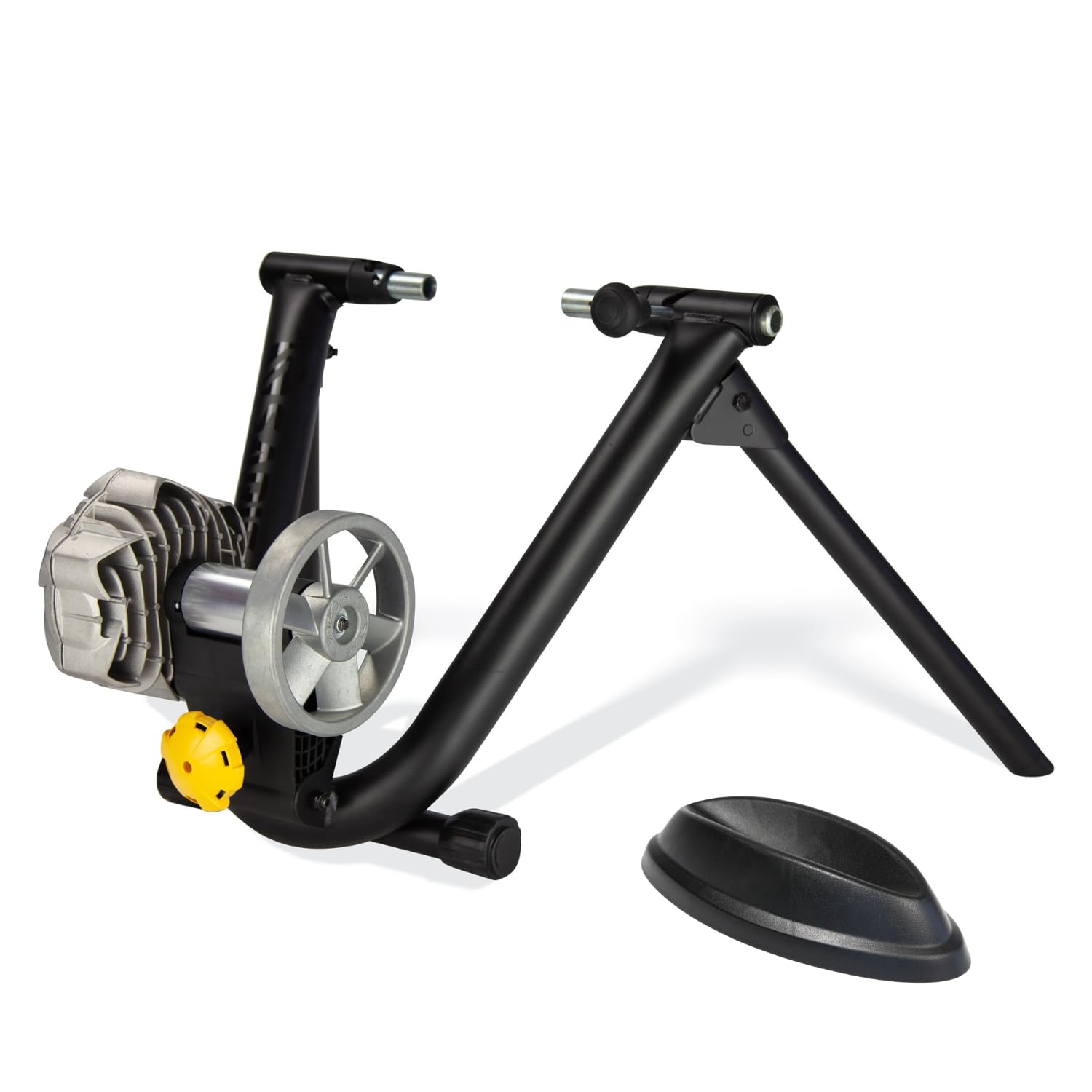
The Fluid2 is the sweet spot for cyclists who want near-silent operation and a road-realistic resistance curve without stepping into smart electronics. Its patented fluid unit uses a precision-balanced flywheel that keeps noise at around 69 dB at 20 mph — quiet enough for apartment use with a trainer tire. The resistance ramps up progressively: pedal harder, feel more drag, just like a real incline.
Setup is straightforward once you watch Saris’s video guide (the written instructions are sparse). The foldable frame collapses to just 22 by 7 by 20 inches, sliding under a bed or into a closet with zero disassembly. It works with hybrid, mountain, and road bikes, and it pairs with Zwift or Rouvy if you add a separate speed or cadence sensor. Customer feedback highlights the sturdy aluminum construction and stable platform even during out-of-saddle efforts.
One practical note: the quick release skewer included seats the left side shallowly, and the locking mechanism may need WD40 initially. A trainer tire is strongly recommended for noise reduction — users who switched to a slick Panaracer Gravelking reported a dramatic drop in sound volume. At this price point, you’re getting 90% of the feel of a premium fluid trainer for a fraction of the cost.
Why it’s great
- Fluid resistance delivers smooth, progressive road feel
- Very quiet operation at moderate speeds
- Ultra-compact foldable design for storage
Good to know
- Smart functionality requires an external sensor (sold separately)
- Left-side quick release seat depth is shallow
- Not intended for frequent daily folding
3. Saris M2 Smart Indoor Bike Trainer

The M2 is the cheapest path into Zwift-powered structured training without needing to buy a separate speed sensor, cadence sensor, or power meter. It packs built-in power, cadence, and speed sensors into a wheel-on electromagnetic unit with ±5% accuracy and a max output of 1500 watts at 20 mph. That level of instrumentation usually costs twice as much.
Assembly is straightforward but requires a dab of WD40 on the slider to ensure smooth calibration. The resistance is controlled automatically via ANT+ FE-C or Bluetooth, meaning Zwift can change the grade in real time — you pedal up a virtual hill and the M2 pushes back harder. The 20-pound steel frame and 300-pound rider capacity provide a stable platform. Noise lands around 70 dB at moderate speeds, and a trainer tire brings it down to living-room levels.
One caveat: the tension knob should only be tightened until the tire has a slight indent — over-tightening to the “click” point can cause tire slippage and inaccurate power readings. Calibration via the Saris app is simple but may not work on the newest smartphone OS versions without updates. For a cyclist who wants app integration on a strict budget, the M2 is the intelligent choice.
Why it’s great
- Built-in power, cadence, and speed sensors
- ANT+ and Bluetooth dual-band connectivity
- Zwift-certified with automatic resistance control
Good to know
- Thru-axle adapter costs extra
- Requires careful tension calibration via Saris app
- Wheel-on design still needs a trainer tire for quiet operation
4. Alpcour Fluid Bike Trainer Stand

The Alpcour Fluid stands out for its stainless steel frame and included carrying bag, making it the most portable option among mid-range fluid trainers. The progressive resistance operates without any manual adjustment — the impeller heats the fluid as speed increases, naturally raising drag. This creates a climbing feel that mirrors outdoor gradients without requiring magnetic settings or dials.
Stability is excellent thanks to the wide stance and anti-slip rubber pads. The dual-lock system uses a tension knob plus a lock ring to hold the bike securely, and users report zero frame shifting during standing efforts. The front wheel riser block is included, and the unit folds flat for easy transport. Customer feedback notes that the initial resistance feels low until you push past 20 mph, making it best for riders who like sustained high-cadence intervals.
A minority of buyers reported missing bolts or slow customer service responses, and the noise level averages around 70 dB — fine for a dedicated room but noticeable in an apartment. The included carrying bag is a genuine differentiator for cyclists who travel with their trainer or need to store it in a closet.
Why it’s great
- Stainless steel frame resists rust and flex
- Includes carrying bag for travel and storage
- Fluid resistance auto-adjusts with speed
Good to know
- Low initial resistance until speed exceeds 20 mph
- Customer service for missing parts can be slow
- Not ideal for knobby mountain bike tires
5. Fitvids Bike Trainer Stand
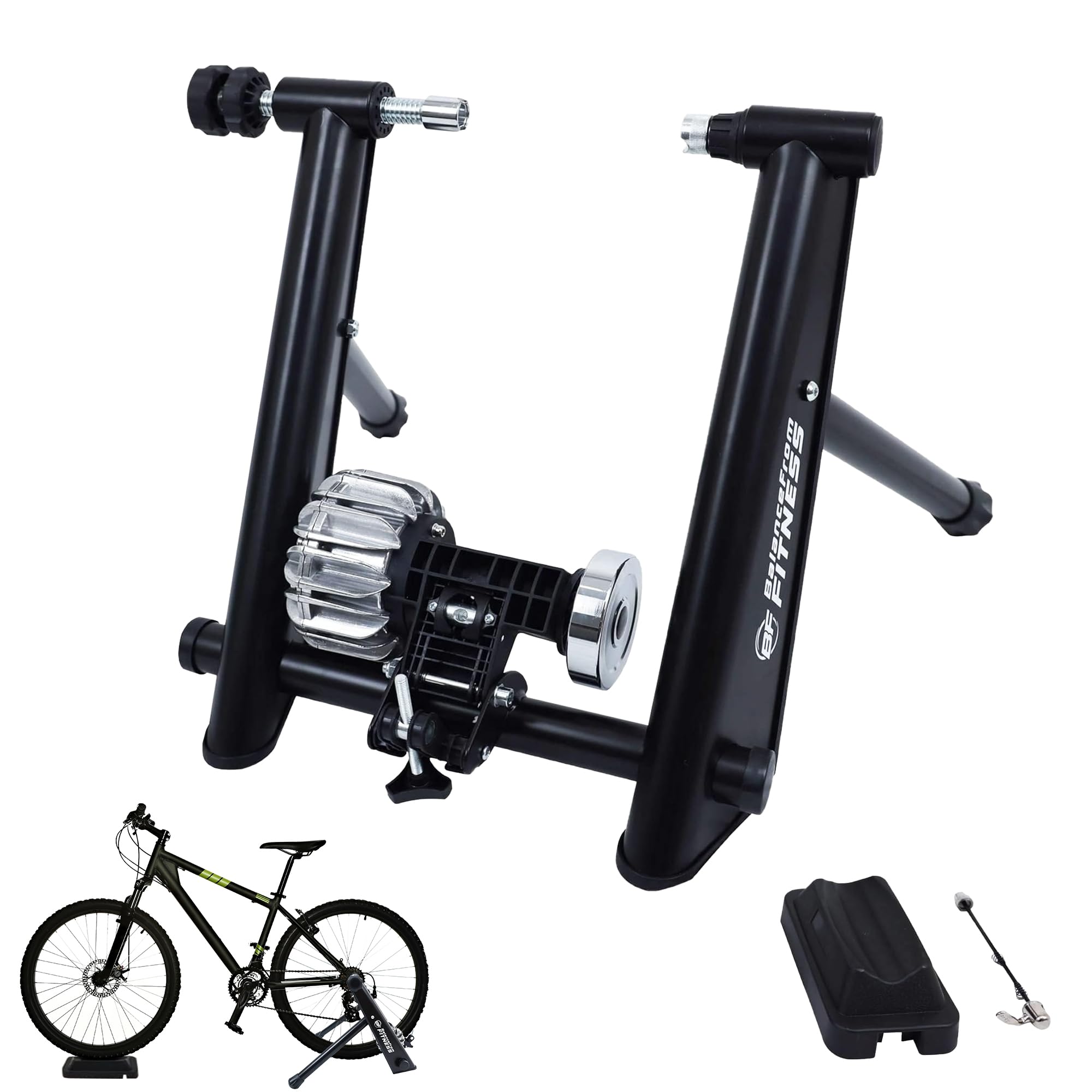
Fitvids offers this unit in both fluid and magnetic resistance variants, making it a flexible option for riders who aren’t sure which damping style they prefer. The alloy steel frame holds up to 330 pounds, which is among the highest load capacities in this price bracket. The wide base and low stance provide unshakable balance during standing efforts, and the rubber feet protect hardwood floors from scuffs.
Setup takes about 15 minutes with the included tools, though the instruction sheet is minimal. The quick release clamp makes swapping bikes easy, and the unit folds compactly for storage. Customer feedback on noise is heavily dependent on tire type — with a slick road tire, the fluid version is surprisingly quiet; with a mountain bike knobby, it sounds like a blender. Users also appreciated the handlebar-mounted resistance dial on the magnetic version, which offers eight levels of tension.
One practical downside: the resistance cable on some units cannot be disconnected during storage, and the tension adjustment between the flywheel and tire takes a bit of trial and error to get right. For the price, you get a robust, versatile stand that covers both fluid and magnetic preferences without sacrificing build quality.
Why it’s great
- Available in fluid or magnetic resistance options
- 330 lb load capacity for heavier riders
- Stable low-profile base with rubber floor feet
Good to know
- Very loud with knobby mountain bike tires
- Instructions are sparse and occasionally confusing
- Resistance dial adjustment is finicky to dial in
6. Topeakmart Magnetic Bike Trainer

The Topeakmart is a no-frills magnetic trainer built for cyclists who want a stable platform without spending on fluid internals. The M-shaped carbon steel frame supports 265 pounds and folds down to just 7 inches thick — one of the slimmest profiles in this roundup. The adjustable leveling feet have gear-like caps that twist to compensate for uneven floors, a small detail that prevents rocking on basement concrete or garage slabs.
Resistance is set by shifting your bike’s rear gears, giving you a wide range through a 10- or 21-speed drivetrain. There is no external resistance dial — the magnetic unit provides a fixed curve, and you get more or less resistance by picking a higher or lower gear. This simplicity makes setup and operation dummy-proof. Customer reviews highlight the surprisingly quiet operation with a slick tire, though the unit still hums loudly with knobby treads.
One limitation: the trainer is designed for quick-release axles only. Thru-axle bikes will need a separate adapter that is not included. The unit weighs 13.8 pounds, making it easy to carry from storage to setup, but the legs require a bit of force to fold and unfold. For a pure entry-level trainer that just works and stores compactly, this is a solid choice.
Why it’s great
- Ultra-slim foldable design (7 inches folded)
- Adjustable leveling feet for uneven surfaces
- Sturdy M-shaped frame for stability
Good to know
- Quick-release axles only; thru-axle not supported
- No external resistance dial — relies on bike gears
- Noise increases significantly on knobby tires
7. Sunlite F-2 Magnetic Indoor Trainer
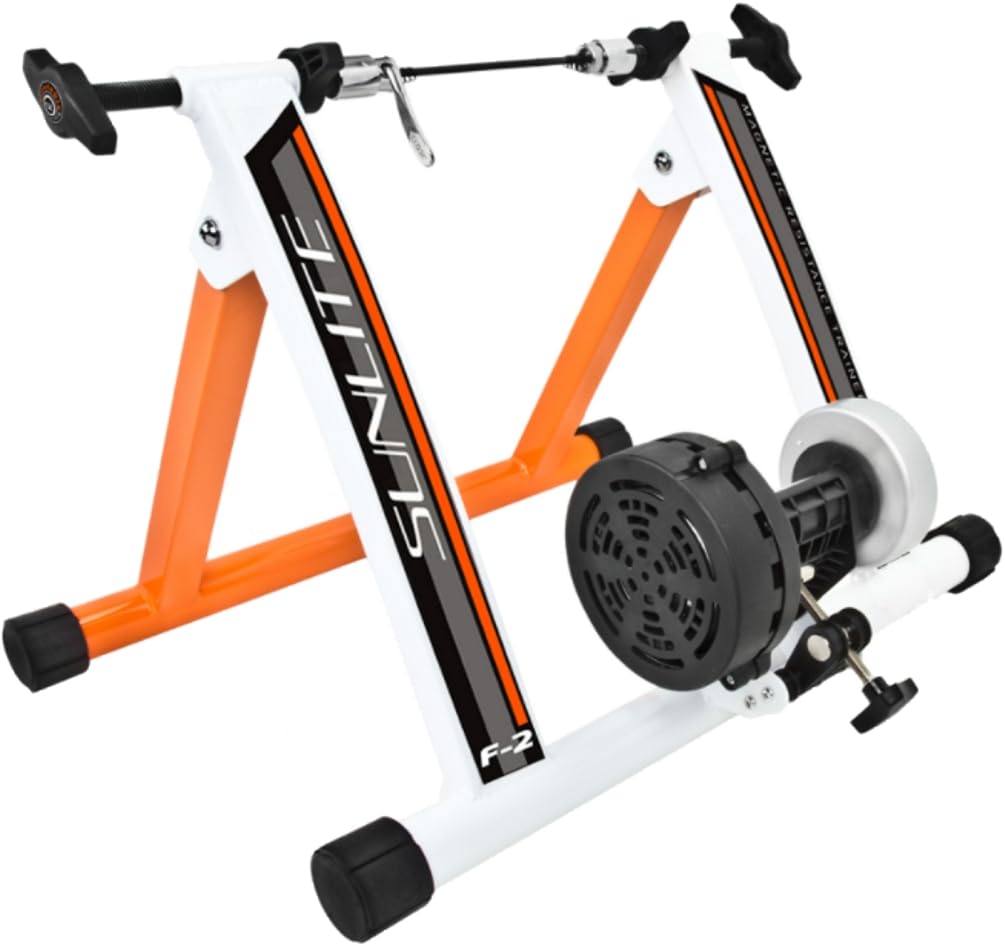
The Sunlite F-2 is the pure budget entry point in this guide — a lightweight magnetic trainer that costs as little as a pair of cycling shorts. The yellow alloy steel frame folds down quickly and weighs just 15 ounces, making it the most portable option by a wide margin. Resistance comes entirely from your bike’s gearing, with the magnetic unit providing a smooth, fixed curve that works well for casual rides of 2 to 25 miles.
Setup takes about 15 minutes without any tools: you remove the rear axle nut, slide the dropout claw into place, and tighten. Customers with bike maintenance experience reported it was a breeze; first-timers may need a YouTube video for the rear wheel fitting. The unit works with 26-inch and larger wheels, and the frame can handle riders up to roughly 200 pounds without noticeable flex.
Noise is the biggest trade-off. With knobby tires, the magnetic resistor hums loudly at high cadences — users describe it as sounding like a low mixer or a loud fan. Switching to slick tires makes a dramatic difference, but the unit is still not apartment-friendly without vibration-dampening gym mats underneath. For occasional riders who just want to spin indoors during bad weather without investing in premium gear, the F-2 gets the job done.
Why it’s great
- Extremely affordable entry-level price
- Tool-free setup in under 15 minutes
- Ultra-light and folds flat for storage
Good to know
- Loud humming with knobby mountain bike tires
- Base may not feel stable above 200 lb rider weight
- Missing controller reported in some shipments
FAQ
Do I need a special tire for a budget bike trainer?
How loud is a magnetic trainer vs a fluid trainer?
Can I use a mountain bike on a budget bike trainer?
What is the difference between wheel-on and direct-drive trainers?
Final Thoughts: The Verdict
For most users, the best bike trainer on a budget winner is the Saris Fluid2 because it delivers fluid-based progressive resistance, a whisper-quiet ride with a trainer tire, and a compact collapsible frame at a price that keeps the barrier to entry low. If you want app-controlled smart training without overpaying, grab the Saris M2 Smart. And for the purest entry experience that just works and stores away, nothing beats the Topeakmart Magnetic for its slim folded profile and adjustable leveling feet.