
Our readers keep the lights on and my morning glass full of iced black tea. As an Amazon Associate, I earn from qualifying purchases.
Choosing a camera with a fixed lens means committing to a specific field of view, forcing you to compose with your feet instead of a zoom ring. The payoff is optical quality — simpler lens designs produce sharper, faster glass with fewer aberrations and wider apertures, giving you images with more character and better low-light performance than virtually any zoom can match. Whether you are after the analog feel of film, the hybrid convenience of instant prints, or the raw resolution of a full-frame sensor, the selection process boils down to sensor size, focal length, and how that single lens fits your daily rhythm.
I’m Min — the co-founder and writer behind Gadgets Feed. I’ve spent hundreds of hours cross-referencing sensor specifications, lens MTF charts, real-world sample galleries, and user feedback from the fixed-lens camera community to isolate the models that genuinely reward their owners with a distinct shooting experience rather than just a spec sheet.
After sorting through modern digital compacts, half-frame film bodies, and hybrid instant systems, the following guide distills the best options into a clear landscape for anyone searching for a camera with fixed lens.
How To Choose The Best Camera With Fixed Lens
Fixed-lens cameras demand a different mindset than interchangeable-lens systems. You cannot swap glass to chase a different perspective, so the priority shifts entirely to sensor quality, the character of that single lens, and how the camera handles in your hands. The right choice comes from aligning these elements with the kind of photography you do most often.
Sensor Size and Image Quality
The sensor is the biggest performance differentiator in a fixed-lens camera. A 1-inch sensor (found in the Sony RX100 VII) offers excellent portability and good dynamic range, but an APS-C sensor (Ricoh GR IIIx, Fujifilm X100VI) delivers noticeably better tonal depth, lower noise at high ISO, and more control over depth of field. Full-frame sensors (Sony RX1R II, Leica Q3) push into professional territory with 42-60MP resolution and superior light gathering, though they come with larger bodies and much higher budgets. For most buyers, a modern APS-C sensor provides the best balance of image quality and pocketability.
Focal Length and Field of View
Your chosen focal length determines how you see the world through that fixed lens. A 28mm-equivalent lens (Leica Q3) suits architectural and environmental street photography with its wide perspective. The 35mm-equivalent focal length (Fujifilm X100VI) is the classic documentary and walkaround standard — close to natural human vision with enough width for context. The 40mm-equivalent (Ricoh GR IIIx) offers a slightly tighter, more intimate frame that works beautifully for portraits and detail shots. If you prefer candid street work, the 40mm is often the more discreet and forgiving choice.
Manual Controls and Shooting Experience
A fixed-lens camera is as much about the feel as the result. Dedicated aperture rings, shutter speed dials, and manual focus clutches speed up your workflow and keep you engaged with the composition. Cameras like the Fujifilm X100VI and the Leica Q3 excel here with tactile, retro-inspired controls. The Ricoh GR IIIx prioritizes pocketability and quick snap shooting with its fast 0.8-second startup, though it relies on menu-driven settings for some functions. If you value the process of shooting as much as the final image, prioritize cameras with physical dials over touchscreen-heavy interfaces.
Quick Comparison
On smaller screens, swipe sideways to see the full table.
| Model | Category | Best For | Key Spec | Amazon |
|---|---|---|---|---|
| Ricoh GR IIIx | Premium Compact | Everyday carry & street photography | 24.2MP APS-C / 40mm f/2.8 | $1,249.95Amazon |
| Fujifilm X100VI | Premium Compact | Film simulation & hybrid viewfinder shooting | 40.2MP X-Trans APS-C / 23mm f/2 | $2,399.00Amazon |
| Leica Q3 | Luxury Full-Frame | Ultimate image quality in a fixed-lens body | 60MP Full-Frame / 28mm f/1.7 | $6,735.00Amazon |
| Sony RX1R II | High-End Full-Frame | Full-frame resolution in a compact body | 42.4MP Full-Frame / 35mm f/2 | $2,592.50Amazon |
| Sony RX100 VII | Premium Zoom Compact | Versatile travel with a bright zoom range | 20.1MP 1-inch Stacked / 24-200mm f/2.8-4.5 | $1,498.00Amazon |
| Canon PowerShot V1 | Vlogging Hybrid | 4K video & streaming with built-in cooling | 22.3MP 1.4-type / 16-50mm f/2.8-4.5 | $797.56Amazon |
| Canon PowerShot SX740 HS | Budget Superzoom | Close-up reach on a budget | 20.3MP 1/2.3-inch / 24-960mm f/3.3-6.9 | $979.99Amazon |
| Panasonic LUMIX FZ80D | Budget Superzoom | Extreme optical reach for daylight use | 18.1MP 1/2.3-inch / 20-1200mm f/2.8-5.9 | from $419.99Amazon |
| Panasonic LUMIX TZ/ZS99 | Travel Zoom Compact | Pocketable zoom for concerts and vacations | 20.3MP 1/2.3-inch / 24-720mm f/3.3-6.4 | $629.00Amazon |
| Fujifilm Instax Mini EVO | Hybrid Instant | Creative instant prints with digital storage | Hybrid digital/instax / 28mm-equivalent f/2 | $351.95Amazon |
| Pentax 17 | Half-Frame Film | Film photography with double the shots per roll | 35mm film / 25mm f/3.5 (37mm equiv.) | $496.95Amazon |
In‑Depth Reviews
1. Ricoh GR IIIx

The Ricoh GR IIIx has earned a cult following for good reason: it packs a 24.2MP APS-C sensor and a dedicated 40mm f/2.8 lens into a body that genuinely slides into a jacket pocket. The 40mm field of view is a deliberate choice — tighter than a standard 35mm, it produces a natural, compressed perspective that isolates subjects from backgrounds without forcing you to step too far back. The GR Engine 6 processor delivers snappy performance with a 0.8-second startup time, making it one of the fastest fixed-lens cameras to get from powered-off to a focused shot. In-body image stabilization (IBIS) is also present, steadying handheld shots down to shutter speeds that would blur on most pocket compacts.
The lens is the star here — it resolves exceptional sharpness even wide open at f/2.8, with micro-contrast that gives images a three-dimensional pop. Hybrid autofocus combines contrast detection with phase-detection points for reliable lock-on in most lighting, though continuous tracking is not its strongest suit. The 14-bit RAW files offer generous latitude for recovery in post, and the built-in film simulation profiles (including Positive Film and B&W) produce pleasing out-of-camera JPEGs. The control layout is streamlined: front and rear dials, a dedicated macro button, and direct access to white balance and exposure compensation.
Battery life is the primary trade-off — the DB-110 lithium-ion pack is rated for roughly 200 shots per charge, so you will want at least two spares for a full day of shooting. The fixed 40mm lens means you are locked into that perspective; there is no zoom to fall back on. The rear LCD is fixed, without tilting capability, and there is no built-in flash. Dust ingress has been a noted concern over long-term use, though a third-party filter adapter can seal the lens barrel. For the photographer who values ultimate portability and image quality over every other consideration, the GR IIIx is the gold standard among modern fixed-lens compacts.
Why it’s great
- APS-C sensor delivers DSLR-grade image quality in a truly pocketable body
- 40mm f/2.8 lens is exceptionally sharp with beautiful rendering
- In-body stabilization (IBIS) helps handhold in dim conditions
Good to know
- Battery life is poor — carry at least two spares for a full day
- No viewfinder and no tilt screen; composing in bright sunlight can be tricky
- Dust can enter through the lens barrel during extension; a filter adapter is recommended
2. Fujifilm X100VI

The Fujifilm X100VI is the sixth generation of a camera that practically defined the modern fixed-lens premium compact segment. It houses a 40.2MP X-Trans CMOS 5 HR sensor — a massive resolution jump from its predecessor — paired with the classic 23mm f/2 lens (35mm full-frame equivalent). That sensor delivers enough detail to crop aggressively while maintaining excellent tonal gradation, and the X-Trans color filter array eliminates the need for an optical low-pass filter, resulting in noticeably sharper output. The addition of 5-axis in-body stabilization giving up to six stops of compensation is a game-changer for this series, enabling usable handheld shutter speeds of 1/10th second or slower.
The hybrid viewfinder remains the X100VI’s signature feature: you can switch between an optical viewfinder with electronic overlays and a full EVF, or split the view with the electronic rangefinder (ERF) mode. The 20 Film Simulation modes, including the new REALA ACE profile, produce vivid, filmic JPEGs straight from camera — a major reason photographers choose this over other fixed-lens cameras. The built-in 4-stop neutral density filter lets you shoot wide open at f/2 in bright sunlight for shallow depth of field without needing a screw-on ND. Autofocus has improved with AI-based subject detection for humans and animals, though the contrast-detection system can hunt slightly in very low-contrast scenes.
The fixed 35mm-equivalent focal length is a versatile walkaround standard, but it does not offer the wider 28mm or tighter 40mm alternatives that some competitors provide. Battery life is typical for this class at around 350 shots per charge (using the EVF depletes faster). The rear screen tilts but does not fully articulate, which limits low-angle and selfie compositions. On the positive side, the magnesium-alloy build feels solid, the aperture ring clicks with satisfying detents, and the shutter sound is among the quietest in its class. For photographers who prioritize shooting experience and out-of-camera color science, the X100VI is a near-flawless tool.
Why it’s great
- 40.2MP sensor with IBIS sets a new resolution standard for the fixed-lens compact class
- Hybrid optical/electronic viewfinder is unique and joyfully usable
- Film Simulations produce stunning JPEGs with minimal post-processing
Good to know
- Autofocus can occasionally hunt in low-contrast light
- No weather sealing; a filter adapter is recommended for environmental protection
- The 35mm-equiv. focal length is a compromise for those wanting wider or tighter perspectives
3. Leica Q3
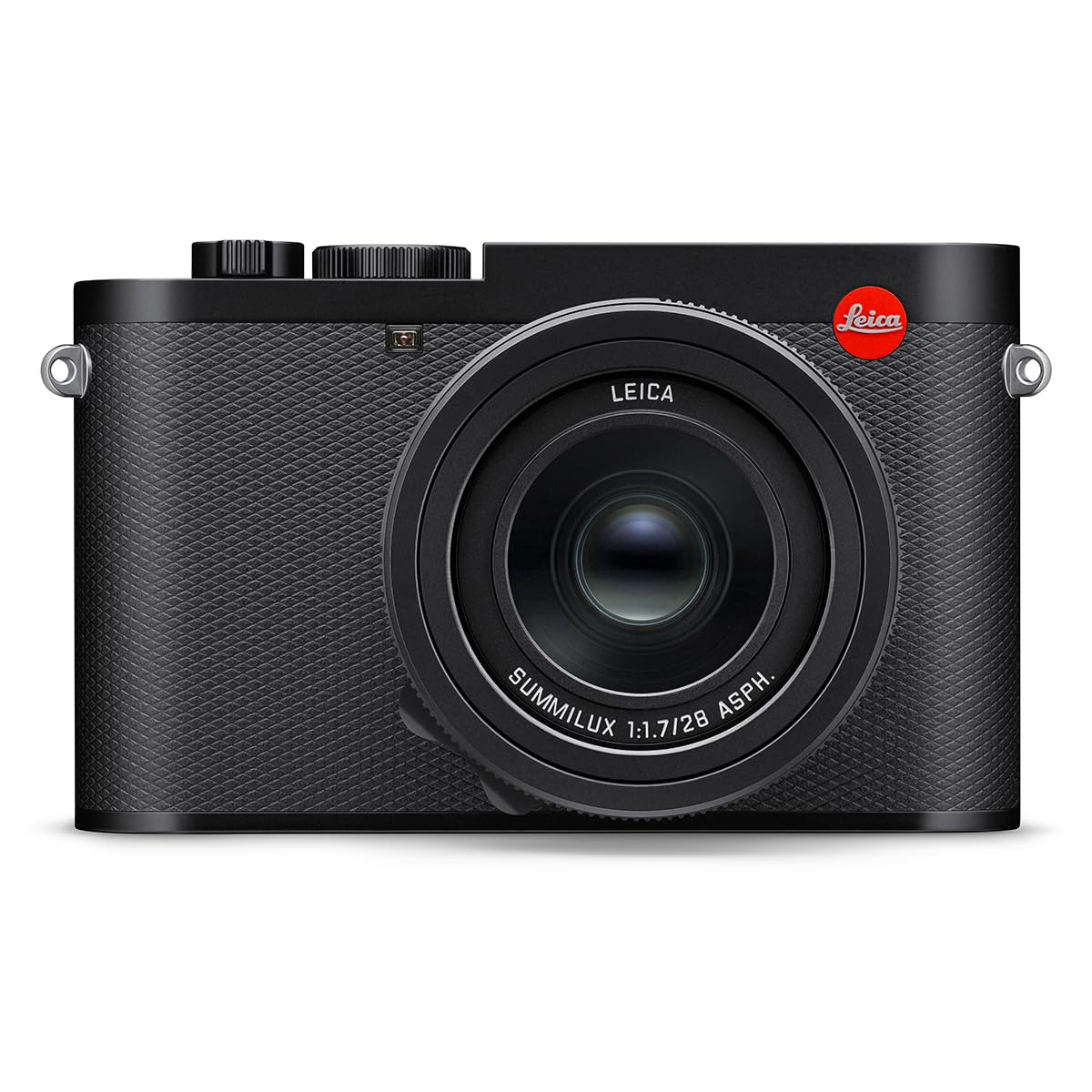
The Leica Q3 is a fixed-lens full-frame powerhouse that pushes the boundaries of what a compact camera can deliver. Its 60MP back-side-illuminated CMOS sensor uses Triple Resolution Technology, allowing you to shoot at 60MP, 36MP, or 18MP by combining pixels — giving you control over file size and noise performance. The Summilux 28mm f/1.7 ASPH. lens is an optical masterpiece: it offers edge-to-edge sharpness even wide open, with minimal distortion and ghosting. The Maestro IV processor is backed by 8GB of buffer memory, enabling 15 fps continuous shooting and instant image review. A digital zoom function crops into the sensor to simulate 35mm, 50mm, and 90mm fields of view while retaining usable resolution — at 50mm you still get 24MP, a practical bonus for framing flexibility.
The hybrid autofocus system uses contrast detection augmented with phase detection and tracking, and it locks onto subjects quickly in most situations. Leica’s interface is minimal but effective: aperture control on the lens barrel, a thumb wheel for shutter speed, and a programmable button for quick access. The 3.68-million-dot OLED viewfinder is bright and detailed, and the 3-inch touchscreen tilts for waist-level and overhead shots. Build quality is exemplary — the magnesium-alloy chassis is sealed against dust and moisture, and the leather-like grip provides a secure hold. The built-in flash is modest but adequate for fill-light in close-quarters.
The price point places the Q3 in a league where it competes with interchangeable-lens full-frame setups, which is a hard value proposition for many photographers. Battery life is surprisingly modest at about 350 shots per CIPA rating, and the 28mm focal length is wide enough that some users find it challenging for portraiture without the digital crop. There is also no option to change lenses — this is a pure commitment to the 28mm view. For a photographer seeking the highest possible image quality in a fixed-lens body that doubles as a luxury object, the Q3 delivers an uncompromising shooting experience that few cameras can match.
Why it’s great
- 60MP full-frame sensor with triple-resolution flexibility for pro-level cropping
- Summilux 28mm f/1.7 lens is optically flawless with beautiful bokeh
- Weather-sealed build and excellent ergonomics for a fixed-lens body
Good to know
- Extremely high budget that rivals mirrorless interchangeable-lens kits
- 28mm is quite wide for everyday use; digital crops help but reduce effective resolution
- Battery life is average — plan for a spare during long shoots
4. Sony RX1R II

The Sony RX1R II is a landmark fixed-lens camera that combines a 42.4MP full-frame back-illuminated Exmor R CMOS sensor with a Zeiss Sonnar T 35mm f/2 lens. This pairing produces exceptional image quality with resolving power that rivals many interchangeable-lens systems. The unique feature here is the world’s first user-selectable optical variable low-pass filter — you can toggle between off, standard, and high settings to optimize for sharpness or moiré suppression depending on your subject. The Fast Hybrid AF system with 399 phase-detection points delivers reliable focus, and the retractable 2.4-million-dot XGA OLED Tru-Finder pops up for eye-level shooting. The 35mm focal length is ideal for everyday photography — wide enough for environmental context, tight enough for selective framing.
The Zeiss Sonnar lens is built with a macro mode that allows focusing down to 14 centimeters, opening up close-up detail shots that a typical 35mm prime cannot reach. The aperture ring on the lens and the dedicated exposure compensation dial give it a tactile handling feel, though the menu system is typically Sony-dense. Images come out with excellent color rendering, rich micro-contrast, and low distortion, which can be corrected in post if needed. The build is solid metal with a comfortable grip, and the overall dimensions are genuinely pocketable for a full-frame camera. The 14-bit RAW files provide substantial headroom for shadow and highlight recovery.
The RX1R II does not include in-body image stabilization, which means you must rely on steady hands or a tripod at slower shutter speeds — a notable omission considering the price. Battery life is a weak point, with approximately 200 shots per charge using the NP-BX1 battery. The autofocus system, while fast in good light, is a generation behind Sony’s latest tracking algorithms, and the continuous shooting speed of 5 fps is modest by current standards. The UHS-I SD card interface also slows burst writing. For a photographer specifically seeking the combination of full-frame resolution and a 35mm fixed lens in a compact form, the RX1R II remains a unique and compelling option.
Why it’s great
- 42.4MP full-frame sensor delivers professional-grade resolution and dynamic range
- Zeiss 35mm f/2 lens is optically superb with useful macro mode
- Unique variable low-pass filter gives flexibility for sharpness vs. moiré
Good to know
- No in-body image stabilization limits handheld low-light shooting
- Battery life is short — expect around 200 shots per charge
- Autofocus is not as advanced as current-gen Sony mirrorless cameras
5. Sony RX100 VII
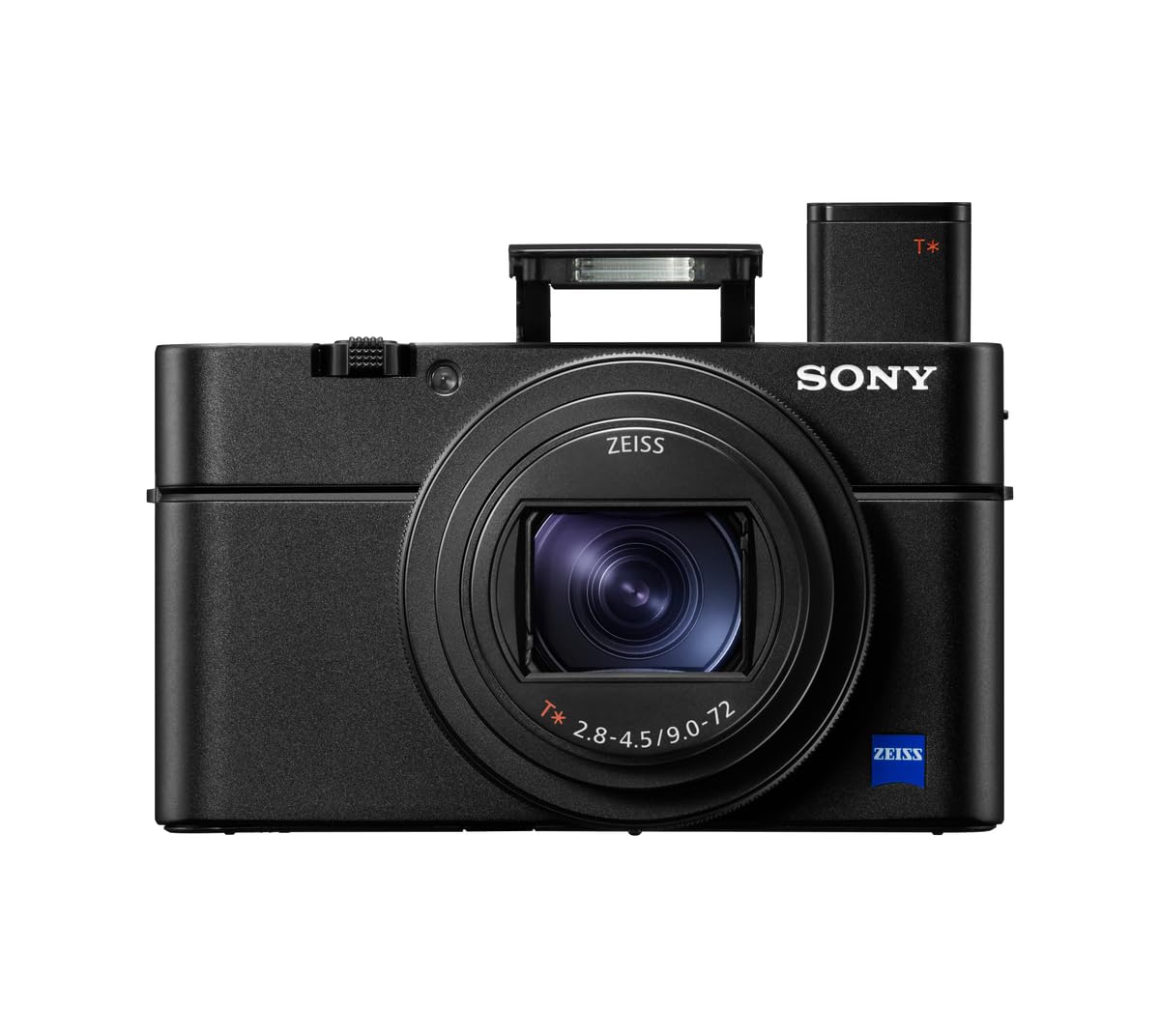
The Sony RX100 VII is the compact zoom champion, but its fixed-lens design — a Zeiss Vario-Sonnar T 24-200mm f/2.8-4.5 — deserves serious attention from anyone prioritizing range without sacrificing pocketability. The 20.1MP 1-inch stacked CMOS sensor is paired with a DRAM chip for lightning-fast readout, enabling up to 20 fps blackout-free shooting with continuous AF/AE tracking at 60 times per second. The 357-point focal plane phase-detection AF and 425-point contrast-detection system cover the frame densely, and AI-based Real-time Tracking works for both humans and animals (stills only). 4K video with S-Log3 and microphone input make this a viable vlogging tool, especially in good light.
The zoom range from 24mm wide to 200mm telephoto is remarkably versatile, covering everything from landscapes and group shots to distant wildlife and concert subjects. The lens is sharp across the frame at the wide end and remains usable at the telephoto end, though you trade the deepest depth-of-field control for that flexibility. Active Mode image stabilization smooths handheld video, and the pop-up EVF gives a bright view even in sunlight. The body is impressively small — about the size of a deck of cards — and features a tilting touchscreen for selfies and low-angle shots. Single-shot autofocus is snappy, though continuous tracking can be stressed with erratic subjects.
The 1-inch sensor, while capable, cannot match the low-light performance or depth-of-field control of APS-C or full-frame fixed-lens cameras — image quality is good but not great past ISO 1600. The lens is relatively slow at the telephoto end (f/4.5 at 200mm), and the small sensor means dynamic range is constrained compared to larger-sensor rivals. The menu system is dense and can overwhelm new users. Battery life is decent at about 260 shots per charge. For travelers who need one camera that shoots wide, zoomed, and everything in between while still fitting in an everyday pocket, the RX100 VII is the most versatile fixed-lens camera on the market.
Why it’s great
- 24-200mm equivalent zoom range in a truly pocketable compact body
- Blazing 20 fps blackout-free shooting with reliable subject tracking
- Real-time Eye AF and 4K with S-Log3 for hybrid photo/video use
Good to know
- 1-inch sensor is outclassed by larger sensors in low light and dynamic range
- F4.5 at the telephoto end limits depth-of-field and low-light reach
- Complex menu structure can be intimidating for beginners
6. Canon PowerShot V1

The Canon PowerShot V1 reorients the fixed-lens compact around the needs of video creators. It uses a 1.4-type (roughly Micro Four Thirds in size) 22.3MP sensor for stills and 18.7MP for video, paired with a built-in 16-50mm f/2.8-4.5 wide-angle zoom lens (35mm equivalent). The headline feature is a built-in cooling fan that enables prolonged 4K recording without overheating — a significant advantage over previous Canon compacts. Canon Log 3 is available, allowing 10-bit color depth with a wide dynamic range, and the hybrid autofocus system with 100 phase-detection points delivers reliable subject tracking during video capture. This camera is purpose-built for vlogging, live streaming, and content creation.
The lens starts at an ultra-wide 16mm equivalent, which is ideal for handheld vlogging with the subject centered in frame, and the f/2.8 aperture at the wide end helps maintain exposure in moderate light. The sensor provides good detail retention up to ISO 6400, and the DIGIC X processor ensures smooth operation. The 3-inch touchscreen tilts up 180 degrees for front-facing framing. USB-C power delivery lets you run the camera off a power bank during long streams. The 10-bit CLog3 footage grades beautifully, giving creators real flexibility in post-production without the bulk of an interchangeable-lens system.
The V1 does not have in-body stabilization — it relies on electronic stabilization which works well for static handheld shots but shows crop and wobble during walking. The lens is relatively slow (f/4.5 at the telephoto end), and the 16-50mm range lacks the reach for detailed close-ups. There is no built-in flash, and the SD card slot is located under the battery door — inconvenient if you use a quick-release plate. The body is larger than typical pocketables, edging into bridge camera territory. For a fixed-lens camera focused squarely on high-quality video creation and streaming, the V1 is a thoughtful, current-generation tool.
Why it’s great
- Built-in cooling fan enables long 4K recording sessions without overheating
- 16mm ultra-wide equivalent is ideal for vlogging and selfie framing
- Canon Log 3 with 10-bit color gives professional-level video grading headroom
Good to know
- No optical image stabilization; electronic stabilization crops and affects walking footage
- 16-50mm range limits telephoto reach and macro flexibility
- SD slot under the battery door is inconvenient with tripod plates
7. Canon PowerShot SX740 HS
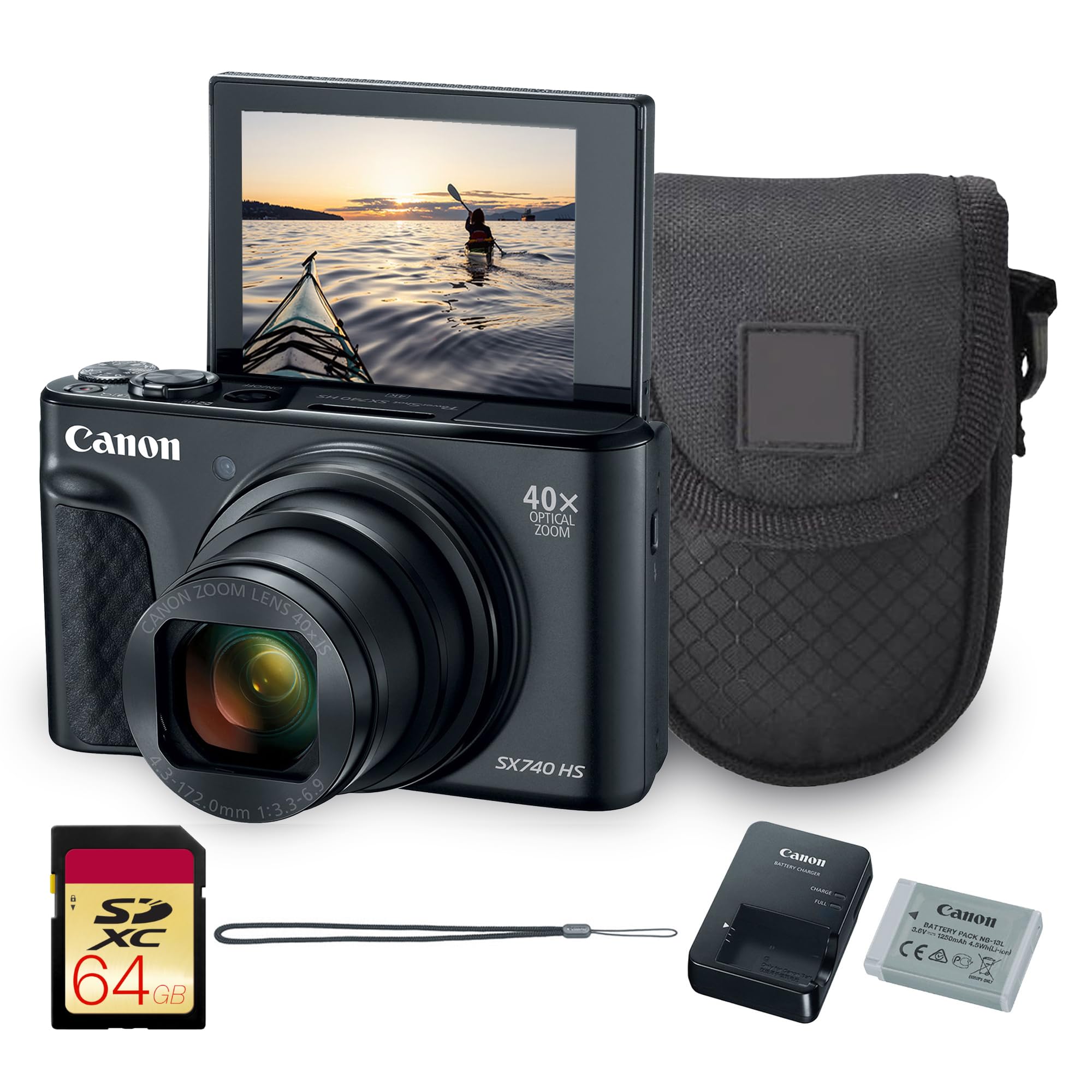
The Canon PowerShot SX740 HS is an entry-level superzoom with a 40x optical zoom lens covering 24-960mm equivalent — an enormous range that brings distant subjects into frame without changing lenses. The 20.3MP 1/2.3-inch CMOS sensor is paired with the DIGIC 8 processor, which enables 4K UHD video recording at 30p and 1080p at 120 fps for slow-motion. Built-in 5-axis stabilization steadies the image at the telephoto end, though it works primarily for video. The hybrid autofocus system is competent in good light. Wi-Fi and Bluetooth connectivity let you transfer files to a smartphone using the Canon Camera Connect app, and the 3-inch tilting LCD is helpful for framing at awkward angles.
At the wide 24mm end, the lens captures group shots and landscapes adequately. Zooming to 960mm, you can fill the frame with a distant bird or a performer on stage. The flash is built in and provides decent fill-light at short distances. The bundle options often include a memory card and a case, adding value. Battery life is surprisingly strong — users routinely report several days of casual use between charges.
The small 1/2.3-inch sensor is the limiting factor; images get noisy at ISO 800 and above, and dynamic range is narrow, making it difficult to recover shadows or highlights. The lens is slow across the range (f/3.3 at wide, f/5.6 at telephoto), so low-light performance is poor without flash or a steady surface. Autofocus can struggle to lock onto distant, low-contrast subjects when zoomed in fully. The EVF is missing, making it hard to compose in bright sunlight. If your priority is getting close-up reach in daylight without spending much, the SX740 HS delivers, but image quality expectations must be adjusted for the sensor size.
Why it’s great
- 40x optical zoom (24-960mm) captures distant subjects with ease
- 4K video and 120 fps slow-motion recording for basic video needs
- Excellent battery life for a compact superzoom
Good to know
- Small sensor produces noisy images above ISO 800 and limited dynamic range
- No electronic viewfinder makes outdoor composition difficult
- Autofocus hunts at full telephoto in low-contrast situations
8. Panasonic LUMIX FZ80D

The Panasonic LUMIX FZ80D is a budget-friendly bridge camera built around a staggering 60x optical zoom lens, covering 20-1200mm equivalent. That ultrawide 20mm starting point is wider than most competitors, useful for epic landscapes and tight architectural interiors. The 18.1MP 1/2.3-inch sensor is paired with a Power O.I.S. stabilization system that reduces handshake at the telephoto end. 4K video and 4K Photo mode let you extract 8MP stills from video clips — a handy feature for capturing fast action without relying on burst shooting. The 0.74x (35mm equivalent) electronic viewfinder with 2,360K dots provides a clear view even in bright conditions. Post Focus mode lets you tap the area you want sharp after shooting.
The 20mm equivalent wide-angle is genuinely useful for expansive shots that most superzooms cannot match. At maximum 1200mm, the FZ80D can photograph subjects hundreds of meters away — a hawk on a branch, a moon crater detail. The lens aperture starts at f/2.8 at 20mm, which helps modestly with low light at the wide end. Autofocus is contrast-detection with 39 points, which can lock on reliably in good contrast. The camera is lightweight at about 616 grams, making it a viable hiking companion. The Aperture ring around the lens provides direct control over f-stop.
The 1/2.3-inch sensor’s small size results in grain at ISOs above 800, and the lens is quite slow at the telephoto end (f/5.9 at 1200mm), meaning you need bright daylight for distant, high-quality shots. Image quality assessments note softness at full zoom and chromatic aberration in high-contrast edges. The interface is not the most intuitive, and there is no Wi-Fi or Bluetooth for easy phone transfer — a notable omission for sharing on social media. Battery life is adequate but drains faster during heavy zoom use. For an entry-level superzoom with extreme reach at a budget price, the FZ80D is a functional tool, though image quality expectations must remain realistic.
Why it’s great
- 60x optical zoom (20-1200mm) offers unmatched reach for the budget class
- Post Focus and 4K Photo features add creative flexibility
- Lightweight body makes long hikes more comfortable
Good to know
- Small sensor produces noisy, soft images above ISO 800 and in dim light
- No Wi-Fi or Bluetooth for direct smartphone sharing
- Contrast-detect AF hunts in low-light and low-contrast scenarios
9. Panasonic LUMIX TZ/ZS99

The Panasonic LUMIX TZ/ZS99 (marketed as ZS99 in North America) is a travel compact with a 30x Leica DC Vario-Elmar zoom lens covering 24-720mm equivalent. The 20.3MP 1/2.3-inch sensor records 4K video at 30p and supports 4K PHOTO burst at 30 fps, and the built-in Power O.I.S. helps stabilize shots throughout the zoom range. The 1,840k-dot tiltable touchscreen allows for waist-level and high-angle composition. Bluetooth 5.0 and a dedicated Send Image button simplify wireless transfer to a smartphone using the Panasonic Image App. The lens Features stepped zoom presets and a Lens Position Resume that remembers your last zoom level after power-off.
The Leica-branded lens is decently sharp at the wide and mid-zoom ranges, and the 30x reach captures distant subjects — useful for concerts, sports, and travel landmarks. The tilt-screen is practical for selfies and group shots at arm’s length. Color rendition from the JPEG engine is pleasing, with good saturation straight out of camera. The compact build truly fits in a pocket alongside a phone, making it easy to carry everywhere. USB-C charging is a modern convenience that eliminates the need for a proprietary charger. The hybrid autofocus uses 171 points for faster acquisition in good light.
The small sensor limits low-light performance, and images show noticeable noise above ISO 1600. The lens is slow at the telephoto end (f/6.4 at 720mm), making it hard to freeze action or shoot in fading light without pushing ISO high. The electronic viewfinder, while present, is small and dim compared to larger cameras. Autofocus can be inconsistent, especially at the telephoto end in low contrast. Battery life is decent at around 260 shots. For a pocketable travel camera with substantial zoom range, the ZS99 hits a sweet spot of portability and reach, but its image quality ceiling is defined by the small sensor.
Why it’s great
- 30x zoom (24-720mm) fits in a pocket, ideal for travel and events
- Tiltable touchscreen and USB-C charging add modern convenience
- Leica lens delivers good color and sharpness at standard zoom ranges
Good to know
- Small sensor produces noisy images at ISO 1600 and above
- Slow f/6.4 at telephoto limits shutter speed and low-light reach
- Autofocus can be inconsistent at full zoom in low contrast
10. Fujifilm Instax Mini EVO
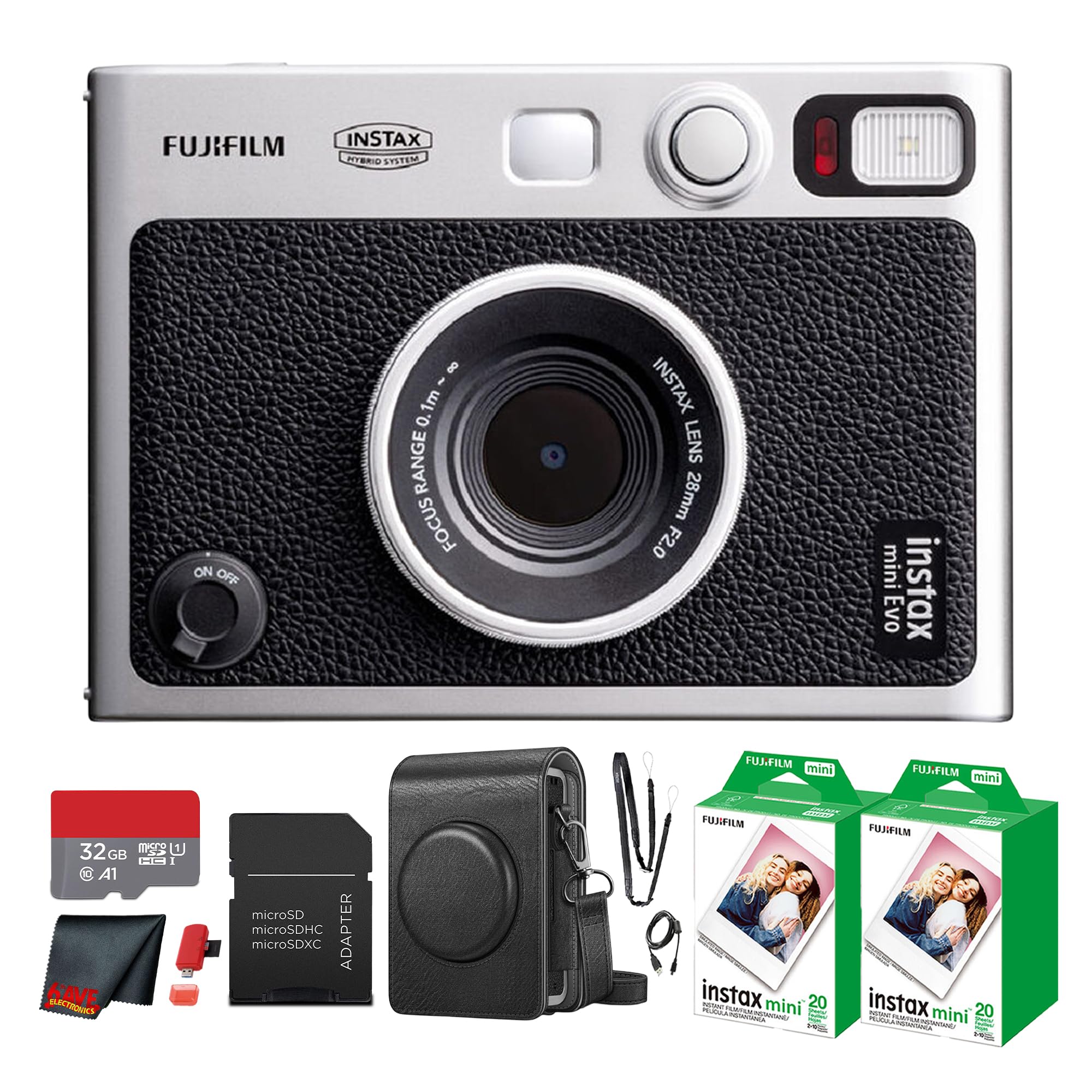
The Fujifilm Instax Mini EVO is a hybrid instant camera that bridges digital capture and analog film output. It features a fixed 28mm-equivalent f/2 lens and a 3-inch LCD screen for composing and reviewing shots before printing. The core innovation is the 10 lens effect options and 10 film effect options, combining for up to 100 different creative looks — you can apply Vivid, Soft Focus, Fisheye, and other styles before committing to a print. Internal memory stores images digitally, and a microSD slot expands capacity. The print lever gives tactile feedback when you decide to print a selected image onto Instax Mini film (2.1 x 3.4 inches).
Dual shutter buttons let you shoot in portrait or landscape orientation comfortably, and the built-in selfie mirror helps frame self-portraits. The Instax Mini EVO app allows you to print photos from your phone, save prints with an instax frame, or use the phone as a remote shutter. Film simulations let you adjust brightness, contrast, and saturation before printing. The hybrid system means you do not waste film on bad shots — you capture digitally, review, and print only the ones you love. The rechargeable battery uses USB-C, and the bundle includes 40 sheets of Instax Mini film plus a 32GB memory card and case.
This is not a camera for pixel-level image quality — the Instax Mini film is a fixed size (roughly coin-sized image area) with limited tonal range. The digital capture is modest for a dedicated camera; the built-in sensor and processing are designed for the small print format, not large displays or prints. The camera is bulkier than a standard point-and-shoot due to the print mechanism. Film costs add up over time. For anyone seeking a fun, creative, hands-on photography experience that produces tangible prints quickly, the Instax Mini EVO is the most flexible hybrid instant camera available.
Why it’s great
- Hybrid digital/instant system avoids wasting film on bad shots
- 100 creative effect combinations encourage experimentation
- App integration for smartphone printing and remote control
Good to know
- Image quality is limited to the small Instax Mini print format
- Bulkier than standard point-and-shoot cameras due to printing mechanism
- Ongoing film costs can accumulate quickly with frequent use
11. Pentax 17

The Pentax 17 is a modern half-frame 35mm film camera designed by Ricoh Imaging, built for photographers who want the film experience with practical advantages. It captures two 17x24mm images on each standard 35mm frame, yielding up to 72 exposures per 36-exposure roll. The fixed 25mm f/3.5 lens (roughly 37mm equivalent in full-frame terms) is treated with HD coating for contrast and flare resistance. A zone-focus system divides distance into six pictogram-marked zones (close-up, portrait, group, mid-range, scenic, infinity), letting you set focus quickly without looking. The manual film advance lever recreates the tactile feel of classic film cameras. Top and bottom covers are solid magnesium alloy for durability and light weight.
The 37mm-equivalent focal length is a natural everyday perspective, close to classic street photography standards. The half-frame format is a huge advantage for film shooters who want to experiment without blowing through rolls — each 36-exposure roll gives 72 shots, effectively halving the cost per frame. The built-in exposure meter handles automatic exposure (aperture-priority mode with fixed f/3.5), so you only need to focus and shoot. The shutter is notably quiet, making it excellent for candid street photography. The design is retro-modern, with clean lines and a build quality that feels substantial without being heavy. The zone focus, while initially a learning curve, becomes fast with practice.
The lens is relatively slow at f/3.5, so shooting in low light requires high-speed film (ISO 800 or faster) or a flash accessory (no built-in flash). The zone focus system lacks the precision of a rangefinder or autofocus, so critical focus at close distances requires careful distance estimation. The price is higher than many comparable vintage half-frame cameras, though the reliability, warranty, and new-production parts justify the premium for many buyers. There is no frame counter for the half-frame exposures — you must track manually or use the standard frame count doubled. For anyone looking to shoot film with modern reliability and half-frame economy, the Pentax 17 is a thoughtfully designed, fun, and practical fixed-lens camera.
Why it’s great
- Half-frame format yields 72 shots per roll, cutting film costs in half
- Quiet shutter and classic manual advance lever provide a pure film experience
- Magnesium alloy build is durable and lightweight
Good to know
- f/3.5 lens is slow for low-light without high-ISO film or flash
- Zone-focus system requires practice for accurate close-up focus
- Price is high compared to vintage half-frame alternatives
FAQ
What advantage does a fixed-lens camera have over a smartphone?
How do I choose between 35mm and 40mm equivalent focal length?
Is a half-frame film camera like the Pentax 17 practical for everyday shooting?
Final Thoughts: The Verdict
For most users, the camera with fixed lens winner is the Ricoh GR IIIx because it packs an APS-C sensor and a razor-sharp 40mm lens into a genuinely pocketable body, delivering professional-grade image quality in a package you can carry every day without thinking twice. If you want the out-of-camera color magic and a hybrid viewfinder that makes you fall in love with photography again, grab the Fujifilm X100VI. And for the ultimate full-frame resolution plus the Leica shooting experience that justifies the price for serious enthusiasts, nothing beats the Leica Q3.
Product prices and availability are accurate as of the date/time indicated and are subject to change. Any price and availability information displayed on Amazon at the time of purchase will apply to the purchase of this product. As an Amazon Associate I earn from qualifying purchases.
CERTAIN CONTENT THAT APPEARS ON THIS SITE COMES FROM AMAZON. THIS CONTENT IS PROVIDED "AS IS" AND IS SUBJECT TO CHANGE OR REMOVAL AT ANY TIME.
Amazon and the Amazon logo are trademarks of Amazon.com, Inc. or its affiliates.