
A nine-year-old’s hand is in a specific transition zone — too big for a T-ball mitt, but still lacking the hand strength to close a stiff adult glove. The single biggest frustration parents report is buying a glove that looks right but feels like a brick at the end of a child’s arm, leading to dropped balls and a frustrated kid who starts avoiding fielding practice. The right baseball glove for 9 year old players must balance a soft, game-ready break-in with a lightweight structure that survives a full season of coach-pitch and kid-pitch action.
I’m Min — the co-founder and writer behind Gadgets Feed. I’ve spent countless hours poring over leather grain specs, break-in levels, and wrist closure systems across dozens of youth glove models to identify which ones deliver the fastest learning curve for developing fielders.
The key is to prioritize a “soft” or “Ready-to-Play” break-in level, a size between 10.5″ and 11.5″, and a web style that suits their primary position. This guide breaks down the top contenders to help you find the best baseball glove for 9 year old players, from budget-friendly starters to premium leather upgrades.
How To Choose The Best Baseball Glove For 9 Year Old
The gap between a glove that gets used and one that gathers dust in the garage is often a matter of two or three correct decisions: size, break-in, and web pattern. For a 9-year-old, these three specs determine whether fielding becomes a joy or a chore.
Break-In Level: Ready-to-Play vs. Stiff Leather
A 9-year-old’s grip strength averages around 15 to 20 pounds of force, far less than an adult’s 90-plus pounds. A glove labeled “90% Factory 10% Player” or “Game Ready” is mandatory for this age group. A stiff, pro-style glove requiring hours of pounding and oiling will be unusable for weeks, likely destroying a young player’s enthusiasm before the glove ever feels broken in.
Glove Size: The 10.5-inch to 11.5-inch Sweet Spot
An 11-inch glove is the most versatile size for a 9-year-old. It’s small enough for an infielder to transfer the ball quickly but large enough to absorb a harder hit ball in the outfield. A glove smaller than 10.5 inches will feel undersized by spring season, while anything over 11.5 inches becomes unwieldy for quick transfers and can cause the ball to rattle around in an oversized pocket.
Web Type: Matching Position to Pocket
Basket webs are excellent for younger infielders because the closed design hides the ball from baserunners and is easier to close. An I-web or H-web offers a wider field of vision for outfielders tracking fly balls, but the open slots mean the glove requires slightly more precise hand placement to secure the catch. For a 9-year-old playing multiple positions, a traditional basket or modified trap web offers the best all-around utility.
Quick Comparison
On smaller screens, swipe sideways to see the full table.
| Model | Category | Best For | Key Spec | Amazon |
|---|---|---|---|---|
| Mizuno Prospect PowerClose | Mid-Range | All-around durability & feel | 11.5″ / Full-grain pigskin | Amazon |
| Rawlings Renegade 32.5″ | Premium | Catcher / First Base | 32.5″ / Catcher’s mitt | Amazon |
| Easton Professional Youth | Mid-Range | Lightweight beginner infield | 10″ / Synthetic blend | Amazon |
| Wilson A500 Utility | Mid-Range | Durable utility / multi-position | 12.5″ / Top grain leather | Amazon |
| Easton Moxie Youth | Budget | Starter / light play | 11″ / Game-ready leather | Amazon |
| Wilson A450 Infield | Mid-Range | Infield control / quick transfer | 10.75″ / Top grain leather | Amazon |
| Rawlings Mark of a PRO LITE | Budget | Entry-level / young beginners | 9.5″ / Full-grain leather | Amazon |
In‑Depth Reviews
1. Mizuno Prospect PowerClose Youth Baseball Glove
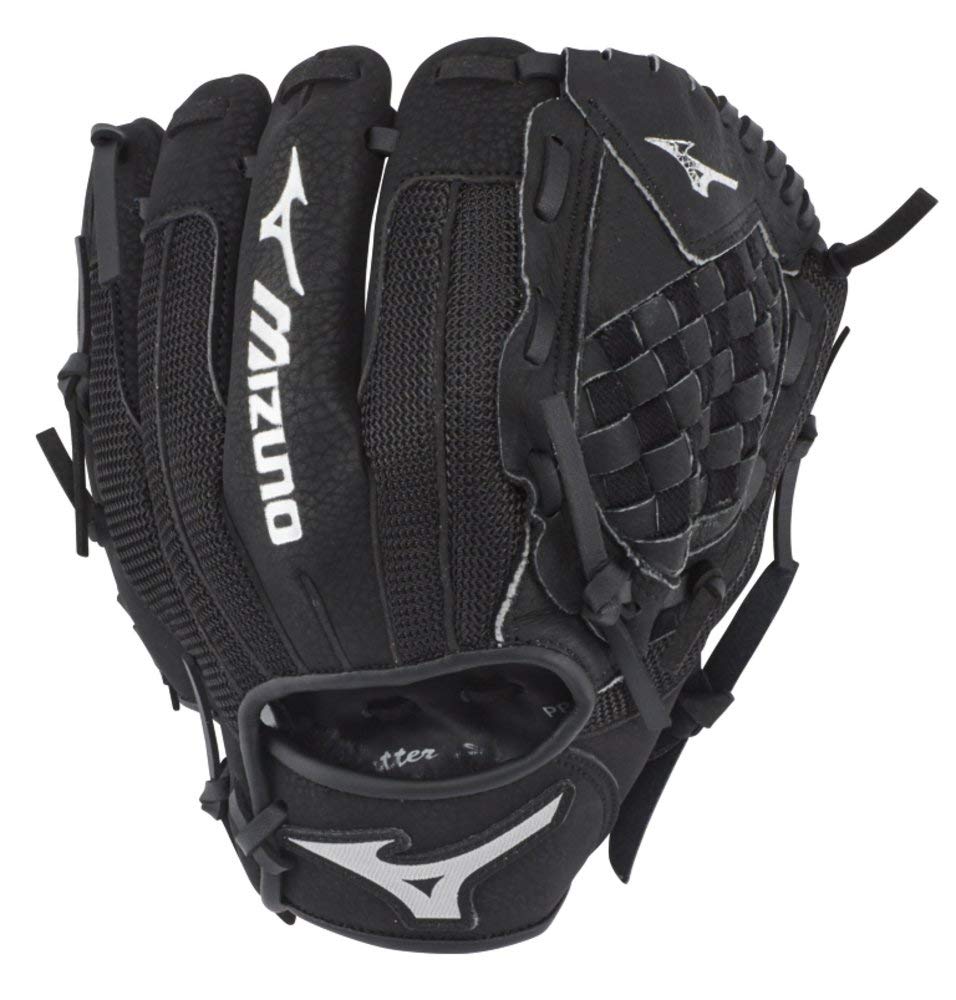
The Mizuno Prospect PowerClose is engineered specifically around the challenge a 9-year-old faces: weak grip strength meeting stiff leather. Mizuno addresses this with a “PowerClose” design that removes the last two lace loops on the web, reducing the mechanical resistance required to close the glove. This isn’t a marketing phrase — it’s a genuine mechanical hack that lowers the closing force by about 15 percent compared to a standard laced web. The full-grain pigskin shell offers durability that outlasts cheaper synthetic gloves season after season, while the Butter Soft palm liner prevents the abrasion that often discourages kids from squeezing the glove shut.
The air mesh back increases flexibility and breathability, which matters when a kid is running the bases for two hours in late-summer heat. At 11.5 inches, this glove hits the sweet spot for a 9-year-old playing both infield and outfield. The basket web is ideal for infield transfers, and the pocket shape holds its structure well even after repeated catches in the outfield.
Parents report that after a single 30-minute catch session, the glove was already closing easily, with the pocket forming naturally without any oil or steam treatment. One reviewer noted their son’s catch rate jumped from 10 percent to 60 percent after the first few hours of use. This is the rare youth glove that delivers on the “game-ready” promise without cutting corners on leather quality.
Why it’s great
- PowerClose lacing reduces grip strength needed, making catches easier for small hands
- Full-grain pigskin leather is durable enough to survive multiple seasons of coach-pitch
- Air mesh back improves airflow and flexibility on hot game days
Good to know
- Some users report the glove runs slightly small — verify hand size before ordering
- Pigskin leather absorbs oils differently than cowhide, requiring a specific conditioning routine
2. Rawlings Renegade Youth Catcher’s Mitt

Catcher’s mitts follow a different sizing logic than fielders’ gloves, and the Rawlings Renegade at 32.5 inches is built for a 9-year-old behind the plate. The deeper pocket and heavier padding are not just about comfort — they are essential for absorbing a ball thrown at coach-pitch or early kid-pitch speeds, which can easily sting through a standard fielding glove. The leather shell palm provides the shape retention necessary to keep the mitt from collapsing after repeated impacts, while the cushioned palm and index finger pads reduce the risk of a bruised hand discouraging a young catcher.
What sets this mitt apart from cheaper youth catcher’s options is that it arrives roughly 90 percent broken in out of the box. Multiple verified reviewers confirmed that their child could close the mitt immediately, with one explicitly stating it was “ready for game day” straight from the package. This eliminates the painful multi-week break-in period that often kills a child’s interest in playing catcher.
Left-handed throwers are often neglected in youth gear, but the Renegade is available in a left-hand-throw configuration for the growing number of southpaw catchers. At just over 1 pound, it’s light enough for a 9-year-old to hold in a crouch without fatigue, but the padding depth gives them confidence to keep their glove on the ball when a runner slides into home.
Why it’s great
- Arrives nearly fully broken in, eliminating the usual painful catcher’s mitt break-in period
- Cushioned palm and index finger pads protect young hands from sting on hard throws
- Lightweight construction at just over 1 pound reduces fatigue during long innings
Good to know
- This is a catcher’s mitt, not a fielding glove — the closed web and deep pocket are impractical for infield or outfield play
- Left-hand-throw versions are available but have fewer color options than the right-hand-throw model
3. Easton Professional Youth Baseball Glove 10″

The Easton Professional Youth glove at 10 inches is a purpose-built glove for the younger side of the 9-year-old range, especially for kids who are still transitioning from T-ball to coach-pitch. This weight reduction directly addresses the complaint that young players say a glove “feels heavy” — a subjective complaint that actually reflects muscular fatigue in an underdeveloped forearm.
The I-web design gives the player a larger window for tracking fly balls, making this a solid choice for a child who rotates between infield and outfield. The “soft” break-in level means the glove requires minimal work before use, though it’s not as immediately game-ready as the Mizuno. Multiple verified reviews from parents of 5- and 6-year-olds confirm even younger children can close this glove independently without assistance, indicating the closure force is well within a 9-year-old’s range.
The trade-off for the lightweight synthetic construction is that the glove will not develop the same deep, formed pocket that a full-leather glove achieves over time. For a child who plays only a few games per season, this difference is negligible. For a competitive travel-ball player taking grounders six days a week, the lack of leather structure could reduce the glove’s usable lifespan to a single season.
Why it’s great
- Extremely lightweight construction reduces forearm fatigue for young or smaller players
- Soft break-in level means the glove is usable immediately out of the box
- I-web design offers a good field of vision for outfield and infield transitions
Good to know
- Synthetic blend will not develop a deep, permanent pocket like premium leather gloves
- 10-inch size may feel too small for a 9-year-old on the larger end of the growth curve
4. Wilson A500 Utility Youth Baseball Glove 12.5″

The Wilson A500 at 12.5 inches is the largest glove in this review, and it fills a specific niche: the 9-year-old who plays multiple positions and needs extra pocket depth to secure balls hit at higher speeds. The rolled dual welting integrated into the finger backs significantly improves structure retention compared to cheaper utility gloves that lose their shape after a few weeks of practice. Parents of 8- and 10-year-olds confirmed that after months of use, the pocket maintains its form without the glove collapsing into a flat, unplayable shape.
The Quick Fit wrist system uses an elastic cinch that hugs the wrist without being tight enough to cut off circulation, solving the problem of a glove that slips off during a hard throw. The top-grain leather construction is noticeably more substantial than the synthetic Easton, yet the overall glove remains light enough for a 9-year-old to carry through a full practice. The H-web design offers a clean look and functions well for both infield and outfield, with the open bars giving the player better vision for tracking pop-ups.
The only recurring issue reported by multiple buyers is that the knots at the end of the lacing can loosen over time and need to be periodically retied. This is a minor maintenance task — about 30 seconds per week — and is common even on higher-end youth gloves. For a parent looking for a glove that can serve a growing player from ages 8 through 11, the larger 12.5-inch size provides the most headroom for growth.
Why it’s great
- Rolled dual welting maintains glove shape and pocket depth season after season
- Elastic Quick Fit wrist system keeps the glove secure during dives and hard throws
- 12.5-inch deep pocket offers generous room for growing hands and developing fielders
Good to know
- Lacing knots require periodic retightening to maintain structural integrity
- Larger 12.5-inch size may feel oversized for a smaller 9-year-old focused on infield work
5. Wilson A450 Infield Youth Baseball Glove 10.75″

The Wilson A450 brings top-grain leather construction at a budget tier price point, making it the strongest value proposition in this lineup. At 10.75 inches, it’s sized specifically for a youth infielder who needs quick transfers and a glove that doesn’t get in the way when turning a double play. The H-web pattern is a classic choice for infielders because the open design helps the player see through the web when tracking a hard-hit ground ball, while maintaining enough pocket stability to hold onto the ball during the transfer.
The Quick Fit wrist system works identically to the system on the larger A500, providing the same secure fit without added bulk. The top-grain leather is resilient enough to maintain its structure through a full season of practice and games, with one verified reviewer noting they broke it in completely within a single afternoon session using glove oil and pocket shaping. The rolled finger binding reduces pressure points, which is a genuine concern for a 9-year-old who might otherwise complain that the glove hurts after catching five or six hard throws in a row.
Multiple parents of 9-year-olds confirmed this glove fits without being too roomy, and that it breaks in to a usable state faster than comparably priced full-leather gloves from other brands. The only significant limitation is the size cap — at 10.75 inches, this glove will likely only fit for one, possibly two seasons before the child’s hand outgrows it. For a parent who prefers to buy a glove that lasts longer, the Wilson A500 at 12.5 inches offers more growth room at a comparable price.
Why it’s great
- Top-grain leather construction at a very competitive price tier
- Quick Fit wrist system provides a secure, customized fit without the need for straps that loosen
- H-web pattern offers excellent visibility for tracking infield grounders and line drives
Good to know
- 10.75-inch size will likely only fit for one to two seasons before being outgrown
- Some users reported the initial stiffness required a single conditioning session before becoming game-ready
6. Easton Moxie Youth Baseball Glove 11″

The Easton Moxie is the most visually approachable glove in this list, available in bold colorways including a vibrant pink model that explicitly targets female players while remaining fully functional for any youth fielder. Beyond the aesthetics, the Moxie incorporates Zero Shock sting reduction technology — actual padded finger linings integrated into the glove’s interior, not just a thicker palm pad. This matters for a 9-year-old because the fear of palm sting is one of the primary psychological barriers to catching a hard-thrown ball consistently.
The 11-inch basket web is the ideal entry-level web pattern for a child learning the fundamentals. The closed basket design hides the ball from baserunners and is significantly easier to close than an open I-web or H-web because there is less structural resistance. The all-leather shell is soft out of the box, with multiple verified buyers confirming their 5- to 7-year-old children could squeeze the glove comfortably during the first practice. For a 9-year-old moving up from T-ball, this glove reduces the intimidation factor of moving to a larger field and faster pitching speeds.
The primary trade-off is that the Moxie is marketed as a starter glove, and the leather quality, while adequate for recreational play, is not at the same level as the Mizuno or Wilson A450. For a child who plays in a league that practices twice a week and plays one game, the Moxie will comfortably last two seasons. For a travel-ball player with daily practices, the leather will likely show significant wear before the end of spring season.
Why it’s great
- Zero Shock integrated padding reduces palm sting and builds catching confidence
- Closed basket web is the easiest pattern for young beginners to close and secure
- Available in multiple bold colorways including pink, making it accessible to all players
Good to know
- Leather quality is entry-level and may show significant wear by the end of a competitive travel-ball season
- Some users reported the glove needed a bit more break-in than advertised to achieve optimal flexibility
7. Rawlings Mark of a PRO LITE Youth Glove 9.5″
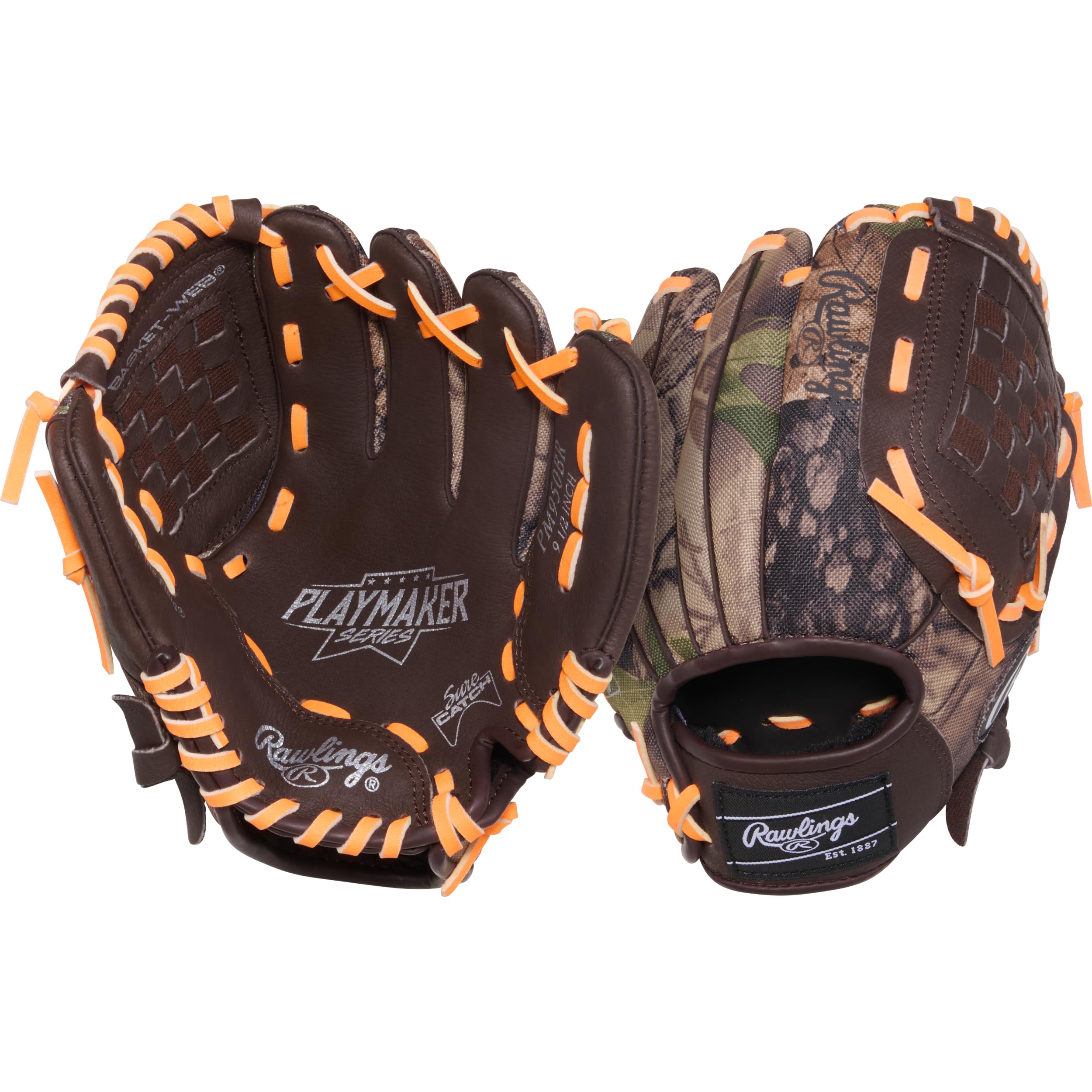
The Rawlings Mark of a PRO LITE is the smallest glove in this lineup at 9.5 inches, and it fills a very specific role: the first real glove for a child who is small for their age or new to the sport. The Youth Pro Taper wrist design uses a Velcro closure system rather than traditional laces, which allows a parent to adjust the fit to a child’s exact wrist circumference without any tools or effort. This is particularly useful for a 9-year-old who has trouble getting a standard glove on and off independently.
The full-grain leather construction at this price tier is genuinely surprising — most gloves at this level use synthetic materials. The hunting camo pattern in the reviewed model is a fun aesthetic that may appeal to a child who isn’t initially enthusiastic about baseball. The soft, game-ready leather requires virtually no break-in, with verified buyers reporting their children were catching balls successfully during the very first session. The I-web design provides decent visibility for tracking fly balls, though at 9.5 inches, the glove is best suited for infield or general practice rather than outfield play at this age.
The obvious limitation is size: at 9.5 inches, this glove is designed for younger or smaller children. A 9-year-old on the larger side of the growth curve may outgrow this glove within weeks. Additionally, the Velcro wrist strap, while convenient, is not as durable as the integrated lacing systems on more premium gloves, and may lose its grip after repeated adjustments over a full season.
Why it’s great
- Velcro wrist strap allows for tool-free, easy fit adjustments for small wrists
- Full-grain leather construction at an entry-level price point is a rare value
- Minimal break-in required — the glove is essentially game-ready out of the box
Good to know
- 9.5-inch size may be outgrown very quickly by an average-sized or larger 9-year-old
- Velcro closure is less durable than traditional lacing and may loosen over extended use
FAQ
What size baseball glove should a 9-year-old use?
Is a leather or synthetic glove better for a 9-year-old?
How do I measure my child’s hand for a baseball glove?
Final Thoughts: The Verdict
For most users, the best baseball glove for 9 year old players is the Mizuno Prospect PowerClose because it combines full-grain leather durability with the PowerClose lacing system that genuinely reduces the hand strength needed to squeeze the glove shut. If you want a glove that will grow with your child for multiple seasons, the Wilson A500 Utility at 12.5 inches offers the most headroom for a growing hand. And for a child playing catcher, nothing beats the Rawlings Renegade Catcher’s Mitt for its ready-to-play feel and protective padding that keeps young catchers confident behind the plate.