
A climbing chainsaw isn’t a smaller version of a ground saw — it’s a completely different tool built around one-handed operation, minimal weight, and a top-handle design that lets you cut while anchored to a rope. The difference between a safe, productive day aloft and a miserable, exhausting battle comes down to whether the saw balances correctly on a single hand and starts reliably with a wrist flick. The wrong choice means fighting the tool instead of the tree.
I’m Min — the co-founder and writer behind Gadgets Feed. I’ve spent countless hours cross-referencing torque curves, chain speeds, and ergonomic designs to separate the true climbing-specific models from the ground saws that manufacturers simply slap a top handle onto.
After analyzing nine of the most serious candidates on the market right now, I’ve narrowed the field to the picks that genuinely serve the arborist and the serious landowner. The chainsaw for climbing you choose will define your range of motion and fatigue level for years to come.
How To Choose The Best Chainsaw For Climbing
A climbing saw lives or dies by its ability to be controlled with one hand while the other hand holds your tie-in point. Every spec — weight, bar length, chain speed, and power source — directly affects your ability to make clean cuts without exhausting your shoulder by lunchtime.
Weight and Balance Are Non-Negotiable
Sub-eight pounds is the practical ceiling for a climbing saw you’ll use all day. Every extra pound multiplies fatigue because you’re not just holding it — you’re maneuvering it overhead, sideways, and at awkward angles. A saw that’s nose-heavy or tail-heavy will fight your wrist on every cut. Look for a unit that sits neutrally in your hand with the battery or fuel tank full.
Bar Length: 10 to 14 Inches Is the Sweet Spot
A 10-inch bar gives you pinpoint precision for limbing and tight spaces, while a 14-inch bar adds reach for thicker material without adding so much nose weight that one-handed control suffers. A 16-inch bar on a top-handle saw is a specialty tool for specific scenarios — it adds leverage that can overwhelm a single wrist during sustained cuts.
Battery vs. Gas vs. Your Workflow
Battery saws offer instant starting, no fumes in the canopy, and zero pull-cord frustration, but they limit your runtime to the batteries you carry. Gas saws deliver endless torque and refuel in seconds, but they require proper starting technique and add vibration fatigue. The best choice depends on whether you’re running a full day of removals or quick pruning sessions.
Chain Tensioning and Maintenance Access
In the tree, you cannot afford a saw that requires tools to adjust the chain. Tool-less chain tensioning and side-access oil caps let you make adjustments while roped in without fumbling or dropping components. A captured bar nut also prevents the bar from shifting during a cut, which is a safety issue that matters more at height than on the ground.
Quick Comparison
On smaller screens, swipe sideways to see the full table.
| Model | Category | Best For | Key Spec | Amazon |
|---|---|---|---|---|
| Milwaukee M18 FUEL Hatchet | Battery Pruning Saw | One-handed climbing precision | 8″ bar, 10.9 lbs with battery | Amazon |
| Echo CS-2511T-12 | Gas Top Handle | Pro climbing reliability | 12″ bar, 6.3 lbs dry | Amazon |
| Echo CS-355T | Gas Top Handle | Power-to-weight ratio | 16″ bar, 8.2 lbs dry | Amazon |
| DEWALT DCCS674B | Battery Top Handle | Fleet compatibility | 12″ bar, 60V system | Amazon |
| STIHL MS 194 T | Gas Top Handle | Build quality and handling | 12″ bar, 7.3 lbs dry | Amazon |
| Husqvarna Power Axe 225i | Battery Top Handle | Quiet, low-vibration cutting | 14″ bar, 6.8 lbs | Amazon |
| Makita XCU06Z | Battery Top Handle | Ultra-light limbing | 10″ bar, 7.2 lbs, 4,720 FPM | Amazon |
| DEWALT DCCS672B | Battery Ground/Climb | Heavy cutting on rope | 18″ bar, 60V FlexVolt | Amazon |
| DEWALT DCCS621P1 | Battery Ground/Climb | Multi-purpose outdoor cutting | 12″ bar, 12.6 lbs kit | Amazon |
In‑Depth Reviews
1. Milwaukee M18 FUEL 8 in. Hatchet Pruning Saw (3004-21P)

The Milwaukee M18 FUEL Hatchet is the closest thing to a climbing-specific battery saw that money can buy, and it’s not an accident — the factory lanyard loop, climbing scabbard, and metal bucking spikes are features lifted directly from professional arborist gear. The POWERSTATE brushless motor delivers 2.3 HP through an 8-inch bar, which sounds conservative until you feel how fast it zings through 4-inch hardwoods without bogging. The full-house chain minimizes vibration, and that matters when you’re making 40 cuts from a single tie-in point.
The included 6.0 Ah High Output battery pushes the total weight to 10.9 pounds, which is heavier than a pure gas top-handle like the Echo CS-2511T, but the balanced chassis and the variable-speed trigger make it feel lighter in the hand. The auto-oiler and translucent reservoir let you monitor oil levels without guessing, and the tool-free chain tensioner means you adjust the chain in seconds while roped in. This is a purpose-built climbing tool, not a ground saw adapted for occasional use above head height.
Battery life is solid for pruning sessions — expect to fill a pickup bed with limbs on a single charge — but you’ll want a spare battery for full-day removals. The charger emits a low hum that’s normal for the M18 system, and the oil weep is minimal compared to other models. If you already own Milwaukee M18 tools, this is a no-brainer; if you’re starting fresh, the performance justifies the investment.
Why it’s great
- Factory lanyard loop and climbing scabbard included.
- Zero vibration with the full-house chain design.
- Tool-free chain tensioning for in-tree adjustments.
Good to know
- Heavier than gas climbing saws at 10.9 lbs with battery.
- 8-inch bar limits reach on larger material.
2. Echo CS-2511T-12 Top Handle Chainsaw

The Echo CS-2511T is widely considered the lightest true climbing saw in its class at just 6.3 pounds dry, and that weight includes a 12-inch bar that punches well above its displacement. The 25.0 cc 2-stroke engine produces 5.3 HP on paper, which translates to reliable cutting through 8- to 10-inch limbs without bogging. Arborists who switched from Stihl MS 201TCs report that the Echo paid for itself within 10 tanks of fuel thanks to fewer starting issues and less vibration fatigue.
The top-handle ergonomics are dialed — the controls fall under your thumb naturally, and the chassis is compact enough to fit through tight crotches and branch unions. This saw starts reliably with a specific technique: choke, one pull, choke off, second pull. Warm starts are usually single-pull affairs. The 12-inch bar gives you enough reach for most limbing scenarios without the nose-heaviness that plagues longer bars on lightweight chassis.
Expect regular maintenance — chain sharpening and air filter cleaning are part of the deal with any gas climbing saw — but the Echo’s reputation for durability means fewer unplanned field repairs. Users report that the saw has handled everything from palm fronds to 24-inch hardwoods (with patience). If you want a gas saw that won’t break your back or your bank account, this is the benchmark.
Why it’s great
- Only 6.3 lbs dry — lightest in this comparison.
- 12-inch bar offers reach without nose weight penalty.
- Pro-level reliability that pays for itself quickly.
Good to know
- Gas engine requires regular maintenance and mixed fuel.
- Starting technique has a learning curve.
3. Echo CS-355T Top Handle 16″ Chainsaw
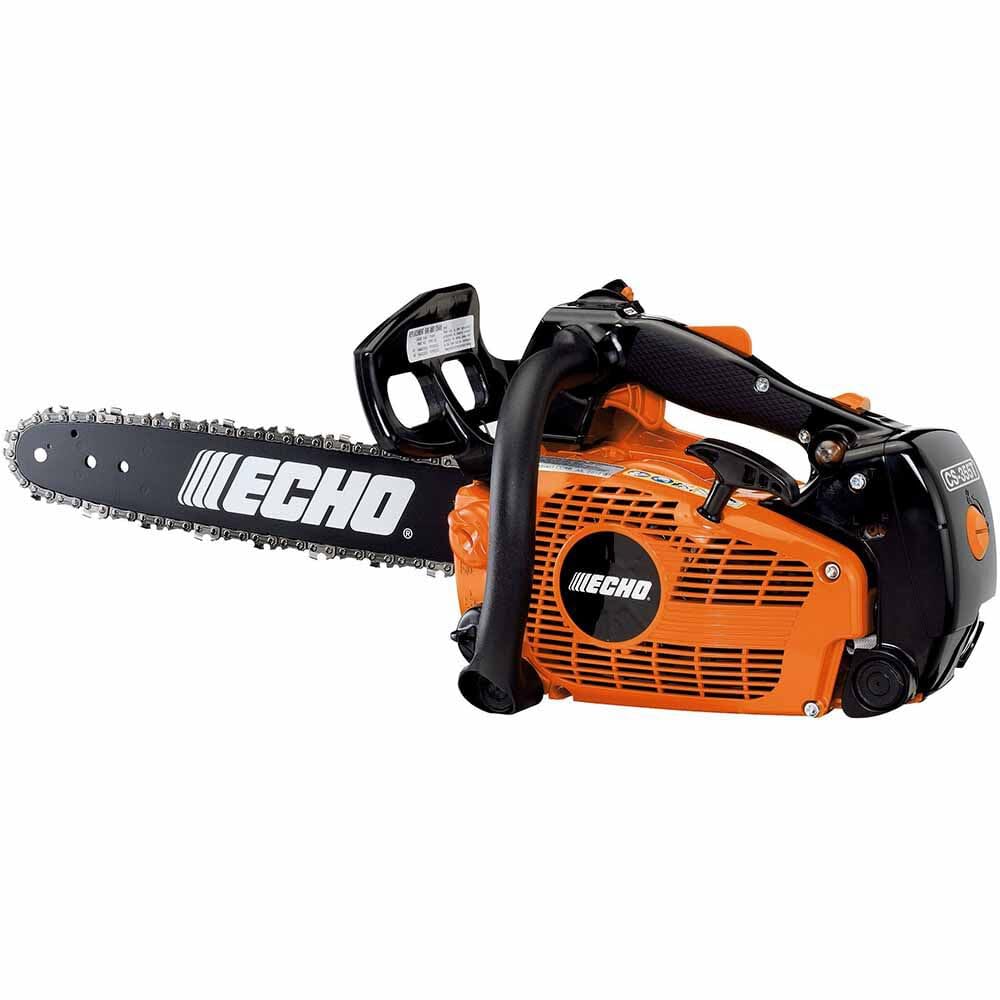
The Echo CS-355T takes the same 25.0 cc powerplant as the CS-2511T and stretches the bar to 16 inches, creating a climbing saw that can handle felling cuts and bucking in the tree without needing a second saw on the ground. At 8.2 pounds dry, it’s 2 pounds heavier than its little brother, but that extra mass is balanced by a chassis that feels planted during aggressive cuts. Users describe it as a “hot rod” that can be tuned for higher RPMs with simple carb adjustments.
The power-to-weight ratio is genuinely impressive for a 35 cc-class saw — it keeps pace with Stihl’s MS 201 while costing significantly less. The Echo’s 5-year consumer warranty (1-year commercial) adds peace of mind for serious users who put a saw through the ringer daily. Starting reliability is consistent with Echo’s reputation: choke, one pull, choke off, second pull. The 16-inch bar is excellent for reaching across large limbs, but it does introduce more nose weight that you’ll feel during extended one-handed operation.
This saw is not the best choice for beginners — the power delivery is immediate, and the longer bar demands respect in tight quarters. But for the experienced climber who needs to make larger cuts without coming down for a ground saw, the CS-355T is a compelling option that beats Stihl on price and Echo on features.
Why it’s great
- 16-inch bar enables felling cuts in the tree.
- Excellent power-to-weight ratio for the displacement class.
- 5-year consumer warranty is industry-leading.
Good to know
- Heavier than dedicated 12-inch climbing saws.
- Nose-heavy feel during one-handed overhead cuts.
4. DEWALT DCCS674B 60V Top Handle Chainsaw
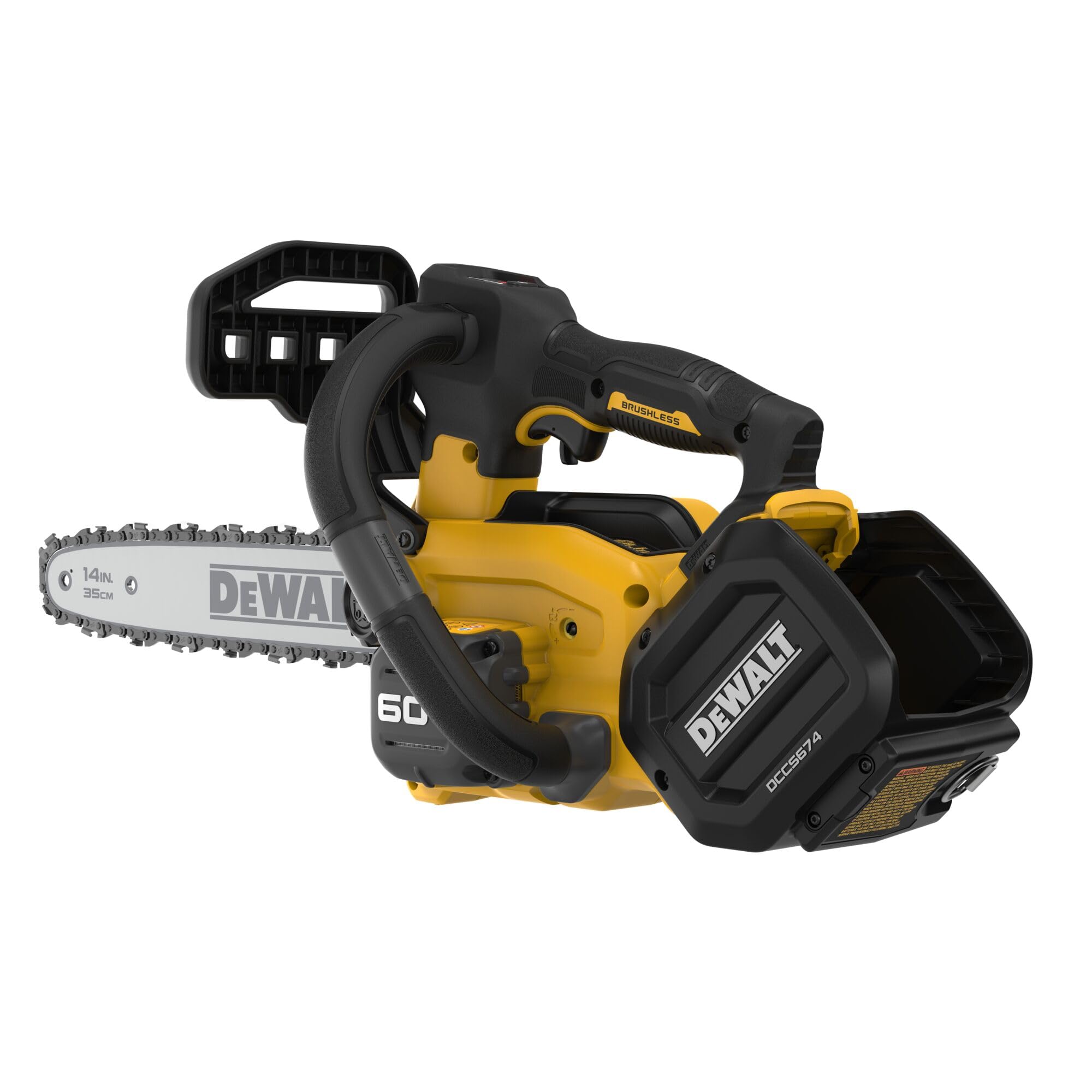
The DEWALT DCCS674B is a 60-volt top-handle saw that delivers gas-like power without the pull-cord, and it’s already earning a reputation among professional tree services who run DEWALT fleets. Users running it daily in climbing and ground operations report that it cuts fast with a 9 Ah battery and matches the speed of small gas saws on limbs up to 8 inches. The 60-volt platform gives it a torque curve that doesn’t sag under load the way some 18-volt saws do.
At just under 10 pounds with a 6 Ah battery, it’s competitive with gas climbing saws in weight, and the instant-on trigger eliminates the starting frustration that costs time in the tree. The top-handle ergonomics are well-executed — the controls are intuitive, and the saw sits neutral in the hand. The bare-tool format (sold without battery or charger) means existing DEWALT 60V or FlexVolt users get into this for a reasonable entry point. The 12-inch bar is a good compromise between reach and control.
The main trade-off is battery runtime — expect to go through multiple batteries on a full removal day, and the cost of extra 60V packs adds up. Also, the chain system can be sensitive to tension; some users report needing to check and adjust more frequently than on gas saws. But for fleet compatibility and instant power, this is a top contender.
Why it’s great
- 60V power delivery matches small gas saws.
- Top-handle design purpose-built for climbing.
- Instant start with no pull-cord frustration.
Good to know
- Bare tool — must own DEWALT 60V batteries.
- Needs frequent chain tension checks.
5. STIHL MS 194 T Chainsaw (30 cm)

The STIHL MS 194 T is the successor to the legendary MS 201, and it carries the weight of STIHL’s reputation for build quality and handling precision. At 7.3 pounds dry with a 30 cm (12-inch) bar, it’s a dedicated climbing saw that rewards experienced operators with excellent one-handed balance. The micro chain system on this saw convinced at least one long-time user who normally runs 3/8-inch chains on MS880s and MS660s — that’s a serious endorsement.
The power output is listed at 1.4 HP, which sounds modest, but STIHL’s engine tuning emphasizes usable torque across the RPM range rather than peak numbers. This means the saw pulls through cuts smoothly without stalling, even when you’re cutting at awkward angles. The anti-vibration system is effective — users who climb all day report less hand fatigue compared to other gas saws. The build quality is unmistakably STIHL: the chassis feels dense, the controls are precise, and the fit and finish are excellent.
But for professional arborists who value reliability and precise handling above all else, the STIHL nameplate delivers. This saw is less forgiving for beginners, but in expert hands, it’s one of the best cutting platforms available.
Why it’s great
- Superb one-handed balance and handling precision.
- Excellent anti-vibration system reduces fatigue.
- STIHL build quality and dealer network support.
Good to know
- Premium price point compared to Echo competition.
- Less beginner-friendly tuning and starting procedure.
6. Husqvarna Power Axe 225i (14-Inch)

The Husqvarna Power Axe 225i is a 14-inch battery saw that prioritizes balance and ease of use, featuring a pass-through battery design that keeps the weight centered in the chassis rather than hanging off the back. At 6.8 pounds with the battery installed, it’s lighter than many gas climbing saws while offering instant electric torque. The Active Cooling system extends battery life during demanding cuts, and the Boost mode delivers 25% more power when you hit a tough section.
All-in-one kits include the battery and charger, so there’s no separate purchase required to get cutting. Users report filling a Toyota 4Runner with limbs on a single charge, and the saw handles 6-8 inch dead elm for up to two hours of runtime. The tool-less chain tensioning is genuinely tool-less — you adjust the chain by turning a knob, no scrench required. The 14-inch bar gives you reach that the 8-inch Milwaukee lacks while keeping the weight under 7 pounds.
The Power Axe 225i is slightly less powerful than premium gas saws on very large material — expect to slow down on cuts over 8 inches in hardwood. The battery system is Husqvarna-specific, so you’re locked into their ecosystem unless you already own Husqvarna battery tools. But for a quiet, fume-free climbing experience with excellent balance and all-day runtime, this is a strong contender.
Why it’s great
- Only 6.8 lbs with battery — competitive with gas saws.
- Pass-through battery design for perfect balance.
- Boost mode adds 25% power on demand.
Good to know
- Less torque than gas saws on material over 8 inches.
- Battery system is Husqvarna proprietary.
7. Makita XCU06Z 18V LXT Top Handle (10-Inch)

The Makita XCU06Z is a 10-inch top-handle saw that weighs just 7.2 pounds — 28% lighter than the Husqvarna T536LiXP — and spins the chain at a blistering 4,720 FPM. That chain speed translates to fast cuts in softwood, and the Makita-built Outer Rotor BL Brushless motor delivers direct-drive power equivalent to a 22cc gas saw. For homeowners and light commercial climbers who already own Makita LXT batteries, this is the most affordable way to get a dedicated climbing saw.
The captured bar nut and lateral chain tensioning make maintenance straightforward, and the adjustable oil flow switch prevents leaks during storage — a common complaint with climbing saws. The 10-inch bar excels at precise pruning and limbing in tight canopy spaces where a longer bar would snag. Users report that a 2.0 Ah battery lasting for 20 cuts on 3-4 inch branches with 75% charge remaining, which is impressive efficiency.
The trade-off is torque — in hard, dry wood over 6 inches, the saw bogs noticeably compared to gas alternatives. The soft-start feature slows down rapid limbing sequences, and the guide plate is less robust than commercial-grade saws. This is a homeowner’s climbing saw, not a production tool for daily professional use. But for the price and weight, it’s an outstanding value.
Why it’s great
- Only 7.2 lbs — extremely light for a top handle.
- 4,720 FPM chain speed for fast softwood cuts.
- Excellent battery efficiency for light pruning.
Good to know
- Bogs in hard, dry wood over 6 inches.
- Soft start slows down rapid limbing.
8. DEWALT DCCS672B 60V FlexVolt 18-Inch Chainsaw

The DEWALT DCCS672B is an 18-inch 60-volt FlexVolt saw that blurs the line between ground saw and climbing saw — it’s powerful enough to fell trees but light enough (around 11 pounds with a 6 Ah battery) to use in the tree for large cuts. The 2.85 HP brushless motor cuts through 20-inch cherry logs without hesitation, and users report that the 60-volt battery lasts long enough for serious removal work. The low-vibration operation is a genuine advantage over gas saws during extended cutting sessions.
However, the 18-inch bar makes this a nose-heavy saw when used one-handed — it’s better suited for two-handed cuts in the tree where you can brace the saw body. The chain tensioner on the current model has been a pain point for some users, with complaints about the chain loosening every 5 minutes and the sprocket design causing the chain to slip. The earlier 16-inch model was more reliable in this regard, and many users express frustration that the new design has regressed.
This saw is best for experienced climbers who need to make occasional large cuts without switching to a ground saw. The power is genuinely impressive, and the 60V FlexVolt platform offers massive compatibility across DEWALT tools. But the chain tension issues mean you need to be comfortable making field adjustments, and the weight distribution is not ideal for extended one-handed work.
Why it’s great
- Powerful enough to fell 20-inch trees.
- Low vibration compared to gas alternatives.
- FlexVolt platform compatibility.
Good to know
- Nose-heavy for one-handed climbing cuts.
- Chain tensioner issues reported on current model.
9. DEWALT DCCS621P1 20V MAX 12″ Cordless Chainsaw Kit
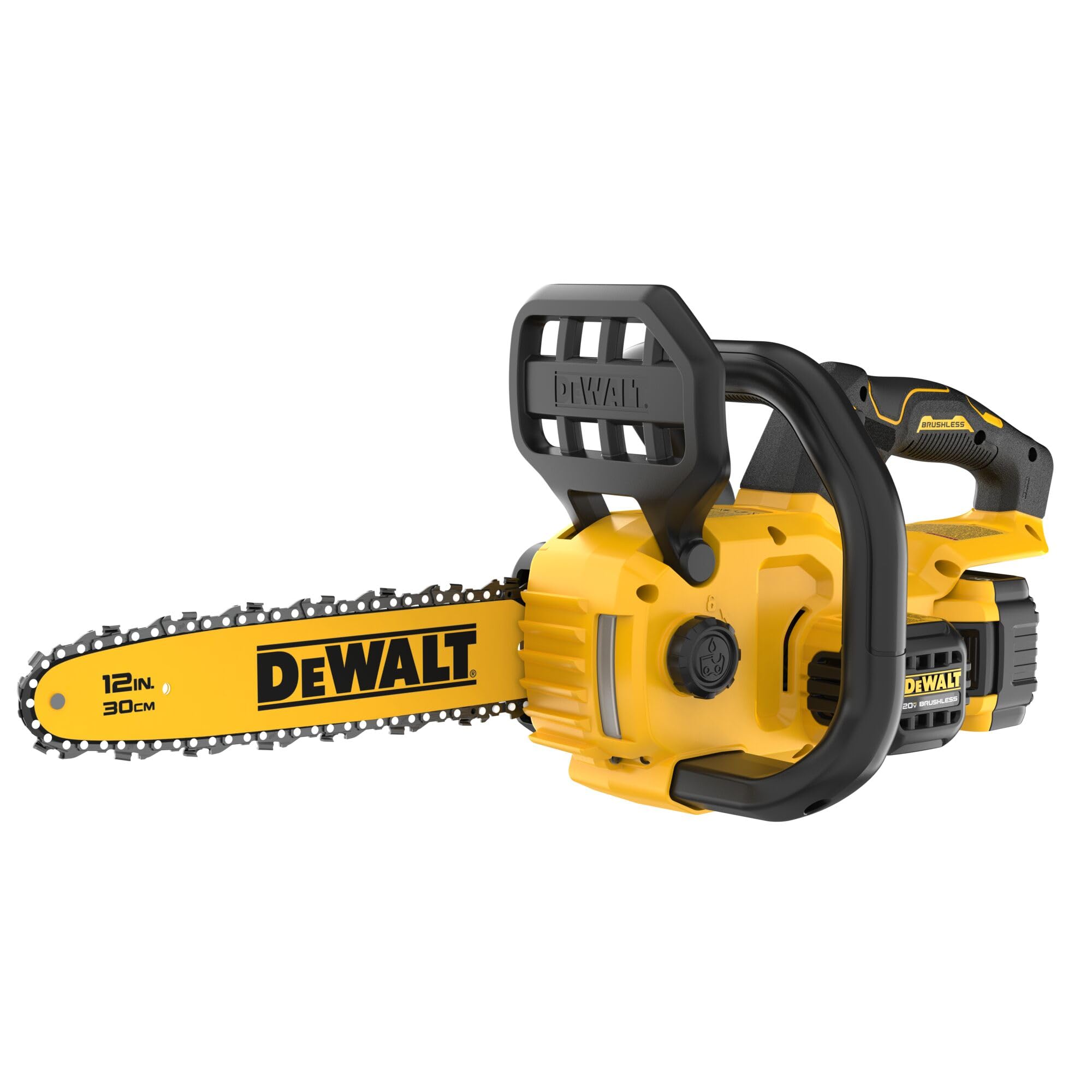
The DEWALT DCCS621P1 is a 12-inch 20V Max chainsaw kit that includes a battery and charger, making it the most accessible entry point for homeowners who need a lightweight saw for occasional limbing and yard work. At 12.6 pounds with the battery, it’s heavier than purpose-built climbing saws, but the included 12-inch low-kickback bar makes it reasonably safe for light duty in the tree. The brushless motor delivers up to 100 cuts per charge, which is solid for a 20V system.
Users report that this saw handles limbs up to 2 inches in diameter easily, and with adequate battery capacity, it can cut through 16-inch oak logs using two batteries. The gas-free operation means no fumes, no carburetor issues, and instant starting every time. It’s a decent saw for ground work and light tree trimming from a ladder, but it’s not designed for professional climbing — the chassis lacks the top-handle ergonomics and lanyard integration that make a true climbing saw safe and effective at height.
The power output is modest at 0.7 HP, so expect slower cuts in dense hardwoods. The chain tensioning is tool-less and easy to adjust, and the included sheath protects the bar during transport. For the homeowner who needs a single saw for both ground and occasional off-ground use, the DCCS621P1 is a budget-friendly compromise, but serious climbers should look at the dedicated options above.
Why it’s great
- Complete kit with battery and charger included.
- Low-kickback bar for safer operation.
- Instant start — no pull cord or fumes.
Good to know
- Not a true climbing saw — lacks top-handle design.
- Only 0.7 HP — slow in dense hardwoods.
FAQ
What is the ideal bar length for a climbing chainsaw?
Is battery or gas better for a climbing saw?
What does chain speed (FPM) mean for cutting performance?
Final Thoughts: The Verdict
For most users, the chainsaw for climbing winner is the Milwaukee M18 FUEL Hatchet because it combines climbing-specific features like a lanyard loop and climbing scabbard with the instant power and low vibration of a battery platform. If you want the lightest possible gas saw for professional daily use, grab the Echo CS-2511T-12. And for fleet compatibility with existing DEWALT 60V tools, nothing beats the DEWALT DCCS674B for instant power on the rope.