
A baby with colic or reflux doesn’t just cry — they arch their back, pull up their legs, and refuse the very bottle that’s supposed to comfort them. The root cause is often air swallowed during feeding, and the wrong bottle design makes it worse with vacuum pressure that forces milk out too fast or traps bubbles in the tummy. Choosing the right system means understanding how the vent, nipple flow, and material work together to mimic the natural rhythm of breastfeeding while keeping gas out.
I’m Min — the co-founder and writer behind Gadgets Feed. I’ve spent over a hundred hours dissecting the internal vent geometries, flow rates, and material science of anti-colic bottles, cross-referencing clinical claims with real-world feeding data from thousands of parent reports.
Every baby is different, but the engineering behind the bottle for colic and reflux is remarkably consistent — the goal is to eliminate negative pressure and air ingestion at the nipple, and the seven systems reviewed here represent the best approaches on the market today.
How To Choose The Best Bottle For Colic And Reflux
The feeding bottle market is crowded with marketing claims, but only a few designs actually solve the physics problem of air ingestion. Here’s what separates effective anti-colic and reflux bottles from the rest.
Vent System Architecture
Every anti-colic bottle relies on a vent mechanism that allows air to enter the bottle without mixing with the milk. Bottles with an internal straw or tube (like Dr. Brown’s) create a dedicated air channel that routes bubbles away from the nipple. Bottles with a bottom vent (like MAM) use a one-way diaphragm at the base. Bottles with a built-in nipple skirt vent (like Philips Avent and Lansinoh) use slits or channels molded into the nipple base. There is no single best design — the right choice depends on how many parts you are willing to clean and how aggressively your baby sucks.
Nipple Flow Rate and Material
Reflux babies almost always need an extra-slow or slow flow nipple (Size XS or Flow 1) to prevent milk from overwhelming their immature esophageal sphincter. Look for medical-grade silicone that is soft enough to compress under gentle suction yet firm enough to hold its shape across dozens of sterilizations. The nipple shape should be wide and breast-like to encourage a deep latch, as a shallow latch increases air swallowing.
Material Safety and Durability
Borosilicate glass is the gold standard for chemical safety — it doesn’t scratch, harbor bacteria, or leach anything when heated. It is heavier and breakable, however. PPSU (polyphenylsulfone) is a high-heat-resistant plastic that mimics glass clarity while being shatterproof and lightweight. Standard polypropylene (PP) bottles are cheaper but can cloud or absorb odors over time. For colic and reflux, avoid polycarbonate entirely due to BPA concerns.
Quick Comparison
On smaller screens, swipe sideways to see the full table.
| Model | Category | Best For | Key Spec | Amazon |
|---|---|---|---|---|
| Dr. Brown’s Anti-Colic Options+ Narrow Glass | Premium | Maximum Colic Reduction | Internal vent tube system | Amazon |
| Philips Avent Natural SCY900/02 | Mid-Range | Breastfeeding Combo | Natural Response nipple | Amazon |
| Pigeon PPSU Wide Neck | Premium | Latch Accuracy | PPSU material | Amazon |
| Lansinoh Anti-Colic Glass 4-Pack | Premium | Pure Glass Safety | Borosilicate glass | Amazon |
| MAM Newborn Essentials 6-Bottle Set | Premium | Complete Starter Kit | Dual vented base | Amazon |
| Gulicola Natural Glass 2-Pack | Mid-Range | Budget Glass Entry | Borosilicate glass | Amazon |
| Lansinoh Anti-Colic Plastic 4-Pack | Budget | Affordable Simplicity | 3-piece design | Amazon |
In‑Depth Reviews
1. Dr. Brown’s Anti-Colic Options+ Narrow Glass 3-Pack
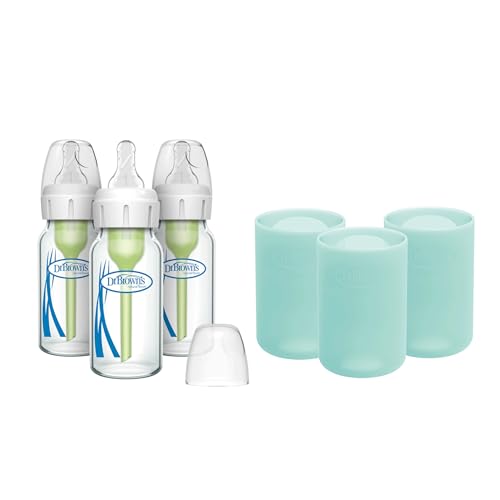
The Dr. Brown’s Options+ narrow glass bottle remains the clinical gold standard for colic reduction because its internal vent tube physically separates air from milk before it reaches the nipple. This creates a vacuum-free environment that eliminates the negative pressure that causes nipple collapse and forces baby to suck harder, which is the primary trigger for air swallowing in standard bottles. Parents report a visible reduction in spit-up volume after just two feedings, which is consistent with the vent system’s ability to preserve milk nutrients by preventing oxidation from vigorous shaking.
The borosilicate glass body is thermal shock-resistant, meaning you can go straight from boiling water sterilization to a cold rinse without cracking — a practical advantage for nightly bottle prep that plastic can’t match. The included mint silicone sleeves provide grip that compensates for the glass weight, though the total five-piece assembly (bottle, collar, nipple, vent tube, vent insert) demands more disassembly time than simpler designs. Parents who stick with the routine find that the extra minute of cleaning is offset by dramatically fewer colic episodes.
Flow consistency is excellent: the Level 1 slow flow nipple delivers milk at a rate that matches newborn sucking strength, preventing the rapid gulp that often triggers reflux. The breast-like nipple shape encourages a proper latch, and because the vent eliminates bubble formation in the milk itself, babies aren’t swallowing frothy liquid that later expands in the stomach. For parents whose primary concern is severe colic or diagnosed reflux, this is the system that has the most published clinical evidence behind it.
Why it’s great
- Proven internal vent system clinically shown to reduce colic symptoms
- Borosilicate glass resists thermal shock and won’t cloud or absorb odors
- Consistent flow rate even during rapid feeding sessions
Good to know
- Five separate parts per bottle require thorough cleaning
- Heavier than plastic equivalents, even with silicone sleeve
- Higher price point than basic anti-colic bottles
2. Philips Avent Natural SCY900/02 2-Pack

The Philips Avent Natural bottle solves the colic equation differently from Dr. Brown’s — instead of an internal tube, it uses a patented Natural Response nipple tip that only releases milk when your baby actively drinks, pausing flow during breathing and swallowing pauses. This on-demand flow control is the closest simulation of breastfeeding physiology available in a bottle, and it directly addresses reflux triggers caused by forced flow from standard nipples that continue dripping even when baby pauses. The anti-colic valve integrated into the nipple skirt vents air away from the milk, keeping bubbles out of the tummy without adding extra parts.
What makes this a standout value is the design simplicity: just three parts (bottle, collar, nipple) that clean in seconds without specialized brushes for vent tubes. Parents switching from Dr. Brown’s consistently report relief at not having to scrub tiny straws in the middle of the night. The 4-ounce capacity is ideal for newborns because it minimizes headspace and trapped air, and the wide neck makes scooping formula powder directly into the bottle a mess-free experience. The Flow 2 nipple included is actually a “slow” flow despite the number — Philips labels their flow rates higher than most competitors.
The no-drip nipple tip is a surprisingly practical feature: you can invert the bottle and it won’t leak, which means less wasted milk during preparation and no sticky residue in the diaper bag. For parents who are combining breastfeeding with bottle feeding, the breast-shaped nipple and flexible silicone make acceptance rates extremely high — multiple reviews note that babies who rejected other designs latched onto the Avent without fuss. It’s less aggressive on colic than the vent-tube systems, but for mild to moderate gas and breastfed babies, the trade-off in convenience is worth the slight reduction in anti-colic intensity.
Why it’s great
- Three-part design is fastest to clean in its class
- Natural Response nipple mimics breastfeeding flow rhythm
- No-drip tip prevents leaks during bottle prep and travel
Good to know
- Less aggressive colic reduction than vent-tube systems
- Flow labels are non-standard compared to other brands
- Plastic body may scratch over time with vigorous brushing
3. Pigeon PPSU Wide Neck 2-Pack
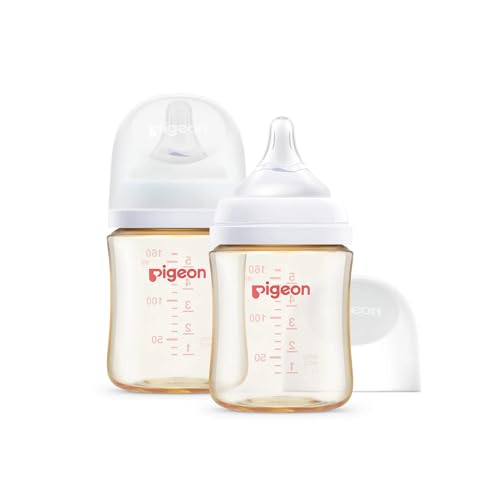
The Pigeon PPSU bottle is engineered around research on the three natural sucking movements babies make during breastfeeding — the nipple is shaped to facilitate tongue undulation rather than the aggressive piston-like compression that air-swallowing bottle feeders often use. This is a fundamentally different philosophy from Western bottle designs that rely purely on vent hardware. The super-soft silicone nipple and the latch-on line guide the baby’s lips into an ergonomic position that seals the mouth around the full nipple base, reducing the air gaps that cause smacking and gulping during feeding.
PPSU (polyphenylsulfone) is the material choice here, and it justifies the premium — it maintains crystal clarity through hundreds of sterilization cycles, doesn’t absorb residual milk fats that cause odors, and remains shatterproof if dropped on tile. The wide neck and streamlined body make single-handed assembly easy, and the screw cap is designed to prevent cross-threading that leads to leaks. Parents report that the SS nipple (equivalent to extra-slow flow) is critical for newborns — the size range extends from SS through 3L, with progressively thicker walls and larger holes that maintain the tongue-movement principle at every stage.
The anti-colic mechanism is subtler than Dr. Brown’s: there’s no visible vent tube, but the air vent is integrated into the nipple skirt and base thread design. This means it won’t reduce as much air intake for an aggressive sucker, but for babies who latch correctly, the reduced need for burping between ounces is noticeable. For breastfed babies transitioning to bottles, this is the design that most closely preserves the oral mechanics of nursing — the nipple stretches with the same resistance pattern as breast tissue, which minimizes confusion and rejection.
Why it’s great
- PPSU material is heat-resistant, lightweight, and shatterproof
- Nipple designed around natural infant sucking biomechanics
- Comprehensive nipple size range from SS to 3L for growing babies
Good to know
- Premium price reflects the high-end material and research investment
- Anti-colic performance depends more on latch than vent hardware
- Wide neck requires compatible bottle warmers and sterilizers
4. Lansinoh Anti-Colic Glass 4-Pack
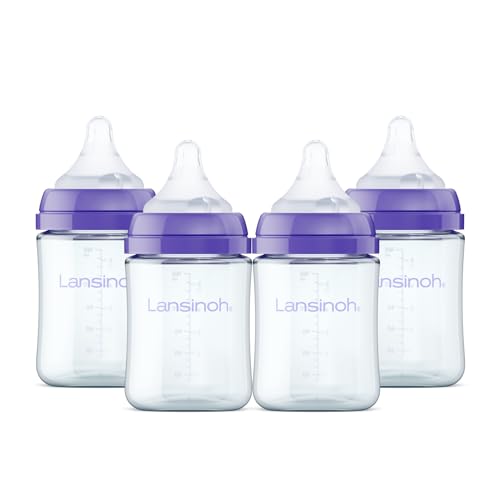
Lansinoh’s glass bottle combines borosilicate glass with the brand’s clinically proven NaturalWave nipple ventilation system, which uses a slit-style air channel at the nipple base to reduce air intake without the complexity of a separate vent tube. This is a mid-point design philosophy: more anti-colic than a simple nipple skirt vent, but fewer parts than the Dr. Brown’s tube system. The extra-slow flow (Size XS) nipple included in this 4-pack is specifically calibrated for newborns 0-1 month, delivering milk at such a gentle pace that even the weakest suckers can feed comfortably without coughing or milk pooling in the mouth.
The borosilicate glass body is noticeably lighter than many competitors’ glass bottles — Lansinoh uses a thin-wall construction that maintains durability (surviving counter-height drops in multiple user reports) while keeping the weight manageable for both parent and baby. The universal fit design means you can swap any Lansinoh nipple size onto these bottles as your baby grows, and the threading is compatible with standard breast pump flanges from Lansinoh and Medela, making this a seamless option for expressing moms who want to pump directly into the feeding bottle. The 5-ounce capacity is a Goldilocks size — enough for a full newborn feeding without excessive headspace that contributes to milk cooling and air mixing.
Parents who switched from plastic to these glass bottles note that the lack of microplastic concerns and the superior heat retention during feeding are tangible benefits for reflux management — warm milk stays warm longer in glass, reducing the temperature fluctuation that can trigger esophageal sensitivity. The 4-count bundle at this price tier is a strong per-unit value for families planning multiple daytime feedings, and the absence of extra parts (just bottle, collar, and nipple) means you’re not trapped in a sink full of tiny components while your baby cries. It’s not the most powerful anti-colic system, but it’s the best balanced for everyday use with breastfed babies.
Why it’s great
- Lightweight borosilicate glass with excellent heat retention
- Extra-slow flow nipple prevents coughing in newborns
- Compatible with breast pump flanges for express-feed simplicity
Good to know
- Anti-colic performance is good but not as potent as tube-based systems
- Glass may break if dropped on hard floors despite thin-wall durability claims
- Max capacity of 5 ounces limits use past six months for heavy feeders
5. MAM Newborn Essentials 6-Bottle Set
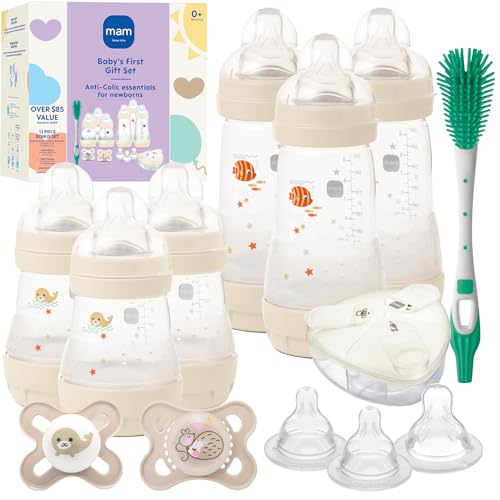
The MAM Easy Start system uses a fundamentally different vent placement — rather than a nipple-channel or internal tube, the anti-colic mechanism is a dual-vented base that sits at the bottom of the bottle. This bottom-up air routing means air enters the bottle through the base and travels to the top, never passing through or mixing with the milk. Clinically, this design reportedly reduces colic symptoms in 80% of babies, and the physics advantage is that even if the bottle is tilted aggressively, the milk consistently covers the nipple opening without air gap, eliminating the “suck air then suck milk” cycle that triggers reflux in upright feeding positions used by reflux babies.
This 6-bottle kit (three 5-ounce and three 9-ounce) with eight SkinSoft nipples spanning slow through extra-fast flow is essentially a complete feeding system from birth through weaning. The glow-in-the-dark pacifiers, formula storage case, and bottle brush are genuine extras rather than filler — the pacifiers have an orthodontic design that supports palate development, and the brush has a specialized tip for cleaning the bottom vent mechanism. The self-sterilizing feature requires only adding water to the bottle, microwaving for 3 minutes, and the internal steam kills 99.9% of germs without needing a separate sterilizer appliance.
The nipple acceptance rate of 94% is supported by the elongated pre-compressed design that feels similar to a nursing breast during the initial latch. For parents who are anxious about nipple confusion or rejection, particularly with premature babies or those with oral aversions, this is a persuasive stat. The trade-off is that the bottom-vent design has more parts to disassemble than a top-vent bottle (you need to unscrew the base ring to clean the vent channels), and the plastic construction is standard PP rather than premium PPSU. However, the sheer completeness of the kit at this price point makes it the easiest recommendation for expecting parents who want a single purchase that covers the feeding journey.
Why it’s great
- Complete newborn feeding system with bottles, nipples, pacifiers, and accessories
- Bottom-vent design prevents air mixing even in tilted feeding positions
- Self-sterilizing in 3 minutes eliminates need for separate sterilizer
Good to know
- Standard PP plastic may cloud or scratch faster than PPSU or glass
- Bottom vent adds more disassembly steps than simple nipple-vent bottles
- Formula storage container is not airtight for long-term travel
6. Gulicola Natural Glass 2-Pack
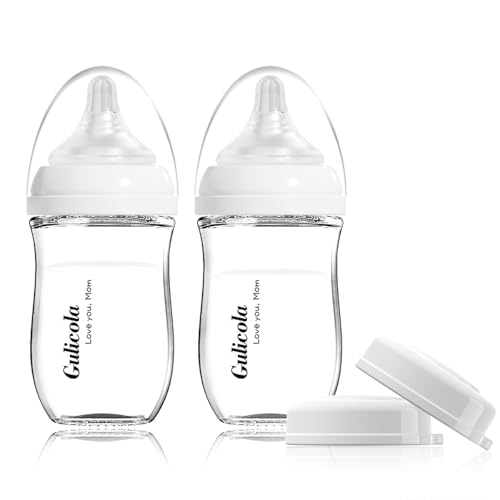
The Gulicola Natural Glass bottle proves that you don’t need a complex vent system to achieve meaningful colic reduction — the ultra-soft breast-shaped nipple incorporates built-in anti-colic vents that allow continuous airflow without the baby losing the seal. The key spec here is the slow flow rate tailored for 0-3 month newborns: the nipple hole is pressed rather than laser-cut, creating a micro-opening that releases milk in drops rather than streams, which significantly reduces the choking and gulping that irritate the lower esophageal sphincter in reflux babies. At this price point for a 2-pack of borosilicate glass bottles, it undercuts every other glass option on the market by a substantial margin while maintaining the same thermal shock resistance and chemical safety.
The durability testing from real users is remarkable — multiple accounts of the bottle surviving drops onto tile floors without cracking suggest the borosilicate glass is thicker-walled than Lansinoh’s, though this also makes the bottle heavier. The wide neck (4-part assembly) makes cleaning straightforward, and the included storage caps transform any bottle into a sealed milk storage container, eliminating the need for separate storage bags or cups. For pumping mothers who want to minimize dish count, you can pump, store, warm, and feed from a single bottle set.
The nipple shape is noticeably softer than Philips Avent’s offering, with a mushroom-like dome that collapses more easily under suction. This is good for establishing a deep latch but less ideal for babies who need flow resistance for oral motor development. The anti-colic vents are molded into the nipple rim rather than being a separate piece, which keeps parts count low but makes thorough cleaning of the vent slits slightly more challenging — you need to pull the nipple inside-out to scrub the channels. For budget-conscious parents who insist on glass, this is the entry point that doesn’t compromise on core safety specs.
Why it’s great
- Borosilicate glass at the lowest entry price in this category
- Integrated nipple vents keep parts count to just four pieces
- Storage caps allow single-container pump-to-feed workflow
Good to know
- Heavier than other glass options due to thicker wall construction
- Nipple requires inside-out scrubbing to clean vent slits thoroughly
- Only 5oz capacity may need upgrade by six months for heavy feeders
7. Lansinoh Anti-Colic Plastic 4-Pack
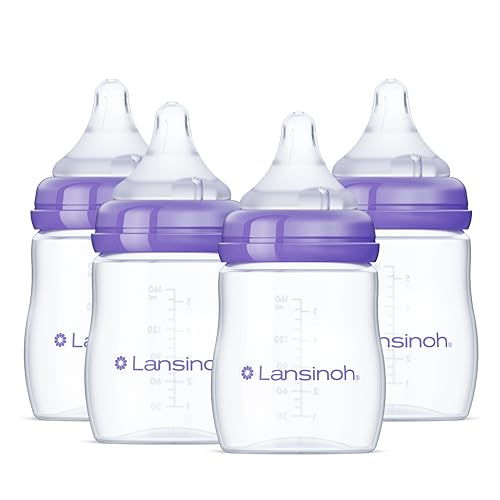
The Lansinoh Anti-Colic plastic bottle is the stripped-down workhorse of this list — three pieces (bottle, collar, nipple) with an air ventilation system integrated into the nipple that uses a slit-and-channel design to limit air intake without the need for a separate vent part. The clinical claim is backed by testing showing reduced colic symptoms, but the real-world advantage over competitors is ease of cleaning: you can fully disassemble and reassemble all three parts in under ten seconds, which is the fastest of any anti-colic bottle reviewed here. The BPA-free PP plastic is lightweight and shatterproof, making it the ideal candidate for diaper bag use, nightstand feeding, or any scenario where dropping is inevitable.
The NaturalWave nipple is identical to the one used in Lansinoh’s glass bottles, so you get the same wide, gentle slope and ultra-soft silicone that molds to the baby’s mouth. The slow flow (Size S, 1-3 months) is slightly faster than the extra-slow XS found in the glass 4-pack, which makes this better suited for babies who have developed a bit more oral strength but still need controlled flow to prevent reflux. The 3-piece simplicity doesn’t sacrifice the breast-to-bottle transition performance — the nipple stretches with baby’s sucking motion to deliver milk at the pace they set, which is the same physiological feedback loop that prevents overfeeding and air gulping in breastfed babies.
The 5-ounce capacity in 4-count is the most cost-effective way to stock a full day’s worth of bottles, and the lightweight plastic is noticeably easier on tired arms during late-night feeds than glass alternatives. The main compromise is material longevity: PP plastic will eventually show clouding from repeated sterilization and can absorb milk odors after months of use, meaning these bottles have a shorter service life than PPSU or glass. For parents who prioritize budget and cleaning convenience over material permanence, and whose babies have mild to moderate colic rather than severe reflux, this is the most practical choice.
Why it’s great
- Simplest anti-colic design on the market at just three pieces
- Lightweight and shatterproof for stress-free on-the-go feeding
- Four-bottle pack offers best per-unit price in the mid-range tier
Good to know
- PP plastic may cloud and retain odors after extended sterilization
- Less aggressive colic reduction than vent-tube or bottom-vent systems
- Slow flow (Size S) may be too fast for newborns with severe reflux
FAQ
Can a bottle really fix colic or is it just marketing hype?
How do I know which nipple flow rate my reflux baby needs?
Are glass bottles safer than plastic for colic and reflux babies?
How often should I replace anti-colic bottle parts?
Final Thoughts: The Verdict
For most families dealing with colic and reflux, the bottle for colic and reflux winner is the Dr. Brown’s Anti-Colic Options+ Narrow Glass 3-Pack because its internal vent tube delivers the most clinically proven air separation and the borosilicate glass provides zero chemical leach and superior heat retention for sensitive tummies. If you prioritize cleaning speed and breastfeeding compatibility above maximum colic reduction, grab the Philips Avent Natural SCY900/02 2-Pack. And for a complete newborn feeding system with self-sterilizing capability and multiple flow stages, nothing beats the MAM Newborn Essentials 6-Bottle Set.