
Dumping a waterlogged plastic tube every morning before work gets old fast. An auto rain gauge eliminates that chore by wirelessly transmitting precise rainfall totals to an indoor display, so you can track precipitation without stepping outside. Whether you are a gardener, a weather hobbyist, or just tired of guessing how much water your lawn actually got, a self-emptying electronic rain gauge gives you the numbers you need in real time.
I’m Min — the co-founder and writer behind Gadgets Feed. I have spent dozens of hours pouring over the technical specifications, customer feedback, and field performance data of the leading wireless rain gauges to identify the models that actually deliver accurate, consistent readings month after month.
The right unit should log rainfall history, survive freezing winters, and update your indoor console without fail. After cross-referencing sensor accuracy, transmission range, and display readability, I have curated this ranking of the best auto rain gauge options on the market today.
How To Choose The Best Auto Rain Gauge
A wireless rain gauge is only as good as its sensor mechanism and the display console that interprets the data. You want a gauge that measures precipitation accurately down to 0.01 inches, transmits reliably across your property, and stores enough historical data to show trends across weeks or seasons.
Tipping-Bucket vs. Analog Collection
Every modern auto rain gauge uses a tipping-bucket mechanism: rainwater fills a small seesaw chamber, which tips when full and triggers a magnetic reed switch. Each tip represents a fixed volume of water (typically 0.01 inches). The indoor console counts these pulses to calculate total rainfall. This design is self-emptying by default, so you never have to manually pour out the water. Avoid units that lack a self-emptying funnel — those are simply old-school analog gauges with a digital readout glued on.
Transmission Range and Frequency
Most wireless rain gauges operate on 433 MHz or 915 MHz radio frequency. Concrete walls, metal siding, and long distances degrade the signal. Look for a listed outdoor range of at least 200 feet in open air; real-world range through a house is usually half that. If your sensor will sit in a backyard garden far from the indoor console, prioritize models with a 330-foot rated range. Some premium stations use Wi-Fi to push data to the cloud, bypassing range limits entirely.
Display Readability and Data Logging
The indoor console should show current rainfall, but the real value is in the history: how much fell in the last hour, today, this week, this month, and this year. A backlit or color display makes checking the numbers at night far more convenient. Larger screens with bold fonts help middle-aged eyes avoid squinting. Confirm the console stores data through power outages — battery backup is a must if you plan to mount the display away from an outlet.
Quick Comparison
On smaller screens, swipe sideways to see the full table.
| Model | Category | Best For | Key Spec | Amazon |
|---|---|---|---|---|
| BIUWING Wireless Rain Gauge | Mid-Range | Easiest Setup & Simple History | 433 MHz / 8 measurement intervals | Amazon |
| La Crosse Technology 724-1415BL | Mid-Range | All-in-One Temp, Humidity & Rain | 915 MHz / 7 rainfall intervals | Amazon |
| Raddy WF-100C Lite | Premium | Full Weather Station with Wi-Fi Upload | Wi-Fi / 500-day data history | Amazon |
| VEVOR 5-in-1 Wi-Fi Weather Station | Premium | Smart Home Integration & Large Display | Wi-Fi / 7.5-inch VA Display | Amazon |
| Raddy VP7 5-in-1 Weather Station | Premium | Color Display & Expandable Sensors | 915 MHz / 7.4-inch color LCD | Amazon |
| Official Tropo CoCoRaHS Gauge | Premium | Manual Professional Precision | Manual / 0.01-inch resolution | Amazon |
| Sainlogic Smart WiFi Weather Station | Premium | AI Forecast & 2-Year Data Export | Wi-Fi / ±1mm accuracy | Amazon |
In‑Depth Reviews
1. BIUWING Wireless Rain Gauge

The BIUWING earns its top spot by delivering a comprehensive rainfall history across eight measurement intervals — now, 1-hour, 24-hour, today, 7-day, month, year, and total accumulation — all displayed on a clear indoor console with a soft blue backlight. The self-emptying tipping-bucket sensor transmits on 433 MHz with a reliable range for most suburban lots, and the included thermometer adds indoor and outdoor temperature readings without requiring a separate sensor.
Setup is genuinely effortless: the indoor base station automatically syncs the time, temperature, and rain gauge after inserting batteries, and the outdoor unit mounts easily with the included bracket. Customer feedback consistently praises the large, easy-to-read screen and the intuitive menu navigation for cycling through historical data. The built-in bubble level on the sensor helps you achieve accurate placement the first time.
One minor trade-off is that the rain history switch sits on the back of the monitor, making it slightly awkward to access if the display is wall-mounted flush. A few users also noted that the outdoor temperature reading can run a few degrees warm in direct sunlight because the sensor housing absorbs heat. For the balance of features, data depth, and setup simplicity, this is the most well-rounded auto rain gauge for most households.
Why it’s great
- Eight rainfall intervals provide granular historical tracking.
- Self-emptying sensor requires zero manual maintenance.
- Auto-setup syncs time and temperature instantly.
Good to know
- Rain history button is on the back of the monitor.
- Outdoor temperature sensor can drift in direct sun.
2. La Crosse Technology 724-1415BL Wireless Rain Station

La Crosse Technology has a long-standing reputation in consumer weather monitoring, and the 724-1415BL reinforces that with a clean LCD display that shows current, 1-hour, 24-hour, 7-day, monthly, yearly, and total rainfall alongside indoor and outdoor temperature and humidity percentages. The self-emptying tipping-bucket mechanism uses internal tilting cups with drain vents to avoid clogs, and the 915 MHz transmission offers solid penetration through standard residential construction.
The display console sits at a compact 7.14 inches deep by 4.94 inches tall, making it easy to fit on a nightstand or kitchen counter. A dynamic icon visually indicates days with or without rainfall, which is a nice touch for a quick glance. Customers report straightforward sensor pairing and a generally intuitive interface after the initial manual clock setup. The included power adapter keeps the display running continuously without draining batteries.
The main durability concern is that a small number of units have stopped reporting rainfall after roughly a year of outdoor exposure, with the temp and humidity functions continuing to work while the rain data freezes. La Crosse’s warranty support has drawn mixed reviews, so checking the return window closely is wise. Still, at this tier, the feature set per dollar is hard to beat for anyone who wants temperature and humidity on the same screen.
Why it’s great
- Integrated temperature and humidity readings on one display.
- Self-emptying tipping bucket requires no manual draining.
- Compact console fits easily on any shelf or counter.
Good to know
- Some units have reported rain sensor failure after one year.
- Customer support response times can be inconsistent.
3. Raddy WF-100C Lite Weather Station
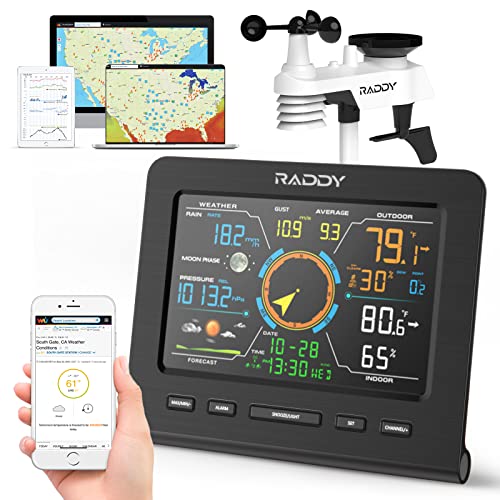
The Raddy WF-100C Lite is a full weather station masquerading as a rain gauge — its 13-in-1 outdoor sensor includes a tipping-bucket rain gauge, anemometer, wind vane, thermometer, hygrometer, barometer, and a solar panel, all feeding data to a sleek color LCD console. The Wi-Fi connectivity uploads real-time readings to Weathercloud and Wunderground, letting you view rainfall trends on your phone from anywhere. The console stores up to 500 days of historical data for detailed analysis.
The color display is well-organized and easy to read from across the room, with configurable modules showing dew point or feels-like temperature. Setup benefits from step-by-step on-screen instructions, and the 330-foot transmission range gives you plenty of flexibility for sensor placement in the backyard or garden. The barometric pressure-based forecast and thunderstorm alert (triggered when pressure drops rapidly below 29.80 inHg) add genuine utility beyond simple rainfall totals.
Some users have found the Wi-Fi setup finicky with iOS devices, and the outdoor temperature sensor can read up to 8°F high in direct sunlight if the radiation shield isn’t properly ventilated. The LCD numbers are also on the smaller side, which may require stepping closer to read. For weather enthusiasts who want professional-grade data logging and cloud connectivity, the WF-100C Lite delivers exceptional depth at a mid-tier price point.
Why it’s great
- Wi-Fi uploads rainfall data to Weathercloud and Wunderground.
- 13-in-1 sensor measures wind, pressure, temp, and humidity.
- 500-day data history with graphical trend analysis.
Good to know
- iOS Wi-Fi pairing can be difficult for some users.
- Outdoor temp sensor is prone to solar heating errors.
4. VEVOR 5-in-1 Wi-Fi Weather Station
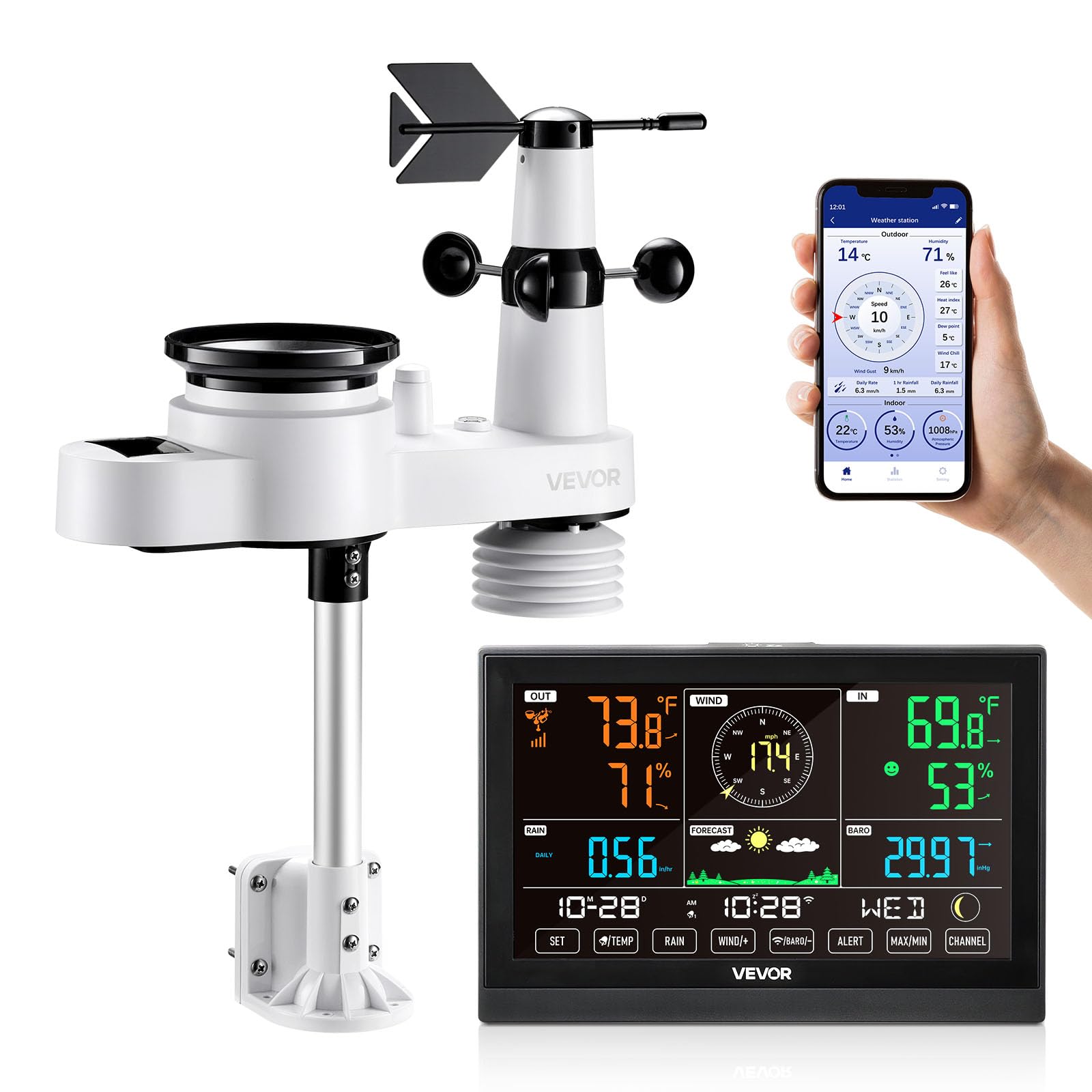
VEVOR’s 5-in-1 station centers on a massive 7.5-inch VA display that offers four brightness levels, making it the easiest console to read from across the living room or during a nighttime check. The 5-in-1 outdoor sensor integrates a tipping-bucket rain gauge, anemometer, wind vane, thermometer, and hygrometer, with a solar panel that powers the sensor on sunny days and switches to battery backup at night or in overcast conditions.
The Wi-Fi Smart Life app connectivity lets you view real-time weather data, store historical trends, and receive alerts on your phone. The sensor boasts an IPX6 waterproof rating and a 492-foot transmission range, which is among the longest in this roundup. The rain collector, wind vane, and thermometer come pre-installed out of the box, cutting installation time significantly compared to multi-sensor systems that require assembly.
One limitation is that the Wi-Fi and date sync functions require the display adapter to remain plugged in, which reduces placement flexibility. The Smart Life app only supports 2.4 GHz networks, and the mounting bracket could use a more robust design for high-wind areas. For users who prioritize reading data at a glance and the convenience of a solar-powered outdoor sensor, the VEVOR delivers impressive screen real estate and connectivity.
Why it’s great
- 7.5-inch VA display with adjustable brightness is supremely readable.
- Solar panel extends outdoor sensor battery life significantly.
- IPX6-rated sensor and 492-foot transmission range.
Good to know
- Wi-Fi sync requires the display to stay plugged in.
- Mounting bracket could be sturdier for hurricane-prone areas.
5. Raddy VP7 5-in-1 Weather Station

The Raddy VP7 elevates the home weather station experience with a vivid 7.4-inch color LCD that displays indoor/outdoor temperature, humidity, rainfall, wind speed and direction, barometric pressure, dew point, feels-like temperature, and a 12-hour weather forecast — all on one screen. The RCC atomic clock automatically sets itself via radio signal, so you never have to adjust for daylight saving or time zone quirks. The outdoor sensor includes a rain funnel, wind vane, anemometer, thermo-hygrometer radiation shield, and a solar panel, with a 330-foot transmission range rated to withstand hurricane-force winds.
The display is polished and easy to read from across the room, and it functions as a subtle night light thanks to the adjustable backlight. Expandability is a standout feature: you can connect up to three additional R5 remote sensors to monitor microclimates in different rooms or outdoor areas, such as a greenhouse, baby’s room, or garage. Dual alarms for weekday and weekend scheduling add practical daily value. Customer feedback highlights the reliable sensor connection and the large, clear numbers.
The control buttons are located on the back of the display unit, which means you have to remove it from the wall to scroll through stored historical data or adjust settings. A few users have reported intermittent connectivity issues between the indoor console and the rain gauge sensor, typically resolved by changing batteries. For the most visually polished display and multi-room expandability, the VP7 is a compelling choice for weather enthusiasts.
Why it’s great
- Large color LCD shows weather data in a clear, attractive layout.
- Atomic clock automatically sets the time via radio signal.
- Supports up to three additional remote sensors for multi-zone monitoring.
Good to know
- Control buttons on the back require unmounting the display.
- Some users report occasional sensor disconnection issues.
6. Official Tropo Rain Gauge & Snow Gauge (CoCoRaHS)
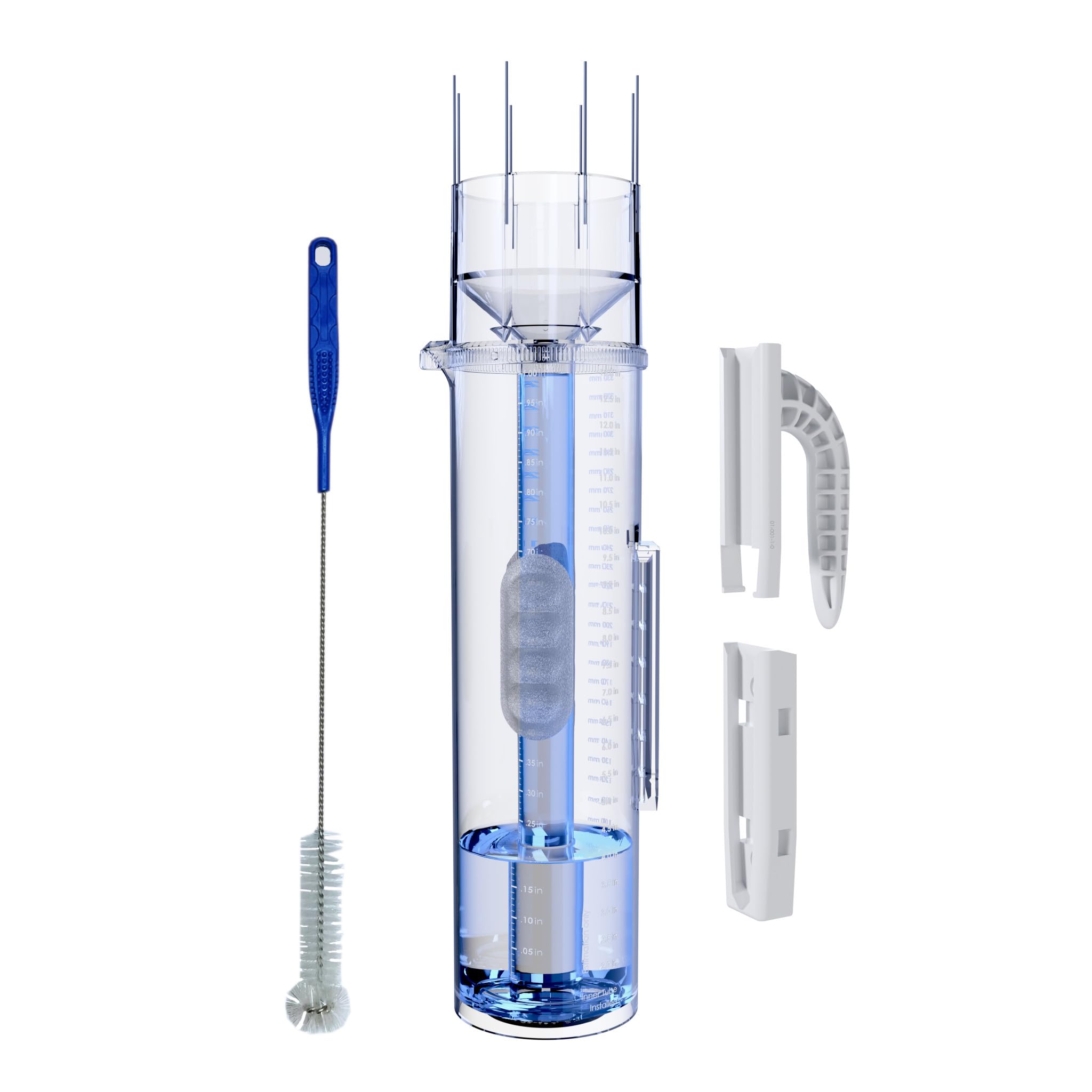
For the user who demands National Weather Service–grade accuracy without relying on batteries or radio signals, the Official Tropo Precipitation Gauge is the CoCoRaHS-approved standard. It uses a dual-cylinder design identical to the NOAA 8-inch standard: the inner cylinder holds 1 inch of precipitation with 0.01-inch graduation marks, and the outer cylinder handles up to 13.5 inches total, with an overflow sleeve that estimates extreme totals. The UV-resistant polycarbonate construction is freeze-resistant with regular winter maintenance, and bird pins prevent contamination from droppings.
Unlike digital gauges, the Tropo requires manual reading and logging, but the trade-off is bulletproof mechanical reliability — no dead batteries, no signal dropouts, no calibration drift. The universal mounting bracket allows quick removal for cleaning or winter storage, and the pour spout makes decanting the outer tube spill-free. The included bristle brush and cleaning material help maintain accuracy over years of use. CoCoRaHS volunteers consistently rate this as the best manual gauge available for precision reporting.
The obvious limitation is the lack of automation: you have to walk outside, read the meniscus, log the number, and reset the inner cylinder after each rain event. If you are contributing to community science networks or simply want the gold standard in manual measurement, this gauge is peerless. For anyone who wants the data to appear on a screen without leaving the couch, a digital model will be a better fit.
Why it’s great
- CoCoRaHS-approved dual-cylinder design matches NOAA standards.
- Freeze-resistant polycarbonate construction with bird pins and pour spout.
- 0.01-inch resolution with overflow capacity for extreme rainfall.
Good to know
- Manual reading and logging required — no wireless display.
- Inner cylinder must be emptied after each significant rain event.
7. Sainlogic Smart WiFi Weather Station
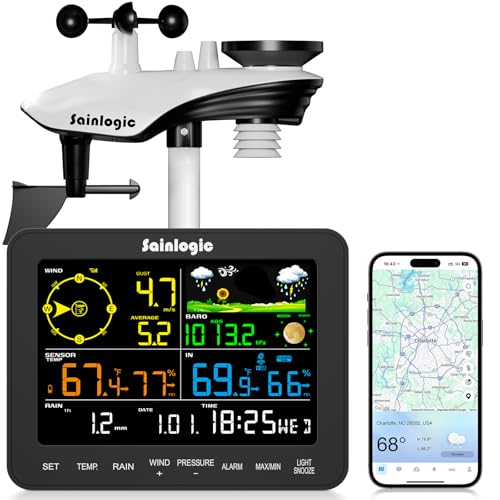
Sainlogic’s entry targets the tech-savvy gardener and agricultural user with Wi-Fi connectivity to the Weatherseed app, which provides AI-driven 24/7 weather forecasting and push alerts for temperature, humidity, and barometric pressure changes. The rain gauge touts professional-grade accuracy of ±1mm for rainfall under 15mm and ±7% for totals up to 9999mm. The display console features enlarged bold fonts for key data points, making it especially accessible for users with declining vision.
The headline feature is the 2-year data storage and Excel export capability, allowing you to download historical rainfall data in monthly increments and analyze seasonal patterns, drought frequency, or irrigation needs. The outdoor sensor connects wirelessly to the display, which then pushes data to the cloud via 2.4 GHz Wi-Fi. Installation is designed to be beginner-friendly, with the sensor mounting on a rooftop, fence, or pole and syncing in three steps through the app.
Build quality concerns have surfaced in customer reviews: some units arrived with hairline cracks in the rain funnel, the LCD backlight can appear dim and uneven in low light, and the plastic adjustment buttons have been reported to stick or skip during input. A few users reported complete smart function failure within days of use. While the data export and AI forecast features are genuinely useful, consistency issues make this a higher-risk purchase that rewards careful inspection upon arrival.
Why it’s great
- 2-year data storage with Excel export for trend analysis.
- Weatherseed app provides AI-driven forecasts and alerts.
- Large, bold-font display designed for easy reading.
Good to know
- Some units have reported build quality issues like cracked funnels.
- Wi-Fi and smart functions can fail early in the product life.
FAQ
How does a self-emptying rain gauge work without power?
Can a wireless rain gauge survive freezing winter temperatures?
How accurate are digital auto rain gauges compared to manual gauges?
Why does my rain gauge display show a higher reading than my neighbor’s?
Final Thoughts: The Verdict
For most users, the best auto rain gauge winner is the BIUWING Wireless Rain Gauge because it delivers the best balance of rainfall history depth, effortless setup, and reliable self-emptying operation at a mid-tier investment. If you want integrated temperature and humidity readings in a proven brand, grab the La Crosse Technology 724-1415BL. And for serious weather enthusiasts who need Wi-Fi cloud uploads and a full suite of environmental sensors, the Raddy WF-100C Lite offers unmatched depth without crossing into professional-station pricing.