
The gap between a smartphone camera and a dedicated compact camera has never been wider, but not for the reason you think. While phone makers chase computational photography gimmicks, the best compact digital cameras still rely on a core physical advantage: a larger sensor paired with a true optical zoom lens that doesn’t degrade quality as you zoom in. That tangible difference in depth of field, dynamic range, and reach is what keeps this category alive for travelers, street photographers, and anyone who wants to capture a moment without carrying a full-frame kit on their shoulder.
I’m Min — the co-founder and writer behind Gadgets Feed. I’ve spent countless hours poring over sensor specifications, lens MTF charts, and real-world sample galleries to separate the handful of genuinely capable compacts from the bloated marketing sheets that litter this space.
Whether you need waterproof ruggedness for snorkeling, a superzoom that can photograph the moon from your backyard, or a pocketable APS-C sensor for everyday carry, this guide to the best compact digital camera will help you cut through the noise and match the right tool to your specific shooting habits.
How To Choose The Best Compact Digital Camera
Before you buy, understand that “compact” is a body classification, not a performance promise. The critical dimensions are sensor size, optical zoom range, stabilization method, and battery type — each directly shapes what you can actually shoot.
Sensor Size Determines Image Quality Ceiling
The most common sensor in budget and superzoom compacts is the 1/2.3-inch format, roughly the size of a pinky nail. It works fine in bright daylight but struggles in low light due to smaller individual pixels that gather less light. Moving up to a 1-inch sensor (used in premium travel zooms) roughly quadruples the light-collecting area, delivering noticeably cleaner shadows and better subject separation. At the top end, APS-C sensors — found in the Ricoh GR IIIx — match the quality of many interchangeable-lens cameras in a body that still slides into a jacket pocket. If low-light performance matters, prioritize sensor size over raw megapixel count.
Optical Zoom Range Defines Your Reach
Optical zoom is the irreplaceable advantage compacts hold over phones. A 5x to 10x zoom covers everyday travel needs — wide group shots and moderate close-ups. If you shoot wildlife, sports, or stage performances, look for 30x to 125x optical zoom lenses. However, extreme zoom ranges come with trade-offs: narrower maximum apertures (often f/5.6 to f/8 at the telephoto end), heavier bodies, and a greater need for image stabilization or a tripod. Know your typical subject distance before you chase raw magnification numbers.
Image Stabilization Saves Handheld Shots
At long focal lengths, even steady hands introduce micro-shake. Optical Image Stabilization shifts lens elements to counteract that motion without degrading image quality — this is the gold standard. Digital stabilization crops the frame and is less effective. Look for “optical” or “mechanical” stabilization in the spec sheet, especially if you shoot above 200mm equivalent handheld. Panasonic and Nikon both use advanced OIS systems in their superzoom models that can compensate for several stops of shutter speed.
Battery and Media Longevity Matters
Some budget compacts still run on AA batteries — convenient in an emergency but expensive and wasteful over time. Lithium-ion rechargeable packs are standard on mid-range and premium models, but battery life varies widely. A 300-shot rating is common, but heavy zooming or video drains it faster. Also verify whether the camera accepts standard SD cards or proprietary media — the latter locks you into a single supply chain. USB-C charging is a welcome modern addition that lets you recharge from a power bank in the field.
Quick Comparison
On smaller screens, swipe sideways to see the full table.
| Model | Category | Best For | Key Spec | Amazon |
|---|---|---|---|---|
| Canon PowerShot V1 | Premium Hybrid | Vlogging and content creation | 1.4-Type 22.3 MP sensor | Amazon |
| Ricoh GR IIIx HDF | Pocketable Premium | Street photography and everyday carry | APS-C 24.2 MP sensor | Amazon |
| Nikon COOLPIX P1100 | Extreme Superzoom | Wildlife and moon photography | 125x optical zoom (24-3000mm) | Amazon |
| Nikon COOLPIX P950 | Superzoom | Birding and long-distance shots | 83x optical zoom (24-2000mm) | Amazon |
| Panasonic LUMIX ZS99 | Travel Zoom | Travel and concert photography | 30x Leica zoom (24-720mm) | Amazon |
| OM System Tough TG-7 | Rugged Adventure | Underwater and outdoor adventures | Waterproof to 15m (50ft) | Amazon |
| Panasonic LUMIX FZ80D | Bridge Superzoom | Versatile all-in-one shooting | 60x optical zoom (20-1200mm) | Amazon |
| Canon PowerShot ELPH 360 HS | Pocket Point-and-Shoot | Family and travel snapshots | 12x optical zoom (25-300mm) | Amazon |
| Kodak PIXPRO AZ255 | Budget Superzoom | Beginners and casual use | 25x optical zoom (24-600mm) | Amazon |
In‑Depth Reviews
1. Canon PowerShot V1

The Canon PowerShot V1 is a hybrid compact that flips the script on vlogging cameras. Its 1.4-type sensor (larger than the 1-inch sensors found in most travel zooms) delivers 22.3 megapixels for stills and 18.7 megapixels for video, with an ultrawide 16-50mm F2.8-4.5 zoom lens at the 35mm equivalent. That sensor size translates to noticeably cleaner high-ISO performance and better subject separation than any 1/2.3-inch superzoom can manage.
Canon built the V1 with content creators in mind: a built-in cooling fan allows extended 4K recording without thermal shutdown, and Canon Log 3 support with 10-bit color depth gives video editors significant grading latitude. The hybrid autofocus system tracks subjects reliably, and the body is still small enough for a jacket pocket despite the internal fan. You lose the extreme zoom range of superzoom compacts, but the trade-off is dramatically better image quality in mixed lighting.
For creators who want high-quality video and stills from a single compact body, the V1 is the most forward-thinking compact on the market. It prioritizes sensor performance and professional video features over raw reach, making it the ideal choice for hybrid shooters who value fidelity over magnification.
Why it’s great
- Larger-than-1-inch sensor with excellent dynamic range and low-light performance
- Built-in cooling fan enables unlimited 4K video recording without overheating
- Canon Log 3 and 10-bit color for professional-grade color grading
Good to know
- Lens range is limited to 16-50mm equivalent — no telephoto reach
- No optical image stabilization; relies on electronic stabilization which degrades walking footage
- SD card slot is under the battery, inconvenient with a tripod quick-release plate
2. Ricoh GR IIIx HDF

The Ricoh GR IIIx HDF is a cult classic for a reason — it packs an APS-C 24.2-megapixel sensor — the same sensor class found in many professional interchangeable-lens cameras — into a body that truly fits in a pocket. The fixed 40mm F2.8 GR lens (35mm equivalent) is optically superb, delivering sharp, contrast-rich images straight out of camera. The HDF variant adds a built-in Highlight Diffusion Filter that softens bright light sources for a dreamy, film-like quality.
This is not a camera for zooming. It has no optical zoom, no flip screen, and no built-in flash. Instead, it prioritizes the purest possible optical path and the fastest possible shooting experience. The snap focus mode lets you pre-set distance and shoot instantly, perfect for street photography where timing is everything. Startup time is under a second, and the USB-C charging means you can top up from a power bank anywhere.
The GR IIIx HDF demands that you work within its fixed 40mm perspective, but in return it delivers image quality that rivals much larger kits. If your photography revolves around daily carry, street scenes, and portraits with beautiful depth of field, this is the compact that will stay in your bag long after other cameras gather dust.
Why it’s great
- APS-C sensor provides professional-grade image quality in a truly pocketable body
- Sharp 40mm F2.8 GR lens with minimal distortion and excellent contrast
- HDF filter adds creative in-camera diffusion effect for unique looks
Good to know
- Fixed focal length — no zoom capability whatsoever
- Autofocus speed is modest; can miss fast-moving moments
- Dust can enter through the lens barrel; use of adhesive filter cap recommended
3. Nikon COOLPIX P1100

The Nikon COOLPIX P1100 is the king of reach — 125x optical zoom covers an astonishing 24-3000mm equivalent range. That can pull in the moon as a textured crater-filled orb, capture a bird perched on a distant branch, or fill the frame with a performer from the back row of a concert. The Dual Detect Optical VR image stabilization is rated to 4.0 stops, which is crucial because at 3000mm handheld even the slightest tremor produces blur.
Nikon added a dedicated Bird-Watching mode on the mode dial that optimizes settings for avian subjects, and the macro mode focuses as close as 1 cm from the lens for extreme close-ups. The rotating LCD screen helps compose shots from awkward angles, and RAW support gives you flexibility in post-processing. The 1/2.3-inch sensor is the weakest link — it limits low-light performance and dynamic range compared to larger sensors — but no other compact can match the P1100’s sheer optical magnification.
The P1100 is a specialized tool for one specific job: getting impossibly close to distant subjects. If that is your primary need, nothing else in this class comes close. Just understand that the small sensor will demand good light, and a tripod becomes essential at the longest zoom settings for tack-sharp results.
Why it’s great
- 125x optical zoom provides 24-3000mm reach unmatched by any other compact
- Dual Detect Optical VR delivers effective stabilization up to 4 stops
- Dedicated Bird-Watching mode and close macro (1 cm) add versatility
Good to know
- 1/2.3-inch sensor struggles in low light and limits dynamic range
- All-plastic build feels delicate for its price point
- Bird tracking mode fails to reliably focus on fast birds in flight
4. Nikon COOLPIX P950

The Nikon COOLPIX P950 delivers 83x optical zoom covering 24-2000mm equivalent, which is massive reach at a significantly lower entry price than the P1100. It handles daytime wildlife exceptionally well, with built-in Moon and Bird modes that dial in the right settings automatically. The 16-megapixel sensor and Contrast Detection autofocus system are the same generation as the P950’s predecessor, but they remain competent for well-lit subjects at a distance.
Image stabilization is adequate for the magnification, though at 2000mm a tripod or monopod will still deliver much sharper results. The rotating LCD screen and electronic viewfinder give flexibility in framing, and 4K UHD video recording lets you capture distant action in motion. Users consistently note that the macro mode is surprisingly capable for such a zoom-heavy camera, with sharp detail at very close focusing distances.
The P950 is not as polished as the P1100 — autofocus can hunt in challenging conditions, and the smartphone app connectivity for image transfer is finicky at best. But for anyone who wants serious superzoom capability without jumping to the top of the price range, the P950 remains the smartest value proposition in this niche.
Why it’s great
- 83x optical zoom (24-2000mm) offers extraordinary reach for the price
- Built-in Bird and Moon modes simplify shooting challenging subjects
- Surprisingly capable macro mode for close-up detail
Good to know
- Autofocus is mediocre, especially for fast-moving or low-contrast subjects
- Smartphone app connectivity is unreliable and frustrating to set up
- Image sensor shows its age compared to newer competition
5. Panasonic LUMIX ZS99

The Panasonic LUMIX ZS99 (also known as the TZ99) is the travel zoom that actually fits in a pants pocket. Its 30x Leica zoom lens covers 24-720mm equivalent, which is enough for wide cityscapes and tight concert shots without the bulk of a bridge camera. The 20.3-megapixel 1/2.3-inch sensor is paired with a tiltable 1,840k-dot touchscreen that helps with overhead or ground-level compositions.
Panasonic includes 4K video and 4K Photo burst mode at 30 fps, letting you extract 8-megapixel stills from video frames. Bluetooth 5.0 with a dedicated Send Image button makes transferring shots to a phone relatively painless. The Hybrid autofocus system is faster than the contrast-only systems found in many superzooms, and the stepped zoom lens with Lens Position Resume lets you recall a specific focal length instantly.
A few caveats: the maximum aperture narrows to f/6.4 at the telephoto end, which demands good light for handheld shooting. The autofocus is not as snappy as a dedicated interchangeable-lens system, and the LCD can be hard to read in direct sunlight. But for pocketable reach that covers 95% of travel scenarios, the ZS99 is the most refined option in its class.
Why it’s great
- 30x Leica zoom (24-720mm) packs serious reach into a truly pocketable body
- Tiltable touchscreen and Bluetooth 5.0 simplify framing and sharing on the go
- 4K Photo burst at 30 fps captures fleeting moments with high success rate
Good to know
- Aperture narrows to f/6.4 at telephoto, limiting low-light performance
- Autofocus can struggle in low-contrast or fast-moving scenarios
- Screen readability suffers in bright outdoor conditions
6. OM System Olympus Tough TG-7

The OM System Tough TG-7 is the only compact in this list that you can take scuba diving without a housing. Rated waterproof to 15 meters, shockproof to 2.1 meters, crushproof to 100 kgf, and freezeproof to -10°C, it survives conditions that would destroy any other camera here. The F2.0 lens (4x optical zoom) is brighter than typical superzoom lenses, which helps in dim underwater light, and the variable macro system focuses as close as 1 cm from the lens.
The TG-7 excels in niche shooting scenarios: underwater microscope mode for tiny marine life, underwater HDR for high-contrast reef scenes, and a built-in field sensor system that logs temperature, depth, and location data to your images. 4K video at 30 fps and 120 fps high-speed recording give flexibility for action shots. The lens has a threaded ring for attaching filters or the optional FD-1 flash diffuser, which dramatically improves macro lighting underwater.
The sensor is a 12-megapixel 1/2.3-inch back-illuminated CMOS — it produces clean files in good light but noise creeps in above ISO 800. It is bulkier than a standard pocket camera, and the many dedicated buttons require some pre-learning. For adventurers who shoot in wet, dusty, or freezing environments, the TG-7 is the only serious choice.
Why it’s great
- Rugged to 15m waterproof, 2.1m shockproof, and -10°C freezeproof without extra housing
- Bright F2.0 lens with excellent macro capability down to 1 cm close focus
- Five underwater shooting modes including underwater microscope and HDR
Good to know
- Small sensor limits image quality in low light above ISO 800
- Bulkier than standard compact cameras; not pocket-friendly
- Many dedicated buttons require learning before intuitive use
7. Panasonic LUMIX FZ80D

The Panasonic LUMIX FZ80D (FZ85D outside North America) offers 60x optical zoom covering 20-1200mm equivalent, starting wide enough for landscape shots and extending far enough for wildlife. The 20mm wide end is unusually wide, making it one of the best superzooms for capturing expansive scenes without stitching panoramas. The Power Optical Image Stabilizer helps keep shots sharp at the telephoto end, though it is not as advanced as the system in the Nikon P950.
Panasonic packed the FZ80D with 4K Photo at 30 fps, Focus Select for choosing your ideal focal point after capture, and Focus Composite for extending depth of field in macro shots. The 0.39-inch OLED viewfinder is bright and detailed, useful when sunlight washes out the LCD. USB-C charging is a welcome modern touch for travelers who want to carry a single cable. The autofocus is contrast-detection with 49 points — adequate for static subjects but not ideal for tracking fast action.
Battery life is middling at about 1.5 hours of active use, and the in-camera charging is slow. The menu system is dense with features, which rewards exploration but can overwhelm beginners. For photographers who want a single do-everything travel zoom that starts wider than the competition, the FZ80D is a solid value proposition.
Why it’s great
- 60x zoom with 20mm wide angle — wider than most competitors for landscapes
- 4K Photo at 30 fps and Focus Select for post-capture focus adjustment
- Bright OLED viewfinder and USB-C charging for modern convenience
Good to know
- Contrast-detection autofocus struggles with moving subjects
- Battery life is limited at about 1.5 hours of active shooting
- Dense menu system has a steep learning curve
8. Canon PowerShot ELPH 360 HS
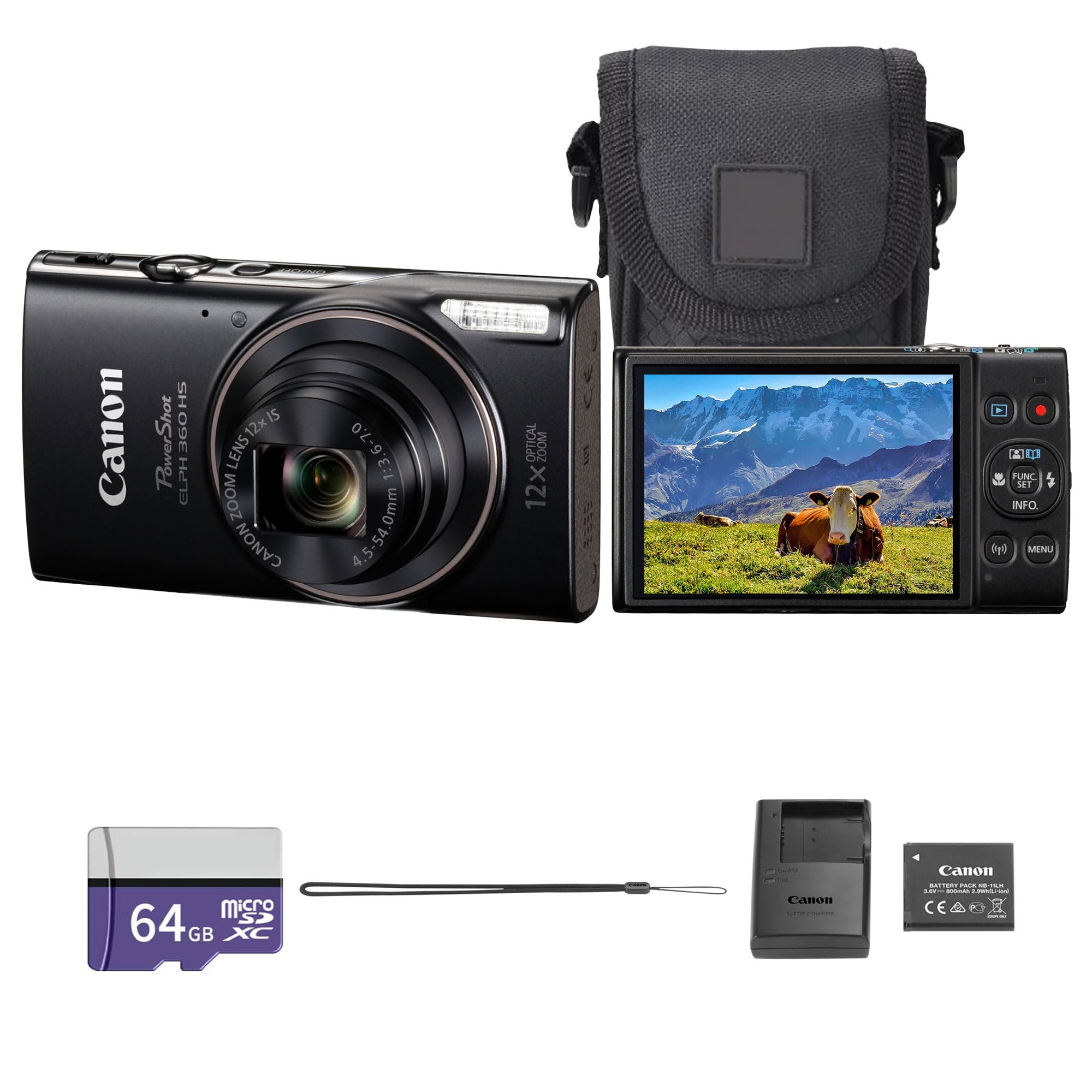
The Canon PowerShot ELPH 360 HS is the modern interpretation of the pocket point-and-shoot that defined casual travel photography. A 20.2-megapixel CMOS sensor paired with the DIGIC 4+ processor delivers snappy performance and good color science straight out of camera. The 12x optical zoom (25-300mm equivalent) covers the most common travel distances without the bulk of larger superzooms, and the Intelligent IS system adapts stabilization to six different shooting scenarios automatically.
This camera is built for simplicity — the Hybrid Auto mode automatically combines stills with video clips into highlight reels, and Creative Shot generates artistic variations with a single press. The 3-inch LCD is clear but not touch-sensitive, and the body is genuinely pocket-sized. It records 1080p Full HD video at 30 fps, which is adequate for family memories but falls short of the 4K standard now common at this tier. The microSD card slot is a minor annoyance if you already own standard SD cards.
The ELPH 360 HS will not win awards for low-light performance — the small sensor and moderate aperture limit its capabilities after sunset. But for straightforward daylight travel shooting from a device that disappears into a jeans pocket, it remains a reliable choice. The included 64GB card in the bundle gets you started immediately.
Why it’s great
- Ultra-slim body truly fits in a pocket or small purse
- 12x optical zoom (25-300mm) covers versatile everyday distances
- Intelligent IS adapts stabilization to six different shooting scenarios
Good to know
- Limited to 1080p video — no 4K recording
- Small sensor struggles with noise in low-light conditions
- Uses microSD cards instead of the more common standard SD format
9. Kodak PIXPRO AZ255

The Kodak PIXPRO AZ255 is the entry point to compact superzoom photography — it packs 25x optical zoom (24-600mm equivalent) into a lightweight body at a price that undercuts nearly everything else. The 16-megapixel CMOS sensor with Optical Image Stabilization produces decent results in good daylight, and the 3-inch LCD screen is adequate for composition and playback. It records 1080p Full HD video, which is sufficient for casual vlogging and family clips.
The AZ255 runs on AA batteries, which is a double-edged sword: you can find replacements anywhere in the world, but the battery life is short and the recurring cost of disposables adds up quickly. The autofocus is contrast-detection with 25 points — basic but functional for static subjects. Users report that the macro mode is surprisingly effective, and the camera handles well for complete beginners who want to learn the basics of zoom range and framing without financial risk.
Image quality has clear limits: the small sensor shows noise above ISO 400, and the lens is soft at the telephoto end. Some users report inconsistent results, with photo quality varying between shots in the same session. For the price, however, the AZ255 offers the cheapest optical zoom reach available in a new camera. It is best suited for kids, teens, or absolute beginners learning the fundamentals of photography.
Why it’s great
- 25x optical zoom (24-600mm) at a price point far below any competitor
- AA battery power means easy replacements anywhere in the world
- Compact and lightweight body is ideal for young or beginner photographers
Good to know
- AA batteries drain quickly and must be replaced often
- Image quality becomes soft and prone to noise above ISO 400
- User experience can be inconsistent; build quality feels basic
FAQ
Can a compact digital camera really beat a modern smartphone camera?
What does the “x” mean in zoom specifications like 60x or 83x?
Are compact cameras with AA batteries still worth buying?
What is a bridge camera and is it the same as a compact superzoom?
Do I need RAW format support on a compact camera?
Final Thoughts: The Verdict
For most users, the best compact digital camera winner is the Canon PowerShot V1 because it combines a larger-than-1-inch sensor, professional video features, and a genuinely compact body into a single tool that works for both stills and 4K content. If you want extreme optical reach for wildlife and distant subjects, grab the Nikon COOLPIX P1100. And for pocketable street photography with APS-C image quality, nothing beats the Ricoh GR IIIx HDF.