
The resurgence of film photography has created a paradox: the very cameras that defined a generation are now being abandoned for single-use disposables that cost more per frame than a sit-down dinner. The entry price has dropped enough that the classic film look is now accessible to anyone willing to load a roll.
I’m Min — the co-founder and writer behind Gadgets Feed. I’ve spent countless hours cross-referencing lens specifications, shutter mechanisms, and real-world image samples across the to range to separate the functional bargains from the overpriced curiosities that flood the market under the “vintage” banner.
Whether you’re a first-time shooter or a returning enthusiast, this guide isolates the bodies that actually deliver sharp negatives and reliable mechanics so you can stop guessing and start shooting. This is the definitive roundup of the best affordable film camera picks that balance build quality with real-world value.
How To Choose The Best Affordable Film Camera
Finding the right entry point into film photography means understanding three pillars: format type, exposure control, and lens quality. The cheapest body is a bad deal if the lens is soft plastic or the shutter mechanism fails after a few rolls. Here’s what matters.
Format: 35mm vs. Half-Frame vs. Instant
Standard 35mm gives you the classic 36-exposure roll with full-frame negatives — ideal for scanning and enlarging. Half-frame cameras like the Pentax 17 squeeze 72 frames onto a single 36-exposure roll, effectively halving your per-shot film cost while producing a vertical 18x24mm negative. Instant cameras like the Fujifilm Instax Mini deliver a physical print in 90 seconds but use proprietary film that costs roughly per shot. For pure value, a reusable 35mm or half-frame body crushes disposables and instant film on cost-per-frame.
Exposure Control: Manual, Aperture Priority, or Full Auto
Fully manual bodies like the Pentax K1000 require you to set both aperture and shutter speed using a built-in light meter — perfect for learning the exposure triangle but slower in fast-moving scenarios. Aperture priority mode (available on the Canon Rebel 2000 and EOS Kiss) lets you dial in the f-stop while the camera selects shutter speed, offering a balanced middle ground. Full auto point-and-shoots like the Kodak Snapic handle everything but often lock you into flash-on or flash-off with limited creative control.
Lens Mount and Glass Quality
Interchangeable lens cameras (Canon FD, Canon EF, Pentax K) let you upgrade glass over time, but the mount determines which lenses are affordable and available. The Canon EF mount (Rebel series) offers an enormous used lens ecosystem. The Pentax K mount has fewer modern options but excellent vintage glass. Fixed-lens cameras like the Kodak Snapic and Pentax 17 remove the upgrade path but guarantee a matched optical design that performs consistently.
Quick Comparison
On smaller screens, swipe sideways to see the full table.
| Model | Category | Best For | Key Spec | Amazon |
|---|---|---|---|---|
| Canon Rebel 2000 | SLR | Interchangeable lens versatility | 7-point AF, Program/Manual modes | Amazon |
| Canon EOS Kiss | SLR | Reliable AF with wide-area point | ISO 100-3200, 30s shutter | Amazon |
| Pentax 17 | Half-Frame | 72 frames per roll, travel compact | 25mm f/3.5 fixed lens, 6-zone focus | Amazon |
| Canon AE-1 | SLR | Classic design with shutter-priority | FD mount, 1/1000s top speed | Amazon |
| Pentax K1000 | SLR | Fully manual learning tool | 50mm f/2 lens, mechanical body | Amazon |
| Kodak Snapic A1 | Point-and-Shoot | Entry-level 35mm with glass lens | 3-element glass lens, auto wind | Amazon |
| Fujifilm Instax Mini 41 | Instant | Instant prints at parties/events | Auto exposure, close-up mode | Amazon |
| Kodak Pixpro FZ45 | Digital | Budget digital stills and 1080p video | 16MP CMOS, 4x optical zoom | Amazon |
| Fujifilm Quicksnap 6-Pack | Disposable | Bulk disposable for weddings/parties | ISO 400, 27 exp per camera | Amazon |
In‑Depth Reviews
1. Canon Rebel 2000 SLR Film Camera with Canon 28-80mm EF Auto Focus Lens (Renewed)
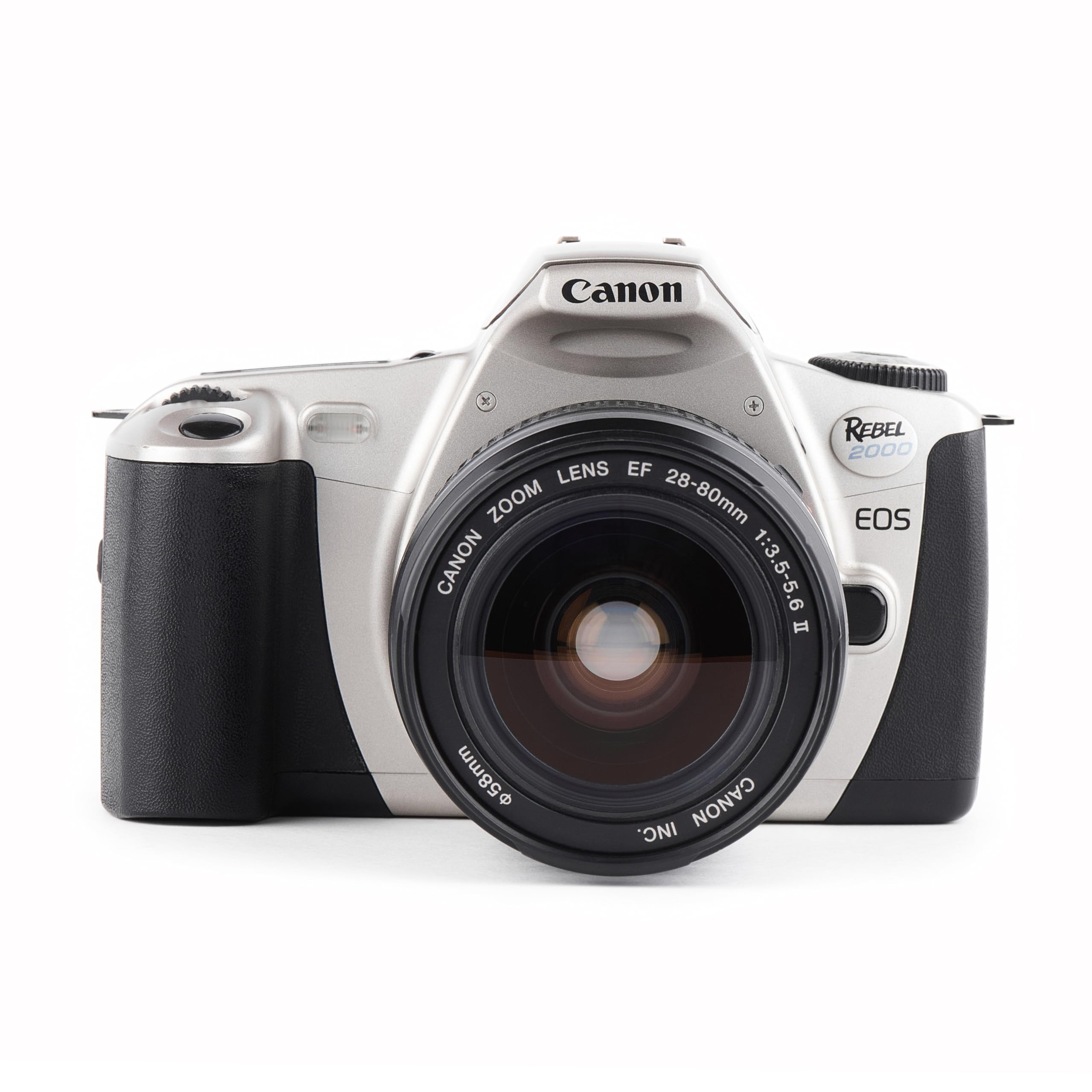
The Canon Rebel 2000 is the smartest entry point into interchangeable-lens 35mm photography at this price tier. Its 7-point autofocus system is genuinely fast and accurate for a film body from this era, and the bundled 28-80mm EF zoom covers the most useful focal range for everyday shooting. The camera offers Program AE, Aperture Priority, Shutter Priority, and full Manual modes, so you can grow into exposure control without outgrowing the body.
Build quality is typical late-90s Canon plastic — lightweight at the expense of tank-like durability — but the EF mount gives you access to an enormous used lens ecosystem from Canon and third-party manufacturers. The built-in pop-up flash is adequate for fill light, and automatic film loading, advancing, and rewinding removes the friction that turns off new film shooters.
Performance in good light with ISO 200 or 400 film produces sharp, well-exposed negatives that scan beautifully. The renewed condition we examined arrived with a working meter, functional autofocus, and clean lens glass. For the price, this is the most capable and expandable system you can put in your hands today.
Why it’s great
- 7-point AF delivers sharp focus consistently
- EF mount opens huge used lens selection
- Full creative modes plus full auto for beginners
Good to know
- Plastic body doesn’t feel rugged
- Renewed condition varies between sellers
2. Canon New EOS Kiss (Rebel G) SLR AF Film Camera With 35-80mm EF Lens (Renewed)

The EOS Kiss — sold as the Rebel G in North America — is nearly identical to the Rebel 2000 but with a slightly simpler feature set that still covers all the essentials. The wide-area autofocus point is reliable for portraits and group shots, and the ISO range from 100 to 3200 gives you flexibility in varied lighting conditions. The 35-80mm EF zoom lens bundled with this kit is optically decent and perfectly adequate for learning the ropes.
What stands out is the condition of renewed units — multiple user reports describe cameras arriving in excellent shape with all functions working correctly, including the meter, LCD display, and film transport. The built-in flash handles low-light situations competently, and the intuitive control layout with a clear LCD makes settings adjustments quick even without the manual.
The maximum shutter speed of 30 seconds in manual mode allows for long exposures and night photography experiments, something point-and-shoot bodies simply cannot offer. Battery life is excellent on a single 2CR5 lithium cell, lasting through dozens of rolls before needing replacement.
Why it’s great
- Excellent renewed condition from many sellers
- Wide-area AF works reliably for everyday shooting
- ISO 3200 support for low-light flexibility
Good to know
- Same plastic build as the Rebel 2000
- Viewfinder is small compared to pro bodies
3. Pentax 17 Compact Film Camera with Half-Frame Format, 25mm F3.5 Lens

The Pentax 17 is a brand-new design that combines modern manufacturing tolerances with classic half-frame photography. By shooting 72 frames on a standard 36-exposure roll of 35mm film, you effectively cut your film cost in half — a massive advantage for daily carry shooting. The 25mm f/3.5 fixed lens is surprisingly sharp for a half-frame optic, and the HD coating reduces flare in backlit situations.
The six-zone focus system replaces autofocus with a manual zone selector ranging from 0.25 meters to infinity, which sounds intimidating but becomes intuitive after a few rolls. Exposure compensation of ±2 EV in half-step increments gives you real creative control over the final image, and the six shooting modes cover everything from full auto to bulb for long exposures.
This camera is built for travel and street photography where compact size and low weight matter more than absolute resolution. The bundled Kodak Gold 200 three-pack gets you started immediately, and the CR2 battery lasts for months of casual shooting. Some early units have shown shutter defects, so verify the seller’s return policy before purchasing.
Why it’s great
- 72 frames per roll halves film costs
- Sharp 25mm lens with HD coating
- Modern build quality and reliable meter
Good to know
- Zone focus takes practice to master
- Quality control issues reported on early batches
4. Vintage Canon AE-1 35mm SLR Camera with 50mm 1:1.8 Lens (Renewed)

The Canon AE-1 needs no introduction — it’s the camera that democratized SLR photography in the 1970s and remains the most sought-after vintage body on the used market. Shutter-priority auto exposure lets you set the speed while the camera picks the aperture, making it a natural step up from full manual without surrendering creative control. The included 50mm f/1.8 FD lens is extraordinarily sharp wide open and renders colors with the classic warm film look.
The all-metal body with chrome top plate is genuinely durable and feels far more substantial than any modern plastic entry-level camera. The TTL metering system uses a silicon cell that remains accurate after 40+ years, provided the 4LR44 battery is fresh. Shutter speeds from 1/1000 to 2 seconds plus Bulb mode cover virtually any shooting scenario.
The renewed units from reputable sellers like Blue Pen Refurbishing have been mechanically serviced and tested, though some users report requiring a replacement due to meter or mirror issues. FD mount lenses are plentiful and affordable, making the AE-1 the gateway into an entire ecosystem of classic Canon glass.
Why it’s great
- Metal body is built to last decades
- 50mm f/1.8 lens is incredibly sharp for the price
- Shutter-priority auto is intuitive and fast
Good to know
- Renewed condition varies widely
- FD mount limits modern lens options
5. Pentax K1000 Manual Focus SLR Film Camera with Pentax 50mm Lens (Renewed)

The Pentax K1000 is the gold standard for learning film photography the hard way — and that’s exactly why it remains in production decades after its original release. Everything is manual: aperture ring on the lens, shutter speed dial on the top plate, and focus ring by hand. The built-in light meter provides center-weighted guidance via a simple needle display, and it runs on a single LR44 battery that lasts multiple years.
The included 50mm f/2 SMC Pentax lens is one of the best kit lenses ever made, delivering sharp center resolution and pleasant bokeh wide open. The Pentax K mount is fully compatible with virtually every K-mount lens produced since 1975, including modern DA series lenses with an adapter ring. The construction is all-metal with a brass top plate and chrome-plated lens mount.
However, the renewed market for the K1000 is inconsistent — several user reports describe receiving units with dead light meters or damaged mirrors. The camera’s simplicity also means no auto exposure modes, no autofocus, and no film advance motor. For someone committed to learning exposure fundamentals, it’s unmatched. For casual shooting, the lack of automation becomes a barrier.
Why it’s great
- Fully mechanical, no battery needed for shutter
- 50mm f/2 SMC lens is optically superb
- Unmatched as a teaching tool for exposure basics
Good to know
- Renewed units often have meter issues
- No auto exposure or autofocus at all
6. KODAK Snapic A1 35mm Film Camera (Ivory White)
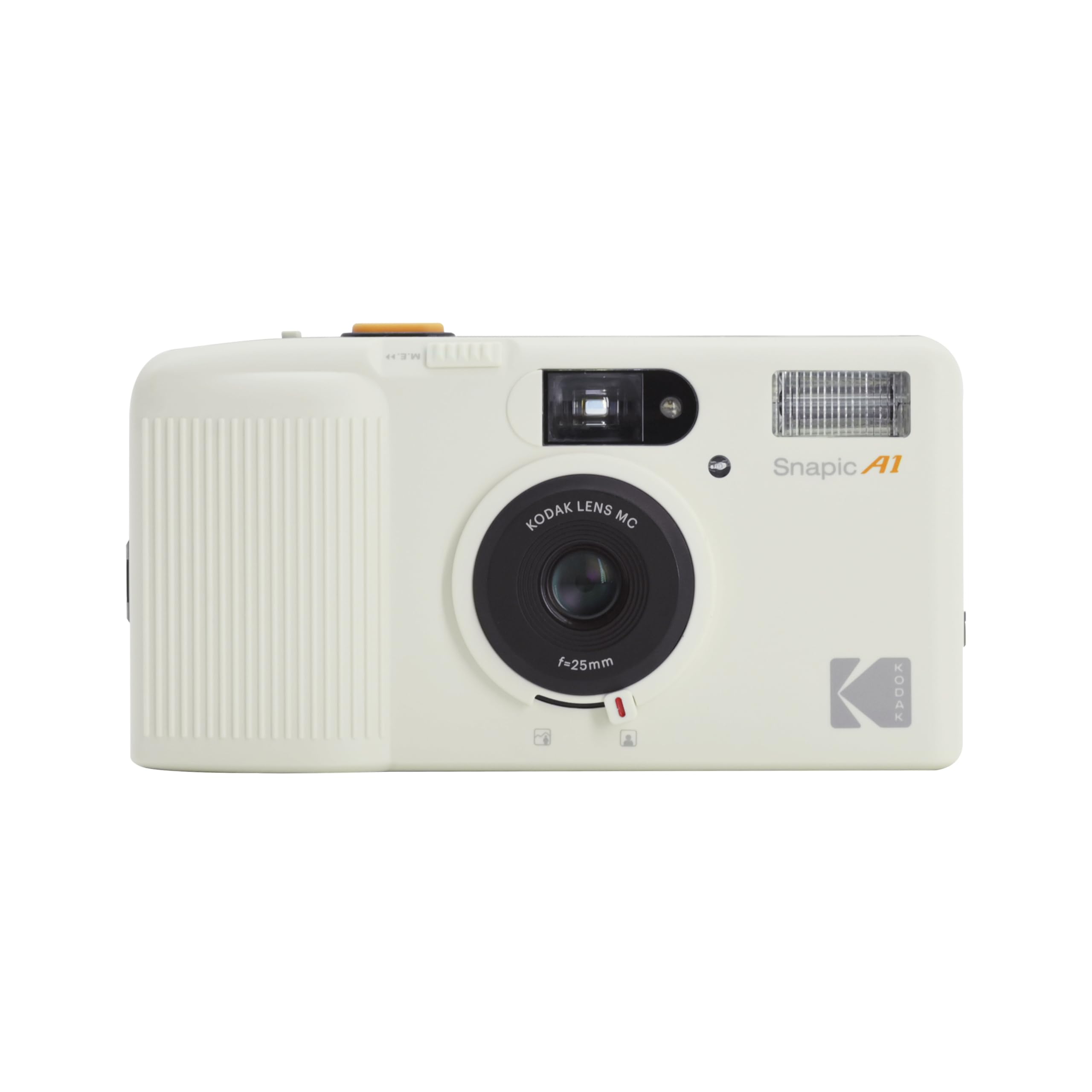
The Kodak Snapic A1 is the most straightforward path from disposable cameras to a reusable point-and-shoot with a genuine glass lens. The three-element 31mm f/9 optic is a meaningful step up from the plastic lens in disposable cameras, delivering noticeably sharper detail and better contrast in daylight conditions. The 2-zone focus system switches between portrait (0.7-3m) and landscape (3m to infinity) via a simple slider.
Automatic film winding and rewinding eliminate the most common frustration point for beginners, and the built-in auto flash with red-eye reduction works reliably indoors. The multiple exposure feature lets you double-expose frames by pressing the multi-exposure button before advancing the film — a creative tool usually reserved for more advanced bodies.
Weight is just 117 grams, making it genuinely pocketable. The plastic build feels light but not fragile, and the compact dimensions (4.65 x 2.44 x 1.38 inches) mean it disappears into a jacket pocket. Use alkaline AAA batteries — NiMH rechargeables can cause inconsistent flash performance. Best results come with Kodak Gold 200 or Fujifilm Superia X-Tra 400 in bright daylight.
Why it’s great
- Genuine glass lens outperforms disposables
- Auto wind and rewind for convenience
- Double exposure mode for creative shots
Good to know
- Plastic build, not rugged for drops
- Only two focus zones with no mid-range
7. Fujifilm Instax Mini 41 Instant Film Camera
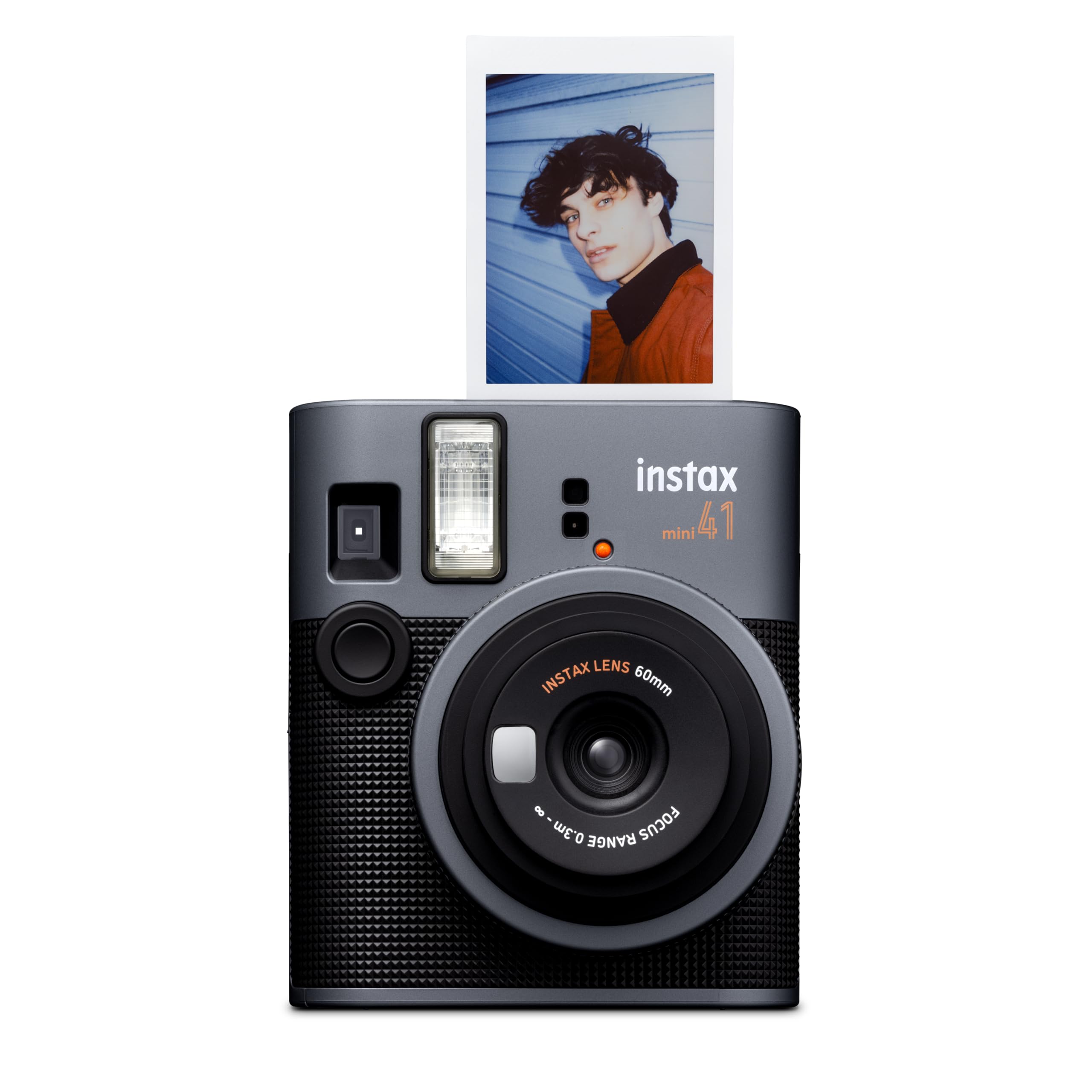
The Instax Mini 41 is Fujifilm’s latest iteration of its best-selling instant camera, adding a built-in selfie mirror and close-up mode with parallax correction to the proven Mini platform. Automatic exposure and flash control mean you get properly exposed prints without any manual fiddling — just press the shutter button and watch the photo develop in about 90 seconds.
The 2″ x 3″ Instax Mini prints are compact and wallet-friendly, and the estimated cost per shot of roughly per print is significantly cheaper than Polaroid film. The retro black design with textured grip gives it a premium feel that justifies its place over older models in the Mini lineup, even though the lens and imaging system are essentially the same as the Instax Mini 12.
Bundled with two AA batteries, a hand strap, and a quick-start guide, it’s ready to use out of the box. Low-light performance is surprisingly solid thanks to the strong built-in flash, though the exposure algorithm tends to slightly overexpose in mixed lighting. For event photography where instant physical prints are the goal, the Mini 41 delivers consistent results with minimal effort.
Why it’s great
- Selfie mirror and close-up mode included
- Auto exposure simplifies instant photography
- Lower per-print cost than Polaroid film
Good to know
- Image quality same as cheaper Mini models
- Proprietary film is expensive per-shot long-term
8. Kodak Pixpro FZ45 Digital Camera, 16MP Point & Shoot

The Kodak Pixpro FZ45 is a digital point-and-shoot that fills a different niche: budget digital photography for users who want instant feedback without the ongoing cost of film. The 16-megapixel CMOS sensor produces detailed images in good lighting, and the 4x optical zoom (27mm wide-angle to 108mm equivalent) offers flexible framing for travel and family snapshots.
1080p full HD video recording is a bonus for simple vlogging or capturing moments that need motion, though the lack of image stabilization means handheld footage can be shaky. The 2.7-inch LCD screen is adequate for composition and playback, and the camera works with SD, SDHC, and SDXC cards up to 512GB.
The biggest weakness is the power system — it runs on two AA alkaline batteries that come included but die quickly. Users report getting only a few hours of use from the included batteries. Rechargeable NiMH AAs or lithium disposables are essential for regular use. The built-in flash is competent for close-range indoor shooting, and the 9-point contrast-detect autofocus is responsive in good light.
Why it’s great
- 16MP sensor produces detailed stills
- Records 1080p video for simple clips
- Very affordable entry to digital photography
Good to know
- AA batteries die quickly; need rechargeable
- No optical image stabilization for video
9. Fujifilm Quicksnap Flash Disposable Camera 400 ISO, 6 Pack
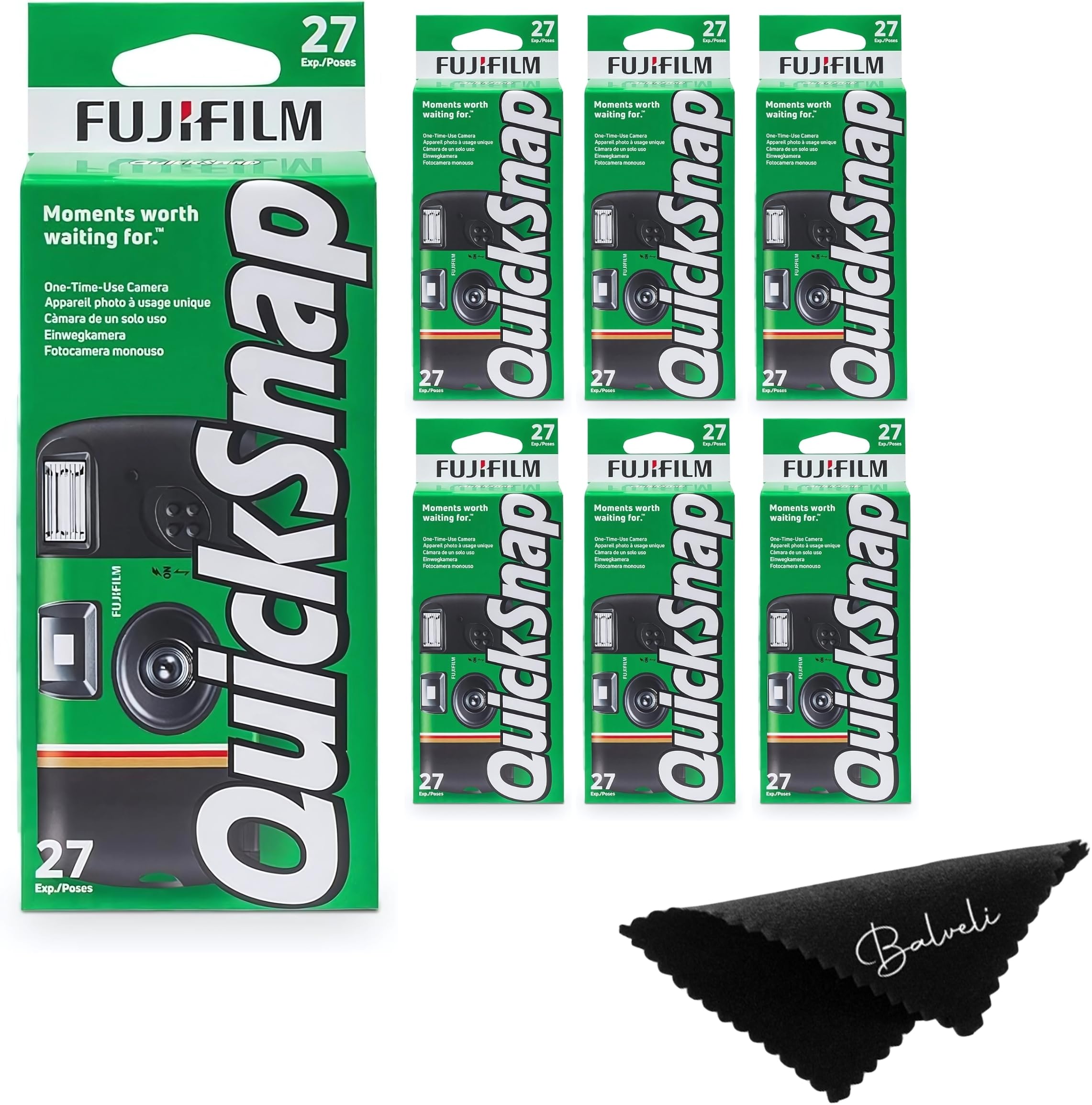
The Fujifilm Quicksnap Flash is the most recognizable disposable camera in the world, and this six-pack is designed for events where you want to distribute cameras to guests. Each camera is pre-loaded with 27 exposures of Fujifilm ISO 400 film — a versatile speed that handles outdoor daylight and indoor flash scenarios equally well. The built-in flash is automatic and provides reliable fill light in low-light conditions.
The 35mm fixed-focus lens is a simple plastic element, so images have the characteristic soft look and vignetting that defines the disposable aesthetic. At this bulk price, the cost per camera is reasonable for one-time use, but the per-frame cost is much higher than shooting the same film through a reusable body. The included Balveli microfiber cloth is a nice touch for keeping lens clean.
For weddings, birthday parties, or bachelorette events where you want disposable cameras on every table, this six-pack delivers a nostalgic, low-stakes shooting experience. The cameras are lightweight with wrist straps for easy carrying.
Why it’s great
- Convenient bulk pack for events
- ISO 400 handles most lighting conditions
- Built-in flash works automatically
Good to know
- Higher per-frame cost than reusable bodies
- Single-use creates ongoing expense
FAQ
What ISO film should I use in an affordable film camera?
Is it cheaper to buy a reusable film camera or disposables long-term?
Final Thoughts: The Verdict
For most users, the best affordable film camera winner is the Canon Rebel 2000 because it combines a genuine autofocus system, interchangeable EF mount lenses, and full creative exposure modes at a price that undercuts a weekend’s worth of disposables. If you want a half-frame that doubles your film economy and packs like a pocket camera, grab the Pentax 17. And for the classic all-metal SLR experience with the legendary 50mm f/1.8 lens, nothing beats the Canon AE-1.