
A single 100-foot HDMI cable run is the most demanding test a signal can face. Standard copper cables degrade over 15 to 20 feet, introducing flicker, sparkles, and blackouts that ruin a home theater or gaming setup. The solution is fiber optic or active copper technology engineered specifically for long-distance transmission, and choosing the wrong one means wasted time rerouting cables through walls or ceilings.
I’m Min — the co-founder and writer behind Gadgets Feed. I’ve spent hundreds of hours analyzing technical specifications like bandwidth in Gbps, connector plating, directional design, and CL3 in-wall ratings to separate the cables that truly deliver 4K and 8K signals without dropouts from the ones that falter under pressure. This guide cuts through the marketing claims to help you pick a cable that actually works at 100 feet.
Whether you are running a projector in your basement or routing a signal to a remote conference room, finding the best 100 ft hdmi cable means understanding how to balance bandwidth, durability, and in-wall safety ratings for a flawless long-distance connection.
How To Choose The Best 100 Ft HDMI Cable
A 100-foot cable is a permanent install for most people, so getting the right type the first time is essential. The three biggest decisions are cable technology, bandwidth rating, and physical construction.
Fiber Optic vs. Copper vs. Active Copper
Standard passive copper cables cannot reliably carry a 4K or 8K signal past about 25 feet. At 100 feet, you need either an active copper cable with built-in signal boosting electronics or a fiber optic cable that converts the electrical signal to light. Fiber optic cables are lighter, thinner, and immune to electromagnetic interference from nearby power cables, making them the preferred choice for long runs through walls or conduit. Active copper cables work well for 4K but rarely support the full 48Gbps bandwidth required for 8K at 60Hz.
Bandwidth and Resolution Support
The HDMI specification determines what resolutions and refresh rates the cable supports. HDMI 2.0 cables deliver 18Gbps, enough for 4K at 60Hz. HDMI 2.1 cables deliver 48Gbps, enabling 8K at 60Hz and 4K at 120Hz with variable refresh rate (VRR) for smoother gaming. For a 100-foot run intended to last several years, choosing a 48Gbps fiber optic cable is the most future-proof investment, even if your current display is only 4K.
Directional vs. Non-Directional Design
Nearly every fiber optic or active HDMI cable designed for runs of 65 feet or longer is directional. One end is labeled “Source” and the other “Display.” Connecting them backward results in no signal at all. Before pulling a cable through a wall or ceiling, clearly mark which end goes to the source device and which goes to the display, and triple-check the orientation before installation. Non-directional cables at this length are extremely rare and usually limited to lower bandwidth passive copper models that cannot handle modern 4K or 8K signals.
In-Wall Rating and Durability
If the cable passes through a wall, ceiling, or floor, building codes typically require a CL2 or CL3 fire safety rating. CL3 is the higher standard and the safer choice for permanent installations. Look for a braided or reinforced jacket that resists crushing and kinking during installation. Gold-plated connectors resist corrosion, and a low-profile connector head makes it easier to route the cable through tight conduit bends.
Quick Comparison
On smaller screens, swipe sideways to see the full table.
| Model | Category | Best For | Key Spec | Amazon |
|---|---|---|---|---|
| BENFEI 8K HDMI 2.1 Fiber Optic | Fiber Optic | Future-proof 8K gaming | 48Gbps / 8K@60Hz / CL3 rated | Amazon |
| LEADSTAR Fiber Optic 8K | Fiber Optic | Durable braided build | 48Gbps / 8K@60Hz / Nylon braid | Amazon |
| Snowkids 8K HDMI Fiber Optic | Fiber Optic | Military-grade tensile strength | 48Gbps / 8K@60Hz / 25K flex life | Amazon |
| FIBBR Fiber Optic HDMI 2.1 | Fiber Optic | Interference-free installations | 48Gbps / 8K@60Hz / YOFC fiber core | Amazon |
| Fibopitcal 8K Fiber Optic HDMI | Fiber Optic | Budget-conscious 8K upgrade | 48Gbps / 8K@60Hz / Ultra-thin design | Amazon |
| Grofyllaa 4K HDMI 2.0 100FT | Active Copper | Basic 4K office/meeting rooms | 18Gbps / 4K@60Hz / Gold-plated | Amazon |
| Monoprice 4K High Speed Active | Active Copper | Pro 4K in-wall installs | 18Gbps / 4K@60Hz / CL2 rated | Amazon |
In‑Depth Reviews
1. BENFEI 8K HDMI 2.1 Fiber Optic Cable 100 Feet
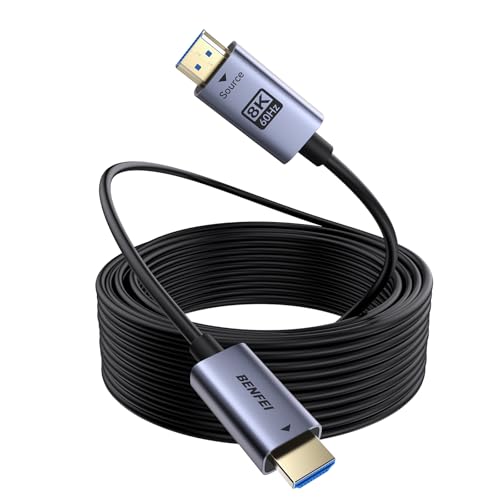
The BENFEI 8K HDMI 2.1 cable delivers the full 48Gbps bandwidth required for 8K at 60Hz and 4K at 240Hz, making it the most future-proof option in the list. Its fiber optic construction eliminates signal loss entirely over the full 100-foot length, a feat standard copper cables cannot match. The CL3 in-wall rating means it meets fire safety codes for permanent installation inside walls, ceilings, or conduits.
Gamers will appreciate the Variable Refresh Rate (VRR) support that eliminates screen tearing during fast-paced action, along with eARC for high-bitrate lossless audio formats like Dolby Atmos and DTS:X. The cable is directional, with clearly labeled “Source” and “Display” ends, so installation is straightforward as long as you plan the orientation before pulling it through tight spaces.
At roughly the sweet spot of mid-range pricing, the BENFEI offers 8K performance, a durable jacket, and a comprehensive 18-month warranty — a combination that is hard to beat for anyone running a serious home theater or gaming setup at this distance.
Why it’s great
- Full 48Gbps HDMI 2.1 bandwidth supports 8K60 and 4K240
- CL3 rated for safe permanent in-wall installation
- 18-month warranty adds purchase confidence
Good to know
- Directional cable requires correct orientation before installation
- Standard jacket sleeve can snarl if not handled carefully
2. LEADSTAR HDMI Cable Fiber Optic 8K 4K 100 ft
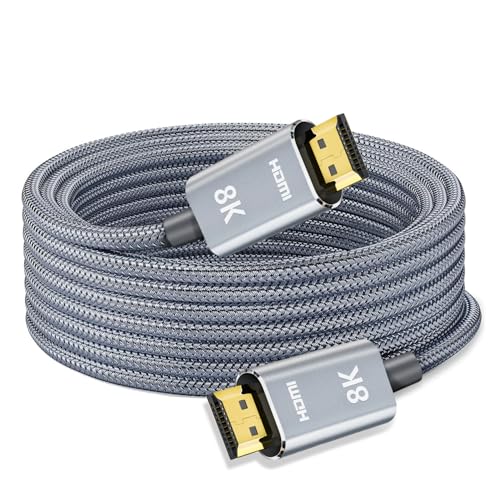
The LEADSTAR 100-foot fiber optic cable wraps its 48Gbps core in a flexible nylon braided jacket that resists abrasion and kinking better than standard PVC sleeves. This makes it an excellent choice for DIY installers who need to snake the cable through crowded conduit or around sharp corners. The braided exterior also reduces tangling during the initial routing process.
It supports 8K at 60Hz and 4K at 120Hz with Dynamic HDR and HDCP 2.2 compliance, covering both current gaming console requirements and future display upgrades. The eARC channel passes Dolby Atmos and DTS:X audio formats, so you can send lossless surround sound from your TV back to the receiver without a separate audio cable. Compatibility extends to PS5, Xbox Series X/S, and PC GPUs.
Some users note the cable is slightly stiff due to the braided construction, which makes temporary or frequently moved setups more difficult. For permanent wall installations, however, that stiffness translates to long-term durability and resistance to damage from accidental tugging.
Why it’s great
- Nylon braided jacket resists kinks and abrasion during installation
- Full 48Gbps bandwidth with 8K60 and 4K120 support
- eARC passes Dolby Atmos and DTS:X audio formats
Good to know
- Braided construction makes the cable stiffer than rubber sleeves
- Directional design requires correct source/display orientation
3. Snowkids 8K HDMI Fiber Optic Cable 100FT

Snowkids brings a military-grade tensile nylon braid and 24K gold-plated ports to its 100-foot fiber optic HDMI 2.1 cable, rated for 25,000 flex cycles. That mechanical endurance makes it a strong candidate for environments where the cable might be moved or adjusted periodically, or for installers who need a cable that can survive being bent repeatedly during routing.
On the performance side, it delivers the full 48Gbps bandwidth with support for 8K at 60Hz, 4K at 120Hz, VRR, ALLM, QMS, and eARC. Backward compatibility extends to all older HDMI versions. The fiber optic core completely eliminates EMI/RFI interference, which is especially useful for runs near power cables or in complex AV racks with lots of electronic noise.
A small number of users report that eARC and CEC functions may be unreliable on very complex home theater systems with multiple devices, though the cable works perfectly on simpler source-to-display connections. Snowkids customer service has been noted for proactively offering refunds when compatibility issues arise, reducing the risk of a bad purchase.
Why it’s great
- Rated for 25,000 flex cycles with military-grade tensile braid
- Full 48Gbps bandwidth and 8K60 support
- Gold-plated connectors resist corrosion over time
Good to know
- eARC/CEC may be unreliable on complex multi-device systems
- Stiffer build is less ideal for temporary or portable setups
4. FIBBR Fiber Optic HDMI Cable 100 ft 2.1 8K
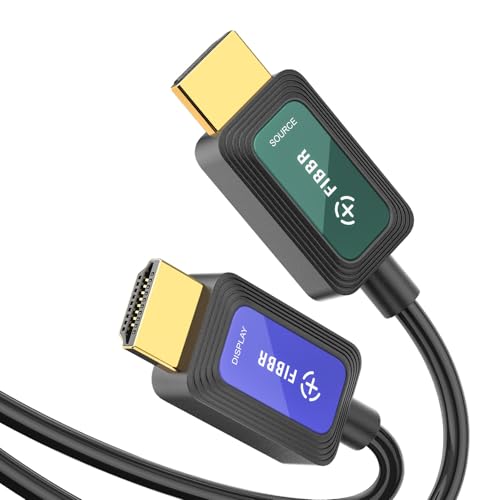
FIBBR uses YOFC fiber optic cores (Yangtze Optical Fibre and Cable) in its 100-foot HDMI 2.1 cable, a material choice that ensures extremely stable light-based signal transmission over long distances. This cable is marketed directly at professional custom integrators and IT managers who need reliable runs in conference rooms, lecture halls, and complex whole-home AV systems.
The 48Gbps bandwidth supports 8K at 60Hz and 4K at 120Hz with VRR, ALLM, QMS, QFT, DSC, and HDCP 2.2 and 2.3 compliance. It is immune to EMI and RFI interference, making it safe to route alongside power cables without signal degradation. The physical connector head is compact — roughly the size of a USB flash drive — which simplifies routing through tight conduit bends and wall plates.
Note that like most fiber optic cables at this length, the FIBBR is directional and does not support ARC or eARC. You will need a separate shorter HDMI cable for audio return from the display to the receiver. Some LG OLED users have also reported potential HDCP 2.2 handshake issues, so check your TV model compatibility before finalizing a permanent install.
Why it’s great
- YOFC fiber core for ultra-stable long-distance signal transmission
- Compact connector head simplifies conduit routing
- Full immunity to EMI/RFI interference from nearby power cables
Good to know
- No ARC or eARC support at 100 feet
- May have HDCP 2.2 handshake issues with some LG OLED TVs
5. Fibopitcal 8K Fiber Optic HDMI Cable 100ft

Fibopitcal delivers a 48Gbps fiber optic HDMI 2.1 cable at an accessible entry-level price point, making 8K-capable long runs available to budget-conscious buyers. The cable is 50 percent thinner and lighter than traditional copper HDMI cables, with 360-degree bendability that helps during tight in-wall or conduit installations. It weighs just 3.2 ounces, reducing strain on the connector ports.
It supports 8K at 60Hz and 4K at 120Hz and eliminates EMI/RFI interference, keeping the signal clean even when running alongside power cables. The directional design means you must connect the “SOURCE” end to the player or PC and the “DISPLAY” end to the TV or projector. The manufacturer explicitly lists a compatibility limitation with certain LG OLED TVs regarding HDCP 2.2 and high-bandwidth formats.
No ARC or eARC support is available at this length, a limitation shared with all fiber optic cables over 60 feet. For the price, you get genuine 48Gbps bandwidth and fiber optic reliability, but you should verify your specific TV model compatibility — particularly for LG OLED owners — before making the purchase.
Why it’s great
- Highest bandwidth (48Gbps) at the lowest price in the lineup
- Ultra-thin and lightweight for easy conduit routing
- Immune to EMI and RFI interference
Good to know
- Known compatibility issues with some LG OLED TVs
- No ARC or eARC support at 100-foot length
6. Grofyllaa 4K HDMI Cable 100FT
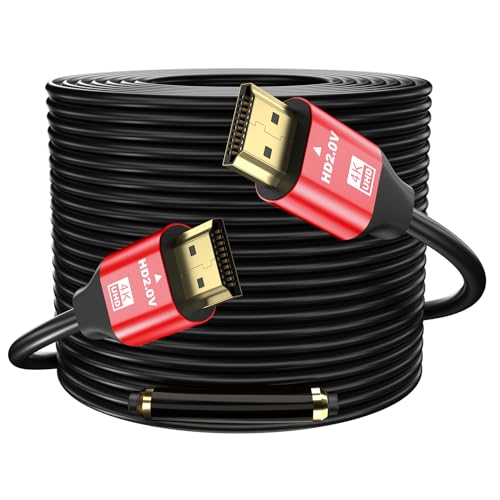
The Grofyllaa 100-foot cable uses a standard copper construction rather than fiber optic technology, which limits its bandwidth to 18Gbps — sufficient for 4K at 60Hz but not for 8K, 4K at 120Hz, or VRR gaming. It is an active copper cable, meaning built-in signal boosters help the signal survive the 100-foot distance, but it remains susceptible to interference from nearby electrical lines.
HDMI 2.0 features are well covered: it supports HDCP 2.2 and 2.3, ARC for audio return, and 3D video passthrough. Gold-plated connectors resist corrosion. The cable works with Roku TVs, PS5/PS4, Xbox Series X, Blu-ray players, and laptops. It is a functional choice for office meeting rooms or basic home theater setups that do not require high refresh rates or HDR at full bandwidth.
A minority of reviews mention random disconnects and graphical artifacts attributed to the unshielded copper construction, especially in environments with significant electrical noise. If your installation runs near power cables or in a conduit with high-voltage lines, a fiber optic alternative is strongly recommended.
Why it’s great
- Least expensive active copper 100-foot HDMI cable available
- Gold-plated connectors for corrosion resistance
- Supports ARC audio return and HDCP 2.2/2.3
Good to know
- Unshielded copper can cause disconnects near power cables
- 18Gbps maximum bandwidth limits to 4K@60Hz
7. Monoprice 4K High Speed HDMI Cable – Active 100ft
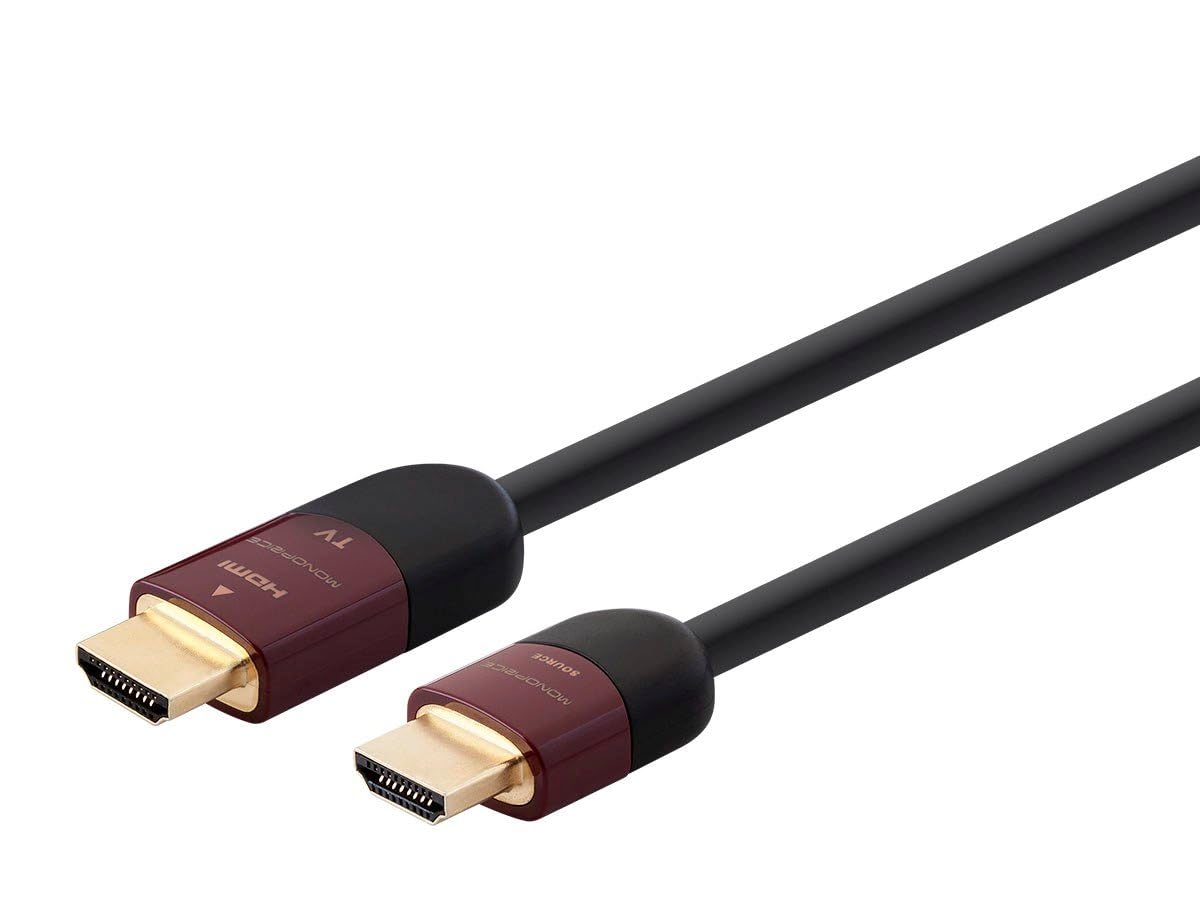
Monoprice is a respected name in professional cabling, and this 100-foot active copper HDMI cable is built with the CL2 in-wall rating required by many building codes for permanent installations. It supports 4K resolutions up to 3840 x 2160 at 24Hz, along with 3D video, Deep Color up to 48-bit, and multichannel audio formats including DTS-HD Master Audio and Dolby TrueHD.
Active electronics in the connector heads boost the signal to maintain integrity over the full 100-foot distance. The cable is directional, with one end labeled for the source and the other for the display. Some models include right-angle adapters to help with wall-mounted TV clearance. The build quality is solid, with a thick jacket that resists damage during installation.
However, the cable is limited to 18Gbps HDMI 2.0 bandwidth and does not support 4K at 60Hz with HDR in 4:4:4 chroma subsampling — a known limitation reported by PS4 Pro users. For modern 4K HDR gaming at full chroma, or for any 8K application, this cable will underperform. It remains a reliable option for 1080p or basic 4K SDR installations where code compliance is the priority.
Why it’s great
- CL2 rated for permanent in-wall installation per building codes
- Active boost electronics maintain signal over 100 feet
- Solid build quality from a trusted pro AV brand
Good to know
- Limited to 18Gbps; no 4K@60Hz HDR 4:4:4 support
- No HDMI 2.1 features; not suitable for 8K or high-refresh gaming
FAQ
Why do 100-foot HDMI cables need to be directional?
Can I use a copper HDMI cable at 100 feet for 4K HDR?
Will a 100-foot HDMI cable add input lag for gaming?
Are 100-foot HDMI cables compatible with all TVs and projectors?
Final Thoughts: The Verdict
For most users, the best 100 ft hdmi cable winner is the BENFEI 8K HDMI 2.1 Fiber Optic Cable because it combines the full 48Gbps bandwidth, CL3 in-wall safety rating, and a robust warranty at a price that undercuts many competitors. If you need the toughest braided jacket for a challenging installation route, grab the LEADSTAR Fiber Optic 8K. And for a professional-grade 4K in-wall install where code compliance is non-negotiable, the Monoprice 4K Active 100ft remains a trusted workhorse.