
A fibula fracture forces you into a bulky boot for weeks, and the wrong choice turns every step into a compromise between stability and raw discomfort. The boot you pick determines whether the immobilization holds your bones in alignment while the rocker sole lets you shuffle through daily life without grinding pain at the break site. Getting the right brace means matching the fracture’s location—distal, mid-shaft, or proximal—to the right height, air compression system, and strap configuration that your orthopedic specialist expects.
I’m Min — the co-founder and writer behind Gadgets Feed. I’ve spent hundreds of hours analyzing specs across dozens of braces, comparing shell rigidity, air pump mechanisms, strap placement, and sole geometry to identify which designs actually keep a fibula fracture immobilized without cutting off circulation or causing pressure sores.
This guide breaks down seven brace options with specific measurements, support levels, and design trade-offs so you can match your recovery stage to the right device. Whether you need a short boot for a stable distal fracture or a tall air cast for a more complex break, here is the definitive breakdown of the brace for fibula fracture that best fits your healing plan.
How To Choose The Best Brace For Fibula Fracture
Selecting the right brace for a fibula fracture involves more than picking a random medical boot off the shelf. The fibula bears about ten percent of your body weight but plays a critical role in ankle stability and load transfer through the syndesmosis. A brace that fails to control rotation or allows lateral bending at the fracture site can delay healing or cause malunion. Here are the three factors that separate an effective recovery tool from a frustrating expense.
Boot Height: Short vs. Tall
Short CAM walkers typically end just above the ankle and suit stable, non-displaced distal fibula fractures where the main goal is to limit ankle inversion and eversion while allowing some knee flexion. Tall boots extend higher up the lower leg, providing greater rotational control for mid-shaft or proximal fibula breaks and post-surgical repairs. A tall boot also offloads more weight onto the tibia, which matters during the early non-weight-bearing phase. Measure from the sole of your foot to the top of your calf—your orthopedic surgeon’s protocol usually dictates the minimum height required.
Air Compression Systems vs. Static Padding
Integrated air bladders allow you to fine-tune compression around the fracture site and surrounding soft tissue, which directly reduces swelling and stabilizes the bone fragments against the rigid shell. Static foam padding offers consistent support but cannot adapt as swelling fluctuates during the first two weeks post-injury. For a fibula fracture, where the lateral malleolus is often tender and prone to pressure points, an adjustable air pump provides the ability to relieve hotspot areas while maintaining immobilization—a feature that becomes nearly essential for sleep comfort.
Rocker Sole Geometry and Weight
A rocker bottom sole shifts your weight from heel strike to toe-off in a controlled arc, reducing the bending moment at the fracture site with every step. The ideal rocker angle for a fibula brace keeps the ankle at a neutral 90-degree angle while the curved sole absorbs shock before it travels up the fibula. Lighter boots under 2.5 pounds cause less gait disturbance, but the trade-off comes in shell thickness—ultra-light models sometimes flex under load near the malleolar region, which can introduce micro-motion at the fracture line. Prioritize a rigid polymer frame with steel reinforcement if your protocol allows partial weight-bearing.
Quick Comparison
On smaller screens, swipe sideways to see the full table.
| Model | Category | Best For | Key Spec | Amazon |
|---|---|---|---|---|
| DonJoy MaxTrax Walker | Tall Premium | Rotational Stability | 2.4 lb with seamless liner; low-profile rocker | Amazon |
| Brace Direct Tall Air CAM | Tall Premium | Air Compression + Insurance | PDAC-approved L4360; pump system | Amazon |
| Brace Direct Tall CAM Walker | Tall Mid-Range | Post-Surgery Support | 2.45 lb; built-in air pump; rocker sole | Amazon |
| United Ortho USA14115 Short Air | Short Mid-Range | Distal Fracture Mobility | 2.2 lb; steel-reinforced uprights; 4 comfort pads | Amazon |
| ManaMed ManaEZ Air Boot Tall | Tall Value | Budget-Friendly Air Cast | Pneumatic 2-step valve; long toe bed | Amazon |
| Brace Direct CAM Walker Short | Short Value | Lightweight Daily Use | Open-toe ventilation; non-skid tread | Amazon |
| Jewlri Walking Boot Short | Short Budget | Entry-Level Protection | Air bladder valves; washable liner; 3 straps | Amazon |
In‑Depth Reviews
1. DonJoy MaxTrax Walker Brace/Walking Boot
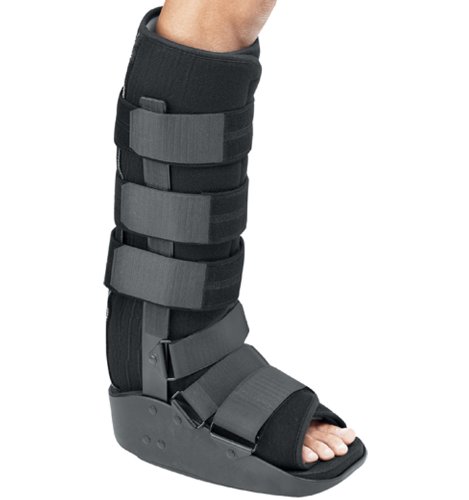
The DonJoy MaxTrax Walker Brace earns the top spot because its engineering focuses on the precise immobilization demands of a fibula fracture—namely controlling rotation at the syndesmosis without introducing shear forces on the lateral malleolus. The cushioned inner and outer sole delivers 2.4 pounds of shock absorption that reduces plantar pressure during ambulation, while the seamless liner construction ensures no abrasive seams sit over the surgical incision or the tender fracture site. The low-profile rocker bottom promotes a natural gait arc that minimizes the bending moment on the distal fibula, a critical detail for partial weight-bearing protocols.
What sets this brace apart from most competitors is the universal fit combined with the material-grade polymer frame that resists flexing under load. Users with stable distal fibula fractures and those recovering from ORIF procedures report that the brace eliminates the “wobble” sensation common in lighter boots, providing the confidence to follow doctor-ordered walking restrictions. The rocker sole geometry—flatter than many air boots—works especially well for patients who need to walk on uneven indoor surfaces during the healing phase.
Multiple reviews highlight that the DonJoy feels more supportive than the standard hospital-issued boot, with fewer pressure points along the fibular groove. The medium size accommodates men’s 7.5–10.5 and women’s 8.5–11.5, and the hand-wash-only liner remains durable through daily cleaning. For a fibula fracture where rotational control and impact absorption are non-negotiable, this brace delivers clinical-grade performance at a price that undercuts many DME providers.
Why it’s great
- Seamless liner prevents irritation over lateral malleolus
- Low-profile rocker sole reduces fracture site bending moment
- Universal fit for left or right foot
Good to know
- No integrated air pump for dynamic compression
- Some users report sizing runs smaller than expected
2. Brace Direct Tall Air CAM Walker Fracture Boot (L4360, L4361)
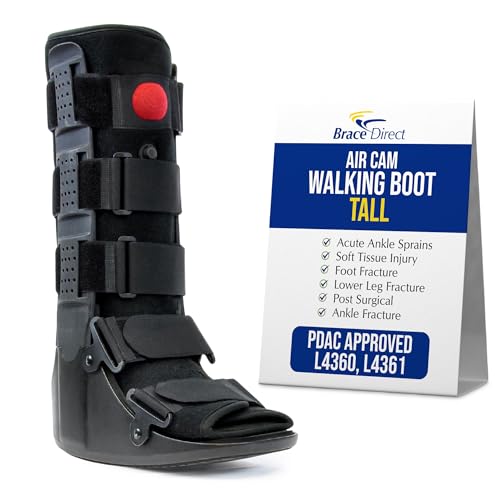
The Brace Direct Tall Air CAM Walker carries PDAC certification under HCPCS codes L4360 and L4361, which means its design meets the medical necessity criteria for insurance reimbursement—a significant advantage for anyone filing claims after a fibula fracture. The built-in inflation pump allows you to dial in targeted compression around the fracture site, which directly addresses the swelling that peaks in the first 48 to 72 hours post-injury. The high-strength polymer frame supports the lower leg without the bulk of a traditional cast, preserving mobility while preventing the rotational stresses that destabilize mid-shaft fibula breaks.
What makes this boot particularly effective for weight-bearing transitions is the low-profile rocker sole combined with the air cell system. Users can reduce air pressure when resting and increase it before walking to lock the foot securely against the medial and lateral support pads. The open-toe construction maximizes airflow—a practical feature for patients who must wear the boot for six weeks or more, as it reduces maceration risk. The small size fits men’s 6–8.5 and women’s 7.5–9.5, and the machine-washable liner simplifies hygiene during long recovery periods.
Customer feedback consistently praises the boot’s comfort for stress fractures of the metatarsals and distal fibula, with several users noting that the air pump system allowed them to avoid a cast entirely. The trade-off is that the boot runs slightly small—reviewers recommend sizing up if swelling is significant or if post-operative bandages are required. For a fibula fracture that needs both dynamic compression and insurance-friendly documentation, this is the most complete tall option available.
Why it’s great
- PDAC-approved codes L4360/L4361 for potential insurance coverage
- Adjustable air pump manages swelling dynamically
- Lightweight polymer frame with open-toe ventilation
Good to know
- Runs small; order one size up for bandaged feet
- Not designed for very short individuals due to calf height
3. Brace Direct Tall Air CAM Walker Fracture Boot (Doctor-Recommended)
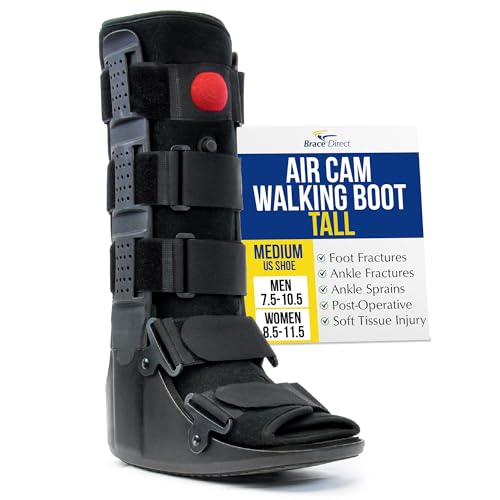
The Brace Direct Tall CAM Walker at this tier shares the same foundational air pump and rocker sole technology as the PDAC-approved version but comes in a slightly different build that prioritizes a taller shell height for additional rotational control. Weighing 2.45 pounds, it provides the stability required for post-surgical fibula repairs where the surgeon needs to protect the hardware from torsional loads. The built-in air compression system lets you adjust the fit around the fibular head, a common pressure point in tall boots that can cause peroneal nerve irritation if not managed correctly.
This model’s strength lies in its medical-grade hook-and-loop straps, which maintain their hold after repeated adjustments. The low-profile rocker bottom reduces fatigue during all-day wear, and the open-toe design keeps the foot ventilated. The medium size fits men’s 7.5–10.5 and women’s 8.5–11.5, and the included medial and lateral support pads allow you to customize the fit for a narrow or wide fibula. Several users who fractured their fibula in combination with an ankle dislocation report that this boot provided immediate pain relief during standing, outperforming the hospital-supplied alternative.
The main limitation reported is the boot’s narrow fit through the heel and ankle section—some users with significant post-operative swelling found the shell too constrictive even with the air bladder deflated. This makes it a better choice for stable fractures or swelling that has already peaked. The customer support team offers a free video fitting session, which helps dial in the correct strap tension. For a tall brace that balances weight, compression adjustability, and structural rigidity, this is a strong contender for complex fibula fractures.
Why it’s great
- Tall shell provides superior rotational control for proximal fractures
- Medical-grade Velcro withstands daily adjustments
- Free video fitting session included
Good to know
- Narrow heel section may not accommodate swollen ankles
- Not as breathable as open-toe alternatives
4. United Ortho USA14115 Short Air Cam Walker Fracture Boot

The United Ortho Short Air Cam Walker targets distal fibula fractures and acute ankle sprains where a full tall boot would create unnecessary bulk without additional clinical benefit. The defining feature is the steel reinforcement embedded in the plastic molded uprights, which provides increased rigidity at the ankle mortise level—exactly where a distal fibula fracture needs the most support to prevent displacement during gait. The rocker sole and shock-absorbing insole work together to reduce the ground reaction force that travels up the lateral column, and the boot weighs just 2.2 pounds, making it one of the lighter reinforced options available.
The included four comfort pads give users the ability to build up support on the medial or lateral side depending on where the fracture line sits. The air bladder system, while not as advanced as the pneumatic pump models, still offers the ability to control compression around the malleolus. The medium size fits men’s 8–11 and women’s 9–12, and the hand-washable foam liner maintains hygiene through extended wear. Reviews consistently describe the boot as “life-changing” for sprains and stable fibula fractures, with several users noting that it allowed them to walk without pain for the first time since the injury.
The main drawback is that the air pump requires noticeable effort to inflate, and the valve system can be finicky when releasing air. A few users also reported that the toe area felt slightly short on size 10 feet, causing the toes to overhang the front edge slightly. Using a knee-high sock and an additional foam insert at the shin resolves the most common rubbing complaints. For a short brace that doesn’t sacrifice structural integrity for weight savings, the United Ortho USA14115 is the gold standard in its category.
Why it’s great
- Steel-reinforced uprights prevent shell flex at the ankle
- Four adjustable comfort pads for custom fit
- Rocker sole promotes natural gait for distal breaks
Good to know
- Air pump requires effort to inflate
- Toe area may be short for larger feet
5. ManaMed ManaEZ Air Boot Tall CAM Boot

The ManaMed ManaEZ Air Boot delivers a tall CAM walker with an integrated pneumatic pump at a price point that undercuts most competitors by a significant margin, making it the strongest value proposition for fibula fractures that require full lower-leg immobilization. The 2-step valve and bulb system locks the air cell in place without gradual deflation—a common failure point in budget air boots—and the long toe bed provides ample room for bandaged or swollen feet, a frequent complaint with short boots that constrain the digits.
The tall reinforced plastic shell with molded uprights protects the fibular shaft through its entire length, and the rocker foot bottom maintains a smooth heel-to-toe transition. The small size fits men’s 6–8.5 and women’s 7.5–9.5, and the boot works on both left and right feet. Users recovering from stable fibula fractures and post-operative repairs praise the comfort and stability, with several noting that the boot allowed them to walk without a walker within days of application. The cast padding inside helps immobilize the ankle while preventing pressure necrosis over the lateral malleolus.
The trade-off comes in the strap configuration—this boot uses only four straps, which some users found insufficient for distributing weight evenly across the lower leg. The lining also tends to shift during extended wear, requiring periodic readjustment. For active patients who need to move around frequently during the day, the ManaEZ may require more attention to strap tension than a premium six-strap boot. But for the price, the air pump reliability and long toe bed make this a smart choice for anyone paying out of pocket for a tall brace.
Why it’s great
- Reliable pneumatic pump with locking valve prevents air loss
- Long toe bed accommodates bandaged or swollen feet
- Tall shell provides full fibular shaft protection
Good to know
- Only four straps lead to uneven weight distribution
- Liner shifts during use and needs repositioning
6. Brace Direct CAM Walker Fracture Boot Short
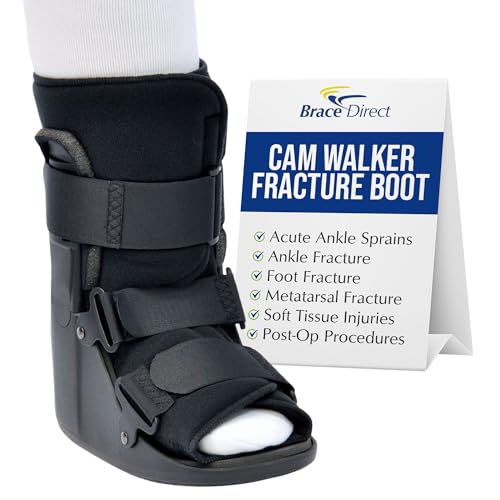
This short CAM walker from Brace Direct offers a lightweight, low-profile solution for stable distal fibula fractures where the treating physician has cleared early weight-bearing. The open-toe design maximizes airflow around the foot, reducing the moisture buildup that can lead to skin maceration during six to eight weeks of continuous wear. The non-skid rocker sole provides traction on hardwood, tile, and low-pile carpet surfaces, which expands your safe walking radius beyond what a smooth-bottomed boot allows.
The doctor-recommended support structure includes extra medial and lateral pads that let you build up the fit around the malleoli, and the adjustable straps accommodate bandages or intermittent swelling. The medium size fits men’s 7.5–10.5 and women’s 8.5–11.5, and the boot is universal for left or right foot. Users who purchased this boot for stress fractures and sprains mention that the lower profile reduces the “clomp” sensation associated with taller boots, making it easier to navigate doorways and stairs without catching the boot edge.
The downside reported by several buyers is that the middle strap tends to sit over the dorsum of the foot without providing effective ankle compression—users with a high ankle sprain component found that an ace bandage was still necessary to achieve adequate stability. The foot cushioning also lacks the density required to prevent arch pain during prolonged standing, particularly for heavier users. For a short brace focused on breathability and low weight, this is a solid option if supplemented with additional padding.
Why it’s great
- Open-toe ventilation reduces maceration risk
- Non-skid rocker sole improves traction on indoor surfaces
- Extra medial and lateral pads for fit customization
Good to know
- Middle strap lacks sufficient ankle compression
- Foot cushioning may cause arch pain with prolonged standing
7. Jewlri Walking Boot, Short Air Walker Fracture Boot

The Jewlri Short Air Walker Fracture Boot provides entry-level protection for fibula fractures at a price that makes it accessible for patients without insurance coverage for DME. Despite the budget-friendly positioning, it includes air bladder technology with red-button valves that allow you to inflate and deflate the liner for a customized fit—a feature typically reserved for boots in a higher price tier. The whole-shaped rigid plastic shell with molded uprights provides the necessary immobilization for stable distal fibula fractures and acute ankle sprains.
The rocker bottom sole design promotes a natural walking gait while the soft, thick insole offers shock absorption during ambulation. Three hook-and-loop fasteners surround the foot and ankle, and a separate soft padding piece provides additional ankle cushioning. The large size fits men’s 10.5–12.5 and women’s 12–14. Users report that the boot holds the heel securely in place with no movement during walking, which directly reduces pain at the fracture site. The removable liner can be washed in cold water, maintaining hygiene through the recovery period.
The limitations reflect the price point: the plastic shell lacks the steel reinforcement found in the United Ortho boot, meaning it may flex slightly under heavier users during weight-bearing. Multiple users noted pressure points that required extra padding, particularly around the Achilles area. The air pump valve system is less sophisticated than the screw-down designs on premium boots, and some users experienced gradual air loss over several hours. For a short-term, low-impact recovery scenario, this boot gets the job done without breaking the bank.
Why it’s great
- Air bladder valves provide adjustable compression at entry price
- Removable, washable liner improves long-term hygiene
- Rocker sole reduces fracture site pain during gait
Good to know
- No steel reinforcement; shell may flex under load
- Air valve can lose pressure gradually over extended wear
FAQ
Can I walk on a fibula fracture with a short brace?
How tight should the air pump be on a fibula fracture boot?
Should I choose a short or tall brace for a Weber B fibula fracture?
Final Thoughts: The Verdict
For most users, the brace for fibula fracture winner is the DonJoy MaxTrax Walker Brace because its seamless liner and steel-reinforced rocker sole provide the rotational control and pressure relief that a healing fibula demands without the complexity of an air pump system. If you need a tall boot with documented insurance codes and dynamic compression, grab the Brace Direct Tall Air CAM Walker (L4360). And for a short, budget-friendly option that still includes air bladder adjustability, nothing beats the Jewlri Short Air Walker Fracture Boot.