
A PVC joint that fails after the walls are closed or the system is pressurized means cutting out the mistake and starting over. The right adhesive for PVC pipe doesn’t just fill the gap — it chemically re-liquefies the pipe surface and fuses two parts into a single homogenous piece of plastic. That is the difference between a temporary patch and a permanent, leak-proof plumbing system.
I’m Min — the co-founder and writer behind Gadgets Feed. I’ve spent hundreds of hours combing through solvent cement formulations, studying set-time curves, and mapping which specific VOC profiles and body thicknesses actually deliver reliable results on Schedule 40 versus Schedule 80 pipe.
This guide breaks down the top options for bonding PVC, from fast-setting cements for wet repairs to heavy-bodied industrial grades for high-pressure lines. Whether you are a homeowner fixing a sprinkler line or a professional running a commercial system, you need a reliable adhesive for pvc pipe that matches your specific job conditions.
How To Choose The Best Adhesive For PVC Pipe
Not all PVC cements are created equal. Choosing the wrong body thickness or set speed can lead to joints that fail under pressure or become impossible to assemble in time. The trick is matching the cement’s physical properties to the pipe diameter, schedule, and environmental conditions of your project.
Body Thickness: Regular, Medium, or Heavy
Regular-bodied cement is watery and runs off vertical surfaces — fine for small-diameter pipe under 2 inches. Medium-bodied cement stays put on pipe walls and fills minor gaps, suitable for most residential work up to 6 inches. Heavy-bodied cement has the consistency of cold honey and bridges larger gaps on Schedule 80 fittings up to 12 inches. Choose the body thickness that matches your largest pipe diameter.
Set Speed: Fast, Medium, or Slow
Fast-set cements harden in 15 to 45 seconds, ideal for wet conditions or when you need immediate pressure testing. Medium-set cements give you one to three minutes to adjust the fitting, useful for larger assemblies. Slow-set formulas provide five minutes or more of working time, essential for complex multi-joint configurations or large-diameter pipe where alignment is critical.
VOC Content and Code Compliance
Low-VOC formulas meet SCAQMD Rule 1168/316A and contribute to LEED credits. Many regions now require low-VOC cements for commercial work, while residential projects in unregulated areas can still use standard formulas. Check your local plumbing code before buying — using the wrong VOC level can fail inspection.
Quick Comparison
On smaller screens, swipe sideways to see the full table.
| Model | Category | Best For | Key Spec | Amazon |
|---|---|---|---|---|
| Weld-On 711 | Industrial | High-pressure commercial lines | Schedule 80 up to 12″ diameter | Amazon |
| Weld-On Wet ‘N Fast | Fast Set | Wet or cold-weather installations | Sets in 30-45 seconds | Amazon |
| Oatey Rain-R-Shine | Primer/Cement Kit | Complete all-in-one starter kit | 4 oz primer + 4 oz cement | Amazon |
| Oatey 16 oz Heavy-Bodied | Clear Heavy | Clean professional finish | Clear formula, 16 oz can | Amazon |
| Christy’s Red Hot Blue Glue | Very Fast Set | Underwater or wet repairs | Sets in under 20 seconds | Amazon |
| Titebond PVC Trim Adhesive | Trim/Sealant | Bonding PVC trim to wood | Polyurethane, 24 hr cure | Amazon |
| Harvey’s Twin Pack | Budget Combo | Basic residential plumbing | 4 oz primer + 4 oz cement | Amazon |
In‑Depth Reviews
1. Weld-On 10121 Industrial Grade PVC Cement

The Weld-On 711 is the standard high-strength solvent cement for pressurized commercial lines. Its heavy-bodied gray formula is specifically engineered for Schedule 80 fittings up to 12 inches in diameter, where the interference fit requires a cement that can fill the gap without dripping. The medium-setting speed — roughly three minutes of working time — gives installers room to rotate multi-fittting assemblies into perfect alignment before the chemical weld locks in.
Users consistently report perfect leak-free joints after 24-hour cure, even on high-pressure irrigation and industrial process lines. The heavy-bodied consistency means it does not run down vertical pipe, which is critical when you are welding upright risers. The low-VOC formulation meets SCAQMD standards, so this cement passes inspection in regulated jurisdictions without sacrificing bond strength.
The heavy-duty applicator dauber is noticeably thicker than standard caps, allowing you to load the brush for large-diameter work without constant redipping. For commercial plumbers or serious DIYers tackling a full house repipe in Schedule 80, this is the only cement you need to keep on the truck.
Why it’s great
- Rated for Schedule 80 pipe up to 12-inch diameter
- Medium setting time allows precise alignment of multiple joints
- Low-VOC formula passes commercial code inspections
Good to know
- Gray color may not be desired for clear pipe repairs
- Heavy body requires firm pressure to push fitting home
2. Weld-On 12497 Wet ‘N Fast PVC Cement
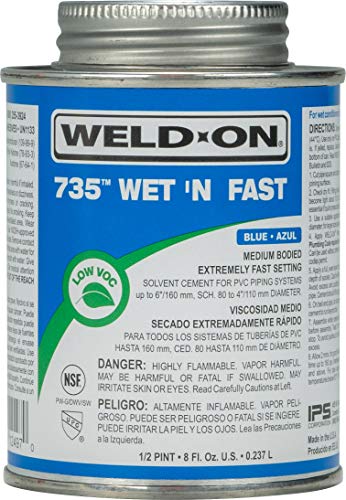
The Wet ‘N Fast cement is formulated for exactly one scenario: bonding PVC in conditions where water is present. This blue, medium-bodied cement sets in 30 to 45 seconds even when the pipe is damp — a capability most standard cements lack. It handles interference fit joints through 6-inch diameter and Schedule 80 through 4-inch, making it suitable for emergency repairs in flooded basements, pool plumbing, or outdoor irrigation systems during rain.
Real-world users have applied this cement to marine mooring stakes that must endure ice flow stress in frozen harbors, with zero failures reported. The extremely fast set time means you must have the fitting pre-aligned and fully seated within ten seconds of applying cement — there is no second chance. The low-VOC formulation reduces solvent fumes, a welcome safety improvement when working in confined crawl spaces.
The tradeoff for speed is working time: you cannot reposition a fitting once the cement grabs. That makes Wet ‘N Fast a specialized tool for experienced plumbers who know exactly where every fitting goes before the brush touches the pipe. For high-stakes wet repairs, this cement is category-defining.
Why it’s great
- Sets in 30-45 seconds even on damp pipe surfaces
- Low-VOC formula meets LEED v4 credit requirements
- Handles pipe up to 6-inch diameter and Schedule 80
Good to know
- No repositioning time after joint is assembled
- Best results require pipe and fitting to be fully dry
3. Oatey Rain-R-Shine Primer and Cement
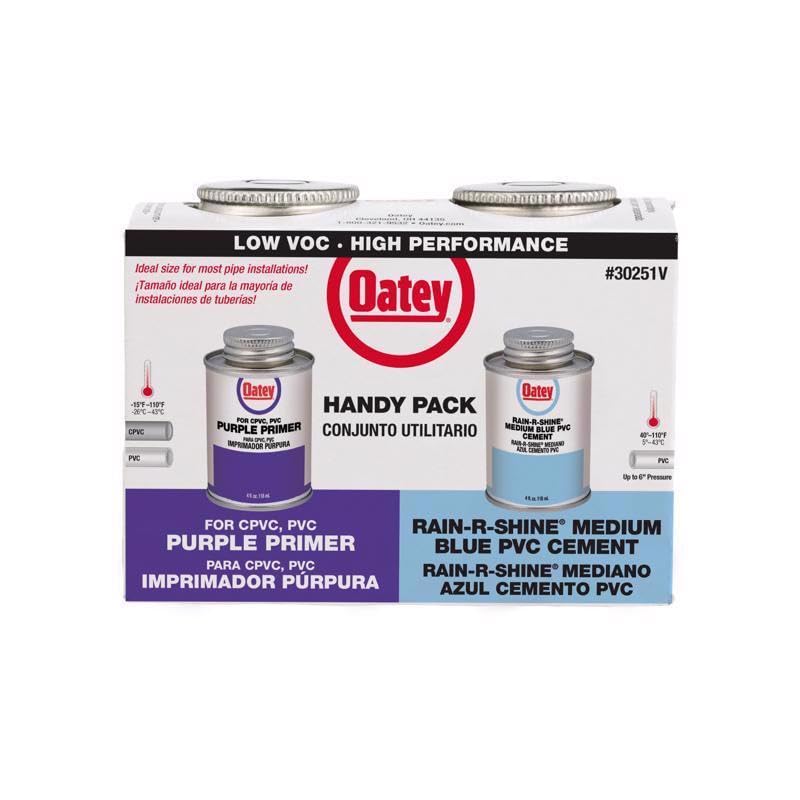
The Rain-R-Shine kit includes both purple primer and blue PVC cement in a single dual-compartment container, each with integrated applicators in the lid. This is the most convenient all-in-one option for homeowners who need to complete small PVC repairs without buying separate primer and cement cans. The primer is purple for code-visible inspections, while the fast-set blue cement provides a reliable chemical weld on pipe up to 6 inches in diameter.
Users report making 25 individual welds using less than half the included cement, making this kit economical for multiple small jobs. The minimum operating temperature is 40 degrees Fahrenheit, which is standard but worth noting if you are working in unheated winter conditions. The cement sets fast enough that you can test the joint within a few minutes, though the 24-hour full cure rating remains necessary for maximum pressure resistance.
The dual-compartment tub design is clever but requires care to avoid cross-contamination between primer and cement. For small-scale projects under 2-inch pipe — sprinkler repairs, pool plumbing, or sink drains — this kit provides everything in one purchase. For larger-diameter work, you are better off buying separate containers in larger sizes.
Why it’s great
- Primer and cement in one convenient dual-compartment container
- Purple primer visible for code inspection compliance
- Cost-effective for multiple small repairs
Good to know
- 4 oz size runs out quickly on larger pipe diameters
- Not rated for Schedule 80 pipe above 4 inches
4. Oatey 16 oz Heavy-Bodied Clear PVC Cement

For applications where appearance matters — exposed plumbing in mechanical rooms, aquarium stands, or clear PVC systems — the Oatey heavy-bodied clear cement delivers a professional, nearly invisible joint line. The heavy-bodied formula has a thick, honey-like consistency that stays put on vertical risers and fills minor gaps without sagging. It is compatible with all schedules of PVC pipe, though it is optimized for Schedule 40 and smaller Schedule 80 diameters.
Users appreciate that the clear cement, paired with a clear primer, produces a finished joint that looks clean and intentional rather than messy and over-glued. The 16-ounce can provides generous volume for multiple projects, and the heavy body means it bridges slightly mismatched fittings without leaking. The set time is on the faster side — you have roughly one minute to seat the fitting before the cement grabs — which is manageable for most residential work.
The main limitation is that clear formulations are slightly less aggressive than their colored counterparts because they lack the pigments and fillers that reinforce the bond. For high-pressure applications above 100 PSI, a colored industrial cement like the Weld-On 711 will produce a stronger weld. For visible, low-pressure drain lines and vent stacks, this clear formula is the right aesthetic choice.
Why it’s great
- Dries clear for a professional, low-visibility joint
- Heavy body bridges gaps on Schedule 40 fittings
- Large 16-ounce can offers great value per joint
- Clear formula may have slightly lower tensile strength than pigmented cements
- Not ideal for high-pressure commercial systems above 100 PSI
5. Christy’s Red Hot Blue Glue PVC Cement

Christy’s Red Hot Blue Glue is the extreme-fast-set option for emergency repairs where standard cements waste too much time. This blue solvent cement sets in under 20 seconds, even when applied to pipe surfaces that are actively underwater — a claim few products can make. The extremely low viscosity allows the cement to wick into tight interference-fit joints instantly, creating a chemical seal faster than any other cement on this list.
Users confirm that this glue sets up reliably in wet conditions, with one reviewer bonding pipe in a flooded excavation with no bond failure. The 4-ounce bottle is small by design — you do not need much for emergency fixes, and the fast set means the joint is pressure-ready within minutes rather than hours. The aggressive solvent formulation means you must wear gloves and work in a ventilated area, as the fumes are potent.
The downside is bottle lifespan: users report the lid design allows the cement to thicken into a jelly-like consistency after two months, even with careful sealing. You need to use the full bottle within a few weeks of opening for best results. For a single emergency repair, this is the fastest path to a working joint. For ongoing maintenance, you are better off with a larger container with a better-sealing cap.
Why it’s great
- Sets in under 20 seconds on wet or submerged pipe
- Extremely low viscosity wicks into tight joints instantly
- Pressure-ready within minutes for emergency repairs
Good to know
- Small 4-ounce bottle is for single-job use
- Lid design leads to cement thickening after weeks of storage
6. Titebond PVC Trim Adhesive and Sealant
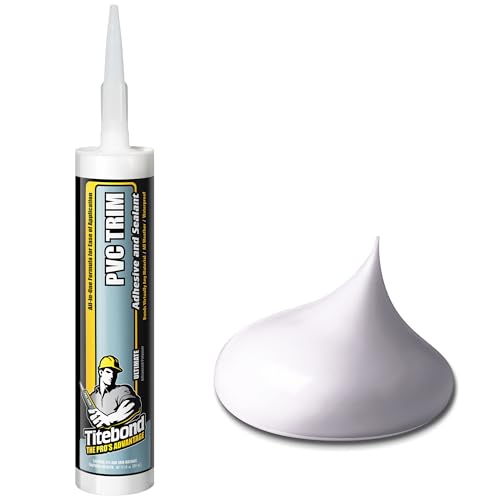
Not all PVC bonding jobs involve pipe. When you are installing PVC trim boards, corner moldings, or shower surrounds, you need a polyurethane adhesive that bonds PVC to wood, metal, or drywall — not a solvent cement that melts the plastic. The Titebond PVC Trim Adhesive is a 2-in-1 formulation that both adheres and seals, providing a weatherproof bond that resists moisture, temperature swings, and UV exposure.
Users report strong adhesion to PVC trim in cold conditions as low as 32 degrees Fahrenheit, where water-based latex caulks would freeze and fail. The consistency is similar to standard latex sealant, allowing easy gun application and tooling with a wet finger. Working time is generous — you can position trim pieces for several minutes before the adhesive grabs, and light clamping for one hour produces a permanent bond.
The tradeoff is cleanup: the polyurethane formula requires acetone for removal, and excess adhesive must be peeled away after drying rather than wiped off wet. For interior and exterior PVC trim installations where nails and screws would mar the surface, this adhesive eliminates the need for mechanical fasteners while providing a sealed, finished edge.
Why it’s great
- Bonds PVC trim to wood, metal, and drywall without screws
- Works in freezing temperatures down to 32 degrees Fahrenheit
- Long working time allows easy positioning and adjustment
Good to know
- Not for pressurized PVC pipe joints — use solvent cement for pipe
- Requires acetone for cleanup, dry excess must be peeled off
7. Harvey’s 19530 Primer/Cement Twin Pack

Harvey’s Twin Pack delivers exactly what a homeowner needs for basic PVC repairs: a bottle of purple primer and a bottle of regular-bodied PVC cement in one box, both 4 ounces. The regular-body cement is thin and flows freely, making it appropriate for small-diameter pipe up to 2 inches — typical for sink drains, toilet flanges, and simple sprinkler repairs. The primer ensures code-visible purple remains at each joint for inspection.
Users report strong, leak-proof bonds on above-ground pool plumbing and general home repairs, with one user saving over compared to a plumber call-out. The cement sets fast enough that you can test the joint within 15 minutes, though the manufacturer recommends the standard 24-hour cure for full pressure rating. The purple primer is water-resistant, which adds a layer of protection in damp environments.
The cap design on both bottles is the primary complaint: the caps can be difficult to reseal after the first use, and some users report needing pliers to break the seal on the second use. For a weekend project that uses both bottles in one session, this is a non-issue. For a toolbox item opened occasionally, consider a cement with a better-sealing lid. For the price of a fast-food lunch, this twin pack gets the job done for basic residential plumbing.
Why it’s great
- Includes primer and cement in one affordable bundle
- Purple primer leaves visible trace for code compliance
- Produces leak-proof bonds on small-diameter residential pipe
Good to know
- Regular body not suitable for Schedule 80 or pipe over 2 inches
- Cap seals poorly after first use, leading to cement thickening
FAQ
Can I use PVC cement on wet pipe?
What is the difference between regular and heavy-bodied PVC cement?
Why do I need primer before PVC cement?
Final Thoughts: The Verdict
For most users, the adhesive for pvc pipe that covers the widest range of jobs is the Weld-On 10121 Industrial Grade — its heavy-bodied formula tackles everything from Schedule 40 residential drains to Schedule 80 commercial mains with a reliable medium set time that allows proper alignment. If you need a fast-welding cement for wet or cold-weather installations, grab the Weld-On Wet ‘N Fast, which bonds in 30 seconds even on damp pipe. And for a basic homeowner twin pack that includes primer and cement for simple repairs under 2 inches, nothing beats the value of the Harvey’s Twin Pack.