
An internal filter sits entirely inside your aquarium, hidden from view, silently churning water through a series of sponges and media to keep your fish healthy and your glass clear. The right unit balances flow rate, filtration stages, and noise levels so you can enjoy your tank without a constant hum or a mess of debris floating in the current.
I’m Min — the co-founder and writer behind Gadgets Feed. I’ve spent countless hours diving into customer feedback, flow rate specs, and filtration designs to separate the quiet workhorses from the noisy pretenders in this crowded category.
This guide cuts through the marketing to help you pick the best internal filter for your setup, whether you house a single betta or a colony of turtles. We evaluated seven top contenders to find the best aquarium internal filter that delivers crystal clear water without breaking the bank.
How To Choose The Best Aquarium Internal Filter
Selecting the right internal filter comes down to tank volume, bioload, and the type of livestock you keep. A filter rated for a 50-gallon tank will struggle to keep a 100-gallon turtle tank clean, but a massive pump in a small nano tank can stress out shy fish. Focus on three key areas before you buy.
Flow Rate and Tank Volume Matching
Internal filter flow is measured in gallons per hour (GPH). A general rule is that your filter should turn over the entire tank volume at least four to six times per hour. For a 40-gallon tank, that means a filter rated at 160–240 GPH. Overpowering the tank can create turbulence that exhausts fish; underpowering it allows waste to accumulate. Look for adjustable flow valves if you plan to dial the current down for slow-moving species or fry.
Filtration Stages and Media Type
Mechanical, biological, and chemical filtration work together to keep water clear and safe. A good internal filter uses coarse sponges to trap large debris, finer sponges for polishing, and bio-media like ceramic rings to host beneficial bacteria. Carbonized sponges or activated carbon help remove odors and discoloration. Avoid filters that rely only on a single thin foam pad — they clog fast and provide minimal biological surface area.
Noise Level, Placement, and Maintenance
An internal filter sits inside your living space, so noise matters. Submersible pumps with epoxy-sealed motors run quieter than hang-on-back units. Ease of disassembly also affects how often you’ll actually clean it. Look for a filter with a removable top canister or snap-apart sections so you can rinse sponges without removing the whole unit. Transparent housings let you spot when the media is clogged without guesswork.
Quick Comparison
On smaller screens, swipe sideways to see the full table.
| Model | Category | Best For | Key Spec | Amazon |
|---|---|---|---|---|
| TARARIUM IX-120 | Premium | Low water level tanks | 290 GPH, 3-stage bio-filtration | Amazon |
| AquaMiracle HCF-314F | Mid-Range | Adjustable aeration/rainfall | 300 GPH, 3-stage sponges, 20W | Amazon |
| AquaMiracle SV-500 | Premium | Green water control with UV | 6W UV light, 130 GPH, timer | Amazon |
| TARARIUM JQP-1500F | Premium | Large tank wave making | 400 GPH, transparent housing | Amazon |
| NO.17 HY-1200F | Mid-Range | Budget-friendly large tanks | 320 GPH, 4-nozzle output | Amazon |
| Atlantis Aqua Aqua-55 | Mid-Range | Bottom-draw filtration | For 20–55 gal, bio-balls | Amazon |
| coospider-repta 024 | Mid-Range | Large tanks with high bioload | 300 GPH, dual-stage sponge | Amazon |
In‑Depth Reviews
1. TARARIUM IX-120 Internal Filter

The TARARIUM IX-120 strikes an excellent balance of flow and versatility, rated for 20 to 75 gallon tanks. Its 290 GPH pump can be adjusted via a flow valve, and the three-stage filtration includes a dense double-sided mesh sponge for debris and ceramic bio-balls for biological filtration. The waterfall output adds aeration without needing a separate air stone.
One standout feature is the low minimum water level of just 2.6 inches, making it ideal for turtle tanks, shallow aquariums, and even quarantine setups where water levels vary. Users report simple top-lid access for media changes, and the quiet operation earns consistent praise across both freshwater and saltwater environments.
The suction cups hold well on clean glass, but some owners of tall 75-gallon tanks note that the weight of the water-filled filter can cause it to droop over time. Adding a small support bridge underneath solves the issue easily. Overall, this filter offers premium build and reliable performance at a price that undercuts many competitors.
Why it’s great
- Minimum water depth of 2.6 inches suits shallow tanks and turtle habitats
- Three-stage filtration with ceramic bio-balls handles high bioloads effectively
- Adjustable flow valve and quiet waterfall aeration
Good to know
- Suction cups may struggle on tall tanks without extra support
- Large footprint may crowd smaller aquariums
2. AquaMiracle HCF-314F Internal Filter
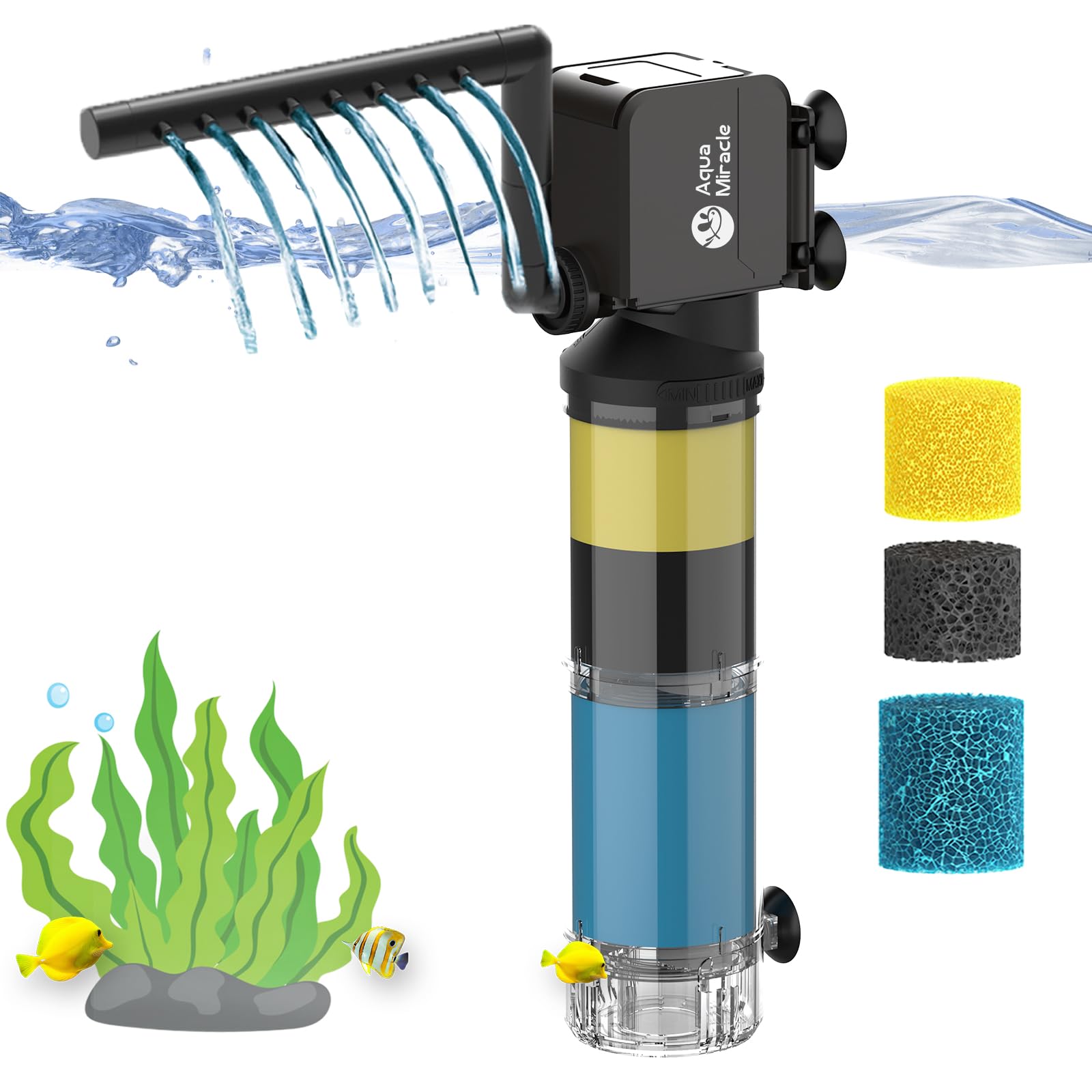
AquaMiracle brings a refined three-sponge design with coarse, carbonized, and fine stages that handle debris, odor, and polishing in one slim 13.2-inch body. The 300 GPH pump is adjustable, and the filter offers two distinct output modes: aerating mode via an included air venturi and rainfall mode through a spray bar for gentle surface agitation.
The transparent housing lets you see exactly when the sponges need rinsing, and the epoxy-sealed motor allows full submersion in shallow water — even horizontally for turtle tanks. Owners of 40 to 150 gallon tanks report water clarity improvements within hours, and the foam media rinses clean without needing frequent replacement.
Some users mention that the sponge stack can compress and reduce flow if not cleaned every three to four days in heavily stocked tanks, and the filter may be too long for tanks under 15 inches in height. The assembly and disassembly process takes a few minutes to master, but once you get the hang of it, maintenance is straightforward.
Why it’s great
- Three-stage sponge system with coarse, carbonized, and fine layers
- Switchable aerating and rainfall modes for flexible oxygenation
- Transparent housing for easy visual inspection of media condition
Good to know
- Sponges clog quickly in high-bioload tanks — requires frequent rinsing
- Length may not fit tanks shorter than 15 inches
3. AquaMiracle SV-500 with UV Light
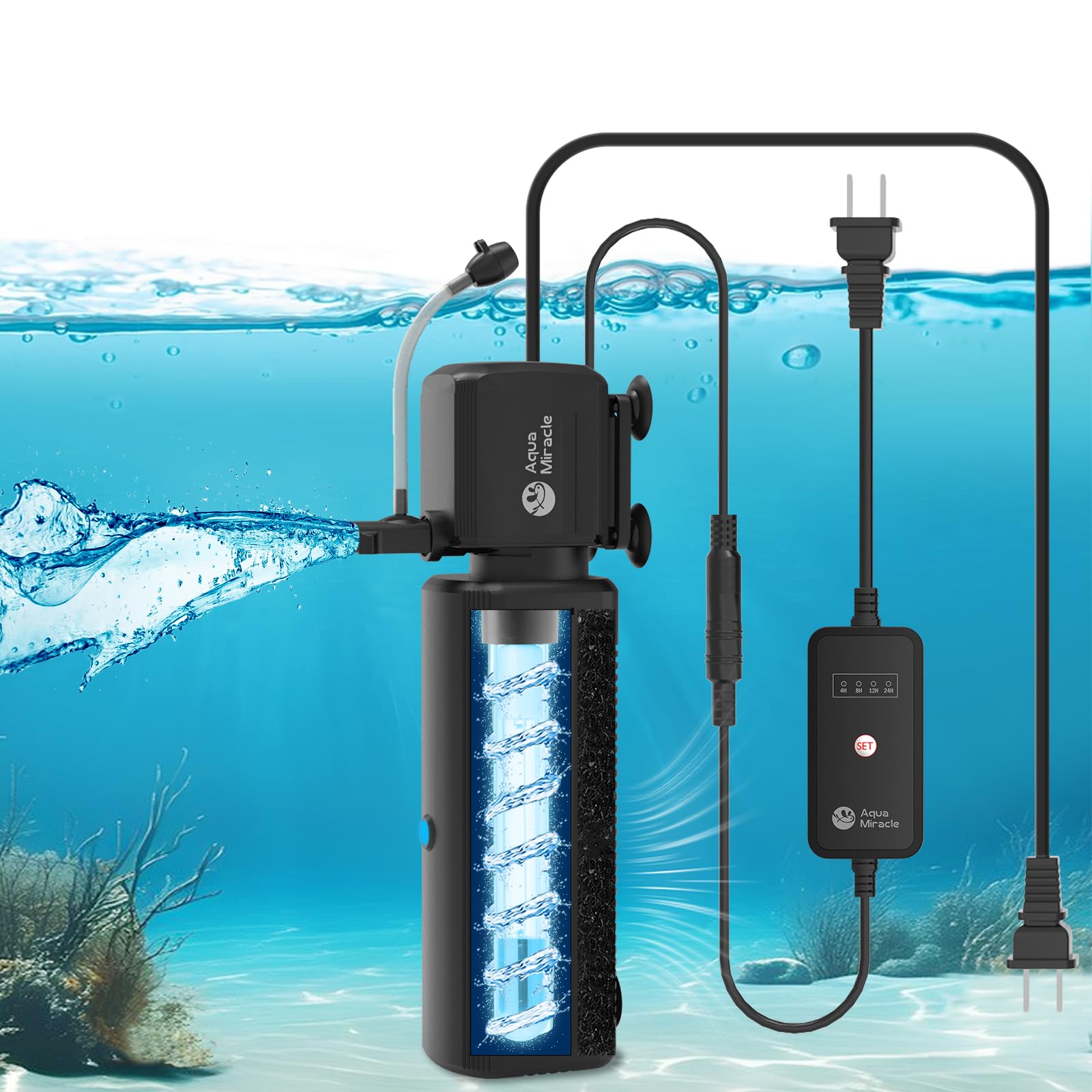
This AquaMiracle model focuses on a specific pain point: green water caused by free-floating algae. The integrated 6W UV light includes a timer with 4, 8, 12, and 24-hour settings, letting you schedule sterilization cycles without running the lamp continuously. The pump moves 130 GPH — modest but tailored for 10 to 30 gallon tanks.
The filter includes a coarse sponge to trap large particles before water hits the UV chamber, protecting the lamp and maximizing light penetration. Users with chronic algae blooms report visible clearing within 12 to 24 hours, and the dual aerating/rainfall modes keep oxygen levels up without blasting small fish around the tank.
Because the flow rate is lower, this filter works best as a supplementary unit alongside a primary mechanical filter rather than a standalone solution for heavily stocked tanks. The UV bulb is rated for about 9,000 hours, and the observation window on the housing lets you confirm the lamp is glowing without removing the unit. It’s not the most powerful filter, but for targeting algae it is uniquely effective.
Why it’s great
- Integrated 6W UV light with programmable timer for algae control
- Combines aeration and rainfall modes in a compact unit
- Observation window confirms UV operation without disassembly
Good to know
- 130 GPH flow is low for tanks over 30 gallons or high bioloads
- Best used as a dedicated algae-fighter alongside a main filter
4. TARARIUM JQP-1500F 400 GPH

The JQP-1500F from TARARIUM pushes 400 GPH, making it one of the strongest internal submersible pumps on this list. Designed for 75 to 200 gallon tanks, it doubles as a wave maker, creating surface agitation that boosts gas exchange and mimics natural river currents. The transparent box design lets you see when the black filter sponge is dirty without prying it open.
Three-stage deep filtration handles solid waste and fine particles, and the customizable media chamber lets you swap in ceramic rings, bio-balls, or extra foam depending on your needs. Users running large planted tanks and koi ponds consistently mention the silent operation and the dramatic improvement in water clarity within 24 to 48 hours after installation.
For tanks under 75 gallons, this pump may create too strong a current — one owner with a 35-gallon tank had to set it aside entirely. The flow director is made of plastic that can become brittle over time, and spare parts are difficult to source. If you have a large tank and want minimal noise with serious circulation, this unit delivers.
Why it’s great
- 400 GPH flow ideal for large tanks, ponds, and wave-making setups
- Transparent housing allows quick visual inspection of sponge condition
- Customizable media chamber for tailored filtration
Good to know
- Too powerful for tanks under 75 gallons — creates excessive current
- Flow director may become brittle over time; spare parts not widely available
5. NO.17 HY-1200F 12W

At 12 watts and 320 GPH, the NO.17 HY-1200F is an entry-level workhorse for 50 to 150 gallon tanks. It includes four separate nozzle attachments, letting you direct the output in multiple directions to improve circulation around decorations or warm spots. The adjustable flow knob lets you dial back the current for more sensitive fish.
User reports span saltwater, freshwater, and even pond setups, with many praising the near-silent operation and the filter media that captures waste effectively. The multiple filter media included in the package covers mechanical and biological needs, and the price point makes it an accessible option for hobbyists outfitting a large tank on a budget.
Where this filter falls short is build quality — the plastic tabs that hold the housing together are fragile and can snap under the pressure required to open the unit for cleaning. Several users report pump failure after three to five months, with the rotor spinning but no water flowing. If you prioritize low cost over longevity, this remains a viable stopgap, but expect to replace it more often than premium options.
Why it’s great
- 320 GPH at only 12 watts — energy efficient for large tanks
- Four nozzle attachments provide flexible water direction
- Budget-friendly entry point for 50–150 gallon aquariums
Good to know
- Plastic housing tabs are brittle and prone to breaking during cleaning
- Inconsistent durability — some units fail after a few months
6. Atlantis Aqua Aqua-55

Atlantis Aqua takes a unique approach by drawing water through the bottom of the filter rather than the sides. This forces water to travel through the entire sponge and bio-ball media stack before returning to the tank, ensuring every drop gets filtered instead of taking the path of least resistance. The result is noticeably clearer water, especially in 20 to 55 gallon community tanks.
The included bio-balls and lifelong sponges eliminate the recurring cost of replacement cartridges. Owners of planted tanks and goldfish setups report that the built-in aeration removes the need for a separate bubbler, and the modular design lets you detach sections for smaller tanks down to 7.6 inches tall. The Manchester-based company offers a one-year warranty and responsive customer service.
Some units experience motor failure after a few weeks, particularly after the first deep clean, and the sealed plastic chambers can limit waste intake for larger debris. A few users also note that the customer service warranty response was slow or nonexistent. If you get a well-built unit, the filtration design is excellent, but the quality control appears inconsistent.
Why it’s great
- Bottom-draw intake forces full-path filtration through all media
- Lifetime sponges and bio-balls eliminate replacement cartridge costs
- Detachable sections fit smaller tanks down to 7.6 inches
Good to know
- Quality control issues — some units fail after first cleaning
- Sealed chambers can struggle with coarse debris and large waste
7. coospider-repta 024 Internal Filter

This coospider-repta filter targets larger systems (55 to 150 gallons) with a 300 GPH pump and a dual-stage black biochemical sponge that removes odors and fine impurities. The adjustable valve increases oxygen levels, and the wave-making output improves surface movement, which is particularly useful for turtle tanks and koi setups where high bioload quickly fouls the water.
The detachable body design allows you to remove the lower half of the sponge for tanks under 15 inches tall, improving fit without sacrificing filtration volume. Buyers with 40-gallon turtle tanks report that the filter clears debris within 12 to 16 hours and runs with only a low hum. The one-year warranty covers defects, and the price point sits comfortably in the mid-range.
The main criticism is that the flow is not adjustable — the pump runs at full 300 GPH regardless of your needs, which can create a strong current unsuitable for slow-swimming or small fish. The included suction cups hold well on clean glass, but some users recommend adding a support bracket for vertical mounting. It is a powerful, reliable filter, but it lacks fine-tuning.
Why it’s great
- Strong 300 GPH pump clears high-bioload turtle and koi tanks quickly
- Dual-stage biochemical sponge removes odors and fine particles
- Adjustable body height fits tanks under 15 inches
Good to know
- Flow is not adjustable — full 300 GPH may be too strong for delicate fish
- Suction cups may need bracket support for vertical mounting
FAQ
Can I use an internal filter in a tank with shrimp or fry?
How often do I need to clean the filter sponges?
Will a UV internal filter hurt my beneficial bacteria?
Final Thoughts: The Verdict
For most users, the best aquarium internal filter winner is the TARARIUM IX-120 because it combines a generous 290 GPH flow, three-stage biological filtration, and a low 2.6-inch minimum water level that fits almost any tank type. If you want adjustable aeration modes and a slim profile, grab the AquaMiracle HCF-314F. And for green water problems, nothing beats the AquaMiracle SV-500 UV filter.