
A dead e-bike battery at the bottom of a hill isn’t just an inconvenience — it’s the moment you realize your charger was the weak link all along. The right bike battery charger does more than top off cells; it manages voltage curves, prevents thermal runaway, and adds years to a pack that would otherwise degrade after a few dozen cycles.
I’m Min — the co-founder and writer behind Gadgets Feed. I spend my weeks cross-referencing controller IC datasheets, measuring charge termination accuracy, and comparing thermal performance data so you don’t have to guess which adapter keeps your lithium-ion pack safe.
Whether you ride a fat-tire commuter or a folding trail bike, the best bike battery charger is the one that matches your pack’s exact chemistry and voltage while adding failsafe layers that cheap units skip entirely.
How To Choose The Best Bike Battery Charger
A bike battery charger is a voltage- and chemistry-specific accessory — there is no universal adapter that safely charges every pack. You need to match three things before you plug in: the nominal voltage, the cell chemistry, and the connector pinout.
Match the Voltage Exactly
Most 48V lithium-ion packs charge to a full voltage of 54.6V, while lead-acid 48V packs peak at around 59V. Using a 59V charger on a lithium battery triggers over-voltage protection or, worse, a thermal event. Always check the printed specs on your battery — if it says “48V Li-ion 13S,” you need a 54.6V charger.
Certification Matters More Than Wattage
UL, ETL, CE, and FCC ratings mean the charger passed real-world testing for thermal runaway, short-circuit isolation, and flame retardancy. A cheap unit without these marks may use undersized MOSFETs and no thermal fuse — the most common root cause of charger fires in garages.
Quick Comparison
On smaller screens, swipe sideways to see the full table.
| Model | Category | Best For | Key Spec | Amazon |
|---|---|---|---|---|
| Hyleton 48V Lithium Charger | Charger | UL-certified safety | 54.6V 2A with 3-in-1 plugs | Amazon |
| HEXWATT 54.6V Charger | Charger | Aluminum housing & quiet fan | 54.6V 2A with 7 connectors | Amazon |
| STIO 54.6V 2A Charger | Charger | Lectric XP compatibility | ETL certified, IP65 waterproof | Amazon |
| Fancy Buying 59V Charger | Charger | Lead-acid 48V 12Ah packs | 59V 1.8A with cooling fan | Amazon |
| Syvrac 54.6V Charger | Charger | Lectric XP & Super 73 owners | 54.6V 2A with DC 2.1mm jack | Amazon |
| YONHAN 15A Charger | Maintainer | Multi-voltage garage use | 15A 12V/24V with pulse repair | Amazon |
| E-FAST 20A Charger | Maintainer | High-amperage fast charging | 20A 12V/24V, 7-stage smart | Amazon |
In‑Depth Reviews
1. Hyleton 48V Lithium Battery Charger
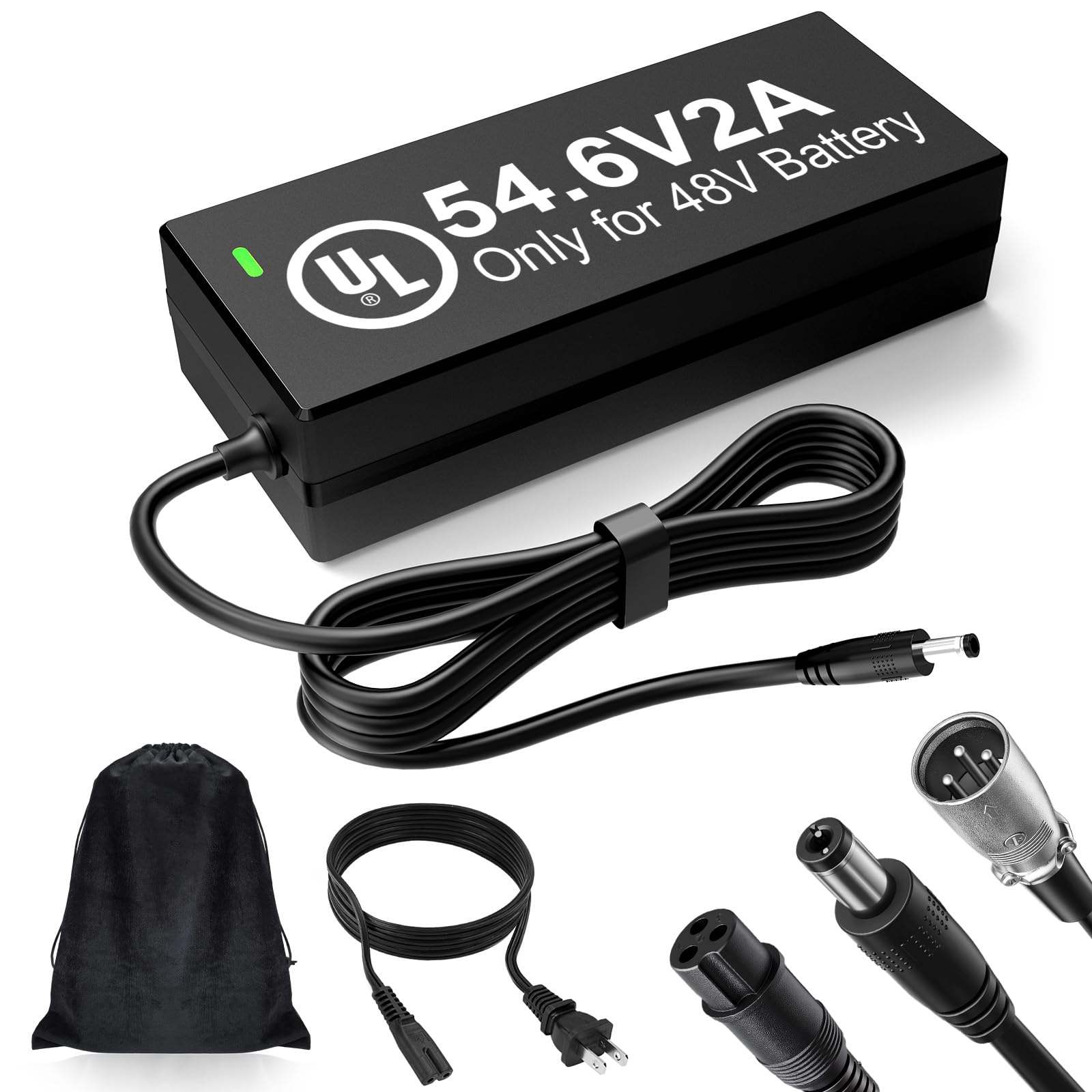
The Hyleton charger nails the most important checklist item for a 48V lithium pack: it outputs exactly 54.6V at 2A, which is the correct constant-voltage termination point for 13S Li-ion batteries. It carries UL certification, meaning it passed real over-voltage, over-current, short-circuit, and temperature tests in a certified lab — not just a self-printed compliance sticker.
The 3-in-1 connector set includes a DC 5.5×2.5mm barrel plug, an 18mm XLR connector, and a 12mm three-pin plug, covering most e-bike brands including Ancheer, Jasion, Aipas, and TotGuard. The aviation-grade aluminum connectors and V0 flame-retardant ABS/PC casing add physical durability that budget chargers skip entirely. The built-in temperature control chip also keeps the housing around 30% cooler during a full charge cycle.
This charger is strictly for 48V lithium-ion batteries — it does not work with lead-acid, 36V, 52V, or 58.8V packs. Verifying your battery’s nominal voltage and connector type before ordering is essential, but if your specs match, this is the safest 2A option at this tier.
Why it’s great
- UL, TUV, SGS, CE, and FCC certified for verified safety
- Three interchangeable connectors cover most 48V e-bike brands
- Intelligent temperature control extends charger lifespan
Good to know
- Not compatible with electric scooters, hoverboards, or lead-acid packs
- Does not work with 52V or 58.8V batteries
2. HEXWATT 54.6V 2A Charger
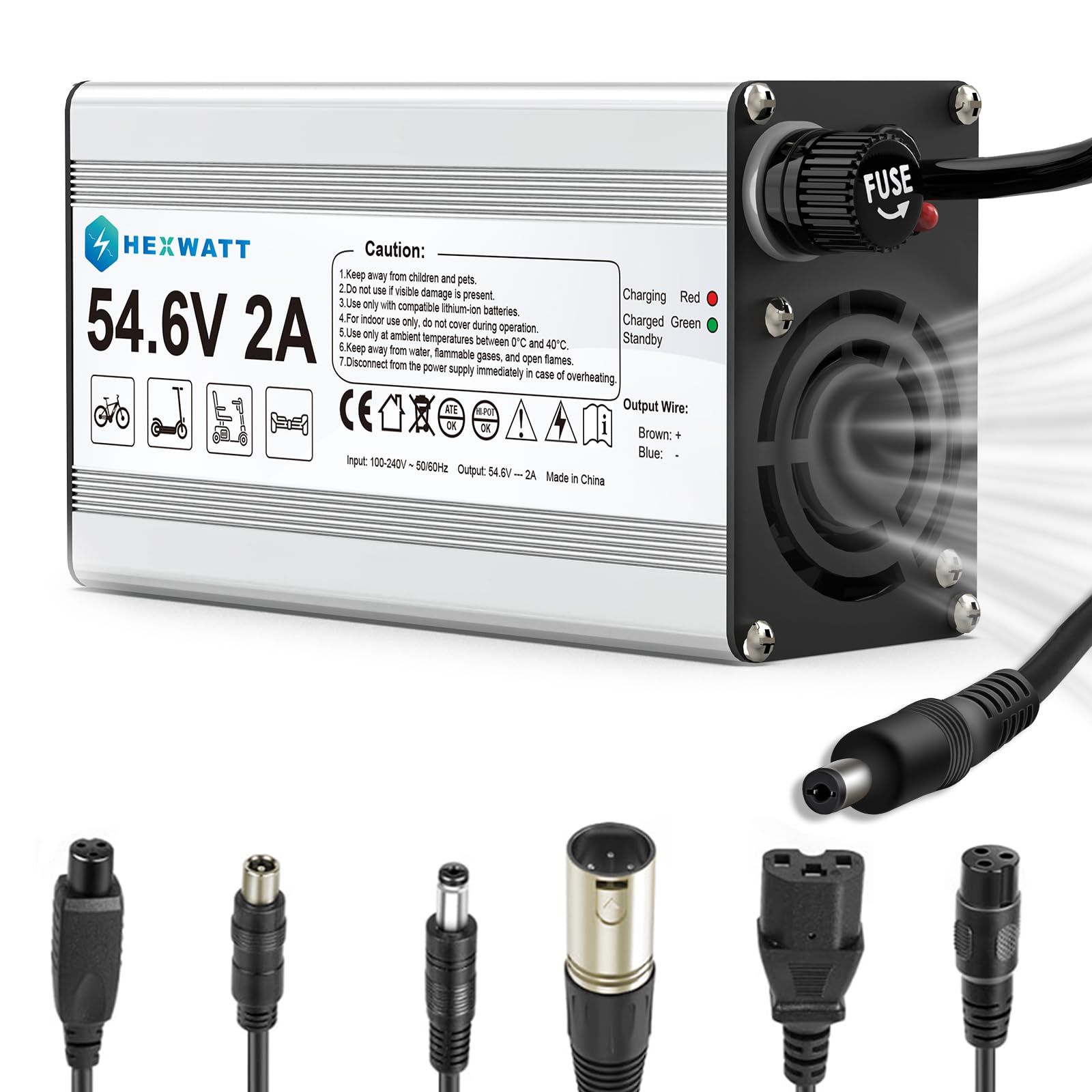
The HEXWATT charger swaps the typical ABS plastic enclosure for a full aluminum housing that acts as a passive heatsink — a meaningful upgrade when charging a 48V 13S pack at the full 2A rate for several hours. The internal flyback topology and replaceable fuse add repair-ability that most sealed plastic adapters lack entirely.
Seven interchangeable connectors come in the box, including multiple barrel sizes, an XLR, and a 3-pin configuration, making this one of the most compatibility-forward chargers on the list. The PWM-controlled CPU management system automatically switches to float mode when the pack reaches 54.6V, preventing overcharge drift. Users consistently report that the cooling fan runs quieter than comparable 2A adapters.
Like all dedicated 48V lithium chargers, this unit is incompatible with LiFePO4 or lead-acid chemistry. The 2-year warranty is twice the industry standard for this category, reflecting confidence in the aluminum build and the replaceable fuse design.
Why it’s great
- Aluminum housing provides superior heat dissipation
- Replaceable fuse adds long-term serviceability
- Seven connectors offer maximum compatibility out of the box
Good to know
- Only works with 48V NMC lithium-ion packs — no lead-acid support
- No carrying case included for the extra connectors
3. STIO 54.6V 2A eBike Charger
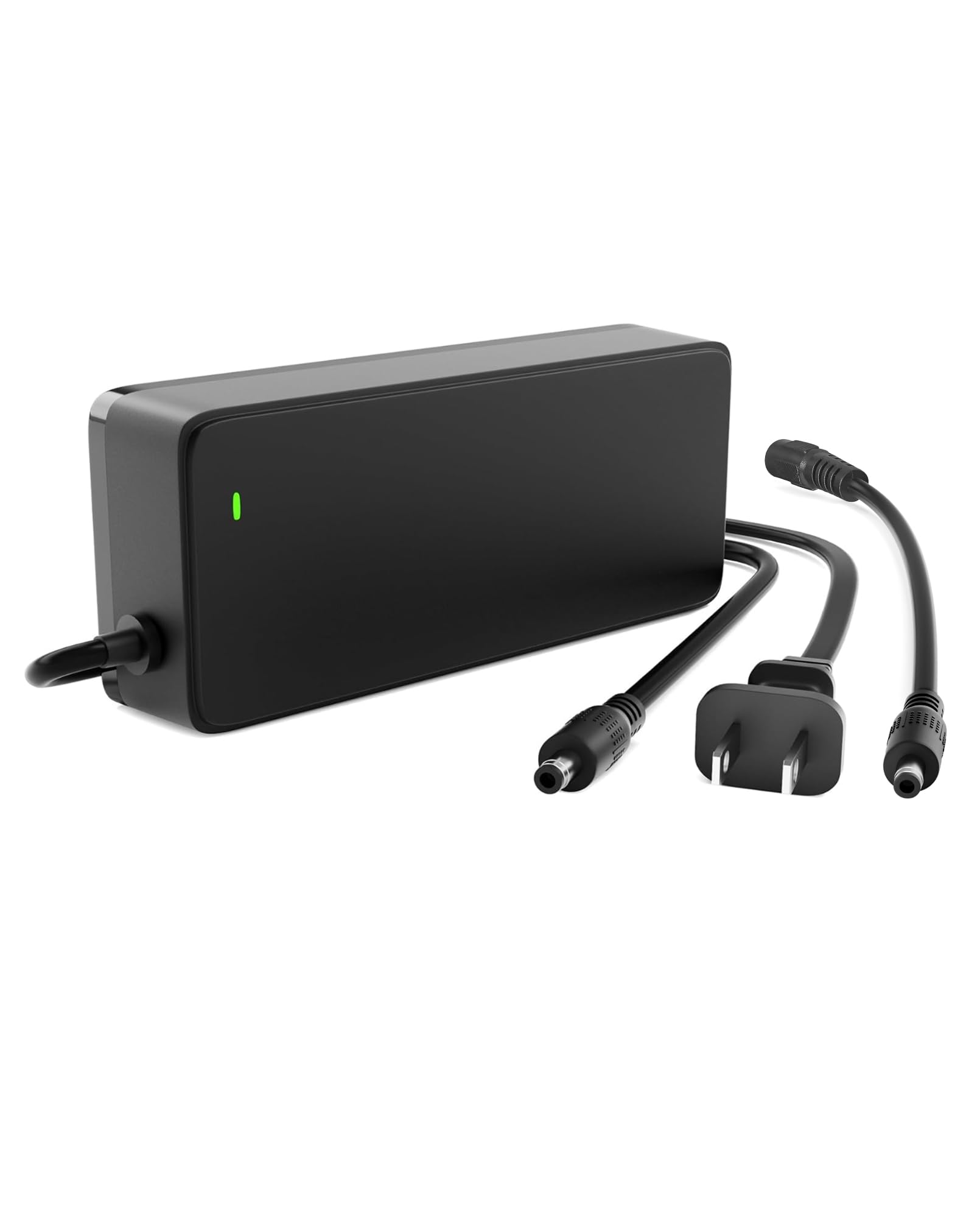
The STIO charger is purpose-built for the Lectric XP ecosystem — it is verified compatible with the XP 1.0, 2.0, 3.0, XP Step-Thru, XP Lite, and XPremium models. The 54.6V 2A output delivers up to 109.2W of power, which is roughly 30% faster than the 1.5A chargers that often ship with entry-level e-bikes. ETL certification backs the safety claims.
A dual-cooling system combines a silicone pad and an aluminum heat sink to keep internal temperatures within the 60335 industry standard, even during summer garage charging sessions. The 18AWG pure copper cable and flame-retardant ABS housing add electrical margin that thinner-gauge chargers lack. The IP65 rating on the connector end provides splash resistance for riders who store bikes in damp sheds.
The DC 5.5×2.1mm barrel connector is the most common e-bike port size, but it is not universal — always confirm your battery’s input jack before ordering. The manufacturer also notes that the charger shell can reach up to 158°F during operation, which is normal per industry standards but worth considering for placement.
Why it’s great
- Exact fit for Lectric XP series and compatible models
- ETL certified with dual cooling for safe high-rate charging
- 2A output charges 30% faster than standard 1.5A adapters
Good to know
- Only one barrel connector type included
- Housing can reach 158°F under full load
4. Fancy Buying 59V 1.8A Charger
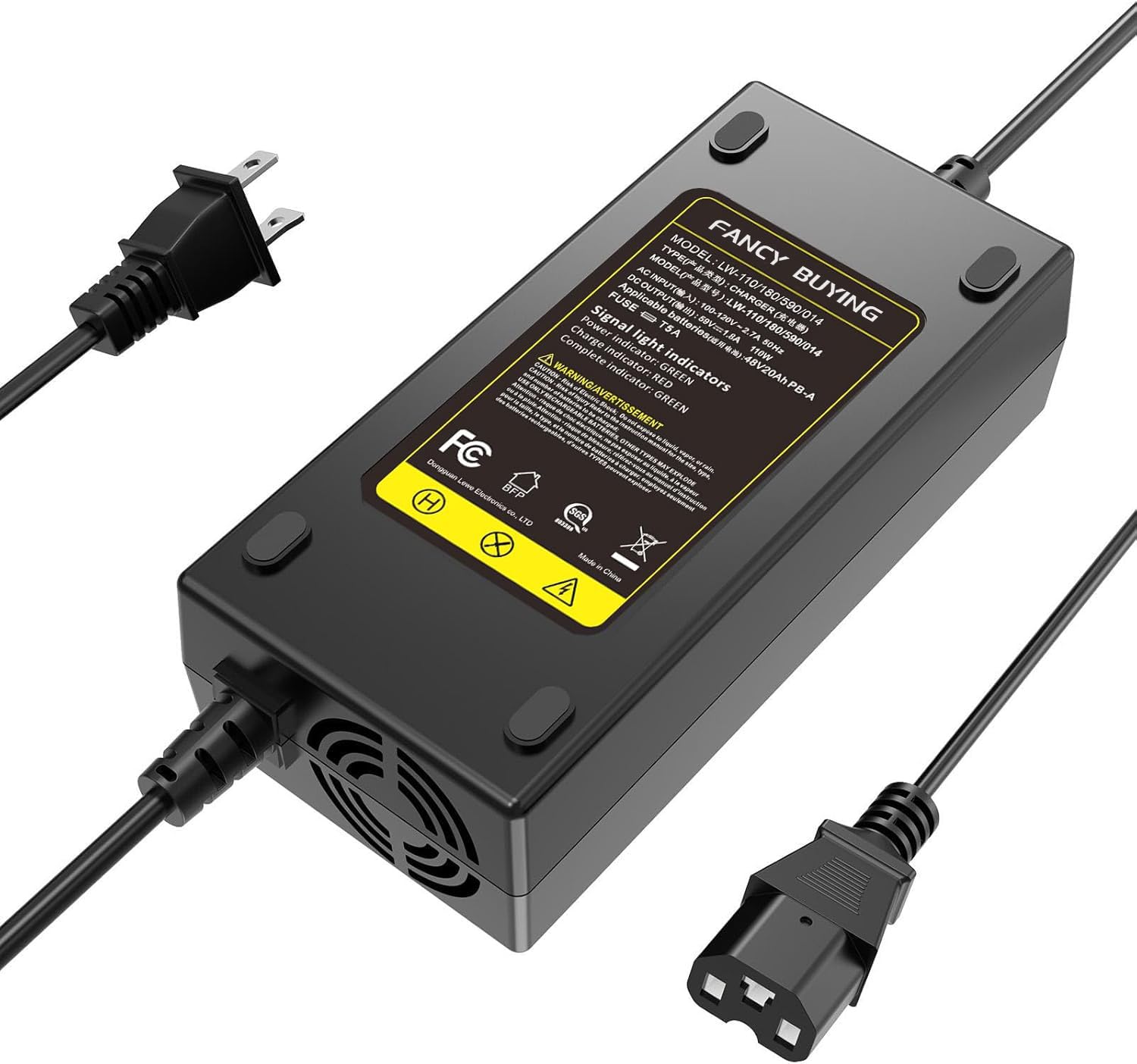
Most chargers on this list target lithium-ion packs, but the Fancy Buying unit is engineered specifically for 48V lead-acid (SLA) batteries, delivering a full 59V output at 1.8A. Lead-acid chemistry requires a higher absorption voltage than lithium, so plugging this into a 48V Li-ion pack would trip over-voltage protection or cause cell damage. If your e-bike or mobility scooter uses a sealed lead-acid 12Ah battery, this is the correct voltage match.
The 3-prong AC input plug is the standard North American wall connector, and the built-in cooling fan — an unexpected bonus at this price point — prevents thermal buildup during the longer charge cycles that lead-acid batteries need. The green/red LED indicator clearly shows charging status: red while active, green when full. Multiple verified buyers report successful use with electric scooters and mobility devices.
The 59V output and 1.8A current rating mean this adapter is tuned for 12Ah lead-acid packs specifically. Larger-capacity batteries will charge slower, and the charger does not support lithium or LiFePO4 chemistries. It is a niche but necessary option for owners of older or budget-friendly electric rides that still run on SLA.
Why it’s great
- Correct 59V output for 48V lead-acid batteries
- Built-in fan keeps charger cool during long cycles
- Clear red/green charging status indicator
Good to know
- Only compatible with 48V 12Ah lead-acid packs
- Does not work with any lithium-ion or LiFePO4 battery
5. Syvrac 48-54.6V 2A Charger

The Syvrac charger uses high-frequency switching technology to maintain a cleaner DC output with less ripple than basic transformer-based adapters — a detail that reduces heat stress on your battery’s BMS during the final constant-voltage stage. It outputs 54.6V at 2A, the precise termination voltage for 48V lithium-ion packs, and includes OVP, OCP, and SCP protections.
The DC 2.1mm barrel jack (5.5×2.1mm) is the most common port on Lectric, Sondors, and Super 73 e-bikes, and verified buyer reviews confirm a direct fit for these brands. The charger automatically switches to float mode once the battery reaches full charge, preventing the gassing that can occur with cheaper units that lack termination logic. The red/green LED also signals when the battery voltage is below 35.7V — a safety warning not to use the charger on a deeply discharged pack.
This unit is rated for 120VAC input only, so international riders need a step-down transformer. The 5-hour charge time is typical for a 2A adapter on a standard-capacity pack. The manufacturer explicitly warns against using the charger if your battery voltage reads below 35.7V, as charging a deeply depleted 48V pack can be dangerous regardless of the charger brand.
Why it’s great
- High-frequency switching produces clean DC with minimal ripple
- Precise 54.6V termination for 48V lithium packs
- Works with Lectric, Sondors, and Super 73 e-bikes
Good to know
- 120VAC input only — not universal voltage
- Do not use if battery voltage is below 35.7V
6. YONHAN 15A Battery Charger

The YONHAN is a different category of device — a 12V/24V automotive-grade smart charger that covers lead-acid (AGM, GEL, SLA, flooded) and LiFePO4 chemistries at up to 15A. While it does not output 54.6V for e-bike packs, it is the ideal maintainer for your car, truck, or motorcycle battery, and it is essential for riders who also need to charge a 12V accessory battery or keep a vehicle topped off during winter storage.
The 9-stage charging process includes desulfation, bulk charge, absorption, analysis, and float modes. The pulse repair technology sends high-frequency pulses into the plates to break down sulfate crystals that form during discharge cycles — several verified users report recovering batteries that showed around 50% state of health back to 84% after a single restore cycle. The temperature-adaptive float mode automatically compensates for both freezing and overheating environments.
This charger cannot jump-start a dead battery, and the desulfation stage may temporarily cause electrical noise that sensitive car electronics could interpret as a signal. The lack of a built-in fan means the unit relies on convection cooling, so it is best used in open air rather than enclosed spaces. It is a specialized tool for multi-battery households, not a direct e-bike charger replacement.
Why it’s great
- 9-stage charging with pulse repair restores sulfated batteries
- Works with LiFePO4, AGM, GEL, SLA, and flooded lead-acid
- Temperature-compensated float mode for winter storage
Good to know
- Not for 48V lithium e-bike packs
- No fan — relies on passive cooling
7. E-FAST 20A Battery Charger

The E-FAST charger delivers 20A on 12V and 10A on 24V, making it the highest-amperage option in this roundup. It is designed for rapid recovery of car, truck, RV, and deep-cycle batteries, not for direct e-bike pack charging. The 7-stage smart algorithm — desulfurization, trickle, constant current, constant voltage, detection, compensation, and floating — automatically adapts to the battery’s condition.
The pulse repair function uses high-power high-frequency low-frequency waves to break down sulfation on lead plates. Verified buyers report that the repair mode revived an 8-year-old lead-acid battery to a steady 12.64V resting voltage. The digital screen displays real-time voltage, current, and temperature, and switches to a “100%” reading when the battery is fully charged. The reverse polarity, overheat, and short-circuit protections are all active simultaneously.
Like the YONHAN, this is a multi-purpose maintainer, not a 48V e-bike charger. It cannot jump-start a completely dead battery, and the desulfation cycle can take several hours to complete. The compact plastic housing is about one-third the size of traditional transformer-based chargers, but the lack of a jump-start mode means you still need cables for a truly flat battery.
Why it’s great
- 20A output charges a dead 12V battery in about 2 hours
- Pulse repair can restore old lead-acid batteries
- Digital display shows real-time voltage, current, and temperature
Good to know
- Not compatible with 48V lithium e-bike packs
- Cannot jump-start a completely dead battery
FAQ
Can I use a 48V lead-acid charger on a 48V lithium battery?
How do I know which connector my e-bike battery uses?
What does the UL certification on a charger actually mean?
Final Thoughts: The Verdict
For most users, the best bike battery charger winner is the Hyleton 48V Lithium Charger because it combines UL safety certification, a universal 3-in-1 connector set, and intelligent temperature control at an approachable tier. If you want the most robust physical build with a replaceable fuse, grab the HEXWATT 54.6V Charger. And for exact-fit compatibility with Lectric XP models, nothing beats the STIO 54.6V 2A Charger.