
Upgrading your 3D printer’s controller board is the single most impactful modification you can make. It directly controls motion accuracy, print speeds, and — most noticeably for anyone with a printer in a shared space — the ear-piercing whine of stepper motors. A silent, 32-bit board transforms the machine from a noisy workshop tool into a device that can run peacefully in a home office or bedroom.
I’m Min — the co-founder and writer behind Gadgets Feed. I’ve spent hundreds of hours analyzing the technical specifications of 3D printer controller boards, focusing on stepper driver quality, CPU architecture, firmware ecosystem support, and connectivity options across the most popular models on the market.
Whether you need a drop-in replacement to silence your machine or a powerful new platform to run Klipper at high speeds, this guide breaks down the specs that matter to help you find the best 3d printer controller board for your specific build.
How To Choose The Best 3D Printer Controller Board
Selecting a control board is a matter of matching your firmware goals, hardware compatibility, and noise tolerance. The most important decision is the stepper motor driver, as this defines the acoustic and motion quality of your prints.
Stepper Driver Type: TMC2209 vs. TMC2225
The stepper driver is the chip that controls the motor current and micro-stepping. TMC2209 drivers offer UART mode for software-configurable current and stealthChop2 for ultra-quiet operation, making them the gold standard for silent 3D printing. TMC2225 drivers provide similar quiet performance but often lack the advanced linearity features that TMC2209 uses to reduce print artifacts like VFA (Vertical Fine Artifacts).
Firmware Ecosystem: Marlin vs. Klipper
Marlin is the reliable, feature-rich standard that runs directly on the board’s CPU. Klipper offloads motion calculations to a separate host computer (like a Raspberry Pi or BTT Pi), allowing for faster print speeds and advanced features like input shaping. If you want Klipper, the board must be compatible with a host controller, or you need a combo board with a dedicated processor.
Form Factor and Compatibility
Not all boards fit all printers. Mini E3 boards are designed to be drop-in replacements for Creality Ender 3 series machines, matching the mounting holes and connector layout. Full-size boards like the Octopus or SKR series require a separate enclosure and wiring. Always verify that the board physically fits your printer’s electronics compartment before buying.
Quick Comparison
On smaller screens, swipe sideways to see the full table.
| Model | Category | Best For | Key Spec | Amazon |
|---|---|---|---|---|
| BTT SKR Mini E3 V3.0 | Mid-Range | Best Overall Upgrade | TMC2209 Drivers | Amazon |
| BTT Pi V1.2 | Premium | Klipper Host Controller | Allwinner H616 Quad-Core | Amazon |
| Creality V4.2.7 (E3 V2) | Mid-Range | Drop-in for E3 V2 | TMC2225 Drivers | Amazon |
| Creality V4.2.7 (E3) | Mid-Range | Drop-in for Ender 3 | TMC2225 Drivers | Amazon |
| Creality V4.2.7 (E3 Pro) | Mid-Range | Drop-in for E3 Pro | TMC2225 Drivers | Amazon |
| K1 Max Mainboard | Premium | K1 Max Replacement | TMC2209 Drivers | Amazon |
| Longer LK5 Pro 3 | Budget | Complete Printer Bundle | TMC2209 Drivers | Amazon |
In‑Depth Reviews
1. BIGTREETECH SKR Mini E3 V3.0

The SKR Mini E3 V3.0 is the definitive upgrade for Creality Ender 3 series printers. It packs the superior TMC2209 stepper drivers in UART mode, enabling software-controlled current and a near-silent stealthChop2 mode that completely eliminates motor whine. The STM32G0B1RET6 main chip is a modern 32-bit ARM Cortex-M0+ running at 170MHz, providing ample processing power for complex Marlin features or high-speed Klipper USB communication.
BIGTREETECH redesigned the heat sink for these drivers, which is critical for sustained high-current operation. The board also adds three controllable CNC fan headers, allowing you to manage chamber and part cooling fans directly from the firmware. The switch to a Micro USB B connector for PC communication is a welcome upgrade over the older Mini USB standard, offering better cable availability.
Installation is almost drop-in for Ender 3 and Ender 3 Pro models, though some users noted that the BLTouch wiring may require a firmware patch. The board is incredibly compact, fitting perfectly into the stock electronics case. For under , this board offers the best balance of silent operation, modern processing power, and community support available today.
Why it’s great
- TMC2209 drivers deliver true silent motion
- STM32G0B1RET6 is powerful enough for Klipper USB mode
- Three controllable fan headers for advanced cooling
Good to know
- BLTouch support may require a firmware patch
- JST fan connectors need a wiring mod for standard fans
2. BIGTREETECH Pi V1.2

The BTT Pi V1.2 is not a printer mainboard itself — it is a dedicated single-board computer designed to run the Klipper firmware host. Powered by the Allwinner H616 quad-core Cortex-A53 processor clocked at 1.5GHz, it easily handles Klipper’s real-time motion calculations and input shaping. It connects to any compatible printer board (like the SKR Mini E3 V3.0) via a standard USB cable, offloading the heavy math from the printer’s MCU.
This board is roughly the same physical size as a Raspberry Pi 3B, making it a drop-in fit for many Pi cases. It features onboard WiFi and a 100Mbps Ethernet port, 4 USB 2.0 ports for cameras and accelerometers, and a 40-pin GPIO header for connecting TFT screens. A critical feature for Klipper lovers is the dedicated ADXL345 accelerometer header, enabling precise input shaping without complex wiring.
Powering the Pi is flexible: you can use a standard USB-C 5V supply or power it directly from your printer’s 12-24V PSU via the DC input pin, simplifying the wiring. While some users reported initial WiFi stability issues, the community firmware repos have largely resolved these. For users wanting to run Klipper without hunting for a Raspberry Pi, this is the optimized solution.
Why it’s great
- Dedicated ADXL345 header for Klipper input shaping
- Can be powered directly from the printer PSU
- Faster than a Pi 3B for Klipper workflows
Good to know
- WiFi stability can require firmware tweaks
- Not a standalone mainboard; requires a separate printer MCU
3. Creality V4.2.7 Silent Motherboard for Ender 3 V2

For Ender 3 V2 owners who want a reliable, factory-made upgrade, this Creality V4.2.7 board is the safest option. It uses TMC2225 drivers, which are practically silent and offer a massive improvement over the standard A4988 drivers on older 8-bit boards. The 32-bit STM32 processor handles Marlin firmware smoothly, and the board comes pre-installed with the correct Ender 3 V2 firmware, making it true plug-and-play.
The board includes thermal runaway protection and an optimized circuit layout that prevents heating issues. Installation is a direct swap: the mounting holes and connector pinouts match the V2’s electronics case exactly. Customers consistently report that the stepper motors become completely inaudible, leaving only the power supply and hotend fans as the source of noise.
One important detail for Klipper users: this board works well with Klipper, but its older TMC2225 drivers lack the UART configurability that TMC2209 offers. You may need to adjust the Marlin config for the V2 display, as the stock firmware is for the original screen. For a no-fuss, official upgrade that retains warranty compatibility, this is the best choice.
Why it’s great
- Pre-installed firmware for true plug-and-play
- Drop-in fit for Ender 3 V2 electronics case
- Thermal runaway protection enabled from the factory
Good to know
- TMC2225 drivers lack the advanced configurability of TMC2209
- Requires a firmware flash for use with Klipper
4. Creality Ender 3 Silent Motherboard V4.2.7

This V4.2.7 board targets the original Ender 3 and Ender 3 Pro, serving as a direct replacement for the stock noisy 8-bit board. Like its V2 counterpart, it uses TMC2225 drivers for a radical noise reduction. The CPU is a 1.2GHz Cortex A13 processor, which is a step up in clock speed from earlier Creality boards, improving response times in Marlin menus and G-code processing.
The board supports both Marlin and Klipper firmware, giving you flexibility as your skills grow. It also includes extra power connectors for accessories like case lights or upgraded screens, which is a thoughtful addition for tinkerers. The board is pre-installed with Ender 3 firmware, but you will need to flash a different firmware file for the Ender 3 Pro or other variants.
Installation reviews are overwhelmingly positive, with users praising the audible silence. The only consistent caveat is that firmware must be installed before first power-on, and the process involves downloading files from Creality’s cloud. The lack of printed instructions is a minor hurdle for beginners, but the community has documented the process thoroughly.
Why it’s great
- Dual firmware support for Marlin and Klipper
- Extra power ports for accessories
- Plug-and-play for original Ender 3
Good to know
- Firmware must be flashed before first use
- No printed installation instructions included
5. Creality V4.2.7 Silent Motherboard for Ender 3 Pro

This variant of the V4.2.7 board is specifically listed for the Ender 3 Pro, though it also works with the Ender 3 Max, Neo, V2 Neo, and Max Neo after a firmware flash. The core hardware is identical to the other V4.2.7 boards — the same TMC2225 drivers and 32-bit architecture — but the pre-installed firmware targets the Ender 3 Pro’s specific screen and configuration.
Users upgrading from the stock 8-bit board report dramatic noise improvements and zero print quality issues after the swap. The board’s bootloader is pre-installed, simplifying the firmware update process. Simply copy the firmware file to a freshly formatted SD card, insert it, and power cycle the printer to complete the flash.
A notable quirk is the heavy application of hot glue on the OEM board’s connectors. Removing these connectors requires tweezers or an angled pick, and taking photos before disconnecting is highly recommended. Some customers found the firmware for the Ender 3 Max Neo was hard to locate, requiring them to use the Ender 5 firmware. Despite these initial setup steps, the board delivers reliable silent motion for a wide range of Creality printers.
Why it’s great
- Works with multiple Ender 3 variants after firmware flash
- Bootloader pre-installed for easy updates
- 30-minute installation for experienced users
Good to know
- Firmware for non-Pro models can be difficult to find
- Hot glue on OEM connectors makes removal tedious
6. Original K1 Max Mainboard with TMC2209
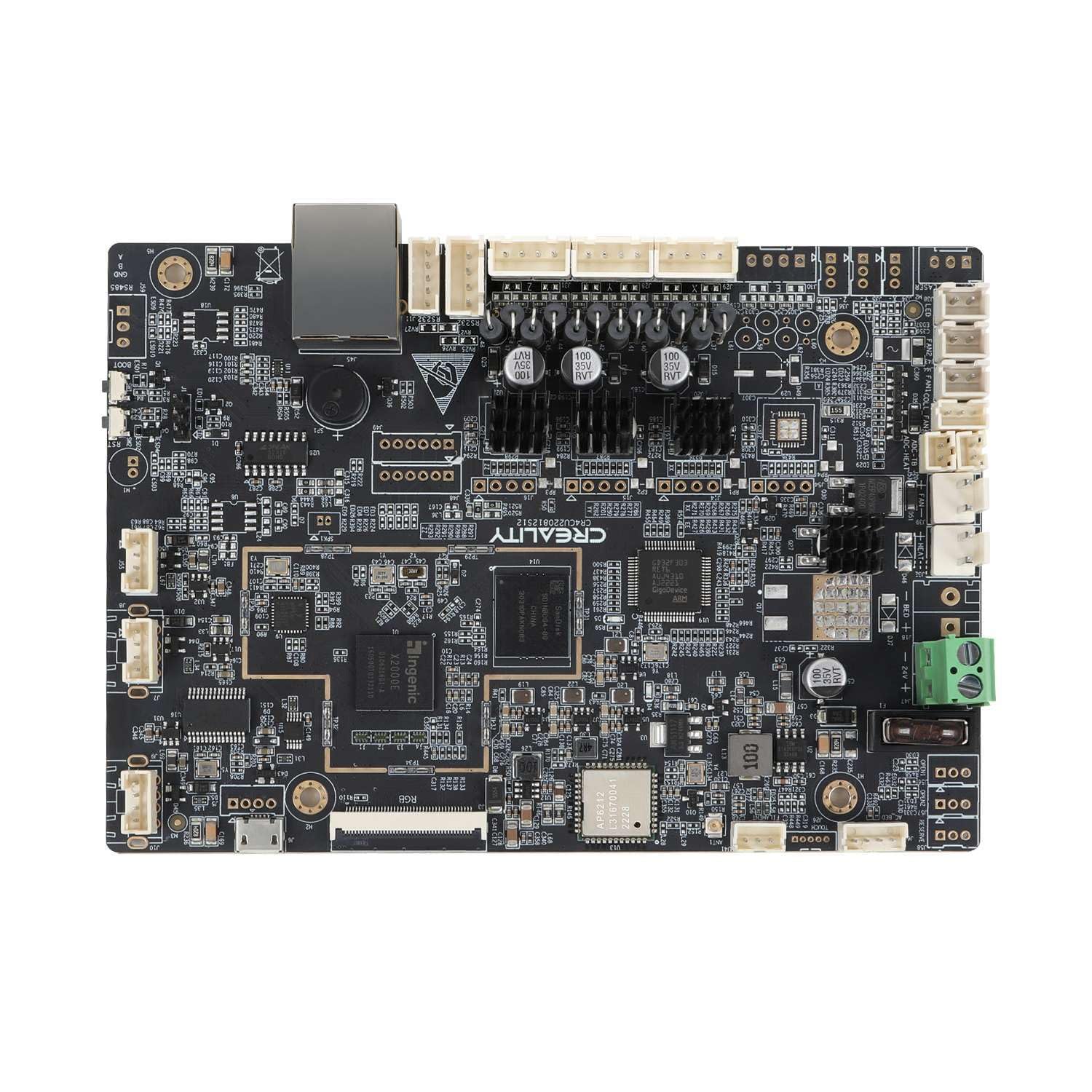
This is the official replacement mainboard for the Creality K1 Max printer. It features TMC2209 stepper drivers, which are required to drive the K1 Max’s CoreXY motion system with high precision and low noise. The board uses a 32-bit X2000E processor and comes pre-installed with the correct K1 Max firmware, ensuring the printer’s high-speed capabilities are maintained.
This board is designed specifically for the K1 Max and is not compatible with other models. It is a warranty-preserving replacement for a failed unit, and customers confirm it is an exact match for the original part. The TMC2209 drivers ensure the printer remains quiet during the fast accelerations typical of CoreXY printers.
One reviewer noted that this board may not be the correct fit for older K1 Max units that use larger geared motors. If your printer has the smaller direct-drive extruder gears, this board is the right choice. For a simple, no-configuration repair of a broken K1 Max board, this is the only option that guarantees compatibility.
Why it’s great
- Exact OEM replacement for Creality K1 Max
- Pre-installed firmware for plug-and-play repair
- TMC2209 drivers support high-speed CoreXY motion
Good to know
- Compatible only with the K1 Max printer
- May not fit older K1 Max units with large geared motors
7. Longer LK5 Pro 3 3D Printer

The Longer LK5 Pro 3 is a complete FDM printer that ships with a 32-bit mainboard featuring TMC2209 drivers. If you are starting from scratch and need a large build volume of 300x300x400mm, this printer offers the most cost-effective entry point into the TMC2209 ecosystem. The board handles the printer’s advertised 180mm/s print speed and 0.1mm precision without noticeable vibration artifacts.
The printer includes features that rely on the controller board’s capabilities: filament depletion detection and power-loss auto-resume. The open-source firmware allows for G-code customization, and the TMC2209 drivers ensure the printer operates quietly enough for a classroom or shared apartment. The silicon carbide lattice glass bed and dual fans complement the board’s output quality.
This printer is 90% pre-assembled, making it beginner-friendly, but the board is not a standalone purchase. Buyers should note that manual bed leveling can be rough, and adding a BLTouch requires complex firmware work that can brick the board if done incorrectly. For those who want a large-format printer with a modern quiet board out of the box, this is a solid package deal.
Why it’s great
- Comes with TMC2209 drivers for quiet operation
- Massive build volume for cosplay and functional parts
- Filament runout and power-loss recovery included
Good to know
- Manual bed leveling is finicky without probe upgrade
- BLTouch installation can brick the board if firmware is wrong
FAQ
Can I upgrade my Ender 3 V2 with a board that uses TMC2209 drivers?
Do I need a separate computer to run Klipper with a new controller board?
Final Thoughts: The Verdict
For most users, the best 3d printer controller board winner is the BIGTREETECH SKR Mini E3 V3.0 because it combines modern TMC2209 drivers with a powerful STM32G0 processor in a compact drop-in form factor. If you want a dedicated Klipper host that also powers input shaping, grab the BTT Pi V1.2. And for a simple, warranty-friendly silent upgrade for your Ender 3 V2, nothing beats the Creality V4.2.7 Silent Motherboard.