
Finding a graphics card that delivers high-refresh 1440p performance without emptying your wallet is the central challenge for PC builders. The RTX 2060 Super, with its 8GB of GDDR6 memory and Turing architecture, sits in a sweet spot that later generation cards have struggled to replicate at a similar cost. It balances ray tracing capability, solid rasterization, and reliable drivers for a multi-year gaming investment.
I’m Min — the co-founder and writer behind Gadgets Feed. My research for this guide involved cross-referencing hundreds of customer benchmarks, analyzing thermal and clock speed data across different cooler designs, and identifying which card variants avoid the common pitfalls like coil whine or inefficient fan curves.
Whether you are upgrading from an older GTX series or building a fresh rig, finding the right 2060 super graphics card requires understanding how each partner model handles power delivery, noise levels, and core clock stability under sustained loads.
How To Choose The Best 2060 Super Graphics Card
The RTX 2060 Super occupies a unique space in NVIDIA’s lineup. It offers the same 8GB memory configuration as the RTX 2070 but at a lower price tier, making it the most practical entry point for ray tracing at 1440p without stepping up to the more expensive 2070 Super or 3060 Ti. Not all 2060 Super cards perform identically, so your choice comes down to cooler design, factory overclock, and build quality.
Cooler Design and Noise Levels
The dual-fan and triple-fan solutions from partners like MSI, ASUS, and EVGA make a significant difference in sustained clock speeds. Cards with larger heatsinks and higher quality fans maintain the boost clock longer during extended gaming sessions. Pay attention to reviews mentioning coil whine or fan revving at idle, as these issues are common with certain budget-oriented coolers. A card with a robust thermal solution will keep the GPU under 70°C, preserving performance and card longevity.
Quick Comparison
On smaller screens, swipe sideways to see the full table.
| Model | Category | Best For | Key Spec | Amazon |
|---|---|---|---|---|
| Nvidia RTX 2060 Super FE | Mid-Range | Reference Builders | 8GB GDDR6, 1650 MHz Boost | Amazon |
| EVGA RTX 2060 KO Ultra Gaming | Entry-Level | Budget 1080p Gaming | 6GB GDDR6, Metal Backplate | Amazon |
| NVIDIA RTX 3060 Ti FE (Renewed) | Mid-Range | 1440p High FPS | 8GB GDDR6, PCIe 4.0 | Amazon |
| Sapphire Radeon RX VEGA 56 | Mid-Range | Compute & 1440p | 8GB HBM2, 2048-bit Bus | Amazon |
| EVGA RTX 2060 SC Ultra Gaming | Mid-Range | Silent Operation | 6GB GDDR6, 1755 MHz Boost | Amazon |
| ASUS RTX 2060 OC EVO | Mid-Range | Multi-Monitor Setups | 6GB GDDR6, 1785 MHz Boost | Amazon |
| MSI RTX 2060 Super Gaming X | Premium | Ultra 1080p/1440p | 8GB GDDR6, Twin Frozr 7 | Amazon |
| MSI RTX 2060 Super Ventus GP OC | Premium | Compact Mini ITX | 8GB GDDR6, 1665 MHz Boost | Amazon |
| STGAubron Gaming PC (2060 Super) | Budget | Pre-Built Entry | 8GB GDDR6, Ryzen 5 5500 | Amazon |
In-Depth Reviews
1. MSI Gaming GeForce RTX 2060 Super 8GB Gaming X

The MSI Gaming X is the definitive 2060 Super variant for gamers who demand minimal noise and maximum thermal headroom. Its Twin Frozr 7 cooler keeps the card under 70°C even during extended 1440p sessions, and the Zero Frozr technology stops the fans entirely under low load for dead-silent operation. The 1695 MHz boost clock out of the box ensures smooth 100+ FPS in titles like Call of Duty and Overwatch at 1080p ultra settings.
This card handles 4K at reduced settings, achieving 60 FPS in many AAA titles when DLSS is enabled. The 8GB VRAM buffer is future-proof for upcoming releases that demand more texture memory, unlike the 6GB variants which may hit limits. The sturdy backplate prevents PCB sag in larger cases.
One minor inconvenience is the MSI Dragon Center software requirement for RGB control, which some users report needing multiple installation attempts. Once configured, the Mystic Light sync works well with other compatible components, but the rainbow default state persists if the software is not running.
Why it’s great
- Exceptional thermal performance with fans rarely audible under 60% load.
- Pre-overclocked 1695 MHz boost delivers consistent frame rates in 1440p.
- 8GB GDDR6 prevents VRAM stuttering in modern titles.
Good to know
- Requires MSI software for RGB control; defaults to rainbow without it.
- Thick 2.5-slot design may block adjacent PCIe slots on compact motherboards.
2. MSI RTX 2060 Super Ventus GP OC

For builders working with small form factor cases, the MSI Ventus GP OC is a 9.1-inch dual-fan card that fits without sacrificing the 2060 Super’s core performance. It runs quiet and cool inside a Mini ITX build, with boost clocks of 1665 MHz that push 144-175 FPS in e-sports titles like CSGO and Valorant at competitive settings. The 8GB VRAM remains a key advantage over shorter 6GB cards.
Owners report excellent reliability after a year of daily use, handling 1440p at high settings for Overwatch, Call of Duty, and Apex Legends. The card’s power efficiency is notable, drawing around 100W under typical gaming loads according to user measurements. This makes it a strong pairing with more modest power supplies in budget pre-builts.
The Ventus GP OC’s main drawback is its modest factory overclock compared to the Gaming X. Manual overclocking can close the gap, but the cooler is less elaborate so thermal headroom for aggressive OC is limited. Also, the card lacks any RGB lighting for those who want aesthetic customization.
Why it’s great
- Compact 9.1-inch length fits most Mini ITX cases with room to spare.
- Low power draw of around 100W under load for efficient builds.
- Quiet fan operation even under sustained gaming.
Good to know
- Lower boost clock than premium variants requiring manual OC for parity.
- No RGB lighting or premium aesthetic features.
3. ASUS GeForce RTX 2060 Overclocked 6G EVO

The ASUS Dual RTX 2060 OC EVO offers a winning combination of high boost clock and reliable cooling at a mid-range price point. Its 1785 MHz boost clock is one of the highest among 2060 (non-Super) variants, allowing it to approach 2060 Super performance in many games. The Wing-Blade fans feature IP5X dust resistance and a 0dB mode that keeps them silent until the GPU reaches 55°C.
This card handles multi-monitor productivity setups with ease, supporting up to four displays via DisplayPort 1.4, HDMI 2.0, and DVI. In gaming benchmarks, users report 70+ FPS in Cyberpunk 2077 at 1080p high settings, though ray tracing requires DLSS to maintain playable frame rates. The aluminum backplate protects against PCB flex in vertical mount installations.
The 6GB VRAM is the limiting factor here for future titles at 1440p with high texture packs. Some users note fan noise becomes noticeable above 60% speed, and the card lacks a true 2060 Super’s memory bandwidth. For pure rasterization at 1080p, however, the price-to-performance ratio remains excellent.
Why it’s great
- High factory boost clock of 1785 MHz for superior out-of-box performance.
- Dust-resistant IP5X fans with 0dB silent mode under light loads.
- Support for up to four monitors with diverse connectivity options.
Good to know
- 6GB VRAM may limit future 1440p gaming with high texture quality.
- Fan noise becomes audible above 60% speed under heavy load.
4. Nvidia RTX 2060 Super Founders Edition

Nvidia’s own Founders Edition card is the reference design that all partner boards are measured against. It features a 1650 MHz boost clock with 8GB of GDDR6 memory on a 256-bit bus, delivering a 33% increase in memory bandwidth over the standard RTX 2060. The dual-fan blower-style cooler exhausts heat out the back of the case, making it suitable for small enclosures with limited airflow.
In real-world use, the FE card provides a solid 1080p ultra experience in titles like Red Dead Redemption 2 and Cyberpunk 2077 with DLSS enabled. The green LED NVIDIA logo on the side is subtle and non-RGB, which appeals to builders seeking a clean, understated look. Driver installation is straightforward, though some users report an initial 5-8 minute black screen on first boot before detection.
The most common complaint about this card is audible coil whine under load, which several reviewers note as irritating. The blower fan also runs louder than dual-fan partner designs when the GPU is stressed. Additionally, given its age, pricing has fluctuated significantly, and the card’s value depends heavily on finding it at a sensible market rate.
Why it’s great
- Reference design with reliable driver support and wide OS compatibility.
- Blower-style cooler exhausts heat out of the case for small builds.
- 8GB GDDR6 on 256-bit bus delivers smooth 1440p gaming.
Good to know
- Audible coil whine reported under sustained gaming loads.
- Blower fan is louder than dual-fan partner coolers at similar RPM.
5. EVGA RTX 2060 SC Ultra Gaming

The EVGA SC Ultra Gaming strikes an excellent balance between noise and performance. Its dual HDB (Hydro Dynamic Bearing) fans produce noticeably less acoustic noise than sleeve bearing designs, and the real boost clock of 1755 MHz places it above most standard 2060 models. This card excels in 1080p ultra gaming, delivering 140 FPS in Doom Eternal and handling Skyrim with 4K texture mods admirably.
For non-gaming uses like video rendering and CUDA acceleration, the 6GB GDDR6 memory provides ample bandwidth for Adobe Premiere and DaVinci Resolve workflows. The metal backplate adds structural rigidity, and the adjustable RGB LED allows integration into themed builds. EVGA’s reputation for customer support is a significant plus for long-term reliability.
Some units exhibit a fan revving issue at idle where the default curve cannot hold speeds below 36%, causing an audible pulsing sound. A manual fan curve adjustment to a minimum of 36% resolves this, and EVGA support has confirmed it is not harmful. The card also lacks a power connector in the box, requiring users to have a compatible 8-pin PCIe cable from their PSU.
Why it’s great
- Quieter HDB fan technology reduces operating noise compared to standard fans.
- High boost clock of 1755 MHz for strong out-of-box framerates.
- Adjustable RGB and sturdy metal backplate for build customization.
Good to know
- Fan revving at idle may require manual curve adjustment to fix.
- No power connector included; requires existing 8-pin PCIe cable.
6. NVIDIA RTX 3060 Ti Founders Edition (Renewed)

For those willing to consider a refreshed secondary market card, the RTX 3060 Ti Founders Edition represents a clear generational uplift over the 2060 Super. Its Ampere architecture brings substantial improvements in ray tracing performance and DLSS 2.0 support, with 8GB of GDDR6 memory on a 256-bit bus. PCIe 4.0 compatibility ensures it gets the most out of modern motherboards and CPUs.
Users report this card runs virtual reality games flawlessly, including Half-Life Alyx and Boneworks, when connected through an external GPU hub. In standard desktop use, it delivers a noticeable frame rate increase over the 2060 Super in titles like Cyberpunk 2077, especially with ray tracing enabled. The renewed condition generally shows no signs of mining wear according to most purchasers.
The main concerns with a renewed card revolve around the included accessories. Some units ship with cables that show visible wear, such as casing protrusions near the connector. While the card itself typically works fine, buyers should inspect all bundled components carefully. For the budget-conscious gamer, this option provides 3060 Ti performance at a 2060 Super price level.
Why it’s great
- Ampere architecture with superior ray tracing and DLSS 2.0 performance.
- 8GB VRAM and PCIe 4.0 support for modern platform compatibility.
- Renewed condition can offer 3060 Ti performance at a reduced cost.
Good to know
- Bundled cables may show wear and require inspection.
- Renewed product carries higher risk of cosmetic imperfections.
7. STGAubron Gaming PC (RTX 2060 Super)
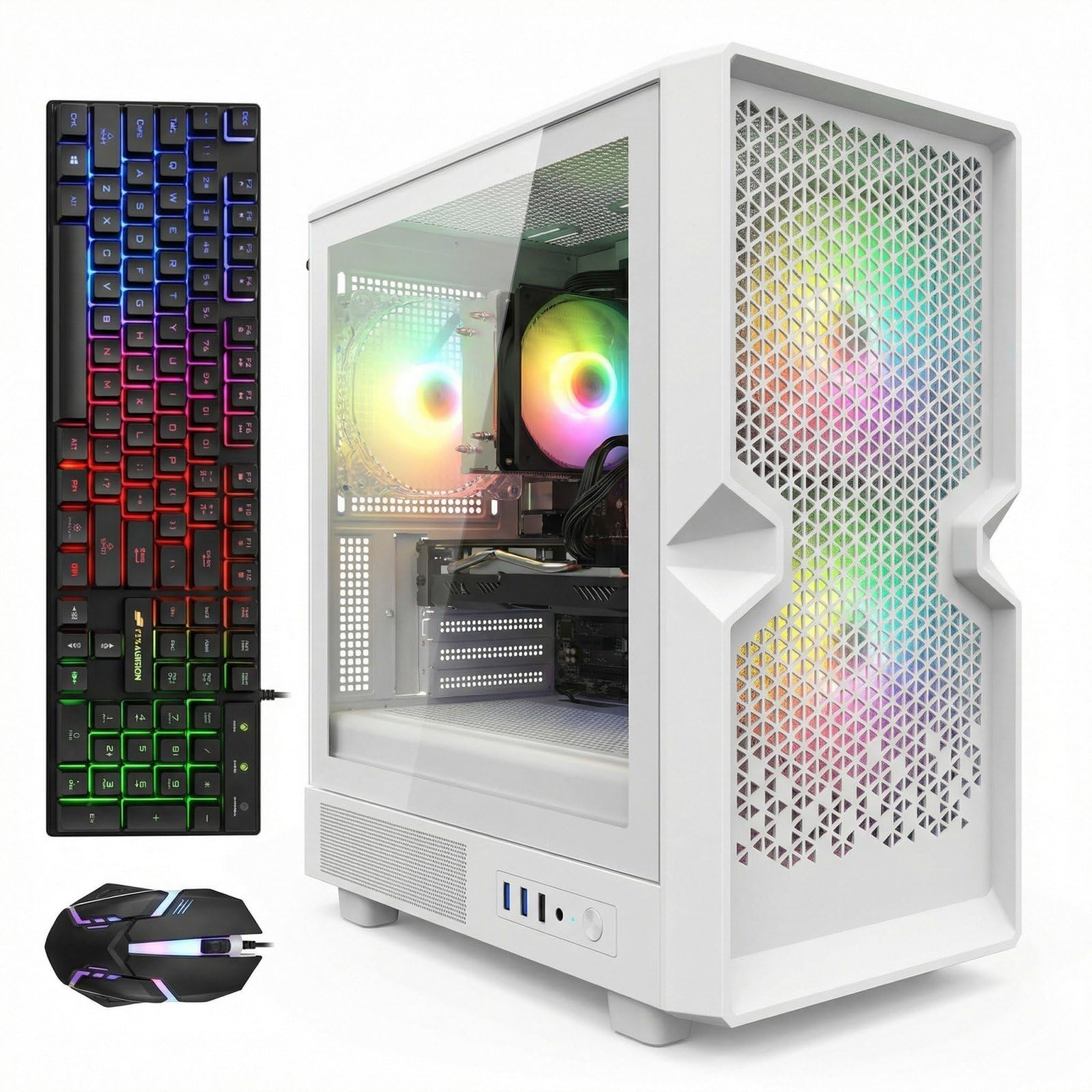
If building a PC feels daunting, the STGAubron pre-built system packages a genuine RTX 2060 Super 8GB with an AMD Ryzen 5 5500 processor, 16GB of DDR4 RAM, and a 1TB SSD. This configuration handles Fortnite, Call of Duty Warzone, and GTA V at 60+ FPS on high settings at 1080p. The inclusion of Wi-Fi 6, Bluetooth 5.2, and three RGB fans makes it a turnkey solution.
Users report the system runs dual monitors smoothly and the packaging ensures the GPU arrives undamaged. The 1TB NVMe SSD provides fast load times, and the pre-installed Windows 11 Home eliminates setup hassle. For newcomers to PC gaming, this machine removes compatibility worries and driver installation steps.
More experienced builders will note that the 16GB RAM runs at a modest 2600MHz speed, which leaves some CPU performance on the table. The system’s power supply is adequate but not modular, limiting upgrade flexibility. As a pure value proposition for someone wanting a 2060 Super experience without assembly, it delivers, but building your own would yield better component quality for the investment.
Why it’s great
- Complete plug-and-play system with genuine RTX 2060 Super 8GB.
- Includes Wi-Fi 6, Bluetooth 5.2, and RGB peripherals for immediate use.
- Handles 1080p gaming at 60+ FPS in most popular titles.
Good to know
- RAM clocked at 2600MHz, limiting CPU performance potential.
- Power supply is non-modular, complicating future upgrades.
8. EVGA RTX 2060 KO Ultra Gaming

The EVGA KO Ultra Gaming is the entry-level workhorse that keeps the RTX 2060 experience affordable. With 6GB of GDDR6 and a metal backplate pre-installed, it provides ray tracing and DLSS support at a price point that undercuts most competitors. Users upgrading from GTX 1650 or integrated graphics report a massive jump in framerates, reaching 60-120 FPS at 1080p in modern titles.
This card pairs well with older CPUs like the i7-3770k, giving a second life to legacy platforms for World of Tanks and similar e-sports titles. The dual-fan design runs quietly during standard gaming and the aluminum backplate prevents PCB warp. EVGA’s Precision X1 software offers straightforward overclocking and monitoring tools.
The main limitation is the 6GB VRAM buffer, which can hit capacity in modern games at 1440p with high texture settings. Additionally, some reviews note that the card’s age means it could be outclassed by newer entry-level options at a similar price point. For pure 1080p gaming, however, the KO Ultra remains a solid, reliable choice from a brand known for excellent warranty support.
Why it’s great
- Entry-level price point for accessing RTX features and ray tracing.
- Metal backplate provides structural rigidity and improved heat dissipation.
- Quiet dual-fan design suitable for budget gaming builds.
Good to know
- 6GB VRAM may limit texture quality in VRAM-intensive titles.
- Can be outclassed by newer cards at similar budget price points.
9. Sapphire Radeon RX VEGA 56

While not an RTX card, the Sapphire RX VEGA 56 with 8GB of HBM2 memory on a 2048-bit bus is a compelling alternative for compute-heavy workloads and FreeSync gaming. At 1440p, it outperforms the GTX 1070 out of the box and can approach GTX 1080 performance with undervolting and overclocking. The 2048-bit memory bus provides exceptional bandwidth for rendering and VR applications.
Users praise this card for VR development with Oculus and SteamVR, noting that hotspot temperatures stay around 69°C under stress testing and cool down quickly. The triple DisplayPort and single HDMI output support up to four monitors, and FreeSync works flawlessly at 2560×1080 75Hz. Flashing the Vega 64 BIOS can yield additional performance gains for experienced users.
The card’s biggest drawback is high power consumption—it draws significantly more wattage than a 2060 Super. A dual Vega 56 setup can overwhelm an 850W power supply. The cooler is not as effective as premium aftermarket designs, and the fan noise can be noticeable without headphones. For raw compute performance and memory bandwidth, though, it offers a unique value proposition.
Why it’s great
- Massive 2048-bit HBM2 memory bus provides superior bandwidth for compute.
- Undervolting and BIOS flashing can unlock GTX 1080-level performance.
- Excellent for VR development with stable thermal performance.
Good to know
- High power consumption; dual cards can exceed 850W PSU capacity.
- Stock cooler can be noisy without custom fan curve adjustments.
FAQ
Is the 2060 Super still good for 1440p gaming in 2025?
What power supply do I need for a 2060 Super?
How does the 2060 Super compare to the RTX 3060?
Final Thoughts: The Verdict
For most users, the 2060 super graphics card winner is the MSI RTX 2060 Super Gaming X because its Twin Frozr cooling and 1695 MHz boost clock provide the best balance of noise, thermals, and raw performance. If you want a compact card for a small form factor build, grab the MSI RTX 2060 Super Ventus GP OC. And for pure 1080p value without breaking the bank, nothing beats the EVGA RTX 2060 KO Ultra Gaming.