
Getting reliable over-the-air TV reception often comes down to one component: the amplifier. Without proper signal boosting, long cable runs, splitters, and distance from broadcast towers can turn a promising antenna setup into a pixelated mess. The right amplifier compensates for signal loss and locks in channels that otherwise remain out of reach.
I’m Min — the co-founder and writer behind Gadgets Feed. I’ve studied dozens of preamplifier and distribution amplifier specs, analyzed user reception reports across varied terrain, and spent many hours researching what separates a clean signal from constant dropouts in this specific category.
This guide breaks down the best options for boosting your OTA signal, focusing on gain, filtering, and installation flexibility to help you choose the right amplifier for outdoor tv antenna and finally cut the cord without compromise.
How To Choose The Best Amplifier For Outdoor TV Antenna
Not all signal boosters are created equal. Choosing the right amplifier for your outdoor TV antenna depends on your specific reception challenges, the number of TVs in your home, and your local interference environment. Here are the key factors to consider before making a purchase.
Gain (dB) and Noise Figure
Gain, measured in decibels (dB), determines how much the amplifier boosts the incoming signal. Higher gain isn’t always better — too much can overload a tuner, causing dropouts. Look for a low noise figure (under 3 dB) alongside moderate gain to ensure the amplifier doesn’t introduce its own static into the signal path.
Filtering: LTE, 5G, and FM
Cellular towers and FM radio stations broadcast near TV frequencies, creating interference that manifests as pixelation or complete channel loss. An amplifier with built-in LTE/5G and FM filtering surgically removes these unwanted signals before they reach your TV tuner. This is critical for suburban and rural installations near cell towers.
Mast-Mount vs. Distribution Amplifier
A mast-mounted preamplifier installs right at the antenna, boosting the signal before it travels down the coax cable. This is ideal for long cable runs (over 50 feet). A distribution amplifier lives indoors and splits the signal to multiple TVs but cannot compensate for signal loss that happens before the cable enters the house. For best results, use both: a preamp at the antenna and a distribution amp at the splitter.
Quick Comparison
On smaller screens, swipe sideways to see the full table.
| Model | Category | Best For | Key Spec | Amazon |
|---|---|---|---|---|
| Televes DiNova Boss Mix | Premium Amplified Antenna | Low-profile attic/outdoor installs with built-in preamp | 29 dBi VHF / 34 dBi UHF gain | Amazon |
| Televes TForce Mast Preamplifier | Professional Preamplifier | Combining two antennas with auto gain control | Dual input, 0–20 dB adjustable per input | Amazon |
| Five Star 200 Mile Antenna | Long-Range Antenna Kit | Roof/attic installations with included J-mount | 200 mile range, supports 4 TVs | Amazon |
| PIBIDI UHD-8903 | High-Gain Passive Antenna | Rural areas with distant towers (no built-in rotator) | 200 mile range, extended element design | Amazon |
| 1byone Omni-Directional Antenna | Omni-Directional Amplified | Multi-directional reception without rotation | Built-in pre-amp, 4GLTE filter | Amazon |
| Five Star 150 Mile Rotator | Motorized Rotator Antenna | Adjusting direction remotely for best reception | 360° motorized rotation, remote control | Amazon |
| PBD Amplified Rotator Antenna | Weatherproof Rotator Antenna | Rugged outdoor use with dual TV outputs | 150 mile range, ATSC 3.0 ready | Amazon |
In‑Depth Reviews
1. Televes DiNova Boss Mix 144286

The Televes DiNova Boss Mix is essentially a complete signal solution in a single, low-profile radome. Its proprietary TForce intelligent gain control automatically adjusts amplification independently across VHF and UHF bands, preventing overload from strong signals while amplifying weak ones. The integrated FM, LTE, 4G, and 5G filtering removes cellular interference before it reaches your tuner, which is a major advantage in suburban areas with nearby towers. Users report picking up stations from over 50 miles away, with one attic installation pulling in a CBS affiliate from 90 miles.
The directional UHF Yagi design with a microstrip array focuses reception precisely toward broadcast towers, reducing noise from off-axis sources. The weather-resistant ABS radome and Zamak mounting hardware make it suitable for attic, rooftop, or balcony installation without external preamplifier components. It operates in passive mode if power is lost, ensuring you don’t lose signal completely during an outage. The included 12V dual-output power inserter and J-mount bracket simplify installation, though mounting fasteners for your specific surface must be purchased separately.
At under , this is the most sophisticated all-in-one amplified antenna in this roundup. The low-profile white housing blends with most exteriors, making it ideal for HOA communities where antenna visibility is a concern. It’s ATSC 3.0 ready and optimized for current US broadcast frequencies under 608 MHz.
Why it’s great
- Intelligent auto-gain control prevents overload while boosting weak signals
- Integrated 5G/LTE filtering eliminates cellular interference at the source
- Compact, low-profile design suitable for HOA-restricted areas
- Dual operation mode works passively if power is lost
Good to know
- Mounting fasteners for specific surfaces are not included
- Maximum range is rated at 60 miles, less than some competitors
- Higher price point than basic amplified antennas
2. Televes 560483 TForce Mast Preamplifier
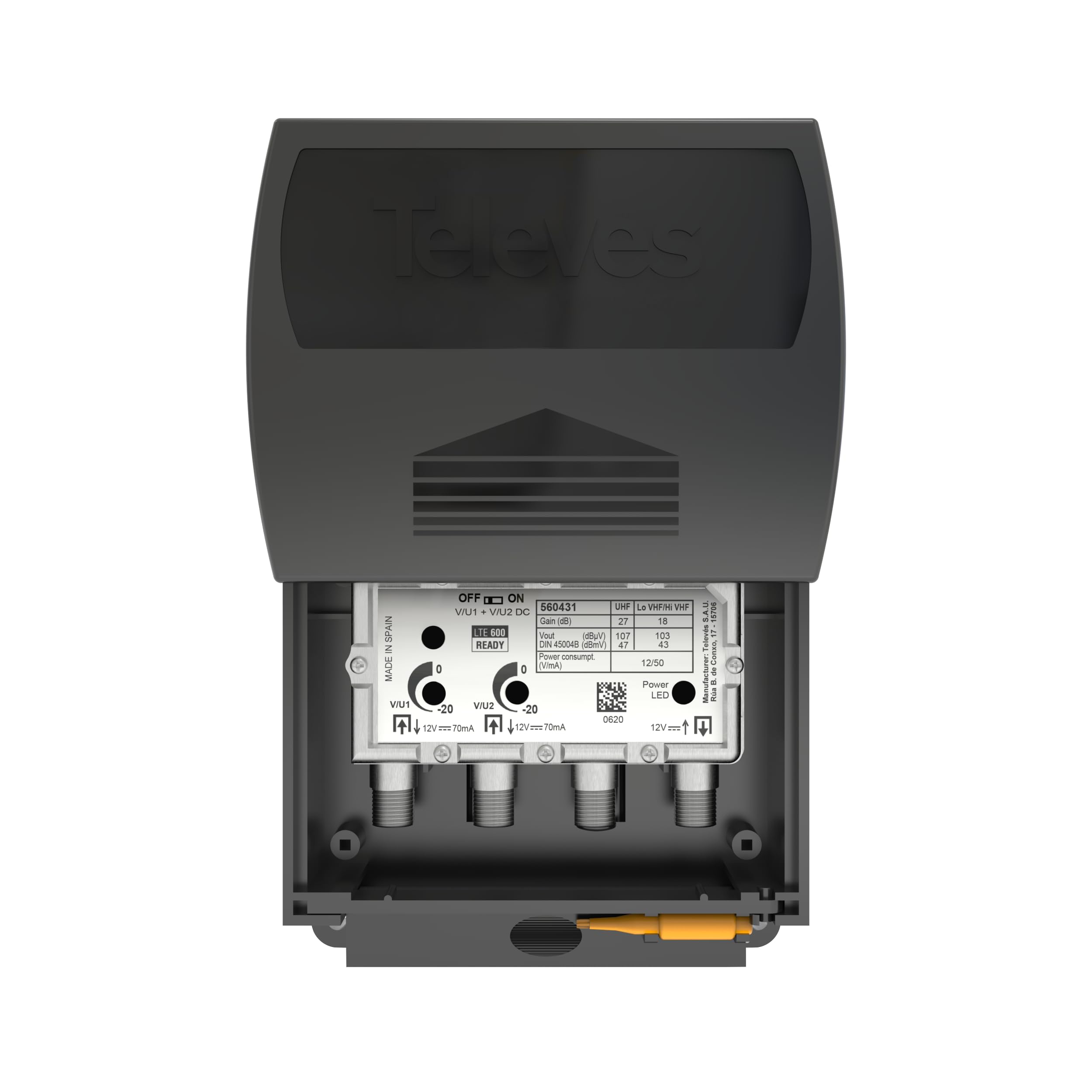
The Televes TForce Mast Preamplifier is a professional-grade solution for complex installations. Its defining feature is dual independent broadband inputs, each covering low VHF, high VHF, and UHF bands. This allows you to combine two antennas pointing in different directions — for example, one aimed at a distant market and another at a local market — without needing a rotator. The TForce technology continuously monitors and self-adjusts amplification independently per band, maintaining a stable output level even as signal conditions fluctuate throughout the day.
Built-in precision filters block FM radio, LTE, and 5G signals above 608 MHz before they enter your system. The steep filter skirts remove the most common sources of OTA interference right at the mast. Each input also has a 0–20 dB manual regulation control, letting you fine-tune the balance between your two antennas when one signal is much stronger than the other. The IP23-rated cast metal and ABS housing provides excellent electromagnetic shielding and weather resistance for outdoor mast mounting.
Users who are between two broadcast markets find this preamp transformative. One reviewer combined antennas for South Bend and Chicago stations, achieving rock-solid reception on both. The 19 dB gain is sufficient for moderate cable runs, though some users recommend adding a distribution amplifier for runs over 100 feet feeding multiple TVs. The UL-listed power supply includes two outputs for convenient whole-home distribution.
Why it’s great
- Dual independent inputs let you combine two antennas without a rotator
- Automatic gain control maintains stable output across varying conditions
- Precision filters block FM, LTE, and 5G interference
- IP23-rated housing with excellent electromagnetic shielding
Good to know
- Plastic case design may not seal fully with larger coaxial connectors
- Gain may be insufficient for very long cable runs without additional amplification
- Requires two antennas to fully utilize its inputs
3. Five Star Outdoor HDTV Antenna 200 Mile

The Five Star 200 Mile antenna offers exceptional range potential at a mid-range price point, making it a strong value play for rural installations. Its extended element design — longer and larger receiving elements than many competing antennas — provides more surface area to capture weak signals from distant towers. The package includes a mounting bracket, J-pole, and TV splitter, so you have everything needed for a basic roof or attic installation right out of the box.
User reports show this antenna consistently pulls in 60 to 128 channels from 45 miles away, even with terrain obstructions like mountains and buildings in the signal path. The 40-foot RG6 coaxial cable included is sufficient for most installations, though longer cable runs of 175 feet may cause loss of low-power stations. The antenna is ATSC 3.0 ready and supports 4K, 1080i, 1080p, and 720p broadcasts across VHF (170–230 MHz) and UHF (470–790 MHz) bands.
Assembly requires aligning the VHF vibrator sections with their screw heads facing the same direction — a detail not explicitly called out in the instructions. The included mounting hardware is functional but some users note the J-pole feels flimsy compared to aftermarket mounts. Overall, for users in moderately rural areas with decent line-of-sight to towers, this kit delivers impressive channel counts without the premium price of European brands.
Why it’s great
- 200-mile range with extended element design for weak signal capture
- Complete kit includes J-mount, splitter, and 40ft RG6 cable
- ATSC 3.0 ready for future NextGen TV broadcasts
- Impressive user reports of 60–128 channels at 45 miles
Good to know
- Assembly instructions could be clearer on VHF element alignment
- Included J-mount is not the most robust option available
- Long cable runs beyond 100 feet may require additional amplification
4. PIBIDI UHD-8903 Outdoor TV Antenna

The PIBIDI UHD-8903 focuses on pure reception performance without the complexity of a built-in rotator or smart auto-gain circuits. Its extended element design — longer and larger than typical competitors — physically captures more signal energy from distant transmitters. Working across VHF (170–230 MHz) and UHF (470–790 MHz), it receives both 1080p and 4K broadcasts. The antenna is lightning protected with a grounded design, adding durability for exposed roof installations.
User reviews highlight exceptional results in rural settings. One reviewer in upstate South Carolina picked up many previously unavailable channels with a simple pole mount installation completed in under 30 minutes. Another user replaced a 12–15 year old larger antenna and found the PIBIDI outperformed it, receiving all stations 40–100 miles away with sharp, clear pictures. The 200-mile range claim is optimistic under real-world conditions, but 40–100 mile performance is consistently verified.
Assembly is straightforward — most elements come pre-assembled, with only a few needing to be combined. The lack of a built-in rotator means you must manually aim the antenna, which can be inconvenient if towers are in different directions. No installation cable, splitter, or mounting pole is included, so budget for those separately. For users who can dedicate a fixed direction toward broadcast towers, this antenna provides remarkable value and signal capture.
Why it’s great
- Extended elements provide superior signal capture over competitors
- Exceptional rural performance with 40–100 mile reception verified
- Lightning protected with grounded design for durability
- Quick assembly with pre-assembled components
Good to know
- No built-in rotator, requiring manual adjustment for multi-direction towers
- Cable, splitter, and mounting hardware not included
- 200-mile range claim is optimistic in practice
5. 1byone Omni-Directional TV Antenna

The 1byone omni-directional antenna solves a specific pain point: eliminating the need for a rotator when broadcast towers surround your location. Its 360-degree reception pattern picks up UHF and VHF signals from all directions simultaneously, making it ideal for valley locations or homes with towers scattered around the compass. The built-in pre-amplifier with Smart Pass technology boosts signals right at the antenna, compensating for signal loss from cable runs up to 32 feet.
An integrated 4G LTE filter removes interference from mobile phone towers, which is critical for suburban and rural installations. The moisture-proof and flame-retardant materials make it suitable for outdoor, attic, or RV use. User reports vary significantly based on location — a Manhattan user received 60 channels including major networks, while a rural user initially got 124 channels but saw that drop to 70, many of which were non-English. Placement is critical; moving the antenna even a few feet can change the channel lineup.
The antenna supports only one TV output. Adding a splitter divides the signal strength, potentially losing channels. The compact 11.8 x 11.8 x 8.9 inch size makes it easy to mount, and assembly requires no tools. However, users report long-term outdoor reliability concerns, with some units filling with water after two years outdoors, corroding the preamp and RF connector. For attic installations where weather exposure isn’t a factor, this is a solid performer.
Why it’s great
- 360-degree reception eliminates need for rotator adjustment
- Built-in pre-amp with 4G LTE filter reduces cell tower interference
- Compact, tool-free assembly suitable for multiple mounting locations
- Good value for testing cord-cutting in multi-direction tower areas
Good to know
- Not fully waterproof for long-term outdoor use without sealing
- Single TV output only; splitting reduces channel count
- Channel lineup can change significantly with small placement adjustments
6. Five Star HDTV Antenna 150 Mile Rotator

The Five Star HDTV Antenna with motorized rotation brings remote-controlled directional tuning to a budget-friendly price point. Its 360-degree rotation motor is controlled via a wireless remote (requiring AAA batteries, not included), allowing you to aim the antenna precisely at broadcast towers without climbing onto the roof. The built-in super high gain, low-noise amplifier ensures clean signal amplification for VHF (45–860 MHz) and UHF reception.
The package includes a control box, remote, 40-foot RG6 coaxial cable, and a 4-way splitter, supporting up to 5 TVs when using the included splitter. Users in signal-challenged locations report success — one reviewer in a valley who had never gotten antenna reception before picked up 61 clear HD channels after a straightforward installation. The antenna supports 4K, 1080i, 1080p, and 720p broadcasts, making it compatible with modern TVs.
There are notable durability concerns. Some users report the rotator motor failing or developing play within months, causing signal loss when wind affects the antenna position. The remote lacks a direction indicator (no N/E/S/W markers), making it hard to know where the antenna is aimed. Multiple reviewers also note that a mounting pole is not included, requiring a separate purchase. For users who need rotator convenience at a low entry price, this unit works well initially but may require replacement sooner than premium options.
Why it’s great
- Remote-controlled 360-degree rotation for easy re-aiming
- Supports up to 5 TVs with included 4-way splitter
- Budget-friendly entry point for motorized antenna setups
- Works well for users in challenging reception locations
Good to know
- Rotator motor durability is questionable, with some units failing within 6 months
- No direction indicator on the remote control
- Mounting pole must be purchased separately
- Wind can cause play in movement, losing signal alignment
7. PBD Amplified Outdoor TV Antenna 150 Mile

The PBD amplified antenna takes the motorized rotator concept and refines it with better build quality and future-proofing. Its 360-degree motorized rotation is controlled wirelessly, and the unit is ATSC 3.0 (NextGen TV) ready, meaning it can receive the latest over-the-air broadcast technology with enhanced picture quality, immersive audio, and richer colors once available in your area. The built-in high-gain, low-noise amplifier delivers up to 150-mile range capability.
Dual TV outputs allow you to connect two TVs directly without needing an external splitter — a convenient feature for multi-room setups. The weatherproof and durable design handles harsh outdoor conditions year-round. User reports are consistently positive, with one user replacing a Mohu Sky 60 and getting more channels without pixelization. A second unit installed in a poor apartment location (ground floor, obstructed) matched the channel count and reception quality of the first unit, demonstrating consistent performance.
The included installation kit provides 40 feet of RG6 coaxial cable and mounting hardware, though the lag bolts used during installation may require a pre-drilled pilot hole to avoid snapping. The manufacturer offers a lifetime warranty with 24/7 customer support, which users praise for responsiveness — one reviewer reported the manufacturer contacted them immediately with detailed channel map information. For those who want a reliable motorized antenna with next-gen compatibility, this is a stronger bet than budget competitors.
Why it’s great
- ATSC 3.0 ready for next-generation OTA broadcasts
- Dual TV outputs eliminate need for external splitter
- Consistent performance across multiple installation locations
- Lifetime warranty with responsive 24/7 customer support
Good to know
- Lag bolts may snap without pre-drilled pilot holes during installation
- Some users report fewer channels than older competitors at the same location
- Range may be less than advertised in hilly terrain
FAQ
Should I install the amplifier at the antenna or inside the house?
Can too much gain cause reception problems?
Do I need an amplifier if my antenna is close to broadcast towers?
Final Thoughts: The Verdict
For most users, the amplifier for outdoor tv antenna winner is the Televes DiNova Boss Mix because it integrates intelligent gain control, comprehensive filtering, and a low-profile design into a single unit that works in both attic and outdoor installations. If you need to combine two antennas for multi-market reception, grab the Televes TForce Mast Preamplifier. And for budget-conscious users seeking a complete kit with motorized rotation, the PBD Amplified Antenna offers ATSC 3.0 readiness and reliable customer support at a compelling price point.