
Getting those tight, perfectly-defined layers in a Japanese rolled omelette requires a pan that holds steady heat across a narrow rectangular surface. Standard round skillets force the egg into a crescent shape, making it nearly impossible to roll a uniform block. A dedicated rectangular pan solves this, but the material choice—cast iron versus non-stick aluminum—determines whether you get a golden-brown crust or a pale, steamed result.
I’m Min — the co-founder and writer behind Gadgets Feed. This guide came from hours of cross-referencing technical specs, comparing heat-retention data, and analyzing user feedback on seasoning durability for this specific cookware niche.
After evaluating both forged aluminum and traditional ironware options, I’ve narrowed down the field to find the very best cast iron tamagoyaki pan that delivers authentic results without frustrating cleanup.
How To Choose The Best Cast Iron Tamagoyaki Pan
Not every rectangular pan can handle the layered rolling motion required for tamagoyaki. Cast iron brings weight, thermal mass, and a developing non-stick surface that aluminum pans cannot replicate. Focus on these three factors to avoid a pan that either sticks or fails to brown properly.
Pre-Seasoning vs. Raw Surface
A pre-seasoned pan arrives with a baked-on oil layer that provides immediate non-stick performance. However, the quality of that factory seasoning varies widely. Some brands apply a thin coat that requires additional home-seasoning before the first egg hits the surface. A raw or lightly-seasoned pan gives you full control to build your own polymerized layer, which tends to be more durable over years of use.
Surface Texture and Smoothness
Cast iron pans from different manufacturers have drastically different surface finishes. A rougher texture helps seasoning adhere, but it also increases friction during the rolling motion. Japanese nambu ironware, like that from Iwachu, is known for being noticeably smoother, which allows the omelette to slide without tearing. Cheaper cast iron may feel like sandpaper initially, requiring several seasoning cycles to smooth out.
Dimensions and Heat Distribution
The inner cooking surface should accommodate three to four whisked eggs without overflowing. Look for dimensions around 7 by 5 inches—this size allows enough depth for rolling while keeping the block compact enough for a sushi topping. Cast iron distributes heat evenly across the flat bottom, but the pan’s walls (straight vs. sloped) affect how easily you can lift and fold the egg layers. Straight sidewalls give you a cleaner edge for each fold.
Quick Comparison
On smaller screens, swipe sideways to see the full table.
| Model | Category | Best For | Key Spec | Amazon |
|---|---|---|---|---|
| Iwachu Iron Tamagoyaki Pan | Premium Cast Iron | Traditional technique | Smooth nambu iron surface | Amazon |
| Iwachu Nambu Ironware 24017 | Premium Cast Iron | Balanced size & quality | Black baked finish, 7.1×5.9″ | Amazon |
| LI-GELISI Pre-Seasoned Iron Pan | Value Cast Iron | Camping & daily use | 3.2 lbs, wood handle | Amazon |
| TECHEF Onyx Collection | Premium Non-Stick | Oven-safe cooking | 450°F oven safe rating | Amazon |
| YumOmNom Pan with Lid | Value Non-Stick | Included accessories | Wood handle, glass lid | Amazon |
| TECHEF Japanese Omelette Pan | Mid-Range Non-Stick | Sloped front for rolling | 7.5×5.5″, induction-ready | Amazon |
| FUNGYAND 12-in-1 Set | Value Non-Stick | Full sushi kit starter | Includes rice molds & knife | Amazon |
In‑Depth Reviews
1. Iwachu Iron Tamagoyaki Omelette Pan

The Iwachu Iron Tamagoyaki Pan represents traditional Japanese nambu ironware craftsmanship with a surface that is noticeably smoother than most cast iron competitors. This smoothness directly impacts the rolling process—there is less friction against the egg sheet, which reduces tearing during each fold. The pan weighs 2.7 pounds, providing enough thermal mass to maintain temperature even when cold eggs hit the surface, which is critical for achieving that thin, even first layer.
Its pre-seasoning is durable enough to resist scratching from wooden chopsticks or silicone spatulas, but many users find that a single home-seasoning session with grapeseed oil at 450°F improves non-stick performance significantly. The wooden handle is removable, which allows you to bake the pan for deep seasoning or cleaning in the oven. Inner dimensions comfortably hold 3 whisked eggs, though 4 eggs will be tight—this forces a slightly taller roll, which is closer to authentic Japanese proportions.
One tradeoff is that the rectangular shape may wobble slightly on glass-top induction stoves due to the lack of a fully flat base across the entire surface. A 5 to 10 minute preheat on medium-low is required before cooking. The pan is not dishwasher safe and requires hand drying and a light oil coating after each use. Over time, the seasoning matures into a virtually non-stick surface that outperforms any disposable non-stick coating.
Why it’s great
- Authentic nambu iron with smooth casting reduces egg tearing during rolls.
- Removable wood handle allows high-temperature oven seasoning.
- Heat retention keeps pan temperature stable through multi-layer rolling.
Good to know
- May wobble slightly on flat glass induction stovetops.
- Requires minimum 5-minute preheat on low to prevent sticking.
- Hand wash only; never use soap or abrasive scrubbers.
2. Iwachu Nambu Ironware 24017 Tamagoyaki

The Iwachu 24017 is a slightly smaller version of the classic tamagoyaki pan, with inner dimensions of 7.1 by 5.9 inches and a depth of 1.1 inches. This makes it ideal for single or double-egg servings, producing a compact rolled omelette that fits neatly into a bento box. The black baked finish is a traditional Japanese surface treatment that provides a solid foundation for seasoning without any synthetic coating.
At 1.18 kilograms (about 2.6 pounds), the pan is dense enough to hold heat but not so heavy that maneuvering becomes difficult during the rolling process. The wooden handle is securely attached and stays cool during stovetop use, though it is not removable, limiting your ability to bake it at extremely high temperatures. Users report that a low-medium preheat of 10 minutes followed by a thin oil coating before and after each use creates a non-stick surface that rivals any Teflon pan.
The construction is slightly thicker than the standard Iwachu iron pan, which improves heat distribution across the flat base. However, the steeper sidewalls require careful spatula work to lift the egg edges cleanly. Induction compatibility is good, but the flat bottom ensures no wobbling on glass surfaces, unlike the larger model. This pan is built to last a lifetime with proper care, making it a strong investment for anyone serious about tamagoyaki technique.
Why it’s great
- Thicker cast iron walls provide excellent heat distribution across the cooking surface.
- Compact size is ideal for single servings and bento preparation.
- Black baked finish creates excellent adhesion for seasoning layers.
Good to know
- Fixed handle cannot be removed for oven seasoning above 400°F.
- Steeper walls require careful lifting technique for the first fold.
- Hand wash only; dish soap will strip the seasoning.
3. LI-GELISI Pre-Seasoned Cast Iron Tamagoyaki Pan

The LI-GELISI pan is a 9×7 inch rectangular cast iron pan that includes a wood handle, a stainless steel scraper, redwood chopsticks, and a silicone oil brush—a comprehensive kit for anyone starting tamagoyaki from scratch. The pan arrives pre-seasoned with a natural oil finish, which cuts down the initial preparation time significantly. Out of the box, it is ready for immediate use on gas, electric, induction, and even open campfires.
Weighing 3.2 pounds, this is one of the heavier options in this lineup, which translates to exceptional heat retention. The mass helps maintain temperature during the rolling process, but it also makes the pan feel unwieldy for quick flips. The rough casting texture provides excellent surface area for seasoning to bond, though the first few uses may require a bit more oil to prevent sticking until the patina builds up properly.
One standout feature is the included oil brush and scraper, which are specifically designed for cast iron maintenance—the scraper helps remove stuck bits without damaging the seasoning, and the brush makes oil application even. The wooden handle is comfortable, but it must be avoided during oven use as it is not rated for high temperatures. This pan works best for those who plan to use it daily and want a complete starting kit without buying separate accessories.
Why it’s great
- Complete starter kit includes scraper, chopsticks, and oil brush.
- Heavy 3.2-pound construction provides superior heat retention for even browning.
- Works on all stovetops including induction and open campfires.
Good to know
- Rough surface texture requires extra oil during the first few uses.
- Handle is not removable, limiting oven seasoning temperatures.
- Weight makes one-handed flipping more difficult than lighter pans.
4. TECHEF Onyx Nonstick Tamagoyaki Pan
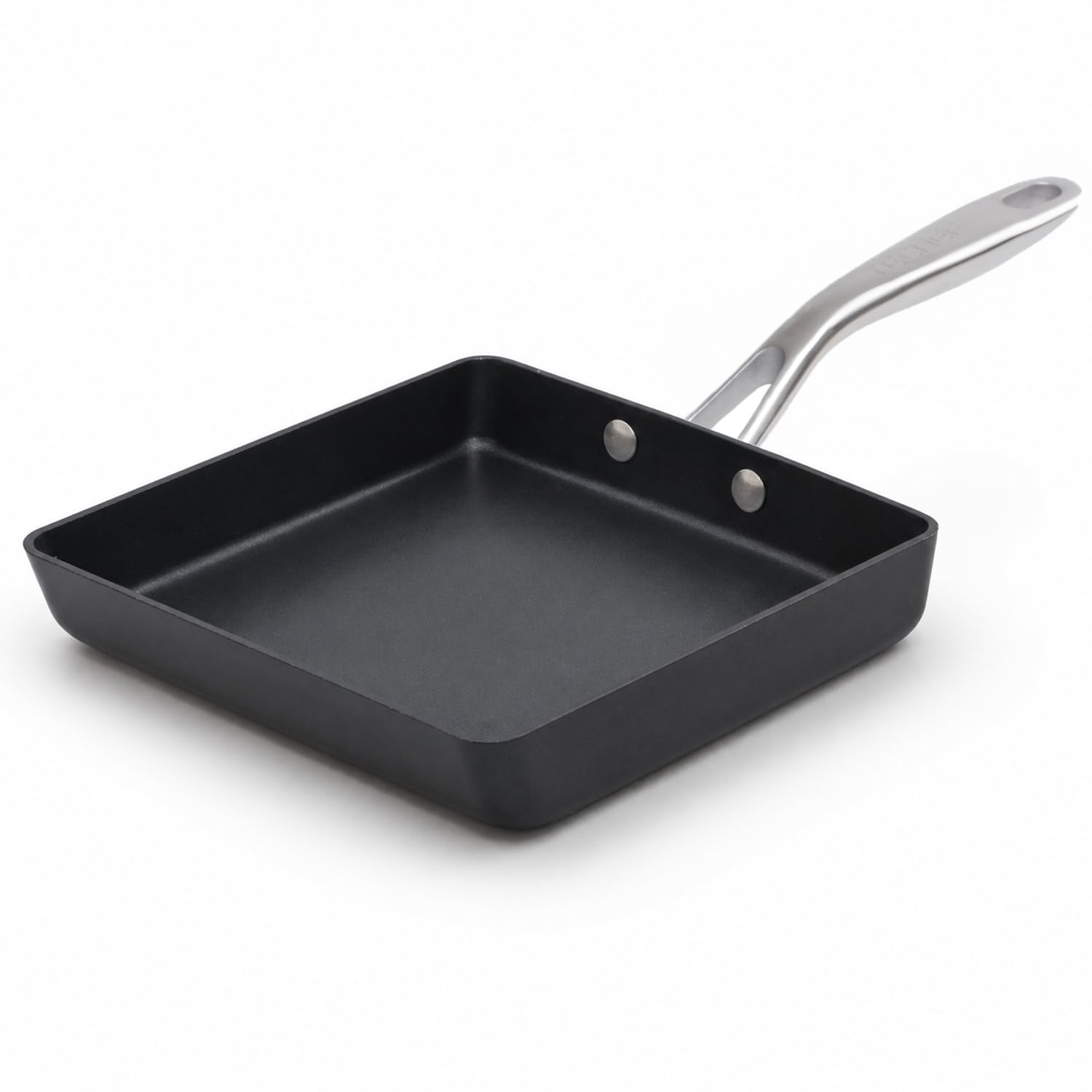
The TECHEF Onyx Collection enters as a premium aluminum non-stick pan that deviates from cast iron but delivers a different set of advantages. Its forged heavy-gauge 3004 aluminum construction heats up faster than cast iron and eliminates the need for seasoning entirely. The 3-layer reinforced Platinum non-stick coating is PFOA-free and designed with scratch-resistant technology, making it suitable for daily use without the maintenance ritual that cast iron demands.
The sloped front and straight sidewalls make the rolling motion intuitive—even first-time users can achieve clean layers without the egg sticking. At 16 ounces total weight, this pan is significantly lighter than any cast iron option, allowing for easy one-handed maneuvering. The double-riveted stainless steel handle stays cool on the stovetop and is oven-safe up to 450°F, giving you the flexibility to finish dishes under the broiler.
One issue reported by users is that the non-stick coating can degrade over time if exposed to high heat or metal utensils. The pan is dishwasher safe, but hand washing is recommended to extend the coating life. Induction compatibility is solid, but the pan requires more power to reach temperature than cast iron because aluminum conducts heat away faster. This pan is ideal for users who want convenience and speed over the traditional cast iron experience.
Why it’s great
- Immediate non-stick performance with no seasoning required.
- Very lightweight at 16 ounces, making one-handed rolling effortless.
- Oven safe up to 450°F and dishwasher safe for easy cleaning.
Good to know
- Non-stick coating will degrade over time with high heat exposure.
- Aluminum construction loses heat faster than cast iron during rolling.
- Induction cooking requires higher power settings for even heat.
5. YumOmNom Tamagoyaki Pan with Glass Lid

The YumOmNom pan offers a unique proposition: a rectangular non-stick pan that includes a matching glass lid, which is rare in the tamagoyaki category. The lid allows you to steam the top of the omelette during the initial cooking phase, which can help set the egg evenly before you begin rolling. The pan body uses a 3-layer inner non-stick coating with rust and abrasion resistance, built on two heat-conducting layers for even temperature distribution.
The composite wood handle is ergonomically shaped and remains cool during stovetop use. The pan is compatible with induction, electric, gas, and natural gas stoves, though the manufacturer notes that outdoor open-fire use is possible. At 1.19 kilograms, the pan feels solid without being overly heavy. The included glass lid has a vent hole, which helps regulate moisture—useful for keeping the egg layers moist rather than dry.
One consideration is that the non-stick coating is not oven-safe, limiting its use to stovetop only. The pan is dishwasher safe, but the high heat cycles may degrade the coating faster than hand washing. Users have noted that the rectangular shape is slightly smaller than expected for 4-egg recipes, so this pan works best for 2 to 3 egg portions. Overall, the glass lid adds versatility for dishes beyond tamagoyaki, such as steamed vegetables or shallow frying.
Why it’s great
- Glass lid allows steaming eggs before rolling for even texture.
- Ergonomic wood handle stays cool during extended cooking.
- Multi-stovetop compatibility includes induction and open fire.
Good to know
- Non-stick coating is not oven safe, limiting cooking methods.
- Best suited for 2 to 3 egg portions; 4 eggs will overflow.
- Dishwasher safe, but hand washing preserves coating longevity.
6. TECHEF Japanese Omelette Pan

The TECHEF Japanese Omelette Pan uses forged heavy-gauge 3004 aluminum, which is commercial-grade material known for resisting warping under high heat. The pan measures 7.5 by 5.5 inches with a depth of 1.2 inches, providing a slightly larger cooking surface than the Onyx collection. The sloped front wall is specifically engineered to make the rolling motion easier—you can angle the spatula under the egg sheet without fighting a vertical edge.
The 3-layer Teflon non-stick coating is PFOA-free and includes a patented scratch-resistance technology that holds up better than standard non-stick pans. Users report that even after months of daily use, the coating remains intact without flaking. The pan is induction-ready and works on electric, gas, and ceramic stoves. It is also dishwasher safe and oven safe up to 350°F, giving you moderate oven flexibility.
One limitation is that the non-stick coating requires careful temperature management—exceeding medium heat can cause the coating to degrade. The pan heats quickly due to the aluminum construction, so it is suitable for cooks who want fast results without the preheating time of cast iron. The stainless steel handle is brushed and stays cool, though it can become warm during extended cooking on high heat. This pan is a strong mid-range option for those who want consistent non-stick performance without the weight and maintenance of cast iron.
Why it’s great
- Sloped front wall simplifies the rolling motion for beginners.
- Forged aluminum construction prevents warping over time.
- Patented scratch-resistant non-stick coating lasts longer than standard Teflon.
Good to know
- Non-stick coating is limited to medium heat to prevent damage.
- Aluminum heat conductivity means faster heat loss during rolling.
- Handle can become warm during extended high-heat cooking.
7. FUNGYAND Tamagoyaki Pan 12-in-1 Set

The FUNGYAND 12-in-1 set is the most comprehensive kit in this lineup, including not just the non-stick tamagoyaki pan but also a silicone spatula, bamboo rolling mat, sharp Japanese knife, and molds for onigiri, musubi, and nigiri. The pan itself is 5 by 7 inches with a multi-layered non-stick coating designed for rust and abrasion resistance. The plastic handle is heat-resistant and stays cool during stovetop use.
The non-stick performance is solid for the entry-level price point—users report that eggs slide without sticking during the first several months of use. The pan is compatible with gas, electric coil, and smooth surface induction stoves, though the thin aluminum construction means it heats quickly and may have hot spots if not preheated properly. The included bamboo mat and knife make this a true starter kit for anyone exploring Japanese cooking beyond just tamagoyaki.
The main tradeoff is longevity. The non-stick coating, while effective initially, will degrade faster than premium options like TECHEF or cast iron. The pan is not oven safe and requires hand washing to extend its life. The plastic handle, while comfortable, limits the pan’s ability to be used under a broiler or in the oven. For someone who wants to try tamagoyaki without a significant financial commitment, this set provides everything needed to practice and improve.
Why it’s great
- 12-piece set includes knife, molds, bamboo mat, and spatula.
- Non-stick coating provides easy release for beginner cooks.
- Compatible with induction, gas, and electric stoves.
Good to know
- Non-stick coating durability is lower than premium options.
- Plastic handle prevents oven or broiler use.
- Thin aluminum may develop hot spots without proper preheating.
FAQ
How do I season a cast iron tamagoyaki pan before the first use?
Can I use metal utensils on a cast iron tamagoyaki pan?
Why does my egg stick to the pan on the first use even though it says pre-seasoned?
What is the correct preheat temperature for a cast iron tamagoyaki pan?
How do I clean a cast iron tamagoyaki pan without ruining the seasoning?
Final Thoughts: The Verdict
For most users, the cast iron tamagoyaki pan winner is the Iwachu Iron Tamagoyaki Omelette Pan because its smooth nambu iron surface and removable handle give you the best foundation for building a durable seasoning that produces flawless rolled eggs. If you want a lighter, immediate non-stick experience without the maintenance ritual, grab the TECHEF Onyx Collection. And for a budget-friendly starter kit that includes everything from a knife to rice molds, nothing beats the FUNGYAND 12-in-1 Set.