
Finding a reliable 12V solar power kit often comes down to matching the right panel wattage with the correct charge controller type and battery chemistry. The difference between a system that merely tops off a battery and one that genuinely powers your gear is buried in the controller’s ability to handle voltage drop and the panel’s real-world output under partial clouds. A solid kit eliminates guesswork, letting you focus on the adventure rather than the wiring.
I’m Min — the co-founder and writer behind Gadgets Feed. I’ve spent countless hours analyzing charge controller efficiency curves, battery compatibility matrices, and panel temperature coefficients to determine which kits deliver on their ambitious claims without forcing you into expensive upgrades.
Whether you are equipping an RV for extended boondocking or setting up a backup system for a shed, this guide to the best 12v solar power kit covers the critical specs and real-world performance data you need to invest wisely.
How To Choose The Best 12V Solar Power Kit
Selecting a complete 12V kit is about evaluating three core components as a unified system — panel type, charge controller, and battery storage. An imbalance in any one of these elements will throttle your entire setup’s performance. Focus on the controller’s Maximum Power Point Tracking capability and the battery’s depth of discharge before you settle on a price bracket.
Panel Efficiency vs. Available Roof Space
Monocrystalline panels dominate the market because they offer the highest efficiency per square foot. If your RV roof or shed has limited real estate, look for panels with a conversion rate above 22%. N-Type bifacial designs add another layer by capturing reflected light from the backside, boosting total output by up to 30% in ideal conditions — critical for smaller permanent installations.
Charge Controller: MPPT is Non-Negotiable for Serious Use
PWM controllers are simple and cheap but waste a significant percentage of the panel’s potential when the battery voltage is low. An MPPT controller can harvest up to 30% more energy from the same panel, especially during winter or partial cloud cover. The premium you pay for an MPPT controller is typically recovered in faster charge times and a healthier battery over the first year of use.
Battery Chemistry and Usable Capacity
LiFePO4 batteries now deliver 4000 to 15000 cycles compared to the 300-500 cycles of lead-acid. More importantly, 100Ah of LiFePO4 gives you roughly 1280Wh of usable energy at consistent voltage, whereas a lead-acid battery of the same rating only offers about half that before voltage sag kills the load. The weight savings are also dramatic — a 100Ah LiFePO4 battery weighs around 22 pounds versus over 60 pounds for lead-acid.
Quick Comparison
On smaller screens, swipe sideways to see the full table.
| Model | Category | Best For | Key Spec | Amazon |
|---|---|---|---|---|
| Renogy 400W Premium Kit | Premium System | High-power off-grid RV setups | 40A MPPT + Bluetooth | Amazon |
| Callsun 400W Bifacial | Panel Kit | Maximum panel efficiency in heat | 25% N-Type 16BB cells | Amazon |
| Renogy 200W RV Kit | Mid-Range Kit | Mid-power van conversions | 22% panels + 30A PWM | Amazon |
| LiTime 100Ah Bluetooth Battery | Battery Upgrade | Expanding existing solar setups | 15000 cycles, 100A BMS | Amazon |
| ECO-WORTHY 200W Starter Kit | All-in-One Kit | First-time solar campers | 50Ah LiFePO4 + 600W Inverter | Amazon |
| Redodo 100Ah LiFePO4 | Battery Upgrade | High-cycle solar battery bank | 100A BMS, 10-year life | Amazon |
| DOKIO 200W Dual Panel Kit | Budget Panel Kit | Shade-prone or low-light areas | Half-cell + bypass diodes | Amazon |
| Topsolar 100W Kit | Entry-Level Kit | Battery maintenance and trickle charge | 30A PWM with angle bracket | Amazon |
| SOLPERK 50W Kit | Compact Kit | Tiny batteries and gate openers | 21-30% efficiency, IP65 controller | Amazon |
In‑Depth Reviews
1. Renogy 400 Watt Premium Kit

This kit delivers 2-2.5kWh per day using four 100W monocrystalline panels paired with a 40A MPPT Rover charge controller. The MPPT controller boasts 99% tracking efficiency and a peak conversion of 98%, outperforming typical PWM controllers by a substantial margin. The 22.5% panel efficiency is paired with a robust 35mm aluminum frame and 3.2mm low-iron glass to handle 2400Pa wind and 5400Pa snow loads, making it suitable for permanent rooftop installation on an RV or cabin.
The included BT-1 Bluetooth module connects the controller to the Renogy DC Home App, allowing real-time adjustments to boost voltage and monitoring of battery state from up to 82 feet away. This is a genuinely useful feature for tweaking parameters when switching between battery chemistries. The kit also comes with Z-brackets, Y-branch connectors, an adaptor kit, and tray cables — everything needed for a clean install except the battery itself.
Long-term users report that after three to five years of continuous use, the system still functions perfectly with no significant drop in panel output. The 10-year panel warranty and 3-year MPPT warranty offer solid peace of mind. The only minor complaint is that the Bluetooth connection can occasionally drop, but the controller’s default settings are safe for most lithium and lead-acid batteries.
Why it’s great
- 40A MPPT controller recovers near-dead batteries in hours with high efficiency
- Complete wiring and mounting hardware included, up to 10AWG gauge
- Bluetooth parameter adjustment eliminates guesswork for different battery types
Good to know
- Panel-to-controller cables are on the shorter side, may require extensions for distant mounts
- BT-1 Bluetooth module can be unreliable with connectivity at range extremes
2. Callsun 400W N-Type Bifacial Panel Kit
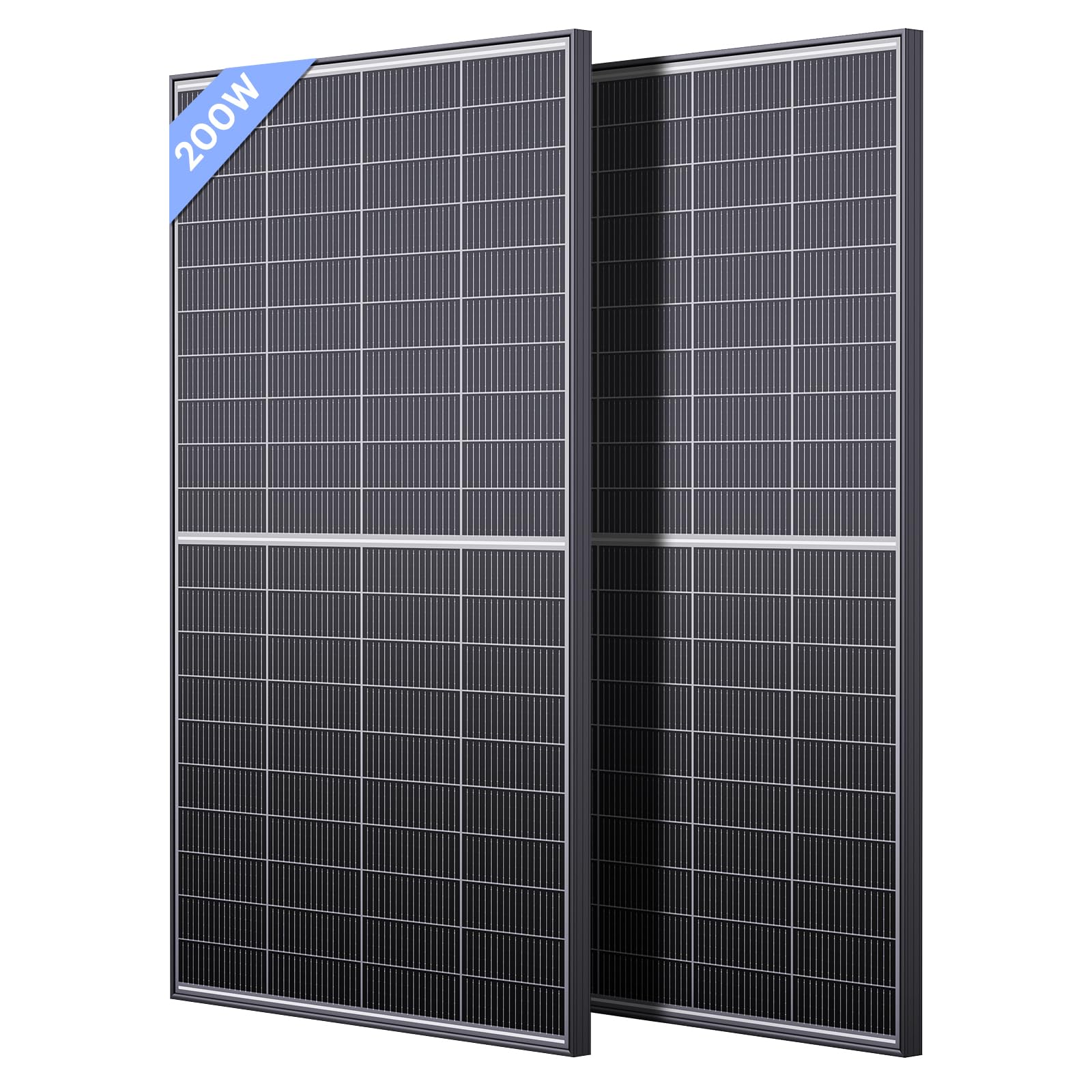
This kit is built around advanced N-Type monocrystalline cells with 16 busbars, achieving a 25% conversion efficiency that exceeds standard PERC panels. The transparent backsheet enables bifacial collection — capturing reflected sunlight from the ground or roof surface to boost total output by up to 30%. In practical terms, many users report these 200W panels consistently peaking above their rated wattage, hitting 420W total in sunny, reflective conditions.
The TwinCell anti-shade technology splits each panel into two independent halves with bypass diodes. If one section is shaded by a vent or AC unit, the unshaded half continues generating at full capacity. This is a critical feature for RVs with rooftop obstructions. The panels also feature a low temperature coefficient of -0.3%/K, meaning they lose less power in hot summer conditions compared to typical panels that drop significantly above 77°F.
Measuring 51.3 inches by 30.3 inches and weighing 23.8 pounds per panel, they fit Class B van roofs more easily than standard 60-cell residential panels. The pre-drilled holes on the back frame allow for mounting on large rail systems. With a 25-year performance warranty guaranteeing at least 84.5% output after 25 years, these panels are built for the long haul. Note that a separate charge controller is required — this is not a full kit with controller and battery.
Why it’s great
- Bifacial design consistently overproduces rated wattage by 5-10% in real settings
- N-Type 16BB cells reduce hot spots and micro-cracks for extended lifespan
- Low temperature coefficient maintains output in 90°F+ climates
Good to know
- Panel kit only — no charge controller or battery included
- Current output may drop below rating in extreme heat despite low temp coefficient
3. Renogy 200W RV Solar Panel Kit

This 200W system uses two 100W monocrystalline panels with 22% efficiency and pairs them with the Adventurer-Li 30A PWM charge controller. The kit produces roughly 800Wh per day under 4 hours of full sunlight, which is adequate for running a 12V fridge and LED lighting in a small van or camper. The panels feature a corrosion-resistant aluminum frame and tempered glass rated for 2400Pa wind and 5400Pa snow loads.
The Adventurer controller supports lithium, lead-acid, and gel batteries with an LCD screen for basic monitoring. Pre-drilled holes on the panel frame and included Z-brackets make installation straightforward. The kit also includes Y-branch connectors for future expansion in parallel. Users consistently report the system keeps batteries at 100% in peak sun while running a 55-quart fridge and exhaust fan continuously.
The primary trade-off is the PWM controller, which wastes some panel potential when battery voltage is low. For users who want maximum harvest from the 200W array, upgrading to an MPPT controller can yield an additional 20-30% energy capture. The Bluetooth module is included, but the Renogy DC Home App has been criticized for connectivity issues — some users eventually replace the controller with a Victron MPPT. Still, for the price point, this is a well-rounded starter kit.
Why it’s great
- Pre-drilled holes and included brackets make roof mounting quick for beginners
- Y-branch connectors allow easy parallel expansion up to 400W
- Powers 12V fridge and lights without grid power in moderate sun
Good to know
- PWM charger loses efficiency versus MPPT, especially in low-light conditions
- Bluetooth app connectivity can be unreliable, frustrating remote monitoring
4. LiTime 12V 100Ah Bluetooth Battery
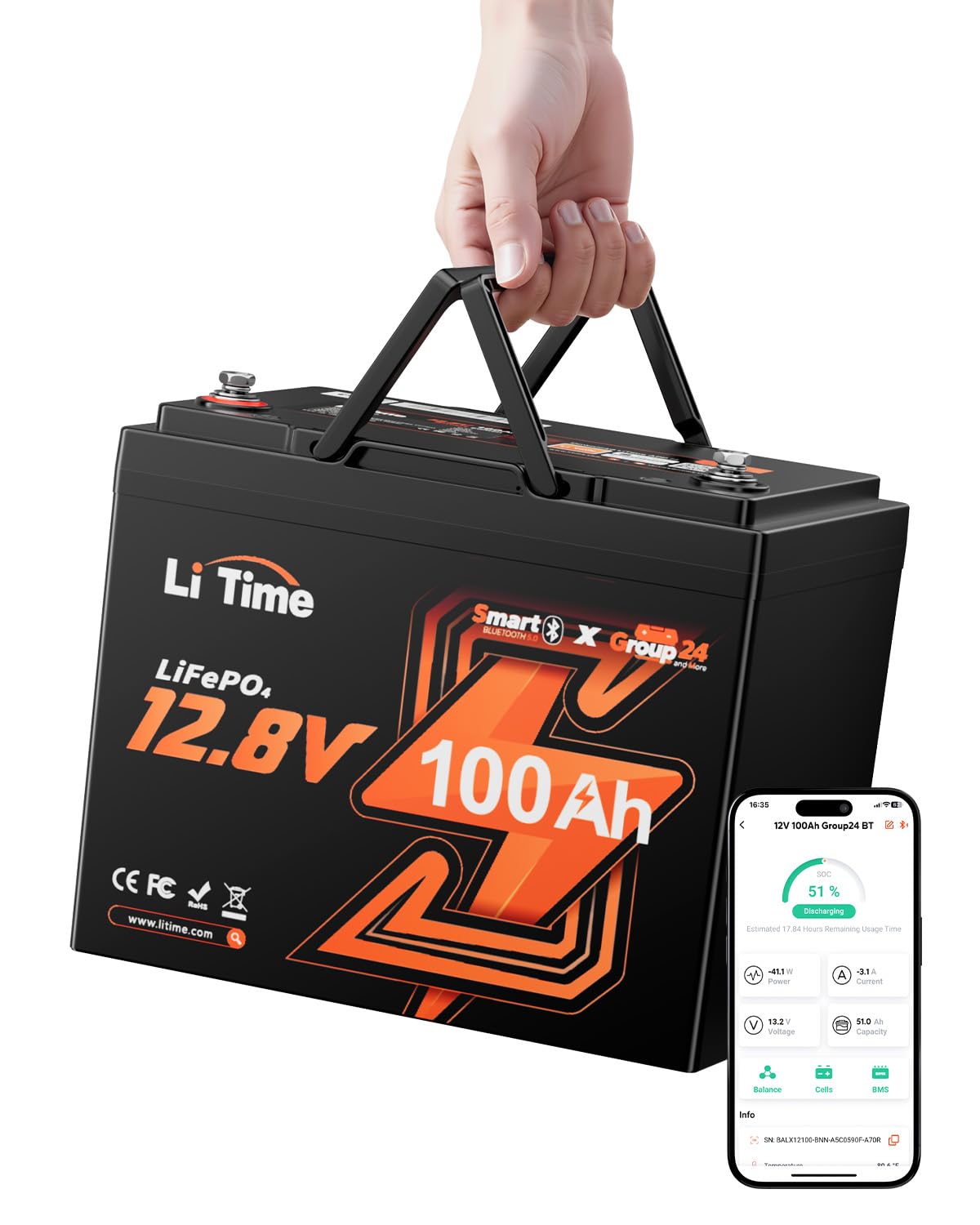
This LiFePO4 battery delivers 1280Wh of usable energy with an advanced 100A BMS that protects against overcharging, over-discharging, overheating, and short circuits. The Bluetooth feature is genuinely useful — you can check real-time state of charge, voltage, and remaining time on your phone without crawling into a storage compartment. Users report the Bluetooth app provides accurate information that helps plan daily energy use with confidence.
The battery fits Group 24, 27, and 31 boxes, and weighs only 21.9 pounds — 63% lighter than a comparable lead-acid battery. With automotive-grade LiFePO4 cells rated for up to 15,000 deep cycles, this battery will outlast multiple lead-acid replacements over a decade. The smart cutoff stops charging below 0°F and discharging below -4°F, protecting the cells in freezing conditions without user intervention.
In real-world use, a single 100Ah battery powers a 55-pound thrust trolling motor for 6-8 hours per day over four days without requiring a recharge. The battery is UL 1973 certified and comes with a 5-year warranty, adding significant reliability for off-grid life.
Why it’s great
- Bluetooth monitoring provides accurate SOC and charging status without physical inspection
- Cold-weather protection prevents damage in freezing conditions automatically
- 15000 cycle rating delivers a decade of daily cycling with minimal degradation
Good to know
- Battery only — requires a separate solar panel and charge controller to operate
- Bluetooth range may be limited in metal battery compartments
5. ECO-WORTHY 200W Complete Solar Starter Kit
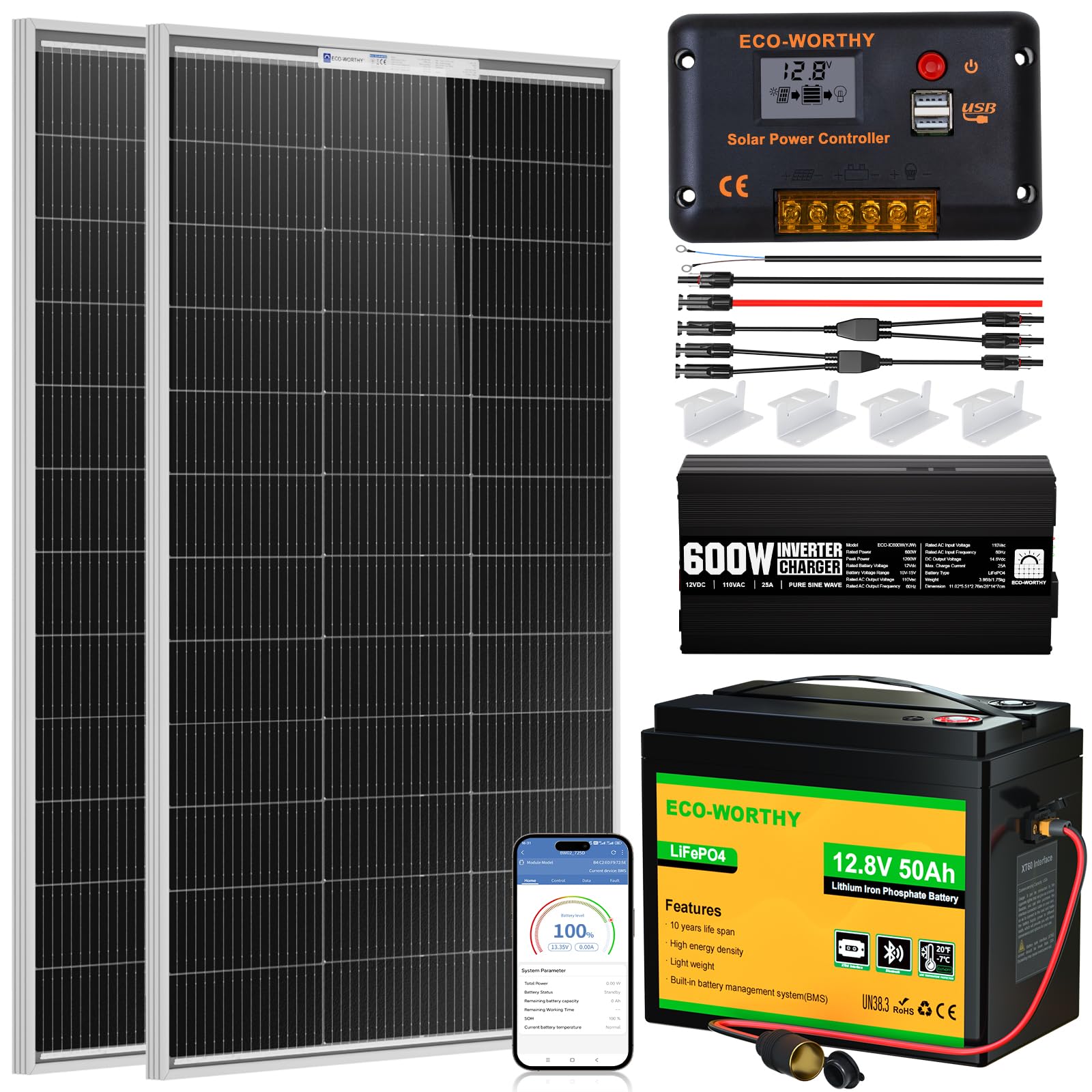
This all-in-one kit includes two 100W N-Type solar panels, a 30A charge controller, a 50Ah LiFePO4 battery with an XT60 port, and a 600W pure sine wave inverter. The N-Type panels achieve 25% efficiency with a bifacial design that captures reflected light for up to 15% extra output. The 50Ah battery delivers 640Wh of usable energy, suitable for running lights, phone charging, a small fan, and a coffee maker during a weekend camping trip.
The pure sine wave inverter provides 600W continuous with 1200W peak surge and a conversion efficiency exceeding 92%. This is adequate for powering sensitive electronics and small appliances. The battery includes an XT60 to cigarette lighter adapter and adds Type-C and USB ports, making it convenient for directly charging phones and laptops without the inverter. The entire system is designed for beginners, with plug-and-play connections where possible.
Shipping is a notable consideration — the kit arrives in five separate packages over the course of a week, and some assembly is required, including crimping MC4 connectors. Some users reported that the included inverter was not durable enough for continuous high loads, and a few received defective units. For light-duty use, this kit provides a stepping stone into off-grid solar without requiring separate component purchases.
Why it’s great
- Complete system with battery, inverter, and panels in one purchase
- N-Type bifacial panels provide higher efficiency in low-light conditions
- XT60 port with USB/Type-C adds direct device charging convenience
Good to know
- Inverter quality is inconsistent — some units arrive defective or underperform
- Shipping is fragmented across multiple carriers, taking over a week
6. Redodo 12V 100Ah LiFePO4 Battery
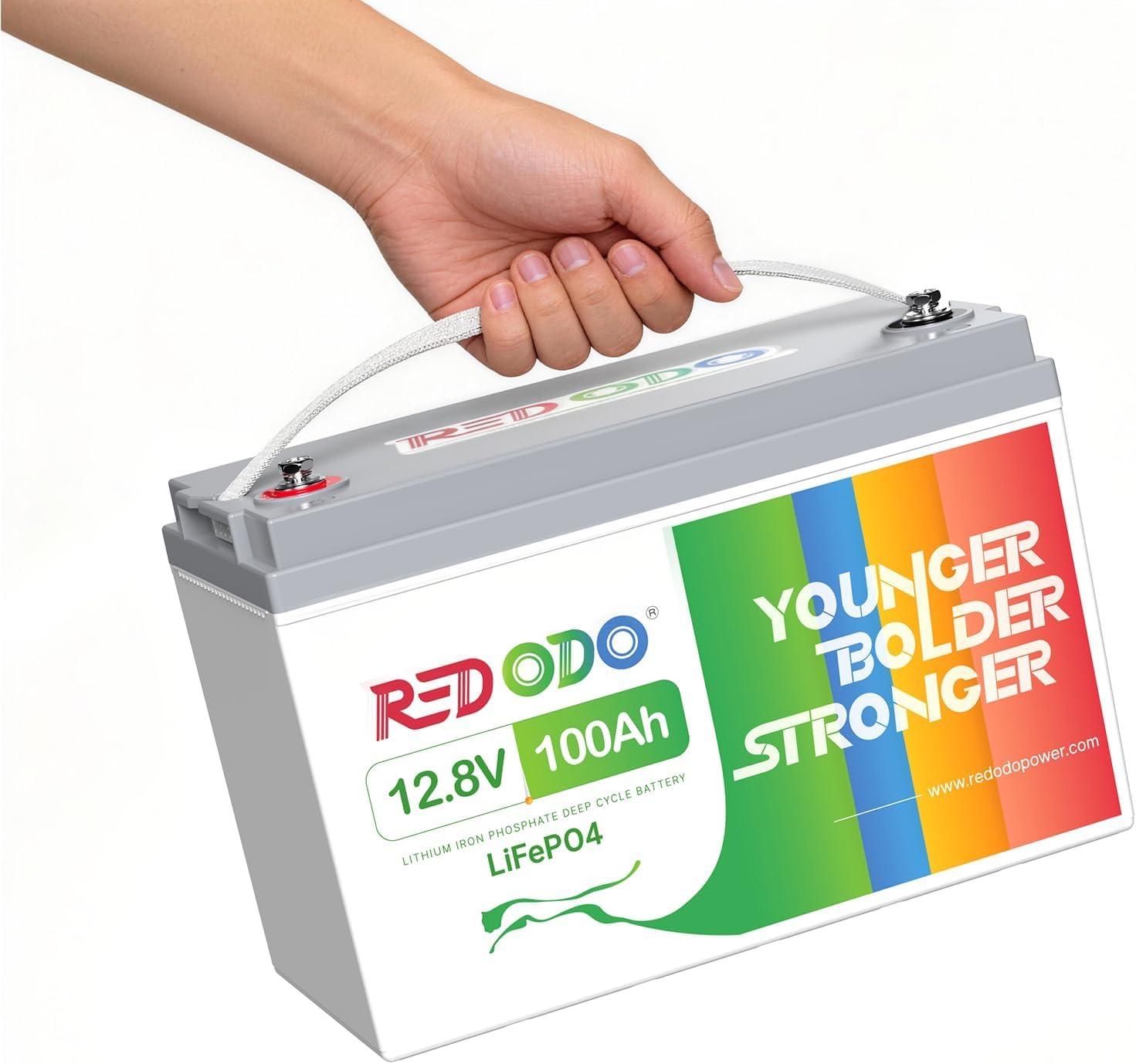
This 12.8V LiFePO4 battery provides 100Ah of capacity with a built-in 100A BMS that protects against overcharge, over-discharge, over-current, short circuit, and high temperature. The automotive-grade cells deliver 4000 cycles at 100% depth of discharge and up to 15000 cycles at 60% DOD, dramatically outlasting lead-acid batteries that typically die after 500 cycles. The battery measures 13 inches by 6.82 inches by 8.46 inches and weighs 22.04 pounds — 60% lighter than a lead-acid equivalent.
The battery supports both parallel and series connections up to 4S4P, allowing expansion to 400Ah capacity or 48V voltage. This flexibility makes it suitable for solar home systems, RV banks, and trolling motor applications. Users report consistent voltage throughout the discharge cycle, eliminating the voltage sag that plagues lead-acid batteries when powering inverters or motors.
Long-term users report three years of daily use in a motorhome with no performance degradation. The Redodo customer support team is responsive and helpful when configuring charge controllers that lack native LiFePO4 profiles. Note that this battery is not suitable for starter applications or golf carts — it is designed for deep-cycle solar and trolling motor use.
Why it’s great
- 4000 cycles at 100% DOD means years of daily use without replacement
- 60% lighter than lead-acid makes installation and transport significantly easier
- Series/parallel expandable to 48V systems or 400Ah capacity
Good to know
- Battery only — separate solar panel and charger required
- Not rated for engine starting or high-cranking applications
7. DOKIO 200W Dual Panel Kit
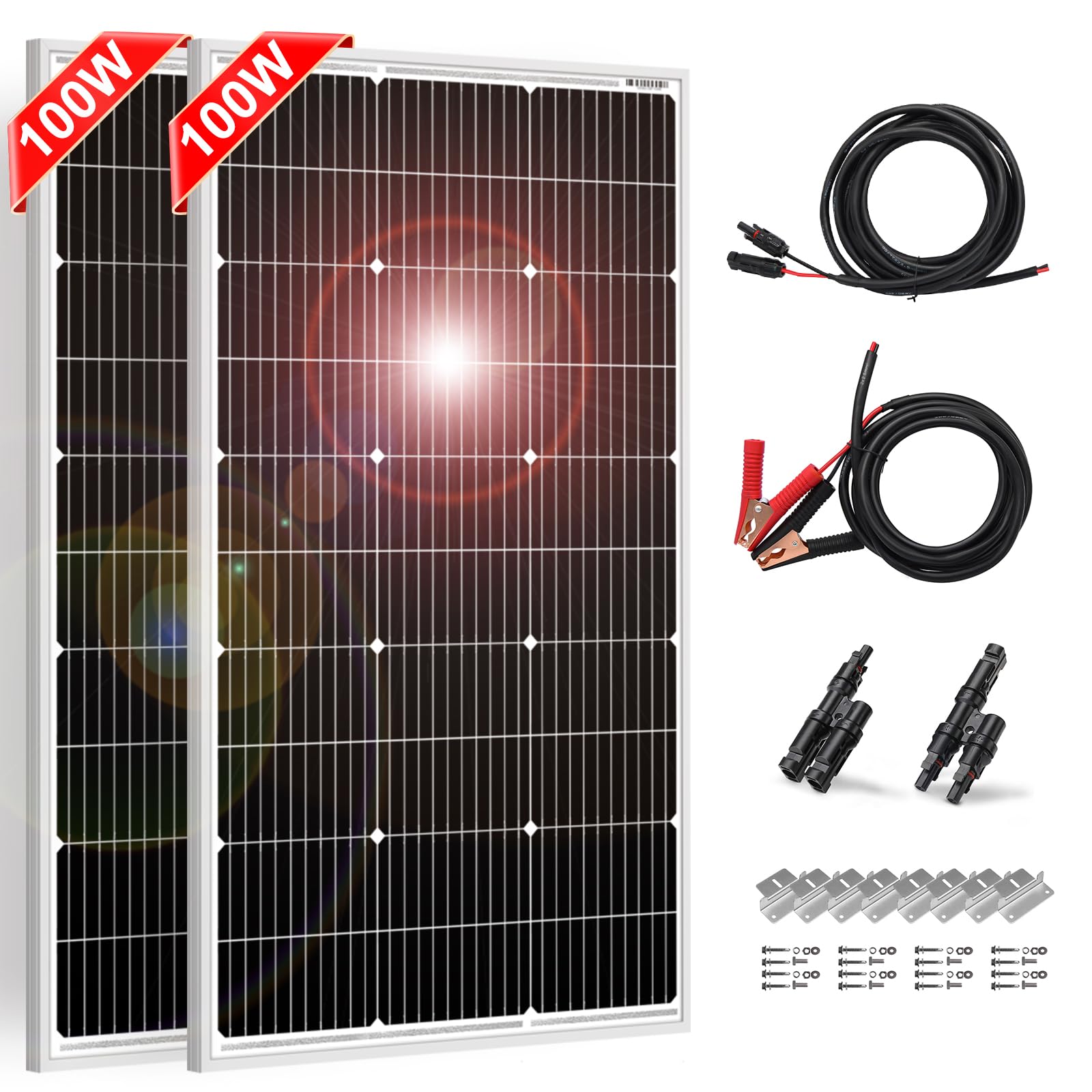
This kit includes two 100W monocrystalline panels featuring a half-cell layout with bypass diodes, designed to reduce shading losses and overheating. The half-cell configuration means if one section is shaded, the unshaded cells continue generating power without the voltage drop that plagues full-cell panels. The panels measure 38.2 inches by 22.2 inches and weigh 24 pounds total, making them more manageable for small roofs or ground mounting.
Included accessories are Z-brackets, alligator clips, and a 5-meter MC4 cable. The 5-meter cable provides extra reach to place controllers or batteries in shaded areas — a practical consideration for installations where the panel must be in direct sun but the battery needs to stay cool. The kit is shipped with foam corners and reinforced cartons to prevent transit damage, which is a common pain point with glass panels.
Note that this kit does not include a charge controller — you will need to purchase a separate PWM or MPPT controller for safe 12V charging. Users report consistent 90-94W output from each 100W panel on hazy days, demonstrating solid real-world efficiency. The build quality is good, with proper diode protection and well-made MC4 connectors. This is a good choice for budget-conscious buyers who already own a charge controller.
Why it’s great
- Half-cell design maintains partial power when one section is shaded
- 5m MC4 cable offers flexible placement for controller and battery
- Packed with foam corners, reducing damage risk during shipping
Good to know
- No charge controller included — must purchase separately
- Door latch clip on packaging can arrive broken in some units
8. Topsolar 100W 12V Solar Panel Kit

This entry-level kit bundles a 100W monocrystalline solar panel with a 30A PWM charge controller, V-shape mounting brackets, two 16ft MC4 cables, and two 5ft O-ring cables for battery connection. The panel weighs 15.84 pounds and measures 46.5 inches by 21.8 inches, with a corrosion-proof aluminum frame and tempered glass surface. The included bracket allows angle adjustment for seasonal sun optimization.
The intelligent charge controller provides full protection against overcharge, over-discharge, over-voltage, and short circuits. It automatically detects 12V or 24V battery systems. The 4.5-amp output is suitable for maintaining and trickle-charging batteries in RVs, tractors, boats, and gate openers. Users report successful use charging multiple tractor and buggy batteries in parallel.
One issue reported by a user is that the controller can lock into 24V mode and refuse to switch back to 12V, even after disconnect and reset attempts. The mounting holes on the aluminum frame may not align perfectly with standard RV roof mounts, requiring drilling through the aluminum. For a basic maintenance charger or a small off-grid setup, this kit performs adequately, but the controller quality is the weak point.
Why it’s great
- Includes adjustable angle bracket for optimal seasonal solar capture
- 16ft MC4 cables provide flexibility for remote panel placement
- Solid construction with anodized aluminum frame and tempered glass
Good to know
- Charge controller may lock into 24V mode, requiring replacement
- Mounting holes do not always align with standard RV roof mounts
9. SOLPERK 50W Solar Panel Kit

This compact 50W kit features high-efficiency monocrystalline cells with a conversion rate between 21% and 30%, coupled with an IP65 waterproof charge controller. The panel uses low-iron tempered glass and a corrosion-resistant aluminum frame, rated to withstand 2400Pa wind pressure and 5400Pa snow load. The kit is designed for charging and maintaining 12V batteries including LiFePO4, Lithium Ion, AGM, SLA, GEL, EFB, and MF types.
Installation is simple with the 60-degree adjustable mounting bracket — you can set the angle at 0°, 15°, 30°, 45°, or 60° to optimize for your latitude and season. All cable connections use SAE connectors for plug-and-play assembly. The kit includes a 10-foot SAE extension cable, alligator clips, and mounting screws. The included controller has three LED lights for charging status indication, though it lacks a display for detailed metrics.
Users report this kit works well for trickle-charging camper batteries and powering a greenhouse fan through a 12V pump system. One user noted the controller failed after about three months while powering a 20Ah lithium battery bank for security cameras. The panel itself continues to perform well in low-sunlight winter conditions in New England. For small, low-draw applications, this kit is functional, though upgrading the controller is a common recommendation.
Why it’s great
- Small footprint fits tight spaces on boats, tractors, and small sheds
- Adjustable bracket with five angle settings optimizes solar capture
- Compatible with multiple battery chemistries including LiFePO4 and AGM
Good to know
- Controller is the weakest component — some units fail within months
- No display, only three LED lights for charging status indication
FAQ
Can I mix different wattage solar panels in the same 12V kit?
How do I calculate the right solar panel wattage for my battery bank?
What is the real output difference between PWM and MPPT in winter?
Final Thoughts: The Verdict
For most users, the best 12v solar power kit winner is the Renogy 400W Premium Kit because it pairs a high-efficiency 40A MPPT controller with well-built monocrystalline panels and Bluetooth monitoring, providing a complete, scalable solution for serious off-grid power. If you want maximum panel efficiency in a compact form factor for tight roof spaces, grab the Callsun 400W N-Type Bifacial Kit. And for a budget-conscious entry into off-grid solar that includes everything you need to start, nothing beats the ECO-WORTHY 200W Complete Starter Kit.