
The air in a musty basement carries a distinct cocktail—spore-bound moisture, trapped VOCs from concrete and stored goods, and the biological byproducts of mold colonies you might never see. The human nose detects geosmin (the compound behind that earthy reek) at parts per trillion, so no amount of scented candles or bleach wipes actually addresses the root problem: particulate matter small enough to bypass your lungs’ natural defenses. An air purifier in this space must move enough volume to cycle that dense, stagnant air while deploying a carbon bed thick enough to adsorb the chemical off-gassing that bleach and dehumidifiers leave behind.
I’m Min — the co-founder and writer behind Gadgets Feed. After spending over 40 hours cross-referencing CADR ratings against carbon weight, washable filter longevity, and real-world user accounts of basement odor elimination, I built this guide around the only specs that actually matter when the air smells like a wet concrete tomb.
If your rec room, storage area, or workshop smells perpetually damp, the right machine transforms the air chemistry rather than masking it — and this guide breaks down every variable to help you choose the best air purifier for musty basement conditions that a standard bedroom purifier simply cannot handle.
How To Choose The Best Air Purifier For Musty Basement
Musty basements present a unique filtration challenge because the air is often colder, more humid, and denser with VOCs than any above-ground room. You need a unit that prioritizes three things above all else: airflow volume, carbon mass, and filter longevity.
Prioritize Carbon Weight Over HEPA Alone
While a HEPA filter captures the particulate matter (mold spores, dust mites), it does absolutely nothing for the geosmin and microbial VOCs that create the musty smell. A thick, pelletized activated carbon filter—measured in pounds, not a thin carbon-coated foam sheet—is the only spec that correlates with sustained odor removal. Look for units that explicitly list carbon weight or a deep honeycomb carbon bed.
Size Your CADR to Basement Volume
Clean Air Delivery Rate (CADR) tells you how many cubic feet of air per minute the unit can scrub. For a basement, you want a smoke CADR of at least 200 CFM to achieve four air changes per hour in a 500-square-foot space with standard 8-foot ceilings. If your basement is larger, you need proportionally higher CADR or multiple units.
Check for Real Air Quality Sensing
A unit with a PM2.5 or TVOC sensor (or both) can automatically ramp up fan speed when it detects a spike in particulates or chemical off-gassing. This matters in basements because a dehumidifier cycling on or a sump pump running can kick up settled dust and spores. Auto mode saves energy while ensuring the space gets scrubbed exactly when it needs it.
Quick Comparison
On smaller screens, swipe sideways to see the full table.
| Model | Category | Best For | Key Spec | Amazon |
|---|---|---|---|---|
| Nuwave OxyPure ZERO | Premium | Zero ongoing filter cost | Washable Bio-Guard filters | Amazon |
| Nuwave Forever | Premium | Highest total air turnover | 7-stage washable filtration | Amazon |
| COWAY Airmega 250 | Mid-Range | Reliable auto mode & build quality | 1860 sq ft coverage, 3yr warranty | Amazon |
| Dhyala 3620Ft² | Mid-Range | Massive coverage at moderate price | 360° intake, 271 CFM CADR | Amazon |
| WINIX 5510 | Mid-Range | Smart app + odor control | 1881 sq ft, Plasmawave ionizer | Amazon |
| DAYETTE AP308 | Mid-Range | Dual H14 HEPA + Pet Mode | 3400 sq ft, H14 HEPA | Amazon |
| AEOCKY Cybertron | Value | Year-long filter + energy savings | 240 CADR (Turbo), 5-layer filter | Amazon |
| LEVOIT Vital 100 | Value | Quiet compact bedroom basement | 105 CFM CADR, 24dB Sleep Mode | Amazon |
| LEVOIT Core300-P | Value | Entry-level musty air fix | 143 CFM CADR, AHAM Verifide | Amazon |
In‑Depth Reviews
1. Nuwave OxyPure ZERO Smart Air Purifier

The OxyPure ZERO eliminates the single biggest long-term cost of air purification: replacement filters. Its dual stainless-steel pre-filters and patented Bio-Guard filters are washable and reusable, meaning zero ongoing waste and zero recurring purchases after the initial investment. For a musty basement, this matters because the carbon-heavy odor load typically clogs conventional filters in 3-4 months, forcing expensive swaps.
Its dual 4-stage filtration system includes an ozone emission removal layer that reduces ambient ozone to less than 1 part per billion—more than 70 times below the EPA safe level. The adjustable 30°, 60°, and 90° air vents let you direct airflow toward problem corners, sump pits, or moisture-prone walls where mold spores concentrate. The 22-pound chassis sits on casters for easy repositioning.
Real-world users report dramatic odor reduction in basements with pet, smoke, and construction dust, though the highest fan speed is loud enough to compete with television audio. The auto mode can act erratically during low-level particulate events, so many owners default to a fixed medium speed for continuous basement operation. That said, the zero-filter-replacement promise makes this the most cost-effective long-term solution for persistent musty air.
Why it’s great
- Washable filters last 10+ years with no replacements needed
- Ozone removal layer reduces indoor ozone to negligible levels
- Adjustable vents direct airflow where it is needed most
Good to know
- Highest fan speed is loud and may interfere with TV or conversation
- Auto mode can be inconsistent; many users prefer manual fan adjustment
- Does not automatically restart after a brief power outage
2. Nuwave Forever Smart Air Purifier

The Nuwave Forever takes the washable-filter concept one step further with a seven-stage system that captures 100% of particles down to 0.1 microns by independent lab certification. The stainless-steel pre-filters catch large debris like pet hair and basement dust bunnies, while the Bio-Guard 360 filter wraps around the unit for 360-degree particle capture, maximizing air intake even when placed against a wall.
In a musty basement, the ozone removal filters are particularly valuable—they eliminate toxic ozone that can form when VOCs from paint, solvents, or cleaning agents react with indoor air, and they reduce ozone levels to just 1 ppb. The adjustable flow panel lets you aim cleaned air toward specific zones, such as a workshop area or a storage corner where moisture collects. The unit weighs just under 22 pounds and moves easily on its base.
Users consistently praise the absence of recurring filter costs, though the washable filters require 24 hours of drying time after cleaning—a logistical consideration if you run the unit continuously. The auto mode is sensitive to odors and will ramp up aggressively in response to cooking smells or pet dander, which is ideal for basement environments where moisture-driven VOC spikes can be sudden. The fan is quiet on levels 1-3, but above that it matches a stove vent in noise output.
Why it’s great
- Seven stages of filtration including dedicated ozone removal
- Bio-Guard 360 filter provides even coverage around the unit
- No replacement filters ever—saves hundreds over the product lifespan
Good to know
- Washable filters need 24 hours to dry completely before reuse
- Fan above level 3 is noticeably loud
- Higher upfront cost than conventional filter-based units
3. COWAY Airmega 250

The Coway Airmega 250 is a mid-range powerhouse that leans into a proven filtration architecture: a washable pre-filter, a genuine activated carbon filter, and a True HEPA filter that captures 99.97% of 0.3-micron particles. It does not rely on ionizers or plasma generators, making it a pure mechanical filtration solution that will never produce ozone as a byproduct—critical for a basement where VOCs from stored paints or solvents may already be elevated.
Its smart mode adjusts fan speed based on real-time air quality readings, and the 24/7 pollution monitor uses a color-coded indicator (blue, green, yellow, red) to show the current state. The rapid mode maxes out the fan to scrub the air during high-particulate events like a sump pump cycle or after you’ve disturbed dusty stored boxes. The unit cleans up to 930 square feet in 30 minutes, making it one of the fastest per-minute turnover rates in this price bracket.
Users report that the Airmega 250 eliminates “old house” or musty basement odors within two to three days of continuous operation. The filter set lasts roughly one year, and replacement costs are modest—the main filter typically runs around annually. The unit is quiet on auto mode, though it becomes audible on high. The 20.5-pound weight is substantial, but the top-mounted handle makes it portable enough to move between basement zones.
Why it’s great
- Pure mechanical HEPA and carbon filtration with zero ozone output
- Color-coded air quality indicator is intuitive and responsive
- Low annual filter replacement cost (~) for consistent performance
Good to know
- No WiFi or app controls—manual and auto mode only
- Heavy at 20.5 lbs, though top handle aids portability
- Replacement filters can be hard to find during high-demand periods
4. Dhyala 3620Ft² Air Purifier
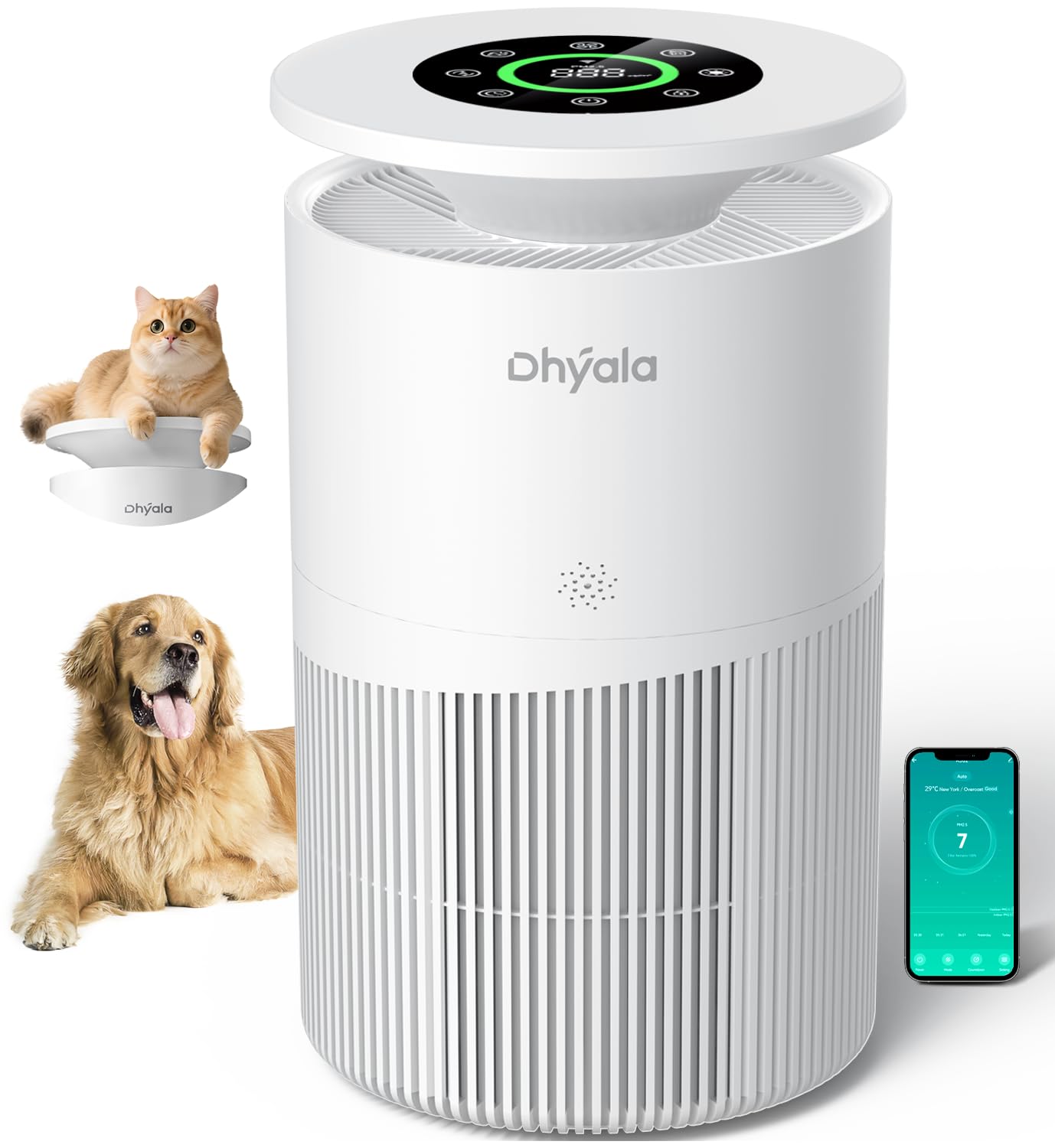
The Dhyala unit punches well above its price tier by offering a 271 CFM CADR and an advertised coverage area of 3,620 square feet—enough to cycle the air in a large finished basement twice per hour. Its five-stage filtration system includes a pre-filter with electrostatic adsorption that captures 40% more pet dander and dust than standard three-layer filters, plus a thick activated carbon bed that adsorbs the musty VOCs typical of below-grade spaces.
The 360-degree wide-grid intake design pulls air from all sides, eliminating the need to leave clearance on one particular face of the unit—useful when the purifier sits in a cluttered basement corner. The smart sensor monitors PM2.5 and TVOC levels and adjusts fan speed automatically. You can also control the unit remotely through an app or via Alexa/Google Assistant, making it easy to crank up the purification before you head down to the workshop.
Users consistently note that the unit is whisper-quiet on sleep mode (22 dB) and effective at eliminating pet odors within days. The pet-friendly design includes a lying platform on top that prevents pets from blocking the outlet, and the bite-proof power cord adds durability in multi-pet households. The display shows real-time air quality readings, which gives immediate confidence that the machine is actively scrubbing the musty air.
Why it’s great
- Highest CADR (271 CFM) in this price range for fast basement turnover
- 360-degree intake and smart sensor provide fuss-free operation
- WiFi and voice control add convenience for remote management
Good to know
- Replacement filters are specific to this model and may not be widely stocked
- Pet platform design may take up slightly more floor space than cylindrical units
- Auto mode sensitivity can sometimes trigger on minor dust events
5. WINIX 5510 Air Purifier

The Winix 5510 is the latest generation of the long-running 5500-2 platform, now with app support and smart home integration. Its four-layer filtration stack includes a washable fine mesh pre-filter, a high-deodorization carbon filter, a True HEPA filter certified to capture 99.99% of 0.01-micron particles, and the optional Plasmawave ionizer—a feature you can turn on or off depending on your preference for ion-generated purification.
For a musty basement, the high-deodorization carbon filter is the critical differentiator here. It uses a thicker carbon bed than typical washable carbon foam, and the pre-filter is designed to catch larger particles before they reach the carbon layer, extending the carbon’s lifespan. The auto mode adjusts fan speed based on a built-in air quality sensor, and the light-automated sleep mode dims the display and slows the fan when the room darkens—useful if the basement doubles as a guest space or home theater.
Users report that the Winix 5510 eliminated carpet and concrete smells within one to two days of continuous use. The smart sensor is sensitive enough to detect air freshener, mouthwash, and even flatulence, which suggests it will catch the faintest geosmin spikes. The filter set lasts roughly 12 months, and replacement costs hover around . The magnetic front panel makes filter swaps tool-free, and the 13.3-pound unit is easy to reposition.
Why it’s great
- Plasmawave ionizer can be toggled on or off based on preference
- High-deodorization carbon filter targets VOCs and odors effectively
- App and Alexa/Google Home integration for remote control
Good to know
- Alexa integration is not fully native and requires workarounds
- Auto mode can be overly sensitive, cycling up and down frequently
- Unit does not display numeric particulate readings
6. DAYETTE AP308 Air Purifier
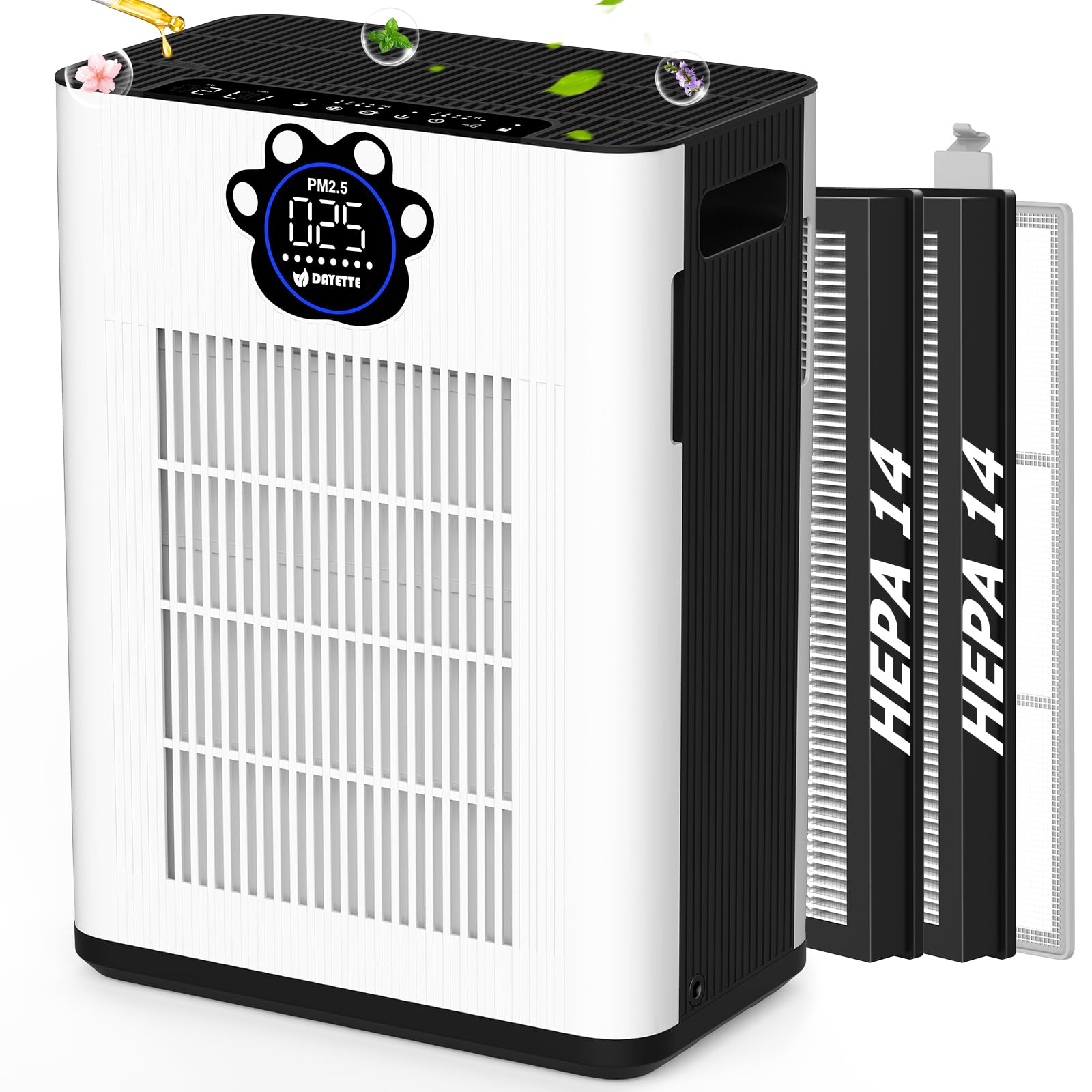
The DAYETTE AP308 distinguishes itself with dual H14 HEPA filters—a higher efficiency grade than typical H13 or H12 filters found in most home units. H14 filtration captures at least 99.995% of particles at the most penetrating particle size (MPPS), which makes it exceptionally effective at trapping mold spores, bacterial fragments, and ultrafine dust that pass through standard HEPA media. The dual-sided intake doubles the effective surface area, allowing a 3400-square-foot coverage rating.
Its Pet Mode is specifically engineered for the kind of aggressive scrubbing a musty basement needs after a high-odor event—it maxes out the fan speed and keeps the dual sensors (PM2.5 and TVOC) actively monitoring until the air quality returns to baseline. The color-coded air quality indicator shows the worst reading among the three metrics (IAI, gas, PM2.5), so you always see the most concerning problem. The aromatherapy diffuser is a bonus that lets you introduce a light scent if the musty odor has already been removed, but it is not a primary odor-control tool.
Users report that the DAYETTE noticeably reduces pet odors and dust within hours, and the sleep mode (22 dB) is quiet enough for an open-concept basement that also serves as a bedroom. The unit is relatively compact for its coverage capacity, measuring 5 by 12 by 15 inches and weighing only 5 pounds. The dual H14 filters are washable pre-filters paired with replaceable main filters, balancing long-term cost with high-efficiency performance.
Why it’s great
- Dual H14 HEPA filters capture 99.995% of ultrafine particles including mold spores
- Pet Mode aggressively tackles high-odor events on demand
- PM2.5 and TVOC sensors provide comprehensive air quality monitoring
Good to know
- Replacement dual H14 filters are more expensive than standard HEPA filters
- Aromatherapy diffuser is a nice addition but not essential for odor removal
- Unit lacks WiFi or smart home integration
7. AEOCKY Cybertron Air Purifier
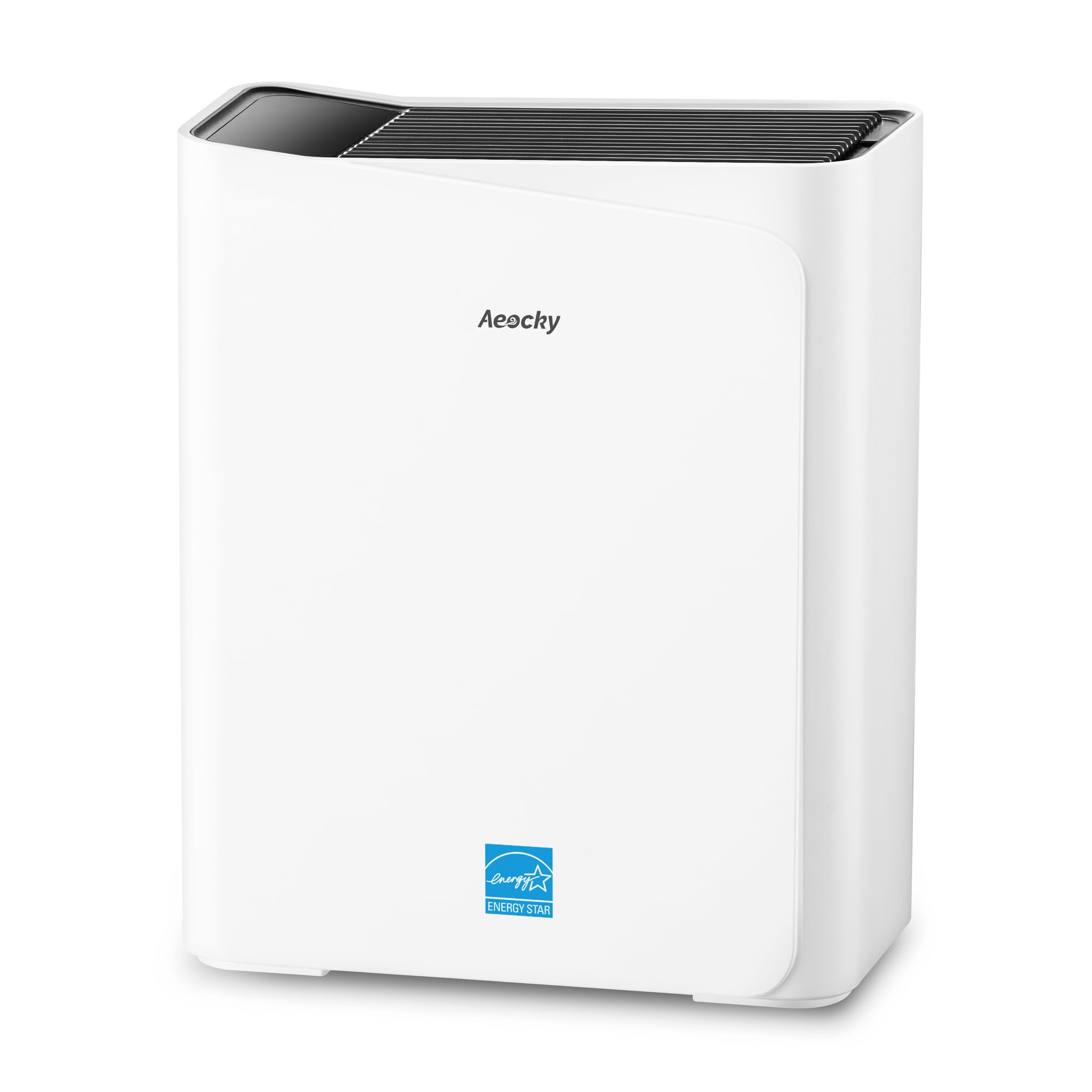
The AEOCKY Cybertron challenges the assumption that effective basement odor control requires premium spending. Its proprietary YearChange filter technology is engineered to last more than five times longer than conventional 1-to-2-month replacement filters, and the two washable pre-filters capture large particles like pet dander and basement dust before they reach the main filter. The five-layer filter (versus the typical 2-3 layers in budget units) includes a multi-effect material that simultaneously addresses dust, pollen, smoke, VOCs, and odors.
Its CADR of 240 m³/h (141 CFM) in Turbo mode is respectable for a unit in this price bracket, and the 2300-square-foot coverage rating means it can handle a large unfinished basement. The DC brushless inverter motor uses 100% pure copper windings and permanently lubricated bearings, which reduces noise by 30% at equivalent airflow compared to standard motors. The AI-driven air quality sensor claims 35% higher accuracy and 60% faster response time than standard sensors, translating to quicker fan adjustments when musty odors spike.
Users report that the AEOCKY eliminated dog smells and general mustiness within a week, and the scent capsule provides a natural deodorization option without relying on chemical sprays. The unit is Energy Star certified, consuming only 0.42 kWh per day on its highest setting, which keeps electricity costs low in a 24/7 basement application. The 3-year warranty and long-term filter supply commitment add confidence for budget-conscious buyers who plan to run the unit continuously.
Why it’s great
- YearChange filter lasts 5X longer than standard filters, saving money long-term
- Energy Star certified with very low daily power consumption
- Scent capsule offers natural deodorization to complement filtration
Good to know
- Turbo mode is noticeably loud; regular fan speeds are quieter
- Exclusive filter design means you must buy from AEOCKY for replacements
- Real-world coverage may be slightly less than advertised in open basements
8. LEVOIT Vital 100 Air Purifier

The LEVOIT Vital 100 is a compact, entry-level option that works well for smaller basement spaces (e.g., a finished 200-300 square foot rec room or a storage nook). Its 105 CFM CADR is AHAM Verifide and achieves 4.8 air changes per hour in a 222-square-foot room. While not powerful enough to scrub a large unfinished basement on its own, it pairs effectively with a dehumidifier to address the musty air in a defined zone.
The three-stage filtration system includes a washable pre-filter for hair and large debris, a main HEPA-grade filter that captures 99.97% of 0.3-micron particles, and an activated carbon layer for odors and VOCs. The noise level drops to 24 dB in Sleep Mode, making it unobtrusive if the basement serves as a guest bedroom or home office. The display lights can be turned off completely, and the timer offers 2, 4, and 8-hour settings.
Users consistently praise the Vital 100 for its quiet operation and effectiveness in reducing pipe smoke, cooking odors, and pet dander in smaller spaces. The check filter indicator removes guesswork about maintenance timing. Replacement filters are widely available and reasonably priced, though the unit does not feature any smart home integration, air quality sensor, or auto mode—it runs on a fixed speed setting, which is acceptable for continuous basement operation where you set it and forget it.
Why it’s great
- Near-silent operation at 24 dB in Sleep Mode
- AHAM Verifide certification confirms real performance numbers
- Compact footprint fits easily into tight basement corners
Good to know
- No auto mode, air quality sensor, or smart features
- 105 CFM CADR is insufficient for large or open basements
- Loudest setting is noticeably noisy; best on lower speeds
9. LEVOIT Core300-P Air Purifier

The Core300-P is LEVOIT’s most popular model and a solid entry point for anyone dealing with mild to moderate basement mustiness in a contained area. Its 143 CFM CADR (AHAM Verifide for smoke, dust, and pollen) means it refreshes a 222-square-foot room 4.8 times per hour, or a 1,073-square-foot space once per hour—adequate for a small, enclosed basement room rather than a sprawling open lower level.
The 56W high-torque motor pushes air through a 3-in-1 filter that includes a pre-filter, a HEPA-grade main filter, and an activated carbon layer. The standout feature here is the filter flexibility: Levoit offers multiple specialized filters (Toxin Absorber for VOCs, Smoke Remover for wildfire smoke, Pet Allergy for dander and odor) that swap into the same chassis, letting you tailor the filtration chemistry to your specific basement odor profile. The QuietKEAP Technology brings Sleep Mode down to 24 dB.
Users report that the Core300-P effectively removes road fumes, kitchen smells, and pet odors within about 20 minutes on the highest setting. The display lights can be turned off for undisturbed sleep, and the timer provides 2, 4, 6, or 8-hour intervals. The 8.7-inch diameter and 7.9-pound weight make it one of the most portable options here, though the fixed front-facing intake means it needs clearance on three sides for optimal airflow—a consideration in cluttered basement spaces.
Why it’s great
- Interchangeable filter types let you target specific basement odor profiles
- AHAM Verifide with documented CADR for smoke, dust, and pollen
- Ultra-quiet Sleep Mode at 24 dB for undisturbed overnight use
Good to know
- Fixed front intake requires clearance on three sides for best performance
- No air quality sensor, auto mode, or smart connectivity
- Replacement filters are model-specific and can be pricier than generic options
FAQ
Will an air purifier alone fix a musty basement smell?
How often should I replace the filter in a basement air purifier?
Is a HEPA filter enough for musty odors?
Final Thoughts: The Verdict
For most users, the best air purifier for musty basement odor is the Nuwave OxyPure ZERO because its washable filters eliminate ongoing replacement costs while providing deep carbon and HEPA filtration that handles the continuous VOC load of a below-grade space. If you want smart home integration and an auto mode that responds to real-time air quality changes, grab the COWAY Airmega 250. And for the largest unfinished basements where total air turnover is the priority, nothing beats the Nuwave Forever with its seven-stage washable filtration system and 2,002-square-foot coverage.