
A tiny transmitter clipped to your collar should liberate your audio, not tether you to a cable or bury your voice under a carpet of hiss. The difference between a professional-sounding interview and a clip that gets trashed in post often comes down to the wireless microphone you chose before you pressed record. The right 3.5mm wireless microphone doesn’t just cut the cord—it delivers studio-grade clarity straight to your camera’s input jack without negotiation.
I’m Min — the co-founder and writer behind Gadgets Feed. I’ve spent countless hours dissecting data sheets, cross-referencing real user recordings, and analyzing the noise floors, bit depths, and battery cycles of this crowded market to separate the signal from the junk.
Whether you’re rigging up for a two-person interview or need reliable audio for daily solo shoots, finding the right 3.5mm wireless microphone starts with prioritizing solid RF stability and clean preamps over marketing gimmicks.
How To Choose The Best 3.5mm Wireless Microphone
A 3.5mm jack might look simple, but the audio path from that tiny round plug to your camera’s recording is a chain of critical components. Break the chain with a weak transmitter or a noisy receiver, and your audio falls apart. Focus on these three pillars to make an informed decision.
The 3.5mm Connection: Locking vs. Standard
A locking 3.5mm connector uses a screw-thread collar that secures the plug into the receiver’s port. Regular 3.5mm plugs can wiggle loose during movement, especially when the receiver sits on a camera hot shoe or in a pocket. For rigs that move—gimbals, run-and-gun interviews, or outdoor shoots—a locking connector is a reliability upgrade that prevents the silent disaster of a disconnected audio feed.
Signal Stability: 2.4GHz Range and Obstructions
Most wireless microphones in this category operate on the 2.4GHz band. The listed range (300 feet to 1,000 feet) is measured in an open, line-of-sight test. Real-world performance drops dramatically when the transmitter is behind your body, inside a jacket, or on the back of a subject. Look for systems with high-gain LDS antennas and frequency-hopping spread spectrum (FHSS) technology—they maintain the link when the signal path is partially blocked.
Audio Failsafes: Internal Recording and Gain Control
Wireless dropouts happen, even with premium gear. A transmitter with onboard recording acts as an insurance policy—your audio is captured locally on the transmitter, so a momentary loss of signal doesn’t lose a sentence. Look for adjustable gain staging on the receiver (volume control in decibels) or, at the premium end, 32-bit float recording that lets you recover distorted peaks in post-production without any audio clipping artifacts.
Quick Comparison
On smaller screens, swipe sideways to see the full table.
| Model | Category | Best For | Key Spec | Amazon |
|---|---|---|---|---|
| RØDE Wireless GO III | Premium | Pro backup recording | 32-bit float on-board | Amazon |
| Hollyland Lark M2 | Premium | Ultra-light & long range | 9g transmitter weight | Amazon |
| BOYA BOYALINK 2 | Premium | Versatile multi-adapter | 3-in-1 RX (Lightning/USB-C/3.5mm) | Amazon |
| MAONO Wave T5 | Premium | Voice presets & ENC modes | 4 voice filters & 14-level ENC | Amazon |
| NEEWER CM26 Pro | Mid-Range | AI noise cancellation value | 2-level AI noise cancellation | Amazon |
| Movo Mini-Duo | Mid-Range | Dual-mic budget combo | 10-hour battery life | Amazon |
| DJI Lavalier Microphone | Accessory | DJI Mic 2 / Mic add-on | Right-angle 3.5mm plug | Amazon |
In‑Depth Reviews
1. RØDE Wireless GO III (Gen 3)

The RØDE Wireless GO III sets a new baseline for what a 3.5mm wireless microphone system should guarantee. Its Series IV 2.4 GHz transmission with 128-bit encryption delivers a link that feels hardwired, even when the transmitter is in a pocket or behind the subject. The locking 3.5mm output on the receiver is a small but critical detail—no accidental disconnects when the camera is on a gimbal.
The headline feature here is 32-bit float on-board recording. If the subject laughs unexpectedly and the levels clip, that audio is fully recoverable in post—zero distortion, no unusable takes. The 40-hour internal storage means you can record an entire production day without touching a card. The Intelligent GainAssist technology automatically rides the levels, so you never have to touch a knob during a live interview.
All necessary cables (3.5mm TRS, USB-C, Lightning) and furry windscreens arrive in the box. The charging hub simultaneously powers all three units. For any creator who cannot afford a single dropout or a clipped peak, this is the safest investment in the category.
Why it’s great
- 32-bit float recording acts as a hard-drive backup for every take
- Locking 3.5mm TRS connector stays secure on active rigs
- Zero-latency monitoring and 40-hour battery per charge cycle
Good to know
- Premium purchase — justifies itself through reliability and post-production time saved
- No built-in lavalier capsule; designed for use with external or clip-on mics
2. Hollyland Lark M2

At just 9 grams per transmitter, the Hollyland Lark M2 feels like nothing on the collar—and that is the point. Heavy lavalier mics pull down shirt lapels or hang awkwardly; the M2’s button-sized transmitter stays flush and invisible. Despite the tiny footprint, it delivers 48kHz/24-bit audio capture with a 70dB SNR that keeps the noise floor low.
The camera version’s receiver includes a 3.5mm TRS output with an intuitive volume knob and three LEDs to confirm level status. Noise cancellation is engaged via a single yellow button on the transmitter, and the receiver’s green LED confirms the mode is active. The LDS antenna technology maintains a stable connection up to 300 meters line-of-sight, though like most 2.4GHz systems, body obstruction reduces that range significantly.
The charging case provides two full recharges, bringing total runtime to 30 hours. The kit includes magnetic clips, lanyards, and a carry case. For creators who shoot long interviews or walk-and-talk segments where the mic’s physical presence matters, the Lark M2’s weightlessness is a genuine advantage.
Why it’s great
- Ultra-light 9g transmitter sits invisibly on any collar
- Excellent battery endurance with 30-hour total via charging case
- Factory pre-paired — true plug-and-play out of the box
Good to know
- Line-of-sight range regulation — body obstruction can cut signal at close range
- Onboard controls are small and fiddly during fast-paced shoots
3. BOYA BOYALINK 2

BOYA’s BOYALINK 2 solves a universal pain point: adapter compatibility. Instead of carrying separate cables for Lightning, USB-C, and 3.5mm TRS, this system integrates all three connectors into the receiver itself. Sliding the 3.5mm adapter into place connects you to any DSLR or mirrorless camera in seconds. The built-in storage keeps everything neat in the charging case.
Audio quality hits 48kHz/24-bit with an SNR above 85dB and a 120dB SPL ceiling—plenty of headroom for outdoor shoots with sudden loud noises. The DSP-based active noise cancellation operates in two strengths (strong and weak), and the included fur windscreens provide mechanical protection against gusts. The 1000ft line-of-sight range is backed by a high-gain LDS antenna that holds the connection better than most systems in this tier when the subject turns away from the camera.
Battery life is 10 hours per transmitter, with the 1000mAh case recharging the set twice (30 hours total). The mute button also doubles as a playback mode trigger, which can be confusing on the first few uses. For creators who switch between a phone and a camera daily, the BOYALINK 2’s all-in-one receiver is a workflow simplification that justifies the investment.
Why it’s great
- Integrated 3-in-1 receiver eliminates the need for separate adapter cables
- High SNR and 120dB SPL handle loud environments without distortion
- Auto-pairing upon opening the case saves precious setup time
Good to know
- Plastic housing feels less substantial than metal alternatives
- Mute button’s dual function can lead to accidental mode toggles in the field
4. MAONO Wave T5

The MAONO Wave T5 shifts the conversation from “clean enough” to “style your sound.” Its 48kHz/24-bit core delivers the expected studio-grade foundation, but the four one-tap voice filters—Vocal Enhancer, Brightness, Warmth, and Magnetic Radio—let you shape the tone in real time without touching an EQ plugin. For social content creators who publish raw footage, this is a serious time saver.
Environmental noise cancellation is handled by a dedicated ENC chip with 14 adjustable levels, controllable via the Maono Link app. At max setting, background chatter virtually disappears while the voice stays full-bodied. The 2.4GHz frequency-hopping technology keeps the link solid at 300 meters open area and 100 meters with body blockage, which is strong performance for the band. The transmitter weights just 9g per unit, matching the Lark M2 for discomfort-free wear.
Battery life is 9 hours per transmitter, with a 40-hour total from the charging case. The receiver includes both USB-C and Lightning adapters alongside the 3.5mm TRS connection, plus a pass-through charging port so you can keep your phone powered during long live streams.
Why it’s great
- Built-in voice presets eliminate the need for post-processing for social video
- 14-level ENC provides granular control over background rejection
- Strong FHSS wireless holds connection behind the body at 100 meters
Good to know
- App control is essential for adjusting ENC levels — lacks onboard quick-switch
- No internal recording backup; relies entirely on wireless link
5. NEEWER CM26 Pro
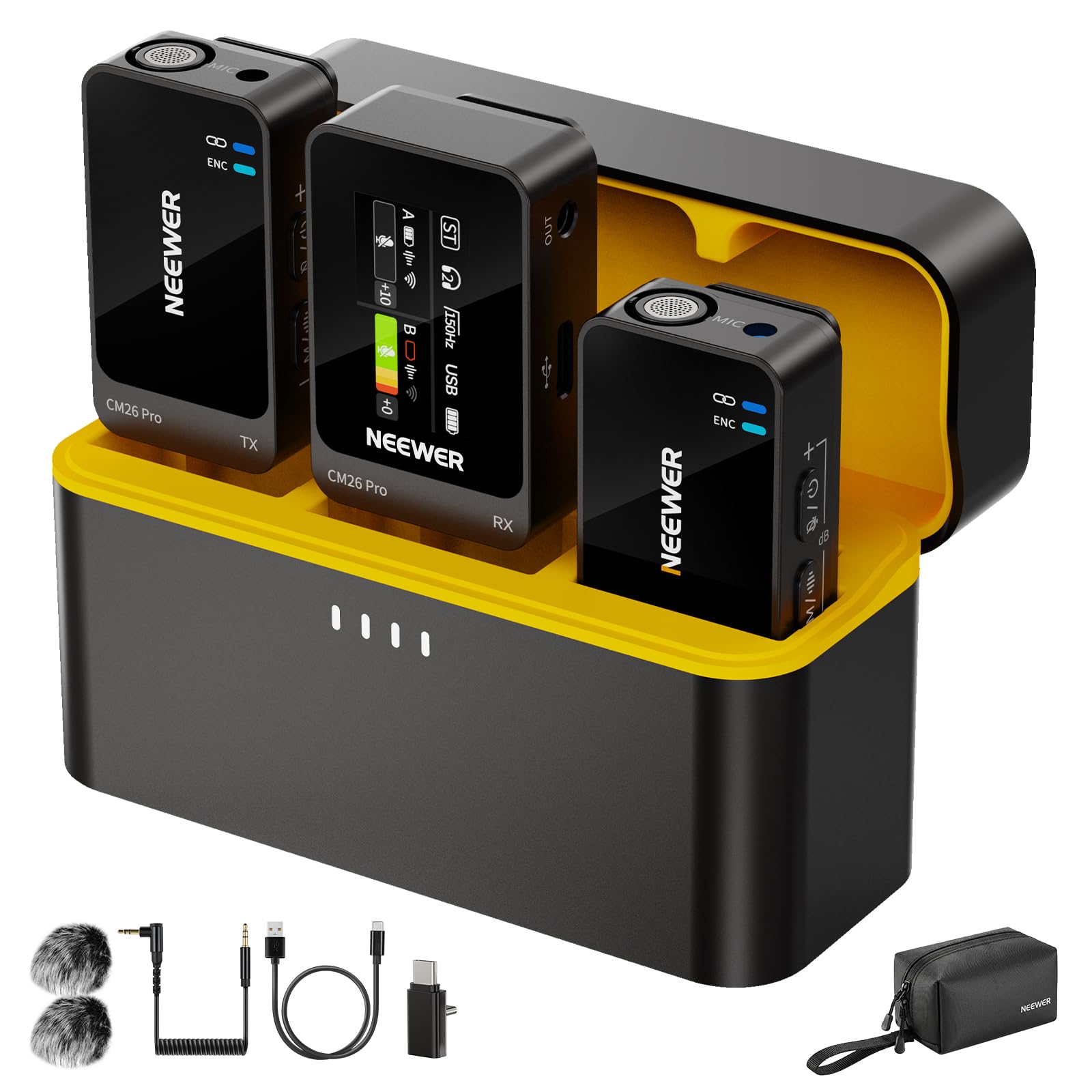
NEEWER’s CM26 Pro punches into the mid-range with a feature set that rivals more expensive kits. The dual-chip architecture (DSP + MCU) drives two AI noise cancellation levels—A1 for moderate ambient suppression and A2 for aggressive rejection of wind and traffic. A one-press mute and a low-cut filter (75Hz/150Hz/OFF) give you direct hardware control over the recording tone without entering a menu.
The audio chain is solid: 48kHz/24-bit sampling, 20Hz–20kHz frequency response, 88dB SNR, and 120dB SPL. The receiver supports three output modes—mono, stereo, and safe track (a mixed safety channel). A 3.5mm TRS headphone jack on the receiver enables real-time or playback monitoring, which is a rare inclusion at this level. The included OTG adapters (USB-C and iOS) ensure compatibility with phones and tablets alongside the camera connection.
Battery endurance is the standout here: total runtime hits 50 hours with the charging case, which can fully recharge the TX and RX units up to 1.8 times. The 100-meter forward range is adequate for most gimbal or stationary shoots. The magnetic attachment system plus clips and lanyards provide three ways to wear the transmitter.
Why it’s great
- Dual-chip AI noise cancellation effectively cleans up traffic and wind noise
- 50-hour total battery life is best-in-class for this price tier
- Headphone monitoring jack allows real-time audio check during recording
Good to know
- Some users report inconsistent volume levels with noise cancellation engaged
- Plastic enclosure feels less durable for heavy field use
6. Movo Mini-Duo

Movo’s Mini-Duo drops the price without dropping the dual-transmitter format. Two ultra-compact transmitters and a single 3.5mm TRS receiver give you two-subject interviewing out of one box. The setup is genuinely simple—auto-pairing on power-up, no menus, no screens. The system connects to any camera with a 3.5mm microphone jack, and the 10-hour battery life per TX handles full-day weddings or corporate shoots.
Audio quality is decent for the price bracket, with selectable noise cancellation and one-touch mute on each transmitter. The 2.4GHz link is rated to 164 feet line-of-sight, which is conservative but honest—users report it holds well indoors, though thicker walls can cause dropouts. The included foam windscreens provide basic mechanical wind reduction, but they are small and can pop off if brushed against clothing.
The kit includes two USB-C charging cables and a velcro carrying pouch. Build quality is ABS plastic, which keeps the weight low. For creators who need a two-mic system for interviews but operate on a tight budget, the Mini-Duo delivers the essential feature set without the premium extras like onboard recording or metal housings.
Why it’s great
- Two transmitters included for interviewer/interviewee setups at a low entry cost
- Auto-pairing and plug-and-play simplicity with no app required
- Lightweight ABS construction reduces neck strain during long shoots
Good to know
- Foam windscreens are poorly secured against wind and clothing friction
- Some users report a faint high-frequency hiss in the background during quiet pauses
7. DJI Lavalier Microphone

This is not a standalone wireless system—the DJI Lavalier Microphone is the external lavalier capsule that plugs into DJI Mic 2, DJI Mic, or any standard 3.5mm TRS transmitter. Its right-angle connector was specifically designed to sit flush against the side of a DJI transmitter, preventing the cable from bending sharply at the port. That small ergonomic detail reduces long-term cable fatigue and accidental unplugs during active movement.
The 20Hz–20kHz frequency response captures a natural voice profile with a slight crispness at the high end. Users note that the mic runs “hot”—the audio output level peaks higher than some passive lavaliers, so setting the transmitter gain to -1 dB is recommended to avoid clipping. The omnidirectional capsule provides consistent pickup regardless of head turns or slight positioning shifts.
Build quality is distinctly DJI: woven cable, sturdy metal-reinforced connector, and a low-profile clip that hides well under a shirt. The 1.2-meter cable length suits average torso heights but may be short for taller subjects. If you already own a DJI wireless system and want better audio than the built-in mic, this is the optimized drop-in upgrade.
Why it’s great
- Right-angle connector prevents cable damage and accidental disconnects on DJI transmitters
- Omnidirectional pattern captures consistent voice across head movements
- Excellent build quality with durable woven cable and metal connector
Good to know
- Requires a DJI Mic 2, DJI Mic, or any 3.5mm transmitter to function — not a standalone system
- Runs hot audio levels; needs -1 dB gain reduction to avoid clipping
FAQ
Can I use a 3.5mm wireless microphone with my smartphone?
Why does my wireless microphone cut out when I turn around?
What is the difference between 3.5mm TRS and 3.5mm TRRS?
Final Thoughts: The Verdict
For most users, the best 3.5mm wireless microphone is the RØDE Wireless GO III because of its bulletproof 32-bit float backup recording and locking connector that guarantee no shoot gets ruined by a dropout or clipped audio. If you want an ultra-light invisible solution for long interviews, grab the Hollyland Lark M2. And for multi-device creators who switch between camera and phone daily, the BOYA BOYALINK 2 with its versatile 3-in-1 receiver offers unbeatable convenience.