
A camera tripod for backpacking is a compromise you can’t afford to get wrong. Every ounce you save on weight you might sacrifice in vibration damping, and every inch you shave off the folded length could limit your maximum shooting height. The best models use carbon fiber to drop the sub-3-pound barrier while still supporting a full-frame body with a telephoto zoom, and they collapse short enough to slide into a water-bottle pocket on your pack.
I’m Min — the co-founder and writer behind Gadgets Feed. I’ve spent hundreds of hours cross-referencing load ratings, folded dimensions, leg-section counts, and head mechanisms across the backpacking tripod market to surface the models that truly earn their carry weight in the backcountry.
Whether you’re shooting Milky Way panoramas above tree line or compressing a creek-side waterfall at dawn, the right support system makes the difference between a sharp keeper and a blurred miss. This guide breaks down the seven top contenders for the best camera tripod for backpacking, ranked by real-world trail utility.
How To Choose The Best Camera Tripod For Backpacking
Selecting a tripod for backpacking means weighing four opposing forces: weight, packed length, maximum height, and stability. A model that excels at all four simultaneously is rare, so you need to know which spec hierarchy matters for your specific photography style.
Weight and Material: Carbon Fiber vs. Aluminum
Every gram counts on the trail. Carbon fiber tripods typically weigh 1.5 to 3 pounds, while aluminum versions often start at 3.5 pounds and climb quickly. Carbon fiber also dampens vibration better than aluminum, which matters for long-exposure shots at dawn or dusk. The premium you pay for carbon fiber directly translates to less fatigue over a multi-day hike.
Folded Length and Leg Section Count
A tripod that won’t fit inside or attach securely to your pack is a tripod that stays at home. Most backpacking tripods fold to between 12 and 17 inches. To achieve that, manufacturers use 4 or 5 leg sections. More sections mean a shorter collapsed length but also more twist locks and slightly reduced rigidity at full extension. A 5-section design folds smallest but demands careful tightening of each lock.
Head Quality and Load Capacity
The ball head is where cheap tripods reveal themselves. A 36mm metal ball head with independent pan and tilt locks lets you compose precisely without drift. Load capacity is a rough guide: a 20-pound rated tripod will handle a mirrorless body with a 70-200mm f/2.8 without sag, but a 9-pound rated model may struggle with the same rig in portrait orientation.
Quick Comparison
On smaller screens, swipe sideways to see the full table.
| Model | Category | Best For | Key Spec | Amazon |
|---|---|---|---|---|
| Peak Design Travel Tripod | Premium Carbon Fiber | Ultra-compact pro-level travel | 20 lb capacity / 15.4″ folded | Amazon |
| SmallRig AP-20 Carbon Fiber | Mid-Range Carbon Fiber | 2-in-1 tripod/monopod versatility | 26.5 lb capacity / 15.8″ folded | Amazon |
| Benro Slim Travel FSL09CN00 | Premium Compact Carbon | Backpack-pocket portability | 12.9″ folded / 57.1″ max height | Amazon |
| Vortex High Country II | Premium Aluminum | Hunting and spotting scope use | 22 lb capacity / 24.3″ folded | Amazon |
| Sirui Compact Traveler 5C | Value Carbon Fiber | Lightweight hiking with mirrorless | 1.87 lb weight / 54.3″ max height | Amazon |
| SIRUI AM-223 Carbon Fiber | Ultra-Compact Mini | Low-angle and macro ground work | 1.62 lb weight / 16″ max height | Amazon |
| K&F Concept 64″ Carbon Fiber | Budget Carbon Fiber | Entry-level full-size backpacking | 2.5 lb weight / 64″ max height | Amazon |
In‑Depth Reviews
1. Peak Design Travel Tripod, Carbon Fiber

Peak Design reimagined the travel tripod from the ground up, and the result folds to the diameter of a water bottle while still supporting a full-frame DSLR with a telephoto lens up to 20 pounds. The unique leg design deploys and locks in seconds with no flipping or fumbling, and the built-in phone mount pops out of the center column for quick smartphone shots. At just 2.84 pounds, it’s light enough for multi-day carries yet stable enough for long exposures when you hang weight from the integrated hook.
The omnidirectional ball head uses a single adjustment ring for fast, intuitive control, though some users note the vertical tilt range is limited compared to traditional ball heads — an L-bracket solves this for portrait orientation. The carbon fiber build dampens vibration well, but in high wind at full extension you may still see slight shake with very long lenses. The included protective case is durable and doubles as a carry strap for external pack attachment.
For the backpacker who wants pro-level stability in the smallest possible package, this is the gold standard. The premium price reflects radical engineering — no other tripod this compact offers this combination of height, load capacity, and setup speed.
Why it’s great
- Incredibly compact folded size (15.4″) for a full-height tripod
- Fast leg deployment with intuitive locking system
- Built-in phone mount and tool storage
- 20-pound load capacity handles pro gear
Good to know
- Ball head has limited vertical tilt range for portrait shooting
- Leg clips can pinch skin during rapid setup
- Premium price point above most backpacking budgets
2. SmallRig AP-20 Carbon Fiber Tripod, 62.2″

The SmallRig AP-20 splits the difference between a dedicated tripod and a hiking staff by converting into a monopod in seconds — a genuine advantage on long ridge traverses where a full tripod is overkill. The carbon fiber legs weigh 2.6 pounds yet support an impressive 26.5 pounds, meaning even a gripped DSLR with a 70-200mm f/2.8 is well within spec. The flip-lock leg adjustments are faster than twist locks and remain secure even after repeated use in sandy or muddy conditions.
The 360° detachable ball head includes a damping adjustment knob that lets you dial in tension for smooth panning, and the Arca-Swiss compatible quick release plate works with most standard L-brackets. A clever 1/4″ threaded hole on the bracket allows mounting a magic arm or smartphone clamp for multi-device setups. The folded length of 15.8 inches fits inside most daypacks, and the included handbag makes external carry easy.
Field-tested through three hunting seasons in rough terrain, this tripod held up without any leg or lock failures. The only compromise is that the 5-section legs require careful tightening of each flip lock during setup, but the speed of the flip mechanism largely offsets this.
Why it’s great
- Converts to monopod for hiking efficiency
- Very high load capacity (26.5 lb) for the weight
- Quick-release flip locks for fast setup
- Extra 1/4″ threaded mount on the bracket
Good to know
- 5-section legs require tightening each lock thoroughly
- Ball head may need replacement for spotting scope use
3. Benro Slim Travel FSL09CN00 Carbon Fiber Tripod

The Benro Slim Travel tripod achieves an astonishing 12.9-inch folded length while still extending to 57.1 inches — that’s full shooting height from a package that fits in a 16-inch backpack side pocket. The 5-section reverse-folding legs are the key to this compactness, and the carbon fiber construction keeps weight at 2.8 pounds. The included N00 ball head uses dual-action controls with independent pan locking, making composition smooth and precise even with heavier mirrorless bodies.
The built-in stabilizing hook lets you hang your backpack for extra wind resistance, and the twist locks grip securely on slick rock or loose soil. Users consistently report that the build quality feels far more robust than the price suggests, with minimal vibration transmission through the carbon fiber legs. The Arca-Swiss compatible quick release plate holds the camera firmly without any wobble.
The only real trade-off is that 5-section legs are slightly less rigid at full extension compared to a 4-section design, but for most landscape and travel photography the difference is negligible. Benro backs this with a 3-year warranty that extends to 5 years with online registration.
Why it’s great
- Extremely compact folded length (12.9″) for pack fit
- Excellent build quality with 5-year warranty option
- Smooth dual-action ball head with independent pan
- Stabilizing hook for adding weight in wind
Good to know
- 5-section legs less rigid than 4-section at full height
- Can vibrate in strong wind for slow shutter architectural shots
4. Vortex Optics High Country II Tripod Kit

The Vortex High Country II takes a different approach — machined aluminum construction that prioritizes durability over extreme weight savings. At 4 pounds it’s heavier than the carbon fiber options, but it’s built to withstand the abuse of hunting seasons and rocky alpine terrain. The 2-way pan head is optimized for spotting scopes and binoculars, though it works fine for cameras with the included Arca-Swiss compatible quick release plate. The 22-pound max load means even large spotting scopes are stable.
The three-angle leg pivot locks let you position each leg independently on uneven ground, and the detachable counterweight hook adds stability in wind. The folded length of 24.3 inches is longer than the dedicated backpacking tripods, so it’s better suited to external pack lashing or vehicle-based trips. The unlimited, unconditional lifetime VIP warranty is a genuine differentiator — Vortex will repair or replace it for any reason, no questions asked.
For backpackers who also hunt or birdwatch, this tripod eliminates the need for separate camera and spotting scope supports. The trade-off is weight and packed size, but the build quality and warranty make it a buy-it-for-life choice.
Why it’s great
- Unlimited lifetime VIP warranty — repair or replace
- Very stable for spotting scopes and heavy optics
- Independent leg angle adjustments for uneven terrain
- Detachable counterweight hook for wind stability
Good to know
- Heavier than carbon fiber options at 4 pounds
- Folded length (24.3″) less packable for backpacking
- Pan head not as smooth as premium ball heads
5. Sirui Compact Traveler 5C Tripod, 54.3″

The Sirui Compact Traveler 5C hits a sweet spot for weight-conscious hikers who don’t want to spend premium prices. At just 1.87 pounds with a 13-inch folded length, it’s one of the lightest full-height tripods available. The 5-section carbon fiber legs extend to 54.3 inches, which is sufficient for most standing shots, and the center column has a hook for hanging a bag or rocks to add stability in windy conditions. The aluminum ball head offers smooth 360° panoramic rotation and tilts vertically for portrait compositions.
Users report that this tripod handles a Sony A7III with a 24-70mm lens comfortably, and the quick release plate is standard Arca-Swiss compatible. The legs can be inverted and folded back 180 degrees to achieve the compact 13-inch storage length, and the included carry bag is well-padded for pack protection. The main compromise is that the 8.8-pound maximum load rating is lower than the competition — it’s ideal for mirrorless kits but may struggle with heavy full-frame DSLRs plus large telephoto zooms.
At full extension the thin legs can be prone to wind shake, so keeping the center column low or adding weight to the hook improves stability significantly. For the weight savings, this is an outstanding value.
Why it’s great
- Very lightweight at 1.87 pounds
- Compact 13-inch folded length for pack fit
- Center column hook for adding stabilizing weight
- Good value for carbon fiber build
Good to know
- 8.8 lb load limit not suitable for heavy DSLR rigs
- Thin legs prone to shake at full extension in wind
6. SIRUI AM-223 Carbon Fiber Mini Tripod

The SIRUI AM-223 is a specialized tool for the backpacker who prioritizes ground-level photography — macro shots, low-angle creek compressions, and star timelapses from a tent. With a maximum height of just 16 inches and a weight of 1.62 pounds, it’s the lightest tripod in this comparison by a clear margin. The 10-layer carbon fiber legs are sturdy enough to hold a full-frame DSLR with a 70-200mm f/2.8, and the B-00K ball head provides smooth 360° panning with no creep under load.
The legs feature three angle positions and can be flattened completely for ultra-low shots, making this an excellent companion for nature photographers who spend most of their time close to the ground. The Arca-Swiss quick release plate locks securely, and the included carrying bag and adjustment wrenches add convenience. Some users report that the red safety release on the ball head can gouge the head if overtightened, and the portrait orientation stability is less confidence-inspiring than larger heads.
If you need standing height, this is not the right choice. But for the dedicated low-angle or macro shooter who wants the lightest possible support system, the AM-223 is nearly unbeatable.
Why it’s great
- Ultra-lightweight at 1.62 pounds
- Excellent stability for ground-level and macro work
- Legs flatten for extreme low-angle shots
- Robust enough for full-frame DSLR with telephoto
Good to know
- Maximum height is only 16 inches — no standing use
- Ball head can be tippy in portrait orientation
- Red safety release may gouge head if overtightened
7. K&F Concept 64″ Carbon Fiber Tripod
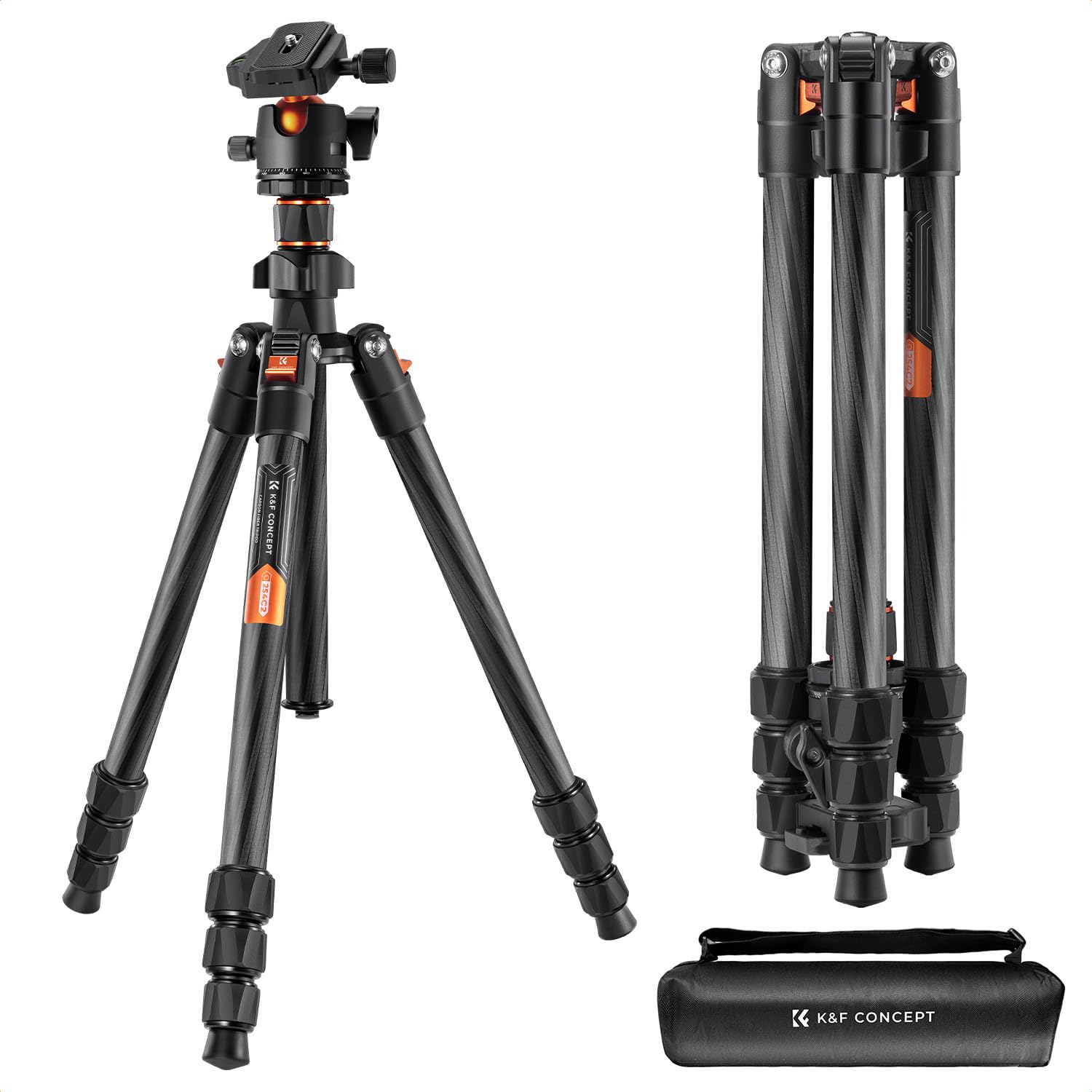
The K&F Concept 64-inch carbon fiber tripod brings full-size height and a carbon fiber build to a price that undercuts most competition by a significant margin. It extends to 64 inches — taller than many dedicated travel tripods — and folds to 16.3 inches for packable storage. The 36mm metal ball head provides smooth 360° rotation and supports up to 17.6 pounds, which covers most mirrorless and DSLR rigs. At 2.5 pounds, it’s not the lightest but is well within the backpacking sweet spot.
The center column can be inverted for low-angle and macro shooting, and a short center column is included for extreme ground-level work. Users consistently praise the value proposition — carbon fiber legs with metal connecting parts for a budget-friendly investment. The main criticism is that the ball head and quick release plate use plastic components inside the metal housing, which some users recommend upgrading to a full metal head for long-term durability.
For the backpacker who wants maximum height and carbon fiber construction without stretching the budget, this is the clear entry-level winner. The plastic head components are the primary compromise, but the legs themselves are solid.
Why it’s great
- Full 64-inch height for standing eye-level composition
- Carbon fiber legs at a budget-friendly investment
- Includes short center column for extreme low-angle work
- 17.6 lb load capacity covers most backpacking gear
Good to know
- Ball head has plastic internal components
- May benefit from a metal head upgrade over time
FAQ
How heavy is too heavy for a backpacking tripod?
Should I get a 4-section or 5-section tripod for backpacking?
Can I use a backpacking tripod with a spotting scope?
Final Thoughts: The Verdict
For most users, the best camera tripod for backpacking winner is the Peak Design Travel Tripod because it offers the best balance of compact folded size, fast setup, and pro-level load capacity in a sub-3-pound package. If you want the versatility of a monopod conversion for long hikes, grab the SmallRig AP-20 Carbon Fiber. And for the most packable folded length that still delivers full shooting height, nothing beats the Benro Slim Travel FSL09CN00.