
A standard copper HDMI cable is a perfectly fine piece of wire until you push it past about 25 feet. Beyond that distance, signal degradation turns your crisp 4K image into a flickering, sparkly mess — or no picture at all. The solution is an active HDMI cable, which uses built-in electronics (and often fiber optic strands) to boost and maintain signal integrity over runs of 50, 100, or even 150 feet without dropping a single frame of data.
I’m Min — the co-founder and writer behind Gadgets Feed. After spending weeks poring over bandwidth specs, connector types, and real-world failure reports for long-distance HDMI runs, I built this guide around the cables that actually deliver on their promised resolution and refresh rate without introducing lag or dropouts.
Whether you’re routing a cable through a wall to a basement projector or connecting a PC in one room to a TV in another, the right active cable determines whether your setup works or fails. I reviewed the seven best candidates to find the true best active hdmi cables that maintain full bandwidth at distance.
How To Choose The Best Active HDMI Cables
Active HDMI cables are fundamentally different from the passive copper cables you’re used to. They contain signal-processing chips that actively reclock and amplify the digital stream, enabling clean transmission over distances where passive cables would fail completely. Here’s what separates a great active cable from one that will give you headaches.
Bandwidth and Resolution Support
Check the rated bandwidth first. HDMI 2.1 spec calls for 48 Gbps, which is required for uncompressed 8K@60Hz or 4K@120Hz with full 4:4:4 chroma subsampling. A cable rated at only 18 Gbps is limited to HDMI 2.0 speeds — fine for 4K@60Hz but not for high-refresh-rate gaming or future 8K sources. Every active cable in this guide supports at least 18 Gbps, but the best ones hit the full 48 Gbps mark.
Fiber Optic vs. Active Copper
At lengths of 50 feet and beyond, fiber optic cables are the dominant choice. They convert electrical signals to light, which is immune to electromagnetic interference from power cables running alongside and suffers virtually zero signal loss over distance. Active copper cables use amplification chips but are heavier and more susceptible to EMI at extreme lengths. For in-wall installations, fiber optic’s thin profile (often under 5mm in diameter) makes routing through conduit and joists dramatically easier than thick copper alternatives.
Directional Installation Requirement
Almost every fiber optic HDMI cable is directional — the “SOURCE” end must connect to your signal device (laptop, console, PC) and the “DISPLAY” end to your TV or projector. Reversing them yields no picture. This is not a defect; it’s the nature of the optoelectronic conversion chips being built into only one connector. Check the labeling before you pull cable through a wall, because fixing a flipped run means pulling it all out and starting over.
eARC Support and Cable Length
Enhanced Audio Return Channel (eARC) enables lossless Dolby Atmos and DTS:X audio from your TV back to an AV receiver over the same HDMI cable. However, many fiber optic HDMI cables over 65 feet do not support ARC or eARC because the return audio channel signal degrades over the long optical path. If you need eARC at distances beyond 50 feet, verify the cable explicitly lists eARC support — and consider a shorter cable (under 66 feet) for the audio return link, paired with a dedicated audio cable or wireless solution for the long video run.
Quick Comparison
On smaller screens, swipe sideways to see the full table.
| Model | Category | Best For | Key Spec | Amazon |
|---|---|---|---|---|
| RUIPRO 8K Armored 50FT | Premium | Mission-critical in-wall installs | 48Gbps, detachable ends | Amazon |
| iBirdie 8K Fiber 50FT | Premium | In-wall rated home theater | 48Gbps, CL3 rated | Amazon |
| LEADSTAR 8K Fiber 100FT | Premium | Longest distance at 48Gbps | 48Gbps, braided, 100 ft | Amazon |
| Snowkids 8K Fiber 50FT | Mid-range | 8K gaming on a budget | 48Gbps, braided jacket | Amazon |
| Mesadsee 8K Fiber 50FT | Mid-range | Budget-friendly fiber optic | 48Gbps, 50 ft length | Amazon |
| FIBBR 8K Fiber 50FT | Mid-range | EMI-prone environments | 48Gbps, YOFC fiber core | Amazon |
| KIMTABO 4K Fiber 100FT | Budget | 4K@60Hz runs on a budget | 18Gbps, 100 ft, 4.8mm | Amazon |
In‑Depth Reviews
1. RUIPRO 8K Detachable Full Fiber Optic Armored HDMI 2.1 Cable 50FT

The RUIPRO 8K Gen4AK is the most thoughtfully engineered active HDMI cable I’ve evaluated. Its defining feature is the detachable connector ends — the fiber optic cable itself is a thin, flexible strand that terminates into screw-on HDMI heads. If a connector gets damaged during a wall pull or a new HDMI standard emerges, you replace only the heads, not the entire in-wall run. The full fiber optic construction means zero electromagnetic interference susceptibility, and the stainless steel armored jacket provides exceptional tensile strength and crush resistance without adding stiffness.
Bandwidth hits the full 48 Gbps ceiling, delivering uncompressed 8K@60Hz and 4K@120Hz with Dynamic HDR and full 4:4:4 chroma. Real-world testing from PC to 4K OLED at 50 feet showed no flickering, no handshake failures, and stable eARC support for lossless Dolby Atmos audio return. The cable is ideal for in-wall or conduit installations where pulling a new run later would be a nightmare. The detachable heads also simplify threading through small openings — you run just the cable, then attach the connectors at each end.
The main trade-off is the transceiver housing on each end, which is larger than a standard HDMI plug. This can prevent flush mounting against a wall plate or in a tight rack setup — an angled adapter may be required for some installations. At a premium price point, this cable is an investment, but for permanent or mission-critical runs, it’s the most future-proof option available today.
Why it’s great
- Detachable heads allow cable upgrade without re-pulling through walls
- Full 48Gbps with flawless 8K@60Hz and 4K@120Hz signal integrity
- Armored stainless steel jacket provides extreme durability
Good to know
- Large transceiver housings may not fit flush in tight racks or wall plates
- Demands the highest budget investment of any cable on this list
2. iBirdie 8K Fiber Optic HDMI Cable 50 Feet
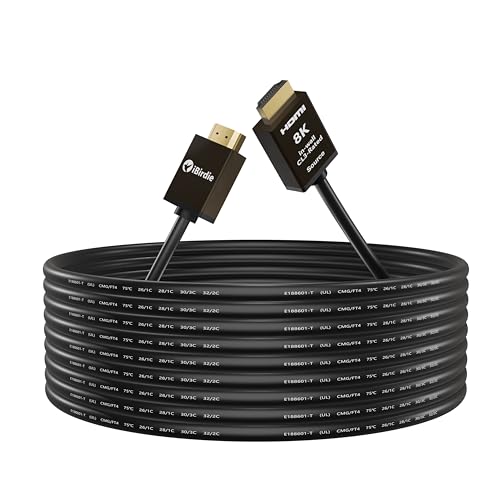
The iBirdie 8K cable earns its premium status through its CL3 in-wall fire safety rating and a clever power design that addresses a common fiber optic failure point. Many active HDMI cables draw power from the HDMI port itself, but some sources — particularly HDMI switches, hubs, and splitters — don’t supply enough voltage. iBirdie includes a dedicated USB power cable that connects to any 5V USB port, ensuring stable optoelectronic conversion even with underpowered source devices. This is a critical differentiator for complex AV setups where the cable passes through a switch.
At 48 Gbps, it handles 8K@60Hz and 4K@120Hz with VRR and eARC support. The cable is fully backward compatible with 4K144Hz and 1080p240Hz, making it equally suited for a high-refresh-rate gaming monitor or a home theater projector. The CL3 rating means it meets fire code for in-wall installation, and the flexible fiber core is roughly the thickness of a coaxial cable — easy to fish through attic joists or wall cavities.
Some users report that the USB power cable is required even when the source port seems adequate, so plan for an available USB port near the source end. The connectors are standard HDMI size without the bulky transceiver housings of the RUIPRO, making it easier to fit behind a TV or into a rack. This is the best choice for anyone who needs a certified in-wall cable with reliable power delivery at a premium but still reasonable price.
Why it’s great
- CL3 fire rating meets in-wall installation code requirements
- Included USB power cable prevents signal drops from underpowered HDMI sources
- Full 48Gbps bandwidth with wide backward compatibility
Good to know
- USB power cable adds one more connection to manage at the source end
- Not suited for installations where no USB port is available near the source
3. LEADSTAR HDMI Cable Fiber Optic 8K 4K 100 ft
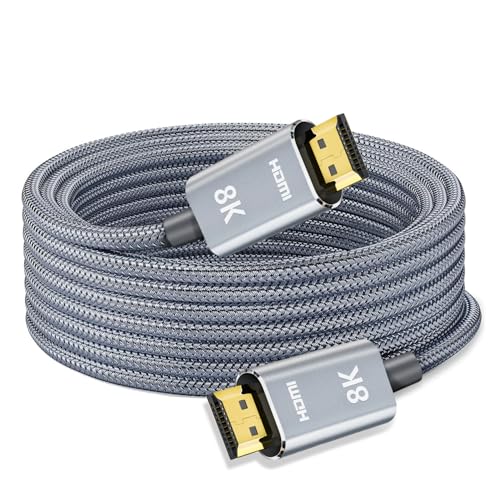
The LEADSTAR 100-foot cable is the rare active HDMI that delivers full 48 Gbps bandwidth at extreme distance. Most cables at 100 feet are either limited to 18 Gbps (HDMI 2.0) or suffer from signal degradation at high refresh rates. LEADSTAR’s fiber optic design maintains uncompressed 8K@60Hz and 4K@120Hz over the full 100-foot run, which is a genuine engineering accomplishment. The cable supports VRR and eARC, so gamers can connect a PC in one room to a TV in another without latency spikes or audio sync issues.
The braided nylon jacket provides solid abrasion resistance and a premium feel, while the fiber core remains thin and lightweight compared to copper alternatives. The directional labeling is clear — SOURCE and DISPLAY ends are printed on the connectors — and the cable comes coiled in protective tubing to prevent kinking during shipping. It’s backward compatible with HDMI 2.0 and 1.4 devices, making it a future-proof investment for a setup that will eventually upgrade sources.
The main caveat is that the braided jacket, while durable, adds some stiffness that makes tight-radius bends a challenge. If you’re routing through a conduit with multiple 90-degree turns, test the bend radius before pulling. Also note that at 100 feet, eARC is supported but may be less stable than on shorter runs; LEADSTAR recommends keeping the source device’s firmware updated for best results.
Why it’s great
- Full 48Gbps at 100 feet — an uncommon achievement in active HDMI cables
- Braided nylon jacket offers excellent durability for long-term installations
- Supports eARC, VRR, and Dynamic HDR for cinematic gaming setups
Good to know
- Braided jacket is stiff, making tight-radius routing difficult
- eARC stability at 100 feet may vary depending on source and display firmware
4. Snowkids 8K 2.1 50 FT Long Fiber Optic HDMI Cable

The Snowkids 8K fiber optic cable delivers the full HDMI 2.1 feature set — 48 Gbps, 8K@60Hz, 4K@120Hz, VRR, eARC, and Dynamic HDR — at a price that undercuts most competitors. The build quality is surprising for this tier: a tight braided jacket covers the full 50-foot length, gold-plated connectors resist corrosion, and the aluminum shell provides decent heat dissipation for the active electronics. It passes rigorous lab testing for signal integrity before leaving the factory, and that shows in the clean video output with no sparkle or dropout artifacts even at maximum resolution.
Gamers will appreciate the VRR and ALLM support, which eliminates screen tearing and minimizes input lag when connected to a PS5 or Xbox Series X. The cable supports 4K@120Hz with HDR, which is the current sweet spot for console gaming. Picture quality is vibrant with accurate color reproduction at 48-bit color depth. The unidirectional design is clearly marked, and the cable is flexible enough for most in-wall runs, though the braided jacket adds some stiffness compared to bare fiber optic cables.
The one reported shortcoming involves eARC/CEC compatibility in complex home theater setups. A small number of users found that the Snowkids cable caused CEC control failures when daisy-chained through an AV receiver. For straightforward TV-to-soundbar eARC connections, it works fine. If your setup involves multiple devices communicating over CEC, verify compatibility before committing to an in-wall installation.
Why it’s great
- Full 48Gbps HDMI 2.1 performance at a budget-friendly mid-range price
- Braided jacket and aluminum shell provide durable construction
- VRR and ALLM support delivers smooth, tear-free gaming at 4K@120Hz
Good to know
- eARC/CEC compatibility may be unreliable in complex multi-device home theater setups
- Braided jacket is stiff, making temporary or frequently moved connections less convenient
5. Mesadsee 8K Fiber Optic HDMI 2.1 Cable 50ft
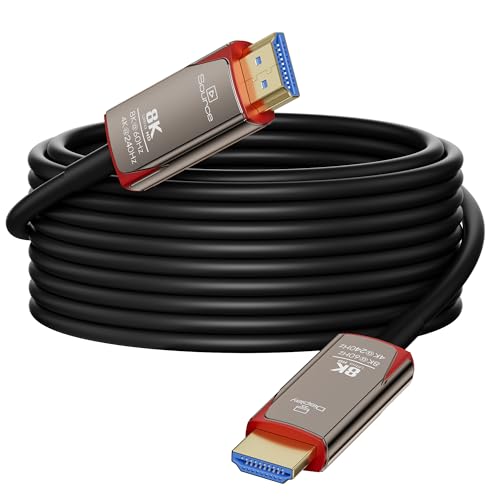
The Mesadsee 8K fiber optic cable is the entry-level champion for anyone who needs a long 48Gbps active HDMI cable but doesn’t want to spend heavily. It supports the full HDMI 2.1 spec: 8K@60Hz, 4K@120Hz, Dynamic HDR, eARC, HDCP 2.2/2.3, VRR, and ALLM. The fiber core delivers lossless transmission with immunity to EMI and RFI interference — critical when routing alongside power cables. Real-world reviews confirm stable 4K@120Hz gaming with no flicker, no noise, and perfectly synchronized audio.
The physical build is respectable for this price tier. Gold-plated connectors and an aluminum shell provide corrosion resistance and heat dissipation. The nylon braided jacket is rated for 20,000 break tests, so it can handle the occasional door slam or trip over the cable. It’s also thin enough to route through most wall conduits, though it lacks a formal CL3 in-wall rating — check local fire codes before burying it inside a wall cavity.
The sole significant complaint involves incompatibility with a specific device: the Govee AI Lightbox. Users report that the Mesadsee cable fails to pass a signal through this particular lightbox, likely due to its lower power supply from the HDMI port. For standard TV, monitor, projector, console, and PC connections, the cable works flawlessly. This is the best choice for a simple, long-distance, high-bandwidth run where you don’t need exotic device compatibility.
Why it’s great
- Full 48Gbps HDMI 2.1 performance at an entry-level mid-range price
- Fiber core eliminates EMI interference when running near power cables
- Nylon braided jacket with 20,000 break-test rating offers surprising durability
Good to know
- Not compatible with the Govee AI Lightbox — may fail in niche device chains
- Lacks a formal CL3 in-wall fire rating for permanent wall installation
6. FIBBR Fiber Optic HDMI Cable 50 ft 2.1 8K 48Gbps
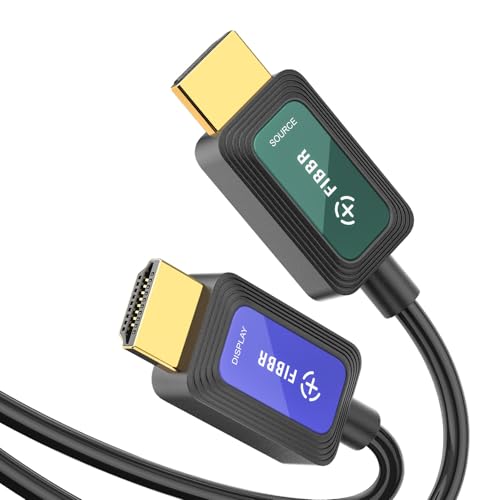
The FIBBR 50-foot cable distinguishes itself with advanced YOFC fiber optic technology that converts electrical signals to light, making it completely immune to electromagnetic and radio frequency interference. This is the cable you want when your HDMI must run parallel to power lines, near a refrigerator motor, or alongside treadmill electronics — scenarios where copper cables produce sparkle, flicker, or audio dropouts. FIBBR also excels at weight and flexibility, weighing only 3.2 ounces for the 50-foot run, making it 50% thinner and lighter than an equivalent copper cable.
Full 48 Gbps bandwidth supports 8K@60Hz and 4K@120Hz with VRR, ALLM, QMS, QFT, DSC, and Dynamic HDR. eARC is fully supported for Dolby Atmos audio return, which is verified in real-world testing with Denon AVRs and LG OLED TVs. The cable works excellently for long-distance projector connections in both home theater and conference room settings. The ultra-thin profile (roughly the thickness of a USB cable) makes it the easiest of all reviewed cables to snake through wall conduits and around tight corners.
The primary limitation is that FIBBR explicitly states that cables 66 feet or longer do not support ARC or eARC. For the 50-foot version tested here, eARC works perfectly. But if you need a longer run with audio return, this is not the cable. Additionally, some buyers report compatibility issues with LG OLED TVs at the highest HDMI 2.1 bandwidth modes — check your specific TV model against FIBBR’s compatibility list before purchasing for 4K@120Hz on LG panels.
Why it’s great
- YOFC fiber core provides absolute immunity to EMI/RFI interference
- Weighs only 3.2 oz — dramatically thinner and lighter than copper cables
- Full 48Gbps with eARC support for Dolby Atmos home theater setups
Good to know
- Cables over 66 feet do not support ARC or eARC — verify length requirements
- Some LG OLED models may have compatibility issues at 4K@120Hz with this cable
7. KIMTABO 4K HDMI Cable 100 ft Fiber Optic
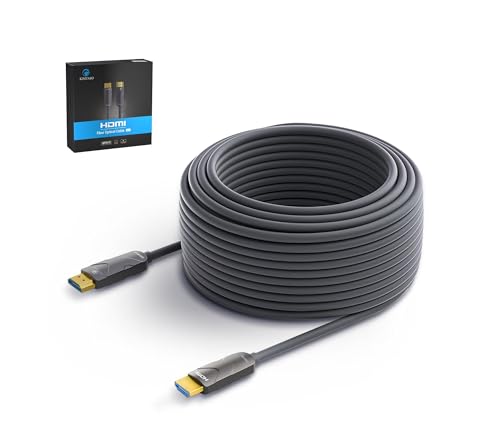
The KIMTABO 100-foot cable is the most affordable active HDMI option in this guide, and it makes a deliberate trade: it supports HDMI 2.0b with 18 Gbps bandwidth rather than the full 48 Gbps of HDMI 2.1. That means 4K@60Hz with 4:4:4 chroma and HDR10 — great for movies, streaming, and standard console gaming, but not for 8K sources or 4K@120Hz gaming. If your display and content never exceed 4K@60Hz, this cable delivers that perfectly with zero signal loss at an extreme 100-foot distance.
The fiber optic design uses a German chipset and OM3 fiber core to achieve clean signal transmission over the full 100 feet. The cable’s 4.8mm diameter is the thinnest on this list, making it by far the easiest to route through tight conduit or under baseboards. It supports HDCP 2.2 and ARC, though eARC is not listed. The zinc alloy shell and gold-plated connectors provide reasonable durability, and the cable has passed reliability testing for long-term use.
The obvious limitation is the 18 Gbps ceiling — this is not a future-proof cable, and you cannot use it for 4K@120Hz gaming or any 8K source. It also uses a unidirectional design, so careful planning of SOURCE and DISPLAY ends is necessary. For users building a budget home theater with a 4K projector 100 feet from the media source, or for connecting a security DVR to a distant monitor, this cable offers outstanding value without compromising signal stability at its supported resolution.
Why it’s great
- Delivers clean 4K@60Hz signal at 100 feet with zero loss or interference
- Ultra-thin 4.8mm diameter makes it the easiest to route through tight spaces
- Most budget-friendly active HDMI cable on the market
Good to know
- Limited to 18 Gbps — no support for 8K or 4K@120Hz gaming
- Does not support eARC — audio return is limited to standard ARC
FAQ
Do I really need an active HDMI cable or is passive copper fine for my run?
What happens if I plug a fiber optic HDMI cable in the wrong direction?
Can I use a 100-foot fiber optic HDMI cable for eARC audio return?
Why do some fiber optic HDMI cables require an external USB power connection?
Is a fiber optic HDMI cable fragile or easy to break?
Final Thoughts: The Verdict
For most users, the best active hdmi cables winner is the iBirdie 8K Fiber 50FT because it combines full 48Gbps performance, CL3 in-wall rating, and a USB power backup at a mid-range price that doesn’t punish you for needing a long, reliable cable. If you want detachable ends and armored durability for a permanent in-wall installation where re-pulling the cable would be a nightmare, grab the RUIPRO 8K Armored 50FT. And for a high-value 4K@60Hz projector run at 100 feet where budget is the primary concern, nothing beats the KIMTABO 4K Fiber 100FT — just understand the 18Gbps limit and plan your source resolution accordingly.