
Buying a solar panel in the 200W to 240W range means staring down a spec sheet full of laboratory numbers that rarely match what you actually get when you set the panel out in your backyard, on your RV roof, or at a campsite. The gap between “STC-rated” wattage and real-world daily yield is the single biggest frustration in this category — and the reason most buyers need to adjust their expectations before they open the box.
I’m Min — the co-founder and writer behind Gadgets Feed. I’ve spent hundreds of hours cross-referencing datasheets, decoding cell technology claims like N-Type vs. P-Type and bifacial gain percentages, and mapping real customer yield data across dozens of solar panel listings to separate genuine performance from marketing wattage.
Whether you are outfitting a van build, supplementing home backup, or packing for an off-grid trip, finding the right best 240w solar panel starts with understanding which specs translate to actual power — and which ones are just numbers on a page.
How To Choose The Best 240W Solar Panel
Selecting a solar panel in this power class requires looking past the headline wattage and into the cell architecture, voltage curve, and physical durability. The panels you see all claim 200W to 220W, but their real-world behavior under partial shade, high heat, and non-ideal angles varies dramatically.
Cell Technology: N-Type, P-Type, and Bifacial
The shift from P-type (boron-doped) to N-type (phosphorus-doped) cells is the defining upgrade in this generation of panels. N-type cells eliminate Light-Induced Degradation (LID), offer a lower temperature coefficient around -0.30%/K, and typically deliver 25% efficiency. Bifacial panels add a transparent backsheet that captures reflected light from the ground or roof surface, boosting total harvest by up to 30% in real-world installations. For a 200W-rated panel, that extra gain can push actual output past the rated number, especially on light-colored surfaces.
Voltage Compatibility and Your Charge Controller
A 200W panel with an open-circuit voltage around 40V can exceed the input limit of many portable power stations designed for lower-voltage consumer panels. Before buying, check your generator or charge controller’s maximum input voltage — some foldable panels advertise high voltage to reduce current loss but become incompatible with common units like the Jackery Explorer series. Panels with a Vmp around 18V to 24V tend to work universally across 12V and 24V battery banks without requiring series wiring.
Durability and Water Resistance
For rooftop installations, look for tempered glass, anodized aluminum frames, and an IP68-rated junction box. For portable panels, ETFE coating outlasts standard PET under UV exposure and resists yellowing. IP67 waterproofing is the minimum for any panel that will face rain or morning dew — lower ratings invite internal corrosion over the first two years of use.
Real-World Wattage Expectations
Every panel in this class loses 15% to 30% of its STC rating in real conditions due to heat, angle mismatch, and wiring resistance. A 200W panel that delivers 170W at solar noon on a clear summer day is performing well. A panel that hits 180W or more is excellent. Any review showing sustained output above 90% of the rated value under actual outdoor conditions indicates top-tier cell quality and efficient bypass diode management.
Quick Comparison
On smaller screens, swipe sideways to see the full table.
| Model | Category | Best For | Key Spec | Amazon |
|---|---|---|---|---|
| Callsun 200W Bifacial | Rigid / Roof | Off-grid garages & van builds | 25% efficiency, bifacial gain | Amazon |
| Renogy 200W N-Type | Rigid / Roof | Class B van & marine installs | 7.5% smaller frame, 25% cell eff. | Amazon |
| BougeRV N-Type Bifacial | Rigid / Roof | Golf cart & 24V battery banks | 30% bifacial gain, 25% eff. | Amazon |
| SOKIOVOLA 220W Portable | Folding / Portable | RV trips & campground set-ups | 25% eff., ETFE coating, IP68 | Amazon |
| MHPOWOS 220W Foldable | Folding / Portable | High-voltage power stations | 23.5% eff., 40V output | Amazon |
| ZOUPW 200W Portable | Folding / Portable | Direct USB device charging | Built-in 60W PD USB-C, 23.5% eff. | Amazon |
| ECO-WORTHY 200W Portable | Folding / Portable | Quick-deploy emergency backup | 10-second kickstand setup, 23% eff. | Amazon |
| Greenmagic 200W Portable | Folding / Portable | Budget-conscious camping set-ups | 23.5% eff., 4-in-1 cable set | Amazon |
| DOKIO 800W (2×400W) | Rigid / Roof | Home shed & cabin arrays | 9.84 ft leads per panel | Amazon |
In‑Depth Reviews
1. Callsun N-Type 16BB 200W Bifacial Solar Panel

The Callsun 200W Bifacial panel is the strongest performer in this lineup for buyers who need maximum real-world power from a rigid panel. N-Type 16BB cells deliver a certified 25% efficiency, and the transparent backsheet captures reflected light from the ground — verified by multiple owners reporting sustained output above 400W from a nominally 200W unit when installed on light-colored surfaces. The TwinCell anti-shade split design halves the panel, so shading one section leaves the other at full production.
The low temperature coefficient of -0.3%/K means this panel loses less power in hot summer conditions compared to P-Type alternatives. Measuring 51.3 x 30.3 x 1.4 inches and weighing 23.8 pounds, it fits Class B van roofs without overhang. Pre-drilled rear holes simplify rail mounting, and the IP68-rated junction box handles rain without concern. The stated 30-year lifespan with 84.5% output retention after 25 years leads the category.
On partly cloudy days, owners see it outperform non-bifacial panels by noticeable margins, keeping battery banks topped off when conventional panels drop off. The genuine overproduction at peak sun is the rare case where lab gains translate directly to extra daily watt-hours.
Why it’s great
- Bifacial design delivers over-rated wattage in ground/roof reflection setups
- TwinCell split minimizes power loss from partial shade
- IP68 waterproofing and -0.3%/K temp coefficient for hot climates
Good to know
- Higher initial cost vs. standard mono panels
- Requires reflective surface to maximize bifacial gain
2. Renogy Solar Panel 200W N-Type

Renogy’s N-Type panel is engineered directly for the Class B van market — it is 7.5% smaller and 11.7% lighter than the previous generation while holding full 200W output. At 49.7 x 30.1 x 1.2 inches and 23.4 pounds, it is one of the most space-efficient rigid 200W panels available, making it the first choice when roof real estate is measured in inches.
The 16BB cell layout with 25% efficiency pushes real-world performance close to the STC rating even in sub-optimal conditions. Owners report panels producing near-advertised wattage in direct sunlight and maintaining meaningful output in full shade — an indicator of excellent bypass diode implementation. The 37.44V max voltage works with both 12V and 24V battery banks when paired with an MPPT controller, and the low degradation rate of ≤1% first year and ≤0.4% annually backs the 25-year output warranty.
Build quality is consistent with Renogy’s reputation — the anodized aluminum frame feels rigid, and the tempered glass front resists hailstones. Owners installing these on shed roofs and marine applications confirm the panel holds up well after months of weather exposure.
Why it’s great
- Compact, lightweight frame ideal for tight rooftop spaces
- Strong real-world output even in partial shade
- Low annual degradation backed by 25-year performance warranty
Good to know
- Mounting feet sold separately
- Standard rigid panel — not foldable for portable use
3. BougeRV N-Type 16BB 200W Bifacial Solar Panel

The BougeRV 200W panel brings N-Type bifacial technology into a competitive price bracket. With 25% cell efficiency and a reported 30% bifacial gain, this panel captures direct and reflected light through its transparent backsheet, pushing total harvest beyond the 200W rating when ground or wall reflection is available.
A key differentiator is the open-circuit voltage of 36.4V, which allows a single panel to charge a 24V battery bank directly without series wiring — avoiding the current losses and reliability concerns of series connections. The 16BB design improves current collection and reduces microcrack risk, while the parallel anti-shade circuit keeps the unshaded half producing at full output. The corrosion-resistant aluminum frame and tempered glass build target long-term outdoor exposure.
Some early units showed condensation behind the glass, BougeRV’s warranty support addressed replacements after escalation. Owners who mounted these on Sprinter roof racks report real-world output around 170W per panel, with bifacial boost adding measurable gains on reflective driveways.
Why it’s great
- Single panel charges 24V batteries directly — no series wiring needed
- Bifacial backsheet captures reflected light for extra output
- Competitive price for N-Type bifacial technology
Good to know
- Customer support experience has been inconsistent
- Some owners reported output degradation after two years
4. SOKIOVOLA 220W Portable Solar Panel
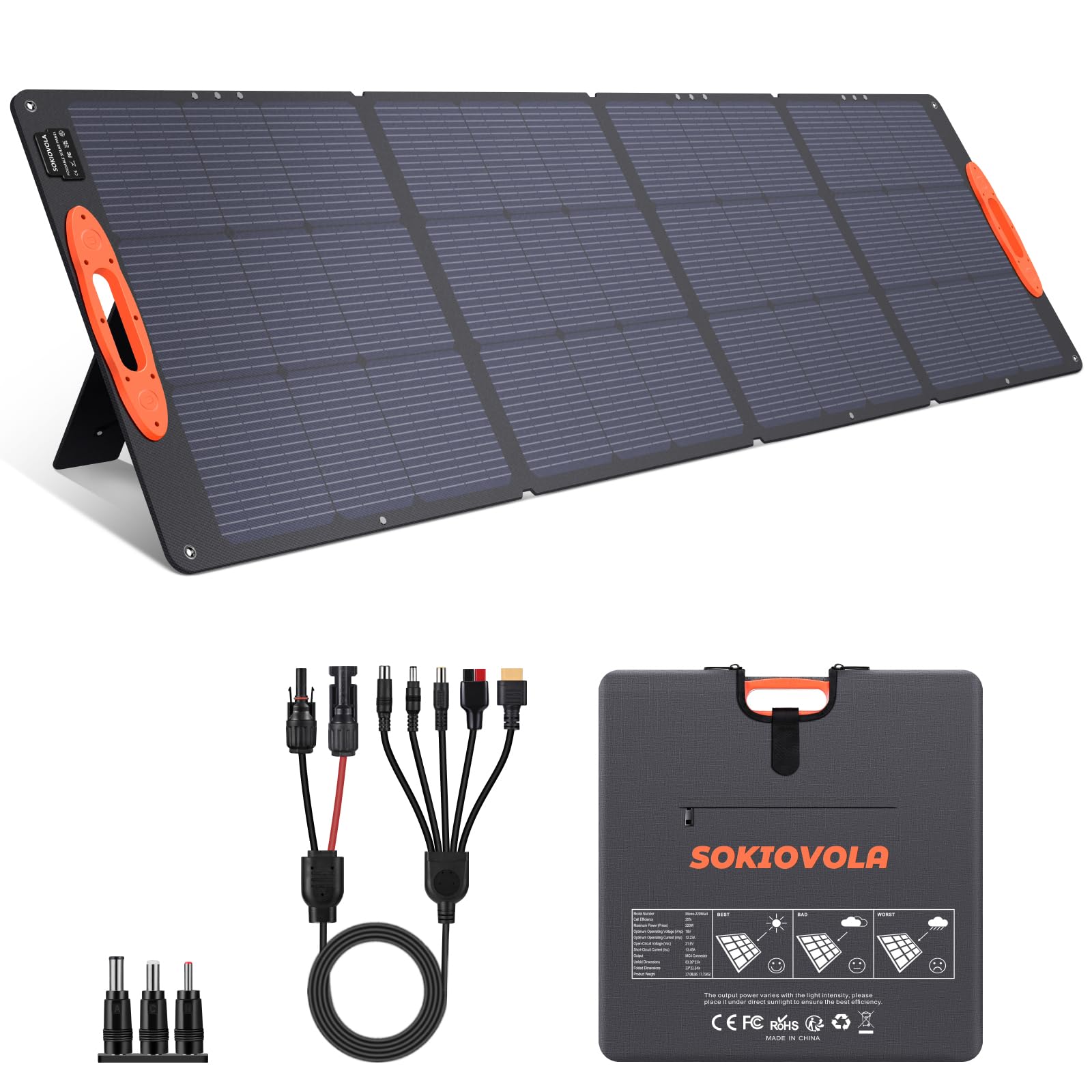
The SOKIOVOLA 220W folding panel is the strongest portable option in this roundup, combining N-Type cell efficiency with ETFE surface coating and an IP68 waterproof rating that exceeds the typical IP67 found on portable panels. At 17.08 pounds and folding to 23 x 22.24 inches, it is manageable for campground setup and RV travel, though it is too heavy for backpacking.
The panel uses A+ grade monocrystalline cells rated at 25% efficiency. In real-world testing, owners consistently see 170W to 177W at solar noon in Southern California sun — roughly 77-80% of the 220W rating, which is excellent for a portable panel that does not have active cooling or a fixed optimal tilt. The included 5-in-1 cable adapters cover XT60, Anderson, DC5521, DC7909, and DC8020 ports, ensuring compatibility with EcoFlow, Jackery, Bluetti, and Anker power stations right out of the box.
The carrying bag functions as a storage case with room for cables, and the magnetic handle simplifies quick relocation. Some owners noted the included XT60 connector showed early failure under repeated use, so carrying a spare connector is sensible. The voltage output around 18V keeps it safe for essentially all consumer power stations without input limit concerns.
Why it’s great
- IP68 waterproof rating — highest in the portable category
- ETFE coating resists UV yellowing better than standard PET
- Universal adapter kit works with all major power station brands
Good to know
- Carrying bag is higher quality than the included cables
- Kickstand alignment can require adjustment after folding
5. MHPOWOS 220W Portable Solar Panel

MHPOWOS delivers a 220W foldable panel that punches above its price point in real-world output. Owners report sustained peaks of 190W to 207W at solar noon, with 170-190W typical during prime hours — performance that rivals more expensive portable panels. The 23.5% monocrystalline efficiency and 40V output voltage are the trade-offs: this panel works best with power stations that accept higher input voltages, so compatibility checking is mandatory.
The 8.5 kg (18.7 lb) weight and folded dimensions of 23.5 x 21.25 x 2.3 inches make it portable but not ultralight — designed for car or RV travel rather than hiking. Four adjustable kickstands allow tilt optimization, though the Velcro straps for the legs can be cumbersome to re-secure during repacking. The 7-in-1 connector set covers the major standards, though the stock cables are short; many owners purchase a separate extension cable.
In partly cloudy conditions, the panel still delivered 150W, and during the worst solar day of December a reviewer hit 198W, confirming the cell quality is genuine. For budget-focused buyers who own compatible high-voltage power stations, this panel offers the best watts-per-dollar ratio in the portable segment.
Why it’s great
- Peak real-world output of 190-207W — near its 220W rating
- Excellent watts-per-dollar value for portable panels
- 4 adjustable kickstands allow tilt optimization throughout the day
Good to know
- 40V output may exceed input limits of many portable power stations
- Kickstand Velcro attachment can be awkward to refold
6. ZOUPW 200W Portable Solar Panel
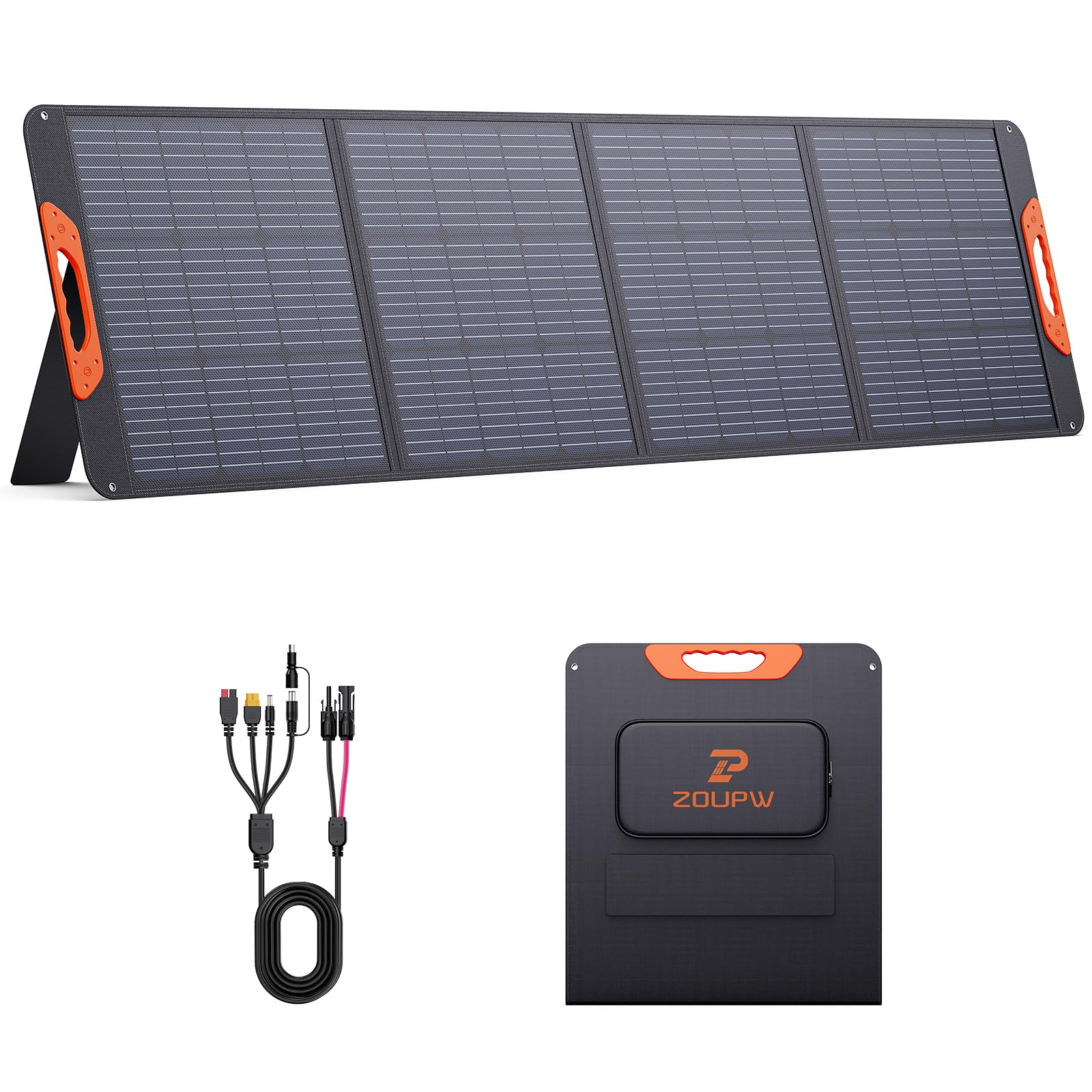
The ZOUPW 200W panel distinguishes itself with a built-in junction box that includes a USB-A QC3.0 port and a USB-C port supporting 60W Power Delivery — allowing direct charging of phones, tablets, and laptops without a separate power station. This makes it uniquely suited for emergency blackouts where keeping communication devices online is the priority.
The panel uses A+ Grade monocrystalline cells rated at 23.5% efficiency with an ETFE coating and IP67 waterproofing. Real-world output from owners averages 130W to 170W depending on conditions, with clear-sky peaks around 170W into a Jackery or Bluetti unit. The 10-foot 5-in-1 cable covers Anderson, XT60, DC7909, DC8020, and DC5521 connectors. Weighing 18.96 pounds and folding to 25 x 21.06 x 1.97 inches, it is comparable to other portable panels in this class.
The four adjustable kickstands support a 45-degree tilt angle that owners say captures 25-30% more energy than flat-laying panels. Magnetic handles hold the folded panel closed, and the overall build quality has satisfied buyers using it for hurricane backup and extended camping. Some owners with Jackery E1000V2 units reported 130W maximums, suggesting the power station’s input limit rather than a panel deficiency.
Why it’s great
- Integrated USB-C PD 60W port for direct device charging
- ETFE coating and IP67 rating for outdoor durability
- Magnetic handle and 45° kickstands simplify daily setup
Good to know
- Real-world output limited to ~130-170W depending on conditions
- Unfolding requires some finesse to align the kickstands
7. ECO-WORTHY 200W Portable Solar Panel
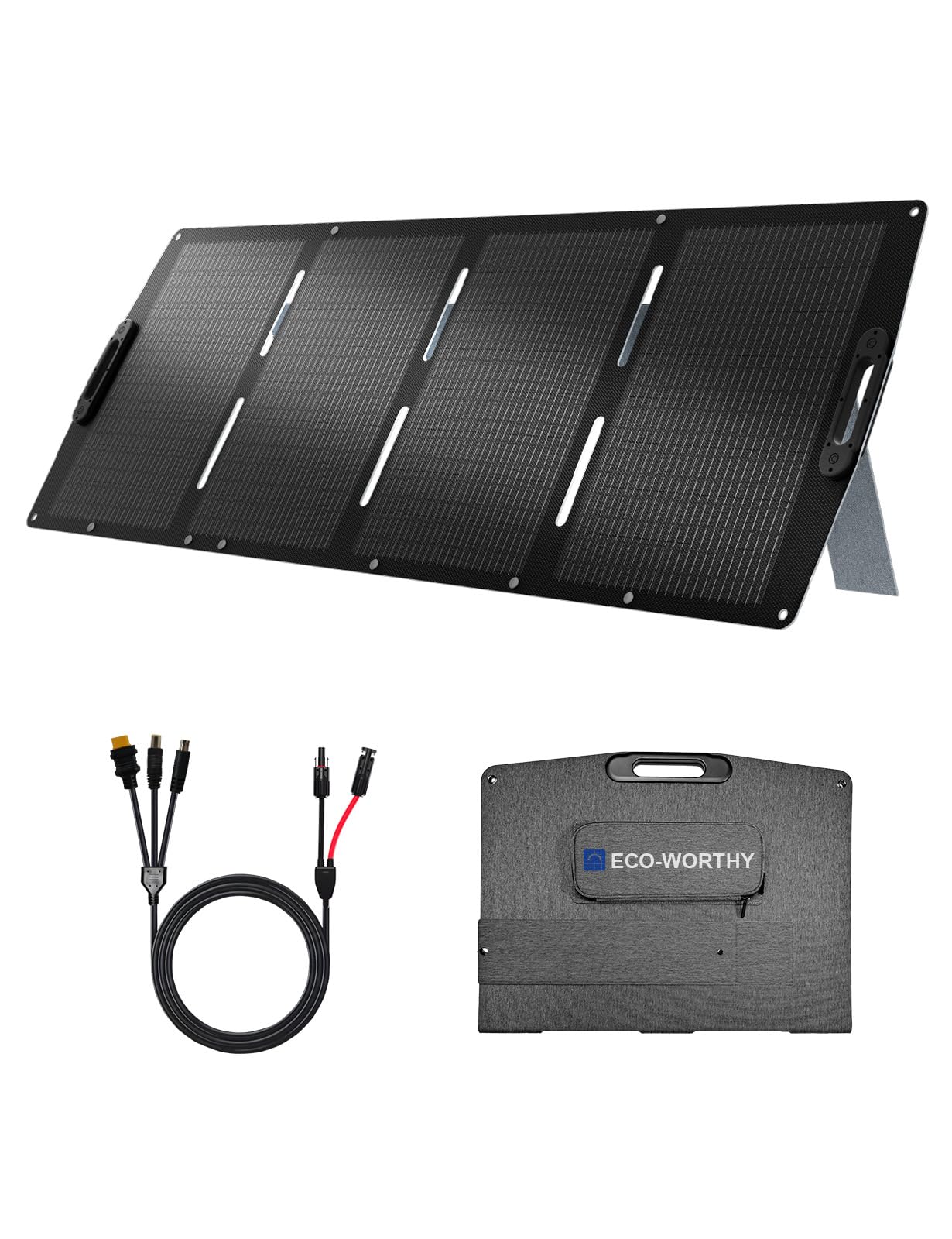
ECO-WORTHY’s 200W foldable panel prioritizes speed: the manufacturer claims a 10-second setup from folded to sun-facing, enabled by four adjustable kickstands that lock into position quickly. Weight is 22.04 pounds, and the folded dimensions of 20.94 x 26.22 x 1.97 inches place it on the larger side for portable panels, but the integrated mounting holes allow optional fixed attachment to an RV or trailer.
The panel uses A+ monocrystalline cells with PERC technology for a 23% efficiency rating, and the 7-layer lamination structure with ETFE surface aims for long-term outdoor durability. The 19.4V output voltage and 10.32 amp capacity are compatible with the majority of consumer power stations. The included 59-inch MC4 cable is short, so a longer extension will be necessary for most practical layouts. Owners report the panel works well with Delta 3 Plus and similar units on partly cloudy days, maintaining charging when fixed panels drop out.
Buyers who purchased multiple units for boondocking confirmed consistent performance across panels, and the open-circuit voltage measured around 31.3V — slightly above spec but still within safe limits for standard MPPT controllers. The one-piece lamination construction reduces the risk of delamination seen in cheaper folded panels.
Why it’s great
- Quick 10-second kickstand deployment for fast setup
- PERC cell technology improves low-light performance
- 7-layer lamination with ETFE adds durability
Good to know
- Cables are short — extension purchase is recommended
- Heavier than some portable alternatives at 22.04 lbs
8. Greenmagic 200W Portable Solar Panel
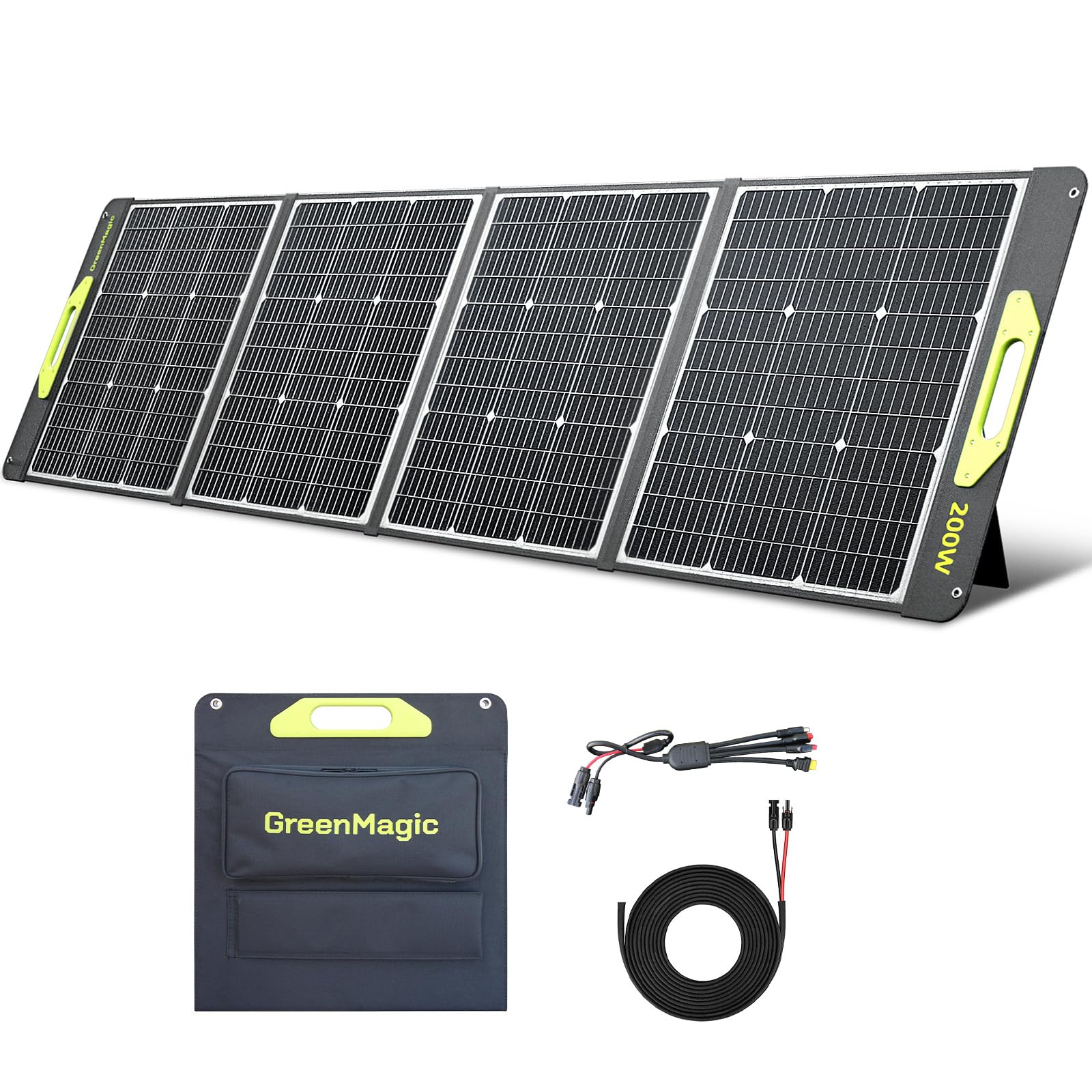
Greenmagic’s 200W panel is the entry-level option here, offering solid monocrystalline efficiency at 23.5% with a foldable design that weighs 11.5 pounds — considerably lighter than the 18-22 pound competitors. The upgraded PET lamination and cloth outer material provide water protection and wear resistance, though the plastic-based construction will not match the long-term UV resilience of ETFE-coated panels.
The output cable uses an MC4 connector with a 4-in-1 adapter covering XT60, Anderson, and DC7909 ports, ensuring compatibility with most power station brands. Real-world owner reports show sustained output around 138W to 148W peak in moderate sun conditions — lower than the premium portable panels, but proportional to the price. One owner using three panels in series with an 80V charge controller reported 550W total, indicating the panel pairs well in larger arrays when voltage matching is managed correctly.
The folded size of 25.31 x 20.87 x 2.17 inches and the included carry cable storage make it practical for car camping. The PET surface is less rigid than ETFE, so careful handling during setup and storage is recommended. For budget-first buyers or those needing a lightweight secondary panel to supplement an existing array, this is the most cost-effective option.
Why it’s great
- Lightest portable option at 11.5 lbs
- Competent 138-148W real-world output for the price
- Works in series arrays with appropriate charge controllers
Good to know
- PET coating less UV-resistant than ETFE alternatives
- Real-world output trails premium portable panels
9. DOKIO 800W (2×400W) Solar Panel Kit

The DOKIO 800W kit bundles two 400W monocrystalline panels for buyers who need serious off-grid charging capacity for a home shed, cabin, or larger battery bank. Each panel measures 67.8 x 44.6 x 2.4 inches — substantial hardware that requires dedicated roof space or a ground-mount frame. The total weight of 44.45 kg (98 lbs) makes this a fixed-installation product, not portable in any practical sense.
The standout feature is the 9.84-foot MC4 lead on each panel, allowing longer runs to a combiner box or charge controller without immediate extension cables. This reduces the number of inline connectors and potential failure points compared to an equivalent array of eight 100W panels. The aluminum frame and tempered glass construction are standard for permanent outdoor installations, sealed junction boxes provide weather resistance for year-round backyard use.
Real-world output from owners with partial shade conditions measured around 560W from the 800W rating, emphasizing the impact of shadow on large-format panels. An MPPT charge controller is strongly recommended to handle the combined current. For buyers whose power needs exceed what a single 200W panel can deliver, the DOKIO kit provides a clean path to 800W capacity with fewer connection hassles than a multi-panel array of smaller units.
Why it’s great
- Long 9.84 ft leads reduce need for extension cables
- 800W total capacity for serious off-grid charging
- Tempered glass and aluminum frame for permanent outdoor use
Good to know
- Large and heavy — requires permanent installation
- Output drops significantly with any shade on the array
FAQ
Why does my 200W solar panel only output 140-170W in real use?
Can I use a 40V solar panel with my Jackery or EcoFlow power station?
Is a bifacial solar panel worth the extra cost for an RV roof installation?
How do N-Type cells compare to P-Type cells for long-term use?
What is the difference between PET, ETFE, and glass solar panel surfaces?
Final Thoughts: The Verdict
For most users, the best 240w solar panel winner is the Callsun 200W Bifacial because its N-Type cells, TwinCell anti-shade design, and genuine bifacial overproduction deliver the highest real-world wattage in this class, outperforming its own 200W rating on reflective surfaces. If you need a small, van-optimized rigid panel that saves roof space, grab the Renogy 200W N-Type. And for portable campers who want the best mix of efficiency and IP68 weather resistance, the SOKIOVOLA 220W is the top portable choice.