
The crack of the bat is the sound of a fastball screaming toward the dirt, and the only thing standing between a wild pitch and a trip to the dugout is the gear strapped to your chest. A chest protector that shifts, gaps, or lacks density turns every block into a gamble, and every passed ball erodes the trust between pitcher and catcher. The right plate armor is a rigid shell of impact-dispersing foam that stays locked in place through a full squat, a cross-body dive, and a foul tip off the collarbone.
I’m Min — the co-founder and writer behind Gadgets Feed. I’ve spent countless hours analyzing the material science behind sports impact protection, comparing foam densities, harness adjustability systems, and NOCSAE certification requirements to separate gear that actually stops a 70 mph fastball from gear that just looks the part.
Whether you are a travel-ball parent sizing up a first set for a 12-year-old or a high school player upgrading from a hand-me-down, this guide covers everything you need to make the right call on the best baseball chest protector for your position behind the dish.
How To Choose The Best Baseball Chest Protector
Picking the wrong chest protector is not about brand loyalty — it’s about a gap in the padding that lets a foul tip bruise a rib or a harness that loosens mid-game and lets the whole unit ride up. You need to understand three specific performance pillars before you commit.
NOCSAE Certification Is Non-Negotiable
The National Operating Committee on Standards for Athletic Equipment sets the impact attenuation standard that every legitimate plate protector must meet. A NOCSAE-certified chest protector has been lab-tested to absorb the energy of a baseball traveling at game speed without transferring dangerous force to the sternum or ribs. If the description does not explicitly say NOCSAE-certified, the unit probably relies on generic foam padding that might soften a catch but will not disperse the shock of a direct hit.
Foam Density and Rebound Characteristics
Low-rebound foam — often labeled as slow-recovery or viscoelastic — is designed to absorb the ball’s energy and hold it rather than springing the ball back toward the field. This is critical for catchers who work on blocking drills because a high-rebound protector can send a blocked ball rolling ten feet away. Mid-range protectors often use a dual-density sandwich: a softer inner layer for comfort and a denser outer shell for impact dispersal. Premium models add a tiered or multi-laminate foam structure that channels force laterally across the plate.
Harness Adjustability and Body-Lock Fit
A chest protector that shifts even a quarter-inch during a lateral slide leaves a window for a ball to sneak through. Look for a four-point webbing strap system or a tension-lock buckle mechanism that secures the unit to your torso independently of the shoulder caps. If the shoulder caps are non-adjustable, the protector may gap at the collarbone on a player with a broader or narrower frame. The best models integrate a moldable wire along the abdominal section that bends to your waistline and resists upward creep during a deep squat.
Quick Comparison
On smaller screens, swipe sideways to see the full table.
| Model | Category | Best For | Key Spec | Amazon |
|---|---|---|---|---|
| EvoShield Pro-SRZ | Premium | Form-fit agility & Fidlock ease | Moldable abdominal wire + NOCSAE chest guard | Amazon |
| Rawlings Velo 2.0 Set | Premium | Complete youth set with Arc Reactor Core | 12U hockey-style set with heat exchange chest tech | Amazon |
| Rawlings Renegade 2.0 Set | Premium | Youth set with Coolflo ventilation | 14 in. chest protector with Arc Reactor Core foam | Amazon |
| Easton / Jen Schro Set | Premium | Fastpitch-specific collarbone guard | 9.7 lbs complete set with Aegis anti-microbial pads | Amazon |
| Mizuno Samurai | Mid-Range | Large frame + low-rebound blocking | Low-rebound foam keeps balls close after block | Amazon |
| All-Star Player’s Series Kit | Mid-Range | Complete catching kit for ages 7-16 | PE protective plates inside chest guard | Amazon |
| Easton Gametime Intermediate | Mid-Range | Intermediate 13-15 fit with adjustable caps | 16 in. size with 4-point webbing strap system | Amazon |
In‑Depth Reviews
1. EvoShield Pro-SRZ™ Baseball Catcher’s Chest Protector
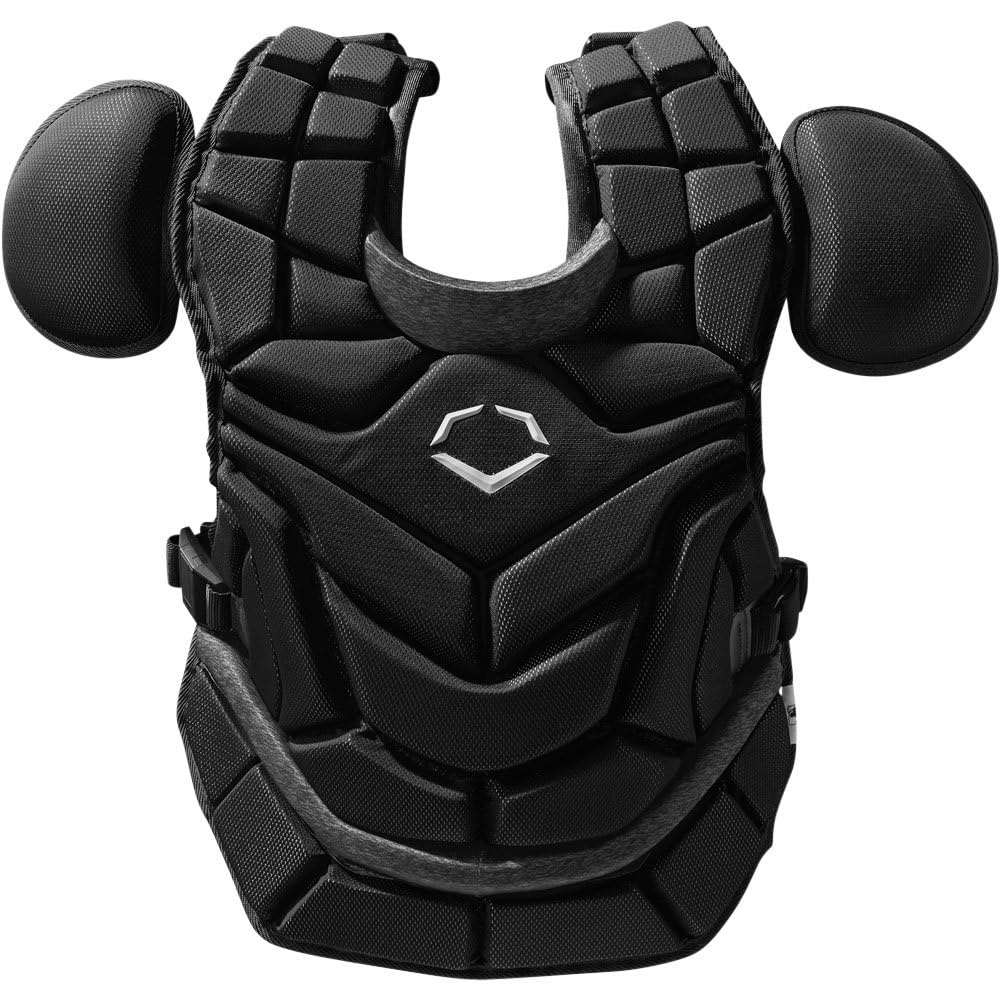
The EvoShield Pro-SRZ redefines what a chest protector should feel like by integrating a moldable abdominal wire that bends to the catcher’s waist contour, eliminating the upward creep that plagues traditional strap-only designs. The magnetic Fidlock buckle lets you snap the unit on or off in under two seconds, a small detail that makes a big difference between innings when you need to adjust your stance. At two pounds total weight, the composite shell strikes a rare balance between high-impact dispersion and unrestricted lateral mobility, letting the catcher rotate through a snap throw without the gear twisting off-center.
The included NOCSAE chest guard slides into a dedicated pocket inside the shell, so the unit meets the full NOCSAE standard only when the guard is inserted — a critical distinction that many players overlook. Reviews consistently highlight the confidence this protector creates in the 12U-16U age range, particularly in the intermediate sizing, where the form-fit design tracks body contours rather than hanging like a flat board. The downside is that the lower abdominal wire has been reported to push through the fabric after five to six months of heavy use, which forces a warranty claim or a replacement unit rather than a simple stitch repair.
The + price point places it firmly in premium territory, but the combination of the locking wire, the quick-release buckles, and the contoured density zones makes it the most technically advanced chest protector available for players who prioritize agility and zero-shift fit. If your catcher values a glove-like feel over traditional bulk and you are willing to monitor the wire’s integrity, this is the unit that sets the benchmark.
Why it’s great
- Moldable wire prevents the protector from riding up during deep squats
- Fidlock magnetic buckle enables lightning-fast removal between innings
Good to know
- Abdominal wire can puncture through fabric after several months of regular use
- NOCSAE guard must be inserted in the pocket or the unit does not meet the standard
2. Rawlings Velo 2.0 Catcher’s Set
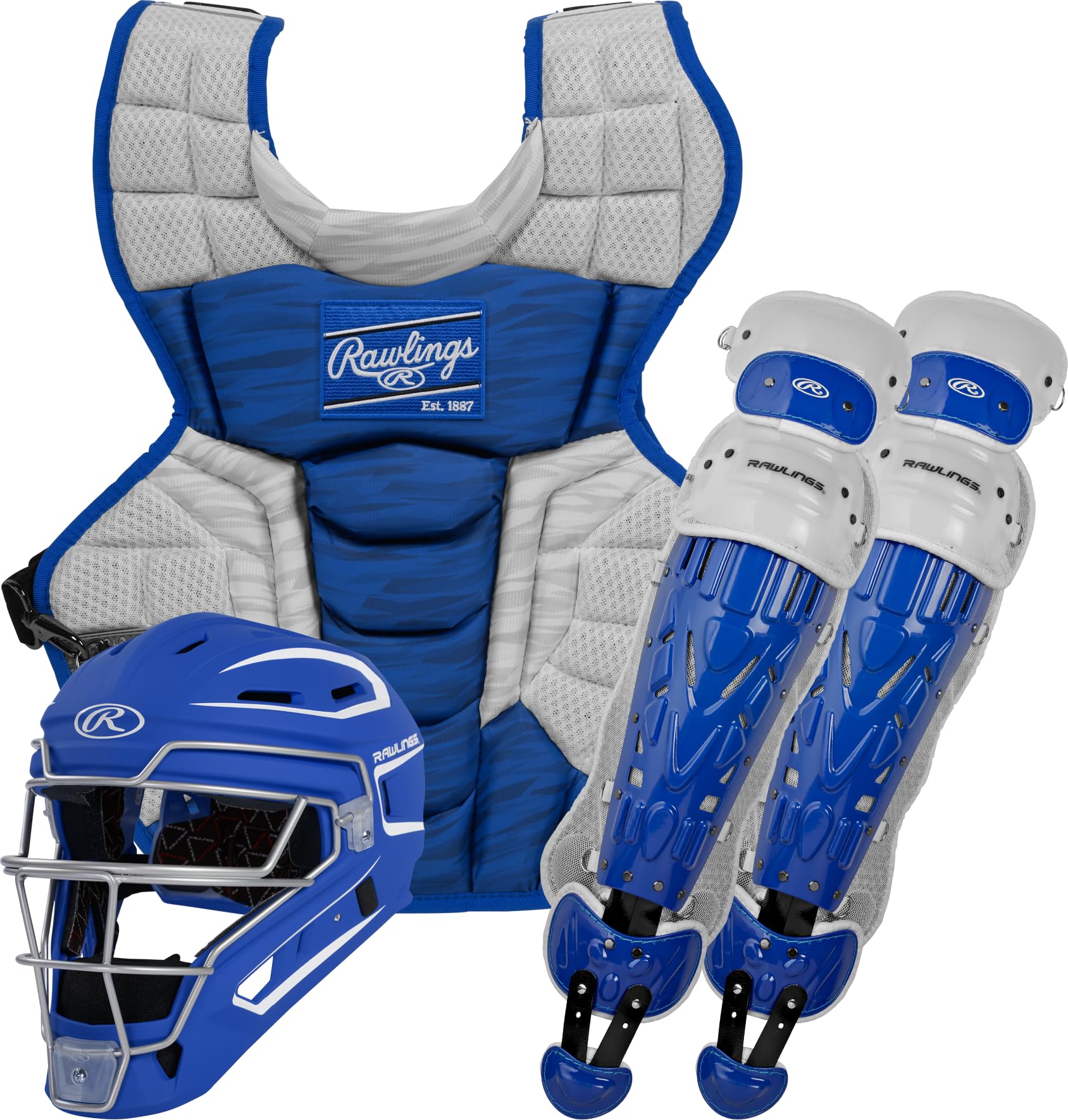
The Rawlings Velo 2.0 is designed explicitly for youth players ages 12 and under, and the single most important feature is the Arc Reactor Core technology embedded in the chest protector — a dual-layer system that blends impact-absorbing polyurethane with an arch-engineered polymer plate. When a ball hits the center of the plate, the arch geometry disperses the force outward across the entire surface rather than concentrating the energy directly under the impact point. The chest protector itself measures 13.5 inches, which is compact enough for a 10- or 11-year-old frame yet still covers the full strike zone in a low squat position.
The set includes a hockey-style catcher’s helmet with a moisture-wicking liner and a three-way adjustable back plate, plus 13.75-inch triple-knee leg guards that incorporate a kneecap shell for slide protection. Multiple verified reviews from parents of 11- and 12-year-olds confirm that the chest protector fits true to size, though the unit runs slightly large — a 100-pound 11-year-old may find the helmet initially bulky and the chest protector offering only about half an inch of horizontal adjustment. The lack of a broader harness range means the Velo 2.0 works best when the player’s body dimensions align closely with the youth 12U target window.
The major durability differentiator is the ventilation architecture: heat exchange channels in the chest foam let hot air escape through micro-perforations, reducing the swampy feeling that causes players to loosen their straps between innings. After two seasons, the Velcro closures may lose some grip, but the chest protector itself and the face mask consistently outlast the user’s growth phase. For the parent buying a single complete set that will protect and cool a young catcher through rec league and travel ball, the Velo 2.0 delivers the most integrated engineering at the upper end of the youth category.
Why it’s great
- Arc Reactor Core disperses impact force laterally across the whole plate
- Helmet moisture-wicking liner and chest heat exchange reduce overheating during long innings
Good to know
- Chest protector has very limited horizontal adjustment — best for players whose frame matches the 12U profile
- Velcro closure on leg guards may wear out after extended use in dusty infield conditions
3. Rawlings Renegade 2.0 Youth Catcher’s Set

The Renegade 2.0 occupies a specific sweet spot: it shares the Arc Reactor Core impact technology found in the Velo 2.0 but packages it in a youth set that ships at a lower price point, making it the smartest value proposition for a 9- to 12-year-old catcher who is still growing rapidly and may outgrow the set within two seasons. The chest protector measures 14 inches — slightly larger than the Velo 2.0 — and covers a broader torso while still maintaining the NOCSAE certification that is mandatory for competitive league play. The Coolflo hockey-style helmet prioritizes air circulation through front ventilation ports and a channeled interior liner, addressing the biggest complaint young catchers have about gear: the heat.
Multiple parents report that this set has survived three seasons of weekend rec league and travel ball with only minor wear on the helmet interior padding. The leg guards incorporate a double-knee design that splits the shell into two articulated pieces, letting the shin and knee move independently during a block — a feature usually reserved for premium adult-level gear. The chest protector’s four-point adjustable harness uses heavy-duty nylon webbing that does not stretch or loosen after repeated sweat exposure, and the PE protective plates inside the chest pad add a rigid skeleton that prevents the foam from bottoming out against the sternum on direct fastball strikes.
The trade-off is that the helmet’s retention system is less refined than the Velo 2.0’s three-way plate, and some 11-year-olds report that the mask feels slightly front-heavy during aggressive head movement. But for a parent who wants NOCSAE-level protection, high-volume ventilation, and a proven durability track record without paying for the top-tier set, the Renegade 2.0 is the most balanced complete package in the youth bracket. The chest protector itself can also be purchased separately if you already own a compatible mask and leg guards.
Why it’s great
- Arc Reactor Core foam technology at a more accessible entry point than the Velo line
- Double-knee leg guard design enables independent knee and shin movement when blocking
Good to know
- Coolflo helmet can feel slightly front-heavy for younger or smaller-headed players
- Interior helmet padding may begin to peel at the edges after extended use in humid conditions
4. Easton The Fundamental by Jen Schro Fastpitch Set

The Easton The Fundamental set was co-developed with professional catcher Jen Schro, and the chest protector’s design reflects fastpitch-specific biomechanics rather than a generic baseball silhouette. The collarbone guard extends higher and wraps further around the neck than a typical baseball protector, addressing the higher frequency of upward-swinging foul tips in fastpitch. The chest foam uses a graduated density system: softer near the solar plexus for comfort on low blocks and stiffer across the sternum and shoulder caps for direct-hit absorption. Mesh ventilation panels run along the side ribs and lower back to combat the heat buildup that fastpitch catchers face during doubleheaders in full sun.
The leg guards are shaped with a narrower knee channel that aligns better with the average female athlete’s hip width, preventing the shell from rotating outward during lateral slides. The helmet includes Clear Dri and Aegis-treated pads that actively fight bacteria and sweat accumulation — a genuine advantage for catchers who practice five days a week and do not have time to air-dry gear between sessions. Verified reviews from parents of 10U and 12U fastpitch players note that the set fits true to size for athletes around 5’3” and 118 pounds, though the chest protector runs slightly short — an intentional design choice to prevent the bottom edge from digging into the thighs during a low squat.
The complete set weighs 9.7 pounds, which is lighter than most traditional catcher’s sets by about half a pound, and that weight reduction translates directly to less fatigue in the fourth inning of a tight game. The downside is that the helmet does not include a beard attachment, a detail that affects some older players who prefer the longer chin guard. For a fastpitch athlete who wants gear engineered for her specific movement patterns, this is the most category-specific protector on the market.
Why it’s great
- Extended collarbone guard protects against fastpitch-specific upward foul tips
- Clear Dri and Aegis pads actively resist bacteria and sweat buildup
Good to know
- Chest protector runs slightly short — intentional but may feel undersized to players used to longer plates
- Helmet lacks a beard attachment for players who prefer extra chin coverage
5. Mizuno Samurai Baseball Chest Protector

The Mizuno Samurai is the protector that big catchers gravitate toward because the waist strap stretches to accommodate a 6’2”, 300-pound frame without pinching or riding up. The core material is low-rebound foam — a viscoelastic compound that absorbs the ball’s kinetic energy and holds it rather than springing the ball back toward the mound. This is a game-changer for catchers who focus on blocking technique because a high-rebound chest pad can send a blocked ball rolling six feet to the right, turning a routine block into a wild scramble. The foam density ramps up from a soft inner layer that molds to the chest shape to a firmer outer skin that spreads impact force across the whole panel.
The adult sizing uses a vertical back strap that extends enough to wrap around broad shoulders, and the shoulder caps are padded with the same low-rebound material so that a foul tip off the top of the shoulder does not ricochet back toward the mask. Mizuno includes a Personalized Name Plate (PNP) on the front — a velcro-mounted patch where you can write the player’s name — which is a small detail that helps avoid gear confusion during team practices with multiple catchers. Verified umpire reviews confirm that taking a direct foul ball to the chest in this protector results in zero pain transfer, which is the highest functional validation a chest protector can earn.
The Samurai is NOCSAE certified, and at around one pound, it is surprisingly lightweight for the coverage area. The main concession is that the closure system relies on traditional pull-on straps rather than a quick-release buckle, so taking it off between innings takes more effort than the magnetic Fidlock systems on premium competitors. For the big-framed catcher who prioritizes stay-put coverage and dead-ball blocking over rapid on/off convenience, the Samurai delivers the most reliable torso coverage in the mid-range segment.
Why it’s great
- Low-rebound foam keeps blocked balls close to the catcher’s body
- Waist and back straps accommodate very large frames without bunching
Good to know
- Pull-on strap closure is slower to remove than magnetic buckle systems
- PNP name plate is a small velcro patch — write the name yourself before use
6. All-Star Player’s Series Youth Catcher’s Kit

The All-Star Player’s Series Kit is the rare all-in-one package that does not sacrifice chest protector quality to keep the total price reasonable. The chest protector features internal polyethylene (PE) protective plates sandwiched between layers of impact foam — a rigid skeleton that prevents the padding from compressing fully on a direct hit. The four-point adjustable harness uses heavy-gauge nylon webbing that wraps independently around each shoulder and each side of the rib cage, which makes it possible to fine-tune the fit for a slender 8-year-old who weighs 72 pounds as well as a broader 13-year-old who is 5’4”. The leg guards include a double protective knee design that articulates naturally during a low block, and the hockey-style helmet has an adjustable back plate to accommodate head growth over several seasons.
This kit is NOCSAE certified across all three components, and the included throat guard clips onto the helmet for an extra layer of protection against foul tips that ride up under the mask. Verified reviews from parents of 10-year-old travel ball catchers report that the set has lasted three years of year-round play before the helmet interior pads started to separate at the edges — an acceptable lifespan for a youth kit at this price range. The chest protector itself consistently earns praise for how securely it stays in place during lateral slides, thanks to the independent shoulder straps that prevent the unit from twisting when the catcher pivots for a snap throw.
The color options (Black, Navy, Royal Blue, and Red) let families match team colors without paying a custom-gear premium. The main trade-off is that the helmet’s padding is less breathable than the Coolflo or Clear Dri alternatives, which means more sweat accumulation during summer tournaments. But for a parent who needs a single purchase that covers a young catcher from helmet to shin guards with no gaps in protection, the All-Star Player’s Series Kit is the most complete value proposition in the youth segment.
Why it’s great
- PE plates inside the chest guard prevent foam from bottoming out on direct impacts
- Four-point adjustable harness fits a wide range of youth body types from 8 to 13 years old
Good to know
- Helmet interior padding is less ventilated than premium alternatives
- Throat guard included but may interfere with full head movement for some players
7. Easton Gametime Intermediate Catcher Chest Protector
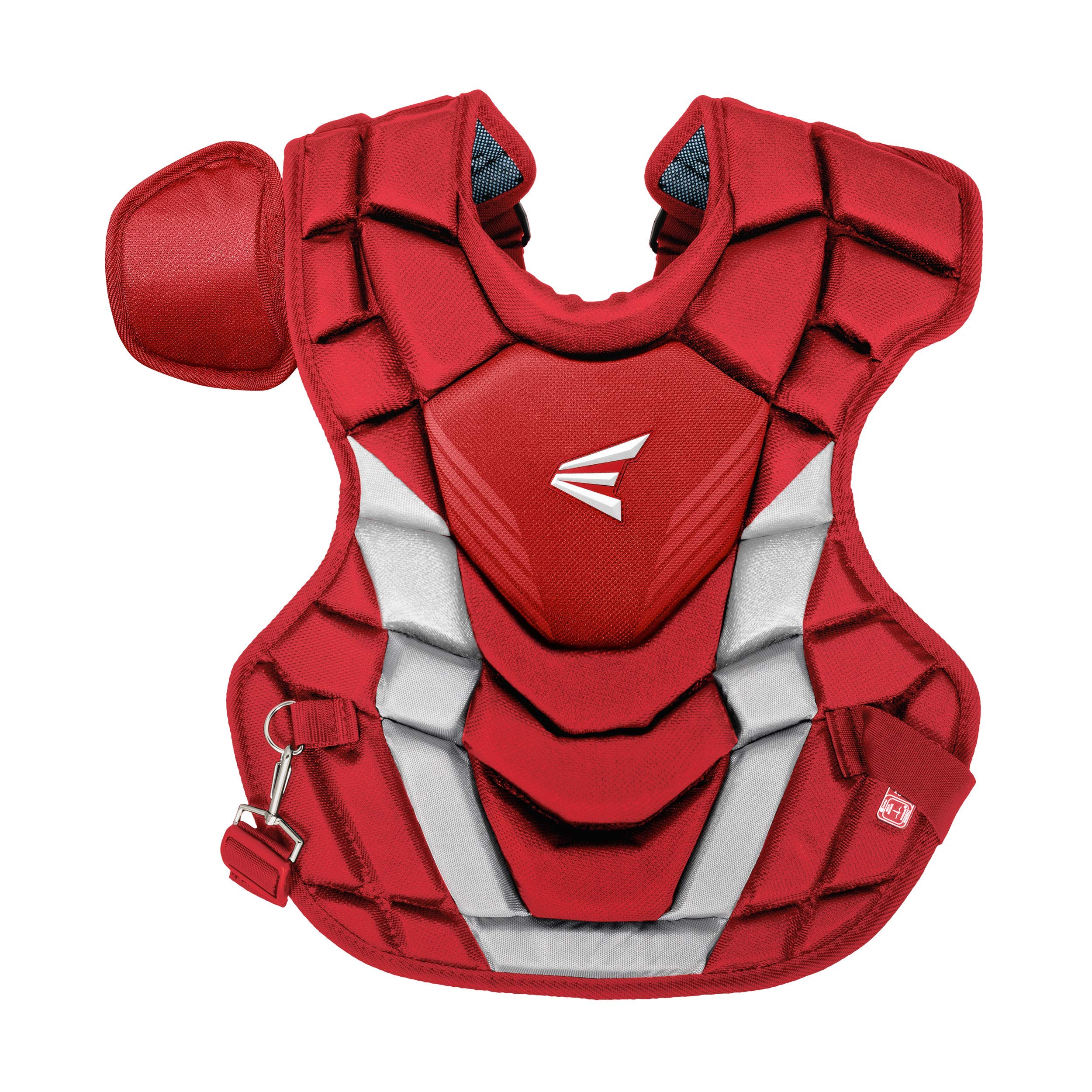
The Easton Gametime Intermediate is the designated stepping-stone protector for teenage catchers who have outgrown youth sizing but are not ready for the geometry and expense of adult premium gear. The 16-inch height is calibrated specifically for players ages 13 to 15, and the defining feature is the adjustable shoulder cap — a pivoting plate that lets the catcher dial in the angle of the shoulder padding to match their individual blocking posture. When a catcher tilts forward into a low squat, a fixed shoulder cap can gap open and expose the collarbone; the Gametime’s adjustable cap tracks that movement and keeps protection flush against the bone throughout the full range of motion.
The four-point webbing strap system uses independent tension locks for the shoulders and waist, so a skinny 13-year-old who is all limbs can cinch the waist tight without creating slack under the arms. The foam abdominal padding is specifically designed for rebound control — the same low-rebound principle found in higher-end protectors — which ensures that blocked balls drop straight down rather than rebounding toward the baseline. Multiple verified reviews from parents of 12U catchers confirm that this protector is noticeably more padded and durable than comparably priced alternatives from Boombah and Champro, and it does not retain odor even after a full summer of two-a-day practices.
The Gametime meets NOCSAE standards for all levels of play, and the red color scheme makes it visible from the dugout — a small confidence boost for a teenager who wants to look the part. The primary limitation is sizing: several 10-year-olds on the larger side found the intermediate fit too snug with no room to grow, so this protector is best reserved for players whose age range matches the intended 13-15 target. For the middle-school catcher who needs adult-level impact absorption at a mid-range price point, the Gametime Intermediate delivers the best balance of coverage, adjustability, and durability in the bridging category.
Why it’s great
- Adjustable shoulder cap pivots to match individual blocking posture and keeps collarbone covered
- Foam padding is denser than competing mid-range brands and resists odor from sweat
Good to know
- Sizing runs true to the 13-15 intermediate range — larger 10-year-olds may find it too tight
- Color options are limited to red, which may not match all team uniforms
FAQ
What is the difference between a baseball chest protector and a softball chest protector?
Can I use a youth chest protector for adult slow-pitch softball?
How tight should a baseball chest protector fit?
Final Thoughts: The Verdict
For most users, the best baseball chest protector winner is the EvoShield Pro-SRZ because the moldable abdominal wire and Fidlock buckle create a zero-shift fit that no other protector matches at any price. If you want a complete set that cools the player and protects through two seasons of travel ball, grab the Rawlings Velo 2.0. And for a big-framed catcher who needs low-rebound foam and stays planted behind the plate, nothing beats the Mizuno Samurai.