
Every electronic circuit tells the truth only when fed clean, stable DC power. A switching wall wart introduces ripple that hides signal anomalies, and a cheap supply drifts under load, wasting hours of debugging on a phantom issue. The right bench power supply turns a chaotic workbench into a controlled test environment where voltage and current are predictable down to the millivolt.
I’m Min — the co-founder and writer behind Gadgets Feed. I’ve spent countless hours poring over datasheets, comparing voltage regulation specs, and studying the build quality of linear versus switching topologies to help you find the best AC/DC power supplies for your bench.
This guide cuts through the noise to recommend the most reliable models for hobbyists, technicians, and engineers. The goal is simple: help you confidently pick the best ac/dc power supplies for your projects without overpaying for features you don’t need.
How To Choose The Best AC/DC Power Supplies
Buying a bench power supply means matching its output capabilities to your typical loads. A unit with a wide voltage range but low current will frustrate when driving motors, while a high-current supply with poor regulation can introduce noise that masks subtle circuit behavior. Focus on three core decisions: topology, output range, and control precision.
Linear vs. Switching Topology
Linear supplies use a heavy transformer to step down AC and then regulate it with a pass transistor, producing very clean DC output with ripple measured in microvolts. They are heavier and less efficient, dumping excess voltage as heat. Switching supplies use a high-frequency oscillator and are lighter, more efficient, and cheaper, but their output contains ripple in the millivolt range that can interfere with RF and audio circuits. For sensitive analog work, the linear topology is mandatory; for digital logic, motors, or general power, a good switching supply is perfectly adequate.
Voltage and Current Range vs. Resolution
Maximum voltage and current are obvious specs, but resolution matters more for precise work. A supply that adjusts in 0.1V steps is fine for charging batteries or powering LEDs, but debugging a 3.3V logic rail requires a display that resolves 0.01V or better. Current resolution to 0.001A (1 mA) is critical for testing low-power IoT devices. The best units combine a wide range (0–30V, 0–10A) with fine encoder knobs that allow coarse and fine adjustments.
Protection and Programmability
Overcurrent protection (OCP) shuts down the output if the load draws more than the set limit, saving your circuit from burnout. Overvoltage protection (OVP) prevents a runaway supply from damaging sensitive components. Memory presets (M1/M2/M3) let you recall common voltage/current settings instantly, saving setup time on repetitive tasks. For advanced users, a programmable supply with USB or Ethernet control enables automated testing sequences.
Quick Comparison
On smaller screens, swipe sideways to see the full table.
| Model | Category | Best For | Key Spec | Amazon |
|---|---|---|---|---|
| KORAD KD3005D | Linear / Premium | Low-noise lab work | 30V / 5A, 1mV resolution | Amazon |
| Siglent SPD3303X-E | Linear / Pro | Dual-channel, programmable | 32V / 3.2A x2, 220W total | Amazon |
| Tekpower TP3005T | Linear / Mid-Range | Low-noise at a good price | 30V / 5A, 0.01A resolution | Amazon |
| HYELEC HY50-06A | Switching / Mid-Range | High voltage range (50V) | 50V / 6A, 150W max | Amazon |
| WANPTEK DPS3010U | Switching / Value | High current repair bench | 30V / 10A, USB-C QC 3.6A | Amazon |
| Pyramid PS15K.5 | Linear / Comms | Ham radio / CB base station | 13.8V / 10A, 250W | Amazon |
| Pyramid PSU990KX | Switching / Compact | Desktop radio and USB charging | 13.8V / 7A, dual USB ports | Amazon |
In‑Depth Reviews
1. KORAD KD3005D – Precision Variable Adjustable 30V, 5A DC Linear Power Supply

The KORAD KD3005D is the gold standard for a mid-range linear bench supply, delivering clean adjustable DC from 0 to 30 volts at up to 5 amps. Its linear topology keeps output ripple to a minimum, making it suitable for powering audio amplifiers, RF circuits, and microcontroller projects where switching noise would corrupt measurements. Dual 4-digit LED displays show both set and actual values simultaneously, eliminating guesswork.
Digital controls let you adjust voltage in 1 mV steps and current in 1 mA steps, with an auto-ranging ammeter that switches between mA and A display for readability at low currents. The supply includes overload, short-circuit, and over-temperature protection, and the auto-speed fan keeps noise down until the unit is working hard. Switchable input voltage (110/220V) makes it usable on different mains systems.
Some users report the current reading can be off by about 6% without calibration, and the output diode can be damaged if a reverse voltage is applied from a battery. The fan is audible at higher loads, measuring around 57 dB from the rear. For the price, however, the build quality — including a large transformer and laced wiring — is excellent for a linear supply with this level of precision.
Why it’s great
- Clean, low-noise linear regulation with 1 mV voltage resolution
- Dual displays show set vs. actual readings simultaneously
- Switchable 110/220V input for global use
Good to know
- Fan noise can reach 57 dB at higher loads
- Current accuracy may need calibration out of the box
- Output diode lacks reverse polarity protection
2. Siglent Technologies SPD3303X-E Triple Output Power Supply
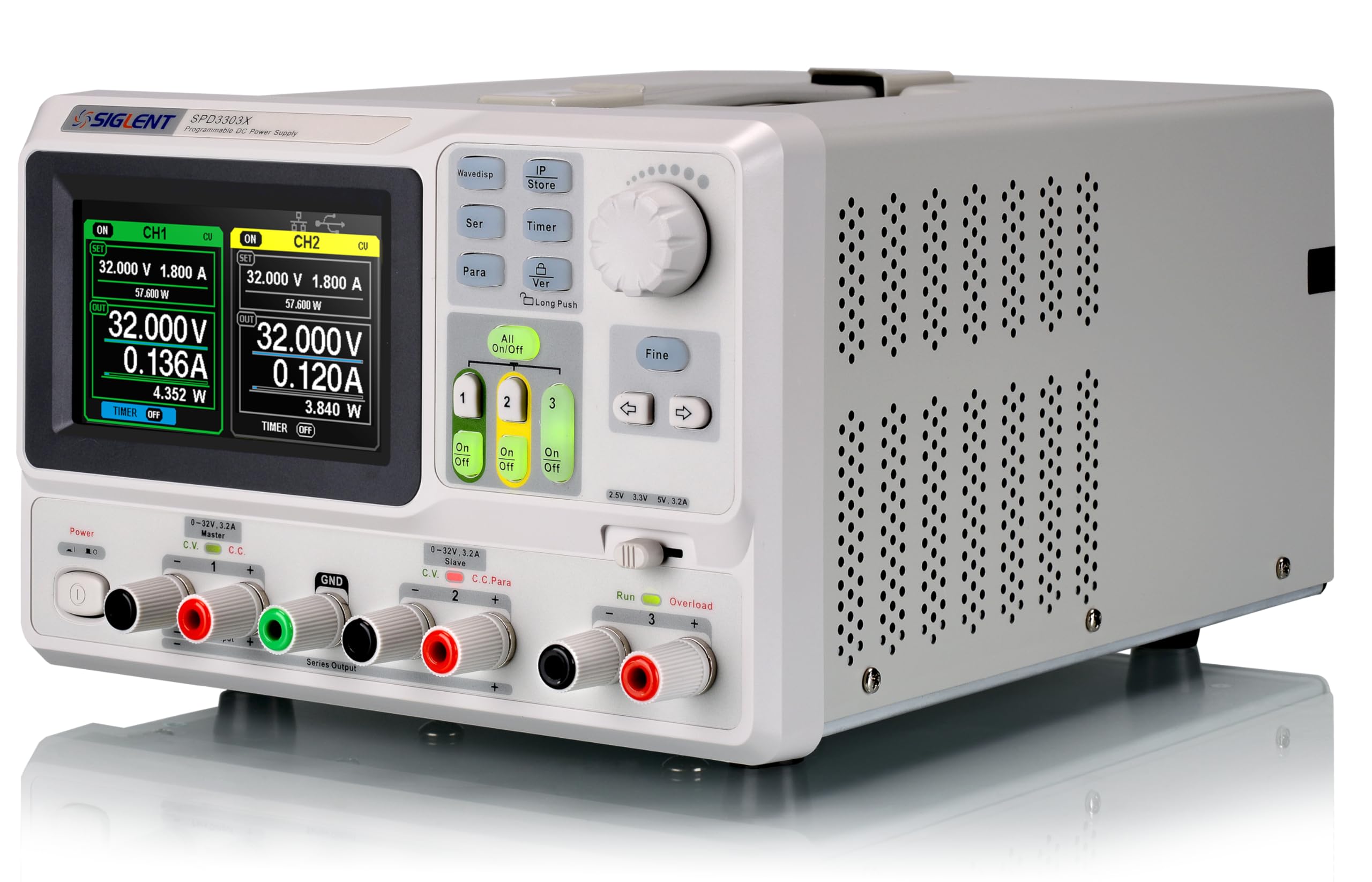
The Siglent SPD3303X-E is a triple-output programmable linear supply designed for engineers who need independent isolated channels. It provides two channels of 0–32V at 3.2A each, plus a fixed third output switchable to 2.5V, 3.3V, or 5V at 3.2A, totaling 220W. Each channel can operate independently, in series for up to 60V, or in parallel for up to 6.4A, covering a wide range of test scenarios.
Precision is a highlight: voltage accuracy is better than 0.016% from 1 to 30V, and residual AC ripple is around 0.5 mV. The supply includes a timing output function and trending graphs on its display. USB and Ethernet connectivity allow full remote programming via SCPI commands, making it easy to integrate into automated test benches using Python or LabVIEW.
The variable-speed fan is nearly silent at idle but becomes noticeable above 50% load. The included banana plugs feel less premium than the rest of the supply. The third channel lacks current tracking display, and the ammeter only resolves to 10 mA (not 1 mA). For most lab work, factors like the excellent build quality and accurate programming outweigh these minor shortcomings.
Why it’s great
- Three isolated outputs with independent, series, and parallel modes
- Excellent voltage accuracy below 0.02% with very low ripple
- USB and Ethernet remote control for automated testing
Good to know
- Fan can be audible under heavy load
- Current display resolution is limited to 10 mA
- Firmware updates require a Windows PC
3. Tekpower TP3005T Variable Linear DC Power Supply, 0-30V @ 0-5A
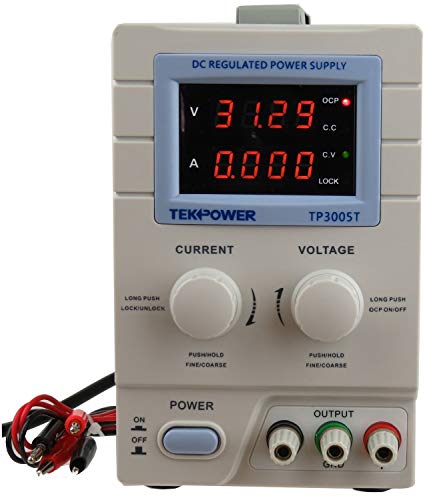
The Tekpower TP3005T fills the gap between cheap switching supplies and expensive lab-grade units by offering a genuine linear topology at a budget-friendly price. It provides 0–30V and 0–5A with a backlit LED display showing 0.1V and 0.01A resolution. Users report the voltage reading is accurate to within 0.01V and the current to 0.001A when cross-checked with a multimeter, making it reliable for most hobby electronics work.
The supply is built with a heavy metal body and a large linear transformer, weighing in at 12 pounds — a sign of proper linear regulation. A built-in thermo-sensor controls the cooling fan, keeping noise down at low loads. Constant voltage and constant current modes are standard, and the unit handled repeated short-circuit tests without issue during testing. The digital controls take a few minutes to learn (tap for fine mode, auto-lock after 1–2 seconds to prevent accidental changes), but quickly become intuitive.
Some unit-specific issues include a mild paint odor when new and a fan that runs at full speed above 1A load, creating noticeable noise. The included alligator test leads have banana plugs that can develop intermittent contact over time. For the price, the internal build quality — heavy transformer, polymer separation, quality capacitors — is exceptional for a linear supply.
Why it’s great
- True linear regulation keeps output noise very low
- Voltage accuracy to 0.01V verified by users
- Heavy-duty build with a large transformer at this price point
Good to know
- Fan runs at full speed above 1A, can be loud
- Included test leads have low-quality banana plugs
- Digital control interface has a minor learning curve
4. HYELEC Variable DC Power Supply 0-50V 0-6A (HY50-06A)

The HYELEC HY50-06A extends the voltage range beyond the standard 30V to 50V at 6A, with a maximum power output of 150W. This makes it a great fit for tasks like balancing EV battery packs, working with 48V telecom equipment, or charging higher-voltage lead-acid batteries. It uses a switching topology to keep the weight down to about 2.7 pounds while still delivering stable output with fine adjustment down to 0.01V and 0.001A on the 4-digit LED display.
A precision encoder knob handles both coarse and fine adjustments, switching between them with a simple press. Three memory slots (M1, M2, M3) let you save and recall common voltage/current settings, which is useful when switching between different project types. The supply includes a 5V/2A USB port (though only USB-A, not Type-C) for powering a phone or a small test jig, plus an output enable/disable button to avoid accidental power-on.
The unit is quiet in operation because it relies on a temperature-controlled fan that rarely spins up during normal use. Some users report that the output connection remains active even when the unit is turned off via the front switch, so disconnecting the load is recommended during shutdown. The input voltage is fixed to 110V AC only, so this supply is not suitable for 220V regions without a step-down transformer.
Why it’s great
- 50V maximum output, ideal for 48V battery systems
- Three memory presets for quick setup recall
- Very lightweight and quiet during normal use
Good to know
- 110V AC input only — no 220V support
- Output remains active if unit is turned off via front switch
- USB port is 5V/2A USB-A, not fast-charge Type-C
5. WANPTEK POWER DPS3010U – DC Power Supply Variable 0-30V 0-10A
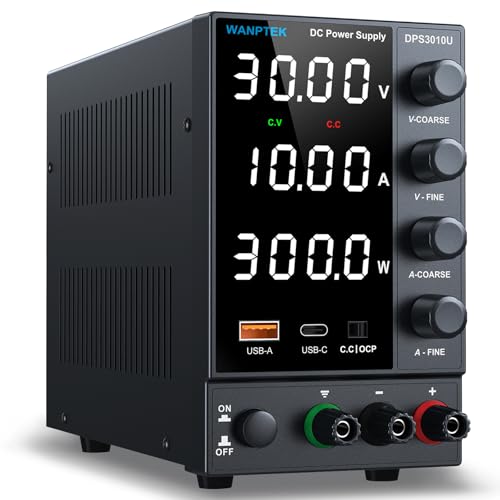
The WANPTEK DPS3010U delivers a powerful 30V at 10A, making it one of the highest-current variable supplies at a budget-friendly price. Its switching topology keeps the unit compact (8.4 x 3.4 x 5.9 inches) and efficient, while an intelligent temperature-controlled fan and heat sink manage thermal loads during sustained use. A standout feature is the built-in USB-A (5V/3.6A) and Type-C Quick Charge port, which can fast-charge phones or power devices under repair without needing an external adapter.
The encoder knobs separate coarse and fine adjustment: the coarse knob sets the value before the decimal point, and the fine knob sets the number after it. This design speeds up voltage and current setting significantly compared to single-knob units. A four-digit HD display shows voltage and current clearly, and the supply includes OCP, OVP, overheating, and short-circuit protection. When a short occurs, the unit stops output and sounds a buzzer, giving immediate feedback.
The supply automatically detects 110V or 220V AC input, eliminating the need for a manual voltage selector switch — a welcome convenience. A few users reported a loose solder connection on the AC switch that required resoldering, and the included output test leads are functional but not premium. For the combination of 10A capacity, USB-C fast charging, and automatic voltage detection, the DPS3010U offers tremendous value for a repair bench.
Why it’s great
- 10A maximum current for high-power device testing
- Built-in USB-C Quick Charge (5V/3.6A) port
- Auto-detecting 110V/220V AC input — no manual switch needed
Good to know
- Some units may have QC issues with solder connections
- Included test leads are basic quality
- Switching topology has higher ripple than a linear supply
6. Pyramid Universal Compact Bench Power Supply PS15K.5 – 10 Amp Linear Regulated
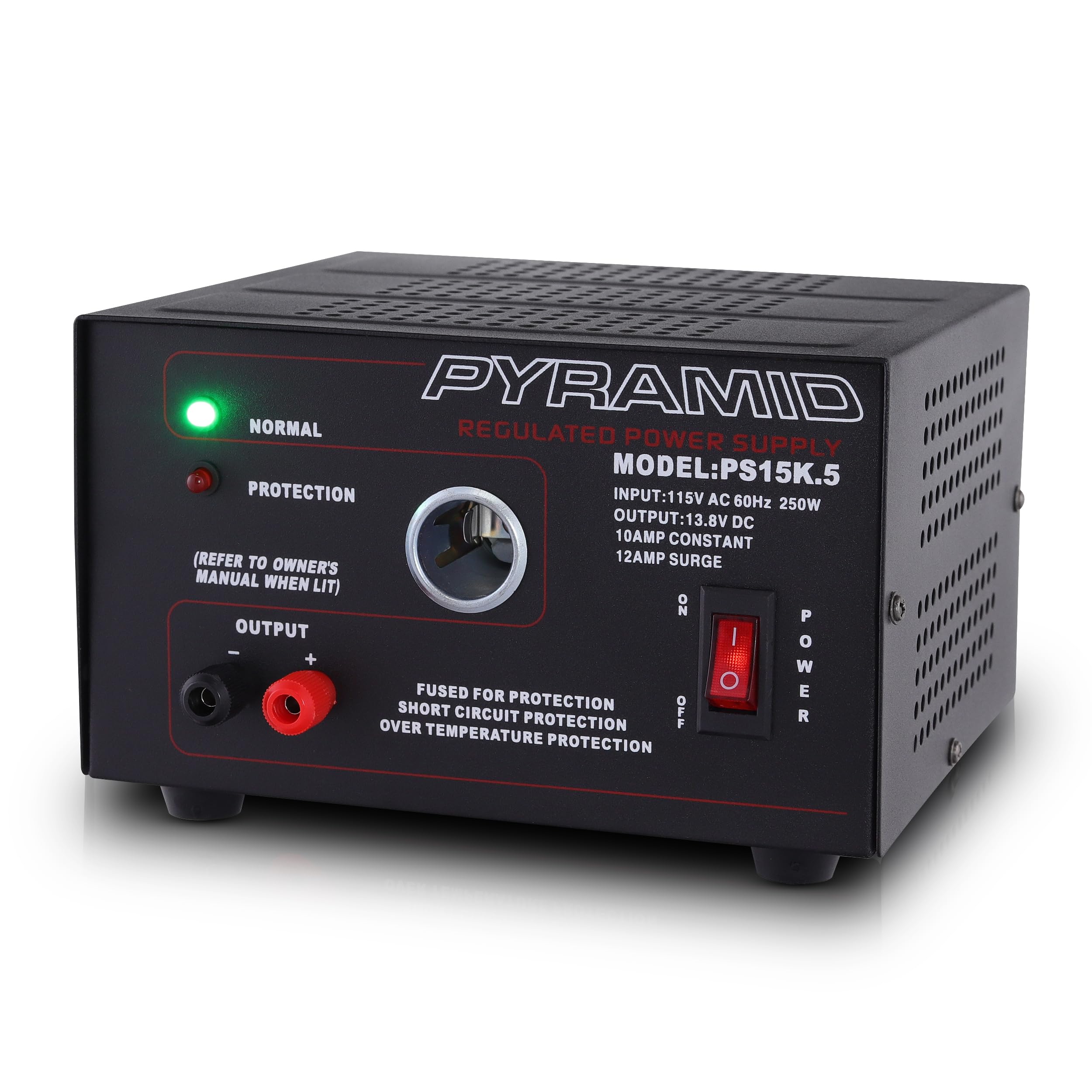
The Pyramid PS15K.5 is a linear regulated supply optimized for communication equipment, delivering a fixed 13.8V DC at 10 amps continuous (12A surge) from a 115V AC input. This voltage matches the standard operating voltage for most CB radios, ham transceivers, and scanners. The linear topology produces very clean DC power, reducing background noise that can degrade receiver sensitivity — several users report improved reception on the Uniden SDS200 after switching from a wall adapter to this unit.
Output is provided via screw-type terminals, which are more secure than banana jacks for the higher currents involved. The unit includes a 12V cigarette lighter socket and a front-panel power switch. Overload and short-circuit protection are built in, and the metal enclosure with a cabinet heatsink is designed for bench-top placement. The simple plug-in operation means no configuration — just connect AC power, attach your device, and switch it on.
There are conflicting reports about a cooling fan: some units clearly do not include one despite the description mentioning it, while others have a fan that runs continuously. This inconsistency suggests a possible revision or manufacturing variation. The fuse is wired on the negative side in some units, which reduces its protective effectiveness. Despite these quirks, for clean 13.8V power in a compact, lightweight package, the PS15K.5 remains a popular choice among ham radio operators.
Why it’s great
- Clean linear regulation at 13.8V for radio equipment
- Screw terminals provide secure high-current connections
- Compact footprint with dedicated 12V accessory socket
Good to know
- Cooling fan may be absent in some units despite product claims
- Fuse placement on negative side reduces short-circuit protection
- Fixed 13.8V output — not adjustable for general bench work
7. Pyramid PSU990KX – Universal Compact Bench Power Supply 7 Amp Regulated
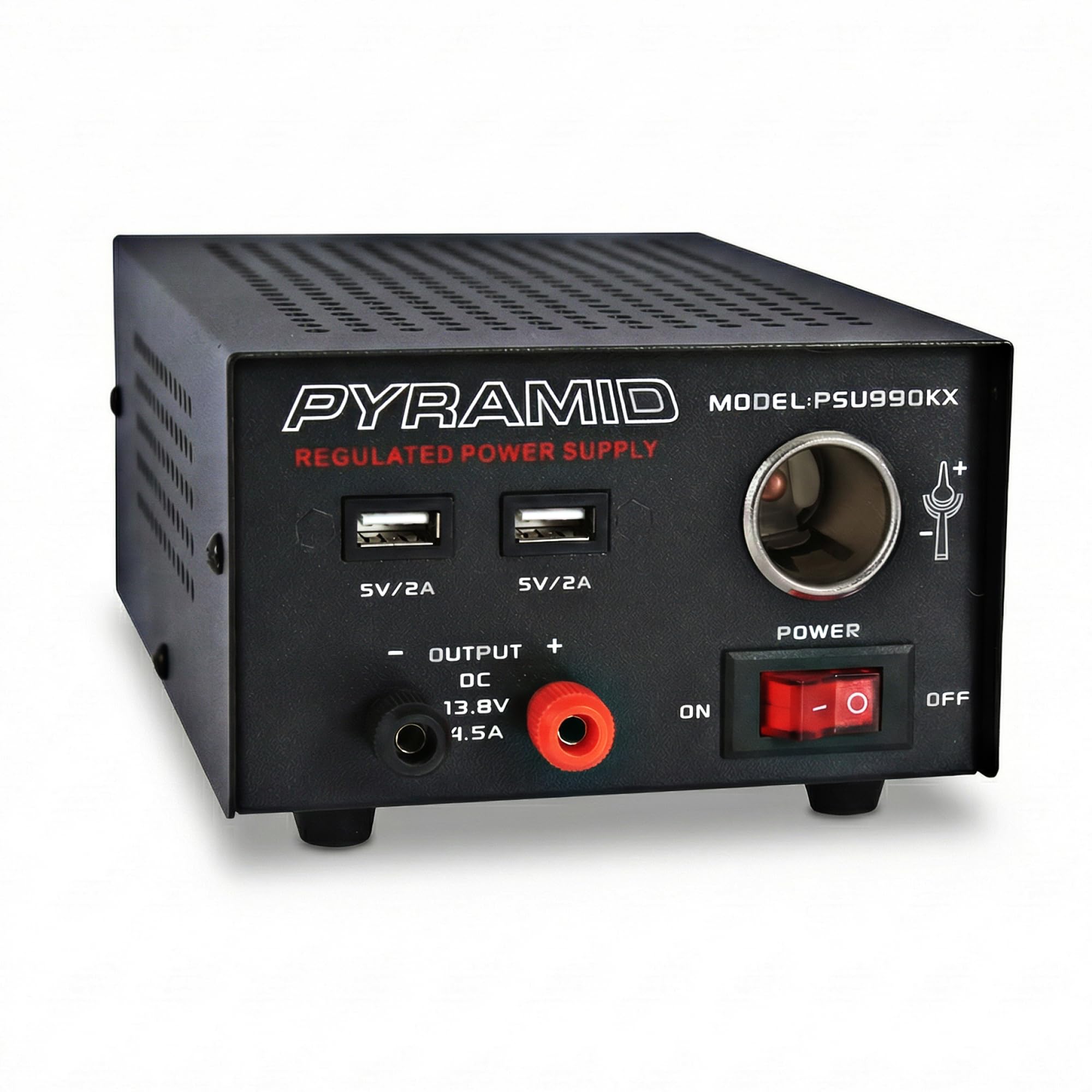
The Pyramid PSU990KX is a compact switching power supply that converts 120V AC to a fixed 13.8V DC output, with a maximum 7A surge and 4.5A continuous rating. It is purpose-built for radio equipment like CB radios, ham transceivers, and scanners where a clean, constant voltage improves performance. The small footprint (7.7 x 4.9 x 2.8 inches) fits easily on a crowded desk, and the metal housing with an integrated heatsink provides passive cooling without requiring a loud fan.
Two USB charging ports (5V/2A) are built into the front panel, adding the ability to charge phones or power Raspberry Pi-type devices without an extra adapter. A front-panel cigarette lighter socket extends compatibility with 12V accessories. Switch-activated power control means no external battery or extra power source is needed — just connect the AC cord and you are operational. The unit includes built-in electronic overload and short-circuit protection for operator and equipment safety.
However, the 4.5A continuous rating is lower than some competing supplies, so running a 50W ham transceiver at full power may push it beyond its comfort zone. A few users noted that the unit runs warm under sustained load, and the provided DC cable is short. For a beginner setting up a simple shack or for powering a scanner and charging gadgets on the same desk, the PSU990KX is an affordable and space-efficient solution.
Why it’s great
- Very compact size for tight desk spaces
- Dual USB ports for charging phones or powering small devices
- Built-in overload and short-circuit protection
Good to know
- 4.5A continuous rating may limit high-power radio use
- Unit can run warm under sustained load
- Included DC power cable is short
FAQ
What is the practical difference between a linear and switching bench supply for repair work?
What current rating do I need for typical electronics work?
Can I use a variable bench supply to charge lead-acid or lithium batteries?
What does the resolution on the voltage display actually mean for my work?
Final Thoughts: The Verdict
For most users, the best ac/dc power supplies winner is the WANPTEK DPS3010U because its 10A capacity, USB-C fast charging, and auto-sensing voltage deliver unmatched versatility for a repair bench. If you want cleaner output for analog and RF projects, grab the KORAD KD3005D for its genuine linear regulation and 1 mV resolution. And for a programmable dual-channel lab supply, nothing beats the Siglent SPD3303X-E with its remote control and isolated outputs.