
Before the smartphone took over every pocket, there was the satisfying click of a rotary dial and the weight of a handset that demanded you sit still to talk. Buying a retro phone today is less about making calls and more about pulling a specific decade into your living room — but the market is flooded with flimsy plastic replicas that look the part but fail to deliver a functional line.
I’m Min — the co-founder and writer behind Gadgets Feed. I’ve spent countless hours sifting through specs, customer reviews, and material quality data to separate the decor pieces that actually ring from the ones that are just shelf dust collectors.
If you want a working conversation piece that connects to a modern landline (or VoIP adapter) without needing batteries or a power brick, you need to find the best 1992 cell phone; this guide was built to deliver exactly that kind of confidently nostalgic buy.
How To Choose The Best 1992 Cell Phone
Every retro phone on this list shares a single DNA strand: a wired RJ11 connection that works with standard telephone networks. But beyond that basic compatibility, the differences in build weight, dialer type, and ringer quality determine whether your purchase feels like a genuine antique or a cheap costume prop.
Rotary vs. Push-Button Dialing
A true rotary dial generates pulse signals that older phone lines handle natively, but many VoIP adapters (like Ooma or Vonage boxes) require tone dialing. If you plan to use the phone with a digital service, look for a push-button keypad model or a rotary phone that explicitly states it outputs DTMF tones. The TelPal 302-Rotary, for example, uses a keypad under the rotary face to fire tones instead of pulses, making it a safe bet on modern networks.
Material Weight and Stability
Real 1960s handsets had heft because their internal bells and metal housings weighed over three pounds. Many contemporary replicas use hollow ABS plastic that slides across a desk when you dial quickly. A resin-and-zinc-alloy base (like the Kreiaoer bronze unit) or a thick ceramic body (like the Cedilis floral model) stays planted and resists cracking if knocked off a nightstand. Check the item weight — anything under 1.5 pounds is likely too light to feel authentic.
Ringer Volume and Noise Floor
Several buyers on this list reported that the mechanical ringer is barely audible outside the room. If you need the phone to function as a daily landline rather than a pure decoration, prioritize models with a physical ringer volume knob on the bottom plate. The Dyna-Living rotary phone includes that knob, while the Peohud button phone adds a toggle between high and low settings. Without this feature, you may miss calls entirely when the handset is in a different room.
Quick Comparison
On smaller screens, swipe sideways to see the full table.
| Model | Category | Best For | Key Spec | Amazon |
|---|---|---|---|---|
| Peohud Retro Desk Phone | Push-Button | Daily landline use with VoIP | ABS/metal body — 2.0 lb | Amazon |
| TelPal 302-Rotary | Rotary/Keypad | Authentic look with modern tone dialing | Thick plastic — cloth cord | Amazon |
| Dyna-Living Rotary Phone | Rotary | Heavy resin decor with volume control | Resin/metal housing — 3.2 lb | Amazon |
| Sangyn Retro Rotary | Rotary | Hands-free speaker on a vintage frame | ABS build — 2.4 lb | Amazon |
| Cedilis Ceramic Phone | Push-Button | Victorian-style decor piece | Glazed ceramic — 2.4 lb | Amazon |
| Kreiaoer Bronze Rotary | Rotary | Decorative entry-level rotary | Resin/zinc alloy — 8 x 10 in | Amazon |
| TelPal French Blue Rotary | Rotary | Lightweight budget rotary dialer | Plastic build — 2.3 lb | Amazon |
In‑Depth Reviews
1. Peohud Retro Landline Telephone

This black-and-gold desk phone weighs exactly 2.0 pounds — light enough to move around but solid enough to stay planted during dialing thanks to the metal and ABS construction. The rear data port allows a modem or answering machine to piggyback on the line, a feature missing from cheaper decor-only phones. Buyers consistently report clear audio quality with zero external power needed, just an RJ11 jack.
The push-button keypad eliminates all pulse-to-tone compatibility headaches. You can plug this directly into an Ooma Telo 2 or a standard PSTN wall jack and get dial tone immediately. The included ringer switch on the back lets you toggle between high and low volume, addressing the most common complaint about retro phones missing loud rings.
Several verified purchasers noted the soft coil cord feels flexible and doesn’t tangle as aggressively as vintage rubber cords. If you need a reliable daily driver that looks like a mid-century desk set but works with modern digital voice services, this unit delivers the most consistent performance across the entire category.
Why it’s great
- Push-button tone dialing works with any VoIP adapter without extra converters
- Ringer volume can be switched high/low for different room sizes
- Rear data port expands connectivity to fax or answering machine
Good to know
- Plastic housing feels lighter than an original 1960s Bakelite phone
- Classic coil handset cord still tangles if you twist it repeatedly
2. Dyna-Living Vintage Telephone

At 3.2 pounds and clad in cast epoxy resin reinforced with a metal internal frame, this rotary phone feels like the real thing when you pick it up. The base measures over ten inches wide, giving it a commanding presence on a desk or entryway table. Buyers describe the bronze floral finish as “museum-quality” and confirm it works on standard PSTN lines right out of the box.
The bottom-mounted ringtone volume knob is a rare inclusion on rotary models — most competitors force you to accept a fixed mechanical bell level. Adjusting it compensates for the fact that real rotary bells are inherently quieter than electronic ringers. One caveat: a small number of buyers reported the handset cradle screw loosens over time, requiring a quick tighten with a standard screwdriver.
The 1-year manufacturer warranty provides peace of mind that most decor-first phones skip entirely. If your priority is a heavy, authentic-feeling rotary that can double as a regular-use landline and you want the flexibility to control the ringer, this is the most premium build in the pool.
Why it’s great
- Heavy resin-and-metal construction prevents sliding on polished surfaces
- Adjustable ringer volume knob on the baseplate solves a common rotary pain
- 1-year warranty adds safety beyond the return window
Good to know
- Rotary dial outputs pulse signals, may need a pulse-to-tone converter for some VoIP boxes
- Handset cradle screw can loosen with repeated use
3. Sangyn Retro Rotary Phone

This 2.4-pound ABS unit packs an unexpected feature: a built-in speakerphone that uses the handset cradle area as a loudspeaker. The traditional mechanical ringer produces a satisfying bell tone that buyers consistently call “loud but not obnoxious.” It works on standard PSTN lines and includes a redial button cleverly hidden in the center of the rotary plate.
The rotary dial itself is the main draw — reviewers love the tactile feedback as the wheel spins back. However, the lightweight ABS chassis means the phone shifts on a smooth desk if you dial quickly. Partner it with a non-slip pad or place it on a fabric surface to keep it steady. The speakerphone function is a genuine convenience for kitchen counter use, letting you talk hands-free without holding the handset.
Some buyers noted the sound quality improved noticeably when they swapped the included wall cable for a higher-gauge shielded cord. The phone works with VoIP through a modem or ATA, but the pulse dialing may cause delays with digital services that expect tone signaling. For pure PSTN users who want speakerphone capability without paying for a premium model, this is a smart compromise.
Why it’s great
- Speakerphone function adds hands-free convenience rare in rotary replicas
- Mechanical bell ringer sounds genuinely retro, not like a digital synthesized tone
- Redial button integrated into rotary plate is practical and unobtrusive
Good to know
- Plastic body lacks the weight of resin or metal alternatives
- Pulse dialing requires a converter for many VoIP adapters
4. TelPal 302-Rotary Black Corded Phone

TelPal’s 1930s-style desk phone solves the rotary compatibility problem by using a modern keypad underneath a rotary-style finger wheel. When you spin the dial, it generates DTMF tones instead of pulses, making it plug-and-play with virtually any VoIP service or digital ATA. The cloth-covered handset cord adds a vintage texture that ABS cables can’t replicate.
The thick first-grade plastic shell and rubber foot pads keep the base from drifting, though the plastic body doesn’t carry the heft of resin. Buyers consistently rate the audio quality as excellent, especially after upgrading the wall cable. The mechanical ringer is noticeably soft — several reviews mention it’s easy to miss if you’re in another room. This phone is best suited for a desktop where you’ll see the incoming call indicator.
Beyond its functional excellence, this unit has seen creative use as a “Wind Phone” in therapeutic settings, where users hold unconnected conversations for emotional healing. That versatility speaks to the build quality and aesthetic authenticity. If you want a rotary look with zero dialing headaches, this is the most technically refined option.
Why it’s great
- Rotary finger wheel outputs DTMF tones, no pulse-to-tone adapter required
- Cloth handset cord provides authentic 1930s tactile feel
- Rubber foot pads prevent sliding on polished desks
Good to know
- Mechanical ringer is quiet — may not be heard from adjacent rooms
- Plastic enclosure lacks the premium weight of resin or ceramic models
5. Cedilis Retro Vintage Landline Phone

The Cedilis phone stands apart because of its glazed ceramic construction — a material choice that gives it a glossy, hand-painted floral finish that no plastic unit can approximate. The LCD panel in the base displays the date and time, a modern convenience that doesn’t break the antique illusion. It uses push-button dialing, so it’s fully compatible with all modern telephone networks including VoIP adapters.
At 2.4 pounds, the ceramic body feels dense and stable, but it is also more fragile than resin or ABS — a drop onto a tile floor could chip the glaze. Buyers rave about the visual beauty but a recurring issue appears: the handset cradle screw is often too short, leaving the receiver wobbly. Some users fixed it with a longer screw from a hardware store, but this is a quality-control gap worth noting before purchase.
The ringer sounds like a standard office phone rather than a bell, which disappoints purists seeking a mechanical ring. However, the audio clarity during calls earns consistent praise. If your primary goal is a stunning Victorian-era decoration that also functions as a landline, this phone wins on looks alone.
Why it’s great
- Genuine glazed ceramic body with hand-painted floral pattern is unique in this category
- Built-in LCD clock/calendar adds practical utility without wires
- Push-button dialing ensures universal network compatibility
Good to know
- Cradle screw may be too short, causing a wobbly handset
- Ceramic shell can chip or crack if knocked off a surface
6. Kreiaoer Bronze Rotary Telephone

This entry-level bronze rotary phone uses a resin body reinforced by a zinc alloy bracket, giving it decent structural rigidity for the price point. The fiberglass circuit board inside is fireproof and moisture-resistant, a thoughtful engineering detail often missing from sub- replicas. It operates entirely on line power — no batteries, no wall wart — and includes a redial function activated by pressing the RD button after hanging up.
The rotary dial action feels functional but not buttery smooth, and the plastic earpiece lacks the acoustic warmth of a vintage metal receiver. Buyers are overwhelmingly positive about its appearance, using it as a prop for photos, stage sets, and retail displays. Several reviews note it works on standard PSTN lines, though the pulse dialing may cause missed digits if you spin too slowly.
The included Chinese and English manual is a minor friction point for setup, but the phone is essentially plug-and-play. For the price, you get a genuinely attractive decorative telephone that can make calls in a pinch. It is not a daily-driver for heavy use, but it is the most affordable way to put a working retro phone on your desk.
Why it’s great
- Zinc alloy internal bracket adds stability uncommon at this budget tier
- Fireproof fiberglass board protects against line surges
- Redial function adds practical convenience without complicating the vintage look
Good to know
- Rotary pulse dialing may not register reliably with all VoIP adapters
- Handset audio quality does not match heavier resin or ceramic competitors
7. TelPal French Blue Rotary Phone
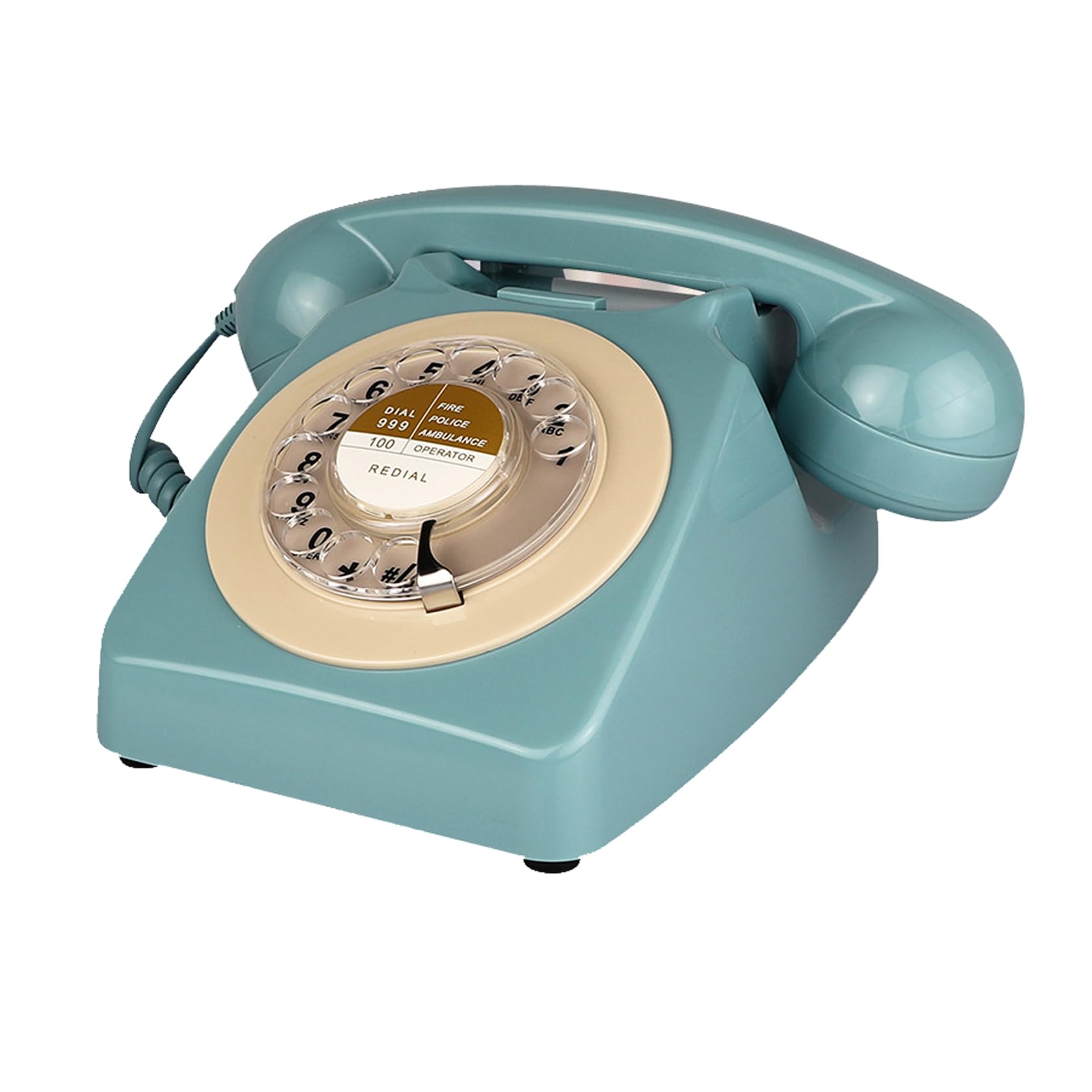
The TelPal 300R comes in a striking French blue finish that immediately evokes 1960s kitchen decor. Its dimensions — 8.66 x 5.31 x 4.72 inches — make it one of the more compact options, suitable for tight counter spaces. The rotary dial requires a deliberate finger motion; users with larger hands may find the dial face small enough that spinning through nine digits takes concentration.
This phone works with VoIP services according to verified buyer reports, though the lightweight plastic body (2.3 pounds) shifts when you dial vigorously. A ringer-off switch on the base lets you silence calls completely, and the handset volume can be boosted for users with hearing difficulty. The audio quality has a higher-than-normal frequency emphasis that some callers found fatiguing on long conversations.
Multiple reviews mention buying this phone for seniors with cognitive decline because the familiar rotary interface triggers positive memories. It ships with both the base cord and handset cord included, so setup is literally plug-and-ring. If you need a colorful, lightweight, functional rotary for occasional use in a secondary location, this delivers the most vibrant aesthetic per dollar.
Why it’s great
- Unique French blue color stands out from generic black/bronze options
- Compact footprint fits smaller desks, nightstands, or kitchen counters
- Ringer-off switch and adjustable handset volume aid senior users
Good to know
- Lightweight plastic body slides easily on smooth surfaces during dialing
- Audio frequency leans bright, which some callers find unnatural
FAQ
Will a rotary phone work with my cable company’s digital voice service?
Do these phones need batteries or a power outlet to work?
How do I make the ringer louder on a modern retro phone?
Final Thoughts: The Verdict
For most users, the 1992 cell phone winner is the Peohud Retro Landline Telephone because its push-button tone dialing eliminates compatibility guesswork while the metal-and-ABS chassis provides enough heft for daily desktop use. If you want an authentic rotary feel with no pulse-to-tone fuss, grab the TelPal 302-Rotary. And for premium build weight and an adjustable mechanical ringer, nothing beats the Dyna-Living rotary phone.