
A broken pull cord or a latch that rattles in the wind turns a simple attic access into a daily frustration. The right latch delivers a secure seal that keeps the door flush against the ceiling frame, prevents drafts and pest entry, and gives you a confident, one-handed pull-down every single time. Choosing the wrong hardware means wrestling with a sagging door or climbing onto a step stool to re-hook a dangling chain.
I’m Min — the co-founder and writer behind Gadgets Feed. I’ve combed through the tensile specs, finish durability, and mounting design of dozens of attic door fastening systems to identify the ones that solve real-world installation headaches and hold up under daily use.
After hours of analysis on cold-rolled steel gauges, zinc plating thickness, and cam-action mechanisms, this is the definitive lineup of the best attic door latch options you can install today.
How To Choose The Best Attic Door Latch
The wrong latch turns a five‑second door drop into a ten‑minute struggle. Focus on three factors: the material’s corrosion resistance, the engagement mechanism (chain bolt vs. cam-action hook vs. pull-down rod), and the door’s swing or slide direction. An unconditioned attic cycles through humidity and temperature swings daily — any hardware that relies on a thin zinc coating will pit within a year.
Material and Finish
Cold-rolled steel with a full zinc plating offers the best strength-to-corrosion ratio for interior attic doors. Stainless steel is even more inert but costs more and can be harder to drill through during installation. Avoid unfinished or painted-only steel; the paint chips at the fastener points and exposes raw metal to moisture.
Mechanism Type
Chain bolts work well for in-swinging doors where the latch slides horizontally into a strike plate. Jamb latches with a cam-action hook are ideal for sliding barn-style doors — they pull the door tight against the frame to stop wind rattle. Pull-down hook systems replace the traditional rope and are best for scissor-ladder attic stairs that need a pole-operated release.
Quick Comparison
On smaller screens, swipe sideways to see the full table.
| Model | Category | Best For | Key Spec | Amazon |
|---|---|---|---|---|
| National Hardware N150-771 Chain Bolt | Chain Bolt | In‑swinging door security | 6 in., cold-rolled steel | Amazon |
| Hillman Zinc Barn Door Jamb Latch | Jamb Latch | Sliding barn doors in wind | 7-in. cam-action hook | Amazon |
| Attic Pull Down Hook Kit (60 in.) | Pull-Down Rod | Scissor-ladder cord replacement | 60-in. stainless steel pole | Amazon |
| Attic Pull Down Hook System Kit (61.5 in.) | Pull-Down Rod | Tall ceilings (10 ft+) | 61.5-in., 0.4mm wall steel | Amazon |
| Joogto 14×14 Metal Access Panel | Access Panel | Flush drywall access door | 1mm thick, galvannealed steel | Amazon |
| AUXTUR Cabinet Hardware Jig | Drill Jig | Precise latch screw placement | Aluminum alloy, 6.7-in. reach | Amazon |
| WTRAVEL Aluminum Attic Ladder | Ladder + Frame | Full replacement attic stair | 375-lb capacity, aluminum | Amazon |
In‑Depth Reviews
1. National Hardware N150-771 V820 Chain Bolt

The National Hardware chain bolt uses cold-rolled steel at a Grade 2 hardness rating, which resists bending far better than the thinner stamped-steel alternatives you find in big-box multipacks. The zinc plating covers the entire surface uniformly, including the interior of the slide channel, so moisture that condenses inside the attic stairwell won’t cause the bolt to seize up over time.
It works on both right- and left-hand in-swinging doors, and the angled strike plate can be flipped to accommodate different door thicknesses and frame angles. At 6 inches, the bolt throw provides enough engagement depth for standard 1¾-inch attic doors while still leaving clearance for the frame.
Installation is straightforward with the included hex-head fasteners, and the spring-loaded locking mechanism keeps the bolt positively engaged — it won’t vibrate loose from an overhead door that’s pushed shut firmly. Users consistently report that the unit feels far more substantial than its online photos suggest.
Why it’s great
- Cold-rolled steel vs. stamped steel offers real bending resistance
- Reversible strike plate adapts to multiple frame angles
- Full zinc plating prevents moisture seizure in attic conditions
Good to know
- Spring tension is strong — may be overkill for lightweight interior doors
- Not designed for sliding or bi-parting door configurations
2. Hillman Zinc Barn Door Jamb Latch with Hook
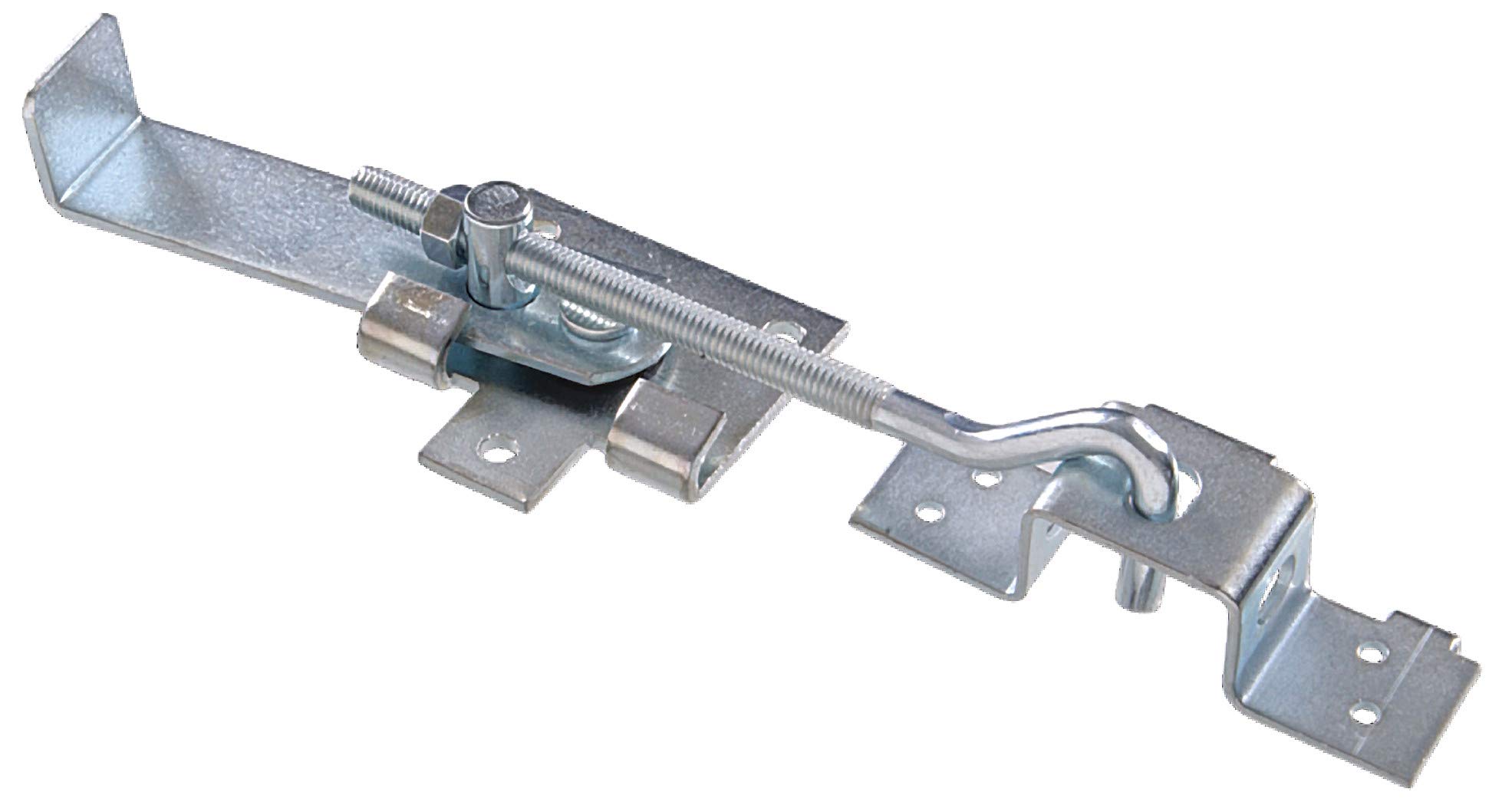
The Hillman jamb latch uses a rotating cam-action hook that pulls the door tight against the jamb as you close it, eliminating the gap that lets wind rattle a sliding barn door. The zinc construction weighs 1.11 pounds and the hook extends a full 7 inches, which gives you enough reach for doors that sit off the wall on heavy-duty track systems.
Installation is reversible for right- or left-handed doors, and the package includes the mounting hardware for single or bi-parting configurations. The cam action means you don’t have to line up a bolt hole — just push the door closed and the hook rotates into place automatically. Users report that doors held by this latch stay rock-solid even in high-wind areas near open garage bays.
The unfinished zinc finish is serviceable indoors but may develop a patina in unconditioned space. For attic doors that open onto a weather-exposed porch or garage, you’ll want to add a coat of clear lacquer. At this price point, it’s the most effective solution for sliding attic door applications.
Why it’s great
- Cam-action hook self-aligns and cinches tight against the jamb
- Reversible design works for both single and bi-parting doors
- Strong spring tension stops wind-induced movement completely
Good to know
- Unfinished zinc may patina in humid attic environments
- Not intended for in-swinging hinged door applications
3. Attic Pull Down Hook Kit — 60 Inch Steel Pole
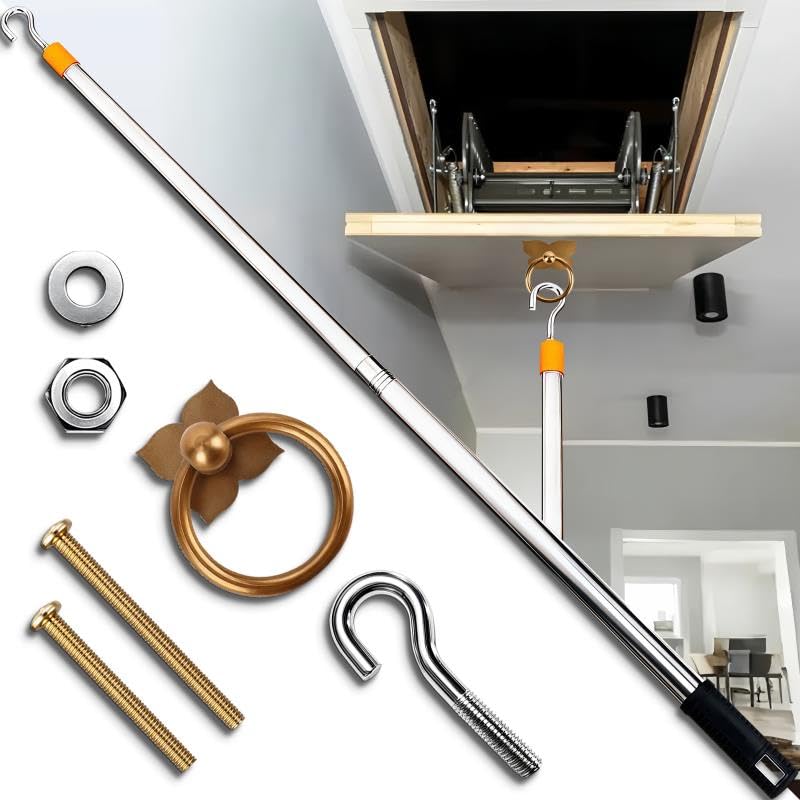
This kit eliminates the dangling rope-and-plastic-handle setup that frays and breaks on scissor-ladder attic stairs. The 60-inch stainless steel pole uses a brass J-hook that catches the ring on the hatch door, and the solid antique-brass handle on the hatch side looks far cleaner than the standard plastic pull ring. The all-metal construction means no UV degradation and no rope fibers shedding into your attic insulation.
The 8mm universal adapter at the pole’s end lets you attach a duster or hook for secondary tasks like grabbing boxes from high shelves. Four rod sections join together, but for a standard 8-foot ceiling you only need two sections — the extras store with the included wall hooks. The brass handle’s finish matches most ceiling hardware and doesn’t show fingerprints.
Installation requires drilling a hole for the handle base that is larger than the typical chain bolt hole, so check your door panel thickness before mounting. The spring in the handle mechanism holds the rod securely during the pull-down motion. Users appreciate not needing a step stool for tall ceilings and report that the rod never catches on the ladder frame during ascent.
Why it’s great
- All-metal construction replaces fragile rope and plastic handles
- Brass finish blends with existing ceiling hardware
- Universal adapter adds multi-purpose functionality
Good to know
- Handle base hole is larger than standard chain bolt openings
- Installation instructions are minimal — may require trial fitting
4. Attic Pull Down Hook System Kit (61.5 in.)
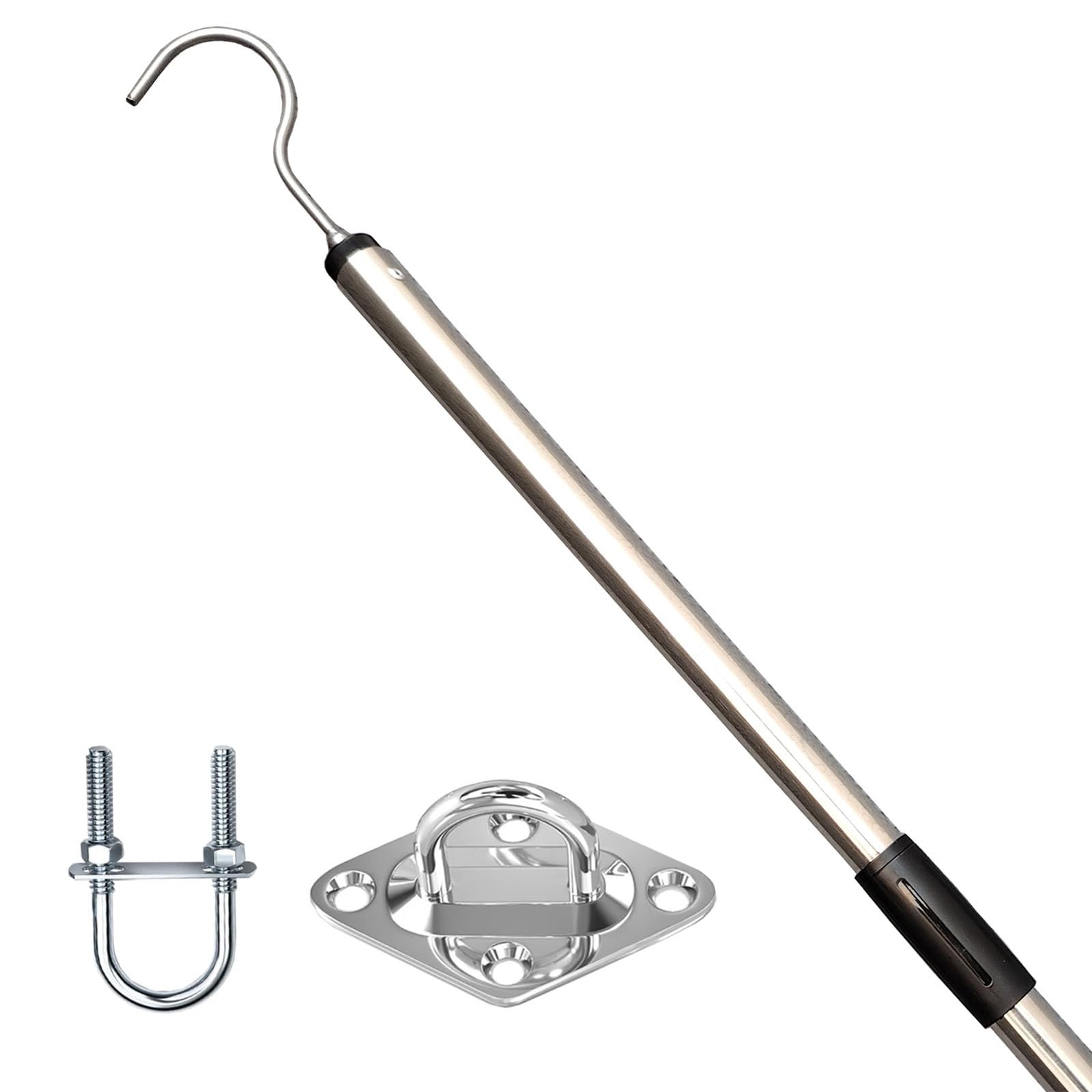
This kit uses a 61.5-inch pole with a 0.4mm stainless steel wall thickness that is 60% thicker than typical 0.25mm competitor poles, giving it noticeably less flex when you apply the downward pull force on the attic stairs. The rated pulling force exceeds 100 pounds, so even a heavy wooden attic ladder won’t cause the hook to straighten out or the pole to buckle.
The kit ships with four pole sections, a J-hook, a rhombus pull handle, and a U-shaped handle — giving you two handle options to match different door panel thicknesses. The top section is reinforced with rivets at the connection point, which is the most common failure location on telescoping or sectional pull rods. The handle attachment screws are M6 size, which are more substantial than the typical M4 hardware found on budget kits.
Assembly takes about 30 seconds, and the sections screw together tightly without wobble. The extra length works well for 10-foot ceilings where a standard 48-inch rod leaves you reaching on tiptoes. The permanent warranty backs the build quality, and the seller responds to hardware concerns with replacement parts rather than requiring a full return.
Why it’s great
- 0.4mm wall thickness reduces pole flex during pull-down
- Two handle styles accommodate different door thicknesses
- Riveted top section prevents the most common rod failure point
Good to know
- Non-telescoping design — sections are fixed length
- Rhombus handle feels lighter than the U-handle option
5. Joogto 14×14 Metal Access Panel

The Joogto access panel is built from 1mm-thick galvannealed steel — heat-treated to create a zinc-iron alloy layer that is significantly more corrosion-resistant than standard galvanized sheet. The baking-paint topcoat is uniform with no bubbles or pinholes, so the panel can be installed as-is or field-painted to match the surrounding ceiling texture without primer bleed-through.
The frame measures 15⅕ inches square, while the panel itself is 13⅖ inches square, leaving a ⅞-inch flange that sits flush against the drywall. Seamless welding on the frame corners adds structural rigidity, and two stiffeners on the outer frame prevent the thin metal from flexing when the screwdriver latch is turned. The latch uses a simple screwdriver slot — no key required — which is convenient for homeowners but not suitable if security against unauthorized access is a concern.
Weighing 3 pounds, the door feels solid when installed and doesn’t produce the tinny resonance that thin access panels make when closed. The included six drywall screws are adequate for fastening to wood studs, but you’ll want to use self-tapping screws if mounting into a metal frame. Users report that the panel’s flush fit eliminates the need for drywall mud touch-ups around the opening.
Why it’s great
- 1mm galvannealed steel resists rust better than standard sheet metal
- Seamless-welded frame with stiffeners prevents sagging
- Baking-paint finish accepts field painting without primer bleed
Good to know
- Screwdriver latch offers no keyed security
- Panel arrives tightly packaged; check for bent corners on delivery
6. AUXTUR Cabinet Hardware Jig

Accurate latch placement on an attic door frame is critical — a misaligned strike plate means the bolt won’t seat, and the door won’t close flush. The AUXTUR jig eliminates guesswork with aluminum alloy drill guides that space holes from 2½ to 5 inches apart in ½-inch increments, and the top-to-bottom reach of 6.7 inches covers the full range of standard latch screw patterns.
The jig folds for storage and includes two PVC spacers that stabilize the tool against recessed drawer fronts or ceiling panel edges. The 4mm drill bushing keeps the bit perpendicular to the surface, preventing the stepped screw holes that happen when freehand drilling into a door edge. The scale markings are laser-etched into the aluminum, so they won’t wear off after repeated use.
While marketed as a cabinet jig, its precision makes it ideal for marking and drilling the mounting holes for any attic door latch that uses a two-screw pattern. The jig’s clamp-free design requires firm hand pressure to prevent movement during drilling, but the PVC spacers provide enough friction on smooth painted surfaces to hold position. Users report it saves significant time on multi-door installations and eliminates the need for measuring tapes and combination squares.
Why it’s great
- Aluminum drill bushing keeps bit perfectly perpendicular
- Laser-etched markings won’t wear off with use
- Folds compact for storage in a tool belt pouch
Good to know
- Not compatible with round or square knobs — expects two-screw pulls
- Requires firm hand pressure; no clamp mechanism included
7. WTRAVEL Aluminum Attic Ladder Pull Down Loft Stairs

If your existing attic door frame is rotted or the ladder mechanism has failed, the WTRAVEL aluminum ladder replaces the entire assembly with a 375-pound load capacity and a 12-step folding design. The aluminum construction weighs 41 pounds — roughly half what a comparable wooden ladder weighs — which makes the pull-down motion significantly easier on the spring mechanism and on your shoulders.
The ladder adjusts for ceiling heights from 7 feet 8 inches to 10 feet 3 inches, with non-slip footing pads and a handrail that provides three points of contact during ascent. The widened steps are 22½ inches wide, which is wider than the standard 18-inch step found on most builder-grade ladders. Heavy-duty hinges at the pivot point eliminate the side-to-side wobble that cheap ladders develop after a few cycles.
The door itself is included as part of the assembly, so this is a full frame-and-ladder solution rather than just a latch. Installation requires cutting the rough opening to 22½ by 54 inches and securing the frame to the ceiling trusses. The aluminum won’t warp or absorb moisture like wood, making it suitable for unconditioned attic spaces where humidity fluctuates. Users consistently report that the ladder feels stable and safe even when carrying boxes up and down.
Why it’s great
- Aluminum is half the weight of wood, reducing spring strain
- Non-slip footing and handrail improve climbing safety
- 375-pound capacity handles heavy storage loads
Good to know
- Requires a full rough opening — not a latch-only upgrade
- 22½-inch width may not fit existing narrow attic openings
FAQ
Can I use a standard door chain lock for my attic hatch?
What is the difference between a jamb latch and a chain bolt?
How long should the pull-down pole be for an 8-foot ceiling?
Final Thoughts: The Verdict
For most users, the best attic door latch winner is the National Hardware N150-771 Chain Bolt because it combines cold-rolled steel durability with a reversible strike plate that fits virtually any in-swinging attic door. If you need to secure a sliding barn door from wind rattle, grab the Hillman Zinc Barn Door Jamb Latch. And for a complete replacement that eliminates frayed ropes and broken plastic handles, nothing beats the Attic Pull Down Hook Kit.