
When the grid goes down, the difference between a chaotic night and a manageable one is measured in watt-hours and transfer switch readiness. Home backup inverters have evolved far beyond the loud, fuel-hungry monsters of the past, splitting into two distinct camps: fuel-based inverter generators that deliver massive peak wattage for entire circuits, and silent battery power stations that run sensitive electronics with zero emissions indoors. Your decision hinges on whether you need to power a well pump and HVAC system for days or keep a fridge, router, and CPAP machine running through a 12-hour outage.
I’m Min — the co-founder and writer behind Gadgets Feed. After analyzing the technical specifications of nine very different backup power solutions, I’ve mapped the trade-offs between pure sine wave output, THD ratings, recharge times, and starting wattage to identify which unit matches which home reliance scenario.
If you are searching for the very best backup inverter for home, you must match the unit’s transfer switch compatibility and surge capacity to your critical load panel, not just the headline wattage number.
How To Choose The Best Backup Inverter For Home
Home backup inverters are not one-size-fits-all. A unit that keeps a campsite happy will fail to start a 240V well pump. The three most important filters are fuel or battery type, surge wattage capacity, and how clean the output sine wave is.
Running Watts vs. Surge Watts
Running watts (also called rated watts) is the continuous power the inverter can deliver hour after hour. Surge watts is the extra burst needed to start motor-driven appliances like refrigerators, sump pumps, and air conditioner compressors. A fridge that draws 700 running watts may require 2,000 surge watts to kick on. Always size your unit so the surge capacity exceeds the sum of all starting loads you intend to connect.
Dual Fuel vs. Battery Chemistry
Gasoline and propane generators offer unlimited runtime as long as fuel is available, but they require ventilation and produce fumes plus noise in the 50-70 dBA range. Battery power stations using LiFePO4 — lithium iron phosphate — deliver silent, zero-emission power indoors with 3,500 to 4,000 cycles to 80% capacity, making them ideal for overnight CPAP machines and network equipment. The trade-off is finite runtime per charge (typically 1-2 days for a fridge) and a higher upfront cost per watt-hour.
Transfer Switch and THD Compatibility
If you want to back up hardwired circuits like lights, furnace blowers, or a well pump, you need a unit with a 14-50R or L14-30R outlet and a transfer switch or interlock kit. Total Harmonic Distortion (THD) below 3% is critical for sensitive electronics, variable-speed drives, and modern refrigerator control boards. Higher THD can cause buzzing, overheating, or permanent damage to devices with switching power supplies.
Quick Comparison
On smaller screens, swipe sideways to see the full table.
| Model | Category | Best For | Key Spec | Amazon |
|---|---|---|---|---|
| Westinghouse iGen12000DFc | Dual Fuel Inverter | Whole home backup | 12,000W peak / 9,000W running | Amazon |
| Jackery HomePower 3000 + Solar | Solar Battery Station | Silent essentials backup | 3,072Wh LiFePO4 capacity | Amazon |
| WEN DF680iX | Dual Fuel Inverter | EV charging + RV | 6,800W peak on gasoline | Amazon |
| Jackery Explorer 2000 v2 | Battery Power Station | Mid-capacity silent backup | 2,042Wh / 39.5 lbs | Amazon |
| AFERIY P210 | Battery Power Station | High value + app control | 2,048Wh / 2,400W inverter | Amazon |
| BLUETTI Elite 100 V2 | Battery Power Station | Compact 1kWh portable | 1,024Wh / 1,800W output | Amazon |
| Champion 2500-Watt | Inverter Generator | Fridge + freezer backup | 53 dBA / 39.7 lbs | Amazon |
| Oxseryn 4400-Watt | Inverter Generator | Mid-power portable | 4,400W peak / 56 lbs | Amazon |
| Oxseryn 2800-Watt | Inverter Generator | Compact emergency starter | 58 dBA / 2,800W peak | Amazon |
In‑Depth Reviews
1. Westinghouse iGen12000DFc
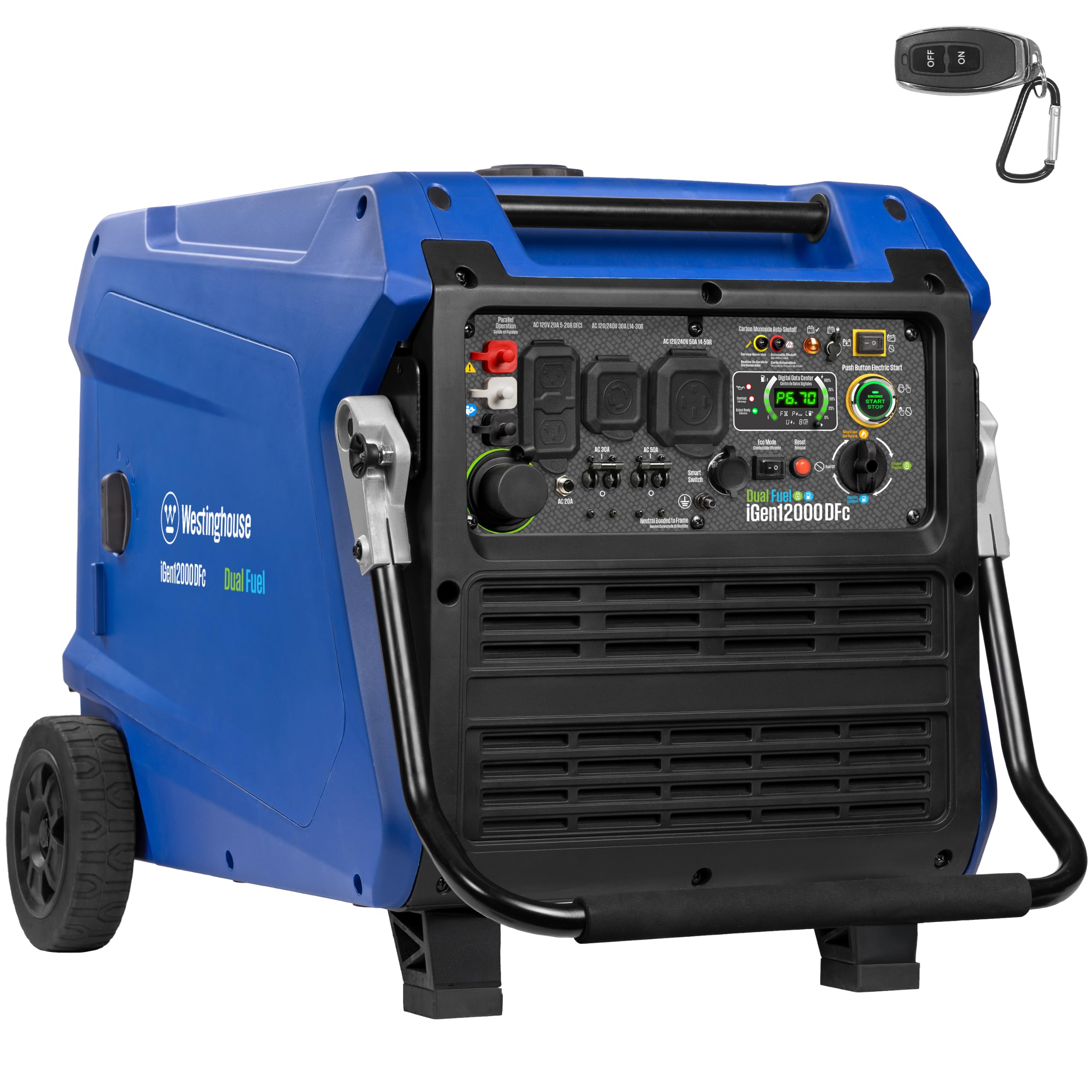
This is the unit you buy when you want to power your entire home — including the well pump, heat pump, and refrigerator simultaneously. The 457cc dual fuel engine delivers 12,000 peak watts on gasoline and 11,000 on propane, with a 50A NEMA 14-50R outlet that connects directly to a transfer switch or interlock kit. At 64 dBA in Eco Mode, it is genuinely neighborhood-friendly, and the remote key fob start means you do not have to walk out in a storm to get power running.
The inverter technology keeps Total Harmonic Distortion at or below 3%, so your sensitive electronics and variable-speed appliances receive clean sine wave power. Owners report running a heat pump, fridge, and clothes dryer simultaneously without voltage sag. The 7.9-gallon tank delivers up to 19 hours at 25% load, and the dual fuel capability means you can switch to propane if gasoline becomes scarce during a prolonged outage.
The trade-off is weight — 187.4 pounds — so it is not a one-person carry. Assembly involves mounting wheels and a folding handle, adding 15 minutes to setup. Some users note the included 10W-30 oil is unsuitable below 23°F, requiring 5W-30 synthetic after the break-in period for cold weather use.
Why it’s great
- True whole-home 50A output via transfer switch or interlock
- Dual fuel flexibility extends fuel logistics in extended outages
- Remote electric start with key fob adds convenience
Good to know
- Very heavy at 187 lbs; requires wheel kit and firm ground
- Included break-in oil is not winter-grade; plan to change to synthetic
2. Jackery HomePower 3000 + Solar Panels
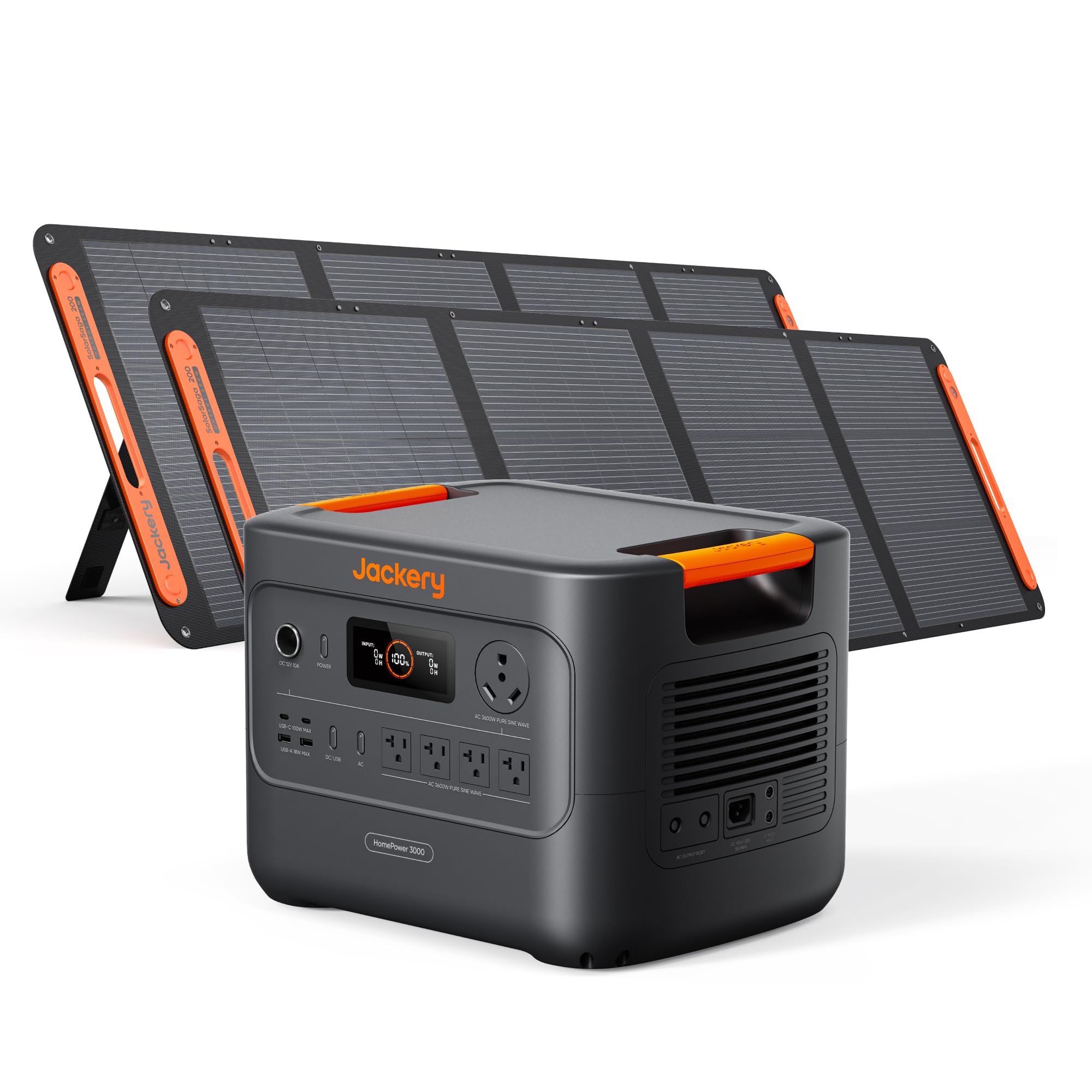
The HomePower 3000 is the answer if you need zero-emission, silent backup for essential circuits — no fumes, no noise, no neighbor complaints. Its 3,072Wh LiFePO4 battery delivers 3,600W continuous (7,200W surge) through a TT-30 RV port and a full suite of AC and USB-C outlets. The ≤20ms UL-certified UPS switchover means your Wi-Fi router, security cameras, and medical equipment never blink during a transfer.
Jackery’s CTB (Cell-to-Body) technology makes this the smallest and lightest 3kWh station at only 59.5 lbs. The dual 100W USB-C PD ports charge laptops and tablets at full speed without adapters. With the included two SolarSaga 200W panels (sold together in this bundle), you can recharge the station to 80% in about 9 hours of direct sunlight, creating a truly renewable backup loop.
The unit is heavy enough for two hands to carry comfortably into a closet or pantry, but a furniture dolly is recommended for longer distances. Real-world tests show it runs a standard refrigerator for 1.5 to 2 days. Note that the battery capacity is not expandable, so plan your load list carefully.
Why it’s great
- Silent, emission-free operation allows indoor placement
- UL-certified UPS with ≤20ms transition protects sensitive gear
- Sustainable solar recharging reduces fuel dependency
Good to know
- Battery capacity is not expandable beyond the internal pack
- Separate wheel kit or dolly needed for easy transport across property
3. WEN DF680iX

The WEN DF680iX stands out because it is one of the few inverter generators under that provides bonded-neutral 240V output for Level 2 EV charging. The 224cc dual-fuel engine delivers 6,800 surge watts on gasoline (5,100 rated) and 6,000 surge on propane (4,500 rated). The 240V L14-30R receptacle charges a plug-in hybrid or electric vehicle at slow Level 2 speeds, turning your generator into an emergency EV charger during grid outages.
The WEN Watchdog CO shutdown sensor and fuel shut-off solenoid are built-in safety features that protect both the user and the engine. The fuel shut-off runs the carburetor dry before shutdown, a detail that extends the life of the unit significantly when stored between storms. The telescoping pull handle and 99.2-pound weight make it manageable for one person to wheel into position.
Real-world buyers report running two RV air conditioners on propane for about 30 hours, and powering a fifth wheel entirely off-grid. A small percentage of users experienced 240V outlet failures early in ownership, but WEN replacement support was described as responsive. The 240V outlet disables the 120V receptacles when active, so expect to choose between high-voltage and standard loads.
Why it’s great
- Bonded-neutral 240V output enables Level 2 EV charging
- Dual fuel flexibility with propane running 30+ hours per tank
- Fuel shut-off system extends storage life between uses
Good to know
- 240V and 120V outlets cannot be used simultaneously
- Some units require warranty service for 240V outlet reliability
4. Jackery Explorer 2000 v2

The Explorer 2000 v2 is the sweet spot in Jackery’s lineup — 2,042Wh of LiFePO4 capacity in a 39.5-pound chassis that is 41% lighter and 34% smaller than typical 2kWh stations. The 2,200W inverter (with 20ms UPS switchover) powers a refrigerator for about 21 hours, CPAP machines for multiple nights, and all home networking gear indefinitely during staggered outages.
AC fast charging from 0 to 80% takes just 66 minutes, and the app-controlled Emergency Super Charging mode fills the battery completely in 102 minutes. Silent Charging mode keeps noise under 30 dB, making it fine for bedroom or office placement. The dual USB-C PD 100W ports charge laptops without needing separate bricks, and the pass-through charging feature means you can keep the station plugged in as a mini-UPS that automatically takes over during a blackout.
Users note that the Bluetooth connection drops occasionally and the solar barrel ports feel slightly flexible when inserting connectors. At during promotional periods, this unit delivers a cost-per-watt-hour figure that rivals mid-range traditional generators without any fuel exhaust or noise.
Why it’s great
- Fast 66-minute AC recharge to 80% is class-leading
- Very lightweight for the capacity — easy to carry up stairs
- App-enabled remote monitoring and Silent Charging mode
Good to know
- Solar barrel connectors feel less robust than competitors’ MC4
- Bluetooth app connection can be intermittent
5. AFERIY P210

The AFERIY P210 matches the Jackery Explorer 2000 v2 in core capacity (2,048Wh) but pushes the inverter output to 2,400W continuous (4,800W surge), giving it a slight edge for appliances with harder starting loads. The LiFePO4 battery is rated for 3,500 cycles to 80%, and AFERIY backs it with a 7-year extended warranty — two years longer than the industry standard, which signals confidence in the battery management system.
The <10ms UPS switching is comparable to premium brands, and the 16-port panel includes 6 AC outlets, 4 USB-C ports (one at 100W), and an XT60 DC output for external battery expansion. The app manages energy consumption, charging schedules, and firmware updates. At full load, the fan noise stays under 30 dB, and under normal loads it drops to 16 dB — practically silent.
A small number of users reported screen glitches after solar charging, requiring multiple restarts, but customer service responded quickly with replacements. The unit weighs 48.5 lbs with a molded handle that makes carrying manageable. For food truck operators or off-grid cabins, the reliable pure sine wave output and generous port selection justify the price premium over smaller 1kWh stations.
Why it’s great
- Highest inverter output in the 2kWh battery class at 2,400W continuous
- 7-year warranty exceeds typical 5-year competitor coverage
- Nearly silent 16 dB operation under normal loads
Good to know
- Some early units had display screen glitches after solar input
- No scheduled charging available in the app yet
6. BLUETTI Elite 100 V2
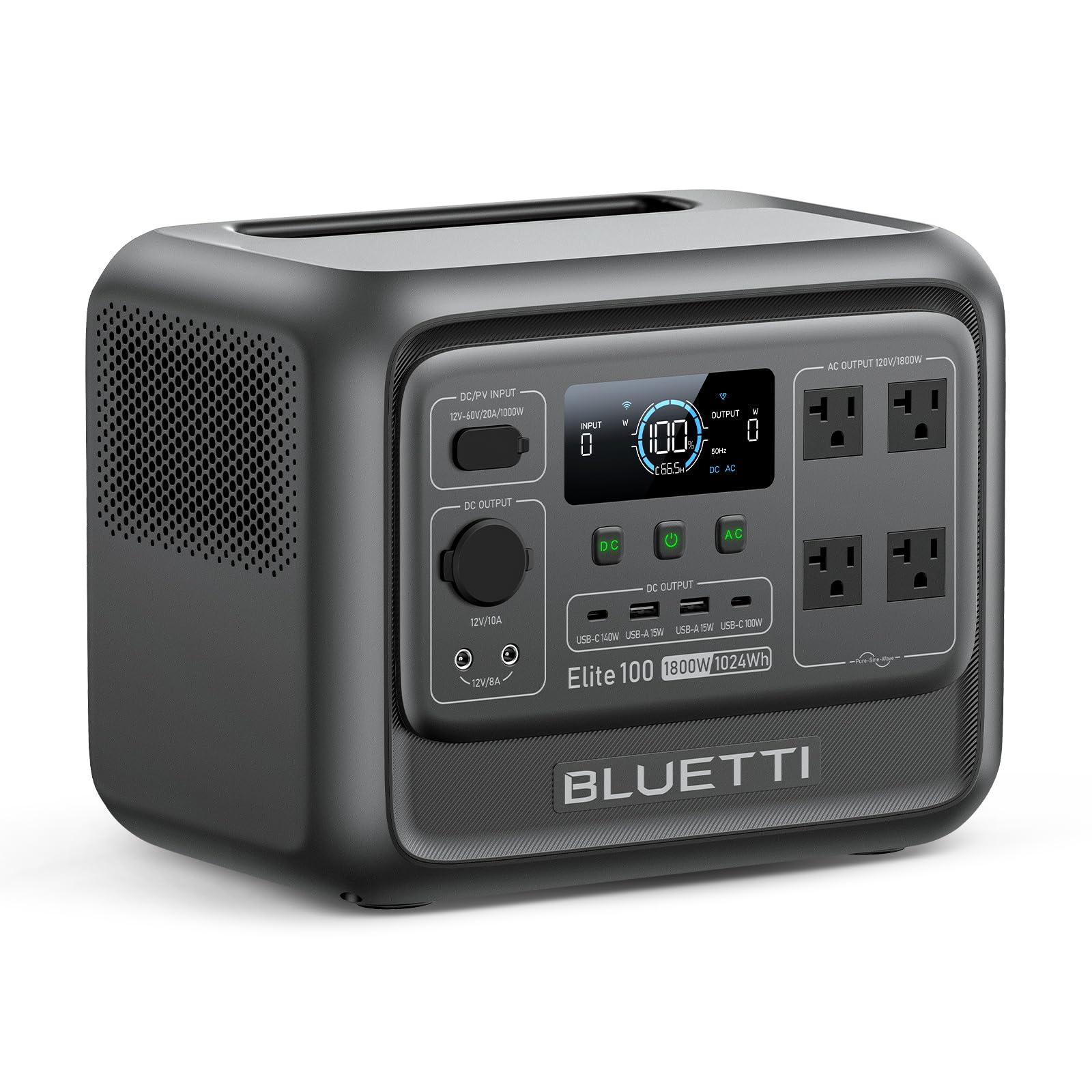
The BLUETTI Elite 100 V2 is the 1,024Wh option that hits a price-performance sweet spot for single-appliance backup. Its 1,800W inverter (2,700W Power Lifting surge) handles a refrigerator, a couple of lights, and a laptop charging station all at once. The 10ms UPS switchover is fast enough to keep a desktop PC or CPAP machine running without any interruption.
The 25-pound weight and compact 17-liter chassis make it easy to carry one-handed. The 1200W TurboBoost AC charging fills the battery to 80% in 45 minutes, and the 1000W solar input can top it off from panels in about 70 minutes. Silent mode at 30 dB makes it suitable for indoor placement without disturbing sleep.
While the 1,024Wh capacity is half that of the Jackery or AFERIY units, it is sufficient for a single critical circuit — most users successfully run a CPAP machine for 2-3 nights or keep a mini-fridge running for a full day. The lack of a built-in light or wireless charging pad is a minor omission compared to the previous generation.
Why it’s great
- Extremely fast 45-minute recharge to 80% at 1200W
- Light enough at 25 lbs for one-handed carry
- 30 dB silent mode is genuinely bedroom-friendly
Good to know
- Capacity limited to 1,024Wh — not suitable for whole-home backup
- No built-in light or wireless charger compared to earlier model
7. Champion 2500-Watt

At 39.7 pounds and 53 dBA from 23 feet, the Champion 2500-Watt is one of the quietest and lightest 2,500-watt inverter generators on the market. It produces 2,500 starting watts and 1,850 running watts with less than 3% THD, making it safe for phone chargers, laptops, and modern refrigerator control boards. The runtime hits 11.5 hours at 25% load on a full tank.
Users report this unit powers a full-size refrigerator, chest freezer, internet modem, LED lights, and a laptop simultaneously at under 50% load. The CO Shield carbon monoxide auto shutoff adds a layer of safety for outdoor placement near windows. The optional parallel kit lets you double output when paired with a second identical unit, though most home backup scenarios will not require it.
A one-year review noted the generator starts on the first or second pull after nine months of storage with stabilized fuel. Some units produce blue smoke during break-in, which clears within the first 10 hours of operation. The 79cc engine is well-supported with readily available parts.
Why it’s great
- One of the lightest 2,500W inverters at under 40 lbs
- Exceptionally quiet at 53 dBA from 23 feet
- CO Shield shutoff adds critical safety during storm operation
Good to know
- May require a few hours of break-in to eliminate initial smoke
- Not enough surge for well pumps or large air conditioners
8. Oxseryn 4400-Watt
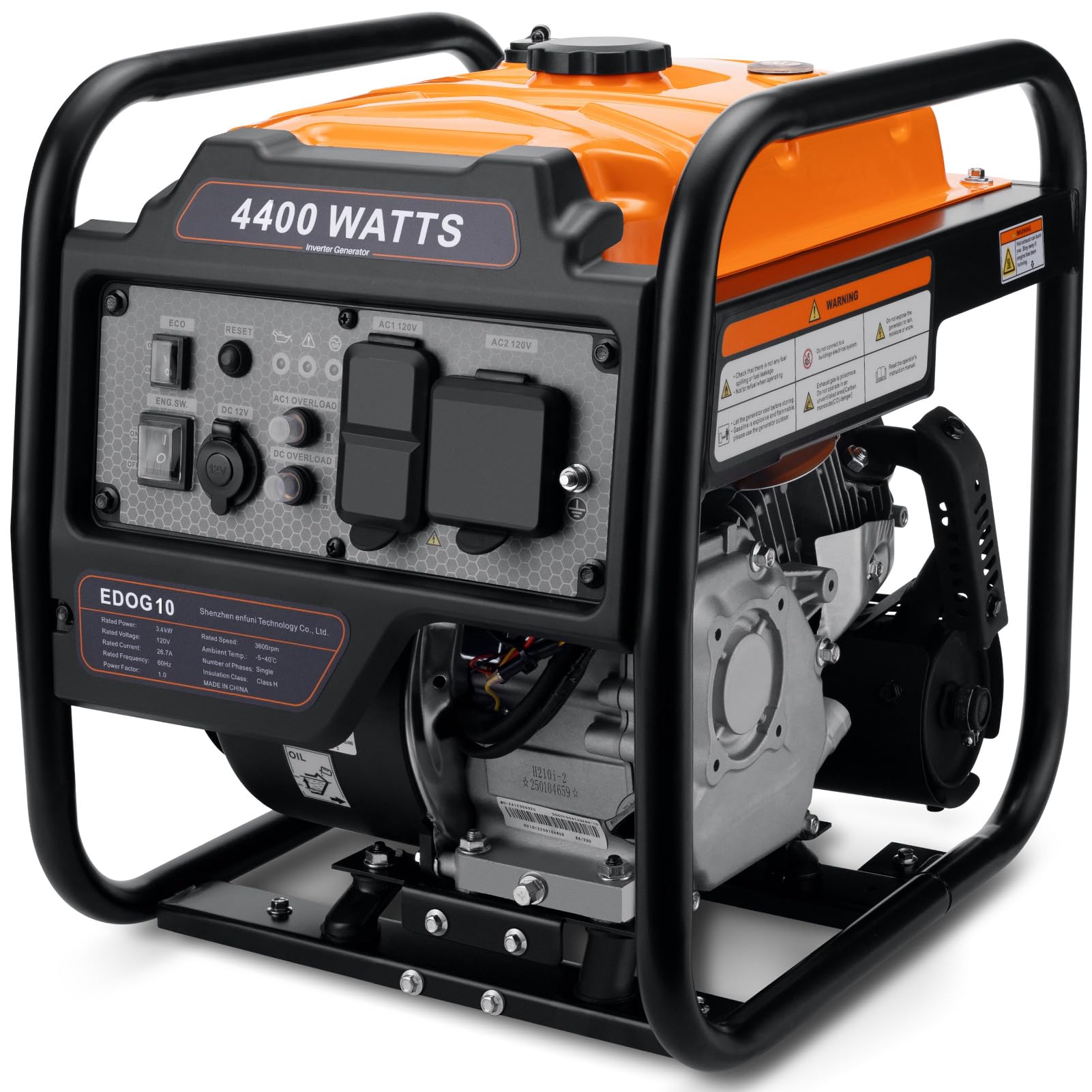
The Oxseryn 4400 is the mid-tier inverter generator that fills the gap between ultra-portable units and whole-home monsters. It delivers 4,400 peak watts and 3,400 running watts — enough to run a refrigerator, freezer, window air conditioner, and microwave simultaneously. The 14-hour runtime at 25% load from the 2-gallon tank with fuel gauge means overnight outages are covered without refueling.
At 56 pounds with a built-in handle, it is portable enough for one person to load into a truck bed. The low noise rating of under 72 dBA from 23 feet is acceptable for neighborhood use, though not as quiet as the Champion. Users report over 200 hours of runtime with reliable operation, and the cold start technology ensures first-pull starts even in cooler weather.
Some customers noted the 2-gallon tank feels undersized for the engine — it runs out around 4 a.m. during extended outages, requiring a middle-of-the-night refill. The reversed choke labeling on early units is easily corrected with a label maker. The lack of CO auto shutoff is a notable omission for safety-conscious buyers.
Why it’s great
- Strong 4,400W peak handles fridge, freezer, and AC together
- Lightweight at 56 lbs for the power output class
- Fuel gauge provides clear runtime planning at a glance
Good to know
- Fuel tank requires overnight refill for extended outages
- No CO shutoff sensor included
9. Oxseryn 2800-Watt
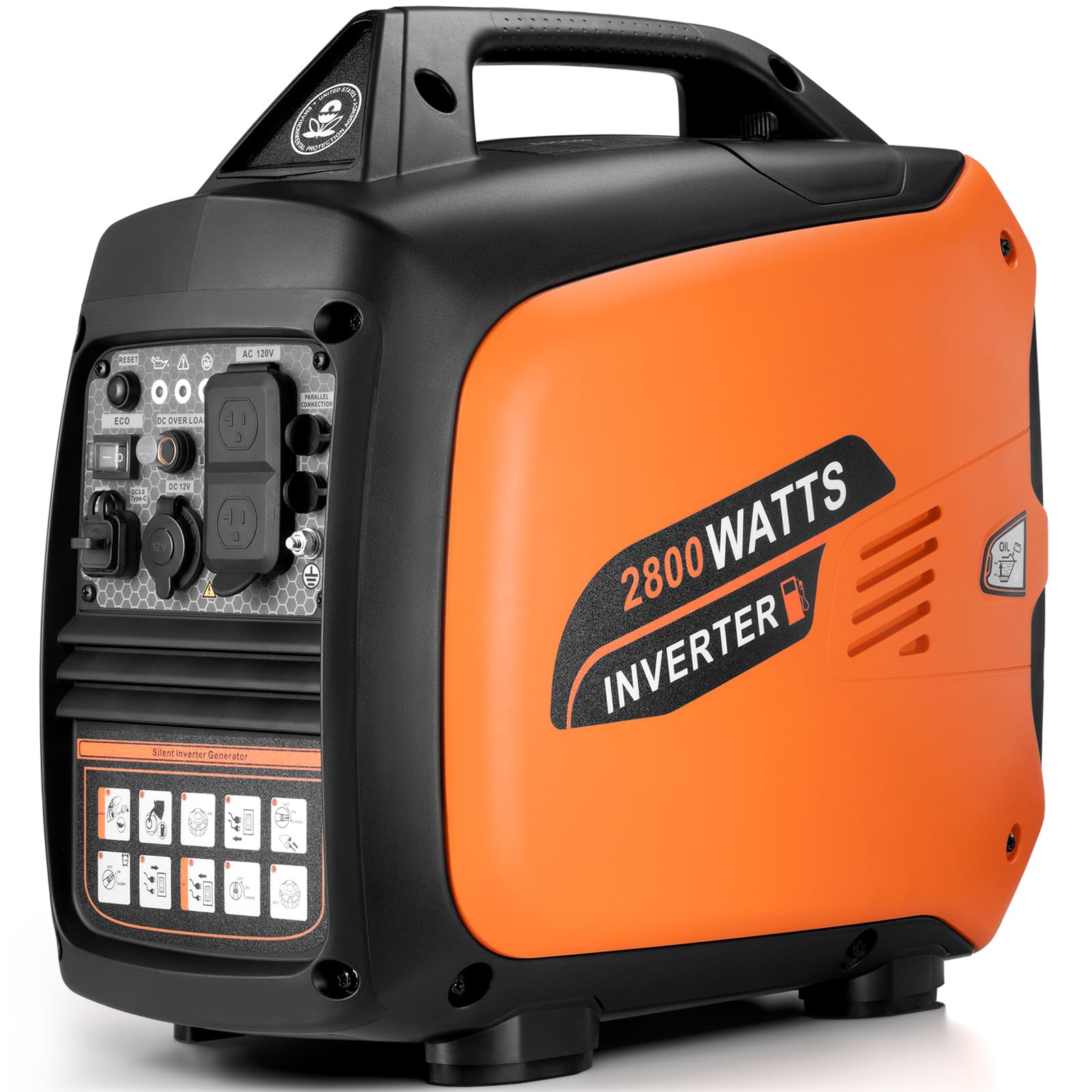
The Oxseryn 2800 is the entry-level inverter generator for homeowners who need basic emergency backup without a large investment. With 2,800 peak watts and 2,000 running watts from the 79.8cc 4-stroke engine, it can run a refrigerator, a few lights, and a laptop charging station for up to 9 hours at 25% load. The less than 3% THD makes it safe for sensitive electronics.
The 40-pound weight and built-in handle make it the most portable unit on this list. The multi-output panel includes two 120V AC ports, a 12V DC port, one USB-A, and one USB-C — the USB-C port is a welcome addition for modern device charging without a separate adapter. The parallel function allows pairing with a second unit for double the output.
Users consistently praise the ease of starting — often on the first pull. The side panel must be removed to check the oil level, which is awkward. Some users found excessive metal grit in the oil during the first few changes, which is normal for break-in but requires extra attention. The 58 dBA noise level is quiet enough for campsite use and respectful of neighbors.
Why it’s great
- Very easy to start on first or second pull
- Includes USB-C port for modern device compatibility
- Parallel capable for doubling power output later
Good to know
- Oil check requires removing side panel — messy process
- Plenty of metal grit during break-in oil changes, expect extra work
FAQ
Can I use an inverter generator indoors during a power outage?
How many watts do I need to run a refrigerator and freezer during an outage?
What does parallel capability mean for a home backup inverter?
Final Thoughts: The Verdict
For most users, the very best backup inverter for home is the Westinghouse iGen12000DFc because its 50A outlet and 12,000W peak output feed a whole-home transfer switch with clean sine wave power and dual fuel flexibility. If you want silent, zero-emission backup for a refrigerator and electronics, grab the Jackery HomePower 3000 with solar panels. And for EV charging during outages, nothing beats the WEN DF680iX with its bonded-neutral 240V output.