
The one spec that separates a flawless 3D print from a stringy, brittle mess is the filament you load — diameter tolerance to 0.02mm, moisture content, and material-specific flow rates define whether your benchy boat sinks or floats. Across seven commercially proven spools, I’ve sorted the best by layer adhesion, warp resistance, and real-world print speeds so you can skip the calibration hell.
I’m Min — the co-founder and writer behind Gadgets Feed. I’ve spent countless hours cross-referencing customer print logs, vendor tolerance claims, and hardness data to isolate the 1.75mm filaments that actually deliver on their boxes.
Whether you need a silk PLA that pops on cosplay props or a PETG-CF that survives outdoor gear, this analysis focuses on fit, finish, and first-layer grip. This is the complete manual for the best 1.75mm 3d printing filament across PLA, PETG, ABS, and carbon fiber blends.
How To Choose The Best 1.75mm 3D Printing Filament
Picking the right 1.75mm spool means weighing dimensional consistency, printing speed targets, and the part’s end-use environment. A silk PLA looks polished on a display stand but wilts under sunlight, while an ABS part survives engine-bay heat but warps without an enclosure.
Tolerance: The 0.02mm Standard
Every filament listed on this page advertises a diameter tolerance of either ±0.02mm or ±0.03mm. A 1.75mm filament that swells by 0.05mm will jam in a standard PTFE-lined hot end, causing skipped steps and failed prints. Stick with ±0.02mm for consistent extrusion at high speeds.
Material vs. Application
PLA is the easiest starter material — low warping, no enclosure needed, and good layer adhesion for decorative prints. PETG bridges the gap with UV resistance and toughness, suitable for outdoor mounts. ABS handles 80°C+ heat but requires a chamber to avoid cracking. Carbon-fiber composites boost stiffness by up to 30% over standard variants but demand a hardened nozzle (0.4mm minimum).
Moisture Sensitivity
PETG is hydrophilic — it absorbs humidity from the air faster than PLA and will hiss, bubble, and string if not dried. All quality filaments ship in vacuum-sealed bags with desiccant. If your spool arrives without an airtight seal, return it immediately.
Quick Comparison
On smaller screens, swipe sideways to see the full table.
| Model | Category | Best For | Key Spec | Amazon |
|---|---|---|---|---|
| SUNLU Silk PLA | Silk PLA | Cosplay & art models | Diam. accuracy ±0.02mm | Amazon |
| Polymaker PETG | PETG | Functional outdoor parts | HDT 70°C | Amazon |
| ELEGOO PETG-CF | Carbon Fiber PETG | Gears & structural brackets | 240–270°C nozzle range | Amazon |
| FLASHFORGE PETG Pro | PETG | Outdoor signs & semi-transparent parts | Diam. accuracy ±0.02mm | Amazon |
| Creality Hyper ABS | ABS | High-temp brackets & jigs | Impact strength 19kJ/m² | Amazon |
| Creality Hyper PLA RFID | High-Speed PLA | Multicolor CFS work | Print speed up to 600mm/s | Amazon |
| Creality Hyper PLA-CF | Carbon Fiber PLA | Drone & UAV frames | 30% higher flexural strength | Amazon |
In‑Depth Reviews
1. SUNLU Silk PLA Filament
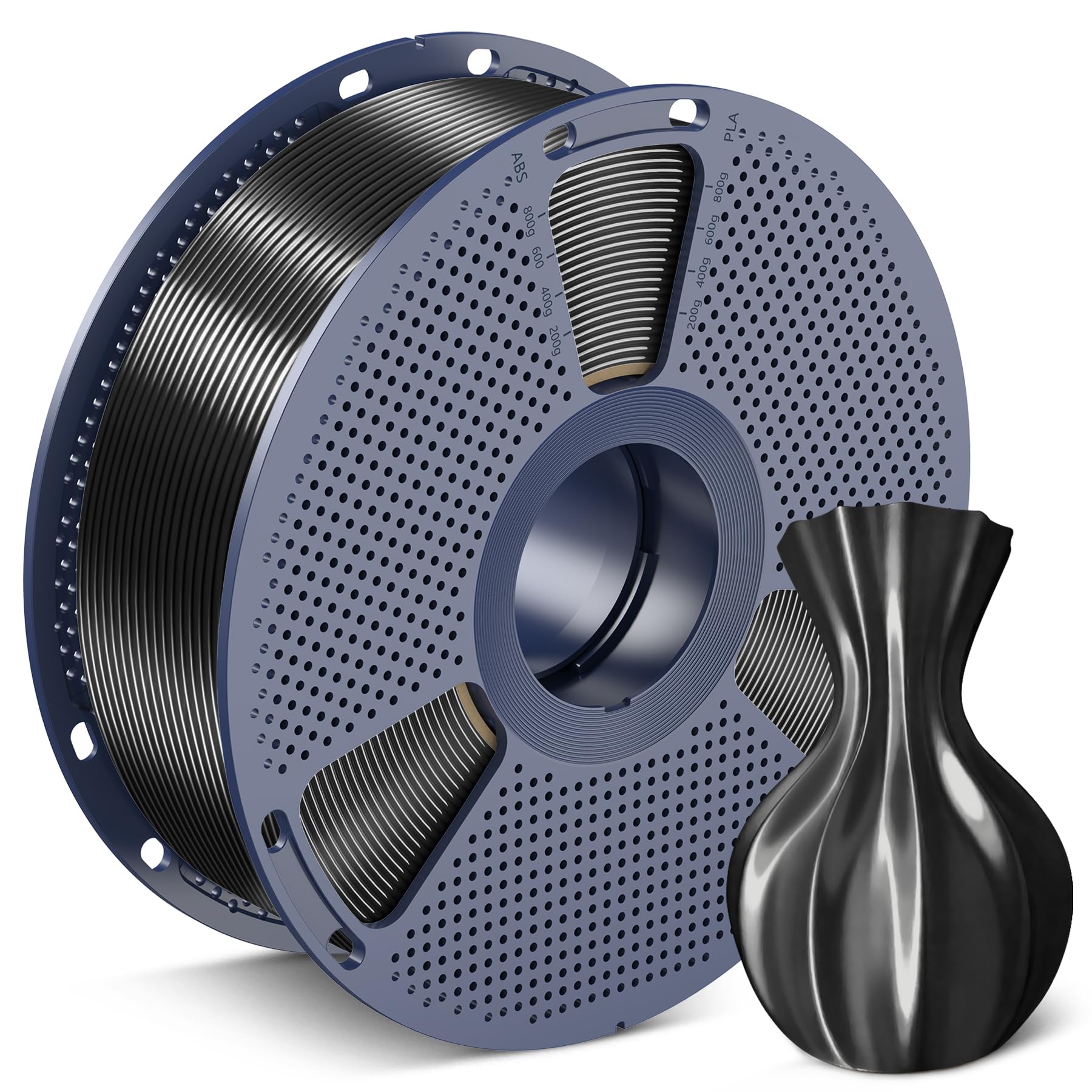
The SUNLU Silk PLA delivers a glossy, reflective finish that stands apart from standard matte PLAs — the pearlescent effect on detailed figurines is immediate, and the 0.02mm diameter tolerance means no mid-print jams in a standard 0.4mm nozzle. Users report success running it at 215°C at 50% speed for maximum shine, with solid first-layer adhesion at 70°C bed temp.
What separates this spool from other silk variants is the neat winding: SUNLU’s dedicated winding fixture prevents tangles even during high-retraction prints, and the vacuum-sealed packaging keeps moisture out from the first layer to the last meter. The 1kg spool size fits most FDM printers without an adapter.
Color consistency holds across batches, and the silk texture hides layer lines better than most budget brands. For cosplay armor and display models, this is the most cost-effective silk PLA that prints without fuss right out of the bag.
Why it’s great
- Silk finish hides layer lines beautifully
- Consistent ±0.02mm diameter, no clogs
- Neatly wound spool prevents tangles
Good to know
- Requires slower speed (30-60mm/s) for best gloss
- Not ideal for functional parts — silk PLA is less tough than standard PLA
2. Creality Hyper PLA RFID
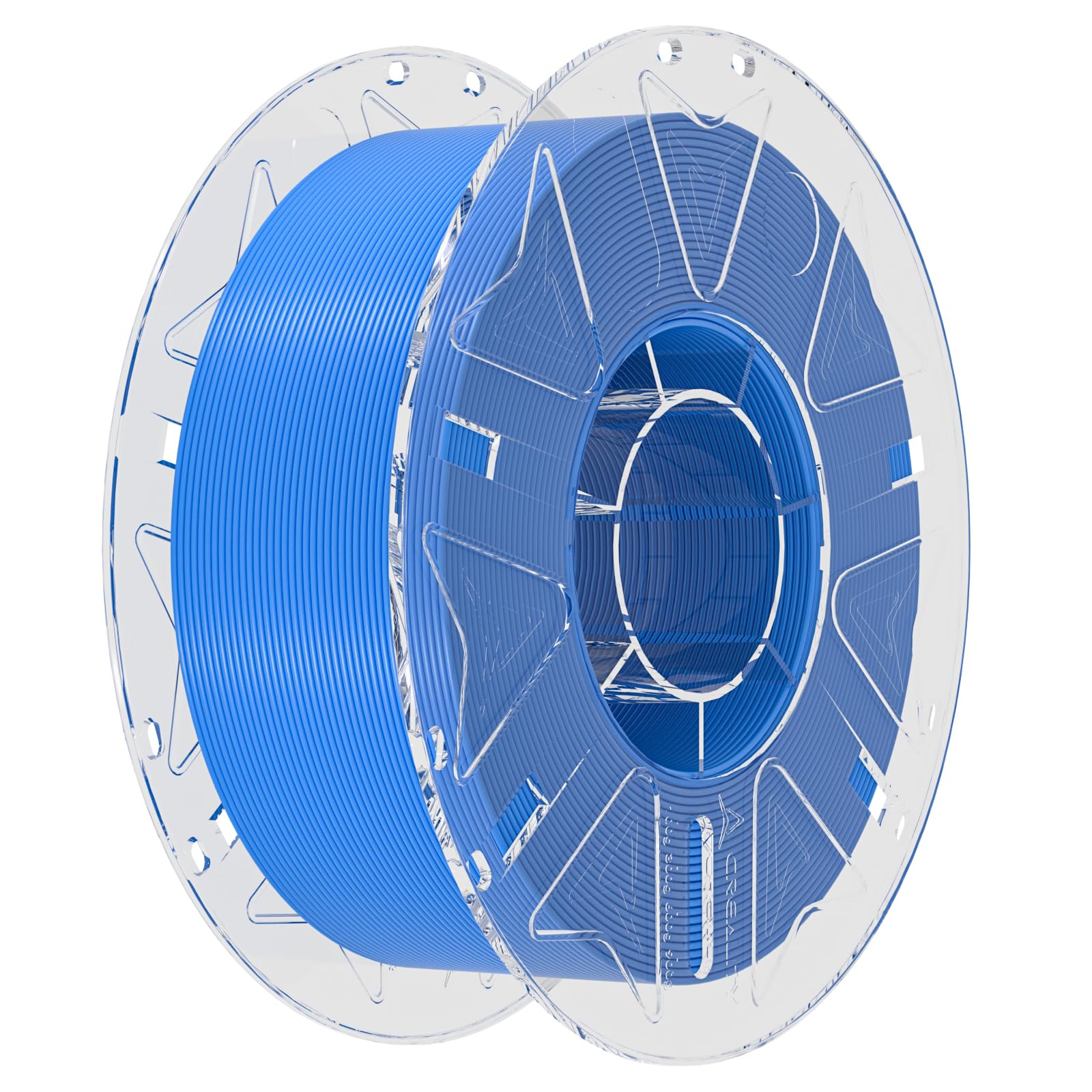
The Creality Hyper PLA with RFID is the most operationally efficient spool on this list — load it into a K2 Plus or Hi Combo, and the CFS auto-detects material type, color, and optimal profile. There is zero guesswork on temperature or retraction settings, which cuts setup time to under a minute.
At 600mm/s travel and 300mm/s outer wall, this filament maintains sharp corners and consistent extrusion without stringing, thanks to a low-melt-viscosity formulation. Users note that bed adhesion is strong enough to hold tall thin vases without a brim, and prints pop free when the bed drops to 35°C.
The higher per-spool cost is offset by reduced waste from failed prints and faster iteration speed. For multi-color workflows using the CFS, the RFID chip alone justifies the premium.
Why it’s great
- RFID recognition for zero-profile hassle
- Handles 600mm/s without stringing
- Strong bed adhesion, easy release at 35°C
Good to know
- RFID works only with Creality Hi/K2 Plus CFS
- Slightly more expensive than standard PLA spools
3. Polymaker PETG Black
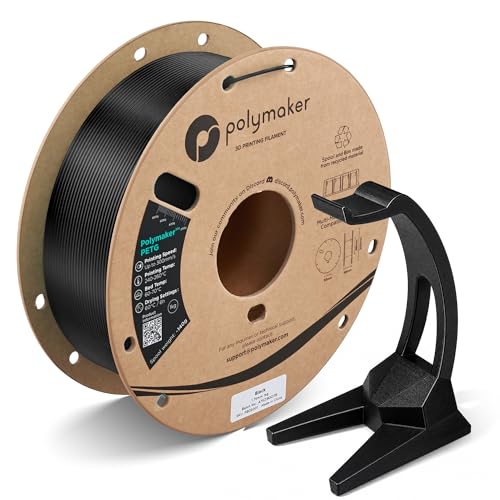
Polymaker’s new high-speed PETG formula matches the print ease of PLA while delivering the temperature resistance and toughness PETG is known for — a heat deflection temperature of 70°C means this filament survives a car dashboard in summer without sagging. Users report nearly zero stringing using generic PETG profiles, a rarity for the material.
The spool is wound cleanly, and the cardboard reel is recyclable, which reduces plastic waste compared to many competitors.
At its price point, this is the most reliable PETG for those stepping up from PLA who want the toughness without the warping nightmares of ABS.
Why it’s great
- Prints like PLA with PETG toughness
- Nearly zero stringing with generic profile
- Strong layer adhesion for functional parts
Good to know
- Cardboard spool may not fit all enclosed dryers
- Color vibrancy is less intense than Bambu/Elegoo equivalents
4. Creality Hyper ABS Gray
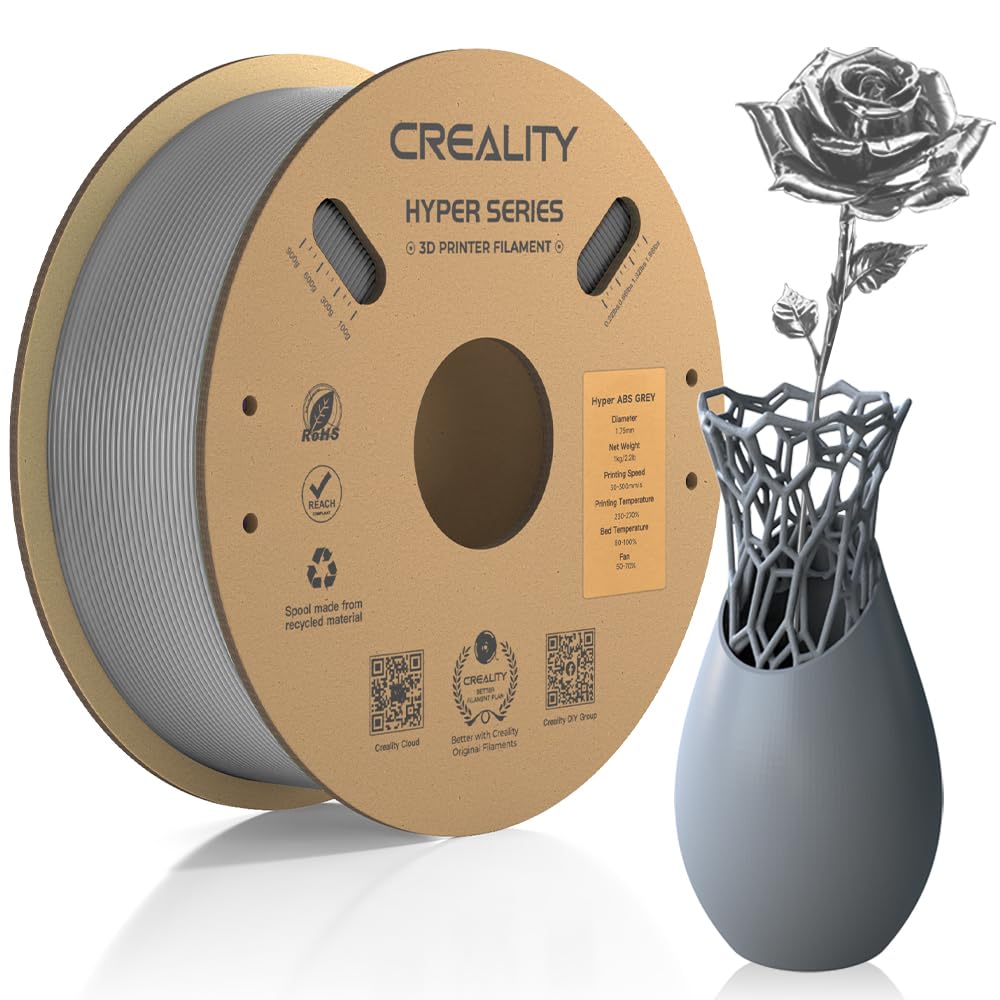
Creality’s Hyper ABS reformulates the traditional ABS experience with lower volatile emissions and a heat deflection temperature of 80°C — 25°C higher than standard PLA, which makes it suitable for under-hood brackets and hot-end shrouds. The impact strength rating of 19kJ/m² is nearly double that of ordinary PLA.
Print speeds can reach 350mm/s without compromising layer fusion, and the reduced monomer content means less odor during printing, though an enclosure is still recommended for large, warp-prone parts. Users successfully ran it on both Creality K1C and Bambu Labs H2C machines with minimal tuning.
For functional prototypes that must resist heat and impact, this is the cheapest way to get ABS-grade performance without the heavy fume extraction required by older ABS formulations.
Why it’s great
- 80°C heat resistance for stressed environments
- Lower fumes than standard ABS
- Compatible with fast core XY printers at 350mm/s
Good to know
- Stringing may occur on retraction-poor profiles
- Still requires an enclosure for large flat parts
5. ELEGOO PETG-CF Black
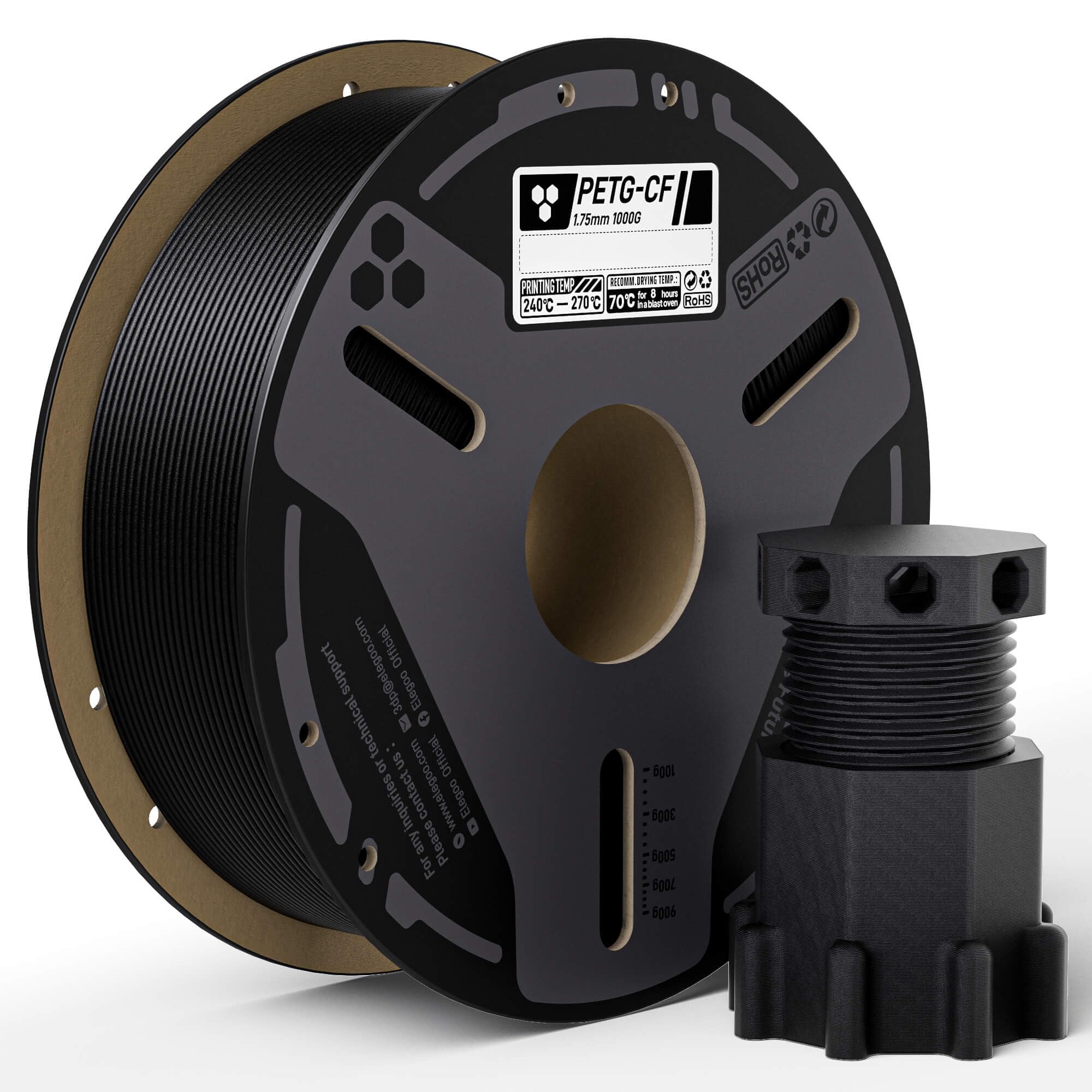
The ELEGOO PETG-CF produces a black matte texture that hides layer lines almost completely, giving functional gears and brackets a machined appearance. The carbon fiber content raises rigidity by roughly 30% compared to standard PETG while maintaining the impact toughness PETG is known for.
A hardened steel nozzle is mandatory — the abrasive CF will wear a brass 0.4mm nozzle in under 500g of filament. At 250°C and 65mm/s, prints show no stringing, and the matte surface reduces post-processing sanding time dramatically.
Users praise the consistency of the spool for price: zero tangles across multiple reviews, and the finish is uniform from first to last meter. For structural parts in UAV frames or jigs, this is the best CF-blend option at this price point.
Why it’s great
- Matte carbon fiber finish hides layer lines
- High impact strength for functional parts
- Excellent dimensional accuracy, no tangles
Good to know
- Requires hardened steel nozzle (0.4mm min)
- Narrow printing temperature window (240-270°C)
6. Creality Hyper PLA-CF

The Creality Hyper PLA-CF is engineered for lightweight, high-stiffness prints like drone frames and RC airplane arms where weight savings matter more than heat resistance. The carbon fiber reinforcement delivers 30% higher flexural strength than standard PLA, and the low-density formulation keeps parts lighter than PETG equivalents.
Print speeds sit in the 50-300mm/s range, with the self-supporting bridging reducing the need for complex support structures. Users on the K2 Plus with CFS note the RFID-less paper spool version should not be used in the multi-color box — stick with the RFID plastic spool variant for automatic recognition.
The matte black finish is professional enough for client-facing prototypes, and the toughness handles repeated impact better than plain Hyper PLA. This is a niche filament for those who need PLA’s printability with carbon fiber’s stiffness.
Why it’s great
- Lightweight with 30% flexural strength boost
- Prints up to 300mm/s with clean finish
- Self-supporting bridging reduces post-processing
Good to know
- Paper spool not recommended for CFS use
- Requires hardened nozzle due to abrasive CF
7. FLASHFORGE PETG Pro Black

The FLASHFORGE PETG Pro brings the low-warp advantage of PLA together with the impact resistance of ABS, making it a solid entry point for large-bed prints like lampshades and outdoor signage. The hydrophobic formulation means it’s less moisture-sensitive than standard PETG — you can leave the spool out for a week without the hissing that plagues other PETG brands.
At 245°C with a 80°C bed, layer adhesion is reliable even on tall prints, and the semi-transparent finish on thin walls opens up aesthetic applications that solid colors can’t match. Users report consistent diameter across the whole spool with no kinking.
The one-year warranty adds peace of mind that’s rare at this price, and the CCD measurement system during manufacturing ensures every meter holds ±0.02mm tolerance. It’s the best budget PETG for beginners moving away from PLA.
Why it’s great
- Low moisture absorption for a PETG
- Excellent bed adhesion with low warping
- Semi-transparent finish option
Good to know
- Color on box may differ slightly from actual spool
- Some users needed a dedicated dryer for best results
FAQ
Can I print carbon fiber filament on a stock Bowden extruder?
Why does my PETG string more than PLA?
Is ABS safe to print in a bedroom without ventilation?
Final Thoughts: The Verdict
For most users, the best 1.75mm 3d printing filament winner is the SUNLU Silk PLA because it balances a stunning silk finish with reliable ±0.02mm tolerance at the lowest cost per spool. If you need high-speed multicolor automation, grab the Creality Hyper PLA RFID. And for functional parts exposed to outdoor weather or mechanical stress, nothing beats the Polymaker PETG.