
Outgrowing a single keyboard is a good problem, but it creates a real one: your second synth or controller ends up perched on a wobbly stool, a stack of books, or worse, its own stand that eats up precious studio floor space. A 3-tier keyboard stand is the single move that reclaims your room, organizes your workflow, and puts every module at fingertip reach without the Jenga act.
I’m Min — the co-founder and writer behind Gadgets Feed. I’ve spent countless hours analyzing load ratings, Z-frame geometry, tier spacing, and assembly tolerances across dozens of multi-level music stands to isolate which designs actually hold heavy gear without sway and which ones waste your top shelf with unusable clearance.
Whether you are a gigging musician needing quick tear-down or a home producer optimizing a deep desk, this guide breaks down the best 3 tier keyboard stand options so you only buy the stability you need, once.
How To Choose The Best 3 Tier Keyboard Stand
A multi-tier stand is a long-term investment in your gear’s safety and your own comfort. The difference between a stand that lasts a decade and one that causes a mid-gig wobble comes down to four specific factors you need to inspect before clicking “buy.”
Frame Geometry: Z-Frame vs. X-Frame vs. Column
The Z-frame design is the overwhelming winner here. Unlike X-stands that block your legs with a central crossbar, Z-frames position the support arms at the front and back of the keyboard, leaving the space underneath completely open for pedals, foot controllers, or a stool. Z-frames also distribute weight more evenly across a wider footprint, reducing the risk of tipping when you lean on an upper tier. Column-style pedestal stands look sleek but often limit width adjustments and can feel top-heavy with 88-key boards on the top shelf.
Real-World Tier Spacing and Depth
Manufacturers often advertise “3 tiers,” but the critical measurement is the vertical clearance between shelves. You need at least 7 to 10 inches of gap — more if your top keyboard has rear jacks that protrude downward. The shelf depth also matters: a shallow top tier (under 10 inches) will not support a full-size synth chassis safely, and some stands ship with a third tier that is only usable with compact groove boxes or drum machines. Always check the depth of the top two arms against your deepest instrument before buying.
Load Capacity Per Tier, Not Total
A stand may boast a 250-pound total capacity, but that number is almost always split across the bottom frame. The upper tiers are the weak point. Mid-range stands typically rate their second tier at 40-60 pounds and the third tier at 20-35 pounds. If you own a heavy 88-key workstation like a Yamaha Montage or a Nord Stage, verify the individual tier rating — not the combined number — or you risk the upper rack arm slowly bending over time.
Quick Comparison
On smaller screens, swipe sideways to see the full table.
| Model | Category | Best For | Key Spec | Amazon |
|---|---|---|---|---|
| OnStage KS7365EJ | Z-Frame | Gigging musicians needing 400 lb base stability | 400 lb base / 60 lb tier | Amazon |
| Hercules KS410B | Auto Lock | Fast setup/teardown with safe locking | 286 lb capacity | Amazon |
| Liquid Stands 3-Tier w/ Wheels | Rolling Studio | Heavy studio workstations that need mobility | 3 tiers, locking casters | Amazon |
| Liquid Stands Dual Tier Z | Z-Frame + Extras | Versatile 2-tier with add-on expansion | 250 lb base / 60 lb tier | Amazon |
| Headliner HL22053 | Desktop 3-Tier | Compact desktop synth layering | V-shape, no tools assembly | Amazon |
| STRICH Dual Tier | Portable Z | Lightweight aluminum two-tier stage use | Aluminum, folds to 5.8 kg | Amazon |
| Stellar Labs 555-13830 | Heavy Single | Stationary 88-key with high load capacity | 176 lb capacity | Amazon |
In‑Depth Reviews
1. OnStage KS7365EJ Folding-Z Keyboard Stand w/ Second Tier

The OnStage KS7365EJ is the gold standard for gigging keyboardists who need a tour-proof stand that handles heavy 88-key workstations without a hint of sway. The base frame alone is rated at an extraordinary 400 pounds, while the removable second tier adds 60 pounds of capacity for an upper synth — enough for a Korg Kronos or Nord Stage on both levels. The Z-frame geometry leaves the floor completely open for an expression pedal, volume pedal, and sustain pedal bank without your foot hunting around a crossbar. Height adjusts from 23.5 to 36.5 inches and width from 21 to 36 inches across the double center brace, so you can fine-tune the fit for anything from a 49-key controller to a full 88-note slab.
Assembly and tear-down average under five minutes once you learn the process, and the stand collapses into four flat pieces that fit into a sports bag for transport. The top tier angle is independently adjustable via a knuckle joint, letting you tilt your upper keyboard toward you for better visual access to displays. Customer reports confirm the stand has survived over 48 shows across 18 months of heavy use with zero structural issues — no rocking on uneven stage floors, no stripped bolts, no wobble even when both tiers are loaded to capacity. The only real trade-off is weight: at 29.5 pounds, it is not a lightweight carry, but the stability is unmatched among folding Z-designs.
For players who prioritize bulletproof construction and need a second tier that actually holds a full-size synth, the OnStage KS7365EJ is the reference standard. The design does require a heavy keyboard on the bottom tier to counterbalance the top for maximum stability, so lightweight controllers on the lower rack may feel slightly less planted at full height extension. Screw holes may need initial force to break through the paint coating during first assembly, but once fitted, all hardware remains tight.
Why it’s great
- 400-pound base load capacity easily handles the heaviest stage pianos
- Folding Z-frame leaves full floor access for pedal boards
- Second tier angle adjustable and holds 60 pounds securely
- Five-minute tool-free tear-down for transport
Good to know
- Heavier than most stands at 29.5 pounds
- Initial assembly requires extra force to seat bolts through paint
- Top shelf may partially block bottom keyboard display at certain angles
2. Hercules KS410B Auto Lock Double Tier Z KB Stand

The Hercules KS410B differentiates itself through its patented AutoLock system — a spring-loaded lever mechanism that lets you adjust height settings instantly without fumbling with pins or wing nuts. The Z-frame is built from heavy-duty stainless steel tubing with a load capacity of 286 pounds (130 kg) across the base, and the adjustable rubber feet thread individually to level the stand on uneven stage floors, a feature missing from many competitors in this price tier. The EZ-LOK tier attachment locks the second shelf at your chosen angle via a quick-release knob, so you can tilt your top keyboard forward for better knob access without tools.
Locking pins and adjustable moving arms make setup and tear-down faster than the OnStage stand, and the whole unit breaks down into four flat pieces for transport. Users consistently report zero wobble or flex even when holding two heavy synthesizers, and the design is widely preferred over Ultimate Support stands for its more substantial second-tier clamp. The stainless steel finish is painted and holds up well to regular stage use. The AutoLock lever is particularly valuable for gigging musicians who need to change height between seated and standing sets — it clicks securely into place with no risk of accidental collapse.
The main drawback is documentation: the KS410B ships with zero assembly instructions, and some adhesive rubber strips in the box have unclear purpose. Hercules also lacks direct factory support for replacement parts, so losing a bolt means sourcing a generic replacement. A few users note the second-tier width depends on the bottom keyboard’s clearance, and the top shelf may not sit perfectly level without careful adjustment of the locking pins. For stage reliability and speed of setup, however, this stand competes directly with the OnStage at a similar performance tier.
Why it’s great
- AutoLock lever provides tool-free, secure height adjustment in seconds
- Adjustable rubber feet level the stand on uneven surfaces
- 286-pound capacity handles heavy dual-keyboard rigs
- EZ-LOK tier attachment locks angle without tools
Good to know
- Ships with no assembly instructions
- No direct manufacturer support for replacement parts
- Top tier may not sit perfectly level without careful tuning
3. Liquid Stands 3 Tier Keyboard Stand w/ Wheels
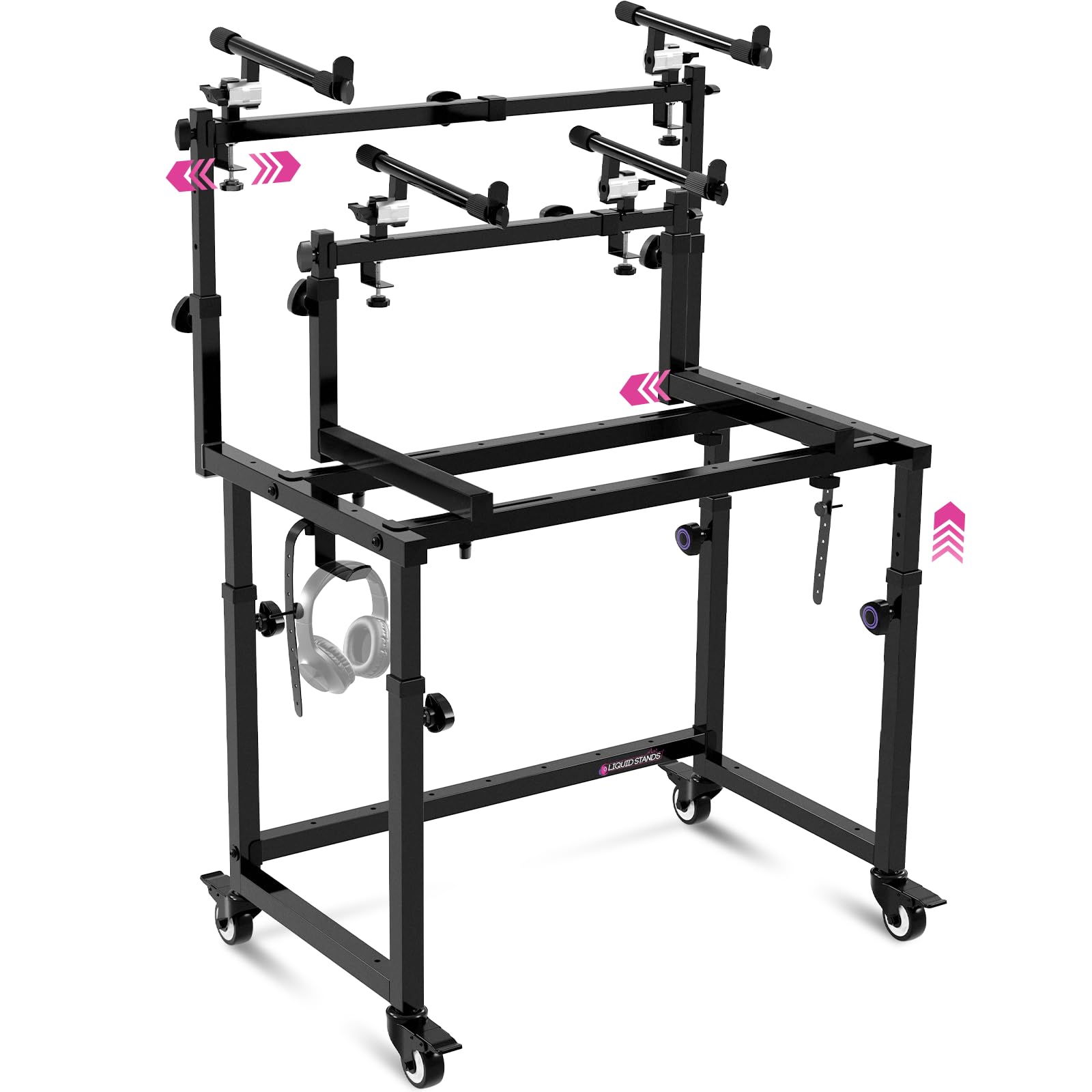
The Liquid Stands 3-Tier converts your keyboard setup into a rolling workstation with 3-inch locking casters, making it the top choice for studio producers who reposition gear frequently. Each of the three tiers supports up to 60 pounds, and the steel frame carries a total 250-pound rating. Width adjusts from 22.5 to 33.5 inches, height from 26 to 36.5 inches, and each tier angle is independently adjustable for ergonomic viewing of screen-based synths and groove boxes. The stand includes security straps for anchoring keyboards, a headphone hook, and adjustable non-slip pads for leveling on carpet or hard floors. It also integrates with Liquid Stands’ own MS1105 tabletop and MS1112 speaker mounts for expanding the workstation further.
Build quality is excellent: the alloy steel components feel substantial, and the locking wheels roll smoothly over most surfaces without adding instability during performance. Users report that even heavy combos like a Yamaha Montage M8x on the bottom and a Roland Fantom 7 on the second tier remain rock-solid with no perceived wobble. Assembly is straightforward, though the instructions are sparse — several users recommend checking the manufacturer’s YouTube videos for clarity on strap attachment and tier positioning.
The realistic limitation of this 3-tier design is that the third shelf has very limited vertical clearance. Unless you are stacking shallow modules (under 6-7 inches deep), the top tier becomes essentially unusable with standard synth chassis. The company acknowledged this in customer correspondence and indicated a revised 3-tier A-Frame model with larger spacing would launch later. If you truly need three fully functional shelves, verify your gear depths against the actual spacing before buying — this stand works best as a premium two-tier unit with an optional tablet or compact module on top.
Why it’s great
- Locking 3-inch casters make repositioning heavy rigs effortless
- Each tier supports 60 pounds individually
- Independent angle adjustment on every shelf
- Works with modular accessories for full studio expansion
Good to know
- Third tier spacing is too tight for most standard synths
- Assembly instructions are vague, require YouTube supplement
- Some units arrive with minor QC issues like damaged packaging
4. Liquid Stands Dual Piano Keyboard Stand with 2nd Tier
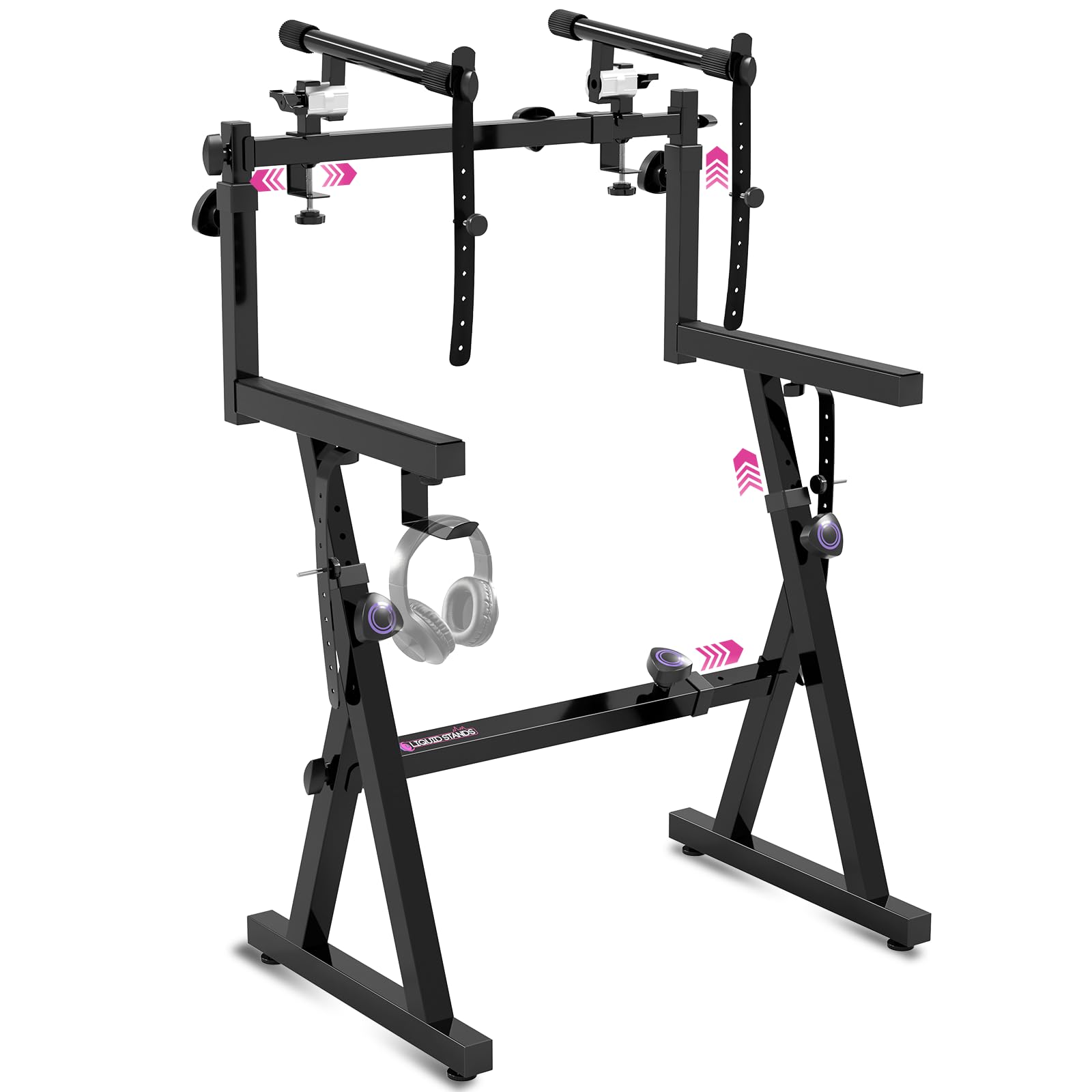
This Z-frame stand from Liquid Stands is a well-rounded two-tier solution that feels more premium than its mid-range price suggests. The base supports 250 pounds, the second tier handles 60 pounds, and the width adjusts from 22.5 to 33.5 inches with height ranging from 14 to 21.5 inches. The stand comes with adjustable feet for uneven floors, anti-skid foam pads that prevent gear slippage, anchoring straps for extra security, and a built-in headphone hook — a small but thoughtful detail that keeps cables organized. Assembly takes under 10 minutes with clearly labeled parts and pre-assembled sections.
Customer feedback consistently praises the independence of the two tiers: each shelf can be positioned at a different angle and height, making it easy to place a low-hanging 88-key piano on the bottom and tilt a smaller synth or MPC unit on the top. The Z-frame geometry provides excellent knee clearance, and the narrow depth keeps the footprint compact even with wide keyboards. Several long-term users confirm the stand remains rock-solid after a year of daily practice and live play with heavy instruments like a Roland RD-700SX combined with a Kawai MP7SE.
The top tier is not perfectly level straight out of the box — some assembly fiddling is needed to align both sides evenly. The feet protrude slightly, which could be a tripping hazard in tight home studios. For a two-tier setup with room to expand later using Liquid Stands’ own add-on accessories, this is a strong candidate that balances stability with thoughtful extras.
Why it’s great
- Independent height/angle per tier for custom ergonomics
- Includes security straps, foam pads, and headphone hook
- 250-pound base capacity with Z-frame knee clearance
- Fast assembly with clear part labeling
Good to know
- Top tier may require adjustment to sit perfectly level
- Protruding feet can be a tripping hazard
- Not a true 3-tier design without add-on purchase
5. Headliner 3-Tier Desktop Synth Stand (HL22053)

The Headliner HL22053 is a V-shaped desktop stand designed specifically for compact synth and groove box layering — it is not a floor stand for full-size keyboards. Built from alloy steel with a powder-coated finish, the stand fits three devices such as the Roland SH-4d, Behringer Crave, Elektron Digitakt, or small-format mixers. The angled tiers improve visibility of LCD screens and make knob tweaking ergonomic compared to flat desk placement. Width is adjustable to accommodate slightly different device footprints, and non-slip rubber pads on all three shelves prevent sliding during aggressive parameter changes.
This is a “no-tools-required” design that comes out of the box ready to use — just unfold the legs and set your gear. The V-shape footprint is stable but relies on the weight of the bottom device to keep the center of gravity low. Users report that Elektron boxes (Digitakt II, Digitone II) fit perfectly on all three shelves, while deeper units like the Arturia MiniFreak overhang the bottom shelf because it is too shallow. Build quality is decent for the price bracket, though a few buyers received units with scratched side panels hidden under the rubber pads, indicating QC inconsistency in packaging.
Stability is only reliable when the bottom tier carries at least a moderate-weight device — a lightweight controller on the bottom makes the whole stand feel top-heavy and prone to tipping forward. The third tier has the smallest depth, suitable only for slim modules or effect pedals. For a dedicated desktop organizing tool that keeps three small synths visible and accessible, the Headliner works well, but it is not a substitute for a floor-standing Z-frame rig if you own any full-size 49-key or larger keyboard.
Why it’s great
- No assembly required, ready out of the box
- Angled tiers improve screen visibility for desktop synths
- Compact V-shape fits small studio desks
- Width adjustable for different device sizes
Good to know
- Bottom shelf too shallow for deeper synths like Arturia MiniFreak
- Top-heavy unless bottom tier carries significant weight
- QC issues with scratched panels reported
6. STRICH Dual Piano Keyboard Stand with 2nd Tier

The STRICH Dual Tier stand is built for portability without sacrificing the Z-frame’s structural advantages. The frame uses high-strength aluminum alloy and reinforced plastics to achieve a weight of just 5.8 kg (12.8 pounds) while still supporting up to 66 pounds on the lower tier and 22 pounds on the upper tier. Width adjusts from 73 to 107 cm (28.7 to 42.1 inches), height from 58 to 70 cm (22.8 to 27.6 inches), and the foldable design reduces volume by over 50% for trunk storage. The upper tier’s EVA foam padding and lower tier’s non-slip rubber feet keep instruments firmly in place.
Users transitioning from X-stands strongly prefer the STRICH because the Z-frame eliminates the knee-banging crossbar issue completely, and the narrow depth is ideal for cramped stage setups. The stand folds into a shape that fits inside a standard 61-key keyboard bag for easy transport. Assembly is straightforward, and the aluminum construction resists corrosion better than painted steel over years of use. Multiple customers confirm it handles a Hammond XK-2 on the bottom with a Roland DS61 on top without flexing.
Some users report a “slight wobble” when two heavy 88-key pianos are mounted simultaneously — the aluminum frame trades absolute rigidity for weight savings. The upper tier’s 22-pound limit means it is not suitable for full-size workstations on top; stick to light synths and controllers. The plastic reinforcement components may not survive hard drops or repeated tour-bus loading as well as an all-steel OnStage unit. For weekend gigs and home studios where weight matters, the STRICH hits an excellent balance of portability and stability.
Why it’s great
- Lightweight aluminum frame at just 5.8 kg
- Folds compactly for trunk or bag transport
- Z-frame design eliminates X-stand knee clearance issues
- EVA foam and rubber pads prevent gear slipping
Good to know
- Upper tier limited to 22 pounds, not for heavy workstations
- Slight wobble reported with two full-size 88-key pianos
- Plastic components less durable than all-steel stands
7. Stellar Labs 555-13830 Heavy Duty Keyboard Stand

The Stellar Labs 555-13830 is a single-level heavy-duty stand that prioritizes absolute stability over portability or multi-tier capability. This is a stationary studio solution: the Z-frame uses steel square tube construction with a 176-pound (80 kg) load capacity, foam cushioning strips on both the top support arms and base sections, and a sprung push-button height adjuster with 14 settings ranging from 585 mm to 895 mm. Width adjusts from 622 mm to 1016 mm (24.5 to 40 inches), and the top arm depth of 500 mm accommodates even the deepest keyboard chassis. The base section depth is 550 mm, providing a wide footprint that eliminates any rocking or tipping risk.
Customers upgrading from X-stands consistently praise the Stellar Labs unit for its “rock solid” feel — even aggressive playing on a heavy 88-key piano produces no vibration or movement. Assembly is simple with clearly marked parts: two Z-side sections, one crossbar, and clamping plates with bolts. The spring-loaded pin mechanism for height adjustment is faster and more secure than friction collars. The weight is 18.9 pounds, making it less portable than the STRICH but still manageable for occasional moves between rooms.
This stand does not fold flat — it is a two-piece plus crossbar design that remains somewhat awkward to transport, and the arms are angled downward approximately 5 degrees, which can cause lighter keyboards to creep forward over time. The fixed depth of roughly 2 feet from the wall may conflict with compact studio layouts. As a true single-tier stand, it is not a direct multi-tier competitor, but if your priority is supporting a single heavy 88-key piano with zero compromise on wobble, the Stellar Labs is the most cost-efficient route to industrial-grade stability.
Why it’s great
- 176-pound capacity, eliminates all keyboard wobble
- 14 spring-pin height settings for precise ergonomics
- 500 mm top arm depth fits deep-keyboard chassis
- Simple, fast assembly with labeled hardware
Good to know
- Single-tier only, no multi-keyboard layering
- Angled arms cause light keyboards to creep forward
- Does not fold flat for transport
FAQ
Can I put an 88-key keyboard on the top tier of a 3-tier stand?
What is the difference between a Z-frame and an X-frame for a 3-tier setup?
Final Thoughts: The Verdict
For most users, the 3 tier keyboard stand winner is the Liquid Stands 3-Tier w/ Wheels because it offers true three-tier capacity with locking casters for studio mobility and a 250-pound total rating. If you need a gig-proof Z-frame that handles the heaviest stage pianos with zero wobble, grab the OnStage KS7365EJ. And for a compact desktop organiser that keeps three small synths visible and accessible without taking floor space, nothing beats the Headliner HL22053.