
The American Bicentennial Coin series is the only U.S. coinage to feature a dual date (1776-1976) and three one-year-only reverse designs: the Colonial drummer boy on the quarter, Independence Hall on the half dollar, and a moon-touching Liberty Bell over the moon on the Eisenhower dollar. Collectors prize these issues not just for their 40% silver content but for the condition of the strike — a weak drumstick or a flattened Liberty Bell step can drop a coin’s graders’ call by three full points on the Sheldon scale.
I’m Min — the co-founder and writer behind Gadgets Feed. I’ve spent hundreds of hours cross-referencing eBay sold listings, PCGS/NGC auction records, and raw ungraded inventory from major numismatic suppliers to isolate which Bicentennial coins currently offer the strongest combination of eye appeal, metal purity, and conditional rarity for serious stackers and casual gift-buyers alike.
The guide below compares seven of the most accessible entry points — from single 40% silver quarters to complete OGP proof sets — so you can buy with confidence and zero regret when searching for the best american bicentennial coin.
How To Choose The Best American Bicentennial Coin
The Bicentennial series spans four denominations (quarter, half dollar, dollar, and proof set), each struck in either copper-nickel clad or 40% silver. Your choice hinges on three factors: metal purity for intrinsic value, strike quality for grading potential, and packaging authenticity to avoid cleaned or altered coins.
Metal Composition — Clad vs. 40% Silver
The U.S. Mint produced two variants for each 1976-S coin: a standard copper-nickel clad issue for circulation and a 40% silver version sold only in the special 3-coin uncirculated set and the 1976 proof set. The silver coins weigh 11.5 g (half dollar) and 24.59 g (dollar) versus the clad versions at 11.34 g and 22.68 g. A simple kitchen scale with 0.1 g resolution can instantly separate genuine silver from clad.
Strike Quality & Eye Appeal
Weak strikes plague the drummer boy quarter — the drumstick and the eagle’s tail feathers often show incomplete metal flow. On the half dollar, look for sharp step details on Independence Hall’s front facade. The Eisenhower dollar frequently suffers from mushy Liberty Bell clapper lines. Always request high-resolution photos that show the reverse detail under raking light before purchasing raw (ungraded) coins.
Grading Considerations & Market Trends
Raw Mint State (MS) coins in the 63-65 range trade at retail premiums of 30-50% over melt value. Premiums explode for certified MS67+ examples because the Bicentennial series has notoriously low populations at the top tier due to bag marks from the Mint’s original packaging. A PCGS MS67 1976-S silver quarter can command three times the price of an equivalent MS65.
Quick Comparison
On smaller screens, swipe sideways to see the full table.
| Model | Category | Best For | Key Spec | Amazon |
|---|---|---|---|---|
| 1976-S Silver Eisenhower Dollar | Silver Dollar | Largest silver Bicentennial coin | 40% silver, 38 mm, 25 g | Amazon |
| 1976 U.S. Proof Set (OGP) | Proof Set | Complete six-coin government set | Clad proof, OGP with COA | Amazon |
| 1976-S Silver Kennedy Half Dollar (BU) | Silver Half | BU half with Independence Hall reverse | 40% silver, 11.5 g, MS | Amazon |
| 1976 Silver Kennedy Half Dollar (Proof) | Silver Proof | Proof finish half dollar | 40% silver, 75% purity | Amazon |
| 1976-S Bicentennial Quarter (Air-Tite) | Silver Quarter | Silver quarter in protective holder | 40% silver, BU, Air-Tite | Amazon |
| 1976-S Brilliant Uncirculated Silver Quarter | Silver Quarter | Highest eye-appeal quarter candidate | 99.9% silver, MS 67+ | Amazon |
| American Coin Treasures Eleven Coin Set | Display Set | Complete Bicentennial set in box | 11 uncirculated coins, clad | Amazon |
In‑Depth Reviews
1. 1976-S U.S. Eisenhower Silver Dollar Coin, 40% Pure Silver, Mint State Condition, Bicentennial Design
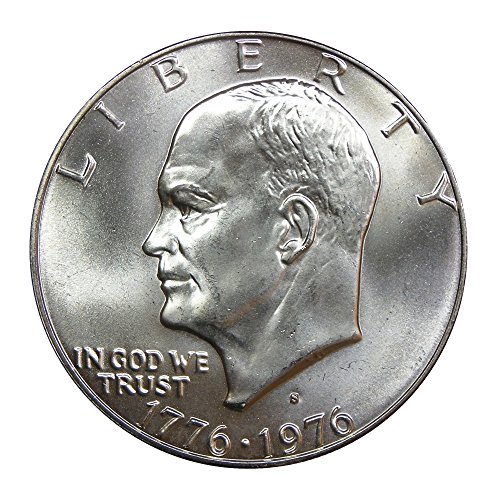
This 1976-S Eisenhower dollar weighs 25 g — exactly 40% silver — and measures a commanding 38 mm across, making it the largest silver coin in the entire Bicentennial series. The reverse features the Liberty Bell superimposed over the moon with the dual date 1776-1976, a design that ran only in 1975 and 1976. In Mint State condition, the luster on the obverse field is frosty white with zero friction on Ike’s cheek or the bell clapper details.
The San Francisco mint mark (S) confirms it came from the 3-coin uncirculated silver set. At 40% silver, the melt value floats with spot silver, but the conditional value — a raw MS coin with strong cartwheel luster — typically carries a 1.5x to 2x multiplier over melt. Buyers report the coin arrives in a capsule with visible rim bumps typical of original Mint packaging, so inspect the obverse field under direct light for hairline bag marks before grading.
For collectors who want one coin that captures the full Bicentennial scale — the largest diameter, the highest silver weight, and the only moon-themed reverse in U.S. coinage — this Eisenhower dollar is the definitive single-piece buy. The 40% silver content also means it will never be worth less than its intrinsic metal value, a floor that clad versions simply do not share.
Why it’s great
- Last silver dollar struck for circulation by the U.S. Mint — historically significant
- 40% silver provides intrinsic melt floor plus collector premium
- Large 38 mm format shows the dual-date and Liberty Bell reverse with high visibility
Good to know
- Raw (ungraded) — buyer must assess strike quality on bell clapper and eagle feathers
- Some examples arrive with minor bag marks from original government packaging
- Not a full proof finish — it is Mint State (BU) with satin luster, not mirror fields
2. 1976 S 1976-S Silver Bicentennial Kennedy Half Dollar Mint State Half Dollar Brilliant Uncirculated

This 1976-S silver half dollar is the gem of the 3-coin Bicentennial set because the Independence Hall reverse is both the most architecturally detailed and the hardest to find with a full strike. The Mint State (BU) condition here promises original cartwheel luster — that circular light flash that rotates as you tilt the coin — which is the single strongest indicator of an untouched, un-dipped surface.
At 11.5 g of 40% silver, the weight alone distinguishes it from the 11.34 g clad version. The S mint mark is sharp on the obverse below Kennedy’s truncation. Collectors report that the primary defect to inspect is the center of the Independence Hall steps — the horizontal lines at the base of the building often show softness even on otherwise pristine coins. A well-struck example with full step definition can command a 2x premium over a mushy strike at the same grade level.
This is the best entry point for the buyer who wants a single silver Bicentennial coin with a recognizable face (Kennedy) and a historic reverse that directly references Philadelphia’s Independence Hall — the actual birthplace of the Declaration of Independence whose 200th anniversary the coin celebrates.
Why it’s great
- Brilliant Uncirculated condition with strong luster verified by multiple 5/5 reviews
- Independence Hall reverse design is specific to Bicentennial year and never reused
- 40% silver content provides long-term metal value floor
Good to know
- Some buyers have reported needing to return coins with reverse strike defects
- No grading certification included — buyer trusts seller’s BU designation
- Satin finish, not reflective — collectors expecting deep cameo proof will be disappointed
3. American Coin Treasures One Year Rarities Eleven Coin Display Boxed Set

This boxed set from American Coin Treasures includes all four Bicentennial denominations (Eisenhower dollar, Kennedy half dollar, Washington quarter, and Lincoln cent with the dual-date cent reverse) plus the Jefferson nickel — eleven coins total, each in uncirculated condition. The display case measures 7.75 x 1.38 x 7.75 inches with a sealed frame and a Certificate of Authenticity, making it a ready-to-gift presentation.
Importantly, these are clad (copper-nickel) issues, not 40% silver — the set is designed for historical and educational value rather than silver stacking. The Eisenhower dollar in this set weighs 22.68 g versus the 25 g silver version. The included drummer boy quarter and Independence Hall half dollar are genuine one-year-only reverse designs, and the Lincoln cent features the 1776-1976 dual date that makes the entire penny a Bicentennial piece.
For the gift-giver or beginner collector who wants a complete, pre-assembled collection that spans the entire 1976 Bicentennial series in one attractive box, this set delivers instant satisfaction. The 1-year warranty adds confidence, and the frame-style display protects coins from accidental handling and environmental toning.
Why it’s great
- 11 coins cover all Bicentennial denominations in one purchase
- Sealed display frame prevents handling damage and toning
- Certificate of Authenticity included with 1-year warranty
Good to know
- All coins are clad copper-nickel — zero silver content for melt value
- Coins are uncirculated but not certified by PCGS/NCG grading services
- Box dimensions are fixed — cannot rearrange or easily remove individual coins
4. 1976 Silver Kennedy Half Dollar 40% Silver Proof
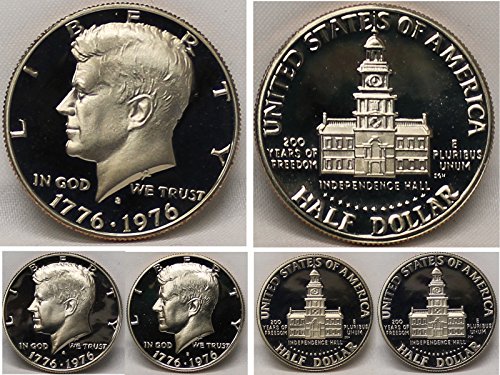
This 1976-S proof Kennedy half dollar features the mirror-like fields that distinguish proof coinage from business strikes — the raised devices (Kennedy’s profile, the lettering, and the Independence Hall reverse) are frosted against a highly reflective background. The 40% silver composition (75% purity ratio per the specification) gives it a weight and ring that clad proofs lack.
The S mint mark on the obverse and the dual date 1776-1976 on the reverse confirm it is a Bicentennial issue. One notable customer review pointed out that packaging varies — this coin may arrive in a simple paper envelope rather than the rigid plastic capsule that serious collectors prefer for long-term storage. If you plan to submit this to PCGS or NGC for certification, factor in the cost of a replacement Air-Tite capsule.
For the collector who values the cameo contrast effect — dark fields behind frosted lettering — this proof half dollar delivers the visual drama that BU coins cannot replicate. The 40% silver content also means it has a melt value floor, unlike the 1976 clad proof sets that have zero intrinsic metal value.
Why it’s great
- Authentic proof finish with mirrored fields and frosted devices
- 40% silver content provides a melt value floor
- Independence Hall reverse is the only architectural design in the series
Good to know
- Packaging is inconsistent — may arrive in paper envelope, not protective capsule
- Proof surfaces are prone to fingerprints — handle only by the edge
- Some buyers report visible spotting or milk spots on the proof field
5. 1976 S 40% Silver Bicentennial Washington Quarter in Air-Tite Holder Uncirculated
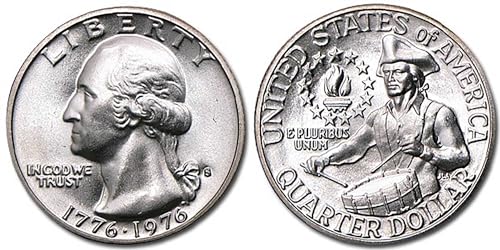
This 1976-S quarter is the most iconic Bicentennial design — the Colonial drummer boy with the torch of liberty and the 13-star flag. It was struck only for the 1975-1976 minting window and never used again. The 40% silver version was exclusively issued in the special 3-coin uncirculated set, making it scarcer than the clad circulation strike by a wide margin.
The Air-Tite holder is a critical inclusion here: silver quarters are only 24.3 mm and easy to lose in storage. The rigid capsule prevents rim dings and keeps the silver from tarnishing via PVC-free inert plastic. The BU (Mint State) finish means the fields have frosty mint luster rather than the mirror finish of a proof. The drummer boy’s drum and the eagle on the reverse should show full detail — weak drumsticks indicate a tired die and lower conditional value.
For the buyer who wants exactly one silver quarter from 1976 to represent the Bicentennial series in a pocket or a small display, this coin in its Air-Tite capsule is ready to collect without any extra preparation. The 40% silver content means it is both a numismatic piece and a fractional silver asset.
Why it’s great
- Drummer boy reverse is the most recognized Bicentennial design
- Air-Tite capsule provides immediate protection from handling and toning
- 40% silver from the official Mint 3-coin set — authentic bullion content
Good to know
- BU finish is satin, not proof — will not have cameo mirror fields
- Single coin only — no certificate or display box included
- Drummer boy details vary in strike strength across different examples
6. 1976 S Brilliant Uncirculated Washington SILVER Quarter Bicentennial 1776-1976 Drummerboy design Quarter US Mint MS 67+
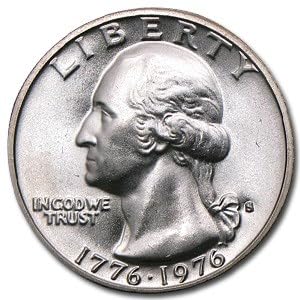
This quarter is the exception in the Bicentennial lineup: it is struck in 99.9% pure silver rather than the standard 40% silver composition. The specification lists purity at 99.9%, and the US Mint grading designation (MS 67+) suggests near-perfect surfaces with only minimal bag marks visible under 5x magnification. The brilliant, blemish-free fields and deep, resonating lettering on the dual-dated obverse are hallmarks of a high-end specimen.
Customer reviews consistently praise the luster, calling it “beautiful” and noting it looks “like it was minted yesterday.” The drummer boy reverse — the only one-year-only design in the quarter series — shows the 13-star flag and torch with crisp detail. A coin graded MS 67+ by the US Mint’s internal standards (or equivalent) carries a substantial premium over a raw BU example because the Bicentennial quarter is notoriously hard to find in gem condition due to the soft silver alloy.
For the serious collector who wants the highest grade possible in a single Bicentennial quarter, this MS 67+ silver specimen represents the top of the market without requiring a full certification submission. The 99.9% silver content also means it has the highest melt value of any Bicentennial quarter on this list.
Why it’s great
- 99.9% pure silver — highest silver content of any Bicentennial quarter
- MS 67+ grade designation indicates premium condition
- Blemish-free fields with strong cartwheel luster per customer reports
Good to know
- Grade is seller-designated, not PCGS/NGC slabbed — value is self-attested
- Silver purity is atypical for Bicentennial coinage — verify with a Sigma tester if stacking
- Higher premium relative to raw BU counterparts due to claimed grade
7. 1976 U.S. Proof Set in Original Government Packaging

This is the official 1976 U.S. Mint Proof Set in its original government packaging (OGP) — a sealed plastic envelope inside a cardboard sleeve that has remained untouched since 1976. The set includes six coins: Lincoln cent, Jefferson nickel, Roosevelt dime, Washington quarter, Kennedy half dollar, and Eisenhower dollar, all struck in proof finish at the San Francisco Mint.
Importantly, this proof set contains copper-nickel clad coins, not 40% silver — the half dollar and dollar in this set are clad proofs, not the silver proofs that appeared in the separate 1976 Silver Proof Set. The value here is entirely numismatic: the OGP and the Certificate of Authenticity provide a sealed, never-handled provenance that a loose coin cannot match. Customer reviews note the coins are in “very good condition with minimal wear/toning” for 49-year-old proof surfaces.
For the collector who wants the complete Bicentennial proof experience — every denomination from cent through dollar in a single government-sealed package — this set is the purest way to own the series without cherry-picking individual coins. The OGP also acts as a tamper-evident seal: if the package is intact, the coins have never been touched.
Why it’s great
- Original Government Packaging with intact seal and COA
- Six-coin set covers all Bicentennial denominations in proof finish
- Sealed provenance guarantees untouched, unhandled condition
Good to know
- All coins are clad copper-nickel — zero silver content
- Proof set does not include the 40% silver variants of half dollar and dollar
- OGP envelope may show age-related yellowing or creasing from storage
FAQ
How can I tell if a 1976 Bicentennial quarter is 40% silver or clad?
What is the melt value of a 1976-S 40% silver half dollar at current prices?
Should I buy a raw BU Bicentennial coin or a certified one from PCGS/NG?
Why does the 1976 proof set not include 40% silver coins?
What is the rarest Bicentennial coin to find in MS67 condition?
Final Thoughts: The Verdict
For most users, the best american bicentennial coin winner is the 1976-S Eisenhower Silver Dollar because it delivers the largest diameter (38 mm), the highest silver weight (11.5 g of 40% silver), and the iconic Liberty Bell-moon reverse — all in one Mint State coin that can be displayed raw or sent for certification. If you want the highest-grade individual quarter with pure 99.9% silver, grab the 1976-S Silver Quarter MS 67+. And for a complete, gift-ready collection that spans all Bicentennial denominations in original packaging, nothing beats the 1976 U.S. Proof Set in OGP.