
Getting consistent reps on the court without a hitting partner has always been the single biggest barrier to rapid improvement. A ball machine solves that, but the assumption that serious training gear starts at four figures keeps too many players stuck chasing balls instead of grooving their stroke.
I’m Min — the co-founder and writer behind Gadgets Feed. I’ve spent countless hours filtering through technical specs, customer feedback, and real-world durability reports to separate the machines that actually deliver from those that just look good on paper.
This guide cuts through the noise to present the best budget tennis ball machine options that prove you don’t need to empty your wallet to get meaningful practice sessions on the court.
How To Choose The Best Budget Tennis Ball Machine
Finding the right machine on a tighter budget means prioritizing the features that actually move the needle in your training. Beginners can get away with simpler controls and lower speeds, while intermediate players need adjustable spin and consistent feed intervals to build muscle memory. Here is what to look for before you click buy.
Ball Speed and Spin Control
Speed measured in miles per hour determines the intensity of your practice. A machine that maxes out around 30-40 mph works fine for form work and junior players, but anyone hitting with moderate pace needs at least 55-60 mph to simulate real rallies. Spin control — topspin and backspin adjustment — is a step up that enables realistic ball behavior off the bounce. Machines with dual motors handle spin much more consistently than single-motor designs.
Oscillation and Shooting Modes
Oscillation is what turns a one-dimensional practice session into a workout that challenges your footwork. Basic machines offer fixed-point shooting only, which is useful for groove work but not for movement. Look for horizontal oscillation that sweeps the ball from left to right, or random oscillation that varies placement unpredictably. The more oscillation options, the more realistic your practice becomes.
Ball Capacity and Portability
Nothing kills a training rhythm faster than constantly reloading balls. Small machines hold around 20-50 balls, which means short hitting windows between pickup sessions. Models with 80-150 ball capacity let you stay in rhythm for much longer. Portability matters too — weight, integrated wheels, and a folding handle determine whether you actually bring the machine to the court or leave it in the garage.
Quick Comparison
On smaller screens, swipe sideways to see the full table.
| Model | Category | Best For | Key Spec | Amazon |
|---|---|---|---|---|
| Nisplay N1 | Premium Entry | Spin capability and portability | 68 MPH / Dual Motor / 26 lbs | Amazon |
| Lobster Sports Elite Liberty | Premium | Reliable all-around training | 70 MPH / 2-4hr Battery / 35 lbs | Amazon |
| PUSUN PT-Smart | Premium | App control and 28-point placement | 75 MPH / 100+ Ball / 32.6 lbs | Amazon |
| PONGBOT PACE S PRO | Premium | Smart sensor and community drills | 80 MPH / 8+ Hour Battery / 46 lbs | Amazon |
| Wilson Portable | Premium | 3-year warranty and brand trust | 75 MPH / 110 Ball / 38 lbs | Amazon |
| Spinshot Lite | Mid-Range | Junior and intermediate practice | ~50 Ball / 2hr Battery / Portable | Amazon |
| Fast Track Feedback System | Mid-Range | Home training with iOS tracking | 20 Feeds/min / iOS App / Portable | Amazon |
| Furlihong 3807BH | Budget | Oscillation and speed adjustment | Up & Down Swing / Triangular Base | Amazon |
| Furlihong 3819BH | Budget | Entry-level casual practice | 30 MPH / 5 Angles / 8 D Batteries | Amazon |
In‑Depth Reviews
1. Nisplay N1 Portable Tennis Ball Machine

The Nisplay N1 punches far above its weight class at 26 pounds with a dual motor design that genuinely delivers topspin, backspin, and flat feeds. Maxing out at 68 mph, it covers the full speed range needed by intermediate players, while the adjustable feed interval from 1 to 9 seconds lets you control session intensity. The external lithium battery provides over 4 hours of runtime and detaches for charging — a thoughtful touch that eliminates the need to haul the whole machine to an outlet.
Portability is a strong suit here. The folding handle and large wheels roll smoothly over grass, gravel, and court surfaces, and the compact footprint fits in most sedan trunks alongside the 80-ball hopper. Users consistently note the solid aluminum build and quick setup, though some report occasional ball jams that self-correct after a few seconds. The remote control covers basic functions but lacks oscillation adjustment — a minor compromise at this price point.
For players who want professional-grade spin control and real portability without jumping to four-figure territory, the Nisplay N1 is the machine to beat. It handles the demands of consistent practice without the bulk or budget strain of premium competitors.
Why it’s great
- Dual motor delivers genuine topspin and backspin for realistic ball behavior
- Lightweight at 26 lbs with excellent wheels and handle for easy transport
- External battery design simplifies charging and extends court time
Good to know
- Oscillator width is not adjustable and lacks remote control
- Ball frequency knob is counter-intuitive with high setting meaning slower feed
2. Lobster Sports Elite Liberty Tennis Ball Machine

The Lobster Elite Liberty has been a mainstay in the mid-range segment for years, and for good reason. It delivers ball speeds from 10 to 70 mph with adjustable topspin and backspin via a single control, plus horizontal oscillation and elevation adjustment from 0 to 50 degrees. The 35-pound build strikes a balance between stability and portability — it is heavier than the Nisplay but feels planted during high-speed drilling.
The 8.5 amp-hour rechargeable battery provides 2 to 4 hours of court time, and the inverting hopper design keeps the ball feed consistent. Users appreciate the consistent shot placement for groundstroke practice, particularly at the 3.0 to 3.5 level, though some note that heavy topspin slows the ball by 15-20 mph compared to flat feeds. The machine lacks a remote control in the base package and the battery indicator is vague, but the 2-year warranty backs the investment.
For players who value consistent, repeatable practice sessions and want a proven platform with solid customer support, the Lobster Elite Liberty is a dependable choice. It does not have app connectivity or fancy features, but it does the fundamentals exceptionally well.
Why it’s great
- Reliable topspin and backspin adjustment for realistic shot variety
- Long 2-4 hour battery life with smart charger to prevent overcharging
- Durable build quality backed by a solid 2-year warranty
Good to know
- Heavy topspin reduces ball speed by 15-20 mph compared to flat
- No remote control included and battery indicator is basic
3. PUSUN PT-Smart Tennis Ball Machine
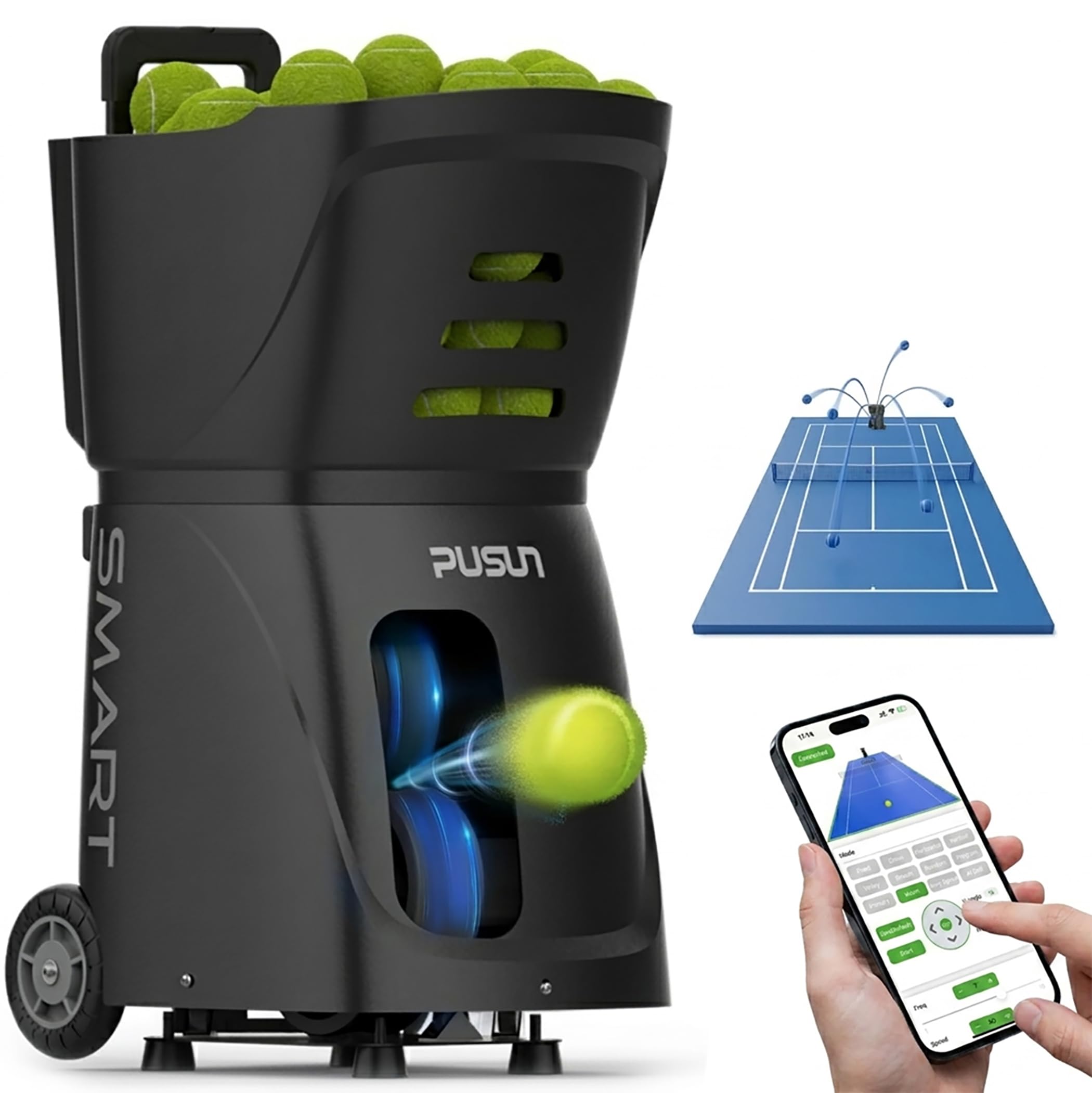
The PUSUN PT-Smart brings app-controlled intelligence to the training court with 12 built-in modes, 28 programmable landing points, and compatibility with Apple Watch for on-the-fly adjustments. Speed ranges from 12 to 75 mph with six levels of spin, and the external oscillation design gives clear visual cues of the machine’s movement, helping players anticipate and react. The 153.6Wh external battery delivers 4-6 hours of play time, which translates to over 5,700 shots per charge.
At 32.6 pounds with a collapsible 100-ball hopper, it fits easily in an SUV trunk. The dust-proof mainboard is designed to resist clay erosion, extending longevity on red clay courts — a thoughtful engineering decision. User feedback is mixed on consistency, with some praising the shot placement and battery life while others report erratic ball feed and speed variation. The Padel mode with 14 specialized drills adds versatility for players who switch between sports.
If you want maximum programmability and are willing to accept some consistency quirks, the PUSUN PT-Smart offers features typically found on machines costing significantly more. It is best suited for tech-savvy players who enjoy tinkering with drill settings.
Why it’s great
- App and Apple Watch control for total command without running back to the machine
- 28-point placement with external oscillation for full court coverage
- Dust-proof mainboard handles clay court conditions effectively
Good to know
- Some users report inconsistent ball feed in speed and spin
- Heavier at 32.6 lbs compared to other portable options
4. PONGBOT PACE S PRO Tennis Ball Machine
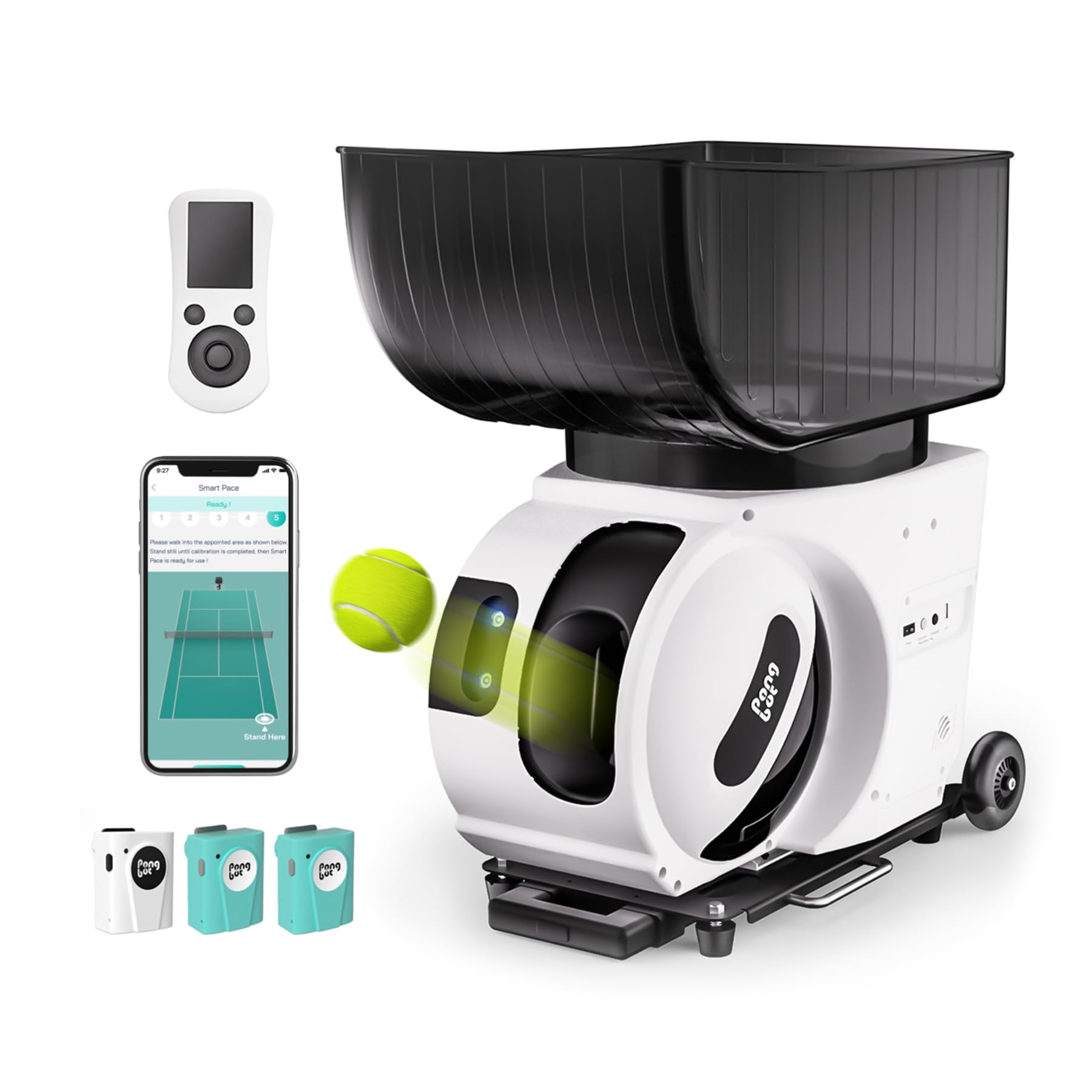
The PONGBOT PACE S PRO integrates smart sensors that unlock adaptive rally drills, recovery exercises, and NTRP match challenges — features that genuinely respond to your position on the court. With a max speed of 80 mph and 60 revolutions per second of spin, it is the most technically capable machine in this lineup. The app and remote control allow you to pre-load up to 30 drills, and OTA updates keep the firmware current without needing a new purchase.
The removable battery lasts over 8 hours, which is class-leading endurance for extended practice sessions. The 150-ball capacity hopper minimizes reload breaks, and the remote-controlled barrel opening makes cleaning straightforward. User feedback praises the recovery trigger exercises and intuitive Android app, though some note that ball placement is not always perfectly precise — but that randomness can actually simulate real match conditions better than fixed drilling.
At 46 pounds, it is the heaviest machine here, but the integrated wheels and pull handle make transportation manageable. The PONGBOT is ideal for serious players who want a highly programmable training partner with community-shared drills.
Why it’s great
- Smart sensors enable adaptive drills that react to player position
- Over 8 hours of battery life and 150-ball hopper for marathon sessions
- OTA updates keep the machine current with new features
Good to know
- Heaviest option at 46 pounds requires some effort for transport
- Ball placement can be slightly random rather than exact
5. Wilson Portable Tennis Ball Machine

The Wilson Portable, manufactured in partnership with Sports Tutor, leans heavily on its reputation for durability and domestic support. Speed ranges from 10 to 75 mph with adjustable topspin and underspin, electronic elevation control, and a random oscillator that delivers shots across the court for movement-based practice. The 110-ball capacity keeps you hitting for longer stretches, and the internal rechargeable battery provides up to 4 hours of play with an overnight smart charger.
The 3-year warranty is a standout differentiator compared to offshore brands that offer limited protection. Users consistently praise the consistent shot delivery and easy knob controls — no app or programming required, just twist and hit. Some note the machine struggles to reach the advertised 75 mph top speed and the handle design makes maneuvering over curbs a challenge. At 38 pounds, it is not the lightest, but the large towing wheels help on flat surfaces.
For players who prioritize warranty coverage and straightforward operation over flashy features, the Wilson Portable is a reliable workhorse. It is particularly well-suited for club players who want a set-and-forget machine that will last for years.
Why it’s great
- 3-year warranty with US-based support for peace of mind
- Easy knob controls require no app or programming
- 110-ball hopper and random oscillator for realistic practice
Good to know
- Advertised 75 mph speed not reliably achieved in practice
- Handle design makes transport over rough terrain cumbersome
6. Spinshot Lite Tennis Training Machine
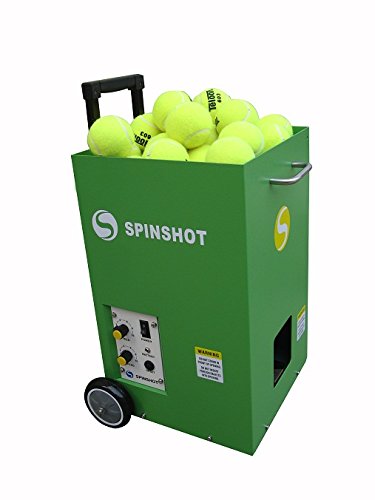
The Spinshot Lite is designed specifically with portability and ease of use for junior and intermediate players in mind. It features multiple speed and height settings, an integrated oscillator for side-to-side practice, and a compact form factor that weighs under 37 pounds fully loaded. The battery life runs around 2 hours, which is sufficient for focused training sessions without the bulk of larger machines.
Users consistently highlight the build quality and professional-looking finish, along with the ability to challenge players at varying levels through its adjustable settings. However, the ball capacity is a significant limitation — it holds just over 50 balls, meaning you get roughly 15 minutes of play before needing to pick up and reload. The battery compartment also lacks a buffer, allowing the battery to shift around during movement, which can be annoying during transport.
For parents looking for a machine their junior can handle independently or players who prioritize lightweight design over extended play, the Spinshot Lite is a solid option. It is not built for marathon sessions, but it delivers reliable performance in a small package.
Why it’s great
- Compact and lightweight design ideal for juniors and easy trunk storage
- Integrated oscillator and multiple speed/height settings for varied practice
- Good build quality with a professional look and feel
Good to know
- Limited ball capacity of ~50 balls means frequent reloading
- Battery compartment lacks buffer, allowing the battery to shift
7. Fast Track Feedback System GEN2
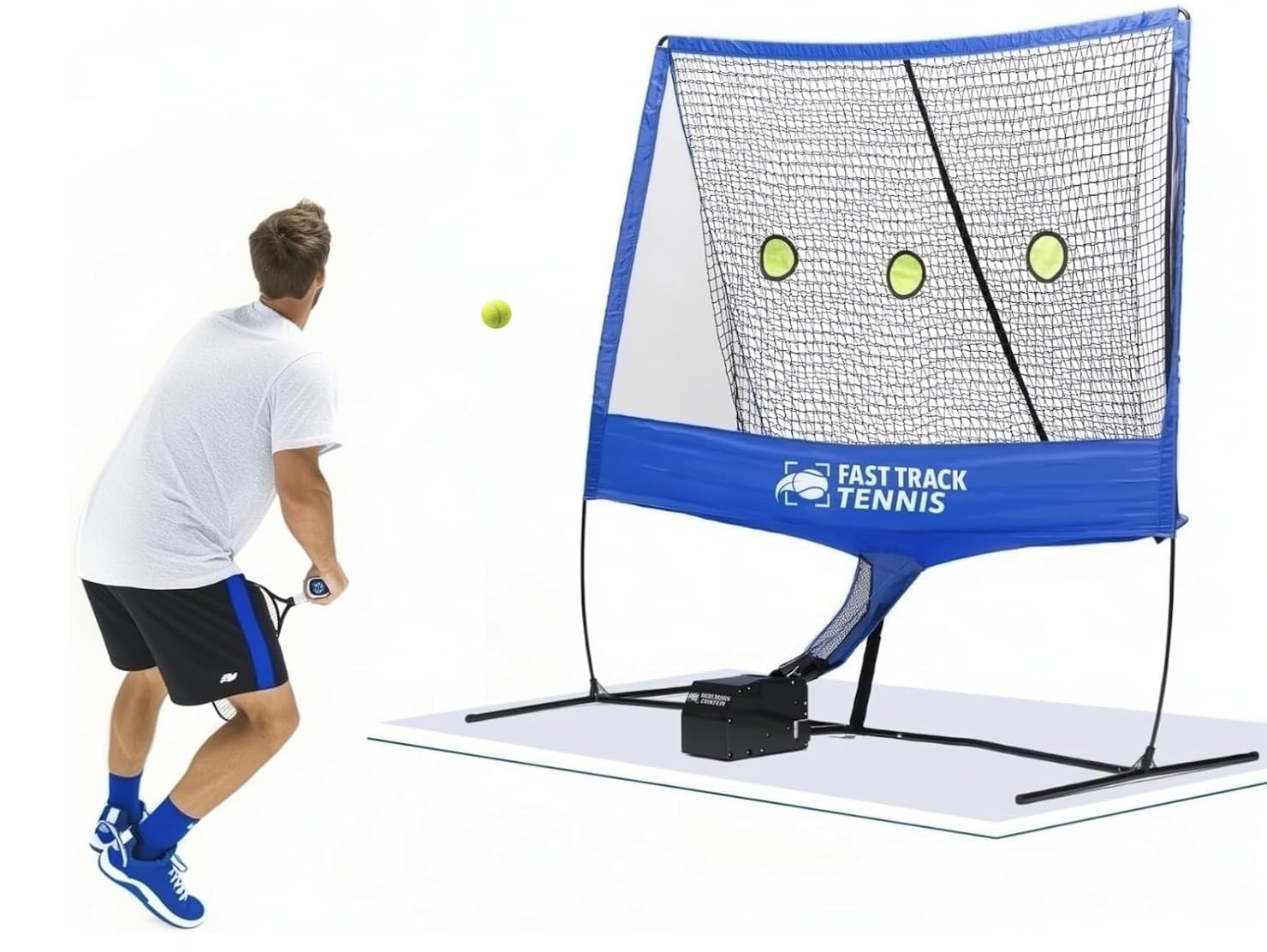
The Fast Track Feedback System takes a different approach from traditional ball launchers. It combines a rebounder net with a ball feed mechanism that delivers up to 20 feeds per minute, paired with an iOS app that tracks your performance metrics. This is less about raw speed and spin and more about building consistent technique through repeated, tracked practice — ideal for home garage or basement setups where a full court is not available.
Users who have integrated it into their training routine report noticeable improvements in footwork and shot consistency, particularly for forehand and backhand drills. Assembly is straightforward, and the system is effective for winter practice when outdoor courts are inaccessible. However, several users report stability issues, with the unit feeling flimsy and occupying significant space without delivering the power of a standard ball machine. The hoop channel for the rod is also too short, requiring frequent adjustments.
The Fast Track system is a niche product best suited for players who want analytical feedback on their stroke mechanics and have limited court access. It does not replace a traditional ball machine for live-ball practice, but it fills a specific training gap effectively.
Why it’s great
- iOS performance tracking provides data-driven feedback on your strokes
- Enables effective home practice in confined spaces, great for winter training
- Improves footwork and technique through repeated focused drills
Good to know
- Flimsy construction and stability issues reported by several users
- Hoop channel requires frequent adjustment for smooth operation
8. Furlihong 3807BH Tennis Ball Machine

The Furlihong 3807BH introduces swing oscillation at a price point where that feature is rare. The up-and-down automatic launch port allows you to vary the trajectory angle with a button press, while the triangular iron base keeps the machine stable during operation. Speed adjustment from low to high covers basic training needs, and the AC adapter plus battery power options give flexibility for court use.
The included carrying bag adds convenience, and the machine supports all skill levels with its adjustable settings. However, the reliability picture is mixed. Some users report units arriving with defects, and longevity concerns surface after a few months of use. The cheap carry bag tears quickly, and battery performance degrades after 15-20 minutes on some units. The machine works great when it works, but consistency across units is a concern.
For budget-conscious buyers who want oscillation capability and are willing to roll the dice on build quality, the Furlihong 3807BH offers features typically reserved for machines twice its price. The 12-month warranty provides some coverage, but buyer experience suggests you may need it.
Why it’s great
- Up-and-down swing launch port for trajectory variation at a budget price
- Triangular iron base provides good stability during operation
- Dual power options with AC adapter and battery support
Good to know
- Inconsistent reliability with multiple defect reports from users
- Included carry bag is low quality and tears quickly
9. Furlihong 3819BH Portable Tennis Ball Machine
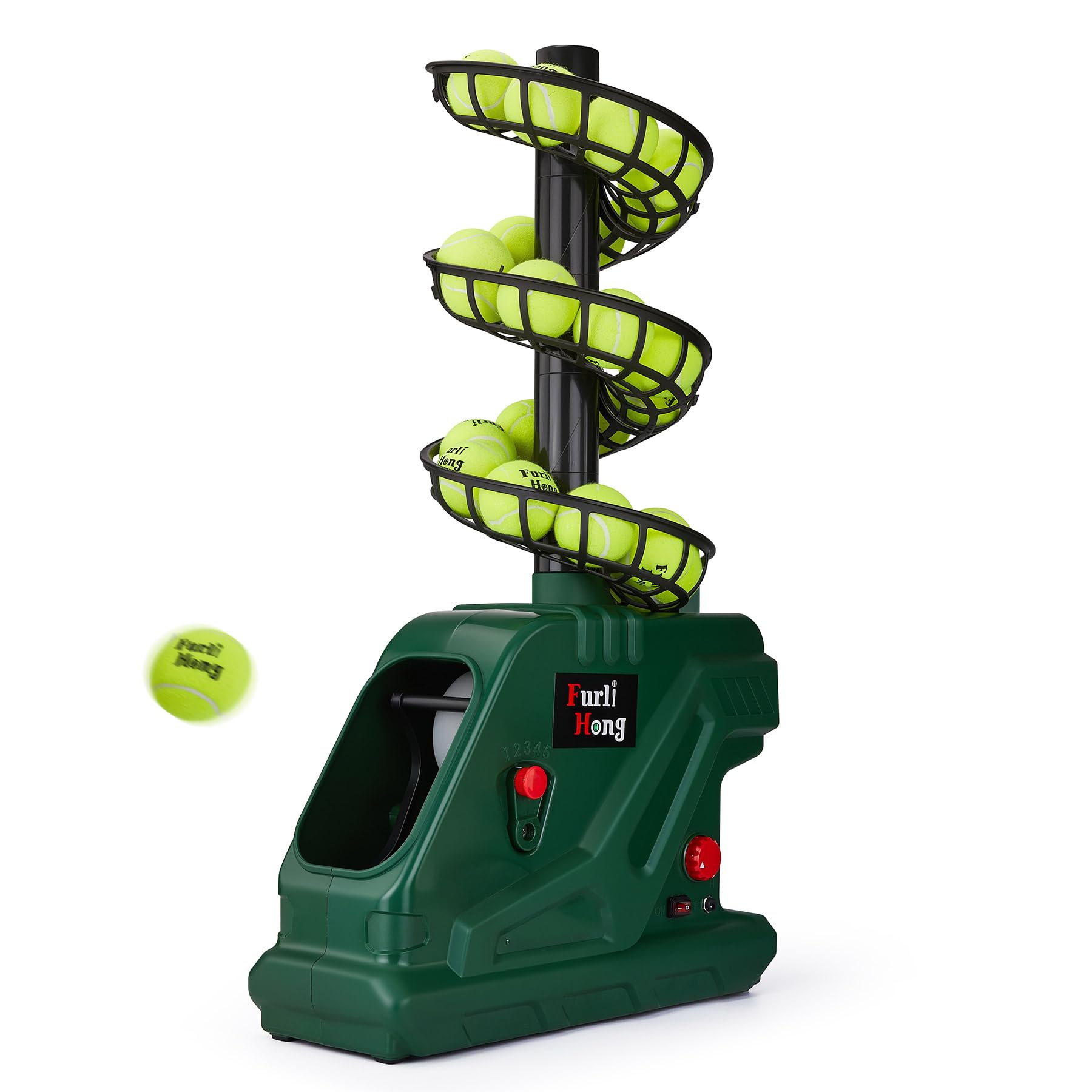
The Furlihong 3819BH is the entry point into motorized ball launching, offering 5 angle settings, 2 power levels, and 4 serve intervals for a variety of shot types. With a top speed of 30 mph, it is firmly in the beginner and casual player territory — useful for form work and light rallies but not for simulating match pace. The machine runs on 8 D batteries or a power bank, keeping it fully cordless on the court.
Assembly is straightforward, and the lightweight design makes it genuinely portable. Users who have owned it for months report it works well for casual practice, feeding easy balls that help groove strokes. The 21-ball capacity is very limited, and the machine collects ball fuzz in the mechanism, requiring regular cleaning. Some units lose power after limited use, suggesting motor or battery longevity is inconsistent. At this price point, expectations should be managed — it is a training aid, not a hitting partner replacement.
For absolute beginners, juniors, or players who just want to get some reps without any financial commitment, the Furlihong 3819BH serves its purpose. It is the most affordable way to automate ball feeding and is best viewed as a stepping stone to more capable machines.
Why it’s great
- Extremely affordable entry into automated ball feeding for casual practice
- Lightweight and easy to assemble with straightforward controls
- 5 angle settings and multiple intervals provide basic shot variety
Good to know
- Limited 30 mph speed and 21-ball capacity constrain training depth
- Motor longevity is inconsistent with some units losing power over time
FAQ
Can a budget tennis ball machine generate enough spin for realistic practice?
How long should the battery last on a budget ball machine?
Is a machine with random oscillation worth the extra cost?
What is the minimum ball speed needed for effective adult training?
How important is ball capacity in a budget machine?
Final Thoughts: The Verdict
For most players looking for the best budget tennis ball machine, the winner is the Nisplay N1 because it delivers genuine spin control, excellent portability at 26 pounds, and a 4+ hour battery in a compact package that fits most car trunks. If you want app-controlled programmability with 28-point placement, grab the PUSUN PT-Smart. And for casual players who just want the most affordable way to get automated ball feeds, nothing beats the price-to-entry of the Furlihong 3819BH.