
An analog volt meter doesn’t lie — that needle sweeps in real time, showing you live voltage trends that a flickering digital display simply cannot match. Whether you are tuning a generator under load, monitoring a boat’s charging system at idle, or diagnosing a fluctuating AC line, the analog needle’s instant physical response reveals the story behind the numbers.
I’m Min — the co-founder and writer behind Gadgets Feed. I’ve spent hundreds of hours combing through technical datasheets, user field reports, and accuracy class ratings to separate the meters that deliver consistent, reliable readings from those that introduce more confusion than clarity.
This guide is built around the best real-world data available, helping you match the right meter to your specific voltage-monitoring task with absolute confidence. We evaluated every option to find the true best analog volt meter for different use cases and budgets.
How To Choose The Best Analog Volt Meter
Selecting the right analog volt meter is about understanding three core trade-offs: measurement range versus reading resolution, permanent panel installation versus handheld portability, and basic functionality versus advanced protection. Knowing where your voltage monitoring falls on each axis makes the decision straightforward.
Understand Your Voltage Type and Range
The most critical first step is identifying whether you are measuring AC or DC voltage. AC meters are built for mains power, generators, and household circuits, while DC meters handle batteries, automotive systems, and solar arrays. Once you know the type, pick a range that puts your expected voltage in the upper two-thirds of the scale — this is where analog meter accuracy peaks.
Panel Mount vs. Handheld Multimeter
A panel-mount gauge is the right choice for permanent installation in a vehicle dashboard, generator control box, or marine helm. It stays put, provides constant monitoring, and usually offers backlighting. A handheld analog multimeter is your tool for mobile troubleshooting — it includes multiple ranges, resistance and current functions, and built-in fuses, but sacrifices a dedicated installation home.
Accuracy Class and Needle Damping
Accuracy class (usually 2.5 for budget models, 1.5 or better for premium units) tells you the maximum percentage error. A Class 2.5 meter reading 100V could be off by ±2.5V — acceptable for monitoring, but poor for calibration work. Needle damping, not always listed, determines how fast the needle settles after a voltage change. Good damping prevents the needle from overshooting wildly, giving you a stable reading faster.
Quick Comparison
On smaller screens, swipe sideways to see the full table.
| Model | Category | Best For | Key Spec | Amazon |
|---|---|---|---|---|
| SNAKOL SK-88C | Multimeter | Professional field service | 2500V DC/AC range, Cat III 1000V | Amazon |
| Blue Sea Systems 9353 | Panel Gauge | Marine & RV permanent install | 0-150V AC, 1V accuracy | Amazon |
| NJTY S471 | Multimeter | Technician & engineering use | 8 functions, dB audio level | Amazon |
| Gardner Bender GMT-318 | Multimeter | Home & automotive basic needs | 6 functions, 14 ranges, fused | Amazon |
| Bosch SP0F000051 | Panel Gauge | 12V automotive dashboard | 8-18V DC, 60-degree sweep | Amazon |
| CGjiogujio 85L1 | Panel Gauge | Generator output monitoring | AC 0-150V, Class 2.5 | Amazon |
| uxcell 85L1 300V | Panel Gauge | Budget AC line check | AC 0-300V, 10V graduation | Amazon |
In‑Depth Reviews
1. SNAKOL SK-88C Analog Multimeter
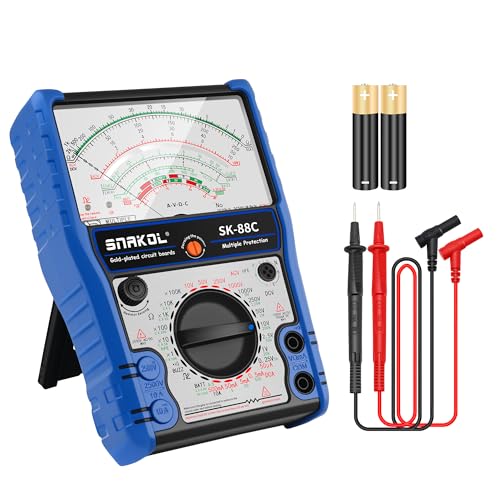
The SNAKOL SK-88C is the most feature-dense analog multimeter in this lineup, packing 11 functions and 24 ranges into a rugged orange body wrapped in a silicone protective sleeve. Its ability to read up to 2500V AC/DC and 10A DC current puts it in a class above standard handheld meters, while the built-in stand and magnetic back make field deployment genuinely practical — you can stick it to a metal panel and keep both hands free for probing.
What truly sets this unit apart is its breadth of diagnostic tools: an LV (load voltage) detection mode for testing regulator diodes, a dedicated LED tester, and a remote control infrared sensor checker that verifies if your TV remote is actually sending a signal. The gold-plated circuit board and Cat III 1000V / Cat IV 600V safety rating indicate real engineering attention, not just a plastic shell with a needle inside.
A few users noted the supplied batteries and fuses were missing from the package, and the print on the manual is frustratingly small — but the core build quality is excellent for its tier. The magnets hold firmly enough for stationary work, and the needle damping is noticeably better than budget alternatives. If your work spans home appliance repair, factory electrical, and even remote control diagnostics, this is the one-meter toolkit.
Why it’s great
- Unmatched 2500V range for heavy industrial and HVAC applications.
- Built-in IR remote tester and LED/LV detection save carrying separate tools.
- Cat III/IV safety rating with silicone sleeve offers genuine protection.
Good to know
- Batteries and fuses may not arrive in the box; check immediately.
- Magnetic grip is functional but not strong enough for bouncing vehicle walls.
2. Blue Sea Systems 9353 AC Analog Voltmeter

The Blue Sea Systems 9353 is a purpose-built AC panel voltmeter designed for the demanding marine environment. Unlike generic white-label gauges, this unit is calibrated to within 1V of a reference digital multimeter out of the box — a precision standard uncommon at this level. The 0-150V AC range covers standard shore power and onboard generator output, and the internal backlight (powered by a separate 12V or 24V DC source) lets you read the sweep even in a dim cabin.
Installation is refreshingly straightforward: direct AC line connections with no shunt or external transformer required. The build quality is immediately apparent — the bezel, lens, and terminal posts are all materially thicker than budget equivalents, which matters when salt air and vibration are constant threats. Users consistently report that it perfectly replaces aging gauges on boats and RVs with zero modification needed beyond the standard 2-1/16 inch opening.
The only consistent complaint is that the backlight, while present, produces a dim green glow rather than a bright white panel. In direct sunlight the needle is perfectly legible, but at night you may wish the lighting were stronger. For a dedicated AC monitoring gauge in a permanent installation where reliability matters more than night-time vanity, this is the clear standout.
Why it’s great
- Factory calibration within 1V of digital reference — genuinely trustworthy.
- Heavy-duty construction designed for marine vibration and corrosion resistance.
- Direct AC wiring with no extra components needed for installation.
Good to know
- Backlight is dim; not suited for night-time reading without supplemental cabin light.
- The premium build comes at a higher cost than commodity panel meters.
3. NJTY S471 Analog Pointer Multimeter

The NJTY S471 takes the core analog multimeter concept and adds genuinely modern conveniences — namely a built-in rechargeable battery via USB-C, eliminating the perennial hunt for a fresh 9V. Its eight measurement functions cover DC/AC voltage, DC current, resistance, transistor hFE gain, battery load testing, and a dB audio level meter, making it particularly attractive for audio technicians aligning stage equipment by ear rather than by digital auto-ranging.
The needle display provides real-time trend analysis that digital meters simply cannot replicate — when you are watching a capacitor charge or a voltage regulator hunt, the needle’s physical swing tells you instantly whether the signal is stable or oscillating. The yellow casing is rugged enough for daily carry, and the inclusion of an audible continuity beep adds modern convenience without abandoning the analog readout. Three fuse tubes (two spares onboard) protect against common measurement errors.
One notable issue: the USB-C charging port is not fully compliant with the standard, meaning some C-to-C cables won’t charge it — you will need an A-to-C cable or an adapter. The seller acknowledges this and indicates a factory fix is underway. Also, there is no polarity indicator on the DC voltage jacks, so beginners must be careful with orientation. For the price, however, the package of features and rechargeability is unmatched.
Why it’s great
- Built-in rechargeable battery with USB-C — no more 9V disposables.
- dB audio level function perfect for radio and audio alignment work.
- Triple fuse protection with two spares stored inside the meter.
Good to know
- USB-C charging is non-compliant; requires an A-to-C cable or adapter.
- No DC polarity marking on input jacks — risks confusion for new users.
4. Gardner Bender GMT-318 Analog Multimeter
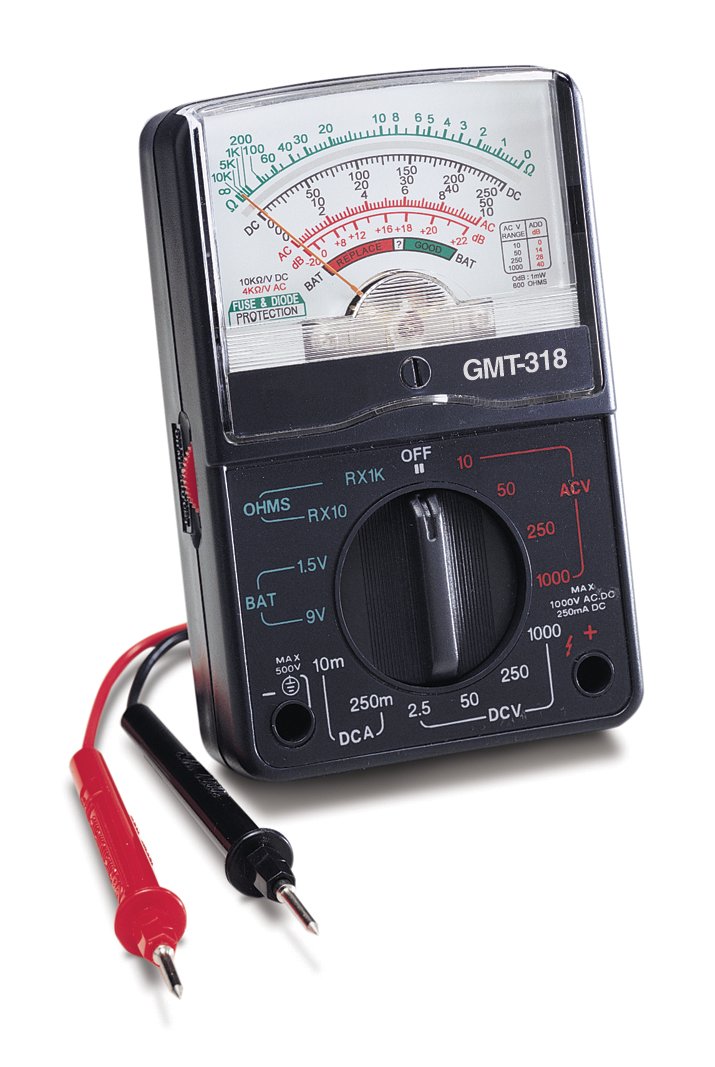
The Gardner Bender GMT-318 is the analog multimeter that belongs in every toolbox — it is compact enough to stash in a truck glove box, fused for basic protection, and easy enough to read that you can check voltage without digging out reading glasses. The 6-function, 14-range layout covers AC/DC voltage up to 500V, DC current, resistance, decibel level, and a battery test function, all through a manual 15-position rotary dial that gives you deliberate control over what you are measuring.
The color-coded analog display is genuinely easy to read at a glance, with separate scales for each function clearly marked. Agency-approved fuse overload protection means that a simple slip of the probe won’t instantly destroy the meter — a critical safety feature for beginners and pros alike. The replaceable test leads are standard-quality, and the operating instructions are clear enough for a first-time analog user to get started without frustration.
At a compact 4.25 inches tall and 0.31 pounds, this is a meter you will actually carry with you rather than leave on the shelf. The primary limitation is its modest range: 500V AC/DC is fine for residential 120/240V and 12V automotive, but insufficient for 480V industrial panels. The small lead plugs can feel loose in the jacks, and the battery compartment is so tight that a rechargeable AA battery requires modification to fit — stick to standard alkaline AAs.
Why it’s great
- Fused overload protection provides real safety against measurement errors.
- Color-coded, clearly marked analog scales are exceptionally readable.
- Compact and lightweight for everyday carry in vehicle or tool pouch.
Good to know
- Battery compartment is very tight; standard rechargeable AAs may not fit.
- Lead plugs are smaller than typical jacks, creating a slightly loose connection.
5. Bosch SP0F000051 Style Line 2″ Voltmeter

The Bosch SP0F000051 is a 2-inch panel voltmeter purpose-built for 12V negative-ground automotive systems, and it nails that specific job with precision. Its 8-to-18-volt range with a 60-degree needle sweep is ideal for monitoring a vehicle’s charging system — you can see instantly whether your alternator is delivering 13.8V at idle or dropping toward 12V under heavy electrical load. The black bezel and black dial face give it a clean OEM+ look that integrates seamlessly into classic car dashes and off-road vehicle panels.
The included mounting hardware and internal 12V backlight make installation straightforward: cut a 2-1/16 inch hole, connect power and ground, and the gauge is live. The backlighting works only when the vehicle’s parking or headlights are on, preserving the factory lighting behavior. Users report accuracy within 0.4V of a calibrated digital multimeter, which is respectable for a dedicated automotive gauge. The aluminum body feels solid, and the needle motion is smooth without excessive overshoot.
The limitation is the narrow voltage window — this gauge cannot read below 8V or above 18V, so it is useless for 24V trucks, 48V solar systems, or AC mains monitoring. Some users note that the needle can appear slightly jumpy when the engine is running with accessories on, though this is often the actual voltage fluctuating rather than a meter fault. For dedicated 12V dash use, this is the most cohesive and aesthetically integrated option available.
Why it’s great
- Focused 8-18V range provides maximum needle resolution for 12V automotive systems.
- Clean black-on-black design looks factory-installed in classic and modern dashes.
- Internal 12V backlight automatically illuminates with headlights for night reading.
Good to know
- Only works on 12V negative-ground systems; no compatibility with 24V or 48V setups.
- Needle may jitter slightly with engine running due to actual alternator ripple.
6. CGjiogujio 85L1 AC 0-150V Panel Meter

The CGjiogujio 85L1 is a no-frills AC panel volt meter designed for one job — measuring 0 to 150V AC — and it does that job adequately for the price. The white 64x56mm face is clean and readable, and the Class 2.5 accuracy means you can expect roughly ±3.75V tolerance at full scale, which is perfectly fine for checking whether a generator or outlet is in the ballpark of 120V. The package is minimal: just the meter itself with mounting nuts and washers.
Users have successfully installed this meter on PTO generators and backup power systems, reporting that it provides a quick visual confirmation of output voltage without needing a multimeter. The small footprint makes it easy to fit into tight control panels, and the plastic body is lightweight at 75 grams. For a fixed installation where you just want a needle to tell you “power is present and roughly correct,” this meter does the job.
The quality control is clearly inconsistent — one shipment arrived with a perfectly functioning meter, while another had a needle stuck at 20V regardless of input voltage, suggesting a factory defect. The mounting nuts are very small, which makes installation fiddly. The lack of any marking or template for the cutout hole also adds hassle. If you get a good unit, it is a bargain. If you get a dud, the low price makes it easier to tolerate, but the inconvenience remains.
Why it’s great
- Low cost makes it affordable for multiple installations or replacement stock.
- Compact 64x56mm face fits easily into tight generator and panel spaces.
- Simple two-wire connection with no shunt or external components required.
Good to know
- Quality control is inconsistent; some units arrive with a stuck or defective needle movement.
- Very small mounting nuts make installation more difficult than necessary.
7. uxcell 85L1 AC 0-300V Panel Voltage Gauge
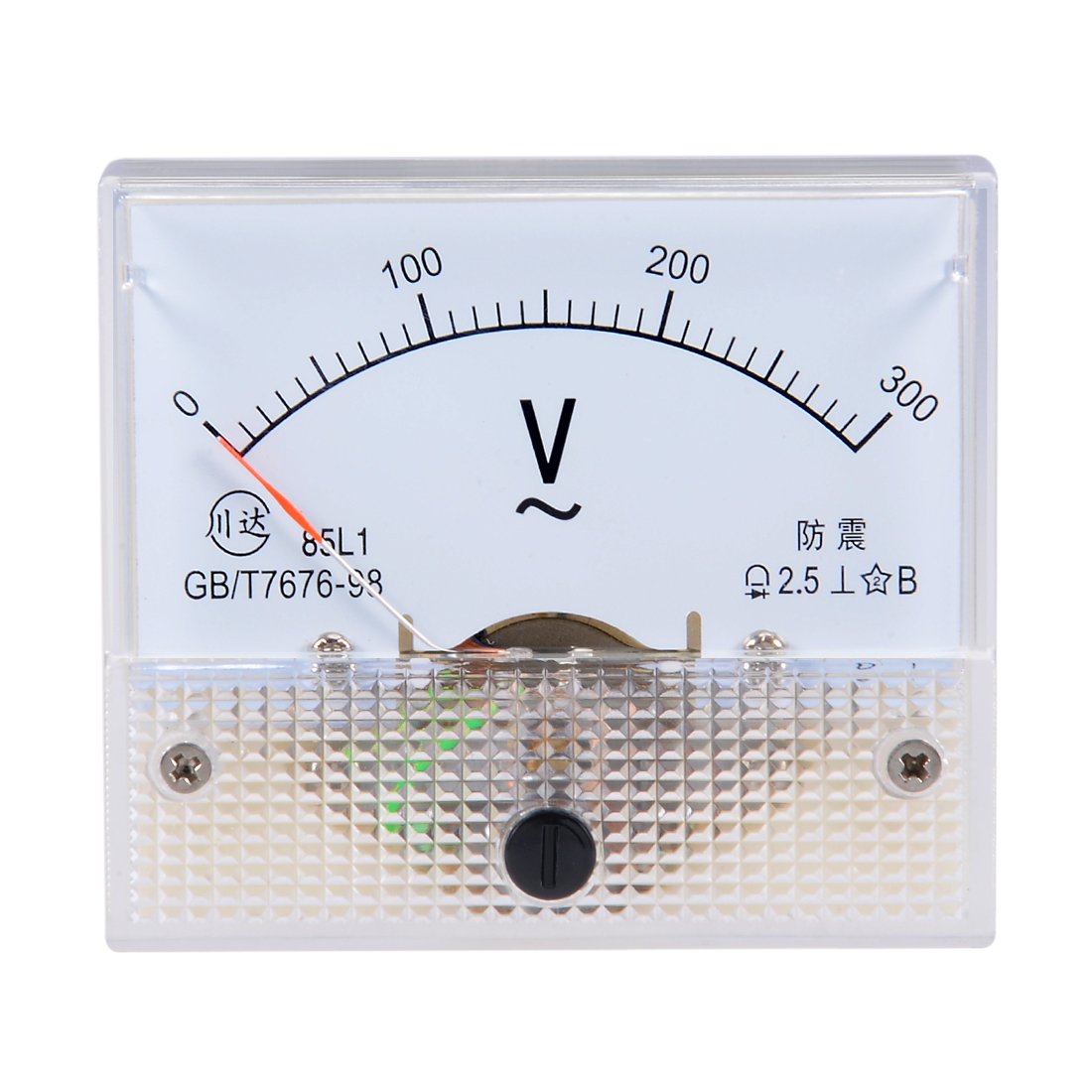
The uxcell 85L1 AC panel meter extends the range to 0-300V with 10V per graduation, making it suitable for monitoring 240V lines, larger commercial generators, and European 230V systems where a 150V meter would peg. The white ABS plastic body is lightweight at just 86 grams, and the 2.54 x 2.22 inch front panel fits standard gang-box cutouts. The Class 2.5 accuracy is typical for this tier, meaning a reading of 240V could be between 234V and 246V — acceptable for general awareness, not for calibration standards.
The real-world feedback from generator owners is positive: the meter installs easily using the supplied nuts and washers, and provides an immediate visual check that the generator is producing usable voltage before plugging in sensitive equipment. The 10V steps are coarse but readable, and the needle sweep is reasonably smooth for the price. One user noted that the lack of a paper drilling template made cutting the hole slightly less convenient, but the dimensions are standard enough that most installers can measure directly.
The biggest risk is the same as with any commodity meter: a small percentage of units arrive defective. One verified review reported a completely non-functional meter out of the box. The absence of internal fusing means that a wiring mistake could damage the meter or create a safety hazard. For a very low-cost, throw-it-in-the-panel-and-forget-it application on a 240V generator or transformer, this gauge offers the widest range in its price class.
Why it’s great
- Wide 0-300V AC range covers 120V, 240V, and 230V international systems.
- Lightweight ABS construction with standard mounting dimensions for easy retrofit.
- Provides a clear visual confirmation of generator or mains voltage at a glance.
Good to know
- No internal fuse or overload protection — wiring errors can destroy the meter.
- 10V graduation steps are coarse; fine voltage changes may be hard to detect.
FAQ
Why does my analog volt meter needle move backwards when I connect it?
Can I use a 0-150V AC panel meter on a 12V DC system?
What does the Class 2.5 accuracy rating actually mean in practice?
Final Thoughts: The Verdict
For most users, the best analog volt meter winner is the Gardner Bender GMT-318 because it balances portability, fused safety, and clear color-coded scales at a price that makes it a no-brainer for basic automotive and home troubleshooting. If you want a dedicated permanent AC gauge for marine or RV use, grab the Blue Sea Systems 9353. And for professional field service requiring multi-function capability and high-voltage safety, nothing beats the SNAKOL SK-88C.