
A camera for the trail isn’t just another gadget — it’s the tool that turns a punishing switchback into a memory you’ll frame on your wall. The compromise between carrying weight, weather resilience, optical zoom, and image quality defines every choice here. Leave the wrong gear behind and you’ll either miss the shot or regret the extra pound in your pack.
I’m Min — the co-founder and writer behind Gadgets Feed. I’ve spent countless hours cross-referencing sensor sizes, weather-sealing ratings, and real-world battery performance to separate the few hiking cameras worth your money from the many that just add weight to your pack.
This guide brings together eleven rigorously vetted options that balance portability, toughness, and optical reach so you can confidently pick the best camera for hiking for your next summit attempt.
How To Choose The Best Camera For Hiking
The right hiking camera lives at the intersection of three non-negotiable specs: weight on the trail, protection from the elements, and the optical reach to capture both sweeping panoramas and distant peaks. Get any one wrong and the camera either stays in the car or produces disappointing shots.
Weather Sealing and Ruggedness
A trail camera must survive rain, dust, drops onto scree, and the occasional river crossing. Look for an IP68 rating or a manufacturer-stated waterproof depth of at least 10 meters, along with shockproof certification for falls of 1.5 meters or higher. Freezeproof construction down to -10°C matters if you hike in alpine conditions or early-season snow.
Weight and Form Factor
Every gram on the trail compounds over ten miles. A pocketable point-and-shoot around 250 grams is vastly more likely to be carried daily than a mirrorless body plus lens that pushes past 600 grams. That said, a lightweight interchangeable-lens system like Micro Four Thirds can still be packable if you pair it with a pancake zoom, giving you sensor-quality advantages over a rugged compact.
Optical Zoom and Versatility
A fixed wide-angle action camera works well for first-person POV and close group shots but falls short when you need to compress a distant ridgeline or capture wildlife without spooking it. A compact superzoom (24-720mm equivalent) gives you both wide landscapes and telephoto reach in one sealed body, while a standard 4x or 5x zoom (28-140mm equivalent) covers most hiking scenarios with better image quality per millimeter of lens travel.
Quick Comparison
On smaller screens, swipe sideways to see the full table.
| Model | Category | Best For | Key Spec | Amazon |
|---|---|---|---|---|
| Sony a7 III + 28-70mm | Full-frame Mirrorless | Premium image quality on multi-day treks | 24.2MP BSI full-frame sensor | Amazon |
| OM SYSTEM OM-5 Mark II | Weather-sealed Mirrorless | Lightweight outdoor system camera | 5-axis IBIS, 6.5 stops | Amazon |
| RICOH GR IIIx HDF | Premium Compact | Pocketable high-APS-C IQ for day hikes | 24.2MP APS-C sensor, 40mm f/2.8 | Amazon |
| Insta360 X5 Essentials | 360° Action Camera | Immersive 360° trail documentation | 8K30fps dual 1/1.28″ sensors | Amazon |
| Panasonic LUMIX TZ/ZS99 | Compact Superzoom | Extreme zoom range in a pocket body | 24-720mm Leica 30x zoom lens | Amazon |
| DJI Osmo Action 6 Bundle | 8K Action Camera | Variable-aperture video for mixed lighting | Variable aperture f/2.0–f/4.0 | Amazon |
| OM System Tough TG-7 | Rugged Compact | Pro-level macro and underwater shots | 15m waterproof, 4x optical zoom | Amazon |
| DJI Osmo Action 5 Pro | Pro Action Camera | All-day battery + low-light 4K video | 4h runtime, 1/1.3″ sensor | Amazon |
| GoPro HERO13 Black | Action Camera | Max-resolution action with lens mods | 5.3K60 video, 27MP photos | Amazon |
| PENTAX WG-90 | Rugged Compact | Indestructible rough-duty point-and-shoot | 14m waterproof, 1.6m shockproof | Amazon |
| Ricoh WG-80 | Rugged Compact | Budget-friendly field work camera | 14m waterproof, 16MP BSI CMOS | Amazon |
In‑Depth Reviews
1. Sony a7 III Full-Frame Mirrorless with 28-70mm Lens

The Sony a7 III sits at the top of the hiking camera hierarchy for a reason — its 24.2MP back-illuminated full-frame sensor delivers a 15-stop dynamic range that handles deep forest shadows and harsh alpine highlights in a single frame. The 693-point phase-detection autofocus system covers 93% of the image area, so locking onto a distant cairn or a fast-moving marmot happens instantly.
At roughly 650 grams for the body alone plus the included 28-70mm f/3.5-5.6 lens, this is a dedicated camera bag setup, not a pocket companion. However, the NP-FZ100 battery provides roughly 710 shots per charge, meaning a three-day trek without a power bank is realistic. The weather-sealing is sufficient for light rain and trail dust, though it lacks the 15-meter submersion rating of rugged compacts.
For hikers who prioritize absolute image quality — think large prints of canyon vistas or low-light forest-floor compositions — the a7 III remains the benchmark. The kit lens is serviceable but upgrading to a weather-sealed f/2.8 zoom transforms this into a true expedition-grade rig. The menu system is dense, so expect a learning curve before your first summit shoot.
Why it’s great
- Full-frame sensor with 15-stop dynamic range for landscape reproduction
- Industry-leading battery life for multi-day treks
- Fast, accurate autofocus with 693 phase-detection points
Good to know
- Bulkier and heavier than any compact or action camera
- Kit lens is a weak point; upgrade for best results
- Weather sealing is splash-resistant, not submersion-rated
2. OM SYSTEM OM-5 Mark II Body Sand Beige

The OM-5 Mark II is the hiking photographer’s answer to the full-frame weight problem. Its Micro Four Thirds body weighs just 366 grams with the battery, yet packs a 5-axis in-body image stabilization system rated at 6.5 to 7.5 stops — enough to shoot handheld at shutter speeds that would blur on any other compact system. The computational photography button gives you instant access to focus bracketing and Live ND, which eliminates the need for a separate filter kit on the trail.
The Sand Beige finish isn’t just cosmetic; the entire body is weather-sealed against rain, snow, and dust to IP53 standards. The 4K video recording is unlimited, so you can roll long timelapses of clouds rolling over a peak without worrying about a 30-minute cap.
Where the OM-5 Mark II falls short is low-light noise versus full-frame sensors — you’ll notice grain above ISO 6400. The 20MP resolution also means less cropping headroom for distant wildlife. But for day hikers who value portability, ruggedness, and the ability to shoot in any weather, this is the most versatile system camera you can fit in a hip pack.
Why it’s great
- Phenomenal IBIS eliminates tripod need for most landscape shots
- Weather-sealed body that’s genuinely packable under 400g
- Computational features (Live ND, focus stacking) built right into the camera
Good to know
- Small grip may feel cramped for large hands
- Higher noise at high ISO compared to full-frame sensors
- Essentially an E-M5 III with USB-C and minor updates
3. RICOH GR IIIx HDF Premium Compact

The GR IIIx HDF proves that a hiking camera doesn’t need a zoom to be effective — its 24.2MP APS-C sensor is the same class of sensor found in the Sony a7 III’s smaller sibling, but crammed into a body that slides into a jacket pocket. The fixed 40mm equivalent f/2.8 GR lens delivers edge-to-edge sharpness that outresolves most kit zooms, and the built-in Highlight Diffusion Filter adds a dreamy quality to landscapes without requiring post-processing.
Weighing only 257 grams with battery and card, the GR IIIx HDF virtually disappears on a pack strap or in a shorts pocket. The USB-C charging means one less cable on the trail, and the fast startup time (roughly 0.8 seconds) catches moments that slower cameras miss. The 40mm field of view forces you to compose deliberately, which often yields more striking images than a wide zoom allows.
The hard tradeoff is the lack of any weather sealing — a light drizzle or dust storm could end this camera’s day. The fixed lens also means no telephoto reach; wildlife and far-off peaks stay out of range. This camera is for the minimalist hiker who values compactness and pure optical quality over versatility, and who is comfortable using a dry bag for rain protection.
Why it’s great
- APS-C image quality in a truly pocketable 257g body
- Sharp f/2.8 lens with beautiful HDF soft-glow option
- USB-C charging and near-instant startup
Good to know
- No weather sealing at all — needs rain protection
- Fixed 40mm lens means no zoom for distant subjects
- Autofocus can be slow for fast-moving wildlife or kids
4. Insta360 X5 Essentials Bundle

The Insta360 X5 redefines what a hiking action camera can capture. Its dual 1/1.28-inch sensors shoot 8K30fps 360-degree video, meaning you can point the camera in any direction on the trail and reframe the perfect shot later — the “invisible selfie stick” effect creates third-person views without a drone. The FlowState Stabilization with 360° Horizon Lock keeps the horizon level even while scrambling over boulders, producing buttery-smooth footage that standard action cams can’t match.
Waterproof to 15 meters without a housing, the X5 handles river crossings and rain showers effortlessly. The upgraded battery lasts up to 208 minutes, and the fast-charge case gets the camera to 80% in 20 minutes — a fuel-up during a rest stop. The replaceable lens design is a first for 360 cameras, so a scratched lens after a rough descent no longer means the camera is dead. The triple AI chipset improves low-light noise reduction significantly over previous generations.
The main compromise is file size — 8K 360 video fills storage quickly, and you’ll need a fast Micro SD card (UHS-I U3 or better) plus the mobile app to reframe footage. The selfie stick is a required accessory for the third-person effect, adding slight bulk. But for hikers who want to document entire trails without ever worrying about framing, the X5 offers a uniquely immersive perspective.
Why it’s great
- Shoot 360° video and pick your angle after the hike
- Excellent stabilization even during strenuous movement
- Replaceable lenses and fast-charge battery case
Good to know
- Requires Micro SD card and app for reframing
- Battery life quoted is optimistic; real use is closer to 2–3 hours
- Selfie stick needed for third-person POV
5. Panasonic LUMIX TZ/ZS99 Point and Shoot Camera

The LUMIX ZS99 solves a problem that no action camera or rugged compact can: bringing a distant peak, nesting eagle, or trail sign into sharp view. Its 30x optical zoom Leica DC Vario-Elmar lens spans 24mm wide to 720mm telephoto, and the 60x intelligent zoom extends that even further. The 1840k-dot tiltable touchscreen lets you shoot from awkward angles — holding the camera over a cliff edge or low to the ground for foreground interest.
Despite the massive zoom range, the body is genuinely pocketable at roughly 300 grams. The USB-C charging and built-in Bluetooth v5.0 with a dedicated Send Image button make transferring shots to your phone painless during a lunch break. 4K video at 30p and HD slow-motion at 120fps add creative options for mountain streams or wildlife behavior. The Hybrid AF system with 19 focus points is adequate for static subjects but hunts in low light.
The tradeoffs are significant for serious hikers: there is no weather sealing whatsoever, so this camera needs a dry bag in any rain, and the small 1/2.3-inch sensor produces noticeable noise above ISO 800. Low-light landscapes at dusk will be grainy. The autofocus can also be frustratingly slow for moving subjects. However, for daylight hiking where optical reach is the priority — think safari-style wildlife or far-off summits — the ZS99 packs more reach per gram than any other option here.
Why it’s great
- Incredible 24-720mm zoom range in a jacket-pocket body
- Tiltable screen for creative and awkward-angle shots
- USB-C charging and fast phone transfer via Bluetooth
Good to know
- No weather sealing — drizzle or dust is a danger
- Small sensor means poor low-light performance
- Autofocus struggles with fast-moving subjects
6. DJI Osmo Action 6 8K Waterproof Action Camera Bundle
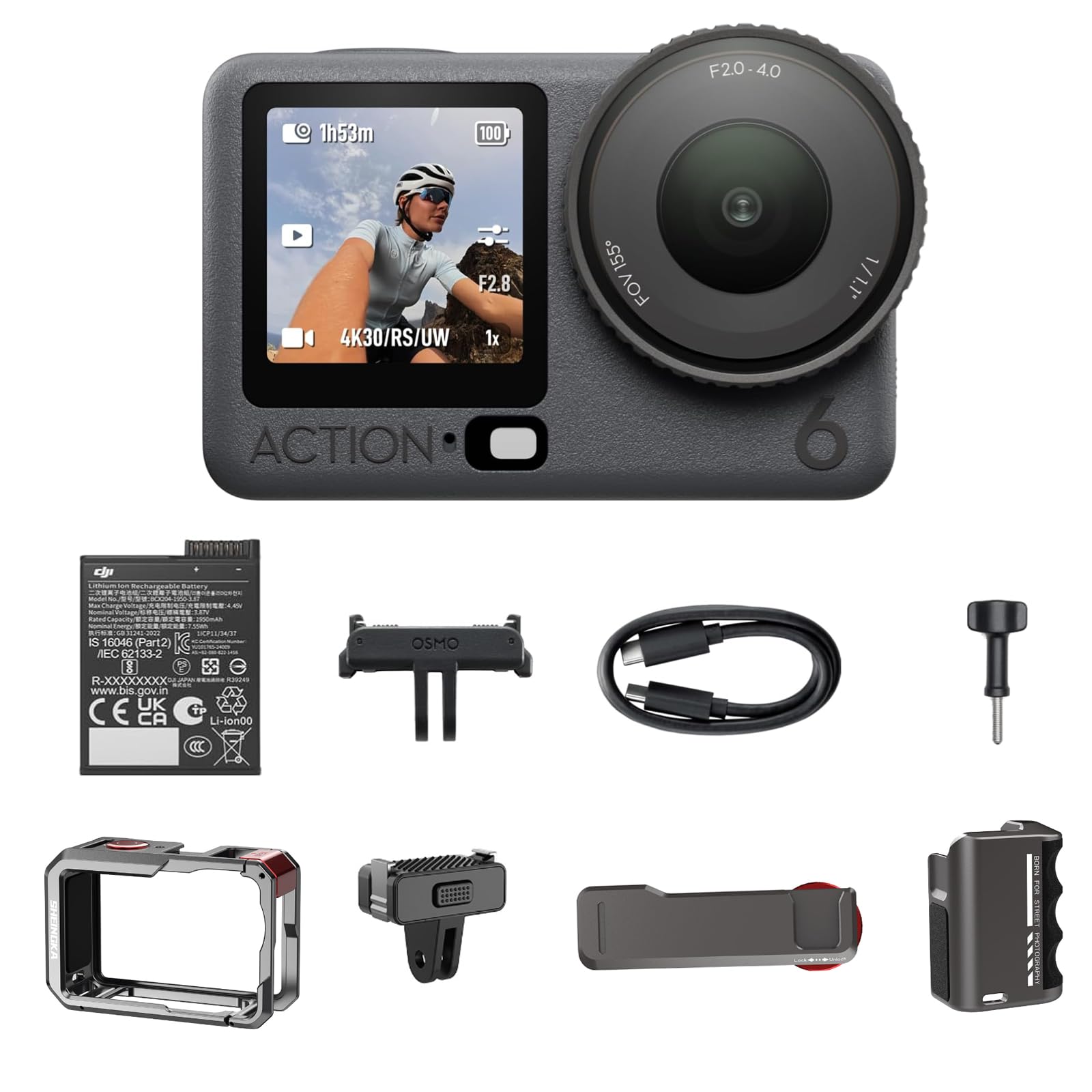
The DJI Osmo Action 6 brings a unique innovation to the trail: a variable aperture from f/2.0 to f/4.0, letting you adapt to changing light without neutral-density filters. The brand-new 1/1.1-inch square sensor shoots 8K video and 38MP stills, offering far more cropping room than any other action camera. The bundle includes the Essential Combo plus a Street Photography Handle Kit, giving you a versatile shooting platform right out of the box.
The 50GB of built-in storage is a safety net for those moments you forget a Micro SD card, and the 4-hour battery life in normal conditions matches the best in class. The camera is waterproof to 20 meters without a housing, so crossing streams or getting caught in a downpour is no issue. The dual OLED touchscreens (front and rear) make framing easy even with gloves on. Gesture and voice controls let you start recording without touching the camera — useful when balancing on a narrow ridge.
Where the Action 6 slightly stumbles is low-light noise; the variable aperture is a net positive, but the small sensor still struggles compared to even a 1-inch compact like the GR IIIx. The 8K video is impressive for action, but demands fast storage and drains the battery faster than 4K recording. The Street Photography Handle Kit adds a comfortable grip for hiking, but also extra length that won’t fit a small pocket.
Why it’s great
- Variable aperture adapts to changing trail lighting
- 50GB internal storage acts as a reliable backup
- Waterproof to 20m and dual touchscreen control
Good to know
- Still limited low-light performance vs. larger sensors
- 8K video is storage-intensive and reduces battery life
- Handle kit adds bulk that won’t fit a pocket
7. OM System OLYMPUS Tough TG-7 Red

The Tough TG-7 is the ultimate go-anywhere, survive-anything hiking camera. It’s waterproof to 15 meters, shockproof against a 2.1-meter drop, crushproof to 100 kgf, and freezeproof to -10°C. The F2.0 maximum aperture on the 4x optical zoom lens (25-100mm equivalent) gathers enough light for forest-floor and overcast-sky shooting, while the variable macro system lets you focus as close as 1 centimeter from the lens — perfect for recording lichen, insects, or trail-side mushrooms in microscopic detail.
The five underwater shooting modes are tuned specifically for underwater color and contrast, making this the best choice for hikers who also snorkel or dive during their trips. 4K video at 30fps and 120fps high-speed recording give you creative options for waterfalls and fast-moving streams. The TruePic VIII imaging engine processes 20MP stills with decent detail up to ISO 800 before noise becomes noticeable.
The TG-7’s biggest weakness is the same one that plagues all rugged compacts: the small 1/2.3-inch sensor produces soft, noisy images in anything dimmer than bright daylight. The autofocus is reliable but slow — you’ll miss candid moments of friends or wildlife. It’s also not as pocketable as a slim compact like the ZS99, with a noticeably chunky body. But if your hiking style involves mud, water, drops, and extremes, the TG-7 will still be shooting long after more delicate cameras have failed.
Why it’s great
- Extreme ruggedness: 15m waterproof, 2.1m shockproof, freezeproof
- Exceptional macro mode for close-up nature detail
- Underwater-specific shooting modes for snorkel/dive hikes
Good to know
- Small sensor limits low-light and dynamic range
- Autofocus is slow for fast-moving subjects
- Bulky body compared to slim travel zoom cameras
8. DJI Osmo Action 5 Pro Adventure Combo

The Osmo Action 5 Pro sets a new standard for trail endurance. Its 1950mAh Extreme Battery delivers up to 4 hours of continuous recording, and the Adventure Combo includes two additional batteries plus a multifunctional case that charges all three — giving you a full day of shooting without a power bank. The 1/1.3-inch sensor with 2.4 µm large pixels and 13.5-stop dynamic range produces noticeably better low-light footage than the GoPro HERO13, creating usable video in twilight and dense forest.
The IP68 rating means the Action 5 Pro is waterproof to 20 meters without a housing, and the color temperature sensor automatically adjusts white balance underwater and on land for natural colors without filters. The subject tracking locks onto a moving hiker and keeps them centered in frame — ideal for group shots where you’re both hiking and filming. The Adventure Combo’s 1.5m extension rod gives you an instant selfie stick or low-angle mount, and the dual OLED touchscreens are bright enough to read in direct sunlight.
Compared to the HERO13, the Action 5 Pro lacks the HB-series lens system, so you can’t swap in a macro or anamorphic lens mod. The 4K120fps cap is slightly below the HERO13’s 5.3K60, though few hikers need those extra pixels. Voice control recognition can also be finicky in windy conditions. For hikers who prioritize battery life and low-light performance above all else, the Action 5 Pro Adventure Combo is the smartest action-camera investment on this list.
Why it’s great
- Best-in-class 4-hour battery with three included batteries
- Excellent low-light performance from the 1/1.3″ sensor
- Subject tracking keeps hikers centered during action shots
Good to know
- No interchangeable lens system like GoPro HERO13
- Max video resolution is 4K, not 5.3K or 8K
- Voice control can struggle in windy trail conditions
9. GoPro HERO13 Black

GoPro’s HERO13 Black remains the benchmark for hiking action cameras because of one feature the competition still can’t touch: the HB-series lens system. Attach the Ultra Wide Lens Mod for sweeping summit panoramas, the Macro Lens Mod for up-close forest details, or the Anamorphic Lens Mod for cinematic-quality trail footage — the camera auto-detects each lens and adjusts its settings accordingly. No other action camera offers this level of optical versatility.
The 5.3K60 video delivers 91% more resolution than 4K, giving you room to crop and stabilize in post without losing quality. The Enduro battery provides up to 79 minutes of recording in 5.3K, and rugged waterproofing to 10 meters means it survives rain, creek crossings, and snow without a housing. HyperSmooth stabilization rivals a gimbal, keeping footage steady even during a trail run or descent over loose talus.
The biggest drawback is the same as every GoPro: the Enduro battery’s 79 minutes at max resolution is short compared to the DJI Action 5 Pro’s 4-hour rating. You’ll need at least two spare batteries for a full day of shooting. The small 1/1.9-inch sensor also means lower light performance trails the DJI’s 1/1.3-inch unit. But if you value lens modularity — shooting wide landscapes one minute and macro close-ups the next — no other action cam matches the HERO13’s flexibility on the trail.
Why it’s great
- Revolutionary HB-series lens system for macro, wide, and cinematic shots
- Class-leading 5.3K video with HyperSmooth stabilization
- Auto-detecting lenses simplify switching on the trail
Good to know
- 79-minute battery at 5.3K requires spare batteries for day hikes
- Smaller sensor struggles for low-light shots vs. DJI Action 5 Pro
- Lens mods are an additional expense over the base camera
10. PENTAX WG-90 Blue Waterproof Camera

The Pentax WG-90 is the rugged compact for the hiker who treats gear hard and wants it to survive. It’s waterproof to 14 meters for two hours, shockproof against a 1.6-meter drop, and freezeproof to -10°C. The six-LED ring light around the lens provides uniform macro illumination that reveals details invisible even to the naked eye — think the veins of a leaf or the texture of a rock face. The Digital Microscope mode captures images from 1 cm away that look otherworldly.
The 16-megapixel back-illuminated CMOS sensor and 5x optical zoom (28-140mm equivalent) cover standard hiking scenarios competently in good light. The Underwater shooting mode optimizes color and contrast for sub-surface shots, and Full HD movie recording at H.264 is adequate for clips shared on social media. The Macro Stand included in the box maintains that 1 cm distance for stable close-ups, which is a thoughtful addition for nature photographers.
The WG-90’s Achilles’ heel is image quality: auto mode produces soft, flat images compared to even a three-year-old smartphone, and manual settings are required to extract usable photos. The LCD screen at 2.7 inches is small by modern standards, and the 230k-dot resolution makes critical focus checks difficult. There are also reports of the battery door seal failing over time, so regular O-ring maintenance is essential. For the price, you’re paying for the rugged shell, not the imaging electronics inside.
Why it’s great
- Class-leading ruggedness: waterproof, shockproof, freezeproof, dustproof
- Six-LED ring light enables unique macro photography on the trail
- Includes Macro Stand for stable close-up shooting
Good to know
- Image quality lags behind modern smartphones in auto mode
- Small, low-resolution LCD makes composition difficult
- Battery door seal can fail over time; needs O-ring care
11. Ricoh WG-80 Orange Waterproof Digital Camera

The Ricoh WG-80 is the entry-level rugged compact that gets the basics right for hikers on a tighter budget. It shares the same 14-meter waterproof depth and freezeproof -10°C rating as the pricier Pentax WG-90, but at a slightly lower price point. The 16-megapixel back-illuminated CMOS sensor and 5x optical zoom (28-140mm equivalent) are adequate for daylight trail documentation — think identifying landmarks, capturing camp setup, or snapping a summit selfie in the rain.
The six-LED macro lights remain a genuine strength for this class, providing enough illumination for close-up shots of trail details, plant identification, or gear inspection. The Underwater shooting mode similarly optimizes color for sub-surface use, making this a viable option for hikers who also snorkel or explore coastal trails. The build quality feels solid and the bright orange color is easy to spot if dropped in undergrowth or snow.
The compromises are severe: image quality is noticeably worse than modern smartphones, with heavy noise above ISO 800, slow autofocus that misses moving subjects, and a small 2.7-inch LCD that’s hard to see in direct sunlight. The 1.6-meter shockproof rating is lower than the WG-90’s, and there’s no built-in flash, which limits versatility in dark forests or cave hikes. For a rugged camera that survives where a phone would die, the WG-80 works — but don’t expect impressive photos.
Why it’s great
- Genuine ruggedness: 14m waterproof and freezeproof for harsh trails
- Six-LED macro lights for close-up detail shots
- Bright color makes it easy to find if dropped
Good to know
- Image quality is outclassed by any modern smartphone
- Slow autofocus misses spontaneous trail moments
- No flash and tiny LCD screen in direct sunlight
FAQ
How many spare batteries should I bring for a full day of hiking?
Can I use a smartphone instead of a dedicated hiking camera?
What’s the difference between action cameras and rugged point-and-shoots for hiking?
Do I need a camera with image stabilization for hiking?
How much does weight matter for a hiking camera system?
Final Thoughts: The Verdict
For most hikers, the winner of this camera for hiking search is the GoPro HERO13 Black because its HB-series lens system offers unprecedented optical versatility in a rugged, waterproof body — letting you shoot sweeping landscapes one minute and macro trail details the next without carrying multiple lenses. If you want the best battery life and low-light performance in an action camera, grab the DJI Osmo Action 5 Pro Adventure Combo with three batteries. And for hikers who need a fully weather-sealed system camera that won’t weigh down a multi-day trek, nothing beats the OM SYSTEM OM-5 Mark II.