
Sleeping in a parked van during summer isn’t relaxation — it’s a tactical endurance test. Without a proper cooling system, the cabin turns into a solar oven by 10 AM, making it impossible to rest, recharge, or even stay inside. The solution isn’t a heavy generator setup or a shore-power-dependent window unit; it’s a dedicated 12V DC air conditioner engineered to run off your house battery bank without waking the neighbors.
I’m Min — the co-founder and writer behind Gadgets Feed. I’ve spent hundreds of hours combing through schematics, comparing compressor technologies, and analyzing real-world amp draw data across dozens of low-voltage AC systems to find the units that actually deliver on their BTU ratings without murdering your electrical budget.
This guide breaks down the nine most compelling options available right now, covering split systems, rooftop units, and inverter-driven models that define the best ac unit for a van in 2025.
How To Choose The Best AC Unit For A Van
Picking the wrong air conditioner for a van can drain your battery in under an hour or fail to keep the cabin cool on a 95°F afternoon. You need to balance three variables: power consumption, physical footprint, and actual cooling output. Here is exactly what to look at before buying.
Power Source: 12V DC Inverter vs. 115V AC
Standard household window units run on 115V AC and require a heavy inverter plus massive battery bank to operate off-grid. A true 12V DC unit with an inverter compressor eliminates the conversion loss — it runs directly off your house batteries, often drawing 40-60 amps on startup and dropping to 20-30 amps once the cabin reaches temperature. This makes inverter-driven 12V units the only realistic choice for overnight van use without running a generator.
BTU Rating vs. Real-World Cooling
Manufacturers list BTUs, but the real metric for a van is how quickly that unit can pull down a space of roughly 80-150 square feet. A 10,000 BTU inverter unit is typically sufficient for a standard van conversion, while a 13,500+ BTU unit is overkill unless you are in extreme desert heat or have a poorly insulated metal box. Over-speccing BTU capacity can actually hurt efficiency — the compressor cycles on and off more frequently, wasting power.
Physical Form Factor: Rooftop vs. Split vs. Portable
Rooftop units mount on a standard 14×14-inch vent opening and keep all components out of living space, but they add height and require roof reinforcement. Split systems, like the CNCEST, place the condenser outside and the evaporator inside, which is stealthier and allows for a lower vehicle profile. Portable units are the easiest to install but take up floor space and vent awkwardly through a window. For most van builds, a low-profile rooftop inverter AC or a split system is the gold standard.
Quick Comparison
On smaller screens, swipe sideways to see the full table.
| Model | Category | Best For | Key Spec | Amazon |
|---|---|---|---|---|
| Outequip 10K BTU | Rooftop Inverter | Ultra-quiet van builds | 54 dB / 55A peak / 21A ECO | Amazon |
| Treeligo 11K BTU | Rooftop Inverter | Heating + cooling combo | 45 dB / 12V DC / inverter | Amazon |
| Contrymod 10K BTU | Rooftop Inverter | Off-grid efficiency | 300-900W / 0.3 kWh/hr | Amazon |
| Outequip 10K BTU w/ Heater | Rooftop Inverter | Mild-climate heating + AC | 43 lbs / 40 dB / 16A ECO | Amazon |
| Gidrox 10K BTU | Rooftop Inverter | APP-controlled efficiency | 40 dB sleep / 350W avg. night | Amazon |
| Dometic FreshJet 13.5K | Rooftop 115V AC | Premium build, max durability | 21 SEER / 70 lbs / 4 dB quieter | Amazon |
| Dometic FreshJet 15K Black | Rooftop 115V AC | Max airflow for large rigs | 350 CFM / 64 lbs / 15K BTU | Amazon |
| FOGATTI 15K BTU | Rooftop 115V AC | Fast cooling in big RVs | 15K BTU / 1,500W heat strip | Amazon |
| CNCEST 11K BTU Split | Split System 12V | Stealth / low profile builds | 62 lbs / 400-600W / 5-speed | Amazon |
In‑Depth Reviews
1. Outequip 10,000 BTU 12V Rooftop AC
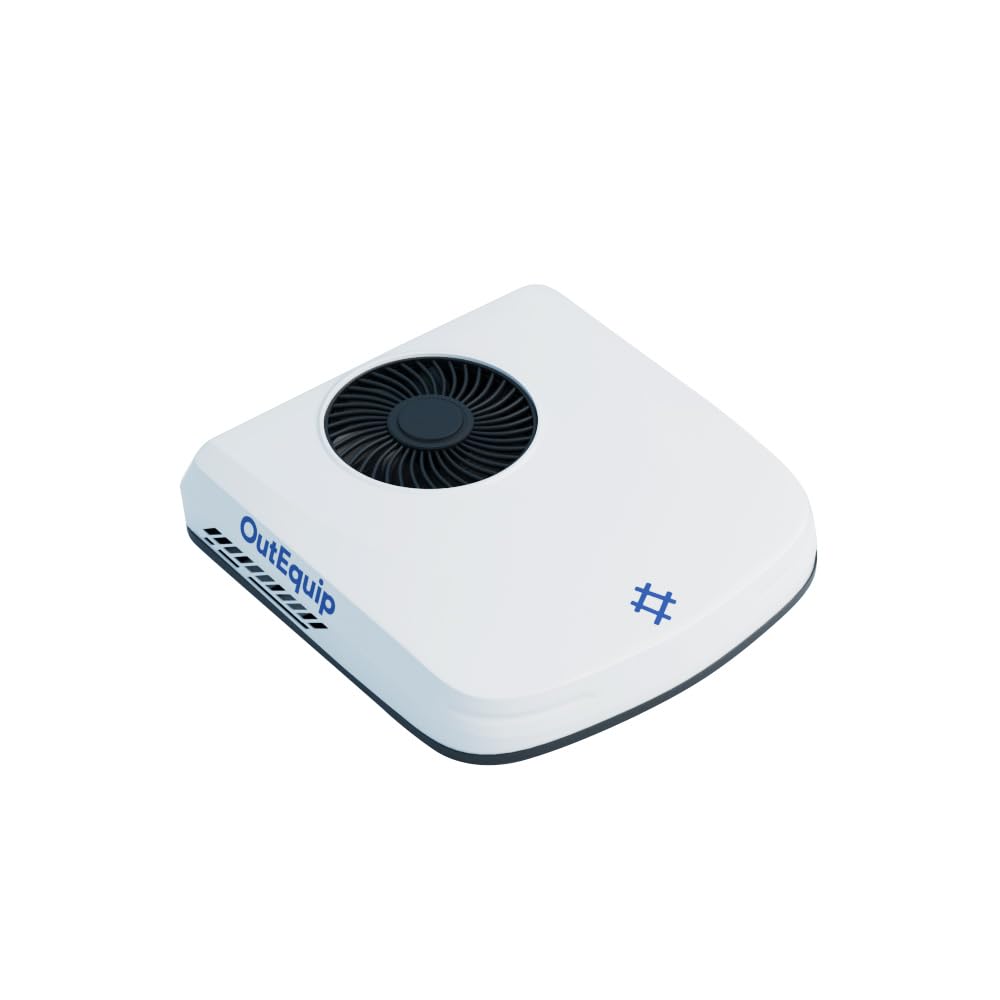
The Outequip 10K BTU rooftop unit hits the sweet spot for van conversions. It uses a brushless copper motor and an inverter compressor, which means it ramps up quietly rather than slamming on at full power. Real-world reports show it drawing roughly 55 amps in Turbo mode before settling to around 21 amps on ECO — that translates to a 360Ah battery lasting 6-7 hours, and a 480Ah bank pushing past 8 hours of runtime. In testing on a Ram Promaster, the unit dropped the interior from 89°F to 79°F in about 25 minutes, which is respectable given the 10,000 BTU rating.
The low-profile design stands at just 7.5 inches tall, making it one of the few rooftop ACs that fits under a standard van roof rack. The included remote and Bluetooth app give you control over Eco, Sleep, and Turbo modes, and the spring-supported mounts absorb road vibration. Installation requires a standard 14×14-inch roof cutout, but you must seal the condenser area thoroughly to prevent rainwater from entering the cabin. At 54 dB, it is quieter than most portable units and whisper-quiet in Sleep mode.
Compared to the Gidrox or Contrymod units at similar price points, the Outequip offers slightly lower peak amp draw and a more compact footprint, which is critical for a van’s limited roof real estate. The only real tradeoff is that the included gasket could be thicker, and the mounting instructions are minimal — you will need to watch a YouTube installation guide for best results.
Why it’s great
- Extremely quiet at 54 dB with inverter compressor
- Low profile (7.5″) fits under roof racks
- ECO mode draws only ~21A for extended runtime
Good to know
- Mounting gasket could be thicker; seal carefully
- Installation instructions are sparse — use video guides
2. Treeligo 11,000 BTU 12V DC Rooftop Inverter AC
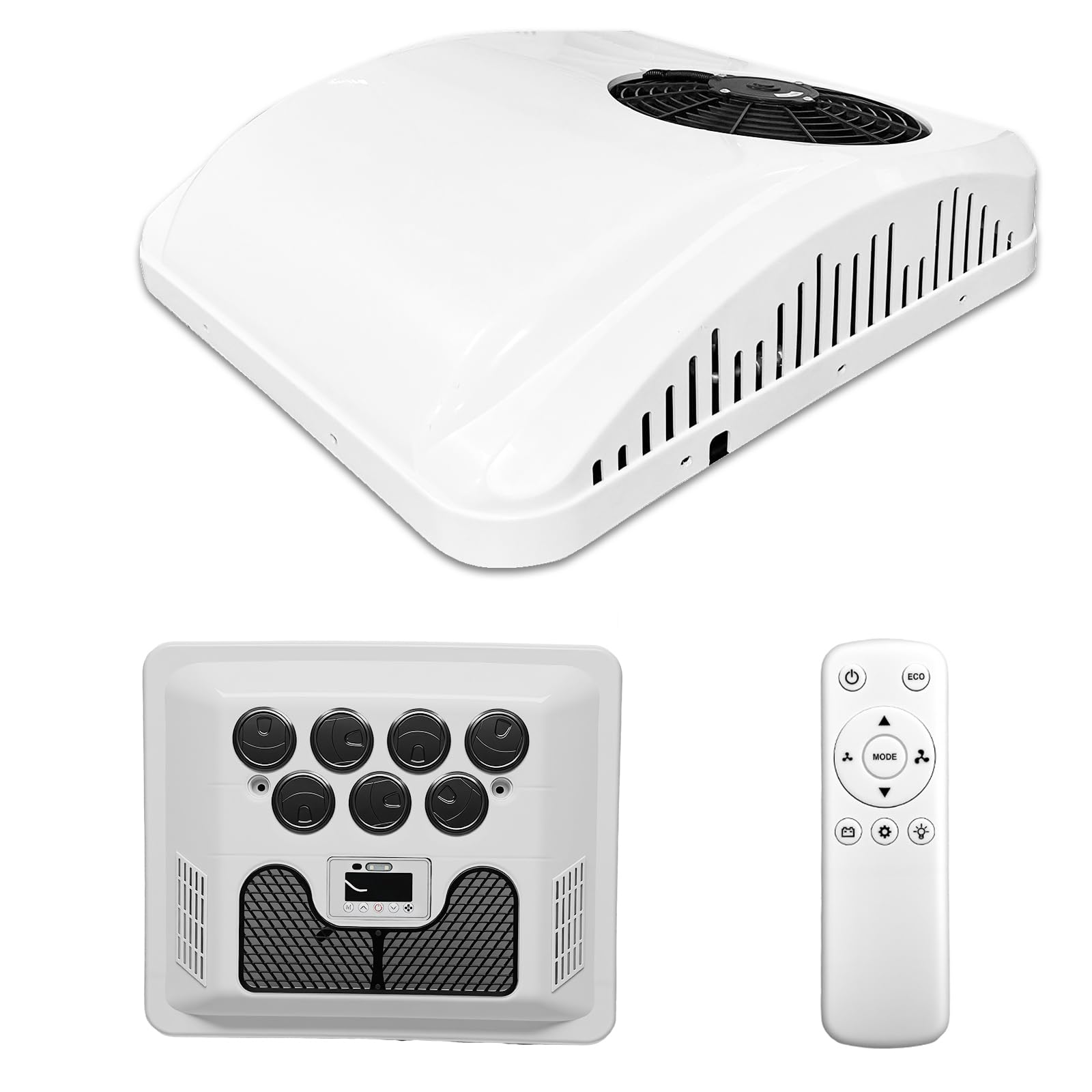
The Treeligo 11K BTU unit is one of the few 12V rooftop ACs that includes both cooling and heating in a single package. The inverter compressor and frequency conversion technology keep operational noise below 45 dB — quiet enough for undisturbed sleep. It runs off a 12V battery bank without any inverter, pulling between 330W and 1,000W depending on mode. Paired with a 300Ah battery, users report running it through the night on ECO. The heating function is a legitimate advantage for shoulder-season camping, though it is not a primary heat source for freezing temperatures.
Installation requires a minimum roof opening of 12.6 x 10.2 inches, which is smaller than the typical 14×14 cutout, giving you more flexibility. The unit comes FCC and UL certified, and it includes multi-layer circuit protection against voltage surges. However, some users have reported difficulty contacting support when issues arise, and one reviewer noted that the unit struggled in high humidity. Another caveat: you may need to upgrade from 6-gauge to 4-gauge power cables if your battery is located far from the roof opening.
For van dwellers who need a single unit that handles both cooking heat and chilly mornings without a separate heater, the Treeligo is the most versatile option here. The tradeoff is that the customer service response can be slow due to time differences, and the unit is slightly heavier and bulkier than the Outequip.
Why it’s great
- Includes both cooling and heating (heat pump)
- Very quiet at 45 dB — ideal for sleeping
- FCC and UL certified with surge protection
Good to know
- May struggle in high humidity conditions
- Customer support can be slow to respond
3. Contrymod 10,000 BTU 12V DC Rooftop AC
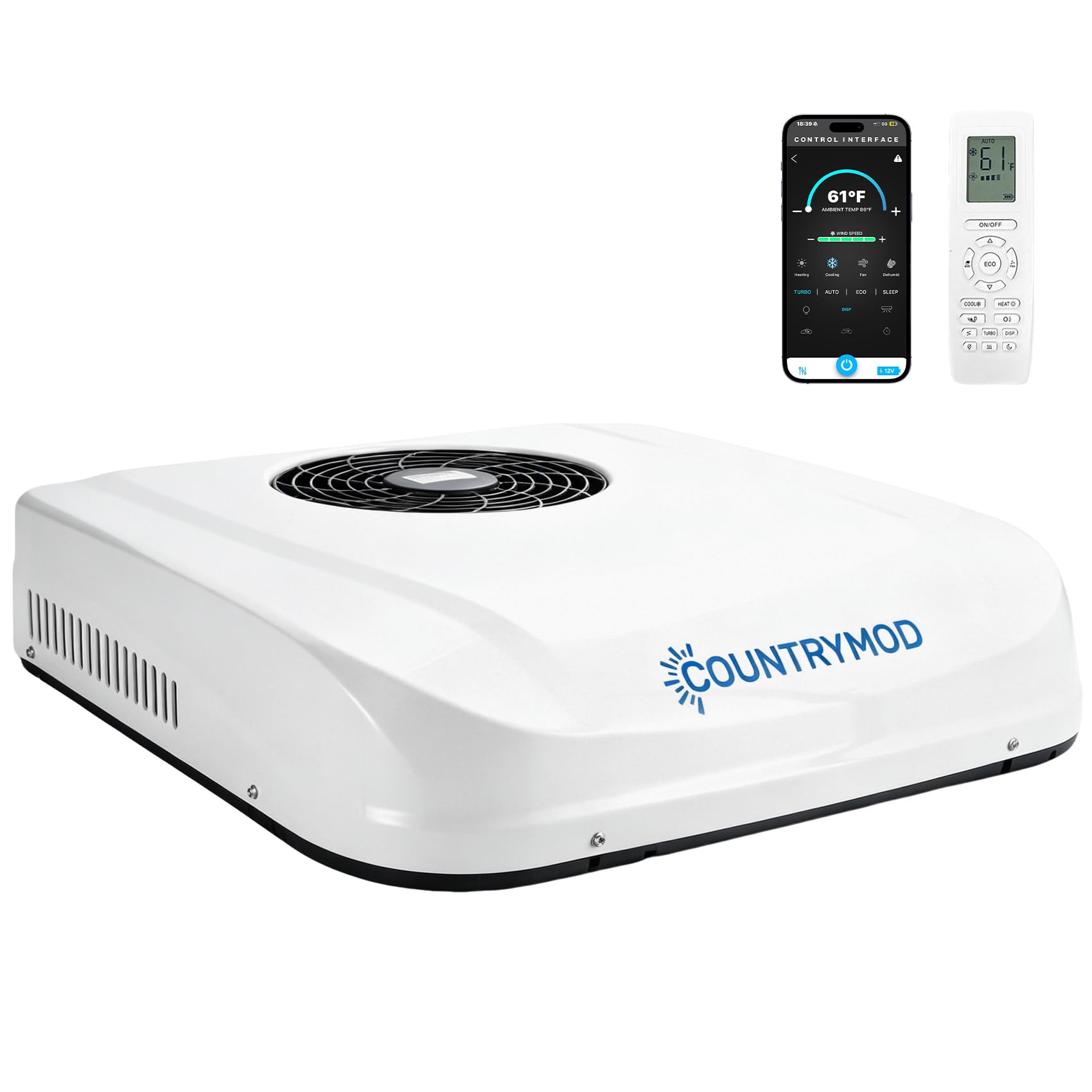
The Contrymod 10K BTU unit is a standout for efficiency. In real-world use, a 300Ah battery can power it for 12 hours on ECO mode, according to one verified buyer who tested it in 113°F desert heat. The unit fits a standard 14×14-inch roof opening, and the horizontal compressor design reduces vibration and lowers the center of gravity.
Noise levels range from 45 to 55 dB, which is in the range of a quiet conversation. The articulating vents distribute cold air evenly, and the remote control is easy to use. One major plus is the customer support from a representative named Tony Allen, who resolved a compressor cycling issue quickly for one reviewer. However, the installation instructions are minimal, and you may need to buy longer metric all-thread bolts if your van’s roof is thicker than standard.
Compared to the Outequip and Treeligo, the Contrymod offers the lowest watt-hour consumption per BTU, making it the best choice for prolonged off-grid stays. The downside is that the plastic lid connectors are fragile — one reviewer broke a bracket at 4.5 ft-lbs of torque. Handle the lid gently during installation.
Why it’s great
- Extremely low power consumption (0.3 kWh/hr)
- 12-hour runtime on a 300Ah battery (ECO mode)
- Low-vibration horizontal compressor design
Good to know
- Lid bracket is fragile — tighten carefully
- Instruction manual is sparse; watch a video guide
4. Outequip 10,000 BTU 12V AC with Heater
This is essentially the same Outequip 10K BTU platform but with an integrated 4,500 BTU PTC heater for light heating. The unit weighs just 43 pounds, which is half the weight of traditional rooftop units, and it stands at only 6 inches tall. In ECO mode, the amp draw drops to roughly 16A, making it one of the most battery-friendly options on the market. The brushless copper fans and spring-supported mounts keep operation at around 40 dB — genuinely quiet enough for undisturbed rest.
The PTC heater is useful for taking the chill off during cool mornings, but it is not a primary heat source for freezing nights. Users have had great experiences with the customer service team, with one reviewer receiving a free swap from a 12V to a 24V unit after installation confusion. The low-profile design fits under a standard roof rack, and the UV-stabilized ABS shroud resists sun damage. Installation is straightforward for anyone with basic 12V wiring experience.
At a similar price to the Gidrox and Treeligo, the Outequip with heater offers the lightest weight and lowest ECO-mode amp draw. The tradeoff is that the 4,500 BTU heater is relatively weak compared to a dedicated diesel heater or propane furnace. If you camp primarily in mild climates and want a single unit that cools and gently warms, this is the pick.
Why it’s great
- Extremely lightweight at 43 lbs — easy solo install
- Very low amp draw on ECO (16A)
- Excellent customer service reputation
Good to know
- Heater is supplemental only, not for sub-freezing temps
- Lid connectors are fragile — handle with care
5. Gidrox 10,000 BTU 12V DC Rooftop AC with Heater
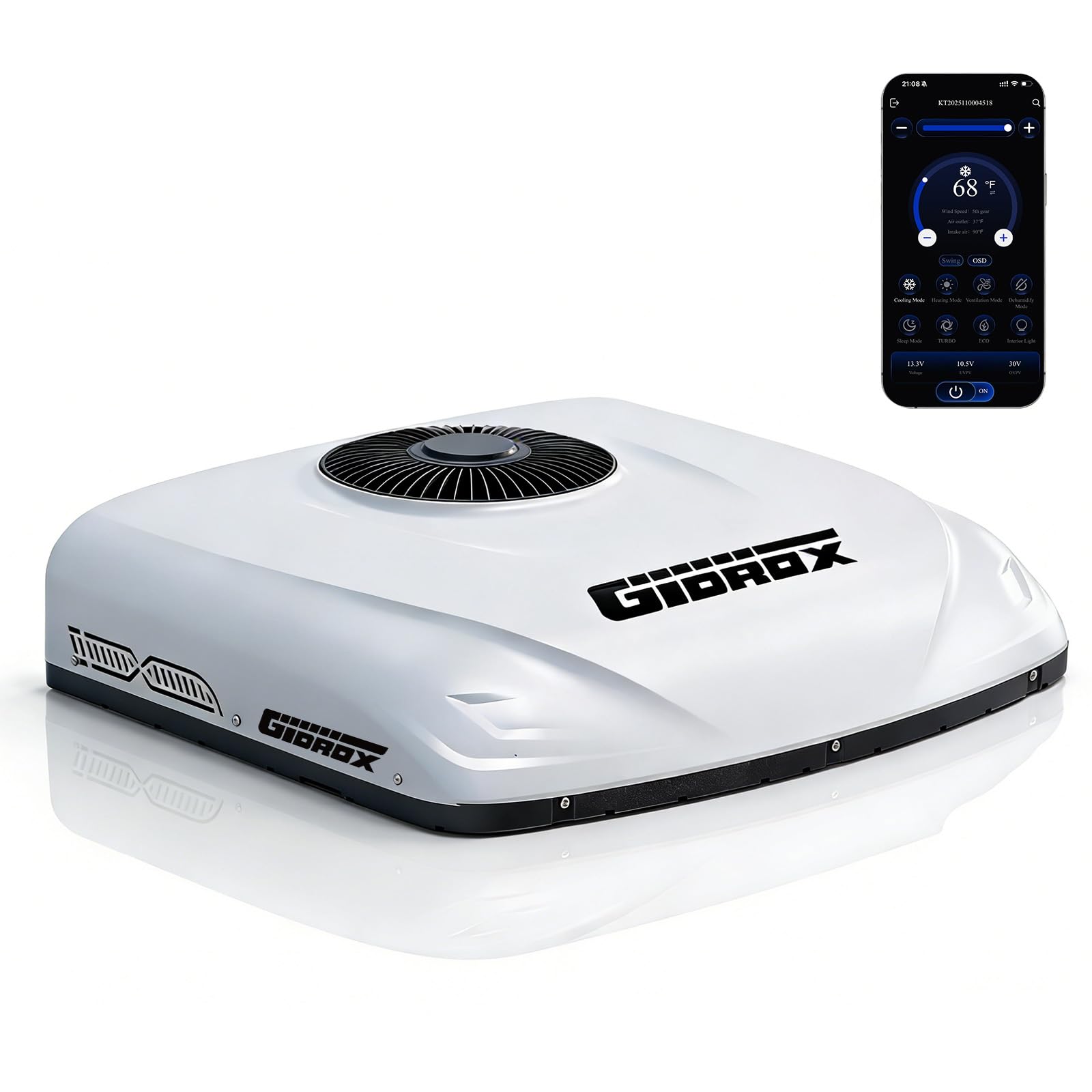
The Gidrox 10K BTU unit stands out for its triple-control system: a physical panel, an infrared remote, and a smartphone APP via Bluetooth. This allows you to adjust the temperature, switch between Turbo/ECO/Sleep modes, and set timers without getting out of bed. The inverter compressor and brushless fan keep Sleep mode at a library-quiet 40 dB.
The 4,500 BTU PTC heater is included for supplemental warmth, and the unit fits a standard 14×14-inch roof cutout with a 19.7-foot power cable. At 54 pounds, it is manageable for a two-person install. The manufacturer Gidrox has been responsive to issues — one reviewer who accidentally damaged the sensor board during installation received a free replacement and paid return shipping. However, the remote control has been reported to be unreliable by some users, making the app the more dependable control method.
Compared to the Outequip and Contrymod, the Gidrox offers the best control flexibility and a very quiet Sleep mode. The main disadvantage is that the threaded mounting rods may be too short for thicker roofs — you may need to buy 8mm all-thread and cut it to length. Also, the unit is slightly pricier than the direct competitor from Contrymod.
Why it’s great
- Smartphone APP control with Bluetooth
- Quiet 40 dB Sleep mode for undisturbed rest
- Responsive customer service from manufacturer
Good to know
- Remote control can be unreliable
- Mounting rods may be too short for thick roofs
6. Dometic FreshJet 3 Series 13.5K BTU

The Dometic FreshJet 3 Series is the gold standard for RV and van rooftop cooling. This 13,500 BTU unit delivers 21 SEER efficiency, meaning it produces more cooling per watt than almost any competitor. It is 14% lighter than the previous Dometic Brisk II, weighing around 70 pounds, and it operates 4 dB quieter. Startup power spikes at roughly 2,000W before settling to 1,600W steady state — that is high, so you need a substantial inverter and battery bank. The e-coated evaporator coils resist corrosion, which is a major advantage for vans exposed to road salt and moisture.
The FreshJet 3 is backwards-compatible with existing Dometic and competitor air distribution boxes, making it a straightforward swap. In real-world testing, one owner reported dropping the interior temperature from 80°F to 64°F in 30-45 minutes. Airflow is 13% higher than the Brisk II, and the refrigerant charge is 28% lower due to the efficient design. The unit is available in both cool-only and heat-pump configurations.
However, the FreshJet 3 runs on 115V AC and 12V DC simultaneously — it is not a pure 12V unit. This means you must run it through an inverter from your battery bank, or plug into shore power. Several reviews mention that the packaging is insufficient, with units arriving with broken mounting tabs. The high price also puts it in a different league from the 12V inverter units above. If you have a large electrical system and want the best build quality, this is the winner, but it is over-engineered and overpriced for a small van conversion.
Why it’s great
- Top-tier 21 SEER efficiency rating
- E-coated coils resist corrosion
- Very quiet and high airflow
Good to know
- Requires both 115V AC and 12V DC power
- Packaging is poor — units may arrive damaged
7. Dometic FreshJet 3 Series 15K BTU Black

The 15,000 BTU version of the FreshJet 3 in black is designed for larger spaces or vans in extreme heat. It moves 350 cubic feet of air per minute using an innovative blower system, and it is 14% lighter than Dometic’s previous lightest unit at just 64 pounds. The e-coated evaporator coils provide exceptional corrosion resistance — a feature unique to Dometic in the RV industry. This unit is backwards-compatible with existing ducted and non-ducted air distribution boxes, so it can replace almost any older rooftop AC.
In real-world use, the black model looks significantly more modern and hides dirt better than white units. It is also 4 dB quieter than previous Dometic models, making it possible to hold a phone conversation underneath it. Installation is plug-and-play if you already have a compatible ceiling assembly. However, like the 13.5K BTU version, this unit requires 115V AC and 12V DC power simultaneously, meaning it is not a pure off-grid solution. It also comes with a premium price tag.
For a large van or a Class B RV that already has a robust electrical system (3,000W+ inverter, 400Ah+ battery bank), the FreshJet 15K is the most capable cooler here. But for a standard van conversion running on a 200-300Ah battery, the 12V inverter units from Outequip or Contrymod are a much more practical fit. The black color is a nice aesthetic touch, but it does not affect performance.
Why it’s great
- Highest airflow at 350 CFM for rapid cooling
- Lightweight for its class at 64 lbs
- E-coated coils for maximum corrosion resistance
Good to know
- Requires 115V AC + 12V DC — not pure off-grid
- Very high price point compared to 12V-only units
8. FOGATTI 15,000 BTU Non-Ducted Rooftop AC
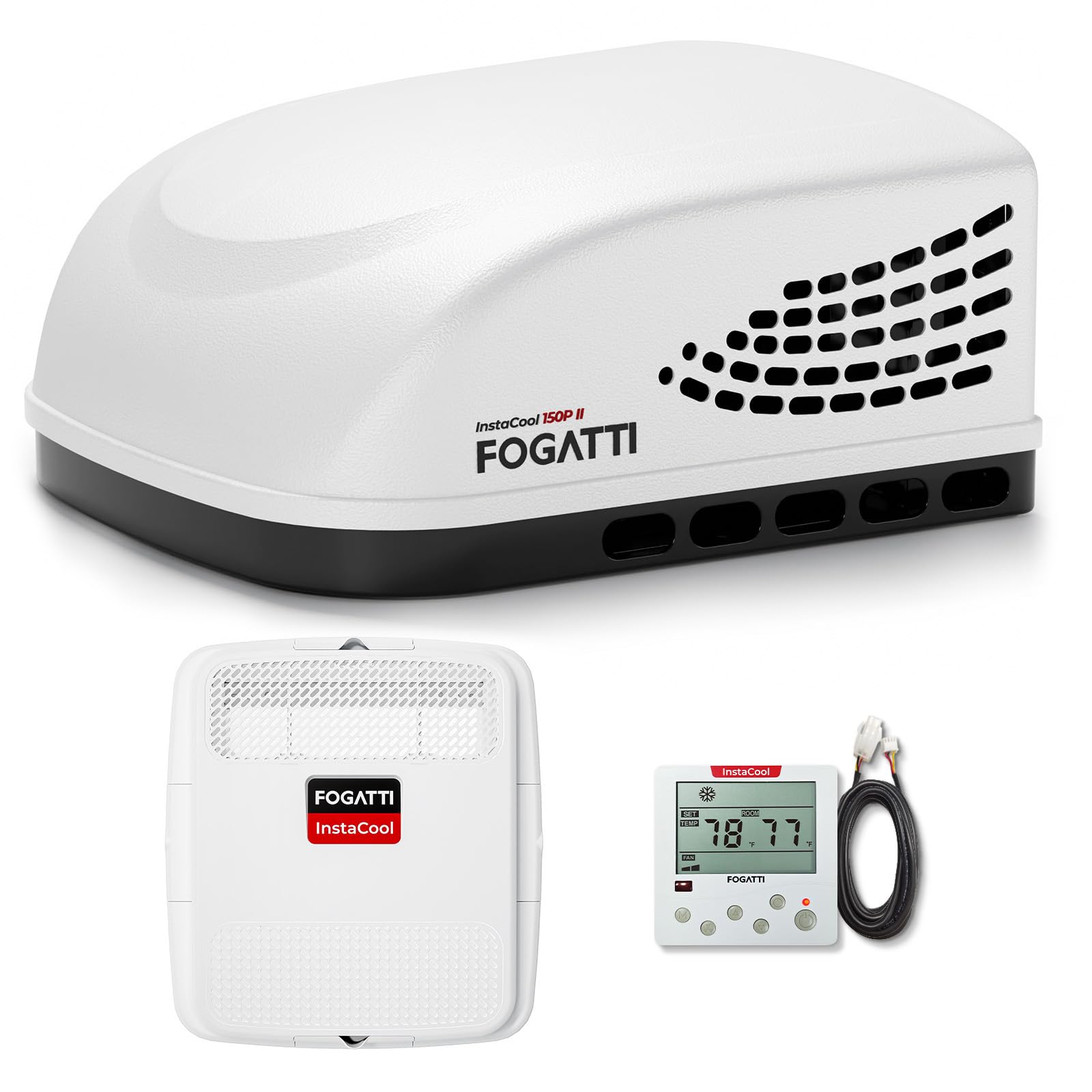
The FOGATTI 15K BTU unit is designed for non-ducted RV installations. It uses a centrifugal compressor and includes a 1,500W built-in heating strip to reduce humidity and provide supplemental warmth. The cooling capacity is substantial — enough to cool a 28-foot RV on a Texas summer day — and the unit is described by multiple reviewers as “super quiet.” Installation requires a standard 14×14-inch roof cutout, and it operates on both 115V AC and 12V DC power, similar to the Dometic units.
The UV-resistant ABS shroud prevents deformation from sun exposure. The unit cycles on and off like a central air system, maintaining a steady temperature rather than blasting nonstop. However, the same requirement for shore power or a large inverter limits its use for off-grid van camping. One reviewer had a blower motor failure shortly after installation, although other buyers reported excellent performance. At a mid-range price, the FOGATTI represents a solid value for its BTU output, but it is not the best choice for a battery-dependent van build.
Compared to the 12V inverter units, the FOGATTI is heavier, less efficient, and cannot run off batteries alone. It is best suited for situations where shore power is always available — such as at an RV park or campground. For a van that spends most of its time off-grid, skip this and go for a dedicated 12V inverter model.
Why it’s great
- Powerful 15K BTU cooling for large spaces
- Includes a 1,500W heating strip for humidity control
- Very quiet operation for its class
Good to know
- Requires both 115V AC and 12V DC power
- Not suitable for battery-only off-grid use
9. CNCEST 12V DC Split Air Conditioner 11,000 BTU
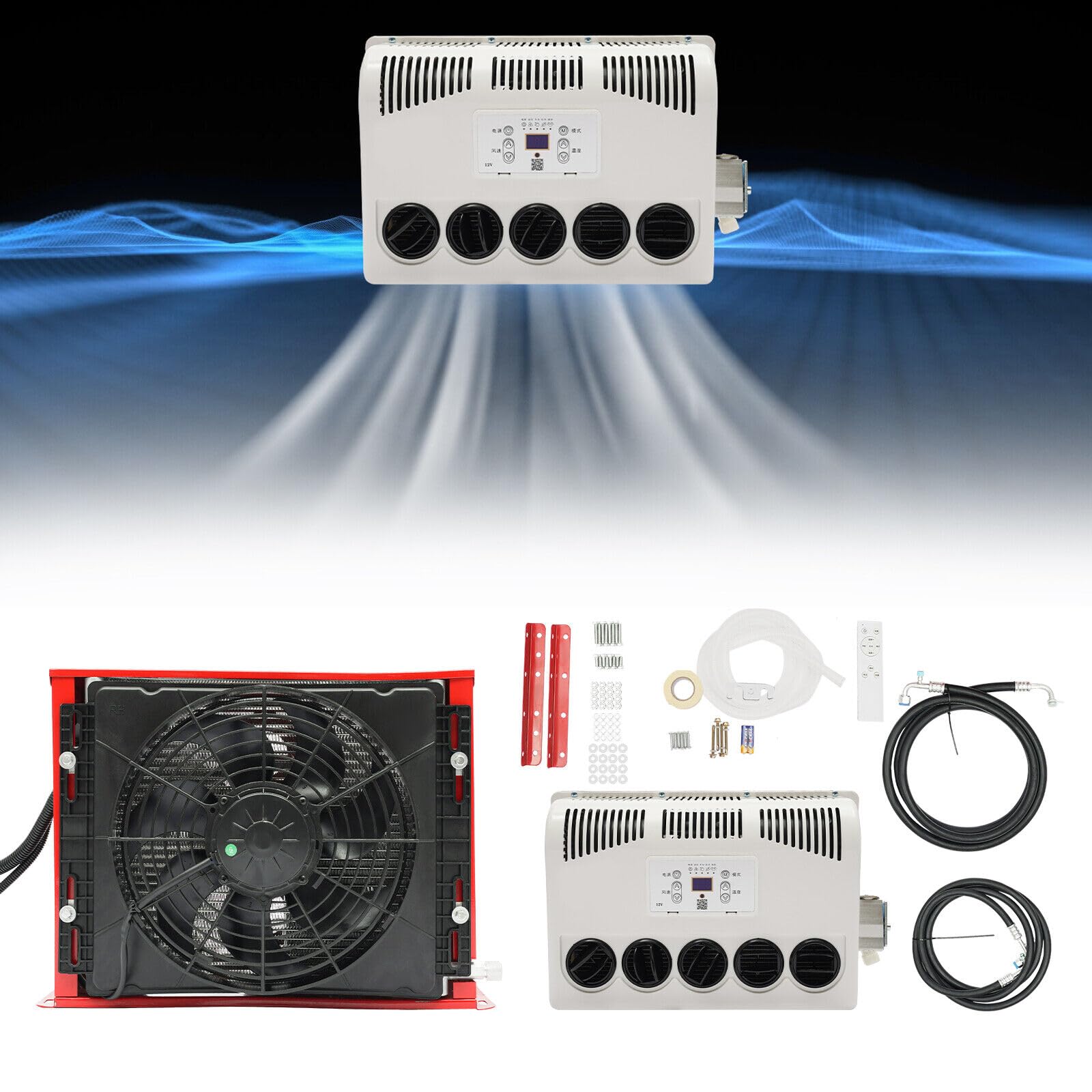
The CNCEST 11K BTU split system is the most affordable entry point for van cooling. It operates on pure 12V DC, drawing 400-600W, and delivers 11,000 BTU of cooling through a separate condenser and evaporator unit. The split design means you mount the heavy, noisy condenser outside the van (or under the chassis) and keep only the slim evaporator inside — a stealthy solution that does not require a roof cutout. The unit includes a remote control and a 5-speed fan, plus under-voltage protection that cuts off below 11V to prevent battery damage.
Real-world reviews are mixed but generally positive for the price. Several truck drivers and van owners report that the unit freezes them out in 90°F+ weather. The installation is straightforward but requires routing refrigerant lines through the vehicle body. However, the customer reviews also reveal a notable failure rate: multiple users reported condenser leaks after 2-3 months. While the seller appears to have replaced some units, others were told to buy a new unit. The control panel labels are in an Asian language, and no English instructions are included.
At the budget end of the spectrum, the CNCEST delivers real cooling at an unbeatable price, but the build quality and parts reliability are clearly lower than the premium rooftop units. If you have a very tight budget and a van where roof mounting is not an option, it is a risk worth considering. For most buyers, spending a little more on an Outequip or Contrymod unit will provide much better long-term reliability.
Why it’s great
- Lowest cost option for 12V DC van cooling
- Split design — no roof cutout needed, stealthy
- Under-voltage protection prevents battery drain
Good to know
- Condenser leaks reported after 2-3 months
- No English instructions, control panel in Chinese/Japanese
FAQ
Can a 12V air conditioner run overnight on a single battery?
What size roof cutout do I need for a standard van AC unit?
Is a split system better than a rooftop unit for a van?
Final Thoughts: The Verdict
For most users, the best ac unit for a van is the Outequip 10K BTU Rooftop AC because of its quiet inverter compressor, low amp draw on ECO mode (21A), and compact 7.5-inch profile that fits under roof racks. If you need heating and cooling in one package, grab the Treeligo 11K BTU unit. And for the ultimate in off-grid efficiency, nothing beats the Contrymod 10K BTU unit with its 0.3 kWh per hour consumption — perfect for extended boondocking.