
A 14,000 BTU window air conditioner is the point where cooling power meets the reality of large, open-concept living spaces, sun-drenched apartments, and sweltering home offices that smaller units simply cannot handle. Pulling this much heat out of the air requires a serious compressor, a substantial heat exchanger, and the electrical draw to match — but the payoff is a room that stays genuinely cold, even when the mercury outside refuses to cooperate.
I’m Min — the co-founder and writer behind Gadgets Feed. After hundreds of hours dissecting compressor types, inverter drive algorithms, CEER ratings, and real-world noise data from customer field reports, I built this guide to cut through the spec-sheet noise and identify the window units that actually deliver on their BTU promise without turning your living room into a wind tunnel or your utility bill into a horror story.
Whether you need smart home integration, whisper-quiet sleep mode operation, or raw cooling capacity for a sprawling great room, this deep-dive guide will point you to the right 14000 btu window air conditioner for your exact situation.
How To Choose The Best 14000 BTU Window Air Conditioner
Choosing a 14,000 BTU window unit isn’t like picking a smaller window shaker. You are making a multi-year equipment decision that affects your comfort, your monthly energy spend, and your home’s noise environment. Below are the critical decision points that separate a satisfying purchase from a regretful one.
Inverter Compressor vs. Standard Rotary Scroll
A standard rotary scroll compressor runs at full speed until the thermostat is satisfied, then shuts off completely — this creates temperature swings and an audible on/off cycling noise. Inverter compressors, by contrast, vary their speed continuously, maintaining a steady temperature and running quieter at low load. Units like the LG DUAL Inverter and the Frigidaire Smart Inverter draw significantly less power during partial-load operation, reducing your kilowatt-hour consumption by up to 35% compared to a fixed-speed competitor. If you plan to run this AC for more than a few hours a day, the premium for inverter technology pays for itself inside two cooling seasons.
Smart Control Versus Basic Remote
A basic infrared remote works line-of-sight and has a range of maybe 20 feet. A Wi-Fi-connected unit with app control lets you pre-cool the house from your commute, tie into a smart thermostat routine, and monitor energy usage. The Frigidaire FHWW144TF1 and the LG ThinQ app allow geofencing — the AC turns off when nobody’s home and starts cooling before you arrive. If you have an open floor plan where the AC lives in a different room than your couch, smart control isn’t a luxury; it’s the only way to adjust the temperature without getting up.
Noise Profile and Decibel Ratings
Most 14,000 BTU units advertise noise levels between 50 and 56 dB — the difference between a quiet library and a running refrigerator. But the character of the noise matters more than the number. A unit with a low-frequency hum at 44 dB (like the LG LW1522IVSM) can be less intrusive than a 50 dB unit with a high-pitched compressor whine or rattling plastic panels. Check reviews for mentions of “ticking,” “whining,” or “vibrating” — those are installation and build-quality issues that no decibel spec sheet captures.
Physical Dimensions and Window Fit
A 14,000 BTU window AC is heavy — most weigh between 68 and 78 pounds. The minimum window opening height is typically 15 to 16 inches, and the width range must accommodate your specific frame. The LG units require a 27-39 inch wide opening, while the GE models fit windows as narrow as 25 inches. Always measure your window’s clear opening width and height before ordering. These units do not fit casement or sliding windows without significant modification, and returning a 70-pound box is miserable.
Quick Comparison
On smaller screens, swipe sideways to see the full table.
| Model | Category | Best For | Key Spec | Amazon |
|---|---|---|---|---|
| LG LW1521ERSM1 | Premium Window AC | Largest rooms (800 sq ft) | 11.2 CEER, 265 CFM | Amazon |
| LG LW1522IVSM DUAL Inverter | Inverter Premium | Ultra-quiet operation | 44 dB sleep mode, BLDC motor | Amazon |
| Frigidaire Smart Inverter | Inverter Smart | Energy savings + app control | 525 kWh/yr, SEER 15 | Amazon |
| Midea Smart Inverter | Inverter Quiet | Lowest noise floor | 41 dBA, variable-speed inverter | Amazon |
| GE Smart Window AC (B0DK63RMDY) | Smart Value | Balanced feature set | SmartHQ app, 3 cooling modes | Amazon |
| GE Window AC (B08R5Q93NG) | Proven Performer | Reliability in large rooms | 4-Star BEE, 700 sq ft | Amazon |
| TCL H14W35W | Smart Budget | Voice control + strong cooling | 3-in-1, 700 sq ft | Amazon |
| DELLA 14,000 BTU | Home Office Pick | Geo-location smart features | 54 dB, 10.7 CEER | Amazon |
| ZAFRO 14,000 BTU | Budget Champion | High dehumidification | 105 pints/day, 50-55 dB | Amazon |
| Frigidaire FHWW144TF1 | Mid-Range Smart | Basic app control at low cost | 960 kWh/yr, Wi-Fi connected | Amazon |
| Keystone 14,000 BTU | Entry-Level | Flat budget for large rooms | 2.1 pints/hr dehumidifier | Amazon |
In‑Depth Reviews
1. LG 14,000 BTU Window Air Conditioner LW1521ERSM1
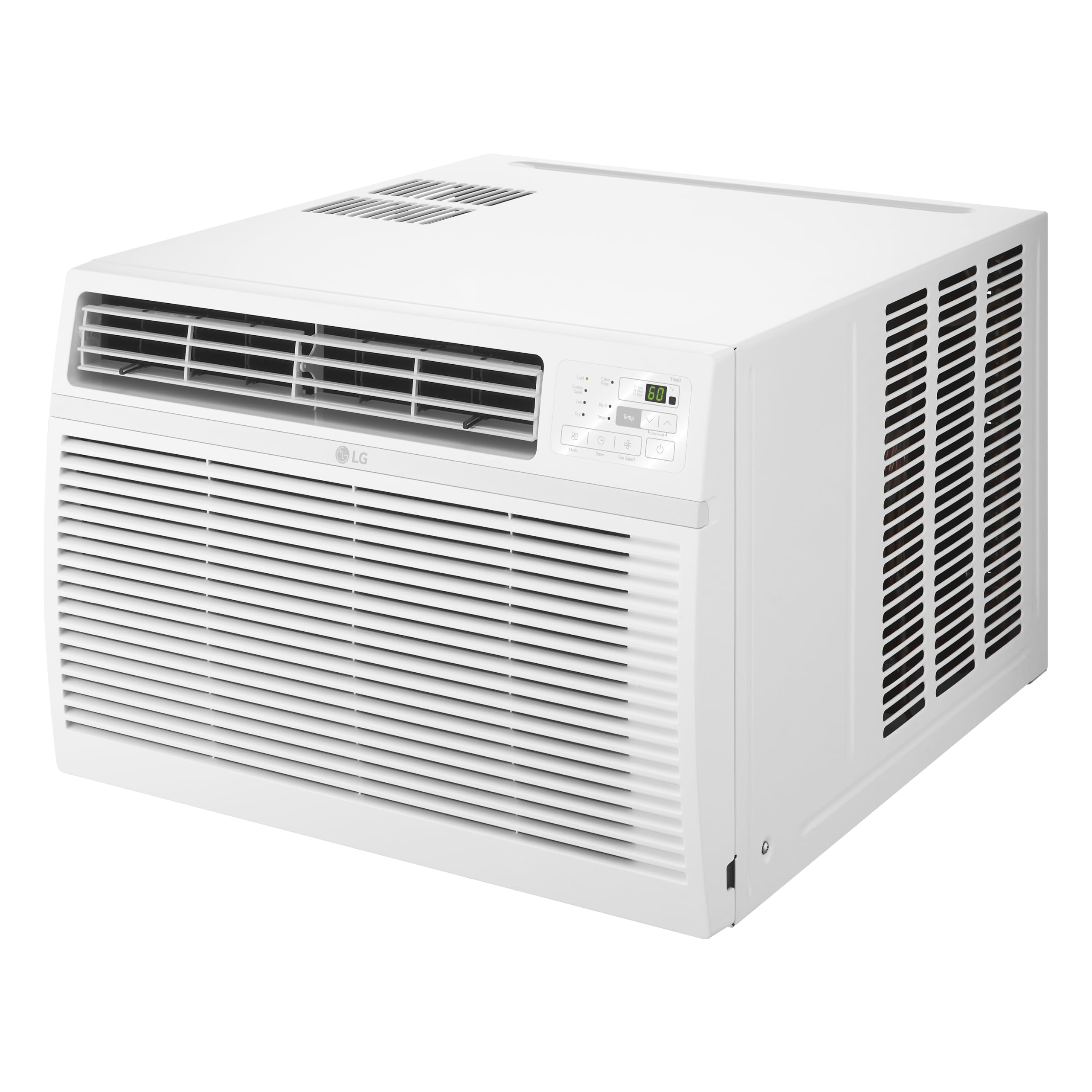
The LG LW1521ERSM1 stakes its claim on the simple truth that 14,000 BTU is plenty to handle an 800-square-foot open-concept space, and it does so with an 11.2 CEER rating that puts it among the most efficient non-inverter units on the market. The rotary scroll compressor delivers a strong 265 CFM airflow that reviewers consistently describe as feeling more powerful than the spec sheet suggests — one buyer noted feeling the breeze 18 feet away on medium fan setting. The build uses R32 refrigerant, which has a lower global warming potential than the older R410A, and the slide-out washable filter with a check-filter alert makes the monthly cleaning routine genuinely painless.
The ThinQ app integration works reliably for on/off, temperature, and mode changes, though the initial Wi-Fi setup can require a reset if the 2.4 GHz band isn’t detected on the first try. Installation is the one area where multiple owners flagged difficulty — the unit is heavy at roughly 70 pounds, and the support brackets need precise alignment that can frustrate a solo installer. The noise profile settles into a steady fan-like whoosh on lower settings that most users find acceptable for sleep, though it lacks the ultra-quiet inverter technology of the premium LG model.
Where this unit really earns its keep is in sustained high-heat conditions. Several verified reviews from Texas and Kentucky homeowners report that the LW1521ERSM1 keeps a 600-700 square foot living area at 72°F even when outdoor temperatures exceed 100°F, which is a stress test that many 14,000 BTU competitors fail. The trade-off is a less refined experience — the plastic housing has some flex, and the directional louvers are basic — but for raw, reliable cooling of a genuinely large room, this LG is the complete package.
Why it’s great
- Genuinely cools 800 sq ft even in 100°F heat
- 11.2 CEER is class-leading for a fixed-speed unit
- ThinQ app provides reliable remote scheduling
Good to know
- Heavy and finicky to install solo
- Louder than inverter competitors at full blast
- Some units arrive with cosmetic shipping damage
2. LG 14,000 BTU DUAL Inverter Smart Window Air Conditioner LW1522IVSM
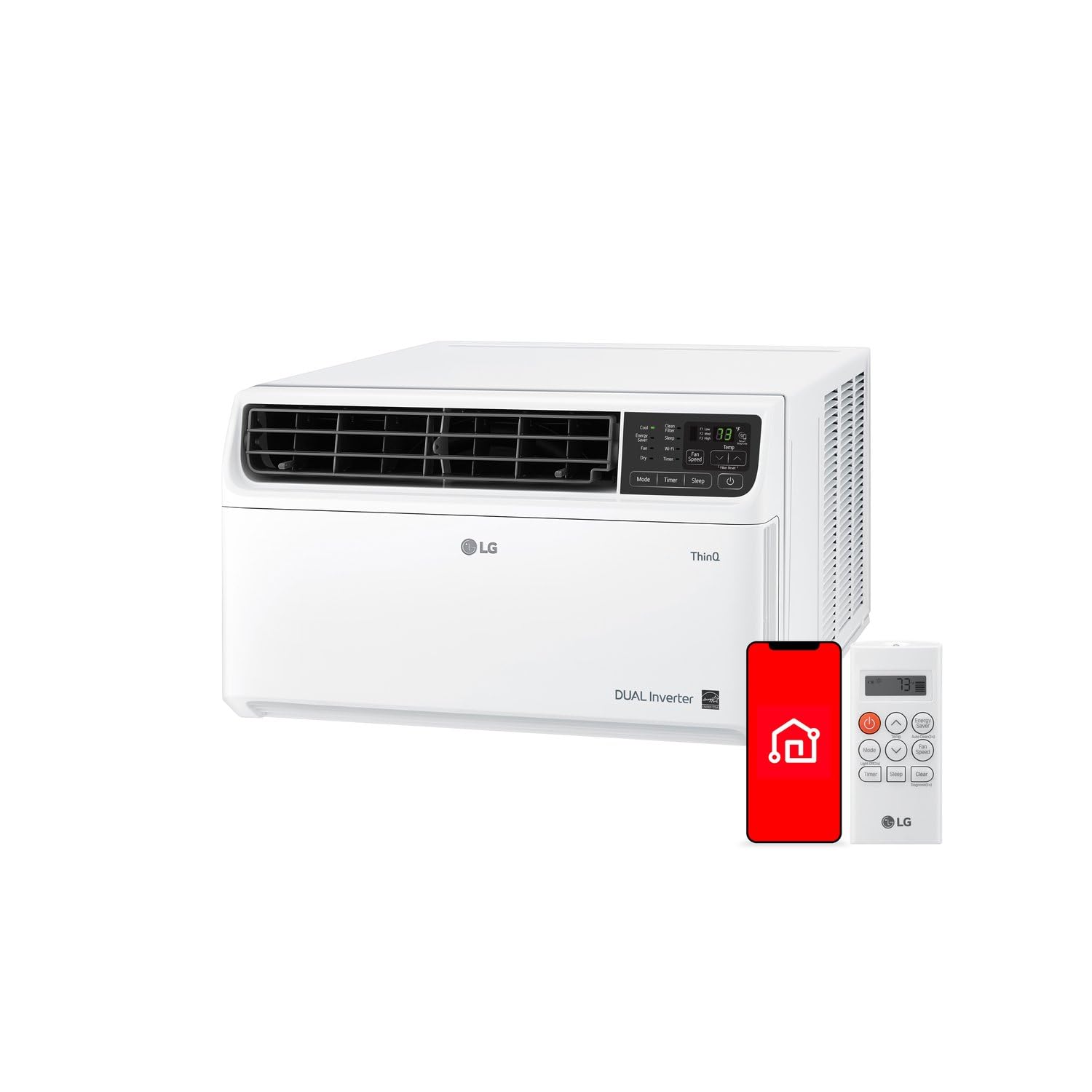
The LG LW1522IVSM uses a variable-speed DUAL Inverter compressor paired with a BLDC fan motor to achieve a noise floor of 44 dB in sleep mode — that’s quieter than a typical window unit running on low. This is not a marketing exaggeration; verified buyers consistently report that the unit is barely audible from the next room and produces a smooth, low-frequency hum rather than the jarring on/off cycling of fixed-speed designs. The DUAL Inverter maintains room temperature within about one degree of setpoint, which eliminates the hot/cold swings that make non-inverter units feel drafty.
The energy savings are equally compelling. LG claims up to 35% less energy consumption versus the ENERGY STAR minimum, and the 1260-watt annual consumption figure supports that for a 14,000 BTU unit. The ThinQ app integration adds self-diagnostics and a self-cleaning mode that runs the fan after the compressor stops to dry out the internal moisture — a feature that matters if you live in a humid climate where mold growth is a concern. The fixed chassis design is meant to simplify installation, but multiple reviews note that it actually requires disassembling the front housing and sliding the chassis into the window first, then reattaching the shell, which adds 20 minutes to the process.
Longevity is the unresolved question. Some users report the unit failing with a CH38 error code (low refrigerant, likely a microleak) after two years, which requires a professional repair that nearly equals the purchase price. Others have units running strong into their third year. The compressor itself uses R32 refrigerant and is built with an aluminium alloy core, which is lighter but historically less durable than copper. For buyers who prioritize absolute silence and steady temperature control above all else, this LG is the top choice — just be prepared for a more involved installation and accept the variable long-term reliability reports.
Why it’s great
- 44 dB sleep mode is genuinely inaudible from adjacent rooms
- Inverter maintains temperature within 1°F of setpoint
- Self-cleaning mode reduces internal moisture and mold risk
Good to know
- Difficult installation requiring partial disassembly
- Some units develop refrigerant leaks after 2-3 years
- Aluminium alloy core is less durable than copper
3. Frigidaire 14,000 BTU Smart Inverter Window Air Conditioner
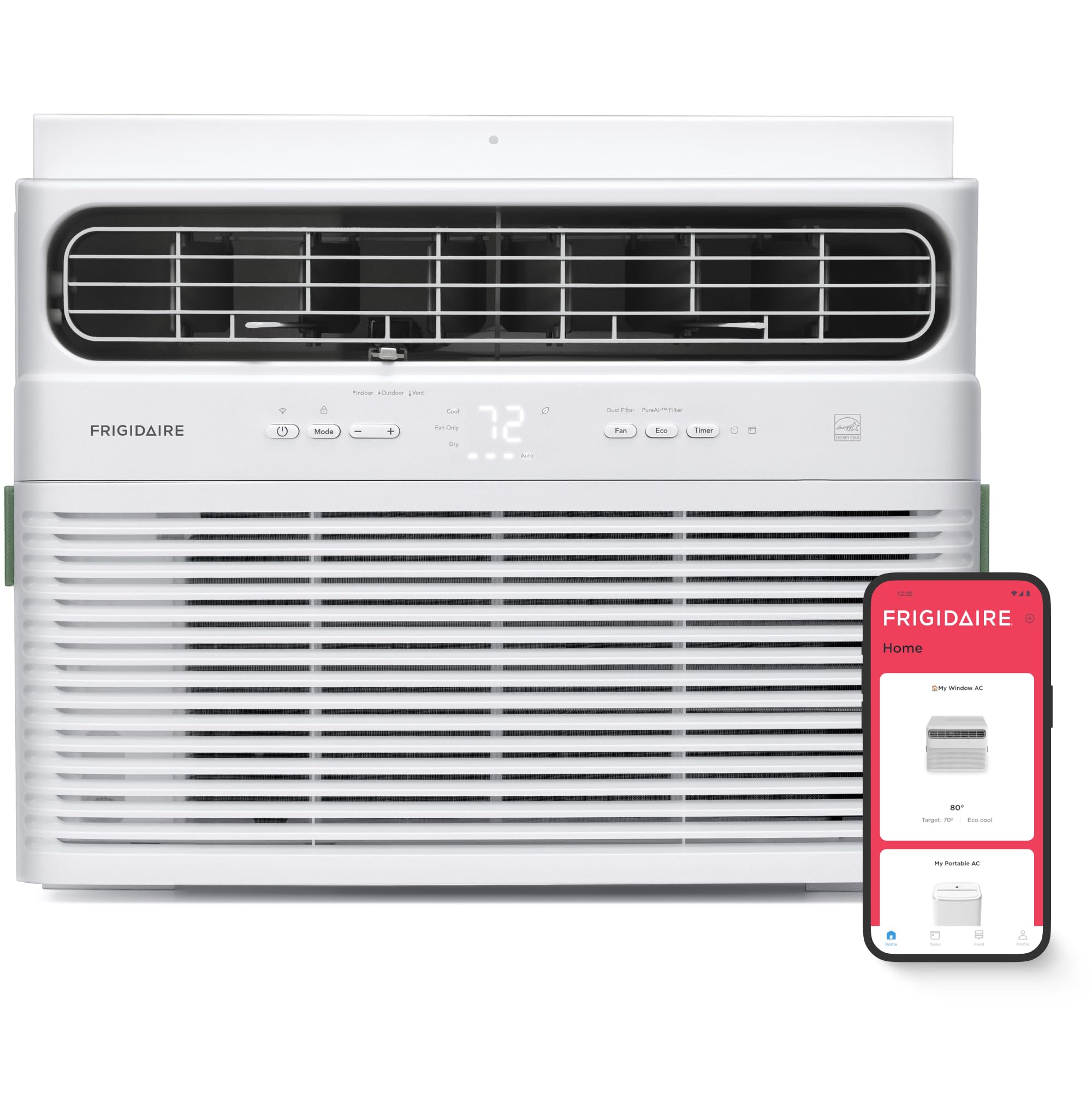
Frigidaire’s Smart Inverter achieves a remarkable 525 kilowatt-hours per year of energy consumption — that’s about half the annual draw of some fixed-speed 14,000 BTU models. The SEER 15 rating is the highest in this comparison and reflects the inverter’s ability to maintain efficient part-load operation. The compressor uses R32 refrigerant and cycles through automatic speed adjustments to hold the room temperature steady without the compressor ever fully shutting off, which eliminates the temperature overshoot that wastes energy.
The 6-way directional louvers offer more precise airflow control than the basic 4-way systems on the LG and GE units, which matters in irregularly shaped rooms where you need to direct cold air toward a specific seating area or away from a thermostat. The Wi-Fi connection to the Frigidaire app is generally reliable, and voice control via Alexa and Google Assistant works without repeated pairing. The 24-hour timer and dry mode add seasonal versatility — dry mode pulls significant moisture from the air without overcooling, which is useful in basement or humid-climate installations.
However, two critical issues are emerging from the user base. First, some units ship without the dust filter or remote control, and Frigidaire’s customer service has directed buyers to purchase replacements separately at their own cost. Second, the return policy for non-working units places the shipping cost on the buyer, which can approach -70 for a 70-pound box. Buyers should unbox and test the unit immediately upon delivery. For those who get a fully functional unit, the combination of inverter efficiency, smart features, and precise airflow makes this the best energy-saving choice in the category.
Why it’s great
- SEER 15 and 525 kWh/yr is the most efficient in class
- 6-way louvers provide superior airflow direction
- Inverter holds steady temperature with no cycling
Good to know
- Some units arrive missing remote or dust filter
- Defective unit returns require buyer-paid shipping
- Customer service is difficult to reach
4. Midea 14,000 BTU Smart Inverter Window Air Conditioner

The Midea Smart Inverter trumps the LG DUAL Inverter on paper with a claimed 41 dBA operating noise — three decibels lower, which translates to roughly half the perceived loudness. The variable-speed inverter technology is paired with a copper-core compressor, which is a durability advantage over the aluminium alloy used by LG and Frigidaire. The Midea SmartHome app provides full control over the four operating modes, three fan speeds, and the 24-hour timer, with geofencing capabilities that automatically turn the unit off when you leave the house.
Real-world user reports confirm the low noise in practice — multiple reviewers describe the unit as producing a “smooth whoosh” rather than a rattle or hum, with no compressor click when cycling between loads. The cooling performance on a 700-square-foot space is described as “powerful” and “accurate,” with the variable-speed drive maintaining a steady temperature without the frequent on/off cycles of a fixed-speed unit. The installation process is simpler than the LG DUAL Inverter because the chassis and shell are more conventional, requiring only the standard window brackets and foam weatherstripping.
The primary drawback is consistency in shipping quality. Several buyers received units with dented housings, crushed fins, or visible pet hair inside the box — suggesting warehouse handling or potential returns being resold without inspection. The unit’s cooling performance has also been questioned in one case where a buyer reported the compressor never engaged. For buyers who receive a pristine unit, this Midea is arguably the best combination of low noise, reliability, and smart features in the inverter category. Test it immediately on arrival and you’ll likely be delighted.
Why it’s great
- 41 dBA is the quietest 14,000 BTU unit available
- Copper compressor core is more durable than aluminium
- Geofencing app control saves energy automatically
Good to know
- Shipping damage and used-unit returns are common
- Defective compressor in some units out of the box
- Installation instructions suggest shell-first, unit doesn’t support it
5. GE 14,000 BTU Smart Window Air Conditioner (B0DK63RMDY)
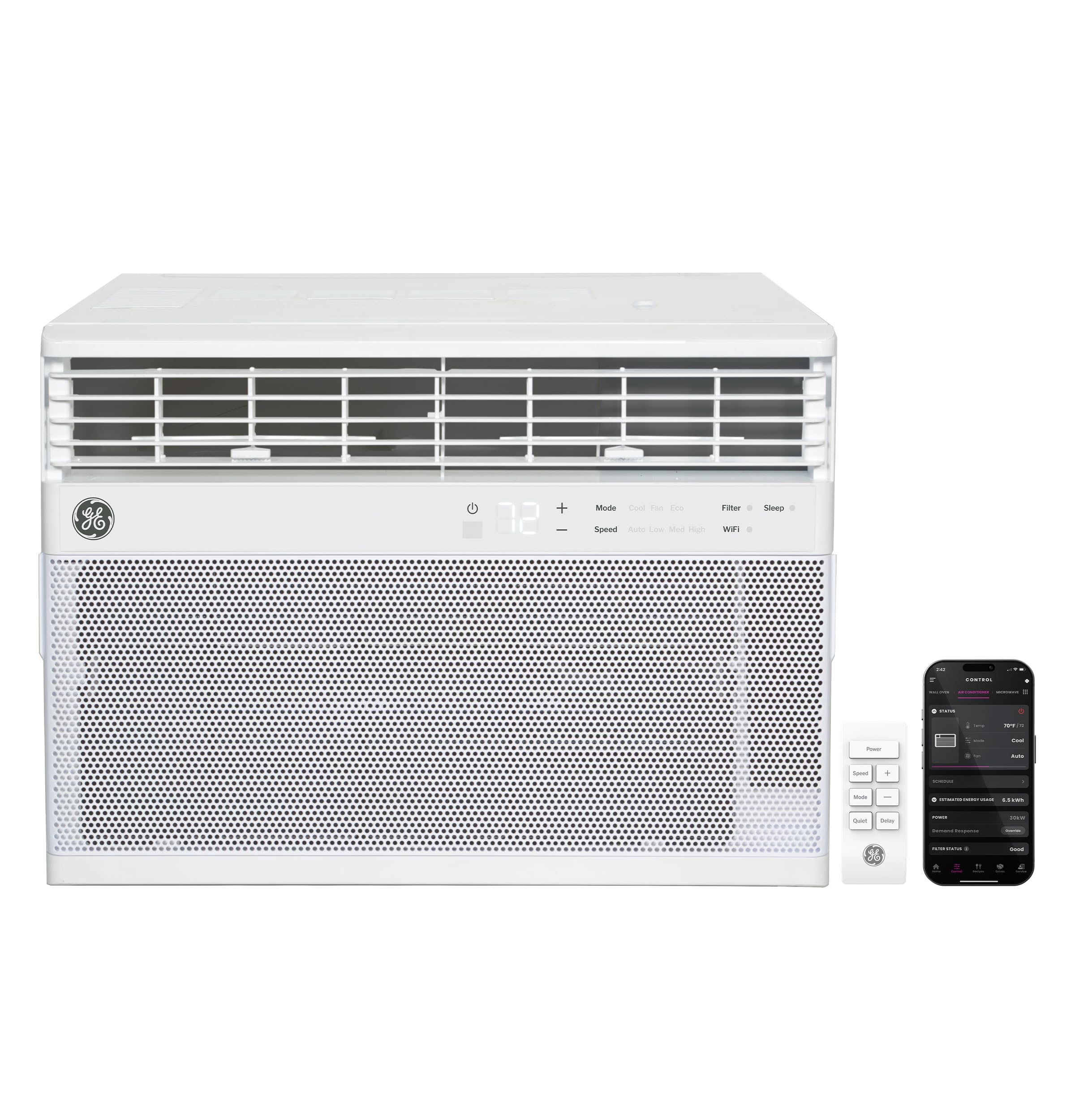
GE’s updated 14,000 BTU Smart Window Air Conditioner brings the full SmartHQ ecosystem to a fixed-chassis design that installs in windows as narrow as 26 inches. The electronic thermostat provides precise temperature control within a degree, and the three cooling modes along with three fan speeds give enough granularity to match conditions from mild evening cooling to full-blast afternoon heat. The washable filter is accessible from the front and includes a maintenance reminder, keeping the unit running at peak efficiency with minimal effort.
The SmartHQ app is one of the more polished smart home integrations in this category — it allows custom scheduling, remote monitoring, and voice control through Alexa and Google Assistant without the pairing struggles that plague some competitors. The ECO mode automatically turns off the fan and compressor once the room reaches target temperature, which cuts energy waste during stable conditions. The 1-year replacement warranty is a noteworthy perk, as most window units only offer a standard limited warranty that requires shipping the unit in for service.
However, the louvers are a weak point. They are unusually tiny, which means airflow is mostly directional forward with minimal horizontal spread — you really need to aim the unit directly at the area you want to cool. Some users also report a temperature sensor issue where the unit reads ambient temp at the control panel (which is inside the window) rather than in the room, causing it to short-cycle. A simple foam insulating pad behind the sensor is a DIY fix that experienced owners recommend. For the feature set, reliability reputation, and smart home polish, this GE represents a solid mid-premium value.
Why it’s great
- SmartHQ app is polished and reliable
- Fits narrow windows from 26 inches wide
- 1-year replacement warranty provides peace of mind
Good to know
- Tiny louvers limit directional airflow control
- Thermostat can short-cycle without sensor foam mod
- Front panel gap allows some warm air infiltration
6. GE Window Air Conditioner 14000 BTU (B08R5Q93NG)

This fixed-chassis GE model has been on the market longer than most competitors, and its longevity has produced a large body of user data that points to excellent real-world reliability. Multiple owners report that three of these units cool an entire 1,700-square-foot home — which is overkill for the rated 700-square-foot coverage, but demonstrates that the compressor is not struggling at its limit. The 4-Star BEE rating indicates that this unit meets benchmark efficiency standards for its class, and users consistently note that their electric bills dropped after replacing older 12,000 BTU units that were running full-time.
The Eco Mode implementation is straightforward and effective: the fan and compressor shut off when the room temperature is satisfied, then resume when it drifts a few degrees above setpoint. The included EZ Mount installation kit is compatible with double-hung windows measuring 25 to 36.625 inches wide, and the slide-out washable filter is accessed from the front without removing the unit from the window. The three cooling modes and three fan speeds are controlled via the electronic panel, the included remote, or voice through Alexa and Google Assistant.
The biggest risk with this unit is the same one that plagues all fixed-chassis ACs arriving by delivery: damage during shipping. The rear coil and bottom frame are vulnerable to crushing if the box is dropped, and some buyers have opened the box in July only to find a unit that was damaged and past the return window. If you order this, unbox and inspect it the same day it arrives. The noise level is average for a 14,000 BTU unit — noticeable in a quiet bedroom but reasonable for a living room — and the overall build quality reflects GE’s long experience in window AC manufacturing.
Why it’s great
- Proven reliability with years of positive user data
- Eco Mode effectively reduces energy consumption
- Easy front-access washable filter
Good to know
- Shipping damage is a common complaint
- Noise level is higher than inverter models
- Large gap between rated sq ft and real-world capacity claims
7. TCL H14W35W 14,000 BTU Smart Window Air Conditioner
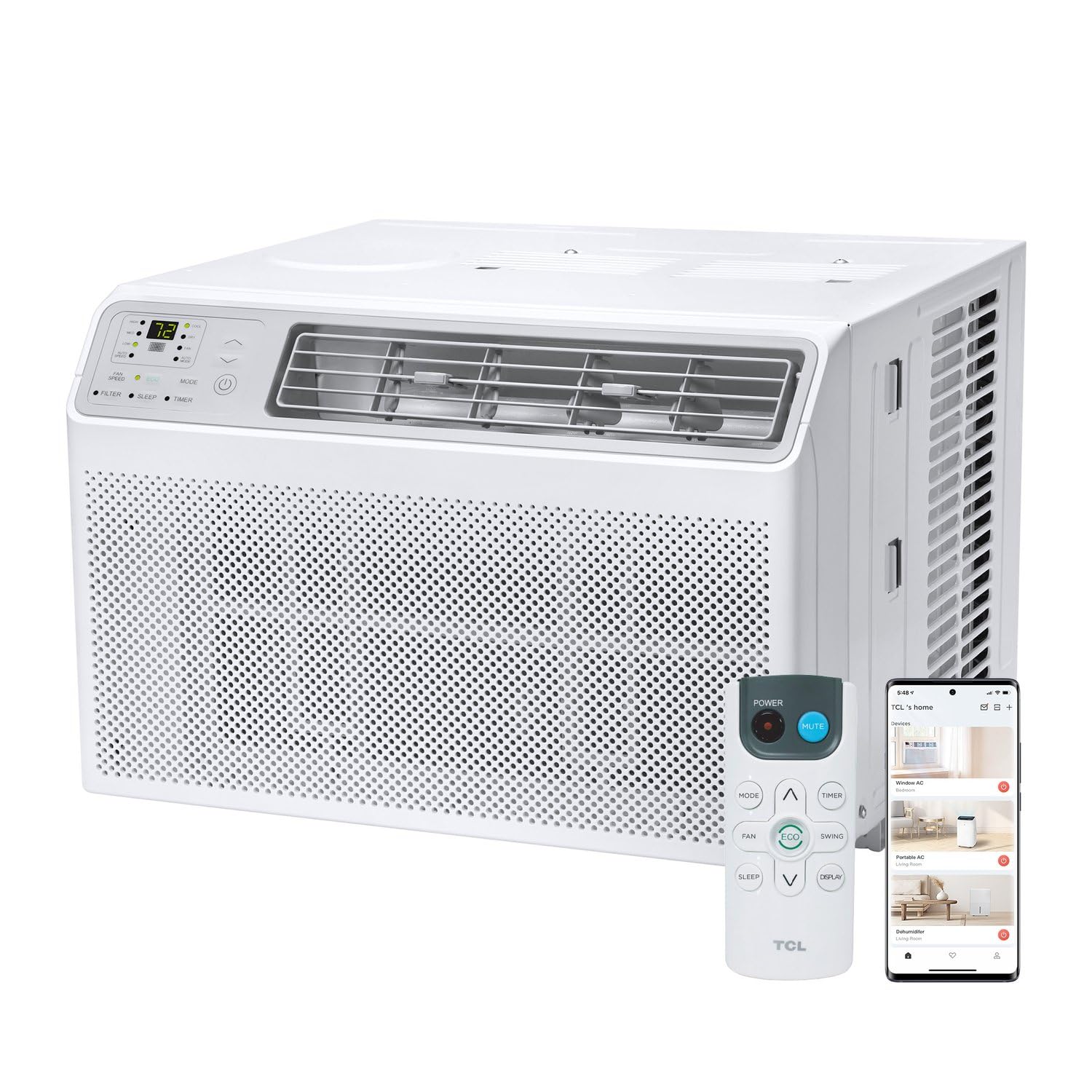
TCL’s entry into the 14,000 BTU window AC market brings the company’s signature value proposition — competitive pricing combined with smart home features that match units costing more. The 3-in-1 functionality covers cooling, dehumidification, and fan-only mode, and the unit is rated for 700 square feet. The centrifugal compressor is a less common configuration in window units, but the user reports indicate strong cooling performance: one East Texas homeowner reported dropping room temperature from 81°F to 68°F in 15 minutes in a poorly insulated house, and the unit maintained that cold output without struggling.
Voice control works with Alexa, Google Assistant, and Siri through the TCL Home app, and the app itself is straightforward with all the standard scheduling and mode controls. The installation kit is comprehensive and the manual is clear, though a screwdriver is required and some windows may need pilot holes pre-drilled. At this price point, you get full smart functionality that is absent from similarly priced units, making the TCL a strong value proposition for budget-conscious buyers who don’t want to sacrifice voice control.
The main compromises are noise and build refinement. Multiple reviewers describe the unit as “louder than expected,” with a noticeable compressor and fan noise that is more intrusive than the LG or Midea units. The aluminium alloy core is lighter but less durable than copper. Additionally, some units arrive with cosmetic damage — dents, broken parts — from shipping, though the units generally still operate correctly. If your priority is keeping your home connected and cool without spending premium money, the TCL delivers the core smart features at a price that leaves room in your budget.
Why it’s great
- Full voice control with Alexa, Google, and Siri
- Strong cooling performance in field tests
- Competitive price for smart-enabled features
Good to know
- Noticeably louder than inverter and premium units
- Aluminium alloy core not as durable as copper
- Shipping damage is relatively common
8. DELLA 14,000 BTU Window Air Conditioner
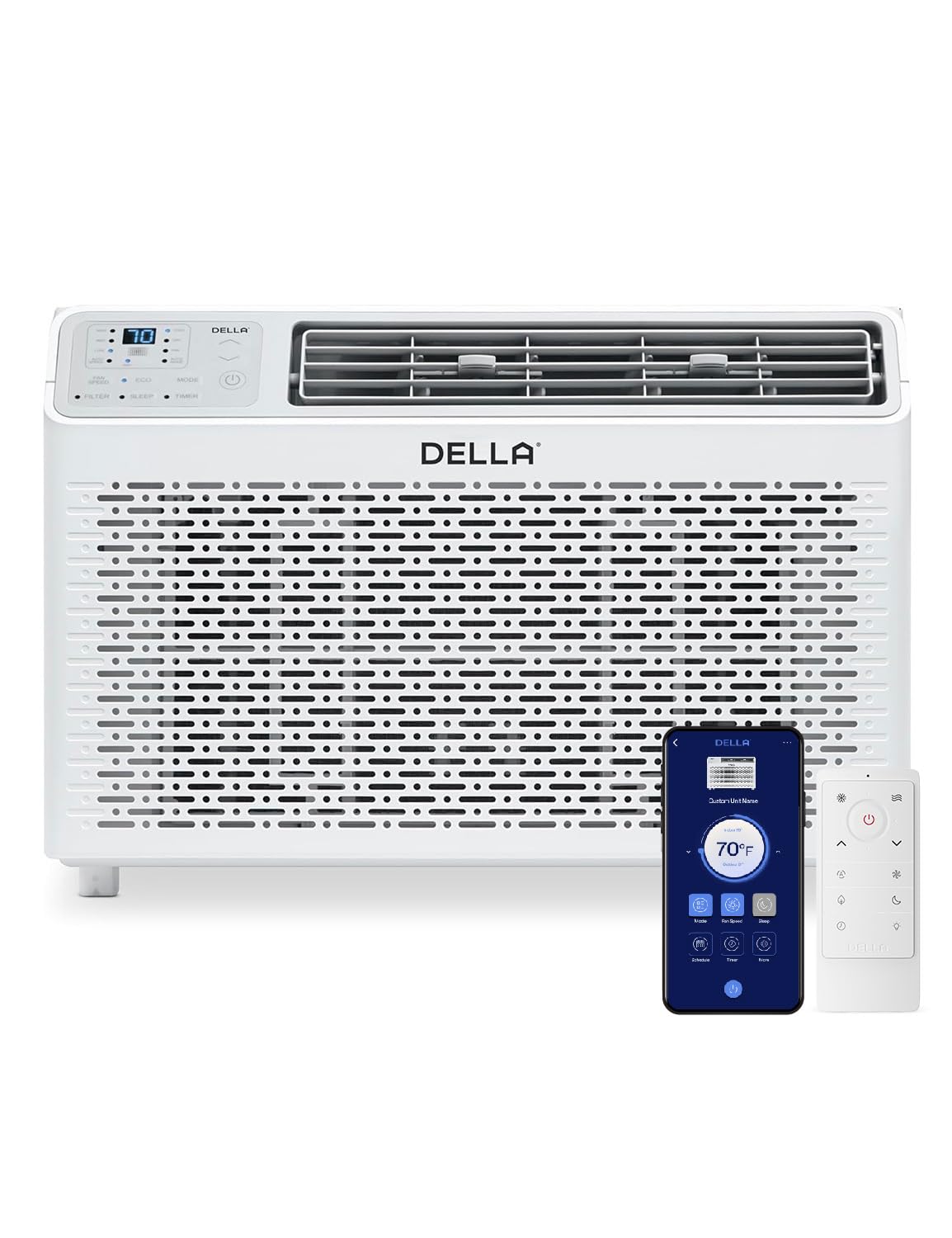
DELLA’s 14,000 BTU unit is designed with a clear emphasis on quiet operation for productive workspaces, advertising sound levels as low as 54 dB. The GEO Location feature in the DELLA+ app uses your phone’s location to automatically turn the unit off when you leave the house and back on when you’re approaching — a genuinely useful energy-saving feature that most competitors lack at this price tier. The 10.7 CEER rating is solid for a non-inverter unit, and the UL listing with the 115V/60Hz power requirement keeps installation simple without needing a dedicated circuit in most homes.
User reviews are notably mixed but skew positive when the units function correctly. The compact dimensions (19.76″ x 21.5″ x 15.16″) and 69.4-pound weight make it one of the more manageable 14,000 BTU units for a single-person installation, though a second pair of hands is still recommended.
The durability concern is real: multiple reviews report compressor failures after two years, with one unit refusing to turn off even in “off” mode (requiring a physical unplug) and another compressor simply stopping entirely. This pattern suggests potential quality control issues in the compressor supply chain. For buyers who plan to use the unit primarily during daytime working hours and store it in the off-season, the two-year lifespan may be acceptable. For year-round use in a primary living space, the premium inverter units offer better longevity prospects.
Why it’s great
- GEO location control saves energy automatically
- Compact and relatively lightweight for its BTU class
- Quiet enough for meetings and calls
Good to know
- Compressor failures reported after 2 years
- Some units can’t turn off without unplugging
- Mixed reliability track record
9. ZAFRO 14,000 BTU Window Air Conditioner
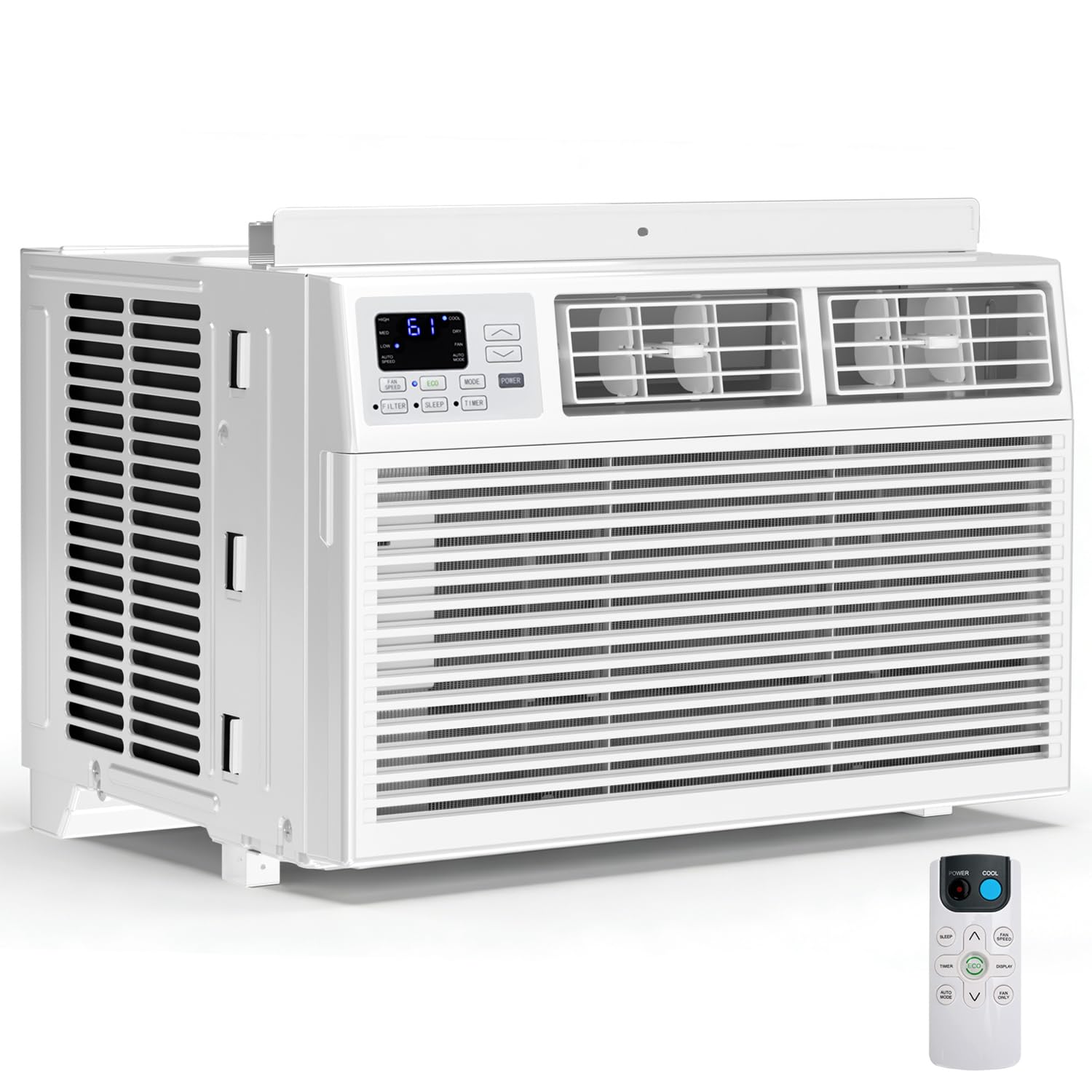
The ZAFRO 14,000 BTU unit separates itself from the pack with a dehumidification rating of 105 pints per day in Dry Mode — that’s nearly double the capacity of most competitors in this category. For anyone living in a humid climate where the air feels clammy even at 72°F, this unit’s ability to pull moisture out of the air while cooling makes a tangible difference in perceived comfort. The 4-way directional louvers provide full horizontal and vertical swing, and the temperature range extends from 61°F to 88°F with ECO, Auto, and Sleep modes intelligently managing compressor operation.
The noise floor is rated at 50-55 dB, which is average for the category and consistent with the non-inverter design. User reviews consistently praise the cooling speed and coverage area — one buyer reports that it effectively cools a 950-square-foot living/kitchen/dining area, and another noted that it maintains 72°F across a large two-bedroom apartment. The 24-hour programmable timer and included remote control provide standard convenience features, and the slide-out washable filter is easy to maintain.
The biggest pain point is packaging quality. Several units arrive with broken front fascia tabs or cosmetic damage from rough handling during shipping, and while the units typically still operate correctly, the aesthetic damage is disappointing. The unit is also slightly louder than some competitors on high fan speed, so it’s better suited for living rooms and common areas than for noise-sensitive bedrooms. For the price, the ZAFRO delivers exceptional moisture removal and solid cooling at a value that undercuts most premium models.
Why it’s great
- 105 pints/day dehumidification is class-leading
- Cools large two-bedroom apartments effectively
- Full 4-way directional airflow control
Good to know
- Shipping damage to front fascia is common
- Noisier than inverter competition on high fan
- Better for living spaces than quiet bedrooms
10. Frigidaire FHWW144TF1 Smart Window Air Conditioner

The Frigidaire FHWW144TF1 is the company’s entry point into the smart 14,000 BTU space, offering Wi-Fi connectivity through the Frigidaire app at a price that undercuts the more premium Smart Inverter model. The 1.17-ton cooling capacity covers up to 700 square feet, and the rotary scroll compressor provides reliable fixed-speed operation. The pre-filter and filter light reminder help maintain air quality, and the remote control provides basic on/off and temperature adjustment without needing to walk to the unit.
The app control is the headline feature here — you can turn the unit on from your phone before leaving work, set schedules, and adjust fan speeds remotely. The energy consumption of 960 kilowatt-hours per year is reasonable for a 14,000 BTU fixed-speed unit, though it does not match the efficiency of the inverter models. User reviews are overwhelmingly positive, with multiple 5-star ratings highlighting the unit’s ability to cool large living room and kitchen combinations effectively without excessive noise.
The limitations are predictable at this price point. The 960 kWh/yr consumption is significantly higher than the inverter models, meaning the upfront savings are partially offset by higher monthly electric bills during heavy use. The fixed-speed compressor produces the standard on/off cycling that some users find noticeable in quiet environments. This unit is a solid choice for budget-conscious buyers who want smart remote control and reliable cooling, but the long-term operating cost and noise profile make it less attractive for year-round or bedroom use.
Why it’s great
- App control provides remote scheduling and on/off
- Reliable Frigidaire build quality
- Good cooling performance for large rooms
Good to know
- 960 kWh/yr is higher than inverter competitors
- Fixed-speed compressor cycles on/off audibly
- No voice control or geofencing
11. Keystone 14,000 BTU Window Air Conditioner
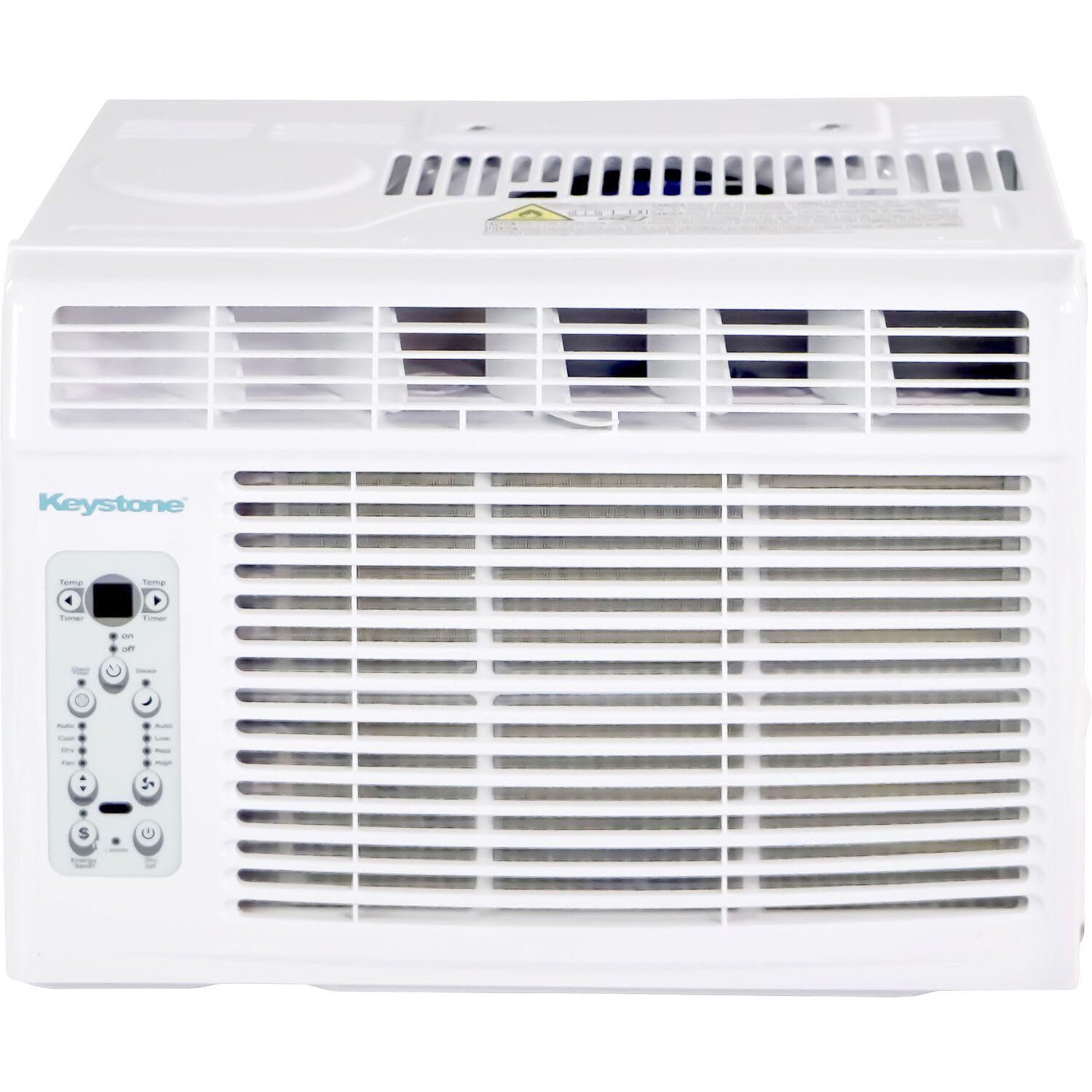
The Keystone 14,000 BTU window air conditioner is the purest expression of budget value in this comparison: a no-frills unit that prioritizes raw cooling power for large spaces without adding premium features or smart connectivity. The 650-square-foot rating is conservative — multiple buyers report that it effectively cools a “huge living room and two adjacent rooms” and helps maintain stable temperatures for aquarium and pet environments. The 2.1 pints per hour dehumidification rate is welcome in humid climates, and the 4-way adjustable louvers allow reasonable airflow direction.
The included remote control features an LCD screen that measures room temperature at the remote’s location and sends a signal to the unit every three minutes for accurate cooling — a clever workaround for the standard problem of the thermostat being inside the window frame where it reads warmer than the room. The washable filter has a convenient check-filter indicator light that removes the guesswork from maintenance schedules. The Energy Saver and Sleep modes automatically adjust compressor and fan operation to reduce power consumption during stable conditions.
The price point comes with predictable trade-offs. The unit is notably noisier than inverter competitors, with several reviews describing it as “audible” or “a bit loud” during operation. Build quality at this tier is functional rather than refined — the plastic panels have some flex, and the assembly lacks the tight tolerances of LG or GE units. Most critically, some units have failed after a short period, with one buyer reporting a unit that stopped working after two days. For buyers on a strict budget who need to cool a very large room and can tolerate the mechanical noise, the Keystone delivers the most cooling per dollar spent.
Why it’s great
- Best cooling-per-dollar ratio in the category
- Remote with LCD temp sensor improves thermostat accuracy
- Energy Saver and Sleep modes help control electric bills
Good to know
- Noisier than most competitors in this lineup
- Build quality is functional but not refined
- Some units fail shortly after installation
FAQ
How do I know if 14,000 BTU is too much for my room?
Can a 14,000 BTU window AC run on a standard 15-amp household circuit?
What is the R32 refrigerant advantage in newer 14,000 BTU units?
Why does my new 14,000 BTU unit sound louder in the box than expected?
How often should I clean the filter on a 14,000 BTU window AC?
Final Thoughts: The Verdict
For most users, the 14000 btu window air conditioner winner is the LG LW1521ERSM1 because it combines class-leading CEER efficiency, genuine 800-square-foot cooling capability, and reliable smart home integration at a price that undercuts the inverter models while delivering performance that satisfies even demanding 100°F days. If you need whisper-quiet operation and steady inverter temperature control for a bedroom or open office, grab the LG LW1522IVSM DUAL Inverter — the 44 dB sleep mode makes it the best choice for noise-sensitive environments. And for the energy-conscious buyer who plans to run the AC daily for six months, the Frigidaire Smart Inverter with its SEER 15 rating and 525 kWh/yr consumption will pay back its premium in reduced electric bills within two summers.