
You pick a movie, press play, and hear a thin, flat layer of sound. The dialog gets mushy, the bass is a vague thud, and the car chase just sits in front of you. A soundbar that only handles stereo leaves the room feeling empty. The whole point of upgrading your audio is to feel the helicopter fly overhead, to hear rain fall behind the couch, and to have the room itself become part of the story.
I’m Min — the co-founder and writer behind Gadgets Feed. I’ve spent hundreds of hours dissecting frequency response curves, DSP channel counts, wireless subwoofer architectures, and real-world user reviews across dozens of home theater audio systems to pin down exactly what separates a gimmick from genuine immersion. This guide focuses on the hardware that actually delivers a convincing 3D sound field for your living room.
No matter if you are building from scratch or replacing aging gear, choosing the right 3d sound system for home theater comes down to understanding channel layouts, subwoofer extension, and how height effects are reproduced.
How To Choose The Best 3D Sound System For Home Theater
The promise of 3D sound is sound placed precisely around and above you. The wrong system leaves the height channels quiet and the surround field disconnected. Focus on four decisions first.
Channel Configuration
The first number is the count of horizontal channels (left, center, right, side surrounds, rear surrounds). The second is the number of subwoofers. The third is the count of discrete height or up-firing channels. A 5.1.4 system means five horizontal channels, one subwoofer, and four height channels. For convincing overhead effects, at least two height channels are the minimum, but four create a more seamless sound bubble.
Subwoofer Extension and Power
The depth of bass defines how physical an explosion or a racing engine feels. Look for a subwoofer that reaches below 30Hz for serious rumble. Larger drivers — 10-inch or 12-inch — can move enough air to pressurize a medium-sized living room. Wireless subwoofers simplify placement, but check that the wireless transmission uses a dedicated band (like 5GHz) to avoid interference from Wi-Fi networks.
Up-Firing vs. Ceiling vs. Bipolar Height Speakers
Up-firing speakers bounce sound off the ceiling to simulate overhead effects. They work well only with flat, reflective ceilings under 12 feet. Ceiling-mounted speakers deliver the most precise height imaging but require in-wall installation. Bipolar height speakers fire from both sides and above, creating a wider overhead presence without need for ceiling holes. Your ceiling height and willingness to run wires dictate the best approach.
Quick Comparison
On smaller screens, swipe sideways to see the full table.
| Model | Category | Best For | Key Spec | Amazon |
|---|---|---|---|---|
| Hisense AX5140Q | Soundbar | Entry-Level Atmos | 5.1.4 channels, 6.5″ subwoofer | Amazon |
| Amazon Fire TV Soundbar Plus | Soundbar | Dialogue Clarity | 5.1 channels, dedicated center channel | Amazon |
| ULTIMEA Skywave X40 | Soundbar | Budget Height Effects | 5.1.2 channels, 35Hz subwoofer | Amazon |
| Klipsch Reference Cinema 5.1.4 | Passive Speakers | Starter Passive Setup | 5.1.4, up-firing on all four satellites | Amazon |
| ULTIMEA Skywave X70 | Soundbar | Deep Bass | 7.1.4 channels, 10″ subwoofer at 20Hz | Amazon |
| Nakamichi Shockwafe Ultra 9.2.4 | Soundbar | Dual Subwoofer Power | 9.2.4, dual 10″ subs, four surrounds | Amazon |
| JBL Bar 1300XMK2 | Soundbar | Detachable Surrounds | 11.1.4, 12″ subwoofer, 1570W | Amazon |
| Klipsch Reference Bundle | Passive Speakers | Full Receiver Setup | 5.1.2, floor-standing towers with Atmos | Amazon |
| Nakamichi Shockwafe 11.2.6 | Soundbar | 6 Height Channels | 11.2.6, dedicated height drivers, 2300W | Amazon |
| Sony BRAVIA Theater Quad | Wireless Speakers | Phantom Center Imaging | 4 wireless speakers, 360 Spatial Sound Mapping | Amazon |
| LG OLED83G5WUA | TV Integrated | TV+Audio Bundle | 83-inch OLED, Dolby Atmos, WOW Orchestra | Amazon |
In‑Depth Reviews
1. Nakamichi Shockwafe 11.2.6 Ch Soundbar System
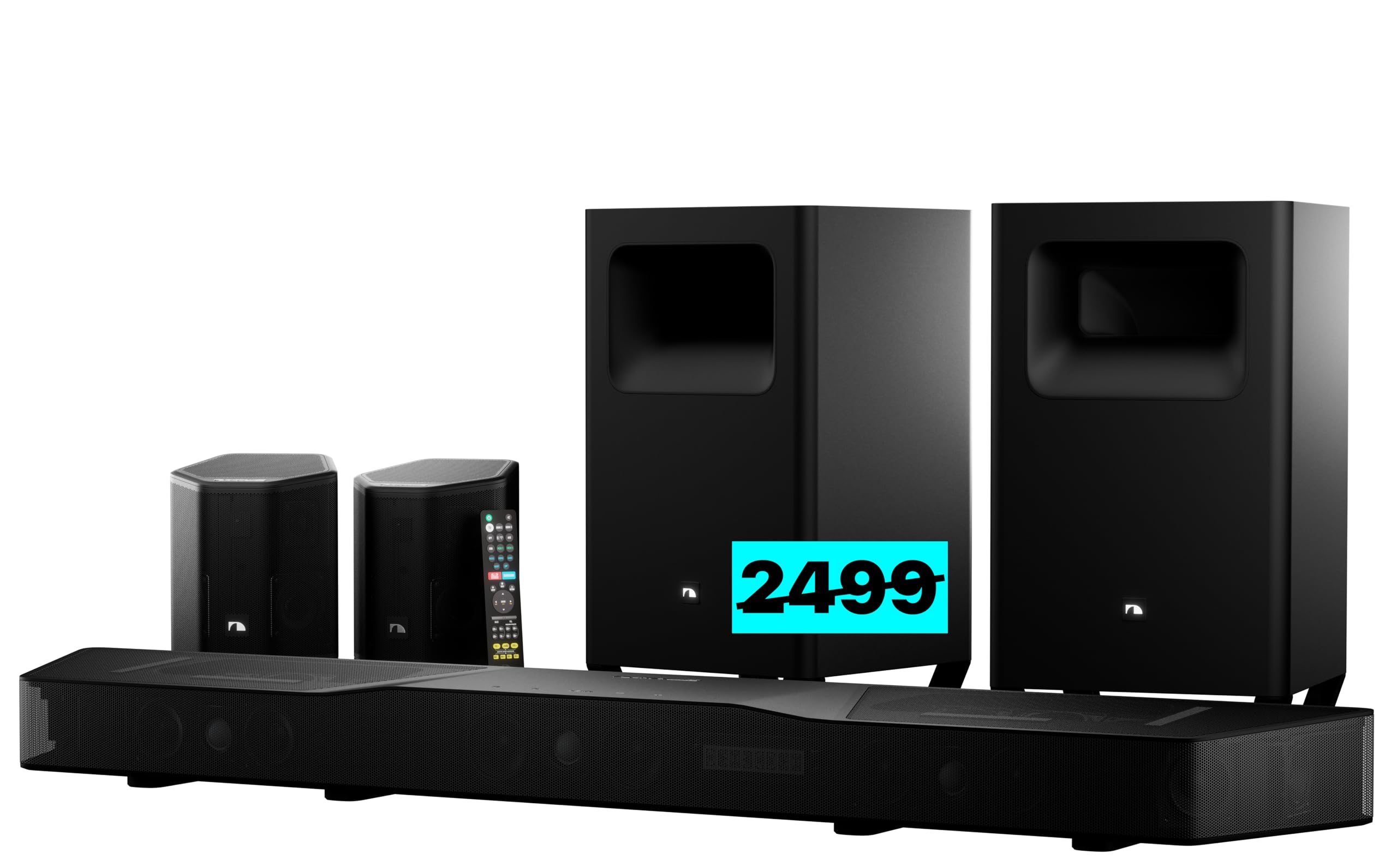
The Nakamichi Shockwafe 11.2.6 is a unique architecture that uses two bipolar surround speakers to create the effect of six discrete surround channels, plus six dedicated height channels for overhead effects. The soundbar itself spans 54 inches and houses front-firing and upward-firing drivers that produce a massive front soundstage. The dual 10-inch wireless subwoofers reach deep into the low frequencies without losing definition, even during complex action sequences.
Setup is straightforward for a system of this scale — the subwoofers and bipolar surrounds connect wirelessly to the main bar, and the included HDMI eARC port supports Dolby Vision and 4K120Hz passthrough. The AHD Ultra engine processes 2300 watts of peak output, and the rear channels deliver precise directional cues that make the room feel larger than it is. Dialogue stays locked to the center channel even at high volume, and the height drivers convincingly place rain, helicopters, and overhead explosions above the listening position.
Owners consistently report that the system competes with dedicated receiver-based setups costing significantly more. The default out-of-box sound is flat, but a firmware update unlocks the full spatial effect; the app-based calibration tool then dials in the subwoofer levels and channel delays for the specific room layout. The bipolar surround speakers weigh just over 8 pounds each and need table space or stands, but the trade-off is a genuinely immersive sound bubble that feels cinematic.
Why it’s great
- Six discrete height channels deliver convincing overhead Atmos effects
- Dual 10-inch subwoofers produce room-filling bass without distortion
- Bipolar surround speakers widen the rear soundstage beyond typical satellites
Good to know
- Large 54-inch soundbar requires a wide media console
- Firmware update is required for the best spatial performance
2. JBL Bar 1300XMK2 11.1.4 Channel Soundbar System
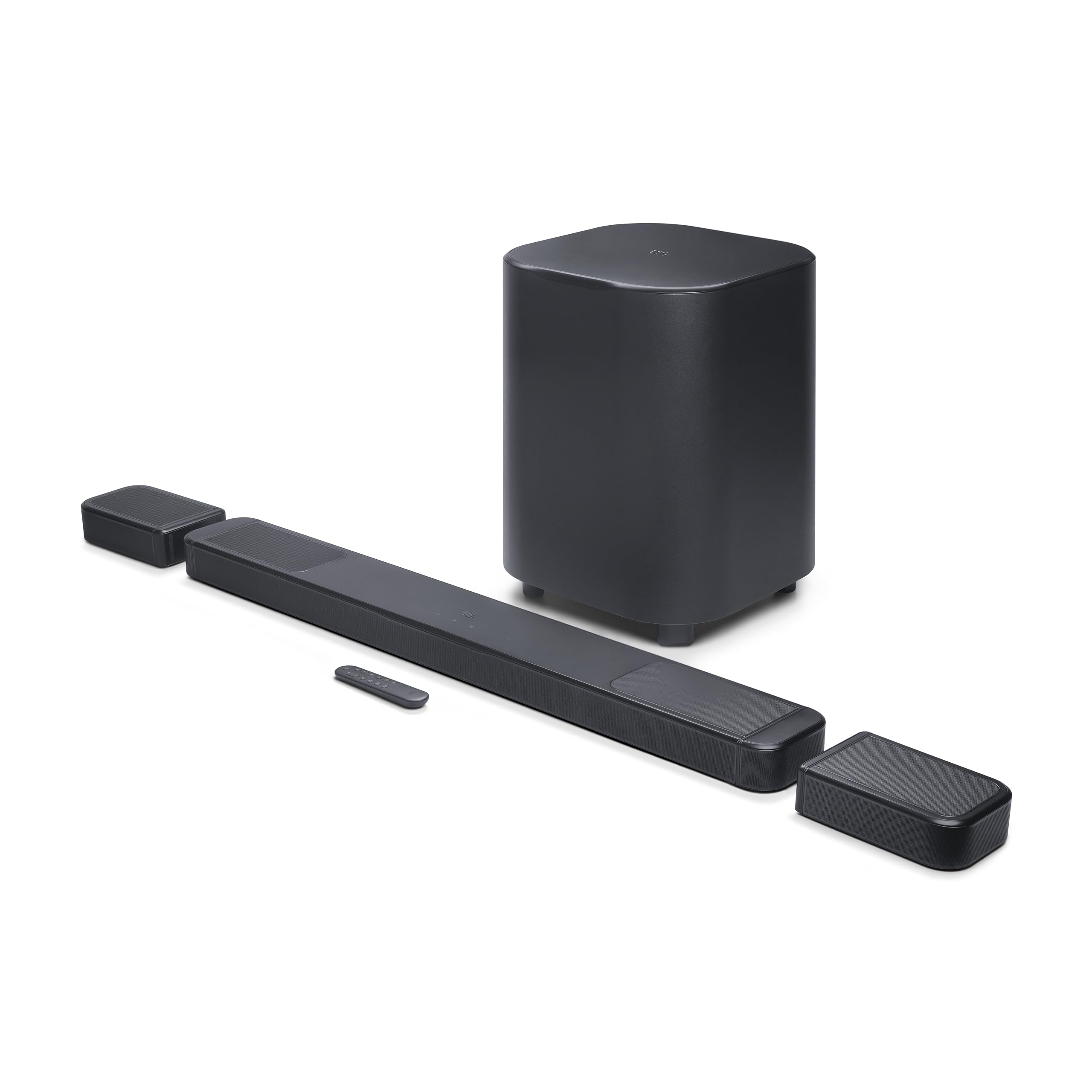
The JBL Bar 1300XMK2 is a rare system that turns its rear speakers into batteries. The satellite speakers attach magnetically to the main bar for charging; when you lift them off, they become fully wireless battery-powered surround speakers with up-firing drivers. This eliminates the need for rear power outlets and makes the system truly plug-and-play. The main bar houses six up-firing speakers in total — two in each detachable satellite and two fixed in the bar itself — for a full 11.1.4 channel Dolby Atmos layout.
A 12-inch wireless subwoofer rounds out the bass department with deep extension that pressurizes a 16-foot by 12-foot room easily. JBL’s MultiBeam 3.0 technology widens the front soundstage so that even without perfect placement, voices and effects sound diffuse and spacious. PureVoice 2.0 automatically adjusts dialogue levels based on scene content, so whispers stay audible without raising the whole system volume. The JBL ONE app provides a 10-band EQ for fine-tuning.
The detachable speakers have a battery life of around 4 to 5 hours, which is sufficient for a full movie, and they recharge quickly when snapped back onto the bar. Owners note that the 1570W peak output can rattle windows and that the system replaces a traditional receiver-based 5.1 setup without losing clarity. The main downside is that the rear speakers need to be returned to the bar after each session, and forgetting to do so leaves them dead for the next viewing.
Why it’s great
- Battery-powered detachable surrounds eliminate rear wires entirely
- Six up-firing drivers create distinct overhead effects
- 12-inch subwoofer reaches deep bass below 30Hz
Good to know
- Rear batteries last 4-5 hours and require recharging on the bar
- System is large and needs substantial cabinet space
3. Nakamichi Shockwafe Ultra 9.2.4 Channel Soundbar System
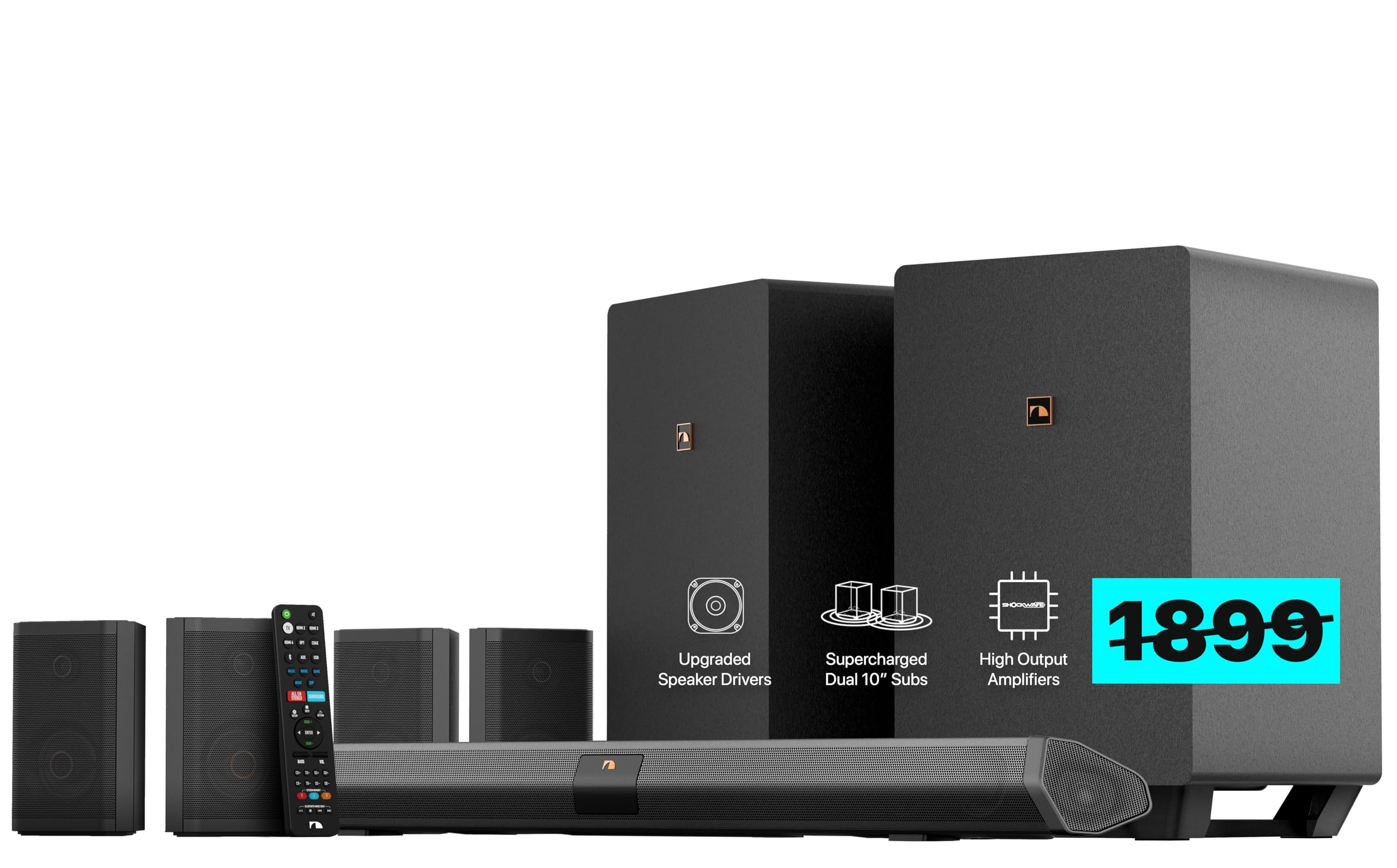
The Nakamichi Shockwafe Ultra 9.2.4 delivers dual 10-inch subwoofers and four modular surround speakers that create a 360-degree sound field. The SSE MAX engine processes Dolby Atmos and DTS:X tracks with clear channel separation, and the dual subwoofer design minimizes low-frequency localization — bass feels like it comes from everywhere, not just one corner. The soundbar includes three HDMI inputs plus eARC for connecting a 4K Blu-ray player and game console simultaneously.
Each surround speaker connects to its respective subwoofer via an RCA cable, so the system isn’t fully wireless, but the connection is reliable and the cords are thin enough to hide under a rug. The four surrounds can be used individually for a wider field or attached to dipole adapters for a narrower footprint. The backlit remote simplifies nighttime control, and the system includes a pre-install guide with room layout recommendations.
Owners upgrade from older Nakamichi models and report that the Ultra 9.2.4 sounds like an IMAX experience in a living room. The bass is tactile without overwhelming dialogue, and the height effects are audible even with standard ceiling heights. The subwoofers are tall — over 20 inches high — so they need floor space, and the surround speakers require tabletop placement or stands. For listeners seeking cinema-level dynamics at a mid-premium price, this system delivers.
Why it’s great
- Dual 10-inch subwoofers distribute bass evenly across the room
- Four modular surround speakers enable flexible placement
- HDMI eARC supports Dolby Vision and 4K pass-through
Good to know
- Surround speakers connect to subs via RCA, not fully wireless
- Subwoofers are large and require dedicated floor space
4. Sony BRAVIA Theater Quad 16-Speaker System

The Sony BRAVIA Theater Quad breaks the soundbar mold by using four separate wireless speakers, each housing four driver units, for a total of 16 speakers. Sony’s 360 Spatial Sound Mapping technology uses these four speaker cabinets to generate 12 phantom speakers, creating a virtual surround field that adapts to the room’s dimensions. There is no physical center channel — the system creates a phantom center that locks dialogue to the screen even when the listener sits off-axis.
Each speaker connects wirelessly to the central control box, which includes two HDMI 2.1 inputs with 4K120Hz, VRR, and ALLM support for gaming. Sound Field Optimization uses the built-in microphones to measure distance and angle to every wall, then adjusts the spatial mapping accordingly. The result is a remarkably coherent sound bubble where effects seem to come from specific points in the room, not just from the speaker locations. Dolby Atmos and DTS:X are decoded natively.
The system requires a separate Sony subwoofer — the SW3 or SW5 — for low-end impact below 30Hz, and only one sub can be connected at a time, which limits bass headroom for large rooms. The app-based setup can be finicky with Wi-Fi interference; owners recommend a wired Ethernet connection to the control box for stability. For those who prioritize a wide, seamless soundstage over raw volume, the Theater Quad delivers a level of imaging that rivals traditional in-ceiling speaker setups.
Why it’s great
- Phantom center channel provides precise dialogue without a center speaker
- 360 Spatial Sound Mapping adapts perfectly to any room shape
- Wireless speakers offer total placement flexibility
Good to know
- Requires an optional Sony subwoofer for deep bass
- Setup software can be glitchy with heavy Wi-Fi traffic
5. ULTIMEA Skywave X70 7.1.4ch Soundbar
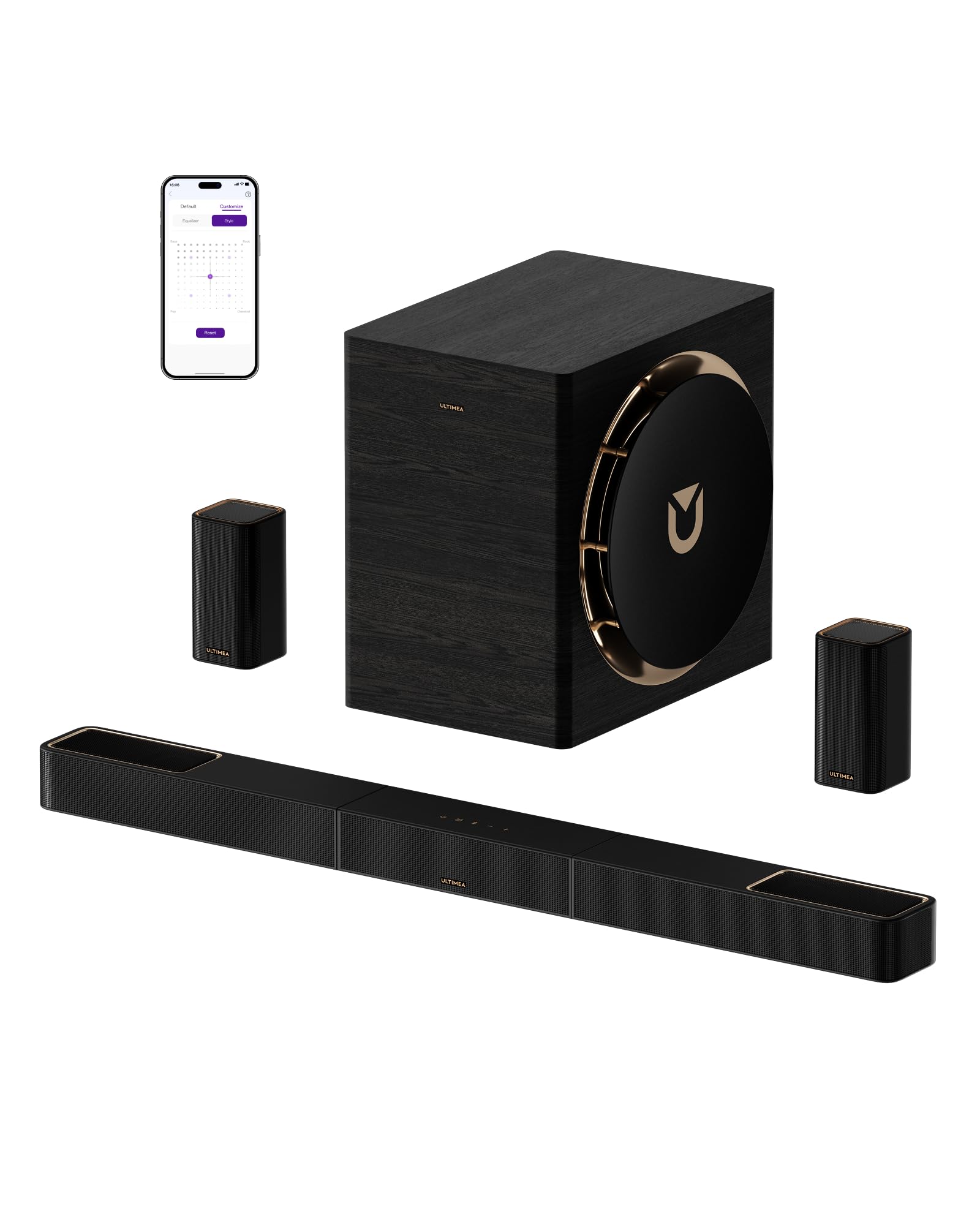
The ULTIMEA Skywave X70 is a 7.1.4-channel system built around a 10-inch wireless subwoofer with a rated low-end extension of 20Hz. That 20Hz figure means the subwoofer reproduces the deepest organ notes and the lowest rumbles in modern movie soundtracks with physical presence. The main soundbar separates into three connected pieces to accommodate wider TVs, and two wireless surround speakers handle the rear channels. The GaN amplifier delivers up to 980W peak power with 98% efficiency.
The NEURACORE processing engine uses a triple-core DSP and dual-core MCU to decode up to 17 channels internally, although the speaker array physically supports 7.1.4. This processing headroom means the system can apply advanced spatial processing to non-Atmos content, and the Surround AI algorithm adds rear channel effects to stereo sources. The companion app includes a 10-band EQ, 121 sound presets, and OTA firmware updates. The subwoofer enclosure uses a wood-crafted cabinet with a metal grille.
Owners note that the bass from the 10-inch driver is both deep and clean, though not as tight as premium ported enclosures from dedicated subwoofer brands. The wireless connection between the soundbar and satellite speakers uses dual 5GHz transmission, which avoids dropouts common with 2.4GHz-based systems. The system lacks automatic room calibration, so manual placement of the surround speakers is needed to fine-tune the soundstage. For buyers who want sub-30Hz extension without spending premium money, the X70 is a strong contender.
Why it’s great
- 10-inch subwoofer reaches down to 20Hz for deep bass
- Dual 5GHz wireless avoids interference and dropouts
- GaN amplifier runs cool while delivering high power
Good to know
- No automatic room calibration; manual placement required
- Middle section of the three-piece bar may have alignment gaps
6. Klipsch Reference Dolby Atmos Home Theater Bundle
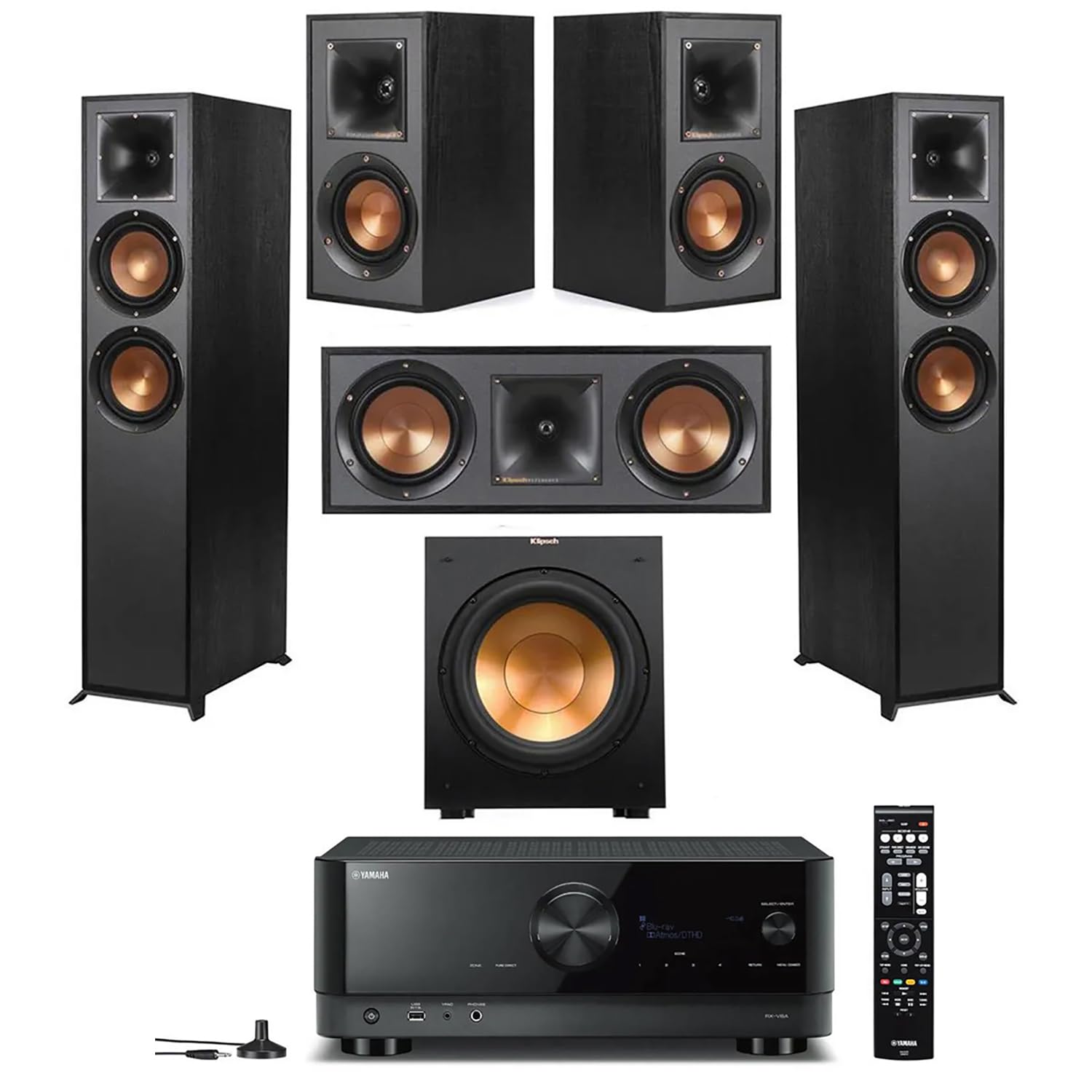
The Klipsch Reference Bundle is a complete passive speaker system paired with a Yamaha RX-A2AB AV receiver. The kit includes two R-625FA floor-standing towers with built-in up-firing Dolby Atmos elevation drivers, an R-52C center channel, two R-41M bookshelf surrounds, and an R-12SW 12-inch powered subwoofer. This is a 5.1.2 configuration that relies on the receiver for amplification and decoding rather than a soundbar’s internal DSP. The Yamaha receiver provides 75 watts per channel and supports 8K video pass-through.
Klipsch’s Tractrix horn-loaded tweeters deliver high sensitivity — between 90 and 96 dB depending on the speaker model — which means even modest amplifier power produces clean, loud sound without distortion. The R-625FA towers include a dedicated up-firing driver that bounces height effects off the ceiling. The 12-inch copper-spun IMG subwoofer produces punchy, authoritative bass that can pressurize medium-sized rooms. The system requires speaker wire connections for all five speakers, and the receiver needs to be programmed with the correct crossover settings (typically 80Hz to 100Hz) for optimal integration.
Owners praise the clarity of dialogue through the center channel and the sheer presence of the floor-standing towers during action scenes. The supplied tower feet use screws that can strip easily, so replacing them with aftermarket spikes is a common modification. The system is ideal for buyers who prefer the upgrade path of a traditional receiver setup or who already own a receiver and want to add Klipsch speakers. For listeners who value future-proofing, the receiver can be upgraded later, while the speakers will remain relevant for years.
Why it’s great
- Floor-standing towers produce wide dynamics without a subwoofer crossover
- Up-firing Atmos drivers in the front towers for height effects
- Yamaha receiver supports 8K video and future speaker upgrades
Good to know
- Requires speaker wire for all five channels; not for clean-cable setups
- Tower feet screws are low quality and may need replacement
7. ULTIMEA Skywave X40 5.1.2ch Soundbar
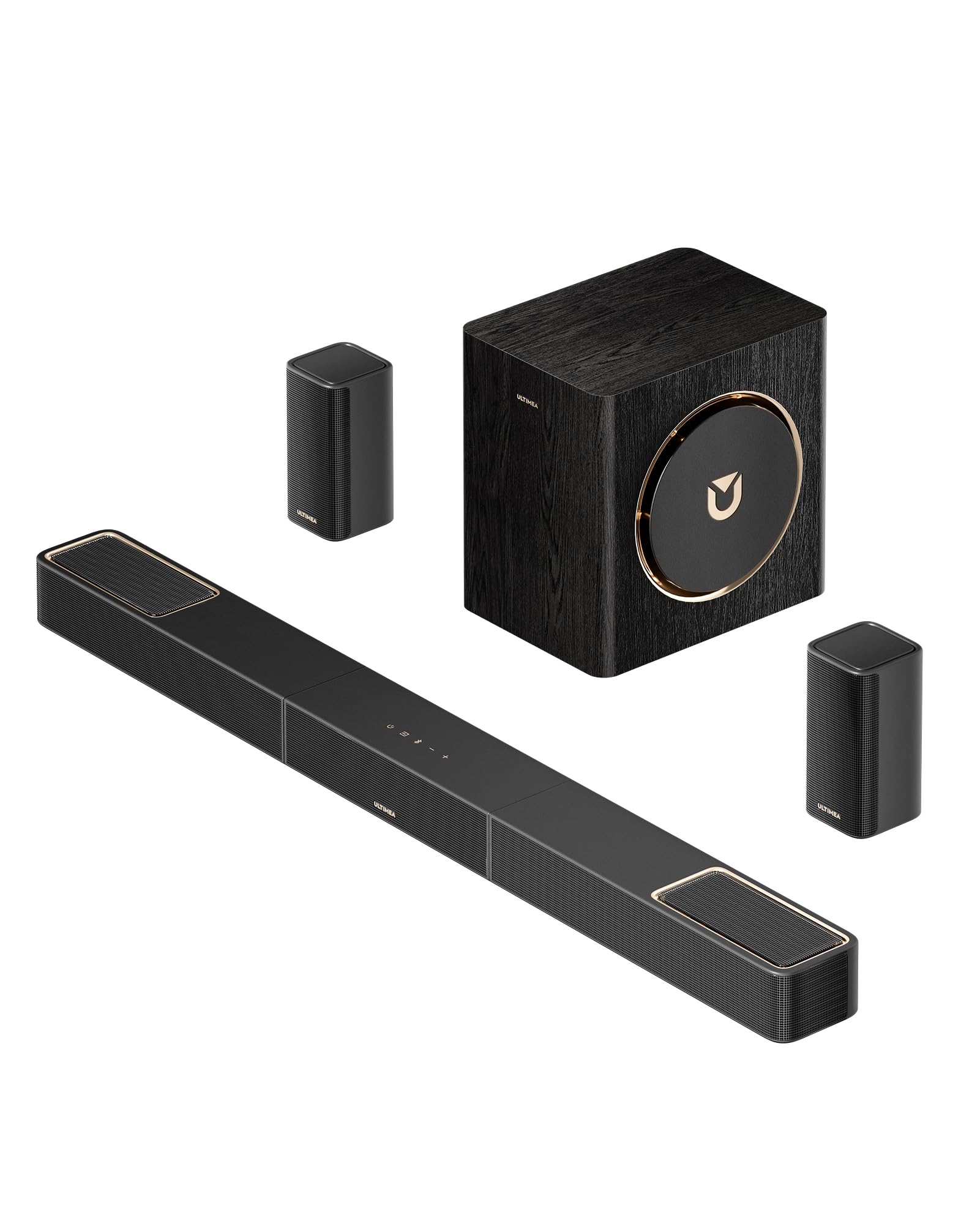
The ULTIMEA Skywave X40 is a 5.1.2-channel soundbar that introduces Dolby Atmos height effects at an accessible price point. The system includes a 6.5-inch wireless subwoofer and two wireless rear surround speakers, all pre-paired out of the box. The GaN amplifier provides 530W peak power with low heat generation, and the NEURACORE engine processes 24-bit/192kHz audio. Setup takes roughly five minutes — plug in the subwoofer and surround speakers, connect the soundbar to the TV via HDMI eARC or optical, and the system automatically pairs.
The up-firing drivers in the soundbar create a noticeable overhead bubble when the ceiling height is standard — around 8 to 10 feet — but the effect is less distinct in rooms with vaulted ceilings. The Gravus subwoofer features an oversized waveguide and a precision-tuned acoustic chamber to maintain bass down to 35Hz without sounding boomy. A 10-band EQ in the companion app allows fine-tuning of the frequency response. The soundbar itself has a metal grille with rose gold accents and a wood-crafted subwoofer enclosure.
Owners consistently note that the X40 outperforms its price class in terms of dialogue clarity and bass depth. The system does not include automatic room calibration, so placing the rear surrounds at the correct height and distance is essential for a coherent soundstage. The hidden display on the soundbar is difficult to read from a distance, and the app connection can occasionally drop. For buyers looking for a true Dolby Atmos upgrade without moving to a passive speaker setup, the Skywave X40 delivers convincing spatial audio at a great value.
Why it’s great
- Up-firing speakers produce credible Atmos height effects
- Wireless sub and surrounds set up in under 5 minutes
- GaN amplifier delivers clean power at high efficiency
Good to know
- Hidden display on the soundbar is hard to read from a sofa
- No automatic room calibration; speaker placement matters
8. Klipsch Reference Cinema Dolby Atmos 5.1.4 System

The Klipsch Reference Cinema 5.1.4 system offers a path to four discrete Dolby Atmos height channels using up-firing drivers in all four satellite speakers. The package includes four identical satellite speakers — two for front height and two for rear — a center channel, and a powered 10-inch subwoofer. Each satellite contains a forward-firing driver and an upward-firing driver, enabling the system to create overhead effects from both the front and rear of the room. The Tractrix horn tweeters provide the bright, detailed high-frequency response Klipsch is known for.
The system is passive, meaning you need a separate AV receiver with at least seven channels of amplification (a 7.1 or 9.1 receiver) to power all speakers and the up-firing height channels. The satellites use push-lock binding posts that work best with 16-gauge wire and small pin banana plugs. The subwoofer is a 10-inch model with a front-firing port and an all-digital amplifier, delivering adequate bass for small to medium rooms but lacking the deep extension of larger 12-inch models.
Owners consistently praise the value for a true 5.1.4 Dolby Atmos speaker set at this price. The ability to place the up-firing satellites in the rear distinguishes this system from many soundbars that only provide front height effects. The compact satellite size (roughly 8 inches tall) fits on bookshelves or stands without dominating the room. The main trade-offs are the subwoofer’s limited low-end output and the need for a separate receiver, but for buyers willing to build a passive system, this kit forms a solid foundation.
Why it’s great
- Up-firing drivers in all four satellites create true 5.1.4 height effects
- Compact satellite size fits easily on shelves or stands
- Klipsch horn tweeters deliver bright, detailed highs
Good to know
- Requires a separate 7.1 or 9.1 receiver (not included)
- Subwoofer lacks deep extension below 40Hz
9. Amazon Fire TV Soundbar Plus 5.1 System

The Amazon Fire TV Soundbar Plus is a 5.1-channel system built around a clear dialogue philosophy. The soundbar itself includes a dedicated center channel driver for vocal clarity, and the system adds a wireless subwoofer and two wireless rear surround speakers. It supports Dolby Atmos decoding and DTS:X, but given the absence of up-firing or height-oriented drivers, the system creates a 3D sound field primarily through psychoacoustic processing rather than physical driver placement. The rear speakers are pre-paired to the soundbar out of the box.
Dialogue Boost offers five levels of vocal enhancement, which is useful for spoken-word content where background music or effects overpower voices. The system includes Movie, Music, Sports, and Night modes. The subwoofer produces respectable bass that fills small to medium rooms, and the surround speakers provide spatial cues that widen the soundstage. HDMI eARC ensures single-cable connection to modern TVs, and the system can be paired with a Fire TV device for unified remote control via the TV’s HDMI-CEC.
Owners consistently report that the system dramatically improves dialogue clarity over built-in TV speakers and provides a noticeable surround effect for movies and gaming. The system lacks the distinct height channels needed for true Dolby Atmos immersion, but for rooms with low ceilings where up-firing speakers would not reflect properly, the processing-based approach works well. The surround speakers require power outlets, but the wireless audio connection is stable. For buyers primarily concerned with dialogue and a simple 5.1 upgrade, this is a well-integrated package.
Why it’s great
- Five-level Dialogue Boost significantly improves vocal clarity
- Pre-paired wireless rear speakers simplify setup
- Seamless Fire TV remote integration via HDMI-CEC
Good to know
- No up-firing drivers; lacks physical height effects
- Stereo separation is limited without the rear speakers
10. Hisense AX5140Q 5.1.4ch Soundbar
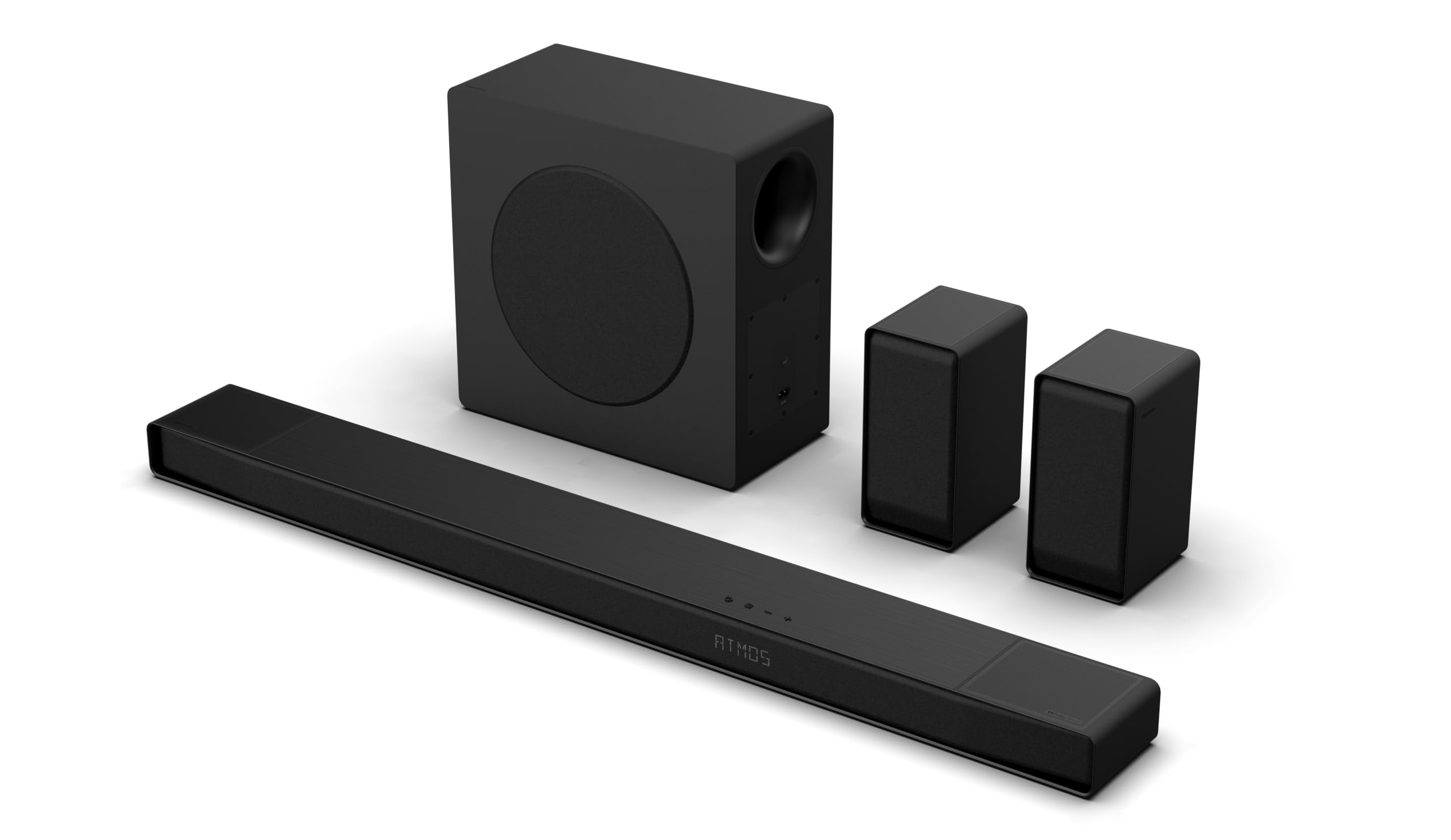
The Hisense AX5140Q is a 5.1.4-channel soundbar system that includes a wireless 6.5-inch subwoofer and two wireless rear surround speakers with up-firing height drivers. The system uses up-firing drivers in both the main soundbar and the rear speakers to create four discrete height channels for Dolby Atmos and DTS:X. The main soundbar has six front-firing drivers and two up-firing drivers, while each rear speaker adds one up-firing driver. HDMI eARC enables single-cable connection to the TV.
Quick Touch EQ modes allow instant switching between seven presets optimized for movies, music, and news. The system includes a room calibration feature that adjusts the tonal balance based on the listening environment. The built-in Bluetooth 5.3 supports wireless music streaming from a phone or tablet. The soundbar is 40 inches wide, making it suitable for TVs 50 inches and larger. The subwoofer connects wirelessly to the soundbar and can be placed out of sight.
Owners highlight the system’s easy setup and the convincing surround effect from the rear speakers. The subwoofer delivers punchy bass down to 40Hz, though it lacks the deep extension of larger drivers. The up-firing height effects are noticeable but less impactful than systems with larger upward-firing drivers or dedicated ceiling speakers. Some users report occasional Bluetooth audio garbling when streaming from an iPhone. For buyers on a tight budget who still want discrete height channels and a full 5.1.4 layout, the AX5140Q provides a solid foundation.
Why it’s great
- Discrete 5.1.4 channel layout with rear up-firing speakers
- Room calibration adjusts sound to the space
- HDMI eARC simplifies setup with modern TVs
Good to know
- Subwoofer only reaches down to 40Hz, lacks deep bass
- Up-firing height effects are subtle, not room-filling
11. LG 83-Inch OLED evo AI 4K G5 Series Smart TV

The LG 83-inch OLED evo G5 is a television that integrates Dolby Atmos support into its own speaker system and also features WOW Orchestra, which synchronizes the TV’s internal speakers with a compatible LG soundbar for a wider soundstage. The TV itself uses an AI-powered Alpha 11 Gen2 processor to upscale standard content to 4K and adjust the sound profile based on the room environment. The LG webOS platform provides access to streaming apps, and the four HDMI 2.1 inputs support up to 4K120Hz for gaming.
The OLED evo panel uses self-lit pixels for perfect black levels and an anti-glare coating rated for discomfort glare-free viewing in bright rooms. Brightness Booster Max pushes each pixel brighter than previous generations, achieving HDR peak brightness above 2000 nits when displaying small highlights. The Filmmaker Mode preserves the intended color grading and frame rate. The TV supports Dolby Vision and HDR10 for high dynamic range content. The included One Wall Design bracket mounts the panel flush against the wall.
The internal speakers produce a wide soundstage for a TV, but they cannot replicate the channel separation and bass depth of a dedicated home theater system. The G5 works best as the visual centerpiece for a separate 3D sound system — the TV itself can serve as the central audio controller via HDMI eARC, passing Dolby Atmos metadata to a soundbar or receiver. Owners praise the picture quality as a meaningful upgrade over earlier OLED generations, noting vibrant colors and deep contrast. For those building a home theater, the G5 provides an excellent foundation, though a separate audio system is needed for true spatial sound.
Why it’s great
- OLED panel delivers perfect blacks and vibrant HDR colors
- Four HDMI 2.1 inputs support 4K120Hz gaming
- WOW Orchestra syncs TV speakers with a compatible soundbar
Good to know
- Internal speakers lack the channel separation for true 3D sound
- Requires a separate sound system for immersive Dolby Atmos
FAQ
Do I need a flat ceiling for up-firing Dolby Atmos speakers to work?
Can I add rear speakers to a soundbar that came without them?
What is the difference between Dolby Atmos and DTS:X for home theater?
Final Thoughts: The Verdict
For most users, the 3d sound system for home theater winner is the Nakamichi Shockwafe 11.2.6 because its six discrete height channels and dual 10-inch subwoofers deliver true cinema-level immersion without the complexity of a passive receiver setup. If you want maximum flexibility with detachable wireless rear speakers, grab the JBL Bar 1300XMK2. And for the purest imaging that eliminates center speaker placement entirely, nothing beats the Sony BRAVIA Theater Quad.